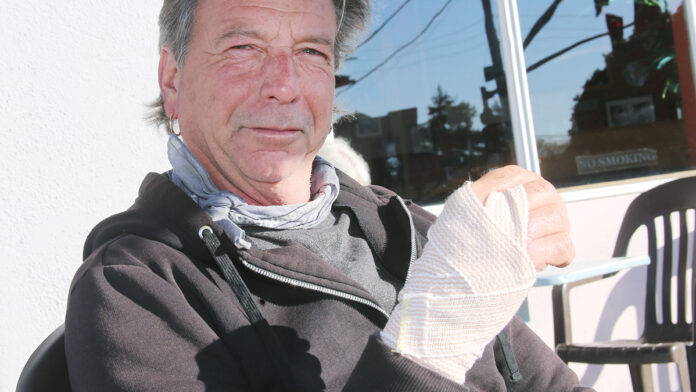

Rio Theatre owner Laurence Bedford was buying light bulbs for a show at the Ace Hardware across the street from his Seabright Avenue music venue on Jan. 27. After paying, Bedford neared the door to leave, and a dog named Teddy Bear mauled his hand, causing a degloving injury that took 42 stitches to repair.
Teddy Bear, who has a record of similar attacks, absconded with his owner after the incident.
Bedford remembers the dog, who was dragging a leash, showing no signs of aggression before the attack, and even wagging its tail. “It was a total surprise,” he says.
Bedford reckons Teddy Bear became spooked when he got too close to the dog’s owner, who was later identified as homeless woman Hope Parks. “He got a really good bite and pulled everything off,” Bedford says.
Bedford says he harbored no ill will toward the dog, who was later euthanized after Parks surrendered him to the Santa Cruz County Animal Shelter. But Bedford wants to convince homeless people to seek services such as vaccinations for their four-legged companions. Many, he says, are reluctant to contact the animal services agency.
That was a problem for Bedford, who didn’t know whether his canine assailant was up to date on its rabies shots. That left him in limbo as authorities searched for Parks. “Homeless folks are afraid that Animal Services will take their dogs, so they are afraid to bring their animals in for care,” he says.
Bedford hopes a talk by Santa Cruz County Animal Services officials during the upcoming Top Dog Film Festival March 13 at the Rio will help show everyone, including the homeless community, that shelter employees are there to help. “I want something good to come of this,” he says.
In receiving the bite, Bedford adds his name to a list of more than 1,000 people who need emergency care for dog bites across the U.S. every day, according to dogsbite.org. Colleen Lynn says she launched the Austin, Texas-based organization to be a clearinghouse of information for people across the U.S. to learn about the breadth of the issue. She hopes it could be a tool for lawmakers who might one day craft nationwide legislation to give teeth to local laws meant to remove dangerous dogs.
Lynn says regulating dogs—even those considered vicious—is largely a jurisdictional issue, generally left to cities and counties. The result, she says, is a confusing patchwork of rules—and it has law enforcement officials scratching their heads, leaving victims in the lurch.
California has a “strict liability jurisdiction” that places the blame for dog bites squarely on the shoulders of owners, says personal injury attorney Dave Spini, who specializes in dog bites for Santa Cruz-based Scruggs, Spini and Fulton. “There is no defense,” he says. “The owner is responsible for damages.” Liability could also fall on landlords if their tenant’s dog latches onto the mailman, Spini says.
Lynn says being attacked thrusts victims into a system where the dog in question might get several chances to correct their behavior. “It’s a system we believe is broken and does not favor the victims,” she says.
It is also a system that can be emotionally charged, pitting friends and neighbors against each other in an argument that frequently focuses on whether certain breeds are more dangerous than others.
Dogsbite.org states that pit bulls were responsible for 66% of the 471 dog-related human deaths in the U.S. between 2005 and 2014.
Many other attacks count other animals as victims. One of those occurred in July 2019, when two loose pit bulls slaughtered five llamas at a property on Fairway Drive in Soquel. The animals were not seized or euthanized because they did not pose an immediate threat to public safety, authorities said.
A local woman who wants to remain anonymous for fear of retaliation says she began looking into the issue years ago when a neighbor’s 5-year-old daughter was mauled. Shark attacks, she points out, prompt closures of entire beaches. Bears and mountain lions that attack people are frequently shot. They’re certainly not afforded the same protections as domestic dogs, she says. “It boggles my mind that we have these attacks, and there are people who still want to save the dogs,” she says.
In her research, the woman says that she fell “into a rabbit hole,” discovering dozens of attacks, many of which she says were from pit bulls. She says she’s lost friends and job opportunities due to her activism.
But Santa Cruz County Animal Shelter General Manager Melanie Sobel says that it’s unfair to judge a breed based on the bad behavior of a few of them, and that it is even more harmful to ban entire breeds because of such misunderstanding.
She says the term “pit bull” is a misnomer used as a catchall to describe “bully breeds” of dogs such as bull terriers, American bulldogs and Staffordshire terriers.
Sobel points out that most dog bites are not reported, and that statistics surrounding them are unfairly skewed toward these breeds, since their bites have the propensity to do more damage.
“But that doesn’t necessarily mean that the breed is aggressive,” she says. “There are lots of factors that go into a dog’s behavior.”
Sobel points out that Teddy Bear was a Labrador mix. “Any animal can be a dangerous animal,” she says. “You need to look for the individual behavior.”
The dog was also unleashed, which is against the law.
With few exceptions, dogs that are not confined on their property must be on a leash. Those that are not can be considered “at-large,” and as such can be impounded by animal control officers employed by the Santa Cruz County Animal Shelter. There’s a handful of places scattered throughout the county that allow off-leash dogs, including Mitchell’s Cove, the beach near West Cliff Drive and Almar Avenue.
In the aftermath of a bite, Sobel says victims should first seek medical care, at which time they will likely fill out a bite report.
That will prompt an investigation by animal control officers, who will determine whether the animal is up to date on its rabies shots. If they are not, they face a 10-day quarantine, either at the shelter or at home.
Whether the animal is removed—either taken for quarantine, or ultimately even euthanized—depends on several factors. That includes the severity of the attack and whether the dog has a history of bites. Investigators also look at how responsible the owner is, Sobel says.
Frequently, owners are given a chance to rectify the situation, which can include installing secure fencing. The animals in question are typically neutered or spayed.
But in the end, Sobel says, the key to dog behavior comes from their human companions.
“When bites take place, the dog is usually running loose not being managed by their owners,” she says. “The key is not to ban breeds; it’s responsible pet ownership.”