Giveaway: Pacific Mambo Orchestra with Herman Olivera

0

If you need a little bit of mambo in your life, don’t miss the Pacific Mambo Orchestra. Considered one of the best Latin big bands in the world with its fusion of mambo, salsa, cha-cha-cha and Latin jazz, the orchestra gives a nod to the big bands of the 1940s. Boasting rafter raising energy, irresistible dance grooves, and style for days, the Pacific Mambo Orchestra has collaborated with an elite roster of artists, including Carlos Santana, Poncho Sanchez, Pete Escovedo and Arturo Sandoval. On Jan. 6, they welcome Grammy-winning vocalist Herman Olivera. 

INFO: 8 p.m. Saturday, Jan. 6. Cocoanut Grove, 400 Beach St., Santa Cruz. $35/adv, $40/door. 423-2053. WANT TO GO? Go to santacruz.com/giveaways before 11 a.m. on Tuesday, Jan. 2 to find out how you could win a pair of tickets to the show.

Love Your Local Band: Animo Cruz

0

A decade ago, reggae artist Mo—short for Animo—remembers playing three-hour bar gigs under the name Animo Jams. He’d play covers, extended jam versions of tunes, and just give it an overall feel-good vibe—“bar-reggae” as he likes to call it.

These days, Mo plays under the name Animo Cruz, which is still reggae, but features a lot more originals, and music that’s more personal and evokes a wide-ranging set of emotions.

“You’re not there catering to people drinking at the bar having a good time. It allows for darker, heavier tones; slower, or more intimate songs,” Mo says. “During the Animo Jams days, I could just be up there not even saying real words, cause people were drunk and having a good time, and all they need is to hear a voice and not necessarily what he’s saying.”

Initially, Mo went solo and played under the name Animo, dropping the “Jams” part of the name. After discovering a Colorado rock band that used the name, he added “Cruz” to the name.

Animo is his nickname; however, it’s also a moniker for his band, much in the way Santana is the name of Carlos Santana’s band. So far, he’s released two EPs, and has a full album slated for 2018. He still plays “bar reggae,” but now does so with the Santa Cruz Reggae All Stars, which plays the Crow’s Nest every Tuesday.

INFO: 9 p.m. Sunday, Dec. 31. Catalyst, 1011 Pacific Ave., Santa Cruz. $25/adv, $29/door. 429-4135.

‘Coolship’ Beers by Soquel Fermentation Project

0

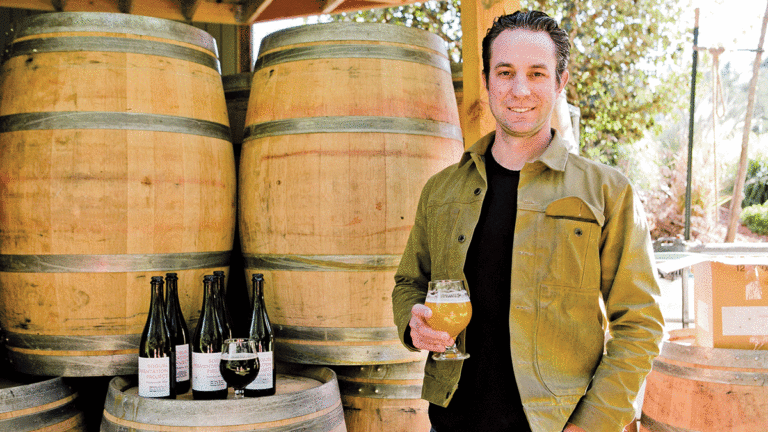
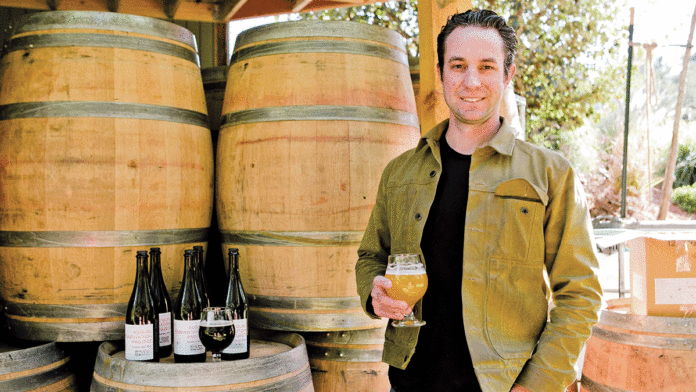
Winter has settled on the Santa Cruz Mountains, and up old San Jose Road where Derek Mortisen lives with his wife, toddler and young twins, the air is cool and crisp as autumn leaves. It’s perfect weather for “coolship” brewing, Mortisen tells me, as he leads me down a path to the garage that serves as his brew house. Inside, oak barrels stacked floor-to-ceiling are filled with fermenting beer.

Mortisen’s new nanobrewery Soquel Fermentation Project specializes in coolship beers, which are produced in a seasonal, low-tech style that harnesses winter temperatures to cool beers naturally by exposing the freshly-brewed wort to the open air instead of cooling it mechanically in a closed environment. This process allows airborne yeasts and bacteria to settle in and create unique, terroir-driven flavors as the beers age in oak barrels anywhere from four to 20 months.

Mortisen began brewing just two years ago, after earning a Ph.D in chemistry, and in the last year his passion project has become a bona fide business. Since February 2017, he’s released six beers through Soquel Fermentation Project—four single-barrel beers and two blended creations—in 750 ml bottles and in kegs to local taphouses. Ranging in color from straw to molasses, all express the kind of sour, funky flavors that beer nerds go ga-ga over and a complexity that keeps the drinker intrigued through the last sip.

I adore all of them, especially Saison #1, a blend of three saisons with a tropical bouquet bursting with pineapple and guava—the result of late-stage dry-hopping with Mosaic hops—and a restrained acidity. Dark Farmhouse #2, aged with blackberries, is a burnt caramel-colored libation with a tartness that hits the center of my tongue before melting into dark fruit and chocolate.

Having found early success with his well-crafted brews, Mortisen plans to stay the course in 2018. He recently hired two brewers and sales managers to help keep everything running while he juggles a full-time job and family life. He hopes that with their help he will be able to increase distribution and the variety of beers available to maintain his current trajectory: “more of the same, but more of it,” he says.


Soquel Fermentation Project is at soquel.co.

Festive Sparkling Rosé from Equinox Winery

Ringing in the new year is such a wonderful festive occasion that it deserves a splendid glass of bubbly. I stopped by Equinox Winery recently to select a special “sparkler” for New Year’s Eve and immediately fell in love with the 2014 Monterey Rosé ($45). It’s a beautiful sparkling wine that’s just waiting to bowl you over with its sassy bubbles and amazing flavors. Made mostly with Chardonnay grapes, a soupçon of Coteaux Champenois Rouge (3 percent) is added to the Monterey Rosé, which adds not only extra flavor but also a delightful pink hue and a touch of magic.

This delicious Monterey Rosé sparkling wine is made by Barry Jackson, an expert winemaker who deserves an abundance of accolades for producing the most beautiful sparkling wines—all made with the méthode champenoise process. A visit to his welcoming tasting room in the Swift Street Courtyard complex is always a treat, and Jackson and his wife Jennifer will be thrilled to greet you.

Jackson says that dry sparkling wine pairs well with casual fun foods, and although we often think that sparkling wine (Champagne) is just for festive occasions, it’s also great to open when friends come over, or to enjoy with a meal. Heck, you can even have it for breakfast!

But, as New Year’s Eve is just a few days away, what could be better than this gorgeous local bubbly to ring in 2018? And, let’s face it, there’s nothing sexier than a glass of “champers.”

Equinox Wine, 334 Ingalls St., Unit C, Santa Cruz, 471-8608. equinoxwine.com. Open 3-7 p.m. Monday to Friday, 1-7 p.m. Saturday and Sunday.

New Year’s Eve Celebrations

Chaminade Resort & Spa in Santa Cruz is doing a couple of events for New Year’s Eve. A three-course prix fixe dinner will be served from 5-10 p.m. in Linwood’s Bar & Grill for $50 with a limited bar menu and children’s menu also available. Their main event will be a Speakeasy Soiree; a 1920s-themed party with live music, strolling dinner, prizes, and beverage package for $160 per person. An overnight Party Package starts at $499 per couple, based on room type. Visit chaminade.com for more info.

Film Review: ‘Star Wars: The Last Jedi’

0

It’s like WWII, only fun! In Star Wars: The Last Jedi, the alt-right First Order has the rebels bottled up—“the RESISTANCE,” the title crawl says in capital letters, a stealth howdy to anti-Trumpers. On the throne is Supreme Leader Snoke, a granddaddy version of Baby Eraserhead played by Andy Serkis.

This moldy dictator faces the same problems Lord Vader had back in the day—sass from a supercilious general (Domhnall Gleeson) and disappointing results from a prize pupil, Kylo Ren (Adam Driver), who returned empty-handed from his mission to find Luke Skywalker.

In writer and director Rian Johnson’s entry in this series—maybe the strongest and sharpest in the 40-year-long epic—fractiousness abounds. Skywalker (Mark Hamill) sulks in his island monastery, overrun with cute space-puffins called porgs; the birdies turn the Millennium Falcon into their rookery. The noble finale of the last episode had Daisy Ridley’s Rey passing the lightsaber to the bearded hermit Luke. It’s picked up right where we left off: Luke tosses the unwanted weapon over his shoulder and vows that he will no longer teach the Jedi arts.

Eventually, he changes his mind. Here, the Force is a spiritual disciple anyone awake can feel their way into. This is opposed to what could be called George Lucas’s single worst idea: making the Force into an inherited quality, found in aristocrats with midi-chlorians in their blood.

The rebels are a matriarchy now. When General Leia (Carrie Fisher, doing a lot of post-mortem acting) is incapacitated by an attack, a new admiral takes over. It’s Amilyn Holdo (Laura Dern), whose idea of an insurgent’s uniform is a lavender evening gown with ruffles. Dern carries herself like a goddess, but she has some strife with one of her rebellious pilots, “a hotshot flyboy” named Poe Dameron (Oscar Isaac).

The 1990s Star Wars entries had big name actors, but they stood around like chess pieces. Watch Last Jedi and think, “My God, it’s full of stars.” Isaac has never looked better than he does here in the cockpit, stripping the cannons off the dreadnought with his missiles, and later asking for more: “Permission to jump into an X-wing and blow something up.”

Rich with minutia is a new wretched hive of scum and villainy, a casino planet. Johnson speeds the camera through like a drone so we can admire the fauna at this chimera-Vegas. One is a drunken little punter in evening clothes who mistakes the beach ball-shaped android BB8 for a slot machine. Finn (John Boyega) and his new comrade Rose Tico (the show-stealing Kelly Marie Tran), who are there looking for help, end up arrested for a parking violation. In the lockup they meet a scurvy yet adept thief (Benicio del Toro)—a jailbird who’s been inside enough times that he knows to sleep with his boots around his neck, so that they don’t get stolen.

Kylo Ren’s walking-wounded emoism looks even more handsomely thwarted than it did last time; to paraphrase Hunter S. Thompson, Driver has the embarrassing sensuality of a 13-year-old girl’s drawing of a horse. “You’re just a child in a mask,” jeers Snoke. As if stagecraft hadn’t impressed Snoke, too.

In a movie in which most of the interiors are cluttered with steaming, smoking aircraft and gridded in with cat walks, Snoke’s throne room is an empty Cinemascopic hangar in glowing vermillion, with a few shiny flunkies in eyeless suits of crimson armor on guard. Long-memoried movie fans see this space, and think “Arthur Freed, MGM, mid-1950s.” And there is a rumble to come on this dance floor, illuminated with lightsabers.

As always in these spectacles, stuff is scribbled in the margins that makes it dense, such as a sea monster breaching and diving, unnoticed, in the sea behind the cliffs Luke paces upon. And the movie recalls echoes of the first film: just as we first saw Luke on a planet of two suns, a double-sunset illuminates our last sight of the old knight. The movie’s richness invites more than one viewing. Johnson’s mature and questioning attitude illuminate this stirring movie about rebellion—reveling in the panache of suicide warriors as well as feeling for the choices of traitors and cowards.


Star Wars: The Last Jedi

With John Boyega, Laura Dern, Adam Driver, Carrie Fisher, Domhnall Gleeson, Mark Hamill, Oscar Isaac, Andy Serkis, Benicio del Toro, Kelly Marie Tran. Written and directed by Rian Johnson. An TK TK release. Rated PG. 134 Mins.

Q&A: Phil Trounstine of CalBuzz

1

Phil Trounstine knows California politics.

After a 20-year journalism career, Trounstine, the former politics editor for the San Jose Mercury News, worked as communications director for Gov. Gray Davis. He later founded a research institute at San Jose State University, and co-authored in-depth studies of power structures within major cities. Trounstine and fellow political journalist Jerry Roberts started CalBuzz.com in 2009, specializing in honest—often biting—political analysis. The site, Trounstine says, made just enough money to cover their occasional travel expenses. Trounstine and Roberts announced earlier this year that they were going on “sabbatical,” although they’ve made time for periodic online dispatches and updates when news breaks—for instance, when a new poll drops with insights on the 2018 elections.


How’s your sabbatical going?

We’re not doing much. Jerry’s doing a lot of stuff locally in Santa Barbara, and we’re doing very occasional stuff on CalBuzz. We’ll probably go to the Democratic state convention, because it looks like it could be interesting this time with the senator’s race and the governor’s race. I’m playing a lot of golf and hanging with my grandchildren.

What do you make of the governor’s race so far?

Gavin was mayor of San Francisco. The mayor of San Francisco is a political leader, but not really a policy leader. But he’s got a lot of policies that he advocates for, and he’s pretty good at it. And he’s the frontrunner, because he’s been running for years. He’s raised a lot of money in the past. Antonio Villaraigosa was the speaker of the assembly and the mayor of Los Angeles. The mayor of Los Angeles is a more hands-on position than the mayor of San Francisco is. He’s got a big base, and he’s killing Gavin among Latinos in the most recent poll—better than two to one. Gavin’s got a big base around the Bay Area. Antonio’s got a big base around Los Angeles. [State Controller] John Chiang is a policy nerd. He’s so nerdy that it’s hard for him to convey much of a message, I think. [State schools chief] Delaine Eastin isn’t going anywhere … who else is there?

Uh, let’s see, John Cox—

Well, the Republicans don’t have a chance. The real race is between Gavin and Antonio. Gavin is maybe four or five points ahead right now, but it’s early, and I don’t think that means much. The senate race, though, is a slam dunk for Dianne Feinstein. She’s older than the Golden Gate Bridge, but nobody cares in big enough numbers to throw her out.

State Senate Speaker Kevin de Leon, who’s termed out, is running against Feinstein. What challenges does he face?

In order to defeat an incumbent, you have to go negative. It doesn’t mean you have to be nasty or dirty. But you have to be negative, because you have to make the case that the person who has the job should be thrown out of office. How is he going to go negative against Dianne? He’s tried to go negative by being to the left of her, by saying she wasn’t tough enough on Donald Trump. She’s not given full-throated support of single-payer healthcare. But it’s not working. It’s ultimately a failed strategy, because if he attacks her from the left in the [June] primary, now he’s stuck with that position when he gets to the general [election]. Instead of just Democrats and independents voting, you bring in all these Republicans. The bell curve switches from the left to the center. That’s Dianne Feinstein’s main lane.

There’s been talk about Freshman U.S. Senator Kamala Harris as a presidential candidate. What are her credentials, and where does a story like that come from?

She’s well-spoken. She’s attractive. She takes flashy positions. And she’s got a good campaign management and public relations staff around her, and they’ve made her a mentionable. I don’t think it’s a serious possibility. I guess what gives it any credibility at all is that if you look at Barack Obama, he had been a senator for a very short period of time when he ran for president. But I don’t think lightning strikes twice, and I don’t think she’s got the policy chops or the political chops that Barack Obama’s got. But if she gets mentioned in Politico, her name gets thrown out there. Plus, the Democratic bench for president isn’t all that deep right now. There’s no obvious candidate. Somebody will emerge. But people keep talking about Joe Biden coming back in. People keep talking about all kinds of possibilities that probably won’t come to pass.

Warren, Sanders … ?

Elizabeth Warren would a terrible presidential candidate. Senators from Massachusetts have not had the best luck, since John Kennedy, of running for president of the United States.

There was a post on CalBuzz about Newsom and Harris both refusing to talk to you guys. How did you feel about their decision?

I don’t think Gavin Newsom can refuse to be interviewed by the L.A. Times, but he can refuse to be interviewed by CalBuzz. We interviewed all of the candidates for governor, but Newsom’s people won’t let him interview with us. We tried, on a number of occasions, to ask Kamala Harris some tough questions, and we’ve seldom got serious responses. The two of them have the same campaign management people, Ace Smith out of San Francisco. They don’t like Calbuzz. That’s the way the world works. They think we’re too mean. We did straightforward, long interviews with all of the candidates about what people stand for on the issues. They all spent time with us on the phone. Newsom wouldn’t do it, so we questioned whether or not he had the guts to be governor of California.   

Single-payer healthcare—is that ever happening in California?

It’s possible if they can demonstrate that it’s financially feasible. There’s a political narrative, but unless it can be shown to be financially possible, there’s a problem.

Congressmember Adam Schiff (D-Burbank) was always seen as a partisan-averse centrist Democrat. Now all of a sudden, it sounds like he’s the leader of the resistance. Obviously, he ranks high on the House Intelligence Committee, so he’s been vocal about the Russian probe and Donald Trump. But Sacramento Bee hinted he could be a U.S. senator before long. Is there something he’s doing right? Or is he just in the right place at the right time?

It’s a combination of those two things. When he started out, he was very reticent. He wouldn’t say too much. He was very cautious. And as time has gone by, he’s been more outspoken, more direct, more clear. And he comes across as a strong voice for justice, vis-à-vis the Trump administration. He’s done himself a world of good by using his position well.

How have you seen journalism change, and what does the future hold?

There’s been a slow and steady erosion of local reporting. It’s a dispiriting thing. It’s not clear if there’s anyone left to cover city hall and school boards. The press suffers from a chronic inability to cut through and tell the truth. It didn’t use to be that journalists had to be in the truth-telling business. They had to be in the fact-telling business. But in the age of Fox News and the creation of alternate realities, it’s more and more important for journalists to say what’s true and what’s not.


More Writers Gone From Santa Cruz Sentinel

1

The face of the Santa Cruz Sentinel is going through changes beyond the departures of arts writer Wallace Baine and editor Don Miller, who left at the end of November amid financial strain and pressure from Digital First Media, run by a money-sucking hedge fund.

Karen Kefauver, who had written a cycling column for eight years, announced in her most recent dispatch, which ran Friday, Dec. 15, that it would be her last, after the feature got axed due to budget cuts. Haven Livingston’s surfing column has met that same fate, as did Stacey Vreeken’s wine column, which Vreeken has since started publishing on her own WordPress site.

Over the years, Kefauver says she loved getting to know mountain bikers, BMX athletes, racers, young riders and government officials—all of whom took their turn in the spotlight of her “Spin City” stories. “What meant so much for me was to shine a light on the unsung heroes in our cycling community,” says Kefauver, who won a Wheelie Award from Bike Santa Cruz County less than two weeks prior to the day her last column ran.

Both “Spin City” and Livingston’s “Just Add Water Column” had run in the sports section, which has additionally laid off reporter Juan Reyes after he had been on the job less than four months. Managing Editor Kara Meyberg Guzman says Reyes will stay on as a contributor.

Other writers are leaving for their own reasons. Environmental columnist Betsy Herbert is moving to Oregon, and longtime food critic Ann Parker is moving to Maine—each of them for reasons unrelated to the paper, they say. Parker, 65, says she wants be closer to an old high school friend and felt winter wonderland in the Pine Tree State calling her name.

Guzman says the Sentinel has “someone in mind” for its next food columnist, although she isn’t ready to make an announcement. And it isn’t clear yet if the Sentinel will replace the “Earth Matters” column, but it won’t replace the other columns, Guzman says.

Kefauver received an outpouring of support when she announced her last column on Facebook. “I know what you must be feeling, believe me,” Wallace Baine wrote in a comment. “Maybe not today, but soon, you’ll be able to shake off the sadness and anger and look back at what you’ve done and really be proud of your work.”

The Best Songs About Santa Cruz, Part 2

3

[dropcap]W[/dropcap]hen we wrote a list of our 21 favorite Santa Cruz songs last year to go with 11 honorable mentions, we felt we had done a complete job.

Sure, there were a couple that we knew got left out.

And we figured there were others that we had probably somehow missed. But how many songs about Santa Cruz could there be, really?

Well, it turns out, many, many more. So after fielding suggestions and doing plenty more research on our own, we now have a working master list that’s well over twice the length of our previous roster. Some of the newer entries, of course, are more obscure. And for their contributions, we extend our deepest gratitude to some of our loyal readers, who apparently moonlight as local music historians—Rachel Goodman, John Patterson and Daniel Dowell.

Anyway, this whole charade all began in the GT office, years ago, when we began compiling a list of our favorite Santa Cruz Songs in our heads and during long-winded discussions about music. Then as 2016 drew to a close, we learned that the ultimate former local band, Devil Makes Three, would be playing the Catalyst, providing us the impetus (well, it was really more of an excuse) to put our growing list down on paper.

And one year later at the end of 2017, it’s Cracker, fronted by former Santa Cruzan David Lowery, that’s playing the Catalyst Friday, Dec. 29, when the oufitt will share the stage with Lowery’s old local band Camper Van Beethoven. And so in honor of that occasion, we present the next—although certainly not the final—installment of the best Santa Cruz songs, with ten more from the local canon.


“Santa Cruz” — Fatboy Slim

We were pretty sure last time around that this edgy piece by instrumentalist Norman “Fatboy Slim” Cook wasn’t actually about our Santa Cruz. We found no evidence of Cook, who’s from Brighton, England, ever visiting, and its music video features a bunch of Christian crosses, making us think maybe it had more to do with musings on religion than anything else. However, we got some flak for leaving it off last year, so before scratching it off this year’s list, I contacted Cook’s management, which responded with a statement from Cook himself: “Yes, it was written about the town. I visited it on a road trip in 1995 (or 1996) and loved the vibe of the town and the locals. It could be twin towned with Brighton, I thought. Twenty years later in 2015, I took my kids there for a couple of days on another road trip to show them the town that inspired the very first Fatboy Slim record. The place is still the second coolest town in the world!” Note to self: Find out where Brighton is, and go visit. JACOB PIERCE


“Month of May” — Larry Hosford

Longtime KPIG fans love this song, and seriously, how could they not? It’s basically Santa Cruz’s “Margaritaville,” complete with an eerily similar island-rock sound—but released two years before Buffet’s hit. Lyrics about catching the “feeshie” down in the Santa Cruz bay and how “together we smoke on the bong pipe” push this anti-anthem to the edge of ridiculousness, but everyone listening to this is almost guaranteed to be too stoned to care. “Month of May” is a spiritual sequel to John Prine’s “Illegal Smile,” and it’s hard to say which one is more fun. STEVE PALOPOLI

“Santa Cruz” — Todd Snider

Todd Snider wrote the ultimate Santa Cruz party song in “Beer Run,” the kind of tune perfect for anyone who knows what it’s like to be running low on libations, and simultaneously not so low on thirsty friends. This other local anthem didn’t make the cut last time around, and although Snider’s “Santa Cruz” doesn’t have the cleverness of “Beer Run,” the straightforward blues rock jam doubles as a touching, heartfelt tribute to the Americana radio station KPIG 107.5 FM—and, more than that, to its late co-founder Laura Ellen Hopper. A song like this is high praise coming from Snider. To be honest, there’s no one more deserving of the honor. JP

“Santa Cruz” — Gold Motel

Greta Morgan has been a touring musician since she was 16 years old, which is maybe why at only 29 she seems to have made an entire career’s worth of music. She started out as a singer and pianist for the acclaimed Chicago band the Hush Sound and is already doing reunion tours with them, among her many other projects. But it was when that band first went on hiatus in 2008 that she escaped to California, where she let some sunny soul seep into the songs of her new band, Gold Motel. On this song, however, it’s sunlight once removed, brightness diffused by darker realities: “Forget it all, it’s just a sun-drenched dream/I bet you make a good memory/I’ll come back soon, when you least assume/Oh, Santa Cruz.” What exactly went wrong is never specified, leaving this among the more mysterious of the bizarrely numerous “alone in Santa Cruz” type songs. SP

“Santa Cruz” — Erin McKeown

In a song propelled forward by rapid-fire drum machine beats and catchy piano riffs, Erin McKeown sings of a passionate romance that burned between cigarettes and sips of alcohol during the evening hours near the beach. And not unlike Gold Motel’s take, this other “Santa Cruz” seems to explore the wistful longing of a fling here in town that the speaker struggles to put behind her. The question remains the same, when it comes to both dreams of faraway paradise and brief romances: How do you know when it’s time to let go?  JP

“Lovers From the Moon” — The Magnetic Fields

This is back from the earliest days of the band, when Susan Anway was singing instead of Stephin Merritt. Anyone familiar with her delivery of “100,000 Fireflies” knows that at peak performance, Anway could convey just as much longing and whimsy as Merritt would on the band’s more famous later albums. This lo-fi indie folk song is another of her best, a lovely balance of Morrissey-esque angst and dreamy courage. It also has easily the best name-check rhyme of any song on our list: “Getting confused/In Santa Cruz.” SP

“Girls From Santa Cruz” — Lacy J. Dalton  

Music fans in these parts have long had a special affinity for the myths of outlaw country, so it certainly seems fitting that Santa Cruz would, sooner or later, secure a place in a myth of its own. In this one, Lacy J. Dalton sings about two Santa Cruz women who steal a stallion and hit the dirt road with a wad of cash, before the cowgirls find themselves tangled in a love triangle. The ballad was written for a 2002 benefit concert of the same name filmed for PBS in Santa Cruz to raise money for the dwindling wild horse populations of Nevada, with Ginny Mitchell and Mary McCaslin backing Dalton up. JP

“Santa Cruz” — Tea Leaf Green

I don’t know why Santa Cruz doesn’t seem to inspire romantic ballads, but this rare one from jammy San Francisco rock band Tea Leaf Green seems appropriate, as locals here fell for their sound way back in the early 2000s, before they were being heralded as a central part of the Bay Area’s rock revival. The feeling was mutual, apparently, as this is a straight-up love song to Santa Cruz, with vocalist Josh Clark asserting about 10 times over the course of four-and-a-half minutes that he’s got to get down here. This may be the first band to make us downright sexy: “We’ll light a fire/Drink some wine/Write messages no one will find/In bottles we corked and cast away/Don’t want it any other way.” But skinny dipping in the freezing cold water off Bonny Doon Beach? Hells to the no. SP

“Seacliff Tonight” — Papa Doo Run Run  

Easily the most wholesome Santa Cruz song we’ve discovered thus far, “Seacliff Tonight” documents an evening date from the point of view of broke Cabrillo College student. In the tune, Papa Doo Run Run, which started as a surf rock tribute band, drenches lyrics with Beach Boys-esque harmonies that reverberate with the sensation of suntans and lying down by the crashing waves.

“Santa Cruz” — The Vaughns

A lot of bands that aren’t from here seem to unfairly pick on Santa Cruz out of sheer jealousy; surf and sun, in particular, seem to inspire vicious fits. But New Jersey rockers the Vaughns do the opposite on this smart and subversive gem from earlier this year. The song questions whether it’s better for love to burn out or fade away, and vocalist Anna Lies concludes that rather than the reckless highs and lows of wild affairs, she’ll take consistency and warmth. Thus Santa Cruz becomes a metaphor for emotion itself: “What’s love? What’s love? Santa Cruz … I don’t need the seasons, I’ve got love.” That is just cool. SP

Lastly, for your listening pleasure, here’s a playlist of our original 20 best songs about Santa Cruz. Enoy!


Update 12/27/17 9:50 p.m.: Updated to include Steve Palopoli’s contributions.

I Write the Santa Cruz Songs

1

[dropcap]W[/dropcap]hen Jake and I wrote about the best Santa Cruz songs last year, only one songwriter had two songs in our top 10: David Lowery. Originally frontman for the iconic Santa Cruz band Camper Van Beethoven while a student at UCSC in the 1980s, he ironically didn’t write a song about Santa Cruz until his Santa Cruz band broke up. In 1991, he moved to Southern California, joining up with lead guitarist Johnny Hickman in the band Cracker, which would go on to platinum-selling success. For Cracker, Lowery wrote “Big Dipper” and “Miss Santa Cruz County,” both of which made our list of best Santa Cruz songs.

Recently, though, I was thinking: millions of people around the world have bought Cracker records over the last couple of decades. The vast majority of those people probably don’t even realize “Big Dipper” is set here—the name of the Boardwalk’s roller coaster is slightly altered, after all, and they certainly wouldn’t recognize where he is when he remembers “sitting on the Café Zinho steps.”

So I asked Lowery—who will come back to where it all began when his two bands join up for a shared bill at the Catalyst on Friday, Dec. 29—if, 25 years later, it even matters that the Cracker fan favorite “Big Dipper” is set in Santa Cruz.

“To me, yes,” says Lowery, “because I can see the setting in my head. When you play a song a bunch, you have to engage with it as if you haven’t played it very much, and you figure out these little tricks to keep your mind from wandering. So a lot of what I do is picture everything. For ‘Big Dipper,’ I’m always picturing those places.”

He does that on other songs, too. “For ‘Northern California Girls,’ it’s the last little stretch of beach on the west side of the pier going toward the cliff. It’s that stretch of beach in Santa Cruz, I picture that.”

That one is particularly interesting to me, because “Northern California Girls”—which came out in 2013 on La Coast Perdida, the second album Camper made after reuniting in 2004—doesn’t actually mention Santa Cruz. And yet, I always imagined it was set here, for some reason.

“Yeah, that’s Santa Cruz,” says Lowery. “I kept it generically Northern California [in the lyrics], but, you know, ‘teach ’em how to surf and play baseball’—that’s Santa Cruz.”

Turns out some of my other suspicions about Camper songs being secretly about Santa Cruz were right, too. For instance, I have always suspected that their 2004 album New Roman Times, a concept album about slacker rebels who align themselves with aliens in a battle against the right-wing Christian army in a dystopian America, was partially set in Santa Cruz. Its lyrics mention the pre-Camper Santa Cruz band Box o’ Laffs, after all, and contain the lines “We would fight for hippie chicks/We would die for hippie chicks/We might stop and surf a bit/But we would die for hippie chicks.”

Lowery reveals there was a whole background narrative for the album that he wrote with bandmate Jonathan Segal, which is now being turned into a novel.

“Some of the stuff’s hard to understand, but all of the leaders of the CVB—which is the rebel group—are all named after beaches. There’s a [rebel] cell out in the high desert by Pioneertown, Joshua Tree, but the main force is in the Santa Cruz Mountains,” says Lowery of the album. “It starts in West Texas, goes to somewhere in the Middle East, and then [the main character, a former nationalist who joins the rebels] goes to somewhere in Southern California and ends up in Northern California in the Santa Cruz Mountains—along the coast north of Santa Cruz, like Davenport or Bonny Doon.”

Still, I tend to take this projecting-Santa-Cruz-onto-Camper-Van-Beethoven songs way too far. That includes “It Was Like That When We Got There,” a song about a bizarre party from the band’s 2014 album El Camino Real. Not only is that entire album made up of songs specifically set in Southern California, but it literally mentions a view of Pasadena. And yet, in my mind it is undoubtedly set in Beach Flats, which makes Lowery laugh.

“I lived in Beach Flats for a while,” he says. “You know that little hilly area of Beach Flats? That would be where that party would be. Because it’d be like ‘who are these people? Where did they come from? I didn’t even know they lived here.’”

Since Lowery has written songs about both Santa Cruz and Los Angeles, I asked him what he considers the main difference between these NorCal and SoCal songs.

“Santa Cruz, you get into more individuals. The people are extremely quirky, so you can write more from that perspective,” he says. “L.A. is more about the big forces down there that shape society: flows of money, the military-industrial complex, institutions like CalTech or the U.S. Navy at Scripps [Institution of Oceanography]. That’s more, a lot of times, what those Southern California songs are about, and the Santa Cruz songs are more about really specific people, like the Blue Ladies in ‘Miss Santa Cruz County.’”

Finally, it has always seemed odd that—although those first Camper Van Beethoven albums don’t sound to me like they could have come out of anywhere but Santa Cruz—he didn’t write an actual Santa Cruz song until Cracker. But looking back, it makes perfect sense to Lowery.

“I was immersed in it with Camper Van Beethoven,” he says. “With Cracker, I had some distance. When you’re living in Santa Cruz, it can be a little more annoying—I’m trying to say this as diplomatically as possible. There’s day-to-day stuff that kind of annoys you. But when you move away from there, you put on the rose-colored glasses, and you only remember the good things.”


Camper Van Beethoven and Cracker play on Friday, Dec. 29, at the Catalyst, 1011 Pacific Ave., Santa Cruz. $22/adv, $25/door. 429-4135.

Six Educational Nonprofits Partner with Santa Cruz Gives

0

Kate Pavao remembers her daughter, Coco, reading in the backseat.

The 12-year-old never stopped; she had read all of Harry Potter by age eight. Whether she was coming home from a short trip to the grocery store or a long vacation, Coco was often deep in the pages.

“She would keep reading. This kid—it was a stack of books all the time,” Pavao says. “It was from the time she was a baby: listening to books on CD, sitting in a stroller, anything she could get her hands on.”

Collette “Coco” Lazenby died in a car crash in 2015. She was a passionate volunteer and environmentalist who did good for the world—working at the Homeless Garden Project, writing to the president about the environment, picking cigarettes up off the beach, collecting jeans for homeless teens, and raising money for causes all around Santa Cruz.

“She was the kid rescuing worms in the rain,” Pavao says. “During beach cleanups, I asked her, ‘Don’t you feel good about yourself?’ She said, ‘No. I feel bad for what people have done to this beach.’

“For Coco, it was about: ‘We need to fix this.’ There’s so much beauty in the world, and we need to take care of it and each other.”

In the fall of the following school year, all 750 students at Watsonville’s Starlight Elementary School received their own memento honoring Coco’s spirit and passion for learning: a book on their birthday.

A few days after the crash, Starlight Principal Jackie Medina went to her friend Pavao’s house and brought up the idea they’d talked about a year before: Give a book to every student as a gift. The school set aside a library shelf with popular books guided by the librarian, with options in English and Spanish, so that any student can pick one when their birthday comes.

The principal had read that summer reading often boosts test scores. Pavao knew how much books meant to Coco.

The next year, Pavao and her husband, Aaron Lazenby, raised enough funds for 2,000 books across four schools. This year, it will be 5,000 in 10 public schools across Santa Cruz County. The Live Like Coco Foundation also gives scholarships and supports other nonprofits.

“Every kid in this community should have the opportunity to read and enjoy all the things our county has to offer, find out who they are and explore their interests, from Watsonville to Santa Cruz,” Pavao says.

A 2016 Grand Jury report praised the nonprofit’s efforts, saying that, for many children, the book they received through the organization was the first they ever owned.

Live Like Coco is one of six education nonprofits partnering with Good Times’ Santa Cruz Gives program for its annual holiday fundraising effort. Other groups include nature education outfit Watsonville Wetlands Watch, which educates kids about Pajaro Valley ecosystems; and literacy proponent Friends of the Santa Cruz Library, which fundraises for local libraries. There are more, too: Peer-mentoring group Girls Inc. of the Central Coast builds confidence in young women; arts advocacy group Tandy Beal & Company immerses children in creative projects; and FoodWhat?! empowers youth by teaching them about food justice.


Fertile Ground

When Margarito Rodriguez discovered wetlands, he was in the third grade.

Every Friday, he visited the Watsonville Wetlands Watch Center on the Pajaro High School campus, where he and his peers took field trips to the marshy soil of the Pajaro Valley.

Years later, he has become one of the program’s 12 wetland stewards, the same types of leaders that had inspired him years earlier.   

Rodriguez now studies journalism and political science at Cabrillo College, and he says the nonprofit continues to inspire the country’s next environmental leaders, many of whom ask him questions they never thought they had.

Founded in 1991, the Watsonville Wetlands Watch’s mission is to protect, restore and foster appreciation of the Pajaro Valley’s wetlands. In addition to outreach and education, the group partners with the city of Watsonville for urban greening, trail creation and trail maintenance. It also plans for the future of the wetlands and publicly comments on projects that could affect habitats.

Executive Director Jonathan Pilch says the organization will also plant trees along streets and parks as part of state cap-and-trade funding, and is launching Wetland Wonders, a program to bring even more students like Rodriguez to the sloughs.

The program seeks to give an environmental education to every young person in the Pajaro Valley. With current funding, they reach less than 20 percent, Pilch says.


Confidence Boosters

Being a first-generation American isn’t easy. It’s harder when parental expectations collide with the wild experiences of high school.

Virginia Howard remembers having privilege growing up: Her parents gave her the guidance to go to a four-year university and could help with the resources to get her there. It wasn’t until she started working with families of incarcerated individuals in Watsonville through her church that she came into contact with girls who didn’t have those same opportunities.

“Many of them were shy and didn’t have parents who could help them go. I was like, God, what can we do for these girls?” Howard says.

A Monterey nonprofit, business and real estate lawyer, Howard soon learned from a friend about a program called Girls Inc. of the Central Coast.

The nonprofit provides Monterey County girls with peer mentors who offer support with life, college, career paths and building confidence through leadership. The one-year program takes high school girls from August through May and connects them with adult and peer mentors who teach them how to set goals, apply to college, and be healthy, along with other life skills.  

Howard decided it should come to Santa Cruz County, too.

By the end of the year, it will serve 180 girls in Watsonville. Howard’s goal is for it be at Santa Cruz High School in 2019.

Girls often bond, moving past the alienations of teenage life. Most importantly, Howard says, the program can help them be self-sufficient. Graduated women have credited the program as a “place to escape” family troubles, cope with stress, avoid pregnancy and gangs, and lead their lives.

Booking It

Christine Candelaria’s kids grew up with the library. The library has also grown up with them.

The Santa Cruz mom of four has been going there for books and exhibits since they were born, and she’s Friends of the Santa Cruz Public Libraries’ newest board member.

“We need to keep engaging kids as they grow older,” she says. Her kids have built robots and battled them in the library and they’re currently taking coding classes there. “When I grew up, it was a quiet space, which I appreciate and still like,” she says. “But I’m glad it’s also evolved to provide whatever else the community wants and needs.”

Candelaria says reading still happens in the library, as it always has, but these newer programs bring the community in.

Friends of the Santa Cruz Public Libraries helps local branches with fundraising and lets residents know about all of the things their library can do. The program raised $20,000 for collections this year—as well as funding math and science programs, sponsoring the Veterans Resource Center, offering summer reading programs and paying for library facilities, like a new outdoor book drop at the Aptos branch.

Candelaria says she just learned about their adult crafting nights and poetry circles, adding, “I’m still on a mission to find everything the library offers.”


To donate to any of the 33 nonprofits participating in Santa Cruz Gives, visit santacruzgives.org through Sunday, Dec. 31.


 

Giveaway: Pacific Mambo Orchestra with Herman Olivera

Pacific Mambo Orchestra
Win tickets to Pacific Mambo Orchestra on Saturday, Jan. 6 at Cocoanut Grove

Love Your Local Band: Animo Cruz

Animo Cruz
Animo Cruz's personal reggae style evokes a wide-ranging set of emotions

‘Coolship’ Beers by Soquel Fermentation Project

Derek Mortisen of Soquel Fermentation Project
Derek Mortisen on his farmhouse brewing style in the Santa Cruz Mountains

Festive Sparkling Rosé from Equinox Winery

Equinox Winery Santa Cruz
Monterey Rosé 2014 is the perfect bubbly to ring in 2018

Film Review: ‘Star Wars: The Last Jedi’

Carrie Fisher Star Wars: The Last Jedi
Rian Johnson’s ‘Star Wars: The Last Jedi’ picks up right where we left off

Q&A: Phil Trounstine of CalBuzz

Longtime political junkie and semi-retired reporter on election season, policy and journalism

More Writers Gone From Santa Cruz Sentinel

Santa Cruz Sentinel Kara Guzman new editor
Changes to columns, sports writing and lifestyle coverage at the local daily

The Best Songs About Santa Cruz, Part 2

best songs about santa cruz boardwalk
By popular demand, we look at 10 more of the top songs with something to say about where we live

I Write the Santa Cruz Songs

david lowery Camper Van Beethoven
As he returns with Camper Van Beethoven and Cracker, David Lowery explains the art of writing a song about his band’s former home

Six Educational Nonprofits Partner with Santa Cruz Gives

Live Like Coco gives books to kids on their birthdays
Live Like Coco, and other local nonprofits, help kids learn about their world and themselves
19,108FansLike
8,845FollowersFollow