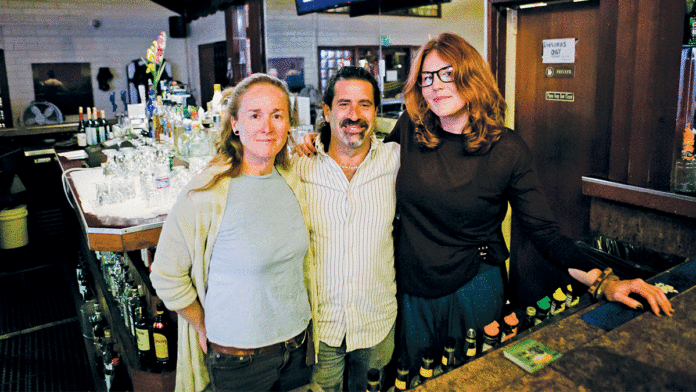
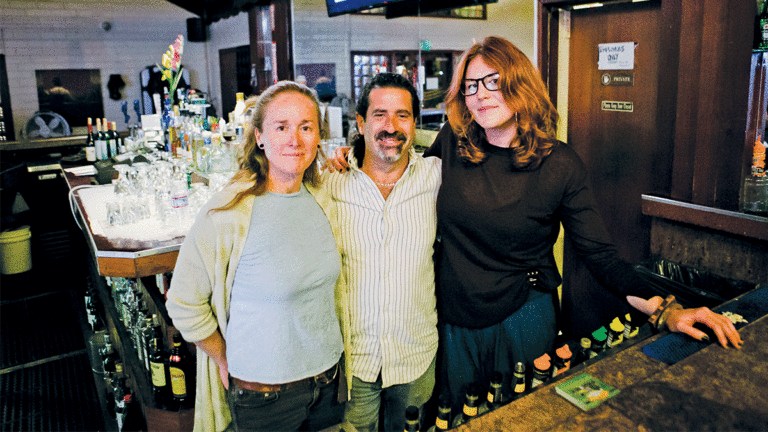
For live music fans around here, Don Quixote’s in Felton is an important space, where many cool bands across the entire musical spectrum have graced the stage. Local real estate agent Bradd Barkan has recently taken over the place, and has big plans.
For starters, he’s changing the name to Flynn’s Cabaret and Steakhouse, a transition that will likely take place in mid-October. Fret not, he plans to continue bringing great music to the stage. The menu is where he plans to make the biggest changes, and he was kind enough to give us a preview of the venue’s new direction.
Why are you changing the name?
BRADD BARKAN: That’s a big question that a lot of people have. There’s a reality to why I’m doing that. Flynn is a friend of mine that passed away about a year ago. He had a shop in Scotts Valley called Cali Style. It was a skate shop/clothing store. It was right next to Nob Hill. There’s a couple of quotes that are going to be on the menu, that he gave. The biggest thing that he didn’t want was to be forgotten. You know how people put out those bumper stickers, never forget this person or that person. For a lot of people, it’s their biggest fear, that no one will remember them anymore. I’m taking away the Don Quixote’s. I’m turning it into a memory for him that I’m hoping will become very well known in the neighborhood.
Tell me a little about the new concept of the restaurant.
I think a lot of people knew the place needed fresh blood. People eat the food there because they go there for the music, but no one goes there for the food. A higher-end steakhouse with crab legs and lobster and lamb is something that’s going to be a base theme. It’s going to be organic. It’s going to be sustainable. It’s going to be farm-to-table. It’s very important to me. I have a vegetarian and vegan half of the menu that’s not going to be just one or two dishes. It’s going to be half the restaurant. I’m looking to cater to a good chunk of the vegan, gluten-free, vegetarian Santa Cruz crowd in addition to the sustainable farm-to-table concept. You put those two together, I’m trying to satisfy bigger groups of people with more diverse tastes. I grew up with a vegan sister, and we fought about places to eat our whole lives. She was never happy with my choice and I was never happy with hers. It seems like a natural thing that’s occurring these days. I think we’re going to step it up as far as the music that comes to the venue, and the service that comes along with it.
One of the most interesting wineries in Carmel Valley is Holman Ranch. Not only is Holman’s tasting patio an upbeat place to visit, but right next door is also a newly vamped-up dining spot called the Holman Ranch Tavern (formerly Will’s Fargo Restaurant).
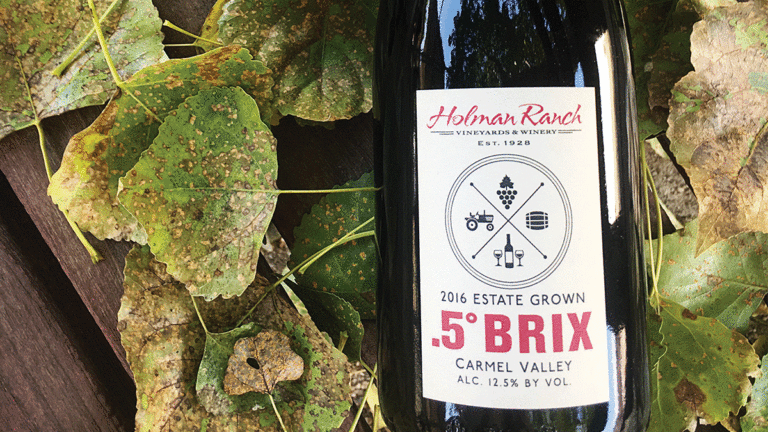
This very tavern is where we stopped for lunch one day and ordered a bottle of Holman’s 2016 .5 Degrees Brix ($22). Packed with tropical aromas and flavors—melon, banana and papaya—this versatile straw-yellow wine also comes with a burst of fresh spring honey, lemon and apple—adding an abundance of appeal. Made from the citrusy Pinot Gris grape harvested in Carmel Valley, this delicious white wine goes well with pasta, meats such as turkey and chicken, and some fish. Our Cheese Board for Two ($14) and Trio of Salads ($14) paired beautifully with the Brix. For lovers of a lighter wine, this lively Brix is the answer.
Holman Ranch Tavern offers Plates to Share & Pair, which come with their own wines as well as some of their Carmel Valley neighbors’ wines, such as Bernardus, Morgan, Chesebro, as well as Jarman, which is another label of Holman’s. Beers are served up, too. A plate of Medjool dates stuffed with blue cheese and wrapped in bacon ($9) comes with the suggested pairing flight of Mad Otter Ale ($8).
In a nutshell, the Tavern is a nifty little spot for light dining and trying out a variety of wines and ales along with some tasty bites.
Holman Ranch Tasting Patio & Wine Shop, 18 W. Carmel Valley Road, Carmel Valley, 659-2640. Holman Ranch Tavern, 16 W. Carmel Valley Road, Carmel Valley, 650-659-2774.
Bruzzone Family Vineyards
Berna and John Bruzzone recently announced that they have closed their Bruzzone Family Vineyards tasting room to the public. They will continue to farm their beautiful vineyards in the Santa Cruz Mountains but will sell their grapes to other wineries in California rather than making their own wine. As of writing this, they have cases of wine on sale, so contact them if you’re interested. Call 332-0909 or email be***@***************ds.com .
Our writer wanted to be the first person to hike the newly re-opened trail up Mt. Umunhum, one of the highest peaks in the Santa Cruz Mountains. Here’s what happened.
11:30 a.m.
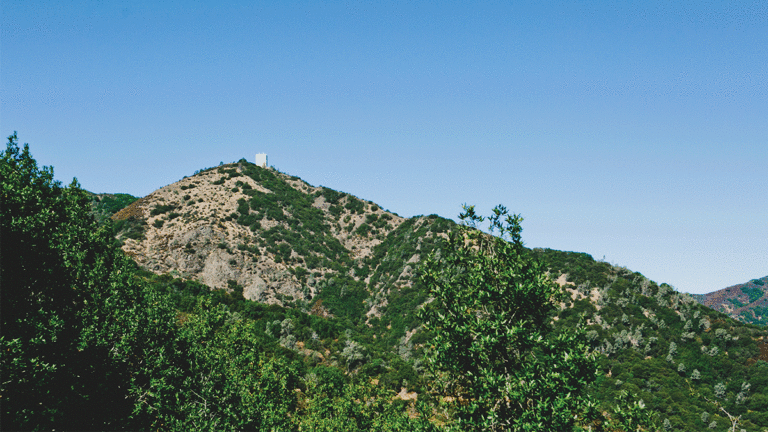
Shortly after finishing the first mile of my hike up Mt. Umunhum, I look up at the large, mysterious rectangular structure at the top for the 20th time. It feels just as far away as it did at the beginning of the trail, effectively deflating any sense of progress I’d made.
If you’ve spent as much time hiking trails in the backcountry as I have, you’ve experienced a “false peak”—meaning you spot what you think is the top of the mountain, only to learn after much exhausting hiking that the spot you had your gaze locked in on was only partway up. Mt. Umunhum is the exact opposite: there’s never any doubt about where the summit is. It’s constantly reminding you—taunting you, one might say.
I won’t spend too much time complaining about how out-of-shape I am, or how hard this measly 3.7-mile hike is turning out to be. I have gone on multiple backpacking trips that exceeded the 100-mile mark, and I’ve survived to wolf down the mandatory victory burger. But I haven’t hiked in a while, and the opportunity to do this hike came up rather suddenly.
I don’t care. For the past year and a half since I heard this trail was opening, I’ve wanted desperately to be the first civilian to climb Mt. Umunhum, reach the 3,486-foot summit, and touch that building on top with my own two hands. So I keep my head down, and put one foot in front of the other, following my guide Brian Malone. That’s what you do when your mind wants to make it to the top of a hill, but your body wants Scooby-Doo and a bowl of Captain Crunch.
Obviously, I’m not the first person to ever hike this trail. The guy walking right next to me, a 51-year-old employee of Midpeninsula Regional Open Space District (the nonprofit that owns this land) has done it several times—Malone even remarks at one point that he “hasn’t hiked the whole thing in a while.”
But it hasn’t been open to the public in decades, and hikers have been waiting to bag this peak since Open Space acquired the land in 1986. When it finally opens to the public on Sept. 18, they can add it to a short list of accessible peaks that can be hiked in the Bay Area (Mt. Tam, Mt. Diablo, Mt. Hamilton). It’ll be open to hikers, bicyclists, and equestrians.
Malone has worked for Open Space for 27 years and knew this long-awaited opening would take time. “I’ve been telling people that have been asking, ‘probably in about 20 years,’” he says. “There was some point in there where I was correct.”
Malone is chipper; he tells me that I got him out of some meetings today, and now he gets to spend the morning hiking and telling me about the trail. The department he manages (Land and Facilities) worked with Midpeninsula planning, engineering and natural resource staff on the design and construction of the trail, and he’s proud of the result. It’s a good trail: well-graded, frequently shaded, nice views. I’m thinking right now that I would enjoy it a lot more if I was in better shape, but what can you do?
10:15 a.m.
The day starts when I meet Malone at the parking lot on Hicks and Umunhum roads a little after 10 a.m. The drive from San Jose proper was short and pleasant; you drive past the Guadalupe Reservoir on your left, and you weave past bicyclists that spend more money on stylish bike clothing than I make in a month.
The Guadalupe Overlook, above the Guadalupe Creek watershed, provides one of the new trail’s best views. PHOTO: AARON CARNES
I get out of my car and Malone’s hand. He’s been waiting for me for about 15 minutes, but doesn’t seem annoyed. He’s a friendly man with a gruff voice that reminds me of Dauber, the loveable sidekick on the ’90s sitcom Coach.
We caravan up Umunhum Road until we stop at another parking lot. Until recently, this was the farthest you could drive up the road. Part of the three-year construction project to open Mt. Umunhum also involved creating a safe road to get to the summit for those not intent on hiking up the hill to experience the peak. That’s fine and all, but Malone and I are going to “earn our peak.”
There’s a side trail at the far end of the parking lot, Bald Mountain Trail (.07 miles one way), that leads to a vista overlooking San Jose and Coyote Valley. We head the other direction to the beginning of the new trail. I stare at the building on top of Mt. Umunhum. It looks so magical, so surreal. If I was an alien conspiracy theorist, I would be absolutely convinced that there were alien corpses stored inside, or that “no one knew the origin of this building” (i.e., aliens built it, just like they did the pyramids). In fact, it’s the last remnant of the Almaden Air Force Station, a general surveillance radar station built to detect a possible Soviet attack. The base opened in 1957, and was operational in 1958. It was part of a network of similar structures along the coast with the same purpose. The Almaden Air Force Station closed in 1980. The Soviet attack never came.
At one point, there were 86 structures up there: housing, a pool, a bowling alley, a movie theater, stores. It was too cumbersome for the base employees to go back and forth to San Jose, so they had their own community of sorts. Clearing out most of the buildings and removing hazardous waste was one of the major hurdles Open Space faced in opening the mountain to the public. It was a long process, which they finished in 2014 with federal funding. The one remaining building is the radar tower, a five-story structure that housed the radar antennae. Today it’s completely empty—and closed to the public (a fact that will likely stir up alien conspiracy theorists, who are not me)—but you can walk right up to it. There was much debate over whether Open Space should remove the building or not. They ultimately decided to keep it based on feedback from the public and a decision by the Santa Clara County Board of Supervisors in May of 2016 to add the radar tower to the County of Santa Clara Heritage Resource Inventory.
11:00 a.m.
It’s a beautiful day to hike. The sun is out. Birds are flying overhead. The fragrant smells of trees and bushes permeate the air, and the views of San Jose are spectacular. The even grade—it never exceeds 10 percent, Malone tells me—is a nice change of pace after the chaos of so many less-maintained backcountry hikes. The gentle smattering of fallen leaves on the trail is a nice touch. It makes you feel like it’s fall already. However, the heat of the sun begs to differ.
That moment when you realize you’ve been hiking for an hour and the top of the mountain looks exactly as far away as it did at the beginning. PHOTO: KEANA PARKER
The frequency of shade helps the hike, but I’m still sweating. Thankfully, Open Space labored over routing the trail under trees as much as possible. We see madrones, bays, nutmegs, and other trees I don’t know the names of leaning overhead, occasionally resembling a Sherwood-Forest-esque canopy.
There’s a trail that goes all the way to Lexington Reservoir, which that means you could hike the entire Los Gatos Creek Trail, walk to Lexington Reservoir, hike an additional 10 miles, and then take the newly reopened trail up Mt. Umunhum. I file that info in the back of my mind for future me.
Downhill to the right, around the bend, I see a wrecked, rusty Volkswagen that was probably brand new when it was left here. I’m always surprised when I see old vehicles abandoned near trails. “A lot of times, it’s old roads where you wouldn’t expect them,” Malone says. Though in this case, he guesses, it was probably driven off of the road. We both stare at it for a few minutes, not saying anything, then proceed.
A majority of the 27 years Malone has worked for the Open Space, he did so as a park ranger. (“I spent 25 years telling people that they were trespassing up here,” he says. “It’s going to be great to actually invite people.”) He strikes me as having a highly scientific mind, knowledgeable about little details I can barely fathom. It turns out he majored in Biology and Environmental Studies, graduating from UC Santa Cruz in 1989. At the time, there weren’t jobs at Open Space like the one he currently holds in Land and Facilities. Maintenance and park ranger work was his way in. It was a role he enjoyed (“I tend to think of myself more as a git-er-done guy than a planner or a scientist,” he says), but at the same time, he’s thrilled at how he’s able to apply his knowledge now.
When I was told I’d have a guide on the trail, I figured that it would be a person making sure I didn’t go off trail and cause damage to the natural habitat, but Malone was a guide in the truest sense of the word, and educated me about everything we saw. He stops a little up the trail and points to a fallen tree on the left: “Oh look, a whiptail lizard,” he says. It takes me a second to see it. The little guy is squirming around. He looks almost snake-like.
“It’s not a rare lizard, but it’s definitely one that shows up more here because of the special environment,” he says.
We gawk at the slithering creature a moment. It reminds me of the vast array of lizards I grew up with. As a kid, my land surveyor dad used to bring home reptiles he found while working in the hills of Santa Clara County. We had an aquarium full of them. My favorite was this alligator lizard that I used to hold. He would wrap his tail around my arm. Nobody told me how hostile alligator lizards typically were—I was lucky he was such an anomaly.
Malone points to a tree that looks similar to a Douglas fir, but tells me it’s a nutmeg, not related to the spice of the same name. You can tell it’s nutmeg and not Douglas fir because of how spiky the needles are, he tells me. He holds one out for me to touch. The razor-thin sharpness of the needles surprises me a little bit, and I stumble back.
“That smell,” I ask, “Is that the nutmeg?” The odor has gotten intense, but it’s a pleasant part of the outdoor experience. I feel like I can taste it. It turns out to be nothing more than bay leaves. One reason the smells are so strong right now is that crews are still out clearing the trail, so there are fresh-cut branches and brush everywhere. Hiking is all about engaging the senses. Looking at the variety of colors of vegetation along the hillside, with pockets of San Jose peeking through, accented by the smells of trees and the sounds of birds, it’s all such a rewarding experience.
12:00 p.m.
Just before the mile-and-a-half marker, we see the best view yet. It’s much of San Jose, including the tiny spot of slightly larger buildings comprising the downtown skyline. This spot on the trail is called the Guadalupe Overlook. It overlooks the Guadalupe Creek watershed. The crew even built a special off-trail viewing area. Someone in the crew apparently wandered in this direction when they were working on the trail and found the hidden spot. They decided to add a side trail with a deck and rails and everything.
“If you’re planning on getting to the summit and you make it here and someone in the family’s not feeling it, you can go out and see the view there, and head back,” Malone tells me.
We stop and stare. Why are smoggy cities so beautiful from far away? I imagine what this view would look like back when the valley was just a valley, and the air was clear—even before it was filled with orchards in the pre-Silicon Valley days. The Amah Mutsun tribe, a group within the Ohlone people, are descendents of Native Americans who lived in this general area. Umunhum, as one of the highest peaks in the area, held a spiritual significance for the Ohlone people. (“Umunhum” means “resting place of the hummingbirds” in Ohlone.) Open Space wanted to ensure that they paid it proper respect, and worked with the Amah Mutsun tribe to do so. They designed and built a ceremonial circle at the summit, and agreed to allow ceremonies there.
Besides the really well-graded trail, a newly designed road to get to the summit, and a nice overlook, Open Space also constructed three bridges to cross three creeks along the trail, which aren’t running at the moment, but will be when it starts raining again. When we get to the first one, Malone lights up, excited to tell me about the installation of the bridges. Most of the construction happened underground, and required lots of concrete. But the bridges themselves were flown in, since there weren’t nearby roads; helicopters hovering above the creek beds slowly lowered them into place. “I came out ceremoniously on the last day, it was an incredible amount of work just for that one day,” Malone says.
The closer we get to the top, the less we talk. After a while you get into a Zen state of hiking that transcends any pain you’re feeling, at least for a while. I’m starting to see the building on the top of the summit less as we climb the side of the final hill. Malone feels really proud that they were able to build this trail with as little impact as possible on the ecosystem.
“When it gets to not imposing a structure on the environment, and making it blend in as much as possible, it’s still a heck of a lot of work, if you do it right,” he says. “The public doesn’t really notice it.”
As we get closer to the top, we slow down. I’m nearly out of water, and do my best to keep my composure. It turns out we aren’t allowed to hike that final half mile, because crews are out working on it. Instead of getting to walk right up to the building and touch it with my own hands, we take the side trail that goes to the parking lot at the top. It’s a little anticlimactic, but I still check this off my list as a completed trail. Malone and I snap a few photos, and I feel accomplished for a few minutes.
“Am I the first person not associated with Open Space to hike this trail?” I ask.
He considers it, and starts listing off people. “Consulting … tractors … regulators …,” he says.
“Yeah, but someone completely unaffiliated with this project?”
“We had a group of bicyclists that was outside that made a promotional video.”
“But what about a hiker? Someone not on a bike?”
He thinks about it.
“I can’t say for sure,” he says finally. “But maybe.”
Last month’s revelations of O’mei owner Roger Grigsby’s support for former KKK leader David Duke sent a chill down the spines of the Chinese restaurant’s biggest fans. Even more so, the news seemed to be a wake-up call to many stunned locals that the kind of racist politics seen in Charlottesville could exist here, within the liberal bubble of Santa Cruz.
After all, there aren’t many places boasting more fading Hillary Clinton and Bernie Sanders bumper stickers than decidedly left-leaning Santa Cruz, and according to voter registrations, our enclave is the third-most Democrat and the fourth-least Republican county in California. But financial support for the U.S. Senate campaign of outspoken racist Duke crossed a line that filled locals of all political persuasions with a boiling anger that soon exploded on social media.
But for all of the outrage directed at Grigsby, there is another high-profile local who regularly spews Duke-like views that many would find just as morally repugnant—one who seems to have so far been immune from the same massive backlash that shut down O’Mei.
And no one has to go digging through public records to find her.
That’s local KSCO talk show host Georgia “Peach” Beardslee, who routinely asks questions, like “Why is it that only black people loot in a crisis?”—as she did shortly after Hurricane Harvey on Wednesday, Aug. 30. During that same broadcast, she compared Santa Cruz’s Beach Flats community, a predominantly Latino, low-income neighborhood, to a “third-world country.” She accused Santa Cruz’s entire city government of being run by communists and wished UCSC a “nasty, fast death” for being a “communist school.”
She opened the show by decrying a “white genocide” that she claims many Americans have been simultaneously ignoring and perpetuating.
“Some of you don’t care about your future, the future of your children, the future of this country,” she mused in her opening remarks that afternoon, particularly upset over O’mei’s closure. “Our president is fighting these battles every day, and all you do is demonize him. You don’t seem to care that white people are being replaced. After all, we’re all Americans, so it doesn’t matter that other races will dominate this country built by white Europeans. Everything you enjoy in this world was given to you by the whites, starting with the light bulb. But let’s not honor that. Let’s get rid of that, along with all the statues and monuments that represent white history. In the future, no one will ever know whites walked the earth. And you defend this? You people of other ethnicities defend this because you feel victimized for being born in poor countries, so everything is owed to you? Why don’t you stay or go to your own countries and make them great, instead of sucking off the American people and their hard work, while you turn your country into a third-world hell hole, like the one you ran from.”
Michael Zwerling, owner of right-leaning KSCO (1080 AM), says he sees no problem with Beardslee’s broadcasts, declining to get into the specifics and deferring instead to the Constitution’s First Amendment protections. “Who’s going to be the arbiter of what’s acceptable speech?” he asks.
Columnist Bruce Bratton, who Beardslee calls part of “the Santa Cruz media wing of Antifa,” had never listened to the twice-weekly broadcast before GT called him up. After hearing her Aug. 30 show, Bratton felt troubled—not so much by her personal attacks, as by the worldview that she’s sharing with listeners around the Monterey Bay. “Good Lordy, Lordy,” he says.
“The ethnic-racial divide is something that she’s perpetuating over and over and over again, and talking about how David Duke is such a wonderful-thinking person. And this is someone who is anti-Catholic and anti-Jewish, and was the leader of the Ku Klux Klan. When she stands up for someone like David Duke, that’s really something,” Bratton says.
In the age of fake news, Beardslee and her colleagues have earned a reputation for playing fast and loose with the facts. While defending Duke’s talk of white separatism, for example, she could not say what position the former Klan leader had been running for, just “some seat in the government.” (He was running for the U.S. Senate in Louisiana.) Her co-host Sam Quinten claimed later that week that Grigsby’s donation was made “many, many years ago.” (It was actually made in August of 2016.) Beardslee spreads falsehoods about everything from the history of slavery in America to the antifascist movement.
Zwerling says the station, where all shows are archived on KSCO.com, and its staff don’t have time to fact-check everything, and errors are bound to slip through. Although Beardslee’s critics see something more toxic, Zwerling thinks certain talk shows should not be taken as news commentary, but instead as opinion, like Rush Limbaugh—a format bordering closer to pure entertainment, he says.
Zwerling says he actually used to be friends with Grigsby, before eventually blocking Grigsby’s phone number after an inundation of messages from the O’mei owner linking to anti-Jewish literature. Zwerling, who’s Jewish himself, says he couldn’t maintain the friendship, and he admits it may sound puzzling that he would go out of his way to defend Grigsby, as he’s done—especially given the restaurateur support for Duke, a Holocaust denier. But Zwerling doesn’t think the owner’s beliefs should get in the way of his business.
Grigsby could not be reached for comment.
These days, the state of American discourse may indeed be in bad shape, according to KSCO station manager Michael Olson, if the station’s callers are any indication. “Instead of picking up their phones, calling in and saying, ‘Look here, Bub, I don’t agree with you because of this and this and this, they shout you down. Which, to me, is the most frightening thing on Earth,” Olson says.
But on the topic of speaking freely, Beardslee, who declined to be interviewed, has a knack for shouting over people, too, sometimes hanging up on people she declares to be “communists” on air.
Freedom of speech has remained one of Beardslee’s favorite talking points, though. It was part of the defense she made of Grigsby last month, in one of her impassioned rants. She later told GT via email that the reasons behind her segments were nuanced.
“It is not just a freedom of speech issue. It is about the rights of American citizens. The right to privacy, the right to donate, the right to have political views,” writes Beardslee, whose show airs every Wednesday and Friday from 2 to 4 p.m. (Grigsby’s donation and address were public record, per federal election guidelines.)
Beardslee became so fired up over the O’mei issue that she informally quit while on the air. She was out of the studio for the next show on Friday, Sept. 1, but back the following week—after what she later called a misunderstanding between herself and Zwerling.
Beardslee’s show is hardly the only one on KSCO that stirs up controversy. The station is also the local home of Limbaugh and Dr. David Biles’ weekly “Perspectives” show, for instance, where the local dentist shares views about chemtrails and his distaste for vaccinations. KSCO has plenty of other local programs too, among them Olson’s own “Food Chain Radio,” as well as Rachel Goodman and Joe Jordan’s environmentally focused “Planet Watch.”
For KSCO’s attempts at diversity, there have been signs of strain on the airwaves, as hosts like Charlie Freedman and Beardslee have recently criticized their colleagues over the microphones. Beardslee even criticized Zwerling and Olson for not denouncing the “communists” that she thinks run UCSC.
Zwerling, whose family has owned KSCO since 1991, says the station is losing roughly $40,000 a month, as reported by the Santa Cruz Sentinel in July, although he says KSCO operating on a deficit is “nothing new.”
Amid the station’s apparent financial insecurity, the on-air tension at KSCO has, at times, felt almost palpable, as when Zwerling joined Freedman, a longtime talk show host, on his Thursday, Aug. 31 show. Zwerling was sitting in to discuss O’mei’s closure, a topic that seemed to rattle him harder than it did Freedman. At one point Freedman briefly turned down Zwerling’s microphone to get a word in, which prompted Zwerling to yell that he wanted it turned back up—before the station owner realized that he could turn it back up himself.
“Don’t ever turn my mic down. I’m the reason you’re here!” Zwerling yelled, after taking the controls. “Get it? Don’t ever, ever, ever turn my mic down. Ever again. Ever again! Do you understand?”
That same afternoon, Zwerling criticized staffers for not better promoting the station and even hinted that the station’s days may be numbered. “I guess it’s only a matter of time before KSCO has to close its doors like O’mei did, because you’re a Trump supporter and because I’m a Trump supporter,” Zwerling told Freedman.
Zwerling and Beardslee have both warned that they think the Santa Cruz left could get its way and shut down KSCO—not that anyone actually seems to be trying—just as the two believe that liberals supposedly did with O’mei. But, since the two of them keep bringing it up, we can’t help wondering whether such a shakeup—which, again, is 100 percent hypothetical—is really their worst nightmare, or more of an exit strategy for themselves and for KSCO.
After all, at a station that’s troubled by infighting and financial struggles, liberals sound like an ideal scapegoat for KSCO’s conservative fans, while perhaps even seeming—at least on the surface—to match Beardslee’s narratives of liberals shutting down everything they disagree with.
Bratton—who Beardslee blames for creating a communist conspiracy to shut down O’mei— tells GT that he already boycotts KSCO anyway, and has for 40 years, since long before Zwerling bought the station. “I don’t listen to stuff I don’t agree with, naturally,” he says.
So, was O’mei really closed down by anyone attacking free speech, as Beardslee suggests?
Brenda Griffin, president of the Santa Cruz County NAACP, doesn’t see it that way. She notes that the First Amendment was written to protect people’s speech from government interference and censorship, not from other individuals, who are also allowed to speak their minds and even vote with their dollars.
“In my mind, unless folks physically went there and boarded up the restaurant or vandalized it,” she says, “I don’t see people not supporting [O’mei] as censorship.”
Update 09/13/17 11:36 a.m.: This story has been changed to reflect KSCO host Georgia Beardslee’s full name.
Jewel Theatre Company continues to offer local audiences an interesting mix of lesser-known modern works and vintage stage classics reimagined for the modern audience. To launch its 13th season, JTC turns to playwright Arthur Miller, and the early drama that helped establish him as the American bard of postwar, middle-class malaise, All My Sons.
JTC and Santa Cruz Shakespeare veteran Art Manke directs this strikingly staged production of Miller’s second play. Originally produced in 1947, it tells the story of the Keller family, whose experiences during and after the devastations of World War II not only haunt their family and community, but also reflect the shifting moral universe created in the wake of war’s upheaval. The play is very much of its era, but a typically reliable JTC cast delivers the gravity of epic Greek tragedy that the playwright intended.
As in classical drama, the action takes place in a single day, at a single location—the backyard of the Keller home in a suburban American town, circa 1947. Joe Keller (the dynamic Allen Gilmore) is the genial patriarch, joking around with the neighbors, but concerned for his fragile wife, Kate (an excellent Nancy Carlin); three years after the war, Kate still desperately believes that their MIA son Larry will one day come home.
Their second son Chris (Tommy Gorrebeeck) has returned from the war and gone back to work at the manufacturing plant his father runs. (Gorrebeeck is tentative at first, but brings depth and shading to the part in the crucial second act.) Focused on the future, Chris invites his former neighbor Annie (spirited Sierra Jolene), who had been Larry’s girlfriend, for a visit, intending to propose to her. Annie is willing, and Joe approves, despite the objections of Kate, who still considers Annie “Larry’s girl.”
Beneath this domestic drama, a thornier conflict surfaces. Annie’s father, Joe’s former business partner, is in prison, after it was discovered their plant sold faulty aircraft parts to the military. Joe was tried at the same time, but exonerated. As the Keller family’s fateful day heads toward its climax, they receive an unexpected visit from Annie’s jittery brother George (a serious turn from Brian Smolin, last seen in The 39 Steps and The Two Gentlemen of Verona at SCS). Fresh from visiting his father, George blames Joe for destroying his family.
The story ignites at the place where blame, idealism, justice, and truth collide, where the necessity of moving forward confronts the inability to let go of the past. JTC stalwart Diana Torres Koss has some effective scenes as a cheery new neighbor with a WASPish side. And a bubbly Audrey Rumsby, along with Shaun Carroll, lightens the mood as neighbor Lydia, formerly George’s girlfriend, and her horoscope-casting husband, Frank.
This realistic drama plays out in contrast to Kent Dorsey’s highly stylized set. The shape is a frame house with shutters, windows, a screen door and a porch, but every surface is papered over with oversized newspaper clippings about the war, the trial, and stories of MIAs returning home. The backyard furniture is painted in the same buff shade of faded newspapers, as if the war and its aftermath have quietly engulfed the entire house and its inhabitants.
Modern’s costume design extends this idea, with the Keller men and their longtime neighbors in muted plaid shirts in the same off-white color range, and khaki slacks. Kate Keller’s beige and blue dressing gown and grey suit also connects her visually to the family’s past. Only the vibrantly colored dresses of the young women, Annie and Lydia, provide a sense of life and forward-looking optimism against the monochromatic stasis of the Keller family home. It’s a smart visual design for this past-haunted play.
The Jewel Theatre Company production of ‘All My Sons’ plays through Oct. 1 at the Colligan Theater at The Tannery; 425-7506. jeweltheatre.net.
Tamsin Wilson recalls sitting in her New York apartment feeling generally dissatisfied and impatient. What jolted her out of this mood was a little centipede that had wandered inside.
“He seemed at peace, just roaming around,” Wilson says. “For a split second, I really envied him.”
This experience inspired the track “Centipede,” which she wrote for her band Wilsen, and which became the lead track on the band’s debut full-length I Go Missing In My Sleep. It’s a tranquil track that actually captures the feeling of staring at this creature for just a second, as time seems to slow down (“Oh I wonder how you move/Your hundred little legs/They spin with such grace.”)
“Centipede” sets the tone of the record, which wanders into a sense of calmness that is neither sad nor happy—a strange detached feeling permeates every song. Wilson says that when she wrote the songs for the album, she didn’t really have an aesthetic in mind, but can see in retrospect how she was creating a cocoon for herself.
“It was a period of time when I was really seeking an escape from the craziness of New York, and just really seeking a bit of stillness,” Wilson says. “I think that ended up encroaching into the songs.”
The band has been playing together since 2012. Wilson, who grew up in the U.K. and later Canada, started the band after finishing college in Boston and moving to New York City. As a teenager, she dreamed of being in the music industry, but imagined herself working behind the scenes. The experience of playing with her bandmates and working out songs with them was an “unexpected surprise.”
The band self-released a handful of EPs, and slowly crafted this first album over an extended period of time, which was released in April.
When the band started the record, they didn’t have a deal with a label, and they didn’t know exactly what it would sound like. Wilson, the group’s primary songwriter, didn’t show the band the songs until just before their first couple of weeks of studio time was booked. They headed out on tour after that first session, and worked in the studio for another 10 days after. In the months that followed, they finished everything up in their respective homes doing overdubs.
These songs were initially very simple acoustic songs. Like the opening song about a centipede, Wilson remains calm and observational in her songwriting.
“I love people and their stories and their histories, and there are a lot of songs influenced by other people’s histories,” she says.
Through the process of recording, the songs became fleshed out with layers of instrumentation, subtle soundscapes, and emotional flourishes. It’s a gentle work of art.
“It’s a wonderful way of working because we were able to revisit parts, and build parts along our entire timeline,” Wilson says. “It was a huge discovery process for sure. You can wake up in the middle of the night and catch something, or a week later, you might want to change something.”
When the album was done, they shopped it around to different labels. Secret City was a perfect fit for them because, as Wilson says, they nurture artists to have careers, not hit singles.
“The catalog is all career artists. They’ve all been with the label since the first record. That was such a good sign for us,” Wilson says. “We want to be doing this for a long, long time.”
They hit the road for their first headlining full U.S. tour and stop in Santa Cruz on Sept. 15. They’ve toured a handful of times before, but they were always supporting other acts.
So far, Wilson has been surprised by the number of fans who have turned out for their first U.S. tour as headliners, but it’s also the path she and her bandmates in Wilsen have planned all along: create a slow build and generate fans incrementally.
“Who knows? Maybe now that we’re on a label, things will change. Top 40 here we come,” Wilson says. “No, I’m joking.”
From start to finish—from the outstanding octopus to the fresh fig tart—our dinner last week at Hollins House was easily the best we’ve had in years. The rockstar heading up the culinary team is young executive chef John Paul Lechtenberg, whose handiwork I’d tasted last spring at an al fresco benefit dinner. The food is enhanced every step of the way by the gracious setting—the 1920s home of passionate golfer Marion Hollins, with its dreamy view across the greens of the Monterey Bay and city of Santa Cruz twinkling in the distance.
Our server Angel (an appropriate name) guided us through this memorable meal, starting with a minerally Astrolabe Sauvignon Blanc 2015 with a bouquet of pears and honeysuckle ($12). Jack chose one of Jeff Emery’s Quinta Cruz Tempranillos ($13) and proved once again that a well-made red wine can work its own magic when paired with fish.
With our wines, a warm house-made sourdough and the fog below starting to prowl atmospherically along the coast, we began our first dish, a colorful starter of Spanish octopus ($16) that remained our favorite of the meal. On a large round plate Lechtenberg had created a plump ochre-hued cushion of intensely-flavored sofrito (think purée of peppers, garlic, oregano, tomato and cilantro). Sculptural branches of marinated roast octopus (impossibly tender) were dotted with brilliant green fava beans, grilled lemon and cherry tomatoes, and crimson Jimmy Nardello peppers. The creation was decked with blue borage blossoms and infant coriander flowers. Every bite offered a layering of those piquant flavors, cascades of harmonic flavors. Nothing conflicting, nothing gratuitous. An edible Matisse full of surprises!
We wanted every single entrée on this menu, from the salmon tartine to the beef and chanterelle pappardelle, but in the end we succumbed to the evening special petite entrée of exceptional fresh local halibut ($17) and splendid diver scallops with Parmesan-laced spinach risotto and roast asparagus ($26).
Our generous pours of wine were busy showing their stuff as we savored the high ceilings, sparkling hardwood floors and the spot-on vintage bossa nova from Stan Getz swirling in the deep background. Hollins House is one of the rare dining rooms in which you can enjoy exciting food and wine while actually conducting a conversation. No decibel irritation to interfere with the mood. Heat lamps were being turned on for patio diners when our entrées arrived.
The halibut special showed yet another variation of the chef’s commitment to the freshest flavors of the moment. More of the brilliant red sweet peppers and fat green favas adorned two small stacked filet pieces, impeccably roasted and stacked together on top of a swirl of puréed eggplant. Thin curls of pickled carrots played with the succulent seafood, and yes, the Tempranillo was a terrific partner for every bite of this fine dish. Jack used a piece of sourdough to round up every last trace of this amazing dish. Meanwhile I sighed over velvety risotto—the kind you fantasize about someday being able to make—surrounded by fat tumescent scallops and the bright tang of heirloom grapefruit, all topped with a thicket of roast asparagus perfumed by tarragon, a micro nasturtium leaf crowning the very top.
Now, about that fig tart ($13). Consider a generous warm tart made with two figs, Kadota and Mission, whose juices had caramelized along the sides of the incredible pastry. Next to the pastry sat a sphere of Earl Grey ice cream studded with cherries, made by David Kumer’s Mission Hill Creamery. A slender necklace of caramel punctuated the frozen cream—how did the chef know that these flavors of fig, caramel and tea-scented ice cream would rhyme and resonate? A thin underlying slick of toasted marshmallow joined the dessert’s two areas of interest, and even that bit of rococo wit made sense with every other note. I hope the Michelin people are paying attention: John Paul Lechtenberg is taking Hollins House to new heights. Destination dining with more than 30 wines by the glass. Get up there soon and be impressed.
Hollins House, Pasatiempo. Tapas on Tuesdays (starting in October), dinners Wednesday-Friday and some Saturdays. 459-9182.
Back when medical marijuana first became a cause celebre around here, conservatives accused activists of a secret agenda to legalize weed entirely. I remember thinking, “Hmm, is it really that secret?” (And also, “How does that in any way invalidate the good reasons for authorizing medical marijuana?”)
The support for legalization got to be so widespread that its talking points became gospel. Taxation! Regulation! It seemed necessary at first, no doubt, as a means of changing minds. But it quickly became an assumption that many cannabis enthusiasts didn’t feel the need to look at more closely. If the goal of legalizing it was achieved, what could go wrong?
Last year, California became the fifth state to make cannabis legal, via an easy win for Prop. 64. And now that there aren’t enforcement issues to worry about (at the state level, at least), it seems like cannabis activists are willing to take a closer, more honest look at weed’s brave new world—and its potential pitfalls. The actual culture around cannabis is not something that people talked about much, if at all, in the run-up to last year’s vote. But now, people like wine industry icon Phil Coturri are starting to speak out about the dangers of cannabis becoming big business, as he does in this week’s cover story by Jonah Raskin. Will smaller growers be pushed out entirely? Will farming methods get even less sustainable? Will the quality and diversity of cannabis itself suffer?
As with the medical marijuana debate years ago, I don’t think anyone is saying these questions invalidate the reasons for legalizing cannabis. But Coturri makes a convincing argument that it’s time they were asked.
Thank you for having not one, but two articles on climate change in the 8/23 issue of the Good Times. When it comes to extending cap-and-trade, I completely agree with Richard Nolthenius that we need a carbon tax, simply because it is the most powerful strategy we have to drastically reduce carbon emissions. Cap-and-trade is a good first step, but the real impact will be a carbon tax, preferably in a carbon fee and dividend form which has bipartisan support. Keep up the great reporting.
Alex Yasbek
Santa Cruz
See You in 5717
Wow, that’s quite a man-crush letter writer Manu Koenig (GT, 8/30) has for local ocean pundit Gary Griggs. I would not hold my breath about a monument, Manu—this being Santa Cruz, someone will find it offensive for whatever reason and tear it down. (Maybe Gary didn’t return a library book 30 years ago, that’s about how it’s getting).
Anyhow, do you recall the mastodon skeleton which was found in an Aptos creek outcropping some years ago? The one from that last ice age, about 10,000 years ago? Well, I attended an excellent talk by a now-retired UCSC Astrophysicist Emeritus—I won’t name him without permission—who assured the audience that despite any various and sundry temperature jigs and jags along the way, the next Ice Age is indeed on its way, right on schedule, to arrive in about 3,700 years. What to believe. Well, don’t take his word for it; let’s agree to meet here 3,700 years from now and see for ourselves.
Pureheart
Aptos
Affordability Affects Everyone
I want to thank Mayor Chase and the Santa Cruz City Council for undertaking the very real challenge of addressing the “escalating problem of housing unaffordability and scarcity” in the city of Santa Cruz. Lack of affordable housing here is a problem that affects everyone, even the homeowners who are blessed enough to be able to own property in the city or who were lucky enough to buy property when it was cheaper. Skyrocketing rental prices mean that soon the only people who will be able to live here are tech workers who commute over the hill. In the meantime, nurses, teachers, sanitation workers, and service workers will have to commute in from cheaper towns. Our traffic situation is bad enough without inviting more commuting.
Besides the increased traffic that is inevitable when the average worker can’t afford to live here, there are other societal ills that come with such a high cost of living. Our town depends on low to middle-wage earners. No one wants to end up in the emergency room with a nurse who is slightly under-qualified, but the only candidate for the job who was willing to put up with a long commute. Similarly, having to call a police officer is bad enough, but no one wants the officer who shows up to have been up all night working a second job to help pay the rent. Unfortunately, these are likely scenarios. As a teacher, I know that Santa Cruz City Schools hesitates to consider candidates who have to relocate, and more than once candidates have accepted teaching jobs only to later rescind their acceptance because they can’t find housing. If we want qualified professionals working in the important positions we rely on, we need to come together and address the problem of high housing costs.
Stacey Falls
Santa Cruz
PHOTO CONTEST WINNER
Submit to ph****@*******es.sc. Include information (location, etc.) and your name. Photos may be cropped. Preferably, photos should be 4 inches by 4 inches and minimum 250dpi.
GOOD IDEA
DOCTOR’S NOTE
The Santa Cruz County Public Health department is taking steps to address an outbreak of Hepatitis A. Cases are up from one to two per year to more than 60 in the last five months, including a few outside “vulnerable populations,” which refers to individuals with poor access to sanitary facilities. Hepatitis A is an inflammation of the liver, and is usually transmitted through fecal-oral contact. Symptoms include jaundice, fever, fatigue, loss of appetite, nausea and vomiting. The health department encourages vaccinations, which are free.
GOOD WORK
MEDAL TO THE PETAL
Crowds crammed in along Capitola’s sidewalks surrounding Soquel Creek and lined either side of the Stockton Avenue bridge for the main event of the 65th—and final—Capitola Begonia Festival. Among 11 entries, the Riverview Rascals team took first for its float airplane, which featured smoke billowing out the tailpipe. As the event wound down, the announcers bantered about their return with a similar-but-different festival. “We’ll see you all next year,” one said, signing off.
“I’m glad that it’s accepted, and people are able to bring their animals with them where they wouldn’t be able to go otherwise.”
Jerri Huggins
Dog Care
Santa Cruz
“I think it’s wonderful, especially for older folks. Everybody needs a little company.”
Pam Schwartz
Sales
Santa Cruz
“I think they’re really important. It’s not a mainstream thing, but I think it should be.”
Leandra Johnson
Business Owner
Santa Cruz
“As long as people aren’t taking advantage of it.”
Tyler Lucas
Merchant Mariner
Santa Cruz
“I feel they need to be trained and certified as to how they behave with the general public, as I almost lost a finger to an emotional support dog in a restaurant.”
Event highlights for the week of September 6, 2017.
Green Fix
UC Master Gardeners’ Garden Tour
How’d you like to go on a garden tour right in your backyard? Well, OK, not your actual backyard, probably, but someone’s backyard. UC Master Gardeners of Monterey leads an around-the-world garden tour featuring eight different Santa Cruz locations showcasing styles from Mediterranean to Japanese that may just inspire your own gardening approach.
INFO: Saturday 9/9. 10 a.m.-4p.m. Starts at the Santa Cruz Museum of Natural History, 140 Front St., Santa Cruz. $25-30.
How many Broadway shows have you been to? The answer is: not enough. However, the Santa Cruz Follies is putting on a show of scenes from eight different Broadway plays, including Annie and 42nd Street. Dubbed the “Best Kept Secret in Santa Cruz,” the Follies features some of the most talented 50-plus performers in town.
INFO: Wednesday 9/13-Saturday 9/16. Santa Cruz Civic Auditorium. 307 Church St., Santa Cruz. santacruzfollies.net. $20.
Sunday 9/10
Farmworker Family Day
Farmworkers have one of the most arduous jobs, and are often faced with difficult life circumstances. The Center for Farmworker Families supports those who work in the fields, and helps to advocate against environmental racism and pesticides in and around the Pajaro Valley. Help support food justice and those who put food on your table everyday.
Having been voted the best street festival in Santa Cruz County, the annual Greek Festival is back again with gyros and spanakopita galore, plus live music and dancing. Learn more about Greek culture while pretending you’re on vacation in Athens. Belly dancing totally optional. Opa!
INFO: Prophet Elias Greek Orthodox Church, 223 Church St., Santa Cruz. livelikeagreek.com. Free admission.
If you aren’t a mole lover now, you definitely will be after this. The fifth annual Mole and Mariachi Festival will feature nine different types of mole, and as much mariachi as you could ever want. If and when you run out of mole to try, move on to unlimited tacos, churros, and chavelas for sale. Proceeds benefit the Santa Cruz Mission and the event is 100 percent solar-powered and zero-waste.
INFO: 11 a.m.-5 p.m. Santa Cruz Mission State Historic Park, 144 School St., Santa Cruz. thatsmypark.org/events. Free admission, tasting kits $10-$15.
In 2015, there were more than 600 reported traffic collisions resulting in more than 300 injuries in the City of Santa Cruz. Street Smarts is the City of Santa Cruz’s campaign to reduce traffic collisions in the city in partnership with local schools and health services to lessen the number of traffic collisions. The campaign will launch Wednesday and be followed by quarterly street smarts traffic presentations on how to be safe on the road.
INFO: 3-6 p.m. Kaiser Permanente Arena, 140 Front St., Santa Cruz. cityofsantacruz.com. Free.














 How’d you like to go on a garden tour right in your backyard? Well, OK, not your actual backyard, probably, but
 Farmworkers have one of the most arduous jobs, and are often faced with difficult life circumstances. The Center for Farmworker Families supports those who work in the fields, and helps to advocate against environmental racism and pesticides in and around the Pajaro Valley. Help support food justice and those who put food on your table everyday.
  If you aren’t a mole lover now, you definitely will be after this. The fifth annual Mole and Mariachi Festival will feature nine different types of mole, and as much mariachi as you could ever want. If and when you run out of mole to try, move on to unlimited tacos, churros, and chavelas for sale. Proceeds benefit the Santa Cruz Mission and the event is 100 percent solar-powered and zero-waste.