
‘There are people currently incarcerated that can see a dispensary from their cell window,’ says Jason Ortiz, Director of Strategic Initiatives for Last Prisoner Project, a cannabis social justice reform nonprofit.
If they’re in for a minor possession offense the propaganda piece that put them there was “Reefer Madness” (1936), a feature-length anti-cannabis PSA. Call it a relic, but everything historical is topical in the long War on Drugs, and it was the first shot fired.
“Just Say No.” “This Is Your Brain on Drugs.” The Crack Epidemic. The Opioid Crisis. All campaigns and conflict theaters.
If there was a four-star general in this war, that would be Harry J. Anslinger, the first commissioner of the U.S. Treasury Department’s Federal Bureau of Narcotics, serving through the Hoover, Roosevelt, Truman, Eisenhower, and Kennedy administrations.
Ortiz calls him a pioneer, but not in the Marie Curie way. More like the Manifest Destiny types that shot buffalo from a moving train.
“Anslinger was the person that really brought this idea of demonizing certain communities using drug policy as a way to disrupt [them],” he says. His explicit desire was to “incarcerate Mexicans and other Latinos and African-Americans.”
“‘Reefer Madness’ was his propaganda piece.”
Of course, he had help from high places with low cunning.
The PSA’s actors might as well be sock puppets, the hands of William Randolph Hearst, the DuPonts, and Anslinger, thrust up inside them. Each had their reasons for killing cannabis, and were responsible for the draconian Marijuana Tax Act of 1937, with hemp as the patsy.
Hearst’s timber holdings were a crucial pillar to his newspaper empire, saving him from bankruptcy during the Depression. Hemp threatened that vertical integration.
The decorticator’s advent meant hemp could be separated into pulp, yielding both a less expensive, more ecologically sound paper, as well as finer fabric that threatened DuPont’s recent invention of Nylon.
The PSA’s release couldn’t have been timed to unsettle the populace before the Seventy-Fifth Congressional hearings, could it?
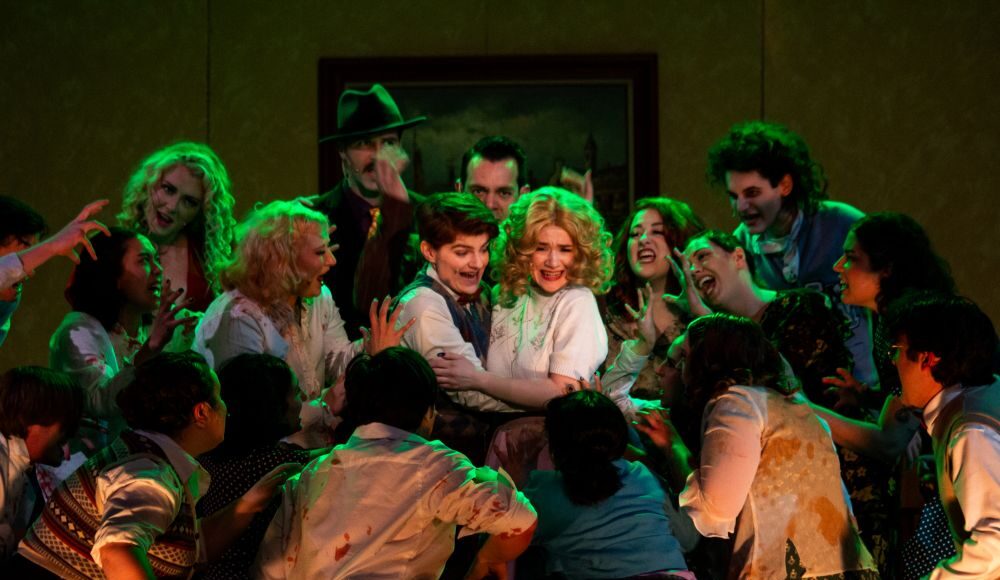
Renegade Theater producer Gennevie “Q” Herbranson condemns the film in her pre-performance intro for “Reefer Madness: The Musical” – featured in our April Fools’ issue and running from April 3 to April 20 – as pivotal to how cannabis was policed in America. She schooled the cast with a dramaturgy drive-in at first rehearsal, showing the film then opening up to classroom-style discourse.
Most hadn’t seen it, says Stage Manager Jacqueline Lopez.
The only one she knows for certain did is tenor Tyler Savin – fitting, since he plays Anslinger stand-in The Lecturer. Everything we see on stage (and in the aisles) springs from his perverse mind, warning us, a PTA audience, of the devil weed’s dangers, “an assassin of youth.”
Even the name “mariHUAna,” Ortiz hits with a hard “H” the same way Savin does, was a dog whistle.
“It was a scaaarry foreign word,” he says. “In Spanish, it’s a term of endearment for the plant.”
Lopez says about the cast’s reactions, “People were very shocked anyone could have believed that at the time.” Gradually, they grounded it in today, naming “Flat Earthers. Anti-Vaxx. Things that they themselves can’t believe people believe.”
“We hope that when it was shown in the classroom to teenagers in 1936,” Director Miguel Reyna says, “at least a few were looking at this and laughing. We hope.”
Ask him what the new Reefer Madness is and he’ll say without hesitation:
“Trans youth.”
Anyone watching politicians hot under their wannabe clerical collars about the sanctity of women’s bathrooms and sports, that gender-affirming surgery is an offense against God, can see what he means.
Hysteria is a versatile tool.
“What’s the next ‘Big Bad?’” Herbranson says.
The final song, “The Truth,” hammers this home in marching footfall beats. Assembling nearly the entire cast, with cameos by George Washington, Uncle Sam, and The Statue of Liberty, who belts an aria, they call out a carousel of coming targets: jazz musicians; immigrants; Darwin; Freud; sex on celluloid; communists; queens.
“The ends will justify the means,” it finishes.
Every corner of production tries to bring reality to the surreality, subtext to text, beginning with choosing Last Prisoner Project as benefactor. Renegade thinks it’s important to acknowledge freedoms we have in California came after many lost theirs.
On Easter at the Vets Hall, where Renegade is doing its residency, Gage Herendeen as Jesus in American flag cowboy boots gave Cadbury communion to the front row between songs, where Kathie Mollica, a 71-year-old Navy veteran (and reefer enjoyer since 13), was the loudest unencumbered laugh in the crowd.
Stationed on the NAS Alameda, then the NAS Miramar, she spoke of an incident in 2016 that caused her to take off her United States Navy flag pin.
Sitting at a Fresno Costco table by herself, a couple asked if they could join her. She said of course. Very quickly came a fusillade of viewpoints she opposed, and wasn’t it so grand he was going to Make America Great Again?
“‘No,’” she said at the time. “‘I know this man. I’m from back East.’”
She asked why they felt so comfortable saying all this, why think she’s part of their choir?
They pointed to the flag pin.
She went home and put it in a drawer.
“I’m not going to let people think this of me,” she said. Her veteran friends agreed with her, discomfited to wear theirs, and it’s only by recent leftist attempts at protests to take back patriotism from the right, starting with the flag, that she’s wearing it again.
“I’m still a little…shy,” she said.
“Especially as we’re sitting here in this Veterans Hall, I’m very proud to have served this wonderful country that this man, in my humble opinion, has destroyed.”
“How can you bankrupt a casino?” she shook her head. “And three, no less. That takes great skill.”
Costume Designer Shimona Miller, who chose those American cowboy boots, approached her consent-based costuming by boosting how The Lecturer would dress the cast.
She toyed with zoot suits, having done her final project on them for her mentor, UCSC Assistant Professor Pamela Rodriguez-Montero. Even during the allegedly united war effort, othering was everywhere, and they were a lightning rod.
Worn in the late ‘30’s into the ‘50’s, the style required “the whole nine yards” of fabric, which was in excess of war rations, so was labeled “un-American and unpatriotic.” Not incidentally, so was the wearer – typically Chicano, Mexican Americans, and black Americans, but also Filipinos, Italians, and even Jewish men, who wore them to protest the Nazis.
Ironically, unlike the European couture we cribbed from, “It is arguably the only American suit,” Miller says.
Reyna, who shares a surname with hero Henry in the play “Zoot Suit,” particularly wanted to clothe the villain in it before budgetary barriers and casting intervened. He envisioned transgressive power in a white villain wearing a symbol of black and Latino culture.
The cast’s villains each grapple with satirizing propaganda that demonstrably hurt people, but so does the hero.
Tenor Raven Voorhees as Jimmy, the tragic goof the entire narrative orbits around, says, “If I don’t take it one hundred percent seriously,” he snaps his fingers, “we lose the entire message of the show.”
Passing a message can be an imperfect handoff, worries baritone Ian Grant as archvillain Jack, wincing every time punching his scene partner lands laughs like a punchline. He sees the alt-right’s reverence for satirical works like American Psycho and Fight Club as a failure of “media literacy.”
“The scary part about the show for me personally is misinterpretation,” he says. “All these themes are getting lost, you know?”
What happens when satire is hammered flat into “truth?” Or worse, Truth Social?
Soprano Lauren Chouinard as “telenovela” antivillain Mae doesn’t take comedy for granted, having tuned in to The Daily Show with Jon Stewart and The Colbert Report “every single night.”
“How I learned about injustice, and thinking critically, was really rooted in satire,” she says.
In dispensary PR from 2019 to 2022, she crafted thinkpieces for normalizing cannabis, witnessing Illinois on the legalization cusp and learning hard truths: black Americans are three to four times more likely to be in jail for minor possession offenses; recreational legalization does not undo that harm; as licensing gets more expensive and compliance more complex, small growers, especially legacy growers, a lot of POC-owned businesses, end up squeezed out.
“While legalization creates opportunity,” she says, “it doesn’t always create equal access to that opportunity.”
Alto Alt-Mae Mitch Truong, a filmmaker set to play the other side of the mirror at the Understudy show Apr. 17th, isn’t sure the story of her mother, who fled an abusive country only to flee an abusive husband, factors into her portrayal. She also isn’t sure this is the land of opportunity her refugee mother sought.
“As a Baptist Christian Vietnamese American child,” she facetiously ticks off, “yes I feel a lot safer here, but at what cost? We’re really just working for these billionaires who want ants making them millions of dollars.”
Big Money is agnostic. It funds true believers and tourists alike, and can split who should be a united front.
Ortiz recounts how a lobbyist for Connecticut dispensaries in 2021 told him that if on an upcoming bill he pursued homegrow, the ability for people to cultivate their own cannabis, it would torpedo legalization, denying all community investment.
He countered that homegrow does not undermine any kind of regulated space for adult-use markets, and was proved right when legalization passed with its inclusion. But the betrayal and factioning in the movement were undeniable.
“Even though we are making progress,” he says, “the hypocrisy, the tension, it still exists.”
Illegalizing cannabis was a means to a community-decimating end for Anslinger and others, but their po-faced propaganda was born to have its sanctimonious bubble popped, and this dark camp musical does that, now approaching its final weekend, culminating in a 4/20 extrava-ganja.
“4/20 is such a part of Santa Cruz DNA,” Herbranson says. She thinks the 4/20 show will be “celebratory.”
“Theater is so ethereal,” she says. “You put all this effort into it, and it happens, and it’s gone. But when you have these long runs, eleven shows total, you get this really tight, kind of summer camp vibe going, and all the actors and all the crew, they just deepen each performance.”
David Volkland, General Manager at Capitola Cannabis Club, the show’s primary sponsor, reminds those attending why it’s right our city hosts this.
“WAMM Phytotherapies was started here in the Santa Cruz Mountains,” he says. The first group to push for medical legalization, which consistently precedes state legalization, “they were the only reason medical marijuana was a thing in California at all.”
Ortiz wishes from his other coast he could attend, sharing a quote by black feminist Toni Cade Bambara that might inspire the cast.
“The role of the artist is to make the revolution irresistible.”
For tickets to the final weekend of Reefer Madness shows, including the Understudy show 4/17 and 4/20 Closing Night, visit onthestage.tickets/renegade-theater-co. April donations are split with LastPrisonerProject.