

If you’ve lived in Santa Cruz for any length of time, you’ve probably stumbled across a drum circle. They pop up on Meetup, Eventbrite, community calendars, gatherings in parks, studios and beaches. Maybe you’ve even paused for a moment and thought, “That looks fun. I should try that someday.” That was me.
Alongside wind surfing and pole dancing. I’d put drum circles into the “interesting things I’ll eventually get around to” file. It wasn’t until local percussionist Jim Greiner reached out and invited me to one of his community drumming events that I finally stopped wondering.
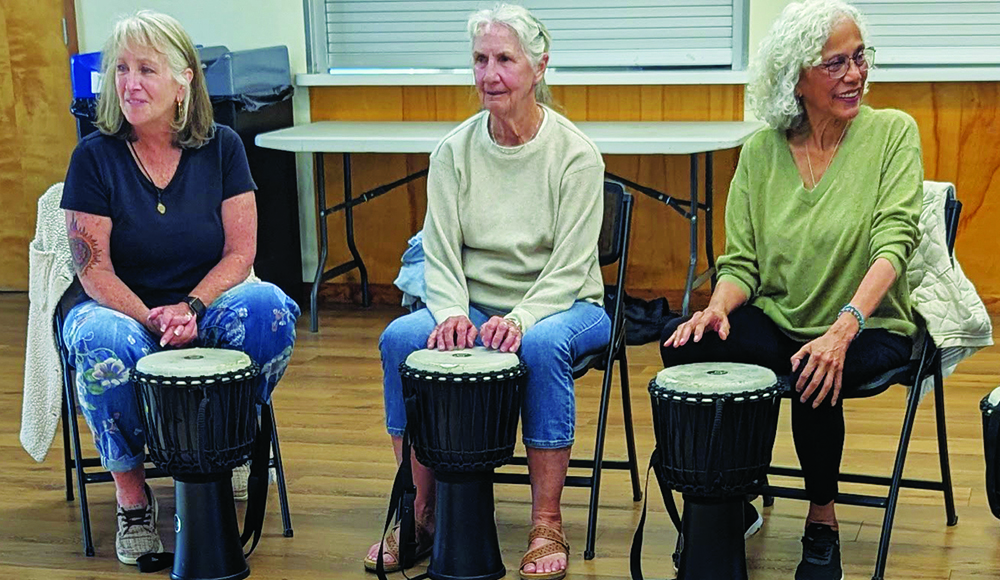
At his studio, I joined a circle that was gathered around an impressive collection of hand drums, shakers and percussion instruments. Jim greeted me with a friendly smile and asked if I had ever played any of them.
“Maybe, the shaker?” I confessed. But Greiner’s enthusiastic introduction to the circle was enough to push aside my fears of musical inadequacy.
Greiner has spent more than four decades studying percussion traditions around the world, including two transformative years in Africa. Along the way, he’s become an internationally recognized performer, educator and pioneer in corporate and community drumming. But what struck me wasn’t his résumé, it was his enthusiasm. He believes drumming has the power to change people, and after one evening in his circle, it’s easy to see why.
Greiner explained that the evening was about finding what he called “the groove.” It was about creating something together, finding group synchronicity through shared tempo, active listening and collective sound. “The groove,” he told us, “is what happens when we repeat a rhythm together until it becomes effortless.”
Greiner uses drumming as a platform for building group cohesion through what he calls Three C’s: communicating, collaborating and celebrating. As someone who studies psychology, I couldn’t help noticing how closely his philosophy aligns with what research tells us about well-being.
Studies show that even ten minutes of drumming can lower stress hormones such as cortisol while increasing feel-good brain chemicals like dopamine. Group drumming has been shown to reduce anxiety and depression while strengthening our sense of belonging and social connection.
Participating in the steady pulse of rhythm doesn’t simply make us feel better—it helps our bodies and minds function better. Research has found that drumming can strengthen the immune system and improve the body’s resilience to stress.
Rhythm also has a remarkable effect on the brain. As we settle into the groove, our brains naturally produce more alpha and theta brainwaves—the same patterns associated with relaxation, creativity, and meditation. Over time, regular rhythmic practice helps strengthen neural pathways involved with focus, coordination, learning, and mental flexibility.
Perhaps most importantly, drumming reminds us that we are not meant to go through life alone. We are “hard-wired” to be social creatures. In other words, there is real science behind why everyone leaves a drum circle smiling.
The lesson itself was surprisingly simple. We started with one bass note. Then added two more. Soon the entire room was pulsing together. Jim encouraged us to take a deep breath before every new rhythm.”If you’re tense while drumming,” he explained, “you’re practicing being tense. If you’re relaxed while drumming, you’re practicing being relaxed.”
As the rhythms became more layered, something unexpected happened. I stopped worrying about whether I was doing it correctly. My attention narrowed to the sound of my hands, the pulse of the group and the surprising satisfaction of contributing one small piece to a much larger rhythm.
Nobody cared if someone missed a beat. The music simply absorbed it. By the end of the evening, the room felt less like a gathering of strangers and more like a team that had created something together.
As adults, we’re often hesitant to try something that we’re not immediately good at. We worry about looking silly. Drum circles effectively dismantle that illusion. Everyone starts as a beginner. Everyone contributes. Everyone belongs.
I drove home feeling lighter than when I’d arrived, not because I’d discovered a hidden musical talent (I definitely hadn’t), but because I’d participated in an opportunity to be fully present with other people.
Maybe that’s the real lesson Jim Greiner has spent decades teaching. It’s not about perfect rhythm. It’s about remembering how good it feels to get out of your head and into the groove.
Learn more about getting involved in our local drumming community at handsondrum.com









Indeed, I found that Jim’s drum circle is all that. And more! As Jim’s life story, his learnings leading to his well-thought out & beautifully constructed insights are well worthy of a story all it’s own. Consider asking him to sit down for an interview. Or several!
Thank you for your wonderful comments, Ron! We’re all in this together!