


Las Vegas runs on illusion.
I’ve been going since I was a teenager — performing there, consulting there, watching it reinvent itself again and again. For decades, the question was simple: which magician, which residency, which restaurant?
Then a building bent the city’s gravity.
The Sphere is the largest LED performance space ever built, a digital sky that swallows more than 18,000 people at a time. It has reset expectations for what live entertainment can feel like.
When artists bring their shows into that impossible canvas, some of the real-time systems helping make it work are designed and assembled inside the Wrigley Building, a former gum factory, on Santa Cruz’s Westside.
Aron Altmark is the founder and executive director of Visual Endeavors, which is now part of Hovercraft Ventures, a Boca Raton, Florida-based experience and innovation company. What Altmark has built is quietly world-class.
His company created PixelCannon, a line of ruggedized “media servers.” If you aren’t in the live-event business, think of a media server as the ultra-powerful brain behind the spectacle. It’s a specialized, heavy-duty computer whose sole job is to juggle massive video files, process millions of pixels in real time, and pump them out to giant screens in perfect sync with the music. PixelCannon takes that immense computing power and armors it for high-stakes live production. These custom-built machines, designed in Santa Cruz and assembled in the Bay Area, are deployed into some of the most demanding shows on the planet.
To understand why that matters, you have to step inside the biggest screen on Earth.
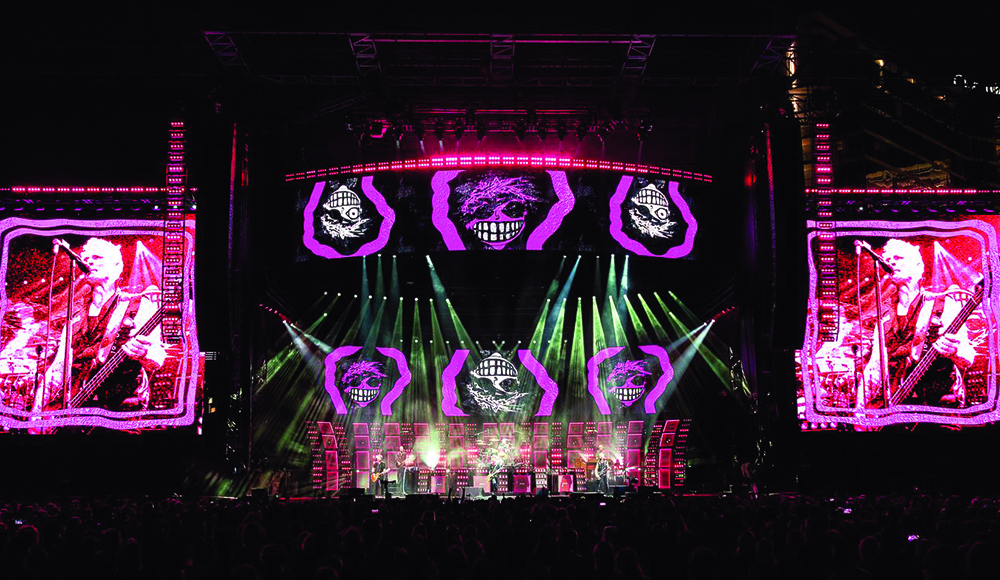
Photo: Courtesy of Visual Endeavors
The Sphere is not a plug-and-play venue. The interior LED surface alone spans roughly 160,000 square feet, wrapping around and above the audience in a continuous, immersive canvas with between 170 million to 256 million pixels of screen. Every pixel has to be fed, every frame rendered, every signal routed without a single hiccup.
That is where Visual Endeavors fits in.
“We are grateful to have been brought in by the production teams creating the content for a few artist residencies,” Altmark says.
Most recently, Visual Endeavors collaborated with BLINK, a Burbank-based creative production studio, to support the Backstreet Boys at the Sphere, delivering an IMAG (image magnification) effects package powered by Notch, a real-time graphics engine used for dynamic visuals that respond instantly during live performance. The team blended live camera feeds with immersive visual treatments across multiple songs. BLINK brought Visual Endeavors in as the Notch integrator and real-time content partner.
Altmark called it “one of the best shows I’ve had the privilege of being a part of in the last few years. Nothing like 20,000 millennials singing along to some of the CDs in my early rotation.”
It was not their first time inside the building. Visual Endeavors’ debut at the Sphere was UFC, staging a fight card inside its immersive environment. Then came the Eagles, alongside production partners and Silent House. More recently, Zac Brown Band. Each residency deepened their familiarity with the room and the systems that power it.
“We just kind of became someone who knows how to do stuff there,” Altmark says.
That reputation is hard-earned. In a venue built entirely around immersion, a rendering freeze is not subtle. It is thousands of people staring at a glitch in the sky.
His broader résumé extends well beyond Las Vegas. Visual Endeavors has contributed to Logic’s Everybody’s Tour, Tiësto’s world productions, and tours for Green Day, Deftones, and Morgan Wallen.
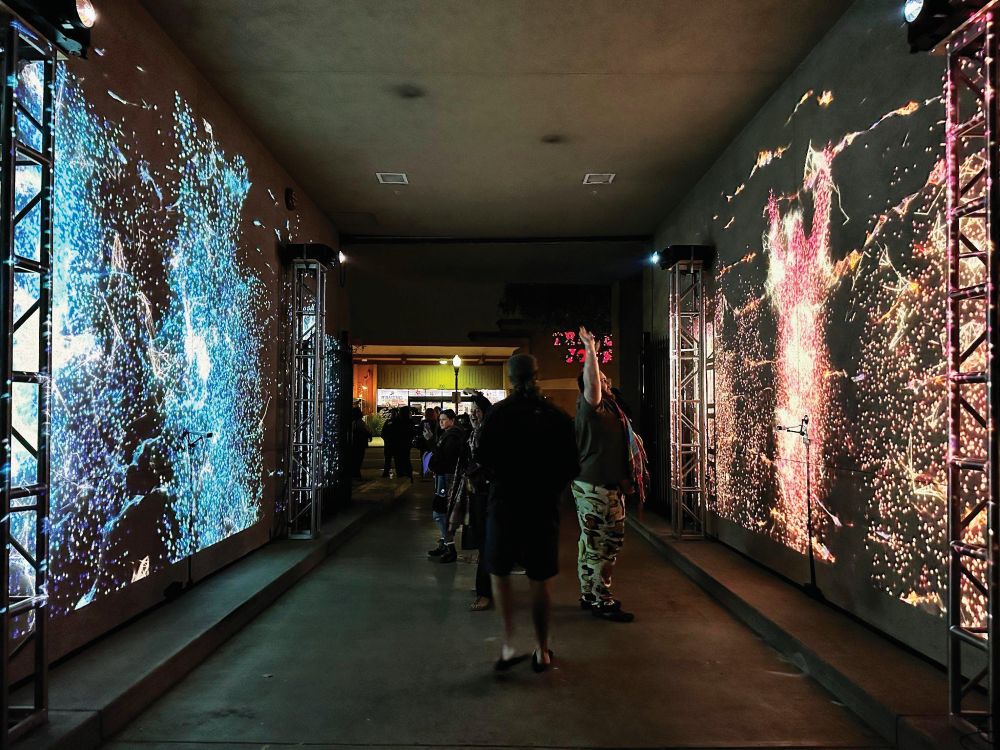
The company also builds corporate activations, product launches, and permanent installations for brands seeking immersive environments rather than static displays. On the corporate side, Visual Endeavors has deployed BlackTrax for major Bay Area tech conferences, where the precision demands are different but equally unforgiving — C-suite presenters who need repeatable, automated follow-spot lighting without anyone fumbling a remote spotlight during a keynote.
His team includes studio and project manager Anna-Marie Freitag, PR and marketing lead Ian Chandler, and creative technologist Mia Zhang — the local team amongst a larger web of project-based collaborators.
Small team, Big rooms
But the team’s footprint extends far beyond giant screens. Visual Endeavors is also the North American Creative Solutions Provider for BlackTrax, a motion-tracking platform capable of tracking performers, objects, and even race cars across a stage in real time. Altmark simplifies the philosophy: “If you can track a person, you can track anything.”
In the lab, he proved it. His team built an air-hockey table with CNC-milled hockey stick player controls housing BlackTrax beacons and a projected puck driven by Notch and real-time physics simulations.
It debuted at LDI, the main U.S. trade show for live entertainment tech, and at ISE in Barcelona, as a partnership with Pixera and BlackTrax — and became one of the most talked-about demos at both.
The same tracking logic that follows a puck on a tabletop can follow a performer on a stadium stage or a player on a full-size arena court. The difference is only scale.
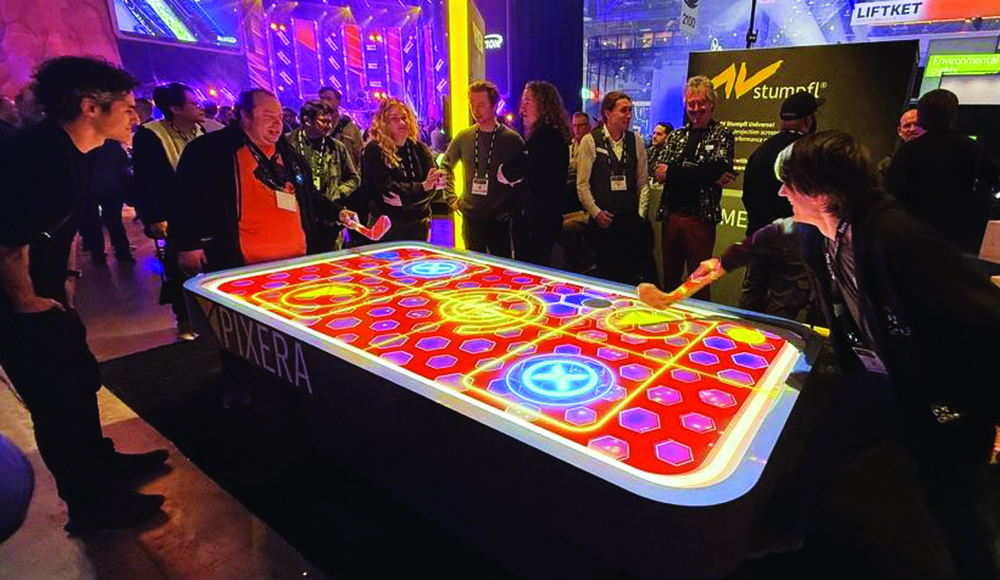
Photo: Courtesy of Visual Endeavors
The tracking work extends beyond spectacle. Visual Endeavors has deployed full BlackTrax systems for a worship campus with hundreds of moving lights operated largely by volunteers — turning any light in the rig into an automated follow spot instead of staffing manual operators every service. Altmark also integrated tracking for LED floor surfaces reacting to performers in real time — particle effects and visual storytelling tied to movement.
He also helped develop BlackTrax’s static lighting tracking feature, allowing conventional stage wash fixtures to activate zone by zone as a performer crosses the stage. It began as a workaround — “a hilarious set of DMX inputs and outputs,” as he described it in a CAST Software webinar — and eventually became a built-in product feature.
What stands out when you speak with Altmark is not ego but fluency. He speaks in render pipelines, GPU cycles, LED density, and signal redundancy. He also speaks in emotion — in audience reaction, in the way a chorus lands when the lighting hits just right. That duality, holding both the technical and the human in the same breath, is the job.
Birmingham to Backstage
Altmark grew up in Birmingham, Alabama, attending the Alabama School of Fine Arts, where dance and theater lighting became early obsessions. He originally wanted to work in film, but live production had its own pull — the immediacy, the unpredictability, the one-shot nature of every show.
“I grew up doing dance and theater lighting,” he says. “That was kind of my thing.”
Music ran through everything. “I grew up playing piano and saxophone and a bunch of other instruments. I just love music. I had a touch of synesthesia as well.”
Synesthesia is the neurological blending of senses — sound triggering color, rhythm manifesting as shape. For Altmark, it meant seeing sound and hearing rhythm as light.
“When I was on the road operating lights for artists, I would kind of feel the music and turn that into something visual.”
After high school, he moved west and interned at a lighting software company in Southern California. “It’s kind of a cliché story,” he says. “I met people and worked my way up the ladder and just chased different opportunities when I thought it was the right one.”
He worked for Steve Lieberman, designer of the Yuma tent at Coachella, then became a training support specialist at A.C.T Lighting, working with GrandMA consoles — the command centers behind arena-scale shows. He attended CalArts while touring. Each chapter layered on theory, software fluency, and industry relationships.
That depth led to touring with DJ Tiësto. “I knew all about the software, and I have a pretty musical background,” he says. “That’s how that happened.” On DJ Logic’s Everybody’s Tour, Altmark was programming on MA lighting consoles and time-coding lasers, video, and lighting into a single cohesive package — an early demonstration of the integrated approach that would define Visual Endeavors.
Then the world stopped. During COVID, Altmark was embedded with XR Studios in Hollywood, working in virtual production — camera tracking, AR object placement (which put virtual 3D models onto real world objects) and virtual shadow creation in programs called Unreal Engine and Notch. The pandemic detour deepened the skills that would later power PixelCannon and gave him fluency in real-time tools that proved essential when live events returned.
Building Machines That Survive the Road
Touring and designing for A-list and middle-market clients revealed a gap in the market. The server hardware Altmark relied on lagged behind the latest releases, and the cost put advanced creative out of reach for many artists.
So he began building and modifying his own hardware — reinforcing chassis, improving airflow, reworking internal layouts, testing under stress. Tinkering became engineering.
The catalyst was Tame Impala’s 2019 Coachella headline set. Altmark and his team built bespoke hardware to handle ambitious Notch visuals outside the traditional media server ecosystem — something more efficient and scalable for life on the road. That prototype became known as the PixelCannon — a touring-grade computer built less like a desktop and more like stage equipment, all of it sealed into something that has to withstand the brutal wear-and-tear of a global tour.
Through a startup partnership with NVIDIA, Visual Endeavors gained early access to next-generation GPUs capable of massive real-time rendering — the kind of hardware that turns abstract data into light on a screen, frame by frame, fast enough to keep up with music.
“We’re putting really robust next-generation hardware into a pretty rugged custom chassis,” Altmark explains. “That way we can ship these computers anywhere in the world and they won’t fall apart.”
Inside each unit: dense stacks of components pushing heat, fans pulling air, processors calculating thousands of visual decisions every second — all housed inside a chassis built for the abuse of touring.
PixelCannon systems sit offstage like silent engines, feeding visuals to walls of LEDs — entire environments rendered in real time, reacting to music, movement, and timing down to the millisecond. They are built for environments where failure is visible and immediate, and where there is no second take.
It’s less like running a computer and more like keeping a plane in the air — everything working at once, nothing allowed to fail.
Redundancy matters. Cooling matters. Latency matters.
Unglamorous work, but foundational.
The Integrator
Visual Endeavors does not operate like a traditional creative agency, pitching campaign decks. They step in when something isn’t working, when a director asks for something the system can’t yet do, when a visual freezes mid-render, when a wall of screens slips out of sync.
They are the people backstage with laptops open and cables exposed, tracing signals in real time as a countdown clock ticks toward doors. The job is to make the impossible idea behave, to take something fragile, unstable, half-working, and make it hold together in front of thousands of people.
“We generally integrate into someone else’s process where they have a problem they can’t figure out,” Altmark says.
That might mean fixing a render bottleneck moments before doors, translating a director’s idea into something the hardware can actually run, or getting content and engineering teams aligned when they are speaking entirely different languages.
Creative vision almost always outruns infrastructure. Visual Endeavors lives in that space between what someone wants to see and what the machines can currently deliver.
If they succeed, no one notices. If they fail, everyone does.
Why Santa Cruz
Altmark moved to Santa Cruz in 2016, seeking quieter ground than Los Angeles.
“I wanted to get away from L.A. and find a spot to land that was a bit quieter.”
He is an avid mountain biker and gravel rider. “You can’t beat the outdoors access. We’re 10 minutes from the trails.”
For five years, he toured while based here, treating Santa Cruz as home between road stints. Eventually, the model shifted. Visual Endeavors began building shows, launching them, and handing them off to touring crews — turning the company from a road operation into a design and engineering lab.
The Wrigley Building became both workshop and laboratory. PixelCannon units are assembled, tested, and shipped from a space surrounded by surfboard shapers, bike builders, and startups. The building itself houses dozens of businesses, and Visual Endeavors is one tenant among many in that thriving Westside hub. But their studio is also a creative lab — projections on every wall, a truss rig of moving lights overhead, and for a stretch, a Meyer Sound spatial audio system from Berkeley for experimenting with immersive sound composition tied to real-time visuals and BlackTrax tracking.
Altmark hosts First Friday events in the studio, inviting guest artists to use the gear for interactive and real-time performances. During a recent CAST Software webinar, he showed his 7-year-old daughter in the space, utterly unbothered by the particle systems and projection-mapped walls swirling around her. “That’s kids these days,” he said with a laugh. The invitation extends to anyone curious about the work — artists, technologists, locals. “If you’re in town, reach out,” he says. “Come hang out and see what we have going on.”
The range of projects radiating from the studio reflects that open-door ethos. Visual Endeavors recently handled projection mapping for Zaccho Dance, an aerial dance company that performed inside San Francisco City Hall — a guerrilla theater production that turned one of the Bay Area’s most recognizable civic buildings into an immersive canvas using Pixera software.
Across the street, even the coffee shop knows Altmark and speaks highly of his family.
There is something distinctly Santa Cruz about building machines that power some of the most advanced shows in the world inside a repurposed gum factory off Mission Street. The Westside has always blended industry and creativity. Surfboards, bikes, tech startups, art studios. PixelCannon fits right in.
Reuse. Reinvent. Iterate.
Inside the Hovercraft Ventures Deal
The Hovercraft Ventures acquisition began with a phone call.
Last year, the global experience and innovation venture platform Hovercraft Ventures acquired Raw Cereal, a production studio Visual Endeavors had collaborated with on major tours, including two tours with Morgan Wallen. When the Raw Cereal team told Altmark what had happened, he was intrigued. The timing made sense — Visual Endeavors had been growing steadily, and the partnership network Hovercraft was assembling matched the way Altmark already liked to work.
“They said, ‘Hey, this just happened and we’re part of this now,’” Altmark recalls. “And I was like, that sounds really cool.”
The fit made sense. Hovercraft Ventures is a platform bringing together top experiential production companies across entertainment, retail, and sports. The model is shared capital, operational support, and creative cross-pollination — specialized companies collaborating on larger projects without losing their individual identities or expertise.
For Visual Endeavors, the deal offers scale without relocation. The lab stays in Santa Cruz. The team stays intact. The work stays the same, just with more resources and a wider network behind it.
“My vibe is I just want to make cool shit with my smart friends,” Altmark says.
Santa Cruz remains strategic, with its proximity to the Bay Area tech ecosystem and talent pipelines from UC Santa Cruz and the broader region. There’s a creative culture that values experimentation over convention.
During our conversation, Altmark was heading to San Francisco for dinner with new partners. Not corporate formality. Collaboration.
“A rising tide lifts all ships.”
AI, Compression, and Craft
As Visual Endeavors scales up, the technology they use is evolving just as fast. AI now threads through nearly every creative conversation. But Altmark is measured about it. He knows that an algorithm can generate a visual, but it takes an artist’s lived experience to know if it actually serves the song.
“AI is a tool,” he says. “It’s a creative tool that you can use or you don’t have to use.”
Visual Endeavors uses it heavily for workflow automation — scheduling, documentation, and project management.
But he draws a line when it becomes a gimmick rather than an instrument. Clients sometimes request AI-driven visuals because it feels futuristic. Altmark pushes back when the application does not serve the work.
“Is it truly going to help the creative process? Is it going to influence how people experience this? Or is it a gimmick?”
“You still need artists who know how to use it.”
The tool can accelerate rendering. It cannot replace taste, troubleshooting, or intuition. The wildest system in the world still needs someone who understands rhythm. An algorithm doesn’t know what a kick drum feels like in your chest, and it can’t anticipate the exact moment the air shifts in a stadium when 20,000 fans hold their breath before a chorus. Altmark does. When he programs a show, he is pulling from that human reservoir—translating the adrenaline of a live room into a digital sky.
A Factory for Wonder
On Saturdays, the Wrigley Building parking lot fills with the Westside Farmers Market — coffee, roasted peppers, citrus stacked in crates. Families drift between produce stands without thinking much about what is happening across the street.
Inside, Visual Endeavors assembles hardware, writes software, and experiments with real-time systems designed to bend light, sound, and space. PixelCannon racks hum beside projection tests and motion-tracking demos aimed at creating environments that feel otherworldly without ever breaking. Even on a quiet weekend, the team is often prepping servers to ship out for the next massive tour.
Santa Cruz has always had a streak of the improbable. Joby Aviation is developing flying air taxis just down the road. And now Hovercraft Ventures is acquiring one of the Westside’s most technically inventive studios, betting that the future of global live entertainment will be engineered right here.
From Wrigley gum to real-time rendering, the Westside is still in the business of manufacturing wonder.
Visual Endeavors is located in the Wrigley Building, 2801 Mission St., Santa Cruz. First Friday open studio events are held monthly. To learn more or schedule a visit: visualendeavors.com
Joshua Logan is a writer, magician, and creative technologist based in Santa Cruz. He writes about technology and culture for Good Times.









I have noticed that of all different types of insurance, health insurance coverage is the most dubious because of the issue between the insurance company’s necessity to remain making money and the customer’s need to have insurance plan. Insurance companies’ commissions on wellness plans are incredibly low, therefore some corporations struggle to gain profits. Thanks for the thoughts you share through your blog.