
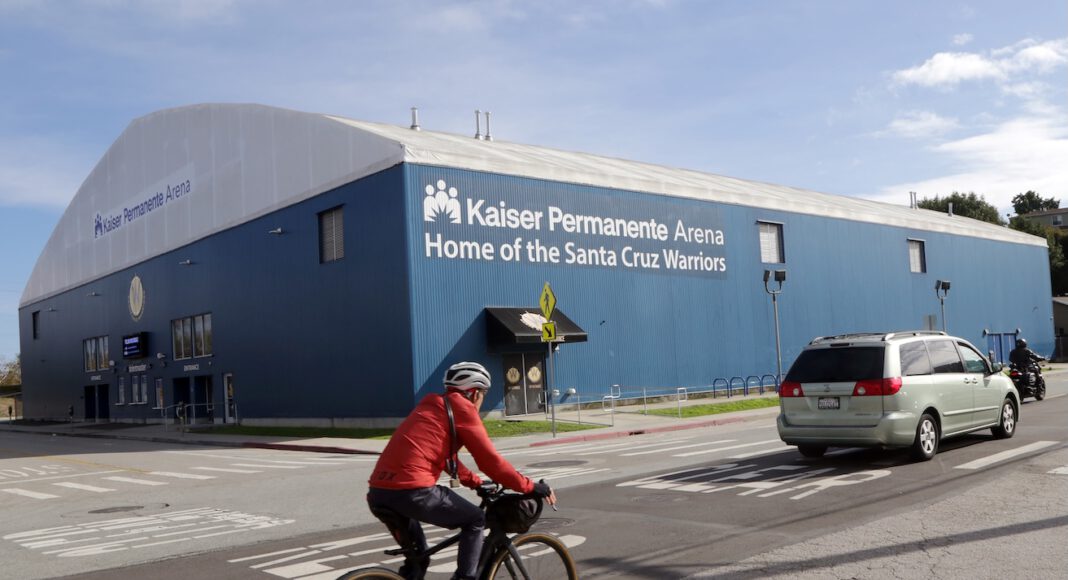
The Santa Cruz Warriors are a step closer to getting a permanent home after the Santa Cruz City Council on Tuesday approved agreements that could pave the way for a new sports and entertainment arena downtown.
The Nov. 17 decision authorizes a memorandum of understanding between the city and the Warriors and an amended ground lease with the Santa Cruz Seaside Company, which owns the land beneath the existing Kaiser Permanente Arena.
The council approved the proposal with Councilwoman Sonja Brunner abstaining.
The agreements do not authorize construction. Instead, they establish a framework for negotiations over financing, location and development.
Mayor Fred Keeley described the decision as a milestone in an effort that began nearly 15 years ago.
“I think it’s fair to say we’re not across the goal line, but we’re in the red zone,” Keeley said.
Santa Cruz Deputy City Manager Bonnie Lipscomb, who presented the proposal to the council, said the project builds on years of planning to establish a permanent arena and create a stronger connection between downtown and the beach area.
The proposed arena would be located in the 29-acre South of Laurel Area, known as SOLA, which the city has designated for redevelopment into a district featuring housing, restaurants, entertainment venues and public spaces.
Lipscomb said the facility could accommodate approximately 3,300 spectators for basketball games and up to 4,000 for concerts and other events.
The existing Kaiser Permanente Arena, built in 2012 as a temporary facility, seats approximately 2,500.
A larger venue would allow Santa Cruz to attract concerts, sporting events and entertainment that currently bypass the city because of limited capacity.
The arena would also anchor a broader redevelopment effort that could include up to 1,200 housing units, commercial development, public plazas and improvements along the San Lorenzo Riverwalk.
Lipscomb presented findings from a new economic analysis by Victus Advisors and RCLCO estimating that the combined operations of a permanent arena and surrounding development could generate more than $43 million annually in economic activity and support approximately 320 full- and part-time jobs.
Over 30 years, the development could generate approximately $1 billion in economic output and $60 million in city tax revenue, calculated in present-day dollars.
Those projections include economic activity from the arena and surrounding development, rather than the arena alone.
Finding the money
The project’s cost and how it would be divided between public and private investors remain undetermined.
Lipscomb outlined several financing tools the city has established to encourage investment in the area.
Those include an Enhanced Infrastructure Financing District that would allow a portion of future property tax growth from new development to fund public improvements.
Santa Cruz also recently received federal Opportunity Zone 2.0 designation for an area encompassing portions of downtown, the beach and the proposed arena district. The designation, effective Jan. 1, 2027, offers tax incentives to encourage private investment.
Lipscomb explained that those mechanisms alone would not be sufficient to finance the project.
The council directed staff to develop a funding strategy that maximizes private investment while identifying appropriate public funding sources.
The proposal drew enthusiastic support from business owners, former elected officials and Warriors representatives.
Ian McRae, owner of Hula’s Island Grill and Tiki Room, said Warriors games have provided a substantial boost to downtown restaurants during the slower winter months.
“I don’t have the numbers,” McRae said. “I can just tell you it’s been significant.”
Conrad Garner, representing the company that operates La Bahia Hotel and Spa and the Dream Inn, said a year-round entertainment venue could help businesses attract customers outside the summer tourist season.
Former mayors Don Lane and Hilary Bryant, who helped bring the Warriors to Santa Cruz, encouraged the council to move forward.
Bryant recalled that the arena has hosted community events extending beyond basketball, including vaccination clinics and memorial services.
“It’s brought so many wonderful things to our community,” she said.
Santa Cruz Warriors President Chris Murphy said the franchise has become an integral part of the community through youth programs, school visits, charitable activities and partnerships with local organizations.
Brandon Schneider, president and chief operating officer of the Golden State Warriors, said the organization remains committed to Santa Cruz.
He pointed to the development surrounding San Francisco’s Chase Center as an example of how an arena can help revitalize a neighborhood.
Councilman Scott Newsome said the proposal complements other downtown investments, particularly housing and improvements intended to make the area more accessible to pedestrians.
Councilwoman Susie O’Hara acknowledged that considerable work remains, particularly in determining how construction would be financed.
The original temporary arena was developed through a partnership involving the city, Warriors and Seaside Company. Lipscomb said the city provided a loan of slightly more than $4 million, which has since been repaid.
Under the newly approved ground lease, the existing arena can continue operating while plans for a permanent facility advance.
The agreement establishes a new four-year term with automatic extensions and allows for the possibility that the existing arena could eventually be transferred to the Seaside Company under certain conditions.
Next steps include identifying a preferred location, negotiating a revised building lease with the Warriors, developing a financing plan and selecting potential development partners.
Those decisions will require additional council approval.