
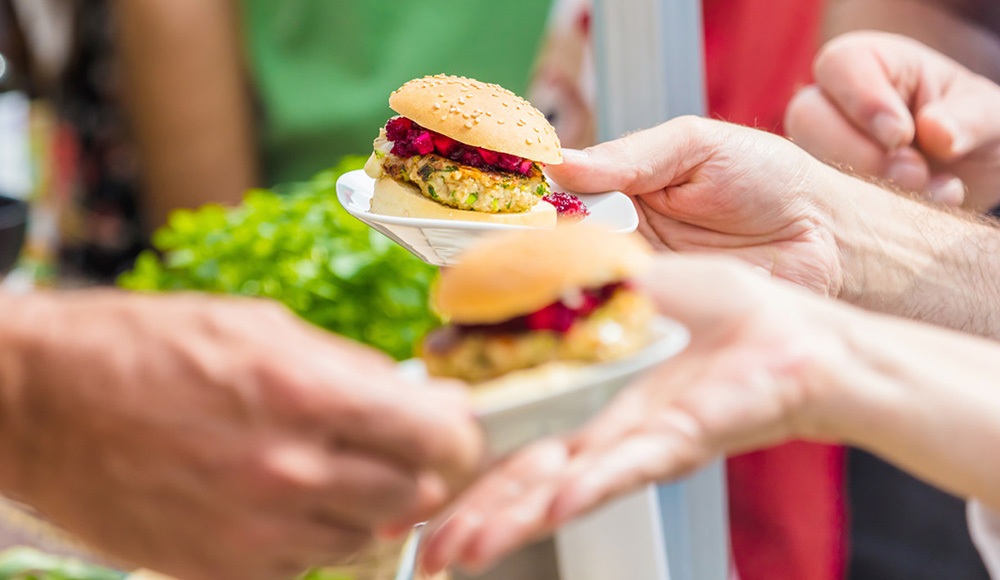
Look, vegans get a bad wrap and I’m not talking about one with old sprouts (although those suck too). For years they’ve been the butt of jokes (How do you know if someone is vegan? Don’t worry, they’ll tell you), the targets of the meat and dairy industries (“But how will you get your protein?”) and are usually thought of as malnourished weaklings (or “soy boys” as many on the Right–and some on the Left–like to say).
Recently – to nobody’s surprise – the President of the United States even used the word “vegan” (which he pronounced “vay-gun.” Again, to nobody’s surprise) derogatorily when describing Texas Senate Democratic candidate James Talarico.
However, veganism is a growing lifestyle worldwide. In 2026, roughly 1-2 percent of the world’s population is vegan, with approximately 13.4 million vegans, or about 4 percent, in the United States alone. Last year the plant-based market in the U.S. was valued at $10.3 billion and is expected to increase 11.72 percent to $27.74 billion by 2032. And it’s not just health food either. In 2021 the National Food Strategy report found that the Impossible Whopper accounted for 8 percent of all Whoppers sold in the U.S. by Burger King.
Which is why events like this year’s annual VegFest on Saturday, June 6 at the Watsonville Fairgrounds, are not only an important way to spread the message of veganism, but also to showcase a real-life example.
“Anything you can do I can do vegan,” explains Robert Cheeke. As one of the key speakers at this year’s VegFest, Cheeke is the living embodiment of how a vegan lifestyle is not only healthier than the omnivorous alternative, but vegans can also be just as badass as well. Cheeke has been living as a vegan activist for over three decades, and for 10 of those years he was a bodybuilder and won two International Natural Bodybuilding Association (INBA) Northwestern Natural Bodybuilding championships, first in 2005 and again in 2009.
“I totally promote and support the idea that anything we can replace with a more compassionate option than the animal one then we should,” he continues. “It’s part of my mission to show people it can be tasty, affordable and accessible.”
Along with Cheeke, this year’s VegFest will feature two different vegan comedians – Santa Cruzan by way of Chico favorite DNA, and Los Angeles-based writer, producer and stand-up Steven Marcus Releford. It will also feature two Story Times, one with local Drag Story Time with queer artist Rogue Roulette and another, non-drag one.
“We’re trying to make it as family-friendly as possible so we have a lot of children’s activities this year,” says Helbard Alkhassadeh. He and his wife, Camilla, are the VegFest organizers and the owners and operators of the Royal Oaks animal rescue, Little Hill Sanctuary.
Other VegFest children’s activities for the little ones will include bounce houses, face painting, flower crown making, and a craft area.
This year’s musical guests represent a wide range of styles and cultures. Michael Gaither and His New Best Friends will entertain audiences with their Americana sounds, while local rocker Adam Stafford reinterprets classic songs by KISS, Pearl Jam, Mazzy Star, AC/DC and more. Conscious hip hop artist Lysn will also be there to drop some knowledge and get attendees on their feet with his infectious beats. Festies will also get a taste of traditional Mexican dance alongside their vegan tacos with Grupo Folklórico Raices Mestízas, a Watsonville-based parent and student folklórico dance troupe. For those feeling more inclined to realign their chakras, the Sri Chaitanya Saraswat Seva Ashram of Soquel will perform a Bhakti Yoga Ceremony that blends sacred rhythms with uplifting mantras and live Vedic music.
“And we’re going to put up pop-up tents because we heard there wasn’t enough shade last year,” says Camilla. “Families will be able to hang out and listen to some music while eating food and their kids make flower crowns, just enjoying the day.”
This year’s fest will also feature alcoholic beverages all from women-owned local businesses.
“We have Fruition, Santa Cruz Cider and Sante Adairius,” Helbard says.
Attendees will also have the chance to enjoy a cooking demonstration on how to make Mixed Mushroom Ceviche and “Do Better” Dubai Cake by Chef and Reverend Beth Love. As the founder of Eat For The Earth – a global community based in Santa Cruz that offers online and in-person culinary classes for eating whole, healthy plant-foods – she’s taken her knowledge to schools, businesses and even the California State Penitentiary System.
The 130 different vendors this year range from vegan leather artists to jewelry makers and farm-to-table delivery services. Of course, one of the biggest yearly draws is the food, and 2026 is no exception. There will be plenty of new options like The Soup Guru, 1837 Vegan and CaCau Bakery and even more returning, such as fresh and healthy favorites such as The Buzz Sushi and Auraganic Juicery.
However, vegan food doesn’t just have to be all raw veggies and juices.
“Not everyone is coming for the fitness or health thing,” Cheeke says of veganism. “So we need to show people there’s a compassionate way to have a popular food – like Mac ‘N Cheese that doesn’t come from any animals – or marshmallows that don’t have gelatin or animal by-products.”
Enter Vegan Circus, a VegFest returning favorite food truck out of Grass Valley.
“I’ve always loved corn dogs,” laughs owner and operator Drea Mason, who’s been a vegan for 14 years. “And it was hard to find a fresh corn dog that wasn’t frozen.”
After testing and tweaking recipes on her friends, family and anyone who was hungry, Mason launched Vegan Circus out of a food truck. Since then she’s made a name for herself in the California Vegan Food Truck world with her “bacon” melt pretzels, burgers, nachos (with homemade “cheese” from carrots and potatoes), and yes, her corn dogs.
For those thinking, “Yeah, but vegan cheese doesn’t even taste the same,” then it’s time to try Mason’s cheese. According to her, the non-vegans might even love it more than the actual herbivores. Don’t believe it? Well, Vegan Circus won the Best Grilled Cheese in the 2024 Sacramento Grilled Cheese Festival.
“I was the only vegan vendor and I won the blind taste test,” she exclaims. “The judges were not too happy about it but I was.”
This will be the third year the self-taught chef is returning to VegFest and she keeps coming back because of the community it creates.
“I love the people, the vendors, connecting with like-minded people and obviously being in a place where I can eat everything,” laughs Mason.
While she’s worked other festivals in the past, Mason says these days she focuses her energy on vegan fests, catering for private parties and working events to support animal sanctuaries. In fact, 15 percent of all of this hard-working,single mom’s profits go directly back to animal rescues. Just a few of the groups she donates to are Animal Place and Sammie’s Friends both in Grass Valley, the Performing Animal Welfare Society (PAWS) of San Andreas, Only Sunshine Sanctuary in Sacramento and Little Hill Sanctuary.
“I’ve always been connected to animals as sentient beings,” she says. “But I grew up not really having the connection between what I was eating and where it was actually coming from. Once I learned that, I – like a lot of vegans – couldn’t look away.”
Vegans for life
The VegFest goes back to 2019 originally sponsored by the national non-profit Vegan Outreach and organized by local vegan activist Wendy Gabbe Day. That first year the Alkhassadehs volunteered to help out but when Day decided not to do a second year, they stepped up to keep it going.
“It’s a labor of love because it’s so much work,” Camilla says, noting the VegFest has only broken even the last two years
However, with expenses continuing to rise due to inflation, tariffs and the Iranian War, VegFest is costing the non-profit owners more than ever. And it’s not just the organizers who are striving to stay afloat.
“A lot of the vendors are also struggling, so we’ve been giving them deals,” she continues. “We want them to be there and we want the ticket prices to be low so we’re keeping it at $5.”
“We want it to be affordable and for people to experience being in a completely vegan environment with others who are interested in it,” admits Helbard. “But it’s been a real struggle this year.“
In fact, on the day I interviewed the couple, just five weeks before the event, they were informed the rental price for the Watsonville Fairgrounds had increased. The Alkhassadehs understand – the venue needs to pay for insurance, security and staffing – but acknowledge they need to be more financially creative if it’s going to continue in the future. In that spirit, this year’s VegFest will have fundraising events during the day and there will be an online auction as well through their website LittleHillSanctuary.org
“We want people to realize it’s a difficult event to put on,” Helbard says. “It costs just under $40,000 and we just want to break even.”
While that’s a hefty sum for any working-class family, for the Alkhassadehs – operating a four acre, non-profit animal sanctuary with roughly 70 animals at any given time – it means stretching their money thin as they can. They’ve already cut back on the number of animals they can rescue from just a few years ago.
In the past, Little Hill’s relied on individuals in the community making monetary donations – general or specifically sponsoring an animal at the sanctuary – or other types of donations like animal feed. Yet, recently things have changed.
“We don’t get donors saying ‘I don’t want to sponsor this animal anymore,’” Camilla says. “It’s ‘I’ve lost my job’ or ‘I’ve had to go take care of my mom.’”
VegFest has scored a number of local and non-local sponsors such as the breweries, Good Times, KION, and Pajaro Valley Printing. However, Little Hill Sanctuary is the only monetary sponsor for this year’s event. The Alkhassadehs say they’ve been approached by “some” entities wanting to sponsor but declined the offers.
“There are some large, corporate businesses and farms that want to tap into it but we don’t want them,” says Helbard. “They don’t fall in line with our mission. There’s a whole point to what we are doing and we’re not going to sell our soul.”
They also see the struggle at their weekly food pantry in Watsonville. As part of the Monterey Food Bank, Little Hill Sanctuary hosts a weekly, vegan, free food pantry to anyone in need. While some of the food is donated, much of it is grown on their land.
“With our food share program we’re seeing the increase in people’s needs,” Helbard says, adding they also donate to a number of local organizations throughout Monterey and Santa Cruz Counties like the Veterans Transition Center, Pajaro Valley Loaves and Fishes, and the Grace Harbor Women’s Center.
“We’ve figured out the numbers and it’s about 1,200 people every month that get something from our food pantry,” he continues. “You can see how long the lines are getting at food pantries, it’s wild how many people are in need.”
This is the main driving force for the Alkhassadehs’ veganism: compassion. Compassion for oneself, the Earth and – most importantly – other living creatures who have the same right to life as anything born on this planet.
Among the animals in their sanctuary is a large, black, sweet-natured hog named Pistachio. Most pigs live anywhere from 13-15 years. Pistachio is 19 years old and still kicking.
“Pistachio has a right to get old just like I do,” explains Helbard. “One of the main goals is to show people that domesticated animals want to get old and live their entire lives.”
Yet most animals slaughtered for their meat barely live past a year.
Typical current meat industry standards see lifespans of one day for male chickens, five to six weeks for female chickens, five to six months for pigs, a year and a half for cows, and the list goes on. According to the Food and Agricultural Organization of the United Nations, 80 billion – that’s 80,000,000,000 – animals are slaughtered a year globally. That’s just terrestrial animals, not including fish or sea animals. The United States makes up 12.5% – or 10 billion animals – of the 80 billion despite accounting for only 4.11% of the world’s population.
There’s another hidden consequence the meat industry takes on humans. No, it’s not heart disease (although eating meat daily increases coronary heart diseases by 9-18%), it’s the toll the industry has on the slaughterhouse workers.
The United States has approximately 800 federally-inspected slaughterhouse plants with another 1,900 under state inspection. Studies in 2025 funded by the US Department of Agriculture found that 81% of workers in chicken plants are at high risk for musculoskeletal disorders, along with 46% in pig processing plants. In 2022, data released by the Occupational Safety and Health Administration (OSHA) found that a staggering 27 workers a day suffer the most severe injuries, such as losing an eye, or result in amputation or overnight stays in the hospital. The data was taken from 29 states operating under federal regulations, while the other 21 states, not included in the data, report to state government.
Most workers are from marginalized or underserved communities. Roughly 80 percent identify as people of color, nearly half are born outside of the United States, and a quarter come from homes with limited English proficiency. Because of this – along with the difference in reporting to OSHA and state inspected agencies – many experts believe the injuries are severely underreported for fear of immigration status or retaliation from their bosses or companies.
“I don’t think there’s any path towards liberation for anyone without the complete liberation of all animals, people and the earth,” Camilla says. “All of that is tied together, and when you bring them all together [with veganism] things fall into balance and it sends you on a path.”
Heavy Lifting
“People say ‘Oh you got to be careful on a vegan or plant-based diet,’” Cheeke says. “No, no, no. Stop right there. I’d say you have to be really careful on a standard American diet. If you follow the status quo: 73.6 percent of Americans are overweight and 42.5 percent are obese. That’s not to bodyshame anybody. It’s to sound the alarm that something is going on here.”
Born and raised on a farm in Oregon to parents who worked in the Animal and Rangeland Sciences Department at Oregon State University, Cheeke was the last person anyone thought would go vegan. However, when he was 15 his sister helped conduct an Animal Rights Week at their high school. After learning about animal testing and factory farms, Cheeke realized he had to make a choice.
“I’ve always had a soft spot for animals,” he says. “Empathy and compassion just run through me and they always have.”
While he was an athlete and on the cross country running team, it wasn’t until he graduated high school that he decided to be a vegan bodybuilder. By meticulously working out and consuming plant-based protein on a high caloric diet, he started bulking up within no time.
“I did something people didn’t think you could do without eating meat,” says Cheeke. “I went from 120 to 220 lbs., and as a vegan athlete, it was something really unique, which is how I made my reputation.”
After leaving the bodybuilding world, Cheeke decided to pursue another passion: writing. He published his first book, Vegan Bodybuilding & Fitness, in 2010 and became a New York Times best-selling author in 2021 when he co-wrote The Plant-Based Athlete: A Game-Changing Approach to Peak Performance with Matt Frazier. Cheeke has published 10 books – including his most recent, 2024’s The Impactful Vegan: How You Can Save More Lives and Make The Biggest Difference For Animals and the Planet – has presented his story at a yearly vegan cruise for the past two decades, and speaks at various vegan fests – nationally and internationally – throughout the year.
“I love the people,” Helbard says. “I love our fanbase that shows up every year but it’s also the folks who I’ve never seen before. It’s their first time there, experiencing vegan food because someone told them about it and they’re curious. It’s the people that make it a great event.”
Santa Cruz Vegfest is June 6, 11am-5pm at the Santa Cruz County Fairgrounds, 2601 E. Lake Ave, Watsonville. Tickets are $5 online and $10 at the door and parking is free for carpools of three or more and $10 for other vehicles.
Schedule for a Big Weekend
Pride and Vegfest promise great festivals
You don’t have to choose between two of the biggest events of the season; you can do both.
Vegfest is Saturday and the Pride Parade is Sunday, although there are Pride events during the week.
Saturday’s Vegfest in Watsonville features speakers, music and food.
Drag queen Rogue Roulette presents Drag Storytime at 11:30am. She is a queer artist, scholar, and advocate who has been doing drag professionally for almost five years.
Comedian DNA performs at 1:30pm. DNA has appeared on NPR’s Snap Judgement, been Timothy Leary’s chauffeur, and has had a hit song on the radio in Northern California.
Comedian Steven Marcus Releford performs at 2:30pm. His material reflects his personal experiences and perspectives about racism and veganism.
Robert Cheeke speaks at 3:30pm. He’s the author of The Impactful Vegan, and his talk is titled: Building Your Body on a Plant-Based Diet and Becoming an Impactful Vegan.
For music:
Adam Stafford, from Salinas, plays at noon. His influences ranged from KISS, AC/DC, and Led Zeppelin, to The Police, Pearl Jam and Mazzy Star.
There is a Bhakti Yoga Ceremony at 11:30am led by the joyful Sri Chaitanya Saraswat Seva Ashram of Soquel.
Grupo Folklórico Raíces Mestízas plays at 2pm. It is made up of students and parents who have been dancing folklórico in Watsonville for many years.
Lysn plays at 3pm. With his band steering the momentum, Lysn pulls you into an experience that speaks for itself.
Michael Gaither and His New Best Friends play at 4pm. They play award-winning Americana originals and mixes in fun covers of the artists who’ve influenced them.
For PRIDE, events include:
A “Sapphic Jam Session” at the Mariposa Coffee bar in downtown Santa Cruz on Thursday, June 4.
The City of Santa Cruz is co-sponsoring a “Celebrate Pride Town Clock First Friday” at the Town Clock June 5. The Grand Marshals will be introduced and a local DJ will provide dance music.
The fourth annual “Queerlantis” is on Saturday 4-11pm at the Veterans Memorial Hall. This is a ticketed event that features live bands, drag performances, a vendor market and a DJ after party.
The Parade on Pacific Avenue starts at 11am Sunday and events go all afternoon at Abbott Square:
Noon: Celebrating the Grand Marshals and Remarks from Dignitaries.
12:45: Renegade Theater Company, Vintage Point Band, Chioke Dmachi, Trianna Feruza and the Heavy Hitters Band, Samba Dancers
2pm: Drag Performers: MC Gallo Gallina, La Bombon Assesina, Miss Monsterra, Tenacious Beef, Empress Astara, Lady Guinea Pinks, Starlight Erotica, Lady Jesus, Oddeng Lee, and Cherry & Franzia.
3:20: Irene the Alien