
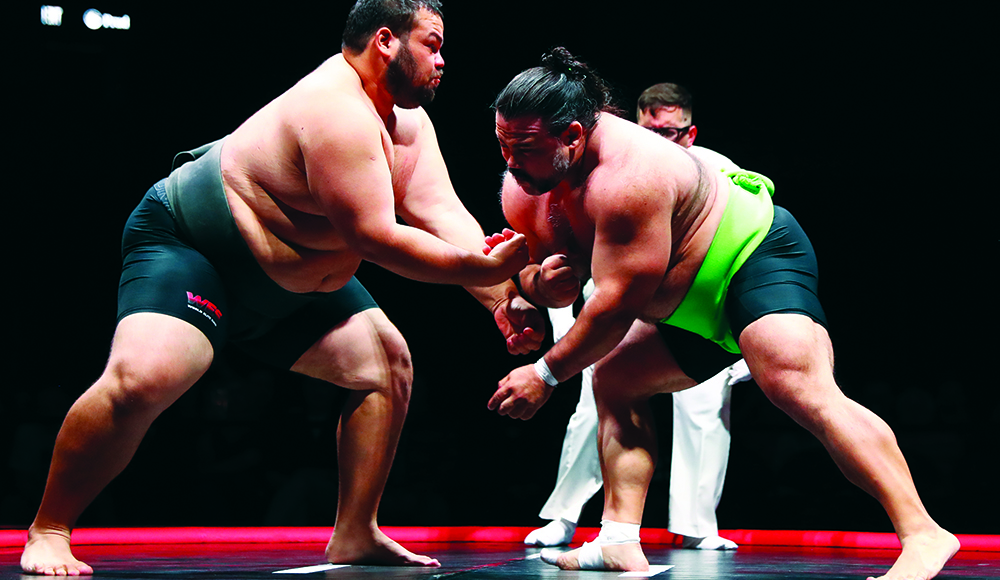
Te wo tsuite! (Get ready!) World Elite Sumo (WES) is coming to Santa Cruz’s Kaiser Permanente Arena. Twelve handpicked sumo warriors will introduce audiences to a slightly Westernized version of this ancient Japanese combat sport in a groundbreaking, single-elimination tournament on Saturday, Sept. 26.
Founded by Abdelrahman “Sandstorm” Shalan, an Egyptian sumo wrestler considered the first and only Japanese pro from Africa, and promoted by Mike Afromowitz, a native New Yorker with a long and colorful history in combat sports, WES is the only independent professional sumo wrestling league established outside of Japan in more than 800 years.
“Santa Cruz will only be our [league’s] fourth tournament ever,” says Shalan. “This is historic on a lot of levels. We believe it’s the beginning of something really big.”
Big is an understatement. These guys are massive.
Sitting in a coffee shop on Mission Street, the 6-foot-3-inch, 350-pound Shalan resembles a bull. The man known to Japanese sumo fans as Ōsunaarashi Kintarō, which means “great sandstorm,” radiates Egyptian charm and positive energy. In comparison, Afromowitz, a reserved and normal-sized human, looks tiny in his green tracksuit and sneakers.
“Do not underestimate him,” Shalan warns me with a laugh.
Among other ventures, Afromowitz co-founded Strikeforce, the legendary mixed martial arts (MMA) league acquired by Dana White’s UFC in 2011 (and absorbed into the UFC two years later). He’s also a trained Muay Thai fighter. He became interested in promoting sumo after seeing an early WES tournament in New Jersey.
“I was attracted to the sport’s athleticism and intensity,” he says. “But I also liked how family-friendly it was. Unlike MMA, this was something I could take my kids to watch.”
Ultimately, Afromowitz was sold on WES after he met Shalan, whom he describes as “a legitimate sumo legend.”
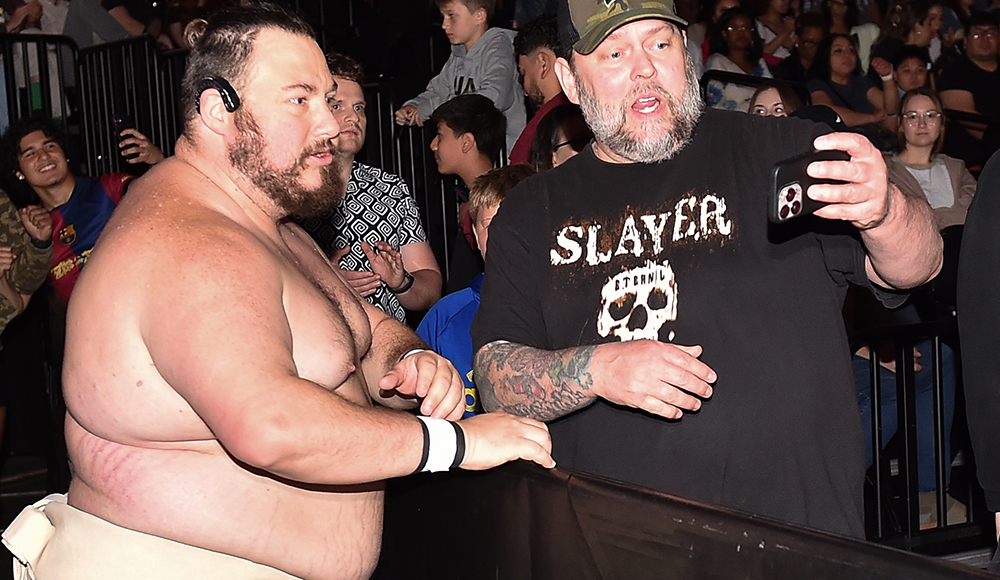
THE LEGEND OF SANDSTORM
Shalan grew up in Mansoura, a community outside of Cairo. He was recruited to sumo at 14 in 2007 while training as a bodybuilder, but was skeptical at first.
“I asked this sumo coach, ‘Why would I become a belly builder when I am training to be a bodybuilder?’” he says. “I thought I could already beat any of the wrestlers he was training. I was very arrogant.”
When a kid less than half his weight pushed the 14-year-old Shalan out of the sumo ring seven times using only one arm, he was chagrined and determined to master this new, foreign sport of strength and leverage.
After only a year of training, Shalan was invited to the sumo world championships and, over the next three years, proved himself to be dominant: In 2008, he won the silver and bronze medals in Estonia; in 2009, he won three gold medals in Bulgaria; and, in 2010, he won bronze in Poland.
By 2011, Shalan decided he was ready to go to Japan and apply to one of the 58 vaunted Japanese sumo stables. Each stable is allowed only one foreign-born sumo wrestler, which makes the odds of going pro long and the scrutiny intense.
“The Japanese couldn’t understand why someone from Africa who looked like me and spoke Arabic would want this. They asked me, ‘Why does a terrorist want to be a sumo wrestler?’” he laughs.
Shalan was eventually accepted by Ōtake stable, but in the beginning, he says, the experience was very hard. He had entered a very old, very alien, very strict culture.
Sumo occupies a special place at the core of Japanese identity. Historic records suggest it began as a Shinto ritual some 1,500 years ago. In the 8th century, the Japanese Imperial Court officially adopted sumo, establishing an annual wrestling festival. The first professional sumo groups, which appeared in the 1680s, eventually developed into the modern Japan Sumo Association (Nihon Sumō Kyōkai), which was founded in 1925.
Like many things Japanese, sumo is beautiful in its simplicity: two large opponents try to push each other out of the dohyō, or sumo ring, or force the other to touch the ground. Yet this basic description belies the speed, power, balance, strength and footwork required to make it to the sport’s highest levels—not to mention the sacrifice and dedication.
“As a new sumo, you live at the stadium and are expected to be a servant or slave to the pro wrestlers. I was up at 4 a.m. to clean restrooms and prep the training room. I had to serve them in every way you can imagine for one year and three months,” he says.
Of the 1,780 wrestlers in the Japan Sumo Association, only 80 are pros, according to Shalan. As a result, most wrestlers never rise above the role of servant. Despite these daunting odds, Shalan became a pro in 2012. He spent nine years rising through the Japan Sumo Association, reaching the first rank of maegashira.
This is no mean feat. Wrestlers at this rank are right on the edge of promotion to komusubi, the lowest san’yaku title rank. As a result, Shalan regularly faced the top wrestlers in the division. At one point in his career, he beat all three of the yokozuna, or grand champions, in a row.
By the time Shalan retired in 2018 with a record of 238-53, his legacy had been cemented. Not only was he the fastest-rising sumo wrestler in the association’s history, with numerous big wins under his belt, but he was a historic trailblazer who’d inspired countless young wrestlers all over Africa and the Middle East.
A SPIRIT OF INNOVATION
“After retiring, my goal was initially to establish an Arabic sumo association, but after living here in the USA for a few years, I polished the idea,” he says. “I decided I wanted to create a true pro sumo association outside of Japan—the first in 800 years.”
Shalan is not afraid to test boundaries, both cultural and technological. In April 2012, shortly after becoming a pro, he became the first wrestler in the Japan Sumo Association to maintain a Twitter account.
“After the association saw my account grow to 30,000 followers in a very short time, they opened their own,” he says. “Now it’s common practice.”
He’s brought this same spirit of innovation to WES, tweaking the ancient sumo formula to make it more familiar and friendly to non-Japanese audiences.
Instead of loincloths, WES sumo wrestlers wear shorts under their traditional mawashi, or sumo belts.
“We want to make sumo easier to watch. The loincloths made some people uncomfortable, especially back in Egypt,” he says. “This way, the focus remains on the action.”
Unlike the single-round format of traditional Japanese tournaments, WES events have best-of-three rounds.
“This allows the audience to build a relationship with the fighter. It’s not just one round and they’re gone. The wrestler can lose a match and come right back and redeem himself,” Shalan says. “It creates more drama.”
WES wrestlers can strike their opponents with an open-hand slap or elbow, but no punches are allowed.
“Everything else is traditional,” Shalan says.
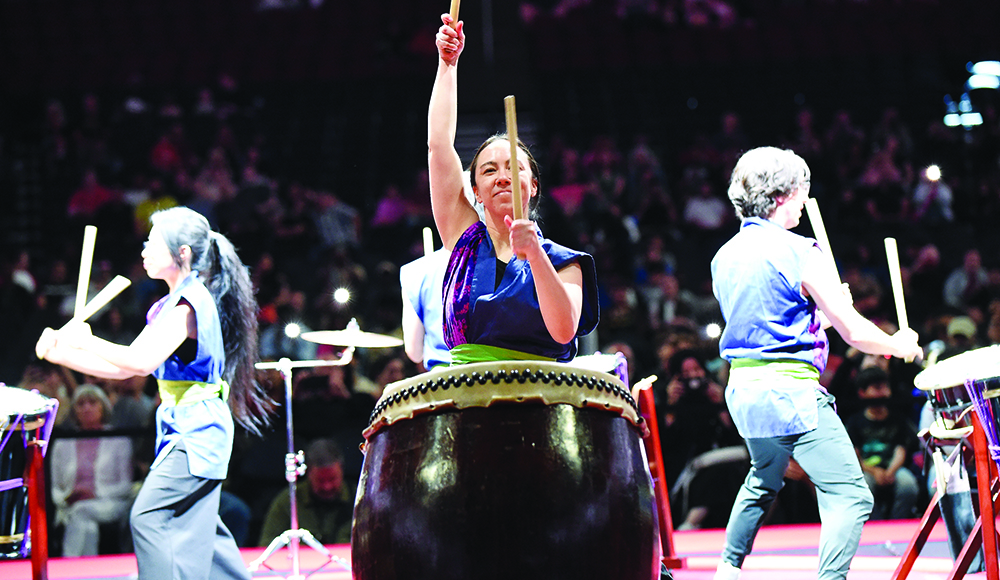
For their first slate of tournaments, WES has chosen venues in unique markets. The first three events were held in Jersey City, Orlando and Newark, New Jersey. Santa Cruz will be the first tournament to test the West Coast’s appetite for sumo. Afromowitz and Shalan are optimistic.
“I used to work in San Jose doing the Strikeforce fights, so I knew there was a familiarity with eastern traditions and an interest in combat sports around here. I started looking around for NBA G-League arenas, came across Santa Cruz, and reached out. They’ve been fantastic to work with.”
“Culturally, Santa Cruz has all the things we were looking for,” Shalan says. “People are different here. They’re free-spirited and think outside of the box. We think they’ll get it.”
Despite this long list of WES firsts, the most innovative thing about the Sept. 26 tournament may be its diverse field of competitors.
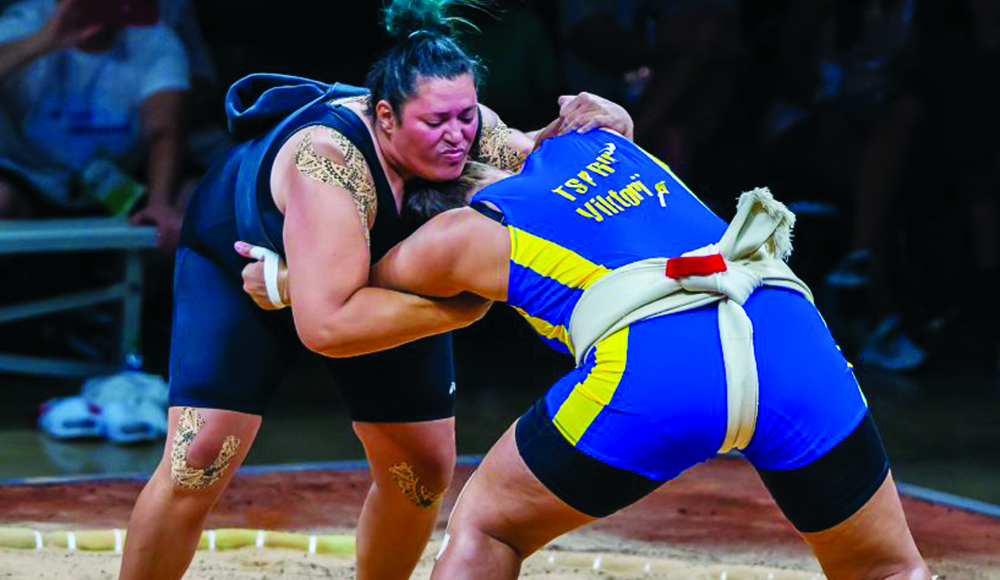
WOMEN SUMO WRESTLERS ADDED
World Elite Sumo announced Tuesday the addition of a four-woman professional tournament to its live event at Kaiser Permanente Arena in Santa Cruz on Sept. 26.
The women’s tournament, which will be produced in a round-robin format, will take place immediately before the championship stage of the already announced, one-night, 12-man, open-weight tournament that will headline the show.
Priced from $50, tickets for the World Elite Sumo event are on sale now at Ticketmaster.com.
Slated for action in the women’s field are Kellyann Ball, “Tanro” Perez, Yaleidy “Jolly” Toro Graniela and Haley Cartmill.
Ball is a 33-year-old resident of Chino, Calif., and a six-time medalist in the annual Sumo World Championships amateur event.
The 23-year-old Perez fights out of Dallas, Texas, and is a two-time bronze medalist in the Sumo World Championships.
Toro Graniela is a 42-year-old native of Whittier, Calif., residing in Mayaguez, Puerto Rico. She is a six-year veteran of amateur sumo competition and was the runner-up in the open-weight division at the 2024 SoCal Open amateur sumo tournament in San Diego.
Fighting out of Portland, Oregon, Cartmill is a 29-year-old Brazilian jiu-jitsu practitioner and was a second-place finisher in the super heavyweight division in this year’s annual Rain City Open sumo event in Seattle.
Each of the four women will compete against the other three female athletes once in a best-of-three matchup.
Based on the number of wins each secures, the top two athletes will advance to face each other in the championship stage of the round-robin tournament.
If any two of the women sumo wrestlers are tied in number of matches won, they will compete in a tiebreaker matchup, with the winner advancing to the championship stage of the tournament.
If there is a tie among three of the women prior to the championship stage, a three-way playoff will be utilized to determine the two finalists.
The previously announced athletes for the World Elite Sumo one-night, 12-man, open weight tournament are number one-ranked Power Slap super heavyweight star and former amateur sumo champion, Makini “Big Mak” Manu of Carson, Calif.; international sumo superstar, Abdelrahman “Sandstorm” Shalan of Egypt via Waldwick, N.J.; Gilberto De La Torre, the Los Angeles-based first Mexican professional sumo wrestler in history; professional wrestling star, Juicy Finau of Chino; three-time African national freestyle wrestling champion Ahmed Khalil of Egypt; Japanese powerhouse Hidenoumi “The Iron Wall” Takuya; six-hundred-pound American sumo Mathew Westwood; Polynesian American martial artist and pro wrestler, Josh “Siua” Tuitupou; former Japanese sumo champion Asahisho Kota; Brazilian sumo star “Rui Junior”; seasoned Russian technician Soslan “Big Bear” Gagloev; and American strongman athlete, Josh “The Ox” Ortiz.
For more information on World Elite Sumo, visit worldelitesumo.com.
LIKE A ROLL CALL AT THE UNITED NATIONS
It probably comes as no surprise to learn that the current undisputed champion of WES, and thus the favorite to win the Sept. 26 tournament in Santa Cruz, is Shalan. He brings years of elite sumo experience to the ring and is clearly still in fighting shape.
Yet it’s not going to be easy. Shalan will have to face an eclectic slate of competitors, ranging from former Japan Sumo Association pros to entertaining wildcards. The list of competitors reads like a roll call at the United Nations.
There’s Soslan “Big Bear” Gagloev, a Russian wrestler considered one of the most imposing international forces in the sport, and Rui Jr., an imposing Brazilian.
There’s Josh “The Ox” Ortiz, a shredded American bodybuilder, and Bakersfield’s Gilberto “El Coloso Aztec” De La Torre. There’s the elite Tongan pro wrestler Juicy Titan and two Japanese ringers—Kota “Asahisho” Matsushima and Iwasaki “Hidenoumi” Takuya.
There’s the monumental American Mathew Westwood, a 6-foot-6-inch legend who weighs in at (this is not a typo) 600 pounds, and world-class Egyptian wrestler Dabsha Elite at just 287 pounds.
“It’s a wild mix of talent,” says Afromowitz. “The field ranges from some of the most experienced sumo wrestlers in the world to more unconventional guys, but each of these athletes has proven that they belong in this ring.”
Yet the most colorful character in the Sept. 26 competitor field may be 400-pound “Power Slap” star, former NFL prospect and amateur sumo champion Makini “Big Mak” Manu.
BIG MAK IS ON THE MENU
Makini Manu’s circuitous journey to the professional sumo ring began in the rec leagues of Casa Grande, Arizona, and Carson, California. He didn’t even step onto a wrestling mat until his sophomore year at Carson High School, and it was not an auspicious beginning.
“I lost my first 60 matches. I didn’t actually win my first match until my junior year,” Manu says. “My dad asked, ‘Are you sure you want to wrestle?’ Then I grew seven inches my junior year, put on weight, and got strong.”
The growth spurt gave Big Mak a competitive edge and built confidence. He lost only four wrestling matches his junior year and started as a fullback and defensive tackle on the varsity football team, graduating in 2011.
When Manu returned from a Church of the Latter-day Saints mission in Detroit, he enrolled at Riverside City College and joined the football team. During the 2013 and 2014 seasons, he earned First Team Offense All-American honors, helping lead the team to a 20-4 record.
“I knew I had to go to other places to elevate my game, so I agreed to play for the University of Utah in 2015,” he says.
But when the team’s offensive scheme changed during spring training, severely affecting his playing time, Manu pivoted from football to rugby. He transferred to Utah Valley University, where he led the rugby team to the 2015 Division I-AA National Championship and earned All-American honors. From Utah Valley, he was signed to the Utah Warriors, a Major League Rugby team, but the experience was short-lived.
“I couldn’t afford to do it,” he says. “It was the inaugural season, and they only paid $100 a game.”
Manu was willing to try anything. He bounced around various professional football leagues, including the Indoor Football League, the XFL and the NFL, and trained to be a professional WWE wrestler with Solofa “Rikishi” Fatu Jr. When his weight started to push 400 pounds, a friend suggested sumo.
“I had tattoos and I was already 26, so Japan wasn’t really an option at that time, but I started winning a lot of sumo matches here in the U.S.,” he says. “I was pretty good right out of the gate.”
In 2021, he placed second in the open-weight division of the U.S. Sumo Open and went undefeated at the North American Sumo Championships. He then placed second at both the 2022 U.S. Sumo Open and the 2023 U.S. Sumo National Championships.
It was an excellent start. Yet, like professional rugby, sumo just didn’t pay enough to support his growing family, so he started coaching high school volleyball with his wife. Then, in 2023, a video popped up on Instagram that stopped Manu in his tracks.
“There was this huge guy slapping another guy in the face,” he says.
Big Mak had stumbled upon the super-heavyweight division of Power Slap, a new, absurdly brutal combat sport. The rules are simple. A “striker” delivers a single, open-hand slap to the face of a “defender,” who must remain utterly stationary and defenseless.
“I signed up and the very next day they called me and asked me to be on season two of the Power Slap reality show,” he says.
The producers of the show loved Manu because he outperformed expectations and immediately became a fan favorite.
“I was the shortest fighter and I had zero experience. I later learned they’d hired me to be the guy who lost, but those guys had no idea what’s in my head. I’m crazy,” he laughs. “I’m Samoan and Māori, so I do a haka (an ancestral Māori dance) before every fight. I can go from zero to 100 instantly.”
Of course, Manu will admit that the first time he lined up across from a Power Slap opponent, he was scared.
“I hit him with everything I had and he didn’t go down,” he says. “I remember thinking, ‘Oh man, I really hope I don’t wake up looking at the lights from the floor,’ but it didn’t hurt at all. I’d gotten hit harder in football.”
Manu went on a Power Slap tear, defeating his first five opponents before losing his first title bout by split decision on April 17 to Dayne “Da Hawaiian Hitman” Viernes.
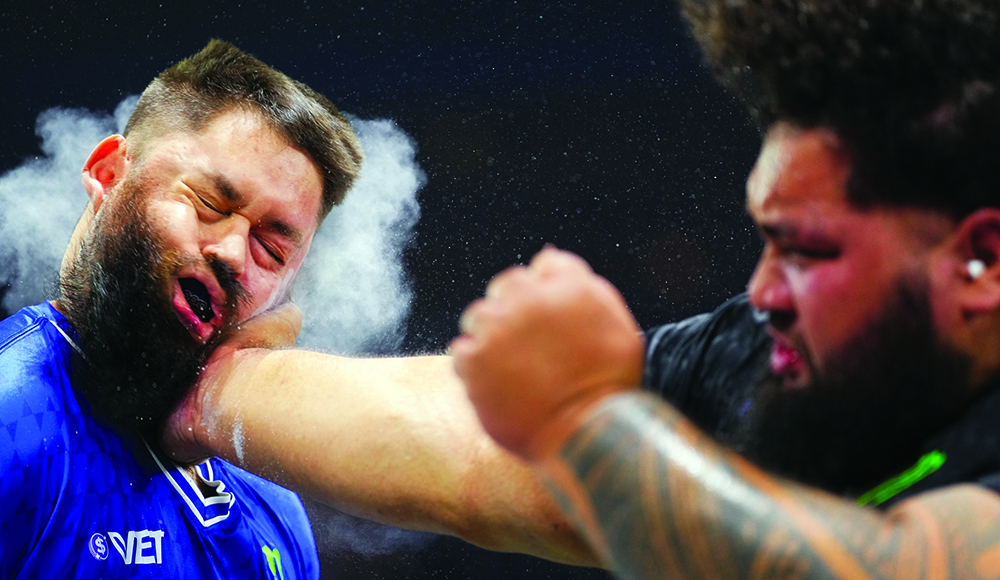
poised to dominate the ring in Santa Cruz on Sept. 26 PHOTO: World Elite Sumo
While waiting for his chance at a second Power Slap title fight, Manu worked construction in Santa Cruz this summer with his dad.
“I was actually building low-income homes right around the corner from the Kaiser Permanente Arena when I saw an ad for World Elite Sumo on my Instagram,” Manu says.
He reached out to Afromowitz, who invited him to compete in the Sept. 26 tournament. While Manu’s last sumo competition was in January 2023, the 32-year-old isn’t worried about being prepared.
“As soon as they asked me to compete in mid-August, I put on my mawashi (sumo belt) and started training in the horseshoe pit of a local park,” he says. “I have cousins who live with me that are bigger than some of the guys I’m competing against, so I train with them.”
Shalan expects big things from Big Mak.
“Makini Manu has made an impact in competitive sports, including amateur sumo wrestling throughout his life and, with his size and athletic ability, we expect him to have a great career as a professional in WES,” he says.
One thing’s for sure. The man can take an open-handed slap.
The World Elite Sumo tournament is at 7 p.m. Sept. 26 at Kaiser Permanente Arena. Doors open at 6 p.m. Tickets start at $50 and are on sale now at Ticketmaster.com. For more information, visit worldelitesumo.com.