

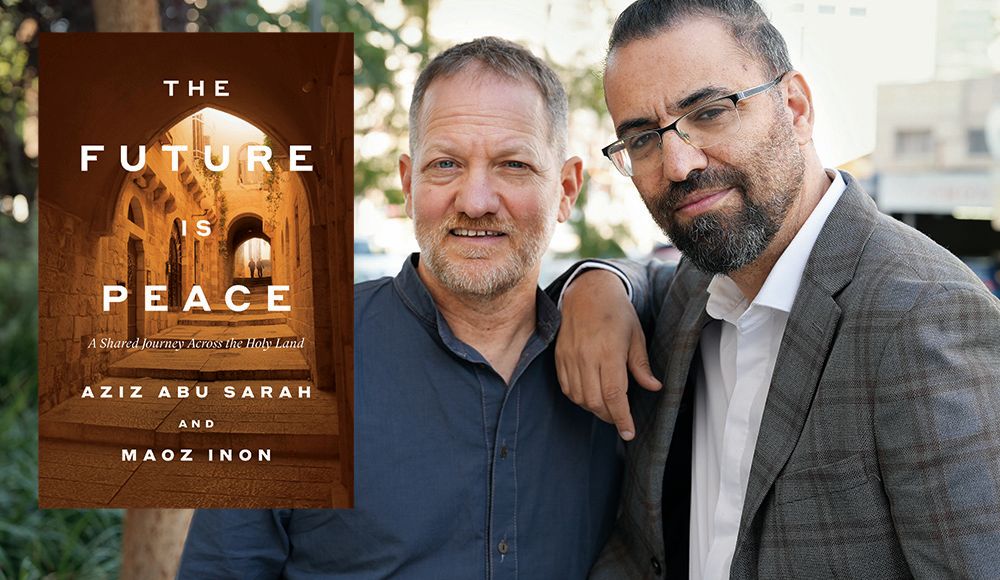
The path to peace in the Middle East is being deepened by two courageous peace activists: Palestinian Aziz Abu Sarah and Maoz Inon from Israel. The two will present their new book – The Future is Peace – at Temple Beth El in Aptos on Monday, April 20, 7pm.
Aziz’s older brother, Tayseer, died in 1990 at 19 after sustaining internal injuries due to torture in an Israeli prison, where he was held on suspicion of throwing rocks. Maoz’s parents were killed by Hamas militants on October 7, 2023.
Aziz and Maoz are co-CEO’s of InterAct International, a nonprofit dedicated to Middle East peace. The book event is co-sponsored by Bookshop Santa Cruz and the Humanities Institute at UC Santa Cruz and will feature a Q&A moderated by Douglas Abrams.
EMPATHY IS ENDLESS
Good Times: Presently, violence in the Middle East has expanded. Maoz, you’re now in Israel. Tell me how you continue to cultivate radical optimism in the midst of the conflicts?
Maoz: I will answer with our book; it’s a shared journey that Aziz and I are inviting the reader to join us on. It’s an eight-day journey across the Holy Land, starting from the kibbutz I was born and where we put the remains of my parents in the ground, only a mile from Gaza. And we travel to Jaffa, Tel Aviv, Nazareth, the West Bank and East Jerusalem, which is Aziz’s childhood hometown. We’re sharing stories from the land and painful stories of one hundred years of conflict. We share our own personal stories; Aziz lost his brother (1990) and I lost my parents (Oct. 7, 2023).
We also share the story of the future. The story of the future is peace and we manifest it within the book. I share the story of my father, a farmer in the Negev desert. For him, it didn’t matter how devastating the season was due to drought, floods, insects, wildfire. Every evening around the dinner table, he shared with us–his five children–that next year he will sow wheat again, because he has agency to make the future better. He will learn from his mistakes, consult with others and get the most fertile seeds. And then he will sow – not with belief or faith – but knowing that next year will be better. This is exactly what Aziz and I are doing now. It doesn’t matter how devastating the current reality is. And it is. But Aziz and I believe that each one of us, and each one of our readers, has the agency to change the future.
Tell me about travel as a form of nonviolent peacebuilding.
Aziz: Both of us have come to this work because of travel. Maoz was traveling around the world and realized, when he was thirty years old, that he knows more indigenous people in Latin America than he knows any of his Palestinian neighbors. That’s what got him to start the Biet Fauzi Azar Inn in Nazareth and connect to the Palestinian community there. For me, it was traveling from East Jerusalem to West Jerusalem, which is a very short trip, and realizing how divided we are as people. I met for the first time Israelis who are not soldiers or settlers. This is why the two of us went into travel, where Maoz started guest houses and I started MEJDI Tours. Travel has been so important!
In The Future is Peace you write, “Many Palestinians fear that acknowledging the horror of the Holocaust is tantamount to excusing the Nakba and the occupation of our land. They have a fear of acknowledging any Jewish pain at all, regardless of whether it was caused by Nazis or by Palestinians. It’s the same for Jewish Israelis who don’t know the history of the Nakba. They fear that if they acknowledge Palestinian suffering, it will absolve Hamas of its horrific deeds.” We have this idea that if we listen empathetically to someone we must end up agreeing with them. Tell me about the power of empathy.
Maoz: Empathy is endless. You never run out of empathy. I believe that when you don’t express empathy towards the other – not in the long run, but in the in the near future – you lose empathy towards yourself. Only a few days after losing my parents on October 7, as well as many of my childhood friends, I gave my first international interview after the Shiva, the seven days of mourning for my parents. I was crying to Helena Humphrey of the BBC. Everyone at the BBC was offering their condolences and I told her, “Helena, I’m not crying for my parents. I’m crying for the children in Gaza that are going to lose their lives now. I’m crying for all the human beings in the region that will lose their life in the world that is about to come.”
By speaking my broken heart publicly, I received so much love and support from Palestinians in Gaza and the West Bank and from citizens of Israel, people all over the world. I was surrounded with support only because I expressed my basic empathy towards the children in Gaza. For me, that was so natural; I didn’t need to practice it as a strategy. Only when we are willing to give our empathy to each creature, each human being, each child – no matter their ethnicity – then we are creating an environment that we want to live within. Empathy is a very powerful tool.
Aziz: The more empathetic you are, the more at peace you are with yourself. You cannot be empathetic to expect a reward. As Maoz said, “It’s not a strategy.” It’s something that has to come from your heart.
The Future is Peace has deep connections to Santa Cruz. Rabbi Paula Marcus traveled with you and local book agent Doug Abrams played a big role in putting the book together.
Maoz: I’ve known Paula for many years. She traveled with my travel company – MEJDI Tours – with her congregation. After October 7 (2023) she wanted to come back, but a lot of the trips going to Israel and Palestine were disaster tourism and would show you how terrible things are and let you go. Paula wanted to come on a trip to connect with the people, both Israelis and Palestinians. And then leave with some hope of what we can do. She came on that trip and we told her that a month later Aziz and I would speak at TED and she said, “My friend Doug is going to be there.” She sent a message to Doug and he saw our TED talk and said, “Do you want to write a book?” Within two months we had a book deal! Since then, Santa Cruz has been our home on the West Coast.
Aziz: If enough of us use our connections to connect with peacemakers, where we are today would be very different. This is the importance of coalitions and why we work with Combatants for Peace and Parents Circle-Families Forum. When you amplify one of us, you amplify all of us.
You remind us that on May 15, 1948, the Palestinian Nakba, more than 780,000 Palestinians were forced out of their homes and over 500 villages were destroyed. Maoz writes, “Palestinians see Zionism as a destructive force… But for many Jews, including my grandparents, Zionism was originally about saving lives.” You point out that after the Holocaust many Jews wanted a safe place to live but that many, including Albert Einstein, did not support a Jewish State. Einstein said in 1946; “The state idea is not according to my heart. I cannot understand why it is needed. I believe it is bad.” Tell me about the different ways that Zionism is understood by Palestinians and Jewish Israelis.
Aziz: The problem with some terminologies is that depending on who says it, it has a different meaning. Also it depends on how it’s manifesting itself. I can tell you from a Palestinian perspective the reason Zionism has such a strong reaction is the way it’s manifesting itself now, and in 1948. The most important thing is that you shouldn’t be talking, or not talking, to somebody because of those labels. If somebody says, “I’m a Zionist,” it doesn’t mean I’m not going to talk to them. And if somebody says, “I’m anti-Zionist,” it doesn’t mean Maoz isn’t going to talk to them.
Maoz: This is exactly how we co-authored the book. Aziz is sharing his own narrative of the Palestinian National Movement and why his family decided to immigrate from Hebron to Jerusalem to make sure the Zionists are not taking over the holy city of Jerusalem. And how my parents, as member of the Zionist movement, immigrated to Palestine under the British Mandate in the late 1930’s, feeling the earth shaking beneath them in Eastern Europe, feeling something horrible is going to happen. They established on my mother’s side, one kibbutz in the Negev, and on my father’s side another kibbutz in the Negev. Being raised in the Zionist educational system, we heard; “People with no land, came to a land with no people.” This was the slogan of my childhood. But we show in the book the maps before 1948, what we used to call Palestine. In 1948 there were 1.4 million Palestinians and 600,000 Jewish people in the land. Before the beginning of the Zionist movement and the Palestinian National movement, Jews and Arabs were living among each other in peace throughout North Africa, the Middle East and Asia. And this is exactly how we’re going to live together in the future.
The book event is co-sponsored by Bookshop Santa Cruz and the Humanities Institute at UC Santa Cruz and will feature a Q&A moderated by Douglas Abrams. Tickets: bookshopsantacruz.com/future-is-peace
Listen to this full interview with Aziz Abu Sarah and Maoz Inon on Transformation Highway with John Malkin on Thursday at noon on KZSC 88.1 FM / kzsc.org.








In case you wondered, this book promo is not free — the price of admission is $38.
Unlike any book promo I’ve been to, at Temple Beth El you can’t attend this book promo unless you buy the book first.