

On Monday, April 13th, in the basement of the County Building in Downtown Santa Cruz, the Santa Cruz County Animal Services Joint Powers Authority Board met to discuss the upcoming fiscal year. It came at a time when questions of mismanagement and underfunding surrounded the shelter.
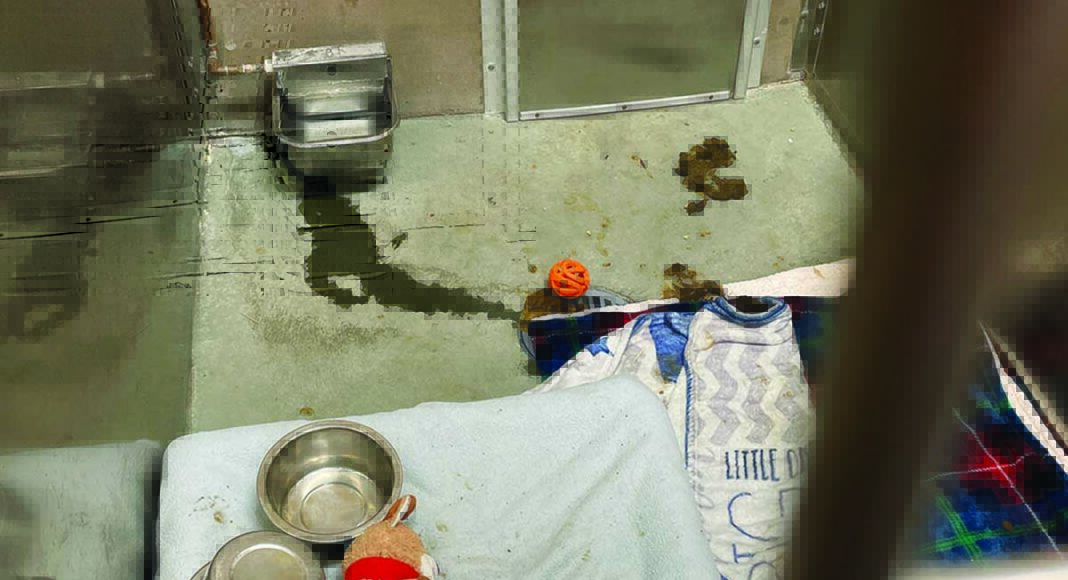
“It wears on staff when we have six puppies in a kennel and a volunteer comes to us crying because there is poopy water all over the floor,” said Jesse Williams during a public comment period. Williams was a volunteer at the animal shelter from 2013 until 2022 when he became a full-time staff member. From 2020 to 2022 he also served as site supervisor for isolation, quarantine shelters for houseless individuals, families and people with disabilities during the COVID pandemic.
“Due to issues that staff are aware are continuous and ‘repaired’ over and over again,” he continued, “Repeating the same things while expecting different results is the definition of insanity, and it already feels crazy at the shelter.”
He also described loose wires on cages sharp enough to cut the animals and staff. When brought to the authority’s attention, the problem was fixed with duct tape.
“Then we show up to dogs throwing up duct tape because they were chewing on the ‘fixed’ solution,” Williams concluded.
A temporary employee, Jennifer Juniper, agreed with Williams. She told the Board about an incident two weeks prior when a volunteer of 15 years came to her in the morning, crying.
“She said she didn’t get any sleep because she was worried about an 8-week-old puppy who was living in a soggy condition because of leaky water dishes,” described Juniper. She said it was a known issue for three months but when the volunteer started asking which authority figures to bring it to, it was fixed within 48 hours.
Maintenance Gaps and Temporary Fixes
Juniper told the Board that the shelter has no dedicated maintenance worker, a position which is also currently unfunded, yet is desperately needed.
“I am in no way, shape or form qualified to do maintenance repairs,” Juniper said. “What that does is take my time and energy away from the animals.”
Because there is no funding for a maintenance manager, many of the “fixes” are often temporary.
According to one shelter staff member who wished to remain anonymous, “it gives the impression of actions being taken when the bare minimum was done just like everything else around here.”
The staff member told GT that once again, water dishes are leaking at the time of this writing and sent a photo to our reporter.
“These are continual problems and it isn’t going away,” they say, adding during their employment there’s never been a time staff considered the shelter “well managed or well maintained.”
This comes three years after Santa Cruz County Animal Shelter employees led a walk out demanding change to an environment in which they argued they were overworked and underpaid.
A 2020 study by the National Library of Medicine reported animal rescue workers have one of the highest workplace suicide rates of 5.3 to 1 million people, comparable to first responders. This is often due to compassion fatigue, burnout and high levels of post-traumatic stress disorder.
Budget Pressures and Funding Challenges
At the meeting, the Proposed Budget for the Fiscal Year 2026-2027 recommended a 7% increase from the contributing members of the various cities within the County, along with the County itself. According to the proposal, contributing members have averaged an increase of 6.7% over the last 10 years, accounting for a 10% cut in 2020 due to the COVID pandemic.
“So we’ve been trying to catch up, and thankfully our member organizations have been good about providing us increases up until this year,” Santa Cruz County Animal Services Authority General Manager Amber Rowland told GT.
The proposal also included what could be done with increases of 3% and 5% if the 7% cannot be achieved.
“It’s probably not likely with this year’s budget situation,” said Rowland of the 7% proposed increase.
During Monday’s meeting, both Vice Chair Elissa Benson of the County of Santa Cruz and City of Scotts Valley Police Captain Jayson Rutherford suggested the next budget proposal on June 8th explore what a 0% increase would look like.
Rowland told GT that just like local residents, the County and various cities are all feeling the financial crunch caused by inflation, import tariffs and now rising fuel prices. Another problem facing the county is major financial cuts from the federal government due to Trump’s One Big Beautiful Bill Act (OBBBA), signed into law on July 4th of last year.
Santa Cruz County is already facing a projected $23.2 million deficit for the 2026-2027 Fiscal Year, which could potentially grow to $67.5 million in 2028-2029. When the federal government cuts spending to the counties for medical and social services, the counties need to redistribute those funds from other areas, such as animal care.
“The federal changes have really hit hard and it most heavily impacts the county,” she admitted. “Because they receive a lot of federal pass-through and state pass-through dollars for programs and operations, and a lot of that has gone away.”
This means that while the shelter is lacking two to three employees compared to other shelters of its size, those roles will remain unfilled. It also means the full-time maintenance manager position will remain vacant for the foreseeable future.
As for the leaky water dishes, Rowland says that part of the problem is due to frequent usage and built-in obsolescence. Because of the budget, the shelter has to purchase the most efficient and cost effective equipment. However, this means parts often break.
“It’s an ongoing issue,” she admits adding dogs also often break the automatic water dishes. She says the shelter is looking into alternative methods of dealing with the problem so dogs won’t go all night with soaked bedding.
“We just had a professional plumber come in and they are preparing an estimate for us to determine how expensive it would be to install shut off valves for every single kennel,” she says. “That way if one is leaking we can just turn it off at that source.”
Efforts, Improvements and Community Support
The shelter has also made some major strides in other ways.
During February and March, the shelter took in 626 non-wild animals, which was a decrease of the last period and from the same time last year. Rowland says this can be attributed to several factors, including the shelter’s spay and neuter program, as well as owners chipping their animals and making sure they are up-to-date with the appropriate licenses. Speaking of pets being spayed and neutered, 187 owned cats and dogs benefited from the Animal Balance affordable clinic February 20–22.
“One of the most effective things we can do to reduce the number of animals we need to care for is to do preventative services,” Rowland says. “But those are also some of the most resource-intensive services. So providing low-cost, accessible, spay and neuter services for community animals is a super great way to reduce the number of animals we have to take in, care for and make decisions about. However, that’s also a fairly expensive undertaking and takes a lot of staff time.”
The shelter was also able to raise additional funds through various benefits, such as the Santa Cruz County Animal Shelter Foundation’s Awkward Pet Portraits, which raised $7,600, where owners pay local artists to create quirky portraits of their favorite furry friends. St. Pittie’s Week, when the shelter sells green merchandise in conjunction with Santa Cruz Cidery, raised $15,000 and the Capitola Classic Skateboarding competition at the Capitola Mall raised an additional $8,000. Local artists Rosebud Wild and Schwa Smith also created original merch for the Classic with a cartoon cat doing a kick-flip on a skateboard appropriately named “Kick-Flip Kitty.”
“Thankfully, we get incredibly generous public support and we’ve received some trusts over the years,” says Rowland.
However, often those trusts are only available for certain services as specified by the benefactors’ wills. The shelter currently needs to replace four vehicles with cages used by animal control officers for off-site duties such as pick-ups of wild or loose animals. When Rowland was hired in 2023, there was no plan to replace any of the vehicles in the shelter’s fleet. This is compounded by the California Air Resources Board’s Advanced Clean Fleets regulation passed in January 2024 which mandates 50% of state municipalities vehicle purchases must meet zero emission standards by 2024, and 100% of the purchases by 2027.
Rowland says this makes the purchases “super cost-prohibitive” when considering the shelter needs vehicles with heavy, air-conditioned cages attached that can also handle off-road terrain or anywhere else animal control officers may need to go. She says the county does have two new vehicles on order that are being fitted with cages. However, the process has been delayed with no expected date on the horizon.
“We had to have the caging installed in Illinois,” she says. “Because there are no local cage fabricators for vans, which we had ordered.”
Of course, all this adds up and eats away at a budget that is leaving staff frustrated and overwhelmed and animals who aren’t neglected but deserve better.
As Williams concluded in his public comment to the Board, “I’m asking you to support our management so our management can support our supervisors, our supervisors can support our staff, and our staff can team up with volunteers to take care of these animals.”









How about having a day or 2/year for the public to donate time to repair/clean/etc like there is for some parks. Do any of the local colleges have vet programs where students could get credits for helping? Can Humane Society Silicon Valley help or at least provide some ideas? Is there a website for adoptions/fostering/donations?
It would help to have some of the rules around adoption revised, or done on a case by case situation! I lost my dog at 20 years old, went to adopt and was turned down! I loved my little guy, he even had laundry! But I wasn’t suitable? Never did figure it out! I have a cat now! He’s 7 years old! Not one health problem.