

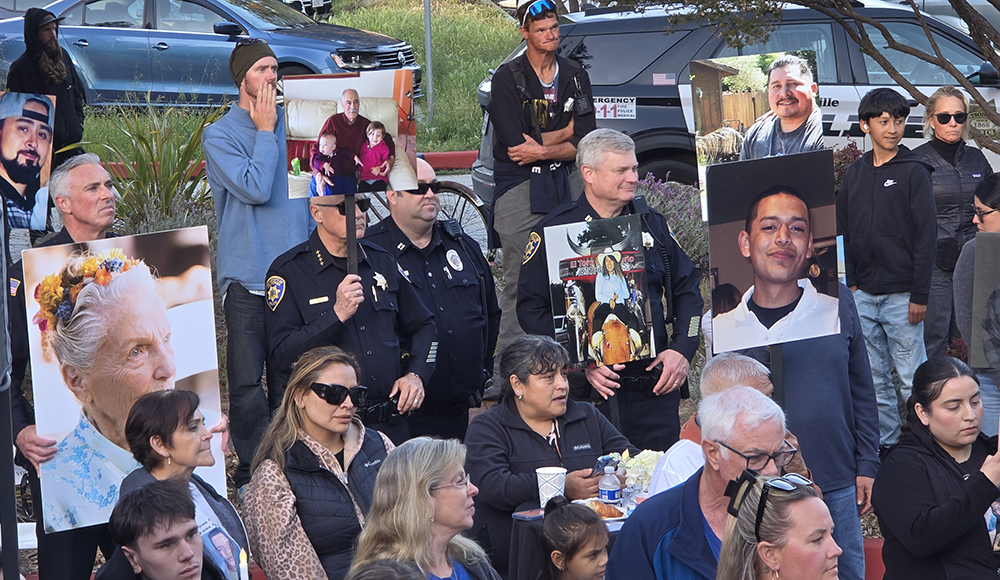
About 100 people gathered around the Santa Cruz County Courthouse on the evening of Wednesday, April 22 for the 15th annual Victims Solidarity candlelight vigil in honor of National Crime Victims’ Rights Week. The somber gathering paid tribute to Crime Victims of Santa Cruz County. It comes a week after the California Assembly Public Safety Committee voted unanimously on Assembly Bill 1902 authored by Assemblywoman Gail Pellerin and inspired by the 2015 murder of Madyson Middleton, 8, a case that sent shockwaves through the Santa Cruz community.
“Your presence reflects a shared commitment to this community to victims and survivors,” District Attorney Jeff Rosell said. “We’re here to honor victims of crime, including those who are no longer with us. We are here to make sure their voices are heard and that they are not forgotten.”
Victims include Christopher Carr, who was stabbed to death at a house party in 2001. His sister, Reba Thomas–a 49ers cheerleader and dance graduate from UC Los Angeles–showed a video of her college senior capstone project in which she choreographed a dance dedicated to her brother.
“In many ways I have grown up alongside this community,” said Thomas, 24, who was four years old at the time of her brother’s murder and started attending the Victims Solidarity gatherings at 6 years old.
“This community has shown me love and comfort in the moments when the rest of the world felt extremely scary and unfair,” she continued.
Following Thomas’ speech, 136 names of victims of violent crimes were read, and placards with their photos were handed to loved ones. If nobody was present to receive one, someone from the crowd would do the honor.
Names like Madyson Middleton, who was brutally raped and murdered in 2015 by convicted killer Adrian Jerry “A.J.” Gonzalez, who was 15 at the time.
Middleton’s mother, Laura Jordan, who was present at the vigil with two close friends, is currently campaigning for the California State Senate to pass AB 1902, which would change several key loopholes and gaps in the current law when it comes to juvenile offenders.
The bill is sponsored by Rosell and backed by multiple Santa Cruz County and City authorities, such as Supervisor Kim De Serpa, Santa Cruz Police Chief Bernie Escalante and Watsonville Mayor Kristal Salcido, along with organizations such as the Walnut Avenue Family & Women’s Center, the Chief Probation Officers of California and the California District Attorneys Association,
When Gonzalez was arrested, he was on a path to be tried in court as an adult due to the heinous nature of the crime. However, in 2018, Senate Bill 1391 was signed into law by then-Governor Jerry Brown. The Bill required that anyone under the age of 16 at the time of the crime should be tried as a juvenile.
Under the law, anyone in the juvenile system is aged out at 25, allowing them to possibly be released. Before his 25th birthday in 2014, the Santa Cruz District Attorney’s Office challenged Gonzalez’s release, leading to a lengthy trial through the early part of 2025, when a jury ruled he was still a threat to the general public and should remain in custody.
Gonzalez is being held in a secure youth treatment facility in Sonoma County Juvenile Hall with other offenders ages 14-24, despite being 26 years old and the nature of his crime against a minor.
Currently, state law holds that in cases like Gonzalez, extension hearings are to be held every two years. This means Gonzalez might be back in court for another possible release next year.
“Each time it’s brought up and I have to go [to court] it’s retraumatizing for my family, my friends and my community,” Jordan told GT at the vigil. “It also traumatized the jury, and I feel for them because I’ve been living with this for 11 years and knew the horrible details, but they did not.”
If signed into law, AB 1902 would change the extension period from two to four years and would clarify custodial jurisdictions. It would also allow hearsay to be admissible at probable cause hearings. The bill also aims to expand rehabilitation centers for incarcerated individuals to state hospitals. Jordan also noted a longer extension period would also mean more time for rehabilitation.
“Jurors came to us and the victim’s relatives came to us to express the horror of having to repeat this process every two years,” Rosell told the Victims Solidarity crowd of AB 1902. “This Assembly Bill is designed to put victims forward to help them so they don’t have to go through the same trauma every two years.”
Shawna Spaulding, who attended Gonzalez’s 2024-2025 trial in support of Jordan, was also at the Victims’ Solidarity vigil. She was holding a sign with a QR Code–along with web addresses JusticeForMaddy.com and SupportAB1902.com– that would take people immediately to an online letter signing campaign so constituents could let their representatives know they support the bill.
Last week Jordan and Spaulding joined Rosell and Pellerin at the state Capitol in Sacramento for the first round of hearings on AB 1902. It was passed unanimously by the committee with one absentee vote.
“[Jordan’s] life was upended, especially in the first five years with setback after setback with 1391,” Spaulding told GT.
“It was the first time in 11 years that I felt my pain and suffering surrounding the legal process–and lack of justice that has happened in this case–was acknowledged of what I’ve been through,” Jordan agreed. “It’s been like a rollercoaster. Every time we move one step forward, we get pulled back, and every change in the law has benefited the defendant, making justice one step further away from us.”
AB 1902 still has five more steps to go before it can reach Governor Newsom. Pending any setbacks, Newsom would have until September 30 to sign it into law.
“The more letter writers the better,” said Spaulding. “Because we need pressure from throughout the whole state.”
Those backing the bill hope it will be one more step in protecting the family and friends of victims like those gathered at the candlelight vigil.
As Rosell told the composed crowd outside the courthouse, “It is an example of victims getting better access to a legal system that, for far too long, they have not been heavily represented in.”