
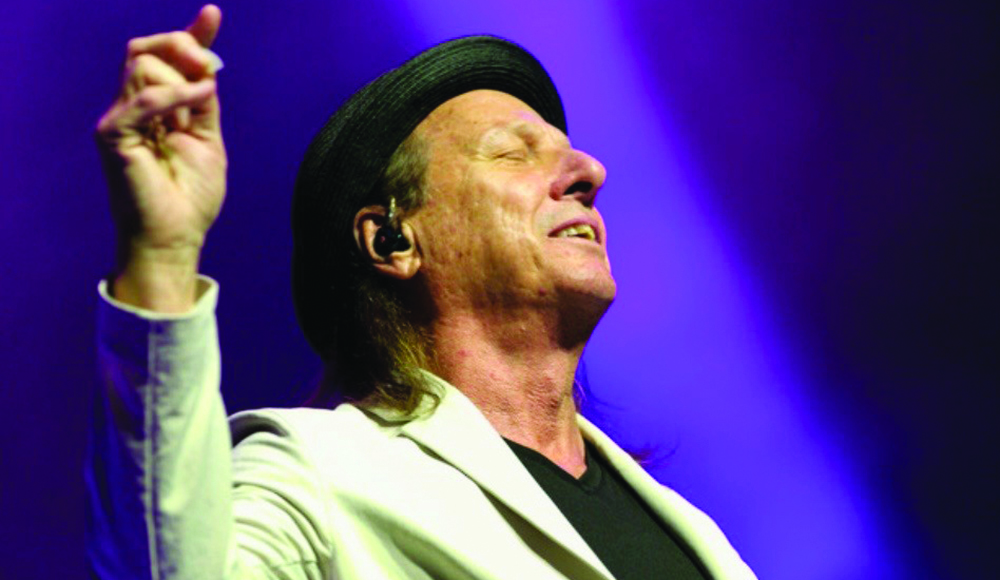
King Crimson has forever been a band of musical alchemy and rebirth — reincarnating, returning in new forms, but always with a recognizable DNA, influencing new styles of music and inspiring new generations of musicians.
Some, once fans, come forward to wear the king’s mantle.
Crimson’s changes always paired the Django-inspired guitar of band co-founder Robert Fripp with contrasting sounds — lilting flute and aggressive saxophone in the Mellotron-lush early years; violin when Crimson was the pioneer of progressive metal; and finally the interweaving twin guitars of the Discipline era, with sound explorer Adrian Belew.
The newest collective of brilliant musicians to manifest the music of King Crimson is BEAT, with Belew returning, performing songs from the 1980s and 1990s. When BEAT rocks the Quarry at UCSC with polyrhythms and power chords, Belew will be joined by his Crimson bandmate Tony Levin, guitar legend Steve Vai playing the impossible riffs devised by Robert Fripp, and for the very first time, Terry Bozzio, bringing the unique fury of his drums and percussion to the beat originally crafted by Bill Bruford, the rock icon who famously left Yes to enter the Crimson mythology.
The October 9 show opens what BEAT has announced as its last North American tour performing King Crimson’s music. There is another turn in the circle: Bozzio takes over from Tool’s Danny Carey, whose commitments with that band keep him away this fall, and songs from 1995’s THRAK join the 1980s repertoire.
This is music whose descendants include Rush, Primus, Genesis and Tool, all of whom have acknowledged Crimson’s influence. Its players have their own places in the pantheon: Rolling Stone included Belew and Vai among its 250 greatest guitarists, Levin among its 50 greatest bassists and Bozzio among its 100 greatest drummers.
Inside Crimson’s elaborate musical structures, windborne melodies and pulsing tension share the same world. Beauty can give way to anxiety; a passage that holds you suspended can turn and bare its teeth. The “Epitaph” lyric “with nightmares and with dreams” reaches across that spectrum, through tenderness, dread and exhilaration. Belew knew that pull before he ever stood beside Fripp.
In our September 16 conversation, Belew talked about becoming part of that music and finding fresh life inside it. The exchanges below have been condensed, rearranged and lightly edited for clarity.
ON ANOTHER LEVEL
Adrian Belew: I was a fan of King Crimson long before I joined the band. When I was a poor, starving musician, I couldn’t wait for their new records to come out. It always seemed like these guys are on another level. I never even tried to work out any of those songs. I wasn’t at that point in my life, but I could tell the intensity and how great they were.
And you became a part of that world. What was it like?
It’s not an easy process to write Crimson-like material. It used to take me and Robert Fripp about two years to feel good about the material and record the record. I guess it’s why a band like Tool takes a long time to make a record. You don’t want to make a record that sounds like you didn’t put 1,000% into it.
When I asked Robert what emotions he felt when performing Crimson’s music, he said simply, “I’m not allowed to get excited.”
I have seen Robert very excited. He almost jumps off his stool and his leg starts twitching,
and he’s playing a solo and he’s really going for it. At that moment you’re seeing the emotional Robert Fripp show up. So it’s not entirely true, but he does mostly keep himself very demure.
Does Crimson’s music affect you differently from the other music you make?
Yes. It’s a special thing when I lock into it and it’s time to either perform it or write some of it. I cannot use the same crayons that I use to color with, on anything else I do, because it’s an intense kind of experience. When you’re writing with King Crimson, you’re going to be intense because you’re really on the burner there. I think that music has always been that way.
A BAND OF THEIR OWN
BEAT is such an unassuming name for this band. Who chose it?
That was Robert. I called him and said, “I’ve put together this band, and here’s the people in it.” I think it really surprised him. He was probably thinking I’d put together some of my buddies, after five years of waiting for me to have that happen. These are my buddies, but they just happen to be the best musicians I could possibly find.
Your Crimson was half Brit and half American. Does BEAT being all-American change the temperament?
I think it is very different. I think we swing in a different way than any other King Crimson has. There’s something different about Americans, how they approach music. I gave the band instructions: Play certain things as they were, and other things, play as you would. For about the first six shows of the first American tour, we were all feeling our way around the music. Then we suddenly locked in. We sounded like our own band. We just got better and never looked back.
We certainly never want to sound like a tribute band or a cover band—you can’t have Steve Vai in a cover band. Couldn’t afford him.
NEW BEAT, NEW CRIMSON
For this North American tour of BEAT, what changes?
Terry is going to add his own thing to what we’re doing and take it in a new direction, whether we want to or not. I’m just kidding. It will be great because of that. It will be fresh again because we’re going to add in a few new wrinkles from some of the songs from THRAK. I think the chemistry between us is going to be amazing.
Have you talked about the drum kit he’ll bring?
We had a three-way call, Steve Vai, Terry Bozzio and me. Steve said, “I think you should play the biggest kit you can.” And I thought, okay, I’m good with that. Terry said, “I do have something smaller that I call the sick jazz kit—it only has three bass drums.” So I thought, I’ve never seen a jazz drum kit with three bass drums. That’s going to be something.
I won’t hold anybody back from whatever they need to do what they do, be that drums or electronic pads or 16 amplifiers and a synthesizer. That’s true for me: I don’t have a little rig. When you get so many things you rely on, those are your tools.
My level of drumming is maybe the next block over from Ringo. I could never attempt the things Danny and Terry can do. Bringing Terry in, it’s almost like you’re bringing in three drummers with one kit. And I only have to pay for one hotel room. See, it’s much smarter.
IT BEGINS IN SANTA CRUZ
Santa Cruz gets the first show of the tour. The big reveal.
I’m excited. I’ll have to hear it and feel it and know it’s what I hope it will be, but I’m pretty sure it’s going to be really fabulous.
What are you looking forward to in Santa Cruz?
I’ve always liked the town. It truly is a bohemian town. It’s cool to be there, and I’ve had a lot of good shows there—and I might go back to a couple of good Mexican restaurants I remember.
Onstage, you can be dressed to the nines or looking bohemian yourself. Which is the real Adrian?
I think both are the real Adrian. That’s how I am as a person. It’s how I am with my songs. I like to go in a lot of different ways. And I do enjoy dressing up. It goes back to watching the Beatles on Ed Sullivan. They looked so different from the rest of the world. I’ve always tried to dress up, in a suit and things, because as much as I’m having a ball and it’s such fun for me, it is at heart a very serious experience.
Any rituals for getting into that mode?
I get my guitar, start playing with it a bit, get feeling like I’m playing guitar again. There’s the dressing-up part, getting into your clothes and you go, okay, we’re going onstage now. And then the last thing is, Tony is a big espresso guy—he brings his own machine on tour. He always makes me an espresso, and we toast each other: “Cheers!” Just to perk us up one last bit. I’m not an espresso fan for anything but that. I hate the flavor.
What else lights the fire?
The first songs I put in the show are two of the most difficult, demanding songs, because I feel like it wakes everybody up, including the audience. You really have to be awake. You can’t walk out there and be kind of ready. Gotta be 1,000%. I blow that whistle and the world goes.
Do you still surprise yourself? Do they surprise you?
Different things step out each night, because everyone’s capable of taking the spotlight when you least expect it. Wow, I never heard someone do that before. These players are so great, I have to pinch myself a little bit. It’s a dream band for anybody. That’s why I encourage people to come out. This may be a once-in-a-lifetime kind of thing.
BEAT performs Friday, Oct. 9, at the Quarry Amphitheater, UC Santa Cruz. Show 7pm; doors 6pm. Tickets: beat-official.com/tour