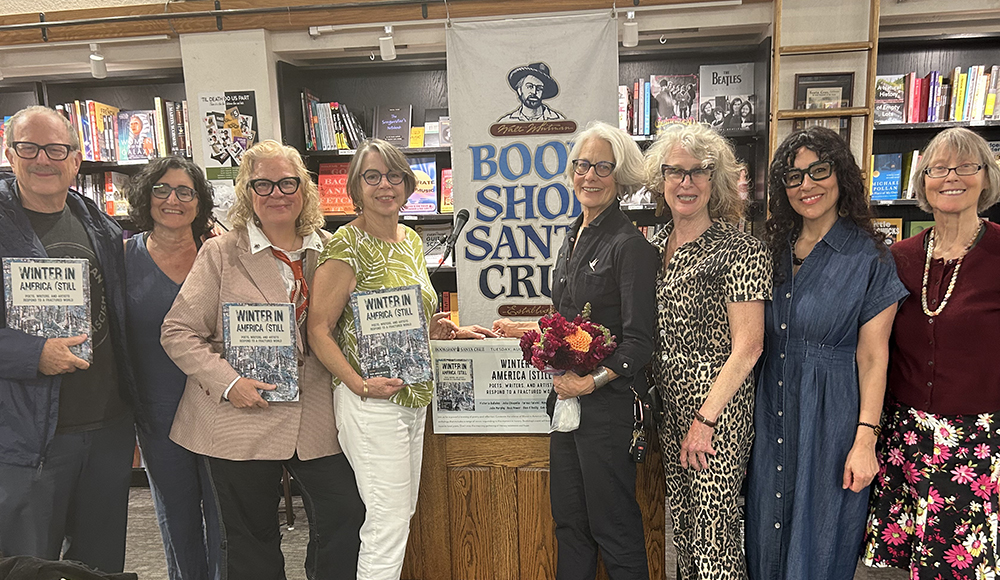
Several dozen Santa Cruz writers grace the new anthology, Winter in America (Still, which collects writers’ and artists’ responses to current conditions.
A sequel to the important anthology Winter in America (Again: Writers’ responses to the 2024 election, this new anthology documents many versions of what it has been like to survive the times since. The title comes from Gil Scott-Heron’s 1984 song, “Winter in America”: “We have been taken over by the season of ice,” Scott-Heron writes.
Published by Carbonation Press in Spokane, the anthology embodies “literary resistance to the erosion of our democracy,” said Roxi Power, one of the editors.
As publisher Greg Bem pointed out, “We live in a world where we cannot be neutral.” He was interested in seeing how “a collectivity of voices would respond to the fracturing” of our time. Like the way geological compression leads to new landforms, the stresses of current events produce new forms of writing. In times like these, Power noted, “you need memorable language to connect with deeper truths.”
“The pieces center around war, ICE, grief, and in particular the impact of these on children,” Power pointed out. How these big concerns deform daily life becomes visible in the poems: In “to break bread/what’s not said,” Farnaz Fatemi writes in response to a 2024 photo from Gaza, “it was the last of our flour/—spellpath, safeglass—/not shattered/she was my last girl…” (Fatemi is the former poet laureate of Santa Cruz County.)
Victoria Bañales, an English instructor at Cabrillo College, describes writing “god bless us” in the steam on the bathroom mirror, reflecting on “us” and the “U.S.”: “a constant state of SOS.” Like so many of the poems, this one echoes the terrors of this time along with measured hopes, like prayers.
Not only the local poets but the nationally known poets in the anthology are reaching for language to describe what this time is like and how we can live in it. In the late Rachel Blau duPlessis’s poem, “Paradoxes of the blaze,” she writes, “We are all enmeshed./And ash is/a grey-white collapse.” The blaze in the title references not only destructive burning but a mark in a tree, providing direction: “We’d wanted/To cut a blaze upon that trace./It was a form of hope.”
Each piece has a glimmer of light in it. As Power puts it, “It’s not just a catalog of despair.”
Similarly, the artists in the book use collage (Julia Forbes and others); seaweed print (Shelby Graham); salt on a car mirror (Mary Burger), and other strategies, inventing media to evoke meanings just out of reach. Each visual piece itself is like a poem, with fresh elements and unexpected juxtapositions.
The purpose of the book, Power explained in an interview with the Good Times, is “community formation across differences—differences in esthetics, regions, identities.” The anthology is intended to work against the current administration’s efforts to isolate groups of people from each other based on their differences, Power said, as well as poetry communities’ tendencies to split into camps defined by esthetics.
Power envisions that the book will support readers working to create social change, providing them with spaces for “reflecting, resisting and grieving.”
The heft of the book speaks to its purpose. It has the dimensions of printer paper but is an inch and a half thick and weighs as much as a small cat. On a lap, it is steadying; the physical book is in dialogue with its content.
“The size represents the possibility of voice and the power of voice, both in the poems and the visuals” explained Bem, whose press, he said, is committed to collaborative publishing with writers. “Some pieces would be disrupted if they had to be cropped and squeezed.”
“This is what community and collectivity means,” he told the Good Times, “offering room to everybody who would bring responses to what’s going on.”
Winter in America is holding two more launch events on Zoom (check the website) andan in-person event at 7 pm on Tuesday, October 6 at Satori Arts, 815 Almar Avenue,Santa Cruz. winterinamerica.org/events