

On Friday, September 18, 1200-odd battery modules remaining at the Moss Landing Power Plant since the January 2025 fire spontaneously ignited. A shelter-in-place order was broadcast, covering one third of a mile.
Just like any earthquake has its incidence of aftershocks, Texas-based Vistra Corp, which shares site operation with PG&E, informed locals last year there would likely be more fires during the extended cleanup, and so this might not be the last. Total removal could not be achieved because some cells remain in a damaged section of the Moss 300 building too dangerous to access.
Chief Jess Cortezof North Monterey County Fire said that the collapsed wall complicating removal is what retained the flames, the “superheated exposure” allowing the batteries to chain-react until expending their stored energy.
“The decision was made that these things had reached thermal runaway,” he said. “The fuel load was too much, and we knew they could propagate.”
Cortez used what he insisted was a non-scientific analogy of how best to fight this type of fire: if you dropped a flaming lithium-ion battery in the ocean, more than by the water and its temperature, the battery is extinguished by burning itself out.
For many small businesses living in the smokestacks’ shadow, the new fire is a discomfiting reminder of life after the first one.
Chef Kim Solano, who owns The Haute Enchilada with her husband Luis, likens it to living next to a “sleeping dragon.” At several points during our brief interview, she was too overcome with emotion to speak.
Unlike other Moss Landing business owners who live locally but at a reasonable distance from the plant, the Solanos moved into a former social club at the back of their restaurant’s property. They already evolved once during Covid, expanding their patio to accommodate entirely al fresco dining, and were forced to evolve again after the 2025 fire, closing what seemed permanently before reopening a year later with limited hours and menu.
“For my community,” she said.
Solano asked that community, used to dishes made with ingredients from her on-site greenhouse, about their comfort level.
“‘Would you come with your newborn grandchild and your mom for lunch next week on the patio?’ And they said, ‘Hell no.’”
Cortez said fear is making people sensitive to what has always been a normal sight – the twice-daily emissions from the natural gas section of the plant. Dispatch is being flooded with calls about “white smoke.”
Seaside resident Emerson Lee used to lead kayak tours in Elkhorn Slough, and worries what his exposure level has been to the batteries’ contaminants. To this day, he refuses to drink the local tap water. He witnessed Friday’s “flare-up,” terrified that because of its proximity there could be a gas explosion.
“I could see orange flames bursting at the second stack on the right of it,” he said. “Above the building line. I just turned my vehicle around and left, out of shock.”
Vistra offered businesses compensation for lost revenue during last year’s evacuation and shelter-in-place windows, and some owners assume they’ll do so again.
Solano is suspicious that any payment accepted amounts to a “waiver.” Humberto Marin, owner of Moss Landing Cafe up the street from her, thinks lost revenue is hard to calculate beyond compromised perishables like beef and seafood. He wonders how to count customers that would’ve come but didn’t. He knows his regulars’ schedules, but can’t account for passersby.
“I believe, on Friday, we lost more than seventy-five percent of sales,” he said.
Furthermore, the “reverse 911 calls” Cortez said the Department of Emergency Management sent to business landlines and cellphones did not reach Marin. He was out at the time, and found out from an employee that a customer alerted everyone the fire was on the news and the road was closed.
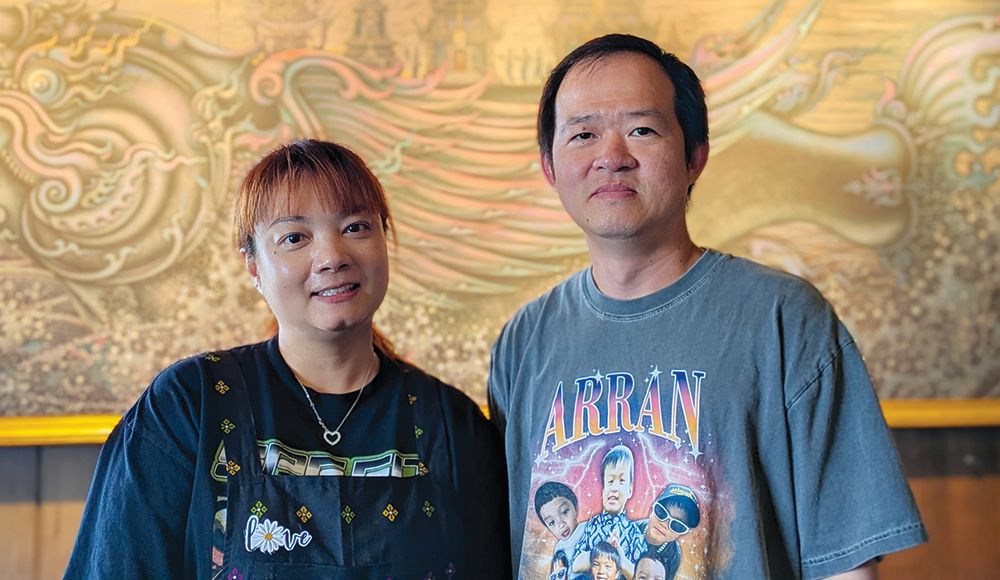
Next door, Nancy Sadkiriyasab of Lemongrass Seafood Bar & Grill Thai Cuisine said neither she nor her husband Arun received official warning from authorities. She remembers returning last year after being closed for five days, masking up and cleaning the inside of packaging, doing a massive restock. Soot was everywhere. She told any employees that if they didn’t feel safe to come in, she understood. Neighbors united in the uncertainty and, each feeling uninformed, did their best to notify each other when one heard something.
When she heard the news on Friday, she said, “Please, not again.”
There is a ghost town feel to “Moss,” what some locals call their town. Four storefronts on the grounds of boutique hotel The Inn At Moss Landing Point lay vacant, and have been for two years.
Solano doesn’t advertise anymore, and thinks this month she won’t even post a schedule. She maintains a monthly newsletter, and prefers engendering a “private club” feel over “a line out the door.” She wants the clientele to choose her establishment for its environment.
“We live in a very, very unpredictable time. I want this to be,” she said, dropping to a whisper, “a place where people can come and have a moment of peace.”