
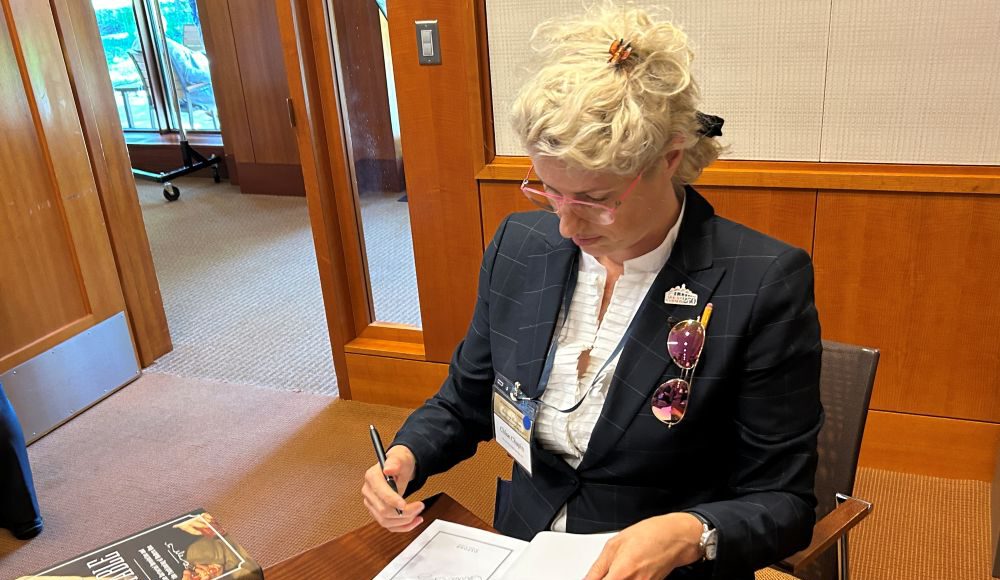
Chloe Chapin—author, former Broadway costume designer, Harvard academic and Santa Cruz native—will be returning to her roots at Bookshop Santa Cruz to share her debut book, Suitable: The Sartorial Revolution and the Fashioning of Modern Men, at a free in-store event with costume designer B. Modern on July 27 at 7pm.
The book, published by Oxford University Press on June 1, is a detailed account of the evolution in men’s fashion between the American Revolution and the Civil War.
But the book is more than just a book about menswear; according to Chapin, “I show how the language of power is written into the clothes we wear.”
The event will be a homecoming for Chapin, not only returning to Bookshop—where she spent her youth shelving used science-fiction books in the basement and eventually working the floor, and later helping out during nearly every winter break or summer off from university.
“I’m proud of her on so many levels, as a person—but it’s also very cool when a bookseller becomes a published author,” said Casey Coonerty Protti, the owner of Bookshop Santa Cruz and a childhood friend of Chapin.
“This is somebody who loves her subject matter, infuses it with cultural phenomena and rounds it out with a sparkling personality,” said Coonerty Protti. “I think it’s going to be just a very joyful event.”
Throughout the book, Chapin traces how the clothing that defined men’s fashion transitioned from a colorful display of ornately decorated frocks to a plain, structured uniform of black-and-white suits, a shift Chapin refers to as “peacocks to penguins.”
The book grew out of Chapin’s dissertation during her PhD in American Studies from Harvard University, but despite being a book of academic pedigree, Chapin thoughtfully engages with the reader, keeping what could be heavy, light and digestible.
Chapin gently guides the reader through the history of menswear—exploring how the plain black-and-white suit has come to be so revered in modern American society, the uniformity that defines it, and how it has come to represent masculinity and power.
“Every time there is sartorial uniformity, there is some kind of power at play, and men’s suits are probably the most pervasive form of visual hegemony in the Western world.” Chapin writes in the preface.
The inspiration for the book came from the multiple decades of Chapin’s adult life spent in fashion and theater, from her time at Santa Cruz Shakespeare to her later work on Broadway.
Part of Chapin’s academic journey into the world of suits and tuxedos and the sartorial revolution began in 2008, born of a discussion with Daniel Radcliffe at the opening night of Equus, said Chapin.
“He was wearing this beautiful midnight blue tuxedo,” said Chapin.
The tuxedo left Chapin captivated, and she approached Radcliffe to discuss it, who explained the royal origins of the particular tuxedo style.
In the 1920s, Edward VIII, the then Prince of Wales, was one of the first widely photographed royals, according to Chapin, and to make his suit tailoring stand out, he chose a midnight blue fabric over the traditional black.
“And I just thought that was such a fascinating story. And so, because of that, I started doing research on tuxedos,” said Chapin.
Nearly 4 years after that conversation, while costuming an opera, Chapin had to decide what the performers would wear for the opening act. However, it was difficult to ascertain what would be period-accurate and appropriate for the scene, said Chapin.
“I was scrolling through my mental database about in the 1850s—was it actually that strict of a uniform that was before tuxedos were invented?” said Chapin.
“And I was like, wait a minute—in the 18th century, they weren’t wearing black and white at all. They were wearing a very wide range of things, just like the women were. But then by 1850, they were all dressed exactly alike. That doesn’t make any sense. Why did that happen?”
While on the quest to answer that question, Chapin found that “the more research I did, the more I found that there was a kind of a bigger question about this uniformity of suits.”
The question became a foundational tenet for both her later PhD and the book.
“I couldn’t be more excited to share it with the Santa Cruz audience,” said Chapin. “Getting the opportunity to share it [the book] with the community that raised me, that helped contribute to this book, is really meaningful to me.”
To attend the free event on Monday, July 27, individuals interested can use the Bookshop website to RSVP.