
Amber Williams is unusually fond of the word yes.
To understand why, let’s go back in time.
Williams was 17 when she gave birth to her son at Dominican Hospital. She had begun smoking marijuana and drinking at 13 and using methamphetamine at 16. By the time her son was born, child protective services was involved and Williams faced an agonizing decision.
Hospital staff told her there were families eager to adopt her healthy baby boy. Williams turned to her father, wondering if adoption might be the best thing she could do for her son.
Her father had a different answer. Williams would raise her son, he told her. She would go to school. She would work. She would build a life.
And Williams said yes.
That teenage mother is now 43 and the CEO of Janus, the county’s largest substance use disorder treatment provider.
Today, as Janus celebrates its 50th anniversary, Williams is working to give that same answer thousands of times over.
“We are a yes organization,” she says.
COMING DOWN FROM THE SUMMIT
Williams’ story began in the Santa Cruz Mountains, where she was raised by her father. Her mother left when she was just six months old.
Home was a dirt road off the Summit, where the family lived largely off the grid, sometimes relying on battery power. Her mornings started at 5:30, when she fed the horses before the long drive to school. Her father, a scientist who worked for IBM and helped develop an early atomic force microscope, raised Williams and her brothers on his own.
He also struggled with alcoholism.
Williams thought of him as an extraordinary man and her best friend, a father who put his only daughter “on a pedestal” and did everything he could to protect her. But as much as she loved her dad, she desperately wanted to escape the Summit.
At Los Gatos High School, Williams was surrounded by reminders of everything her family didn’t have. She wore her brother’s hand-me-downs while classmates arrived in designer clothes and expensive cars. It was a world sharply divided between the haves and the have-nots.
Eventually, her family moved to the Bear Creek area, and Williams transferred to San Lorenzo Valley High School. She played volleyball, danced and cheered, but she was getting into other things as well. The teachers and staff there took a special interest in a young girl being raised by her father and brothers.
“I think the school did their best to try and raise me too.” Still, Williams rebelled.
By 16, she was spending time in downtown Santa Cruz, smoking weed, drinking and using methamphetamine. Her father would come looking for her, sometimes chasing after her until he fell and hurt himself. Williams would return days later to apologize.
Williams describes her teenage self as “a little rogue runaway in Santa Cruz.”
Then, at 16, Williams learned she was pregnant.
Her son was born at Dominican Hospital on Aug. 31, 2001.
What followed was not a clean, cinematic journey into recovery. Her father’s insurance initially covered 21 days at a sprawling Scotts Valley campus Williams describes as almost luxurious, with horses, a pool and medical staff. But Williams needed more time, and she needed a place where her newborn son could remain with her.
That brought her to the Janus Perinatal Program. And the difference was apparent the moment she walked through the door.
The private setting had felt, as Williams called it, “bougie.” Janus was decidedly not. In those days, its perinatal operation ran out of the former Max’s restaurant on Ocean Street, with little money but a lot of determination. Williams calls it “very bootstrap.”
But what Janus lacked in polish, Williams found it made up for in something she needed far more.
“I was a baby raising a baby,” she recalls. At Janus, she could finally say that she had no idea how to do that.
LEARNING TO SAY YES
Williams spent 10 months in the Janus Perinatal Program, followed by another three months as an outpatient. Along the way, Janus staff taught her not only how to stay in recovery but how to become a mother.
She still remembers sitting with a giant Costco tub of mint chocolate chip ice cream, happily sharing it with her 3-month-old son until a staff member intervened.
“You cannot feed him ice cream,” a staff member told her. There were countless lessons like that.
“They allowed me to be honest about saying, ‘I don’t know how to do this,’” she recalls. “I did not know how to parent my child.”
Afterward, she rented a room from a family friend and enrolled at Cabrillo College. But she didn’t leave Janus behind.
Once she had a car, a beat-up $500 Nissan Stanza, she returned to Janus to volunteer, driving women from Janus to 12-step meetings around the community. She strategically parked the unreliable car on hills so she could push-start it afterward.
Eventually, volunteering wasn’t enough.
Williams began showing up at the old perinatal center on Ocean Street, sitting beneath the stained-glass window left behind from its days as Max’s restaurant. One day, a Janus manager asked what she was doing there.
“I’m going to sit here until you give me a job,” Williams told her.
Williams kept coming back until a Janus manager finally relented and gave her some papers to file.
On Feb. 27, 2004, Williams officially joined the staff. She has been there ever since.
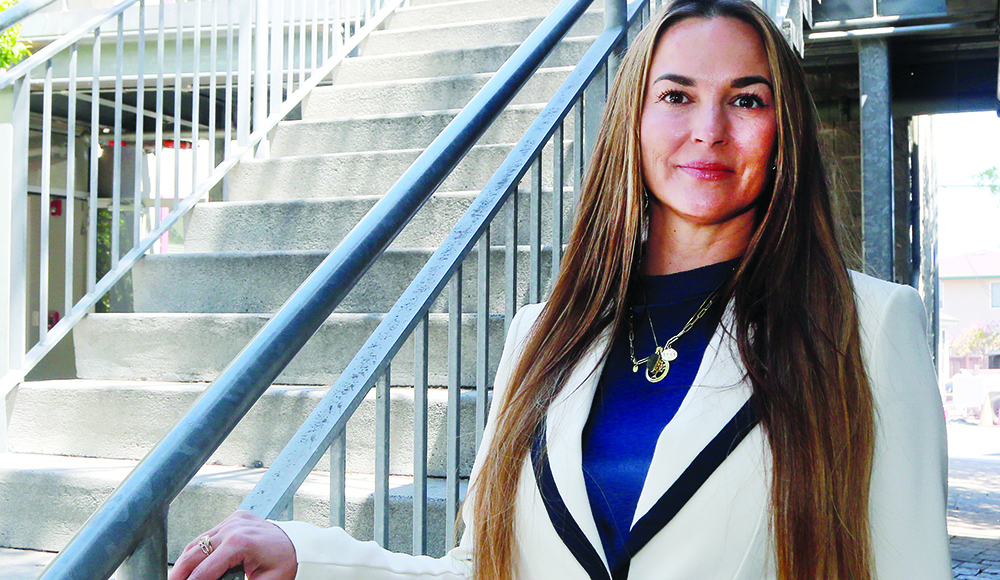
of everything her family didn’t have. It inspired her to help others. PHOTO: Tarmo Hannula
CHANGING THE ENVIRONMENT
Williams had bigger plans for the organization from the beginning.
When she walked into Janus after leaving the private location in Scotts Valley, she made herself a promise.
“I’m gonna change this,” she remembers thinking. “I’m going to be the CEO here one day.”
What struck her most was the environment. Williams had experienced firsthand the stark difference between a private insurance-funded center and a nonprofit operating on limited resources.
She believed the surroundings themselves mattered and sent a message about what those struggling with addiction deserved and what they could imagine for themselves.
“Being able to rise to something and aspire towards something is extremely impactful,” she says.
It would take nearly two decades for Williams to reach the CEO’s office. During that time, she worked in admissions, compliance and other departments, learning every aspect of Janus from the inside out and from the ground up.
But the promise she made as a young client stayed with her.
And her attachment to Janus runs deep. She puts it bluntly: “Don’t ever question my love affair with Janus. That comes first.”
Part of that commitment comes from seeing her own story repeated in others. Many Janus employees first came to Janus as clients, then returned as employees to help those coming behind them.
“That is the whole beauty of Janus,” she says. “They get to come back, give back.”
For Williams, improving Janus began with creating spaces that reflect the dignity of its community while addressing the complex needs of each client.
BUILDING WHAT WAS MISSING
As Williams moved through the ranks at Janus, her ambitions for the nonprofit grew beyond its physical surroundings.
She wanted to make the maze of disconnected providers easier to navigate. Over the years, Janus expanded its continuum of care to include withdrawal management, residential and outpatient models, medication-assisted treatment, perinatal services, recovery housing and behavioral health support.
“We didn’t have every level of care 25 years ago,” Williams says.
Then, in 2009, the gaps she had spent years trying to close became painfully personal. Her father died, in part due to alcoholism.
His death left Williams not only grieving the father she adored but also confronting the painful reality that his life probably didn’t need to end that way.
“He was my best friend,” she says. “I became extremely inspired to create something that would have helped him save his own life.”
That loss only strengthened Williams’ determination to make it easier for people to get help without becoming lost between providers. She describes the difficulty of expecting a person struggling with substance use disorder, perhaps alongside mental health challenges, to call provider after provider.
“They need a consistent thread of one or two or three contacts. Max,” she says. “So we built a system to provide exactly that.”
What began as a social-model alcoholism program in 1976 has grown considerably and now serves thousands each year across Santa Cruz County.
But the work remains unfinished, and the number of people still struggling weighs on her.
“It breaks my heart that we still have so many folks struggling with mental health and substance use.”
THE NEXT CHAPTER
Fifty years after Janus was founded, one of its biggest projects is taking shape in a building familiar to anyone who regularly travels through Santa Cruz County.
The former Rodeway Inn, a three-story, 95-room hotel visible from Highway 1 in Watsonville, is being transformed into a 120-bed residential facility for men. Janus received the keys to the property in March.
The Watsonville project had a most unexpected origin: a bobsled run in Park City, Utah.
Williams was there for leadership training with YPO PacWest, part of the Young Presidents’ Organization. Williams says she is the only CEO in the group representing a nonprofit.
The YPO experience routinely takes participants well outside the conference room. In Park City, that meant heading to the bobsled track to train with members of Jamaica’s famed bobsled program, whose improbable Olympic story inspired the hit movie Cool Runnings. While waiting in line for a run, Williams found herself talking with another CEO. They introduced themselves and began chatting about their respective businesses.
At some point, the conversation turned to what Williams was trying to do back home in Santa Cruz County. Janus was looking to grow, and Williams had been searching for a property that could accommodate more clients. A hotel, she believed, could work.
And that’s when things got interesting.
“I’m looking to buy a hotel in Santa Cruz County,” Williams told him.
“I’m looking to sell one,” he replied.
The hotel was in Watsonville.
“This is God working in mysterious ways,” Williams says.
The coincidence carried particular weight. An opportunity to dramatically expand what Janus could offer men had landed right in front of her.
“How can you deny that?” she asks. “At the time I thought, ‘It’s gotta come to life now.’”
The Watsonville facility is expected to provide clinical care, case management and peer support while significantly broadening Janus’ presence in South County. Plans also call for the site to become part of a larger regional recovery hub serving Santa Cruz and neighboring counties, with the possibility of adding a South County sobering location.
The project represents another significant expansion of the system she has devoted her career to.
THROUGH THE SAME DOORS
More than two decades after Williams first walked through the doors of Janus as a 17-year-old mother with her infant son, she still walks through them every day.
But now, she walks through them as its CEO.
Asked what that younger version of herself would think if she could see her life now, Williams responded with a touch of humor.
“Are you trying to make me cry?” she asked lightheartedly. Then her answer turned more reflective.
“Well, I think she’d be extremely proud. I know I’m proud of her.”
Then Williams imagined that younger version of herself standing in the Janus lobby today.
“If my little girl self was in the lobby she’d be jumping for joy,” Williams says. “I gave that first yes to myself. And to my son. Now we continue to say yes to others.”
That may be the simplest yet most profound measure of what Janus has become in its first 50 years.