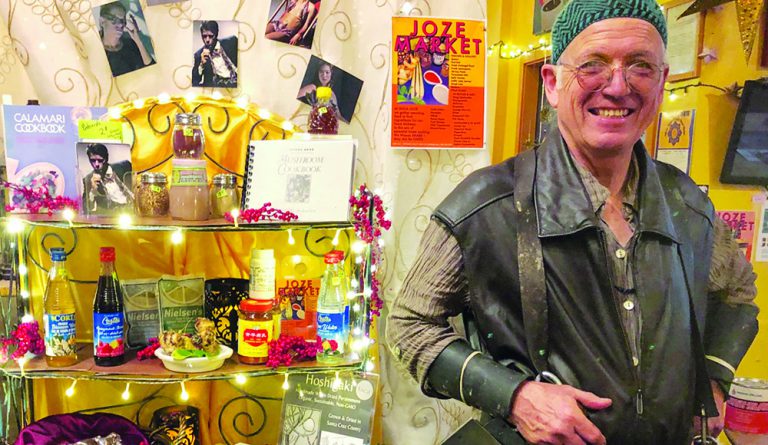
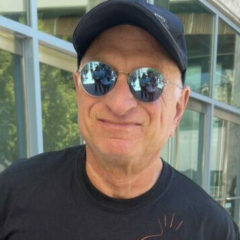
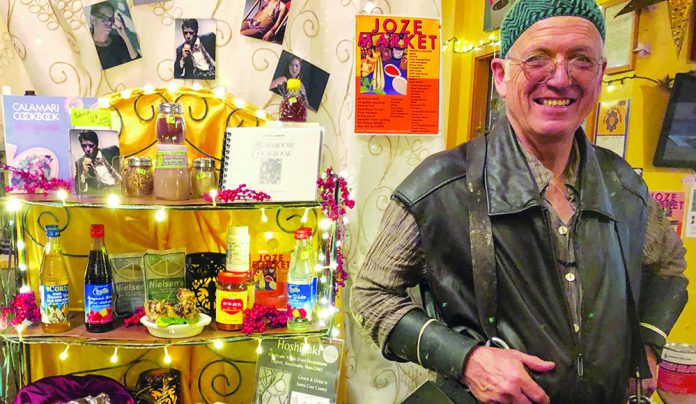
For decades he was the eye in the brilliant culinary storm that was India Joze Restaurant.
Catering all over the county to the delight of special events and roving foodies, he then took his talents over to a tiny hole-in-the-wall on Front Street and continued to whip up meals that belied belief. King of Spices, Jozseph Schultz is also a cultural historian and eco-anthropologist who’ll be joining up with Judy Slattum and Made Surya for a Taste of Bali, its markets, spices and authentic restaurants.
Filled with temples and artwork, Bali is a mirror of Santa Cruz, and Santa Cruz is in many ways a mirror of Bali, “where everybody’s an artist,” says Jozseph. Its beauty will form the content and background of the August tour.
How are you handling the transition from restaurant chef to private citizen?
SCHULTZ: I had a restaurant for 50 years. That doesn’t even make sense! India Joze was my social life. So trying to recreate that, after the sort of disaster of Covid which destroyed everybody’s social life, well I haven’t really gotten my feet under me yet. The dream is to have my country place spiffy enough that I can have people come over, either for money or not. I don’t care, you know, I can cook for them, and we can hang out and talk and have the idealized, the platonic form of human interaction, which is talking and eating. And cooking.
What are the biggest changes you’ve observed in local dining culture in the past decade? Can we blame Covid, or the economy, or were big changes already happening?
This used to be a cheap place to live, [laughter]. So it was great for artists. Back when we had India Joze, everybody would come; those were magic times. Being a cheap place to live means you have a pool of workers who don’t need to make very much to make ends meet. Now it’s completely insane. Today I would have to pay restaurant workers $30 an hour, so that’s changed forever and that does not change back. My hat’s off to anybody who tries to keep a restaurant open today.
So that means that the great, deep social connection that is food is also falling away.
What would you like to be doing now? Continue catering?
I’d like to create an idealized society where people can get together and see each other and socialize. Catering is arduous. If you start from zero, it involves setting up something, and break it all down, put it away, and all that takes infinitely longer than doing it. In the restaurant, it was all there. The people, the money, the infrastructure. All I had to do was really cook. But things are in progress.
What are you looking forward to on this trip to Bali?
Food is a concrete thing, but it’s also a metaphor. I’m interested in how food works in Bali. There’s a deeply artistic strain in Bali. Bali has an integrated society. Everybody goes to the ceremonies, the very rich people and the very poor people. They’ll all mingle in Bali, not like here.
It’s beautiful and wonderful and extraordinary, but it’s a museum in some ways. When conquered, they slaughtered the aristocracy in Bali in the early 1900s. Then it reestablished as a self-consciously cultural museum. Bali is filled with rituals and spirits. There’s tremendous amounts of ritual. And it goes on all the time, ritual and ceremony and offerings. It’s absolutely inescapable to an extent. Yet there’s a kind of freedom available when you don’t have to question every single thing you do. And has a very, very high level of social cooperation, because they are a rice-field culture. They’re one of the only sustainable agricultural places on earth. The geography is much like the Big Island of Hawaii. In the cooperation that has developed, spirituality is a part.
The Balinese believe that paradise isn’t somewhere else. They already live in Paradise. As Phil Oakes said, in an ugly world, the only real protest is beauty, right?
Specifics?
As far as how the tour will happen, we will interact with the culture in coconut workshops, my cooking demos, temple sites, farm tours, visits to coffee and clove plantations, touring rice fields and palm sugar villages. Lots of tastings.And of course there are countless food stalls and restaurants. There’s an incredible variety of food, you can get great sushi in Bali.
Photos, itinerary and details can be found at danutours.com. A Taste of Bali with India Joe Schultz – August 17-30
In late February and early March,thousands of Santa Cruz South County residents received letters warning that tests had detected chromium-6 above California’s new drinking-water standard in more than twenty groundwater sources. One South County woman said, “That’s the same poison that was in the water in the Erin Brockovich movie. Do I lose my breasts or lose my uterus?”
Chromium-6 has a hell of a reputation, thanks to Brockovich taking on PG&E in Hinkley, CA, and subsequently the Julia Roberts movie. But the situation in Santa Cruz County is different. Local scientists say the chromium-6 detected here appears to come from the natural geology beneath the Central Coast, not from industrial pollution. While the numbers that triggered the letters exceed California’s new regulatory limit for chromium (10 parts per billion,) they are still far below the concentrations that helped Julia Roberts win an Oscar. In the famous Erin Brockovich-PG&E case, chromium-6 concentrations in groundwater near the industrial source reached tens of thousands of parts per billion. The readings that triggered notices in parts of Santa Cruz County are from natural sources, generally between about 10 and 40 parts per billion,thousands of times lower. Before we start picturing tanker trucks hauling bottled water up and down Highway 1, here’s what scientists and water officials say about the situation: the discovery deserves attention, chromium-6 is not a great long-term diet, but we are not in crisis.
What chromium-6 is
Sierra Ryan, Water Resources Program Manager for Environmental Health, Santa Cruz County, says, “Chromium-6 is a metal found naturally occurring in parts of Santa Cruz County. It is found in the geologic features South and East of Valencia Creek. In some locations it exceeds the recently changed California Drinking Water Standards.” Under the right conditions, trace amounts can convert into the hexavalent form and dissolve into water. Ryan says, “It is naturally occurring, we have no history of industry that would cause contamination.”
This process has been documented in aquifers throughout California. Blair Robertson, a public information officer with the State Water Resources Control Board, said the phenomenon is well known to hydrologists. “In much of California, including parts of the Central Coast, chromium-6 in groundwater is largely associated with natural geology, specifically chromium-bearing rocks that can release it into water under certain conditions,” Robertson said.
Why the notices went out now?
The reason residents are hearing about chromium-6 now has less to do with new contamination and more to do with new rules. California recently adopted a maximum contaminant level of 10 parts per billion for chromium-6 in drinking water, one of the strictest standards anywhere in the world. Water systems must now notify customers if levels exceed that threshold. The new standard reflects California’s precautionary approach to public health. Long-term exposure at high concentrations has been linked to cancer risk, so, regulators set limits designed to protect people over a lifetime of drinking water.
When do chromium levels become dangerous?
How high does the level of chromium-6 in water have to get before is causes cancer? The honest answer is: No amount is thought to be completely ideal, but very low amounts mean very low risk.There is no cliff where chromium-6 suddenly becomes dangerous; the risk rises gradually, and regulators argue over how much risk is acceptable.
0.02 parts per billion (ppb)was set by the Office of Environmental Health Hazard Assessment (OEHHA) as the level associated with about aone-in-a-million lifetime cancer risk for someone drinking that water every day over a lifetime (EPA.) California’s current legal drinking-water limit is 10ppb for chromium 6. It reflects what the state determined was feasible to require of water systems while still protecting public health (California Water Board).
Should people worry?
Robertson explained that California’s standard includes a large margin of safety. “Exceedances don’t mean the water is immediately unsafe to drink,” he said. “They trigger regulatory requirements, but they do trigger regulatory requirements to bring the levels down.” The current federal standard for total chromium in drinking water is 100 parts per billion. Canada regulates chromium-6 at 50 parts per billion. The highest naturally occurring readings seen locally, according to county water experts, are less than half of the federal standard and below the Canadian limit.
Santa Cruz has spent years debating water supply solutions, including the desalination plant voters rejected in 2014. Some residents have wondered whether that decision played a role in the chromium-6 notices. I asked Sierra Ryan if the Desalination Plant had been built, would we be having this conversation? She said that we would.
“The desalination plant would have served the City of Santa Cruz and some of Soquel Creek service areas. Chromium-6 is found in Watsonville, which wasn’t part of the planned service area. Soquel Creek would likely still use some of their wells in the south part of their service area, and numerous small water systems would also still be facing this issue.” The geology beneath Santa Cruz County would still be there regardless of how coastal cities produce water.
Soquel Water District Program Manager Melanie Mow Schumacher says, “Since this new state regulation has been set, there are several water supplies in our county that need to address it. Soquel Creek Water District currently has a treatment project out to bid and we aim to begin construction later this year.”
If there is a takeaway from this story, it may be this: drinking water systems are constantly evolving as science improves. Water managers test for contaminants more precisely than ever before. Standards change. Regulations tighten. New treatment technologies emerge. Chromium-6 is a known carcinogen, but the difference today is that it is being detected because monitoring has improved and standards have become more protective. If you’re concerned about your water, that’s a good thing to be concerned about. Reach out to your water department. I found them very responsive.
Our skin is our largest organ. Our exoderm is an echo of our lifestyle choices, as all sun worshipers and sleep skippers eventually come to learn. Eating the right foods can make a big difference in the way you face the world.
In fact, research shows the Mediterranean Diet is consistently associated with slower skin aging, better elasticity, and fewer wrinkles by supplying amply antioxidants, healthy fats, and nutrients involved in collagen production. Not surprising since this is the dietary pattern most closely associated with gut health and longevity as well.
Here are the foods most strongly linked with dermal health:
Olive Oil
Extra-virgin olive oil is rich in monounsaturated fats and polyphenols that help protect skin from oxidative damage and inflammation. Here in Santa Cruz, local growers like Belle Farms deliver the real deal.
Skin benefits
Supports skin elasticity
Helps reduce inflammation linked to wrinkles
Provides vitamin E, which protects skin cells
Mediterranean diet studies have repeatedly found that higher olive oil intake correlates with fewer signs of skin aging.
Make the most of it: replace butter, canola, corn and vegetable oils with extra virgin olive oil. Use it in cooking and drizzle it liberally on salads.
Omega rich, sustainably harvested fish provide omega-3 fatty acids, which help maintain the skin barrier and reduce dryness and inflammation.
Skin benefits
Supports skin hydration
May reduce inflammatory skin conditions
Helps maintain smooth skin texture
Omega-3s also help counteract UV-related skin damage.
Make the most of it.. Baked, steamed, grilled or canned wild salmon twice a week is a great addition to your meal plan. Note: Be sure to avoid farm-raised salmon and select sustainably harvested choices to avoid antibiotics or toxins in your seafood.
Tomatoes help
Tomatoes contain lycopene, a powerful antioxidant that helps protect skin from sun-induced damage.
Skin benefits
Supports collagen stability
Helps reduce oxidative damage from UV exposure
Linked with smoother skin texture
Make the most of it. Cooking tomatoes with olive oil increases lycopene absorption. Diced sundried tomatoes make a rich and delicious addition to your green, bean and whole grain dishes.
Leafy Greens
Leafy greens like spinach, kale, and chard provide vitamin C, beta-carotene, and lutein, nutrients that help defend skin against oxidative stress. It’s easy to stock up on locally grown varieties at any of our community farmers’ markets.
Skin benefits
Supports collagen production
Protects skin from free radicals
Helps maintain skin tone and clarity
Make the most of it. Sauté spinach with olive oil and garlic for a delicious side dish. Try a simple kale salad or Swiss chard sauté with your favorite plant protein for a simple, delicious and fortifying meal.
Berries
Berries are among the richest sources of polyphenols and vitamin C, both critical for skin repair and collagen synthesis.
Skin benefits
Boosts collagen production
Reduces oxidative stress
Helps maintain firmness
How to use them: Enjoy berries fresh from the basket,or add frozen berries to your morning oatmeal or chia pudding for an antioxidant and protein-rich way to start your day right!
Nuts and Seeds
Almonds, walnuts, and seeds like hemp, chia and pumpkin supply vitamin E, healthy fats, and minerals essential for maintaining skin structure.
Skin benefits
Protects skin from oxidative damage
Helps maintain skin barrier integrity
Supports elasticity
Make the most of it: Snack on almonds, add walnuts to oatmeal, hemp seeds to smoothies or make a chia pudding.Toasted pumpkin seeds are delicious on your daily salad.
Avocados
Avocados are rich in monounsaturated fats and vitamin E, nutrients associated with improved skin elasticity.
Skin benefits
Supports collagen structure
Helps maintain skin moisture
Reduces inflammation
Make the most of them: Dice into salads, slice over omelets or mash into a topping for your favorite sourdough toast.
Simple takeaway:
Foods most associated with youthful skin tend to share three qualities:
Together, these foods form the backbone of the Mediterranean diet—one of the eating patterns most consistently linked with slower biological aging and healthy, glowing skin.
Elizabeth Borelli is a local wellness advocate and workshop teacher. To learn more about the Mediterranean Diet, benefits and recipes, visit ElizabethBorelli.com
[1]Can we shorten this to just ‘Fatty Fish’ It’ll save a little space
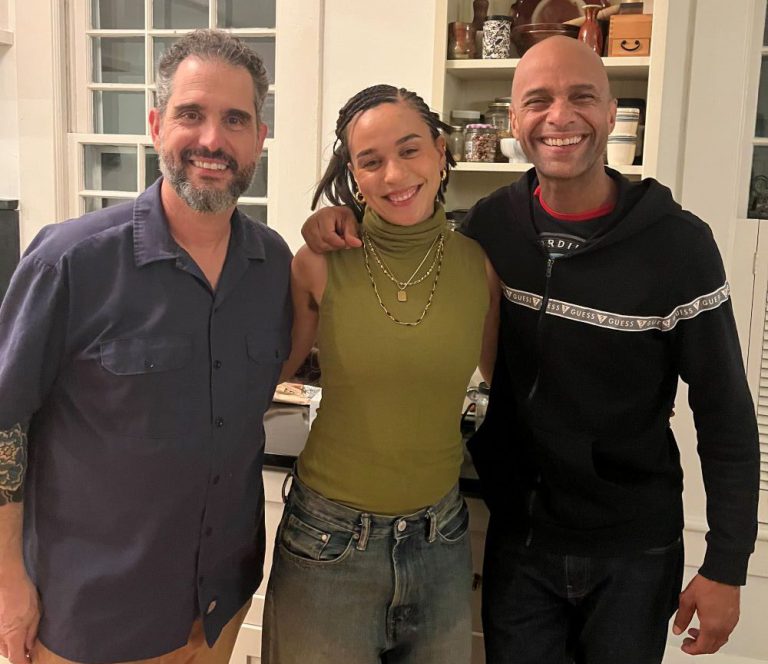
It only takes a few seconds of watching Charlie Hunter, a 35-year veteran onstage, play guitar to realize you’re in the presence of a master musician. What you’ll notice between songs is that Hunter is also a fine storyteller with a wicked sense of humor. The Charlie Hunter Trio will be joined by the magnificent vocalist Lo Steele (celebrating her new release, Only a Drop) at The Kuumbwa Jazz on March 16th.
Legend has it that Hunter grew up in a retro-fitted school bus on a commune in Northern California. The young lad lived and breathed the kind of hippie “back-to-the-earth” movement that this current crop of crystal-carrying, VW-driving, patchouli-smelling, tie-dyed folk can only dream of.
In record store bins across the country, Hunter is most often pigeon-holed as a jazz musician. But the unsung truth is that Hunter was a pivotal pioneer in launching the now ubiquitous universe and spherical mega-industry of jambands.
Back in 1994, Hunter had a residency at The Elbow Room in San Francisco. Playing with drummer Jay Lane (who would end up in Dead & Co) and Dave Ellis (Bob Weir’s cohort in Ratdog) on sax, this trio was one of the ur-jambands. This trio is the Rosetta Stone for, let’s say, Goose or insert your favorite new jamband that blends genres, thinking they’re a modern-day Leif Erikson.
What is now thought of as “progressive” is because that early Hunter trio was swinging a machete through the brush that existed between jazz, rock, improvisation, funk, blues and soul.
Five years later, in 1999, Hunter joined Medeski Martin & Wood (MMW) at the Bowery Ballroom, NYC. Whatever Hunter hadn’t already forged a path towards, MMW showed everyone there were no limitations on what could be explored musically and sonically. One only needs incredible talent and a curious mind.
While Hunter did open for The String Cheese Incident in 2002 and loves collaborating with everyone, the fifty-eight-year-old has zero intention of ending up in the jamband record store bin. His school bus roots glowed bright when the subject of jamband was brought up. “Oh. How not to be political? Well. Do you mean the cultural arm of the soft white supremacy movement? Or whatever this commodified, wealth-oriented kind of thing is. “It’s just not my culture,” says Hunter from his home somewhere in America.
One thing that comes across on the 60+ plus albums that Hunter has put out solo, or collaborated on, is authenticity. A jazz take on Bob Marley, with The Charlie Hunter Quartet’s Natty Dread album, released in 1997, would sound janky in lesser hands. Hunter puts that to rest with complete devotion to the essence of the music, Bob’s Rastafarian spirit, and through that, bringing in new generations of jazz listeners. Hunter seems to break ground in every endeavor.
Hunter’s most recent collaboration, Only a Drop, with Portland’s Lo Steele, is a beautiful gem of an album. Lo Steele was born into the music royalty of the great Northwest. Her mother, LaRhonda Steele is known as Portland’s First Lady of the Blues. “And my dad’s an incredible piano player and songwriter,” says the coolly exuberant Steele from the road.
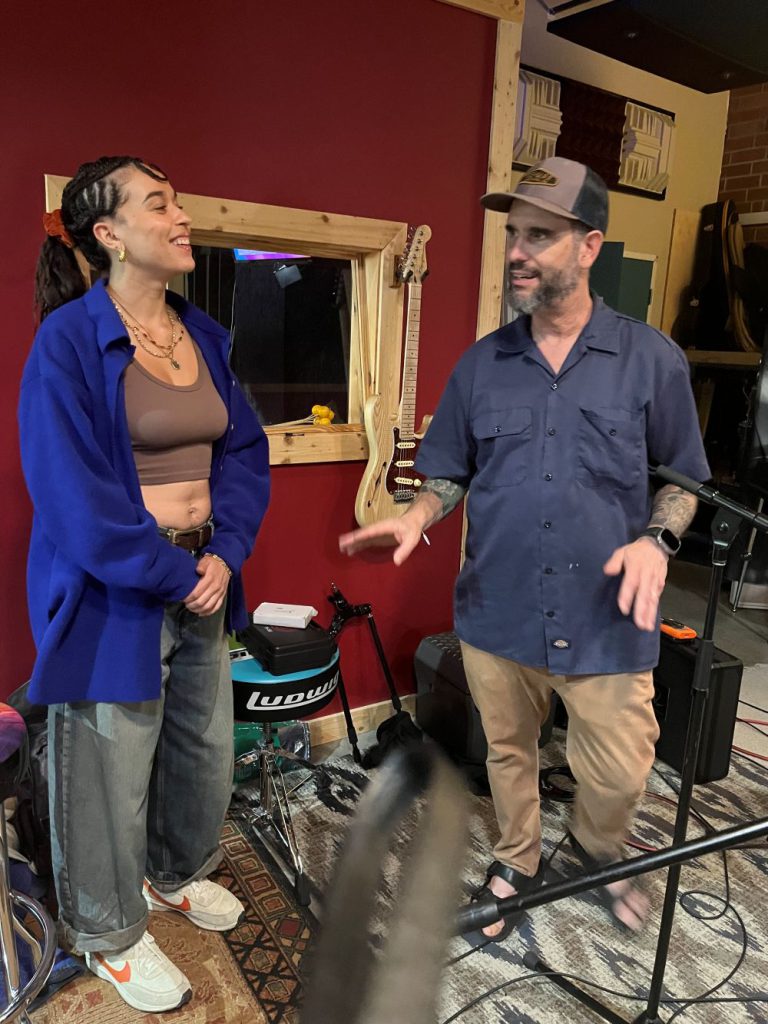
STUDIO CHEMISTRY — Lo Steele and Charlie Hunter share a moment in the studio while recording their collaborative album Only a Drop.
“We grew up playing in family bands and singing backgrounds, then eventually graduating to singing leads. We were doing all of the local festivals. I’ve been singing from the age of 8,” Steele proudly explains.
Growing up under the tutelage of her critically acclaimed, and cherished by a large community, mother, the new release, Only a Drop, is a family affair. “She’s excited. She’s on the album. It’s interesting ’cause usually, we’re doing the Waterfront Blues Festival and I’ve been joining her onstage. It’s been the LaRhonda Steele Band. So, we had a conversation about if this year it was the Lo Steele Band? Like, how do you feel about that? We have to sort of negotiate occupying different spaces, and having our own moment. She said, ‘Thank you for asking me. That means a lot. I’m excited for you.’ And this year I’m also releasing an album. If something goods happening to me, something goods happening to her,” Steele laughs.
Only a Drop was a dream collaboration, with an incredibly fluid musician whom Steele completely appreciates. “Charlie has such, despite his incredible skill, such an appreciation for space and storytelling. He really listened to my lyrics and my melodies. I never felt like we were in competition. I felt like he like clicked into the story and he honored the story and made it musically interesting – while not distracting from the message and the lyrics. It also brought out a more groove based, like funkier, bluesier side of what I do. So the album kind of lives in that space, which is really exciting for me,” Steele concludes.
Charlie Hunter has stayed true to the ethos of inclusiveness and has collaborated with musical auteurs like Norah Jones, Mos Def, and D’Angelo. And also, surprisingly, Dead & Co lead guitarist, John Mayer.
“I think guitar playing, especially the electric stuff, is kind of a side hustle for him in a way,’ Hunter begins, talking about working with Mayer. “I think that the thing, that I think he does best, is write songs and play them solo on acoustic guitar. That is, to me, that’s his wheelhouse. And he does a really good job of that and actually plays some really great guitar when he’s playing acoustic alone, and just doing his thing. But I’m biased towards that kind of thing. So that’s just me,” the iconoclastic Hunter concludes.
The Charlie Hunter Trio will play on Monday March 16th at 7:00pm and 9:00pm, at the Kuumbwa Jazz Center, 320-2 Cedar St, Santa Cruz. Tickets are $40 and $21 for students. More info at kuumbwajazz.org
There is an all-star tribute show of Sly and The Family Stone’s music, coming to hotspot Moe’s Alley on Thursday, March 12th. The band consists of half of ALO, plus Ray White of Frank Zappa fame, and includes legends like (David Nelson Band’s) Mookie Siegel. One name that should pop off the poster, is Vicki Randle .
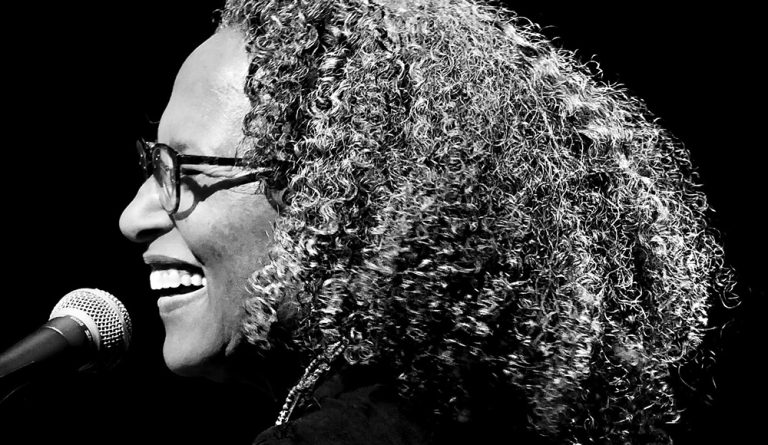
In the past, multi-instrumentalist Randle has played, or toured with, pinnacle legends such as Aretha Franklin, Celine Dion and Herbie Hancock. You might recognize her face, and presence, from her long tenure with The Tonight Show with Jay Leno from 1992, until 2009.
“I only toured with one band after I left the show, and that was Mavis Staples. I was 38 when I got TheTonight Show in 1992. So I had already had a full life of touring. I started when I was 20,” Randle says, from her home in the Bay Area.
Randle currently plays with a number of bands. For the last 13 years Randle’s “Black Dyke” band, Skip the Needle slays crowds. “We are for queer women. Three of us black, and all of us grew up playing rock music,” Randle states proudly.
Being the first female member of a late-night band, on a show with an incredibly long run, with upwards of 14 million viewers a night, five nights a week, was an opportunity most musicians can only dream of. But it’s a real job. Which means sacrificing a lot of personal freedom.
“The guys could go over and play at the Baked Potato,” Randle begins. “I played a different kind of music. I wasn’t necessarily only a jazz musician. So, if there was a show in town and I could get there, after Jay–we finished shooting right around six. But for the most part, it was really hard to make plans. There was always these wars going on between the two main (Leno and Letterman) shows. So, if they took a hiatus, we couldn’t take a hiatus at the same time. And our hiatuses were only a week.
“So we worked all the time. We just worked all, you know, five days a week. And if they wanted to shoot something or needed to do something, contractually, we had to prioritize The Tonight Show. So it was hard to do other work, which is one of the reasons I wanted to leave the show,” Randle concludes.
In person, do not doubt that Randle is an iconic and authentic force, as you would have hoped to believe. At the Sly Stone tribute, you will see somebody who relishes every second onstage. “It’s always been an emotional experience for me. Music just fills me with joy. I can’t imagine doing it any other way,” says Randle.
Note that there’s a lesson inside the story of the brilliant mind of Sly Stone. A man who brought forth such joy with “Dance to the Music” (1968), “Everyday People” (1968), “Thank You (Falettinme Be Mice Elf Agin)”, to name just a few. For Stone’s life was also riddled with addiction and missed opportunities, and that’s something Randle knows something about.
“I’m a sober alcoholic. I’ve been sober for 45 years. And I fully understand, at least for myself, that drug addiction and alcoholism is a disease that most people don’t think about as a disease. If he (Sly) had died young of cancer, people would have felt sorry for him. And true, cancer doesn’t usually make you not show up. (Laughs) I mean, to cause all the mayhem that he caused. So, we earn our bad reputations for sure. Not everybody is lucky enough to get sober,” Randle says.
With no intention of slowing down, Randle is touring this summer with the most influential hardcore punk band–Detroit’s MC5. “My friend Brad Brooks, who’s the lead singer, wrote a new record with Wayne Kramer and asked me to do some overdubs and vocals.And then asked if I wanted to play bass. Everything that’s happened to me in the music industry has been unplanned and completely out of left field. And then I asked myself, wait, can you do this? And, I thought, I love those songs. I played those songs in my band when I was in high school,” Randle laughs, as she gets ready for another gig.
A Tribute to Sly Stone happens Thursday, March 12th at Moe’s Alley, 1535 commercial way, Santa Cruz at 8pm. Tickets are $40adv/$45 door
It’s been nearly 30 years since the release of 1997’s Good Will Hunting, the movie about a mathematical genius with a troubled past from South Boston that turned Matt Damon and Ben Affleck into famous actors and filmmakers. The film was a commercial and critical hit, and the history of how it was made became part of Hollywood folklore.
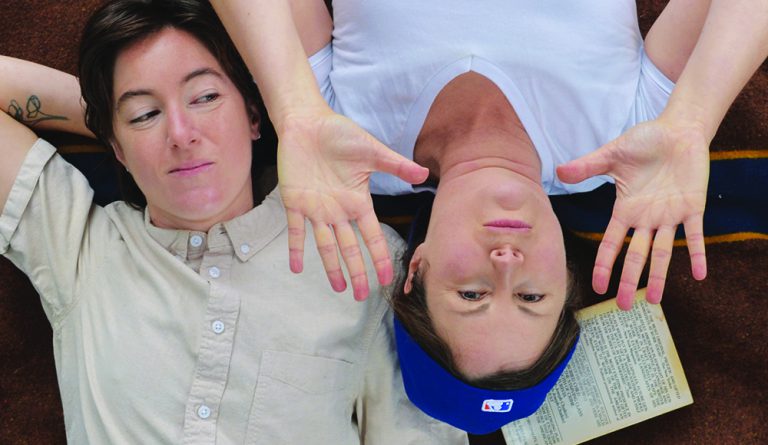
That story, albeit a fictionalized take, is told in Matt & Ben, a comedic, two-woman show running at Santa Cruz Actors’ Theatre March 13 through 22. Written by The Office’s Mindy Kaling and Brenda Withers, and directed by Ian Dyer, the play recounts how the two Hollywood golden boys started out as childhood buddies and total unknowns in Massachusetts, before Gwyneth Paltrow, Bennifer, Bennifer 2.0 and the Dunkin’ Donuts ads happened.
“The conceit of the play is that the script for Good Will Hunting falls fully formed and realized from the sky, and the whole rest of the play is about them deciding what to do with it and trying to figure out what it means on a cosmic level,” says actress Sarah K. Michael. “There’s a parody element to it. But it’s also a rumination on the nature of close friendship and how that can be challenged in the face of creative disagreement.”
As the movie’s legend goes, Damon began writing Good Will Hunting while still studying at Harvard. After moving to L.A., he and Affleck shopped the script around to various studios and directors before it was ultimately produced by Harvey Weinstein’s Miramax Films and directed by Gus Van Sant. The film was nominated for nine Oscars, scoring one for Robin Williams for Best Supporting Actor and another for Damon and Affleck for Best Original Screenplay. At 25, Affleck was the youngest person to win for that category.
Kaling and Withers were students at Dartmouth when they wrote Matt & Ben, which premiered in New York in 2002. Kaling would go on to star in and write for The Office and become a Hollywood powerhouse in her own right.
Michael read the play some 15 years ago while living in New York. After appearing together in Evil Dead: The Musical at the Mountain Community Theater in 2024, Michael, Dyer and co-star Sarah Mitchler launched their own theater production company, Good Egg Productions, and chose Matt & Ben as their first show.
The play takes place inside Affleck’s dirty, rundown apartment in Somerville, Massachusetts. Affleck, played by Michael, is an athletic, bro type, while Damon, played by Mitchler, is more of an intellectual. The two are competitive, struggling actors living off of junk food when the script for Good Will Hunting literally falls from the sky and onto their coffee table. They argue over the fate of the script and who gets to portray Will.
“It’s really fun playing around with the differences between Matt and Ben,” says Michael. “Matt is a really smart guy who’s always two steps ahead of the game. Physically, he’s a little guy. Ben is more of a jock and a classic dude. But despite their differences, they’re best friends. It’s kind of an opposites attract scenario. And even though they make fun of each other the way that guys do and they really frustrate each other, it all comes from a place of deep love and admiration.”
The play mocks Hollywood’s love of rags-to-riches stories and, in a more subtle way, the disparity between the haves and the have-nots in the movie industry that still exists today.
“It’s written by and for two women who are playing these iconic men who became so successful so fast,” says Michael. “One of the questions the play poses is why did that happen? Why do some people get on the fast track to success and not others? Why did these middle-class, cis white men have this privilege when those in marginalized roles are still struggling? It looks at what privilege can bring to someone’s career. Being a woman of color, Kaling is able to ask those questions, but in a really funny way.”
The play also reminds the audience how a movie’s origins can contribute to its enduring popularity.
“The story behind the creation of the film is part of its narrative,” says Michael. “The fact that they created it in this really scrappy way, wrote it themselves, and then pitched it to the right people. It’s an inspiring underdog story that still resonates with people.”
Matt & Ben runs Friday-Sunday, March 13-22, 2 & 7 pm, at the Santa Cruz Actors’ Theatre, 1001 Center St., Santa Cruz. Tickets $35 at santacruzactorstheatre.org.
In theater, “breaking the fourth wall” means acknowledging the audience. An actor steps out of the pretense that what’s happening on stage is real. It’s a disruptive moment of truth that can deepen the experience. I would love you to break the fourth wall in your own life, Aries. It’s a favorable time to slip free of any roles you’ve been performing by rote and just blurt out the more interesting truths. Tell someone, “This isn’t working for me.” Or say, “I need to be my pure self with greater authenticity.” Breaking the fourth wall won’t ruin the show; it will be more fun and real and entertaining.
TAURUS April 20-May 20
English speakers like me use the terms “destiny” and “fate” interchangeably. But a scholar of ancient Sumer claims they had different meanings in that culture. Nam, the word for “destiny,” was fixed and immutable. Namtar, meaning “fate,” could be manipulated, adjusted, and even cheated. I bring this to your attention, Taurus, because I believe you now have a golden chance to veer off a path that leads to an uninteresting or unproductive destiny and start gliding along a fateful detour.
GEMINI May 21-June 20
The coming months will be a favorable time for you to shed the fairy-tale story of success that once inspired you when you were younger and more idealistic. A riper vision is emerging, calling you toward a more realistic and satisfying version of your life’s purpose. The transformation may at first feel unsettling, but I believe it will ultimately awaken even deeper zeal and greater creativity than your original dream. Bonus: Your revised, more mature goals will lead you to the very rewards your youthful hopes imagined but never quite delivered.
CANCER June 21-July 22
Even if you’re not actually far from home, Cancerian, I bet you’re on a pilgrimage or odyssey of some kind. The astrological omens tell me that you’re being drawn away from familiar ideas and feelings and are en route to an unknown country. You’re transforming, but you’re not sure how yet. During this phase of exploration, I suggest that you adopt a nickname that celebrates being on a quest. This will be a playful alias that helps you focus on the pregnant potential of this interlude. A few you might want to consider: Journey Seed, Threshold Traveler, Holy Rambler, Map-Edge Maverick, or Wanderlust Wonderer. Others? Choose one that tickles you with the sense that you are being born again while you travel.
LEO July 23-Aug. 22
Love is more than a gentle glow in your heart or a pleasurable spark in your body. When fully awakened and activated, it becomes a revolutionary way of being in the world that invites you to challenge and rethink all you’ve been taught about reality. It’s a bold magic that alters everything it encounters. You can certainly choose a milder, tamer version of love if you wish. But if you’d like to evolve into a love maestro—as you very well could during the next 12 months—I suggest you give yourself to the deeper, wilder form. Do you dare?
VIRGO Aug. 23-Sept. 22
Octopuses have neuron clusters in their arms that enable them to “think with their limbs.” Let’s make them your spirit creature for now, Virgo. Your body’s intuitions are offering you guidance that might even be as helpful as your fine mind. This enhanced somatic brilliance can serve you in practical ways: a creative breakthrough while doing housework, a challenging transition handled with aplomb, a fresh alignment between your feelings and ideas. I hope you will listen to your body as if it were a beloved mentor. Trust your movements and physical sensations to reveal what you need to know.
LIBRA Sept. 23-Oct. 22
I love your diplomatic genius: the capacity to understand all sides, to hold space for contradictions, to find the middle ground. But right now it’s in danger of curdling into a kind of self-erasure where your own desires become the one thing you can’t quite locate. Another way to understand this: You are so skilled at seeing everyone’s perspective that you sometimes lose track of your own. Here’s the antidote I recommend: Practice the revolutionary act of having strong opinions, of preferring one thing over another without immediately undercutting your preference with a counter-argument. I guarantee that your relationships will survive your decisiveness. In fact, they will deepen as people locate the real you beneath your exquisite balance.
SCORPIO Oct. 23-Nov. 21
New love cravings have been welling up inside you, Scorpio. These cries of the heart may confuse you even as they delight you and invigorate you. One of your main tasks is to listen closely to what they’re telling you, but to wait a while before expressing their messages to other people. You need to study them in detail before spilling them out. Another prime task is to feel patient awe and reverence for the immensity and intensity of these deep, wild desires.
SAGITTARIUS Nov. 22-Dec. 21
If you are fulfilling your birthright as a Sagittarius, you are a philosopher-adventurer with a yearning for deep meaning. As you seek out interesting truths, your restless curiosity is a spiritual necessity. You understand that wisdom comes from collecting diverse, sometimes contradictory experiences and weaving them into a coherent worldview. You have a fundamental need to keep expanding and reinventing what freedom means to you. All these qualities may make some people nervous, but they really are among your primary assignments now and forever. They are especially important to cultivate these days.
CAPRICORN Dec. 22-Jan. 19
In traditional navigation, “dead reckoning” means finding your position by tracking your previous movements. Where you have been tells you where you are. But it only works if you’ve been honest about your course. If you’ve been misleading yourself about the direction you have been traveling, dead reckoning will get you lost. I bring this to your attention, Capricorn, because I really want you to rededicate yourself to telling yourself the deepest, strongest, clearest truths. Where have you actually been going? Not where you told yourself you were going or where other people imagined you were going, but where your choices have actually been taking you. Look at the pattern of your real movements, not your stated intentions. Once you know your true position, you can chart a true course for the future.
AQUARIUS Jan. 20-Feb. 18
You’re entering a rambling zigzag phase. Each plot twist will branch into two more, and every supposed finale will reveal itself as the opening act of another surprise. Fortunately, your gift for quick thinking and innovative adaptation is sharper than ever, which means you will flourish where others might freeze. My suggestion? Forget the script. Approach the unpredictable adventures like an improv exercise: spontaneous, playful and open to the fertile mysteries.
PISCES Feb. 19-March 20
Can you compel acts of grace to intervene in your destiny? Can bursts of divine favor be summoned through the power of your will? Some spiritual scholars say, “Absolutely not.” They claim life’s wild benevolence arrives only through the mysterious tides of fate—impossible to solicit and impossible to predict. But other observers, more open-minded, speculate that your intelligent goodness might indeed attract the vivid generosity of cosmic energies. I bring this up because I suspect you Pisceans are either receiving or will soon receive blessings that feel like divine favor. Did you earn them, or are you just lucky—or some of both? It doesn’t matter. Enjoy the gift.
MATT & BEN For those interested in learning about how the movie Good Will Hunting was written, this is not the play to see. Ian Dyer directs the hilarious and completely untrue story about how Matt Damon and Ben Affleck supposedly wrote the script for the famous movie. The two-person production features local talent Sarah Mitchler (Mountain Community Theater) and Sarah K. Michael (Cabrillo Stage) as Matt Damon and Ben Affleck respectively. The satirical play focuses on how the young actors struggle with ethics, fame, business, and gossip. A script suddenly appearing before them truly tests their friendship. ISABELLA MARIE SANGALINE
INFO: 7pm, SC Actors’ Theatre, 1001 Center Street, Santa Cruz. $39. 431-8666.
EDM
SIPPY Born in Australia, LA’s Sippy conquers stages worldwide with her progressive sonic contributions at EDM festivals. A musically appreciative family provided the support for Sippy to take chances culminating in her debut album, Scars in Stereo. Having come up through the Australian festival community, Sippy has expanded her base globally and now has headlining sets at impressive venues and festivals like Red Rocks, Tomorrowland, and Lost Lands with crowds approaching half a million attendees. Felton Music Hall will be reverberating with deep bass that will vibrate for miles. Pushing the envelope on what soundscapes an individual can seemingly create out of thin air, Sippy is a magician on the turntables. DNA
PAPER WINGS Emily Mann and Wila Frank are a musical duo called Paper Wings. Together they create a gorgeous gossamer quilt of songs that phase in and out of sounding like ghostly harmonies from previous centuries. The acoustic guitar and banjo certainly add structure to the sand castle compositions, but one can truly get lost in the mesmerizing blending of voices. Folk songs about loneliness and wandering the forest and glades pour forth from Paper Wings, like clean well water from a cistern. Having performed with folk legends like Laurie Lewis, Tim O’Brien and Steve Earle, this pastoral pair are dedicated artisans to an enduring American tradition. DNA
JAEGER & REID Oakland duo Judi Jaeger & Bob Reid draw upon their roots (Canada and California respectively) in the creation of their original, acoustic-based music. Playing guitars and ukulele and singing, the pair focuses on vocal harmonies and songs with emotional resonance. 2017’s From Way Up Here combines original compositions with gentle, nuanced readings of classics like “Both Sides Now” and “The Times They are a Changin’.” The expansive What a Trip from 2022 takes a similar approach, with the duo giving their interpretation of “Turn, Turn, Turn” and others, including Judi’s contemplative “Monterey” and “You Can’t Go Home.” BILL KOPP
BLACKWATER HOLYLIGHT Five women from Portland who packed up and moved to LA to escape the PNW gloom have cracked open a creative geode with their band, Blackwater Holylight. With menacing riffs and ethereal vocals, they’ve created a tension of confidence and vulnerability to their music that’s strangely alluring. In their newest album, Not Here Not Gone, they continue to explore shades and sounds of light and dark. The juxtaposition of heavy lyrics with sing-song vocals or shoegaze guitar and airy synths could be a reflection of the exhilarating but terrifying decision the band made to relocate and the feelings of uncertainty or decisiveness everyone experiences. SHELLY NOVO
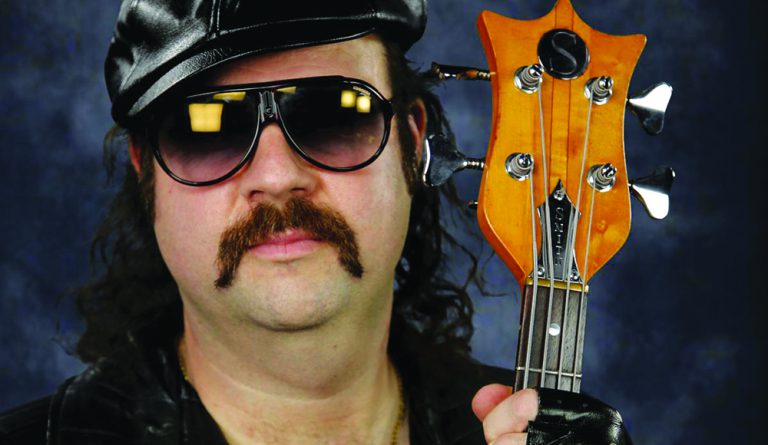
DONNY BENÉT Australian multi-instrumentalist Donny Benét debuted on record with 2011’s Don’t Hold Back. Born Benjamin Waples, Benét has a jazz foundation (as a bassist) but came to fame making music influenced by Italian disco. Much of his recorded work is bult on a foundation of synthesizers, but Benét’s facility on a wide range of instruments gives his music a more organic texture. A recent release, 2024’s Infinite Desires charted in Australia. For this tour, Benét returns to his roots, leading a band through a set that celebrates the electric bass guitar. It’s in support of il Basso, the latest in his instrumental series of releases. BK
INFO: 8pm, Catalyst, 1101 Pacific Ave., Santa Cruz. $37. 713-5492.
BENEFIT
SQUID-FEST When local radio station KUSP went silent, the community suffered a tremendous loss. Enter the Central Coast Community Radio coalition, a group of ex-KUSPers and community members who raised the funds to purchase 90.7FM with the call sign of KSQD. Since then, KSQD has been the go-to for everything Santa Cruz and Central Coast from Rachel Anne Goodman’s “Talk of the Bay” news program to Gary Shapiro’s music-meets-history program “Shapiro at Large,” along with national programming like the long-running independent news show, “Democracy Now.” This weekend, this benefit show and concert features the legendary George Kahumoku Jr., Poi Rogers and an auction to win “art and trips to far off destinations.” MAT WEIR
INFO: 1pm, Resource Center for Nonviolence, 612 Ocean St., Santa Cruz. $30. 423-1626.
LATIN
EDNA VAZQUEZ With a soulful voice and powerful message, Edna Vazquez is a woman with something to say. Growing up in Jalisco, Mexico, Vazquez was raised on traditional Mexican music along with R&B, jazz, folk and rock giving her a cornucopia of sound to draw from in her adult life. She learned how to sing as a teenager when she couldn’t afford to buy her grandmother a birthday gift, so instead she learned how to sing her grandmother’s favorite song. That same love and passion continue throughout Vazquez’s art whether it’s as a solo artist or with the bosa nova group, Pink Martini. MW
INFO: 7pm, Kuumbwa Jazz Center, 320-2 Cedar St., Santa Cruz. $18-$35. 427-2227.
MONDAY 3/16
LITERARY
THE ANTIDOTE Strange, sweeping, and deeply humane, Karen Russell brings her newest novel, The Antidote, to the public. The MacArthur Fellow and Pulitzer finalist colors five characters in this Dust Bowl epic that reflects on history and memories. The characters juggle grief and fear their secrets being revealed by a time-travelling camera and a “Prairie Witch” who embodies their memories. Set in the fictional town of Uz, Nebraska, the story follows a crumbling brought on not just by the Great Depression and the dust storm, but by the violent histories kept secret by its townspeople. Through conversation with author Jennifer Tseng, Russell will unpack the details behind this speculative fantasy. SHELLY NOVO
INFO: 7pm, Bookshop Santa Cruz, 1520 Pacific Ave., Santa Cruz, 423-0900.
We live in dark and turbulent times. Following the news cycle can make you want to throw your phone into Monterey Bay and go live in the redwoods with coyotes. Every headline hits you like a punch in the gut. But from March 12th through March 21st, the 14th Annual Watsonville Film Festival offers an antidote. As people of color are misrepresented and erased, the Latine community of Watsonville is using cinema to reclaim agency, tell their human story and resist the powerful forces that prefer silence.
Watsonville Film Festival (WFF) Executive Director and Co-Founder Consuelo Alba asked me, “Just reading the news every day, it gets crazy, right? That’s why I’m so excited about the festival this year; our theme is ‘Art As Resistance’. The festival this year is about telling our stories to strengthen our communities through film.”
The 14th Annual Watsonville Film Festival opens in Watsonville at Green Valley Cinema from March 12 through March 15, Q&As and evening celebrations. It then travels south to Salinas for a special program at Maya Cinemas on March 19 and 20. The festival concludes in Santa Cruz on March 21 with a final day of films and gatherings at the 418 Project.
Over 7 days, in three cities, the festival will screen over 50 films, stage a Q&A with their creators and stars after each film, will offer poetry, music, a Filmmaker Summit of panels with industry leaders, networking, coffee and burritos.
It is no secret that Mexicans work harder than anyone and party even harder. Each evening concludes with an after-party. I attended an after-party in Watsonville once and lived to tell about it; I can’t recall what I did or said that night but am pretty sure it was part of the cultural exchange.
The Watsonville Film Festival has become one of the few places in the county where tech workers, farmworkers, artists, and aging surfers can sit in the same room without arguing about housing. It has built a community of filmmakers who are bound and determined to illuminate humanity; the familia of it, the beauty and laughter of it. Representation matters now more than ever, and the festival fully intends to spark dialogue and inspire change.
Festival Director Alba says many of these films are being produced in Watsonville and then they go to the festival circuit. With 50 films this year, it is becoming a film town. LA seems to be noticing the amazing quality of film coming out of Watsonville and David Aguilar is coming up from LA to screen “Hangtown”. I watched three trailers for this year’s WFF and taken together, they trace an emotional journey about the discovery of fear, the confrontation with inherited trauma, and the long, unfinished work of freedom.
“Hangtown”
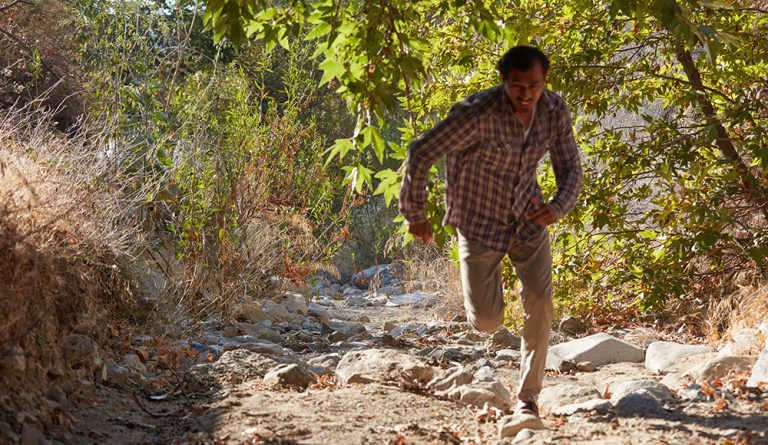
HANGTOWN Teenager Sammy, played by Geovanni Ryan, is forced to relive the same discrimination waged against his Mexican immigrant parents. He doesn’t speak Spanish but finds a father figure in a fleeing Mexican immigrant, played by Ricardo Cisneros, as armed vigilantes close in. PHOTO: Contributed
“Hangtown” is an autobiographically inspired story written and directed by Los Angeles film maker David Aguilar about growing up in Placerville, California (nicknamed Hangtown for 1849 vigilante justice.) Placerville is a town where a kid can grow up speaking English, think he’s American and then discover the country has other ideas.
Aguilar says writing about the racism he grew up with in Placerville “was all gut.” He remembers walking down Main Street on his way to school and passing the Hangman’s Saloon. Every day he’d look up to see a life-size dummy with black hair, dark skin, and a handlebar mustache hanging from a noose. David told me, “The dummy looked like the adult men in my family, my uncles, my father. It had similar facial features. Every day I was reminded, I don’t fit in here.” Aguilar remembers his father had a print of the Mexican Revolutionary Emilio Zapata that hangs in David’s home office today. “That dummy hanging by a noose looked like Emilio Zapata.” He says he was never called the traditional racial slurs like “wet back” or “spic.”. “In Placerville I was called the N-word.”
Screening at the Watsonville Film Festival, Saturday, March 14th, 5:30pm, at Cinelux Green Valley Cinema, “Hangtown”is not coming-of-age white bread fare. The movie opens with 12-year-old Sammy riding his bike by the famous Placerville dummy in the hangman’s noose. Subconsciously trying to fit in, Sammy opens his Dukes of Hazard Lunchbox, with the Confederate Flag on it. Then as a teenager Sammy is forced to relive the discriminations his Mexican immigrant parents lived through. He doesn’t speak Spanish but finds a father figure in a fleeing Mexican immigrant. He takes charge as armed vigilantes close in on both of them.
Director Aguilar says that he wished he could have seen a film like “Hangtown” when he was 12. “If there had been, maybe I would have had my own cultural awakening a little sooner and stood a little taller each day.” He says he might have known that there was “space for me to exist, exist in the world on a larger stage, where cinema and film and art was all available to me, and that my story mattered.”
“Hangtown” is refreshingly gritty stuff. Be sure to hydrate for it. Aguilar says his mission as a filmmaker is to create fresh narratives told through the eyes of Chicano characters who challenge the status quo through personal growth. “I want young Chicanos to understand that we are Indigenous people who have the right to live, work, and thrive in our homeland. We no longer have to see ourselves through a Eurocentric lens or define ourselves through an American construct. “Hangtown” is the film I needed as a boy, and the one I’m proud to share now.”
Chicano is the hyphen between Mexican and American. – David Aguilar
David calls himself Chicano because, like himself, the word is a combination of Mexican and American. He says Mexican American is a term of assimilation and fits first generation Americans. But Chicano is the in-between state in which he exists where the lines are blurred. More than that, it is a point of cultural pride, a point of resistance. “Terms like Latino and Latinx erase our indigenous heritage, that’s why I embrace the term Chicano.”
I remember first hearing “Chicano” during the Caesar Chavez resistance in the 60s, but David tells me it started before that, during the time of the Zoot Suitors in the 1940s. “We were Chicanos before this was the United States. We will be Chicanos after it’s gone.” Aguilar says Chicanos are the least portrayed ethnic group in the media and yet they go to the movies and stream more than any other group. “If I could have seen a movie like “Hangtown” when I was 12, it would have showed me that I have a place, that I have this power to make films inside me.”
If “Hangtown” is about the moment a child first recognizes injustice, the next film in the festival explores what happens years later, when those early wounds return in unexpected ways.
“El Regreso del Miedo”
Director/Producer: Berenice Manzano Castro
FEAR RETURNS “El Regreso del Miedo” (the Return of Fear) is set against the emotional landscape of first-generation life in California. The film explores how fear can become both prison and protector. In facing it, the protagonist must decide whether to watsonville-film-festival-art-as-resistanceremain haunted by the past—or reclaim his future. PHOTO: Contributed
In her directorial debut, Mexican American filmmaker Berenice Manzano Castro explores the emotional and psychological legacy of fear within immigrant and first-generation communities. “El Regreso del Miedo” (Return of Fear) The film examines how fear can shape identity and how confronting it can become an act of liberation. Manzano Castro’s film brings an intimate, first-generation perspective to themes of belonging, healing, and reclaiming one’s narrative.
The “Regreso de Miedo” trailer opens and closes with “It’s okay to be scared.” Castro says the film focuses on first generation fears and seeks to bring them comfort because “first generation folks are the most likely to be the most confused and terrified.” Castro says, “It’s okay to be scared, because without fear, you can’t be brave.”
The soundtrack includes ghostly music, at times underscored by a heartbeat as a poster appears with the written message, “Ya no estamos aqui” (We are no longer here.) Surrealistic images flash and melt with horror film intensity. The teenage protagonist Luis holds an older worker who appears to be dying. TV screens list warnings to “Beware of illegal aliens”. Screens are held by dark colored hands with long, sharp, fingernails, evoking vampiresque terror. The fingers reach for a little boy hiding under a table.
Berenice identifies as a Mexican American filmmaker. “I think for me, because I’m first generation, I’m very in tune with the culture that my parents grew up with. And so, I feel more into tune with that kind of culture, from Mexico. Some people are second, third generation, so they feel more comfortable with calling themselves Chicanos. It depends on case-by-case basis. For me, it’s just that connection I have with Mexican culture and my parents, so that’s why I consider myself Mexican American.”
Castro says she wrote the project in the summer of 2024 and then filmed it that November. “But obviously, I had no idea this was all going to be even more symbolic and impactful with our current age. I was more thinking in terms of the main actor, Luis, who he’s experiencing these dreams or visions of his past and revisiting them. He’s returning to that state of fear.” Fear is not the end of the story. The final step is deciding who we become in spite of it. This film was supported by the WFF Cine Se Puede initiative to help emerging filmmakers to advance their careers.
“Libertad” (Freedom)
A film about transgender asylum seeker Alejandra Daniela by Director Brenda Avila–Hanna
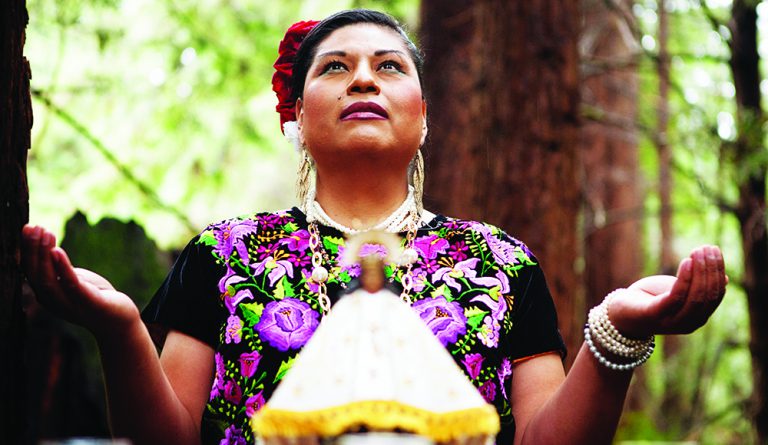
FREEDOM QUEST “Libertad” (Freedom), made in Watsonville,is a moving drama that follows a transgender Latina navigating the tension between family loyalty and personal independence as she seeks asylum in the U.S. PHOTO: Contributed
WFF Director Consuelo Alba says, “One of the films we’re bringing back after a recent world premiere screening in New York is “Libertad”. It’s the story of a transgender woman from Santa Cruz.”
What strikes me about the films I’ve watched from this year’s WFF is they show us how Indigenous people know who they are (and when they don’t) and how comfortable they are in their own skin, even as they are persecuted for its color.
Hearing the protagonist Alejandra Daniela speak in “Libertad,” you get loud and clear that this soft-spoken woman knows who she is. She is comfortable. She is beautiful. She opens her movie’s trailer by saying, “I am not a line in a paper you can erase. Being transgender is part of my soul, it’s part of my heart. I am Oaxacan, indigenous; those are things you cannot erase.”
Director Brenda Avila-Hanna, “It’s definitely a unifying theme; we know who we are, right? As immigrants, we know very well who we are, who are neighbors are. I think that’s part of that awkward but heartbreaking feeling of constantly having to be defined by others’ opinion and approval and perception.”
“Libertad”, made in Watsonville, Santa Cruz and Oaxaca,is a moving drama that follows a young, transgender Latina navigating the tension between family loyalty and personal independence as she seeks asylum in the U.S. Blending intimate storytelling with a sharp social edge, “Libertad” explores how freedom is never abstract, it is negotiated in kitchens and workplaces, in whispered conversations, and in the quiet decisions that can change a life.
Avila-Hanna says that Alejandra Daniela wanted to bring trans healthcare to more people and educate everybody because “trans people can have different medical needs, that have nothing to do with being trans. And sometimes if the hospital receptionist looks at you in a certain way, where people address you in a way that can be hurtful, you might not feel safe. A lot of trans patients feel very unwelcome and just walk away. They miss important things because they’re afraid.”
Taken together, “Hangtown,” “El Regreso del Miedo”, and“Libertad”feel less like separate films and more like a three-part meditation on migration and freedom: a boy discovers courage before he understands history, a woman returns to the trauma she thought distance could erase, and a trans woman asks what happens after survival. The progression mirrors the lived experience of many communities in California: fear, reckoning, and finally, the radical act of self-definition.
Other feature films also capture the theme of Art As Resistance: “Asco: Without Permission” is about a Chicano avant-garde collective in LA in 70s. There is also “Following Harry” (Belafonte). Consuelo Alba tells me they have been in major festivals and you can see synopsis and trailers at https://watsonvillefilmfest.org.
The WFF Grows!
Director Consuelo Alba tells me that when the WFF began in 2012 there were few films made locally. “There were very few, and now every year we see more and more local films, and we’re very proud to present these films to their community.”
The WFF survived the pandemic; two weeks after they cancelled the 2020 Festival, they were screening the movies online. After the Pajaro flood they had to cancel part of the festival but adapted and had a smaller program at the library. Every year WFF also brings award-winning films and gems from big festivals like South By Southwest, Tribeca, Sundance, Los Angeles and San Francisco Latino Film Fest.
“A Festival is not just about watching films, it’s about building community and it’s about connecting with filmmakers, asking, learning from each other, as artists and as an audience.” Her goal is to humanize their community, to be proud and celebrate with joy who they are. The festival gives her more energy to say, “I’m not going to give up to fear and terror. This is the moment to stand up. I’m not going to be fighting on the streets. I’m going to do it through my work, bringing love and unity, and sanity through film. Creating these spaces for everyone to connect and be welcome in a space of sanity and joy and beauty.”
The Watsonville Film Festival reminds us that resistance does not always look like protest. The most powerful political act may simply be telling the truth about how we live. You may go to the Watsonville Film Festival with a heavy heart, but you’ll leave with a fuller one.
The Watsonville Film Festival runs March 12-21. Information and schedule at watsonvillefilmfest.org
It’s one thing to keep Santa Cruz weird, but my priority these days is to keep it politically involved and active.
We are in the darkest times, not a great thing to think about in a magazine called Good Times, but it’s almost unescapable. Things are happening around us, many of them cruel and thoughtless and it’s hard sometimes to think about what we can do to make a difference.
That’s why we’re celebrating the 14th year of the Watsonville Film Festival, which this year is focusing on resisting the bad, inhumane things going on around us.
Our cover story by Richard Stockton recommends some of the films you’ll want to check out, as the festival expands to Santa Cruz and Salinas.
Festival organizers have fought to keep it prospering after the pandemic reduced the number of movie-goers, but by finding important, relevant and unafraid film makers, they have made it a great success, one for which we should be proud.
Our story says it best:
“Following the news cycle can make you want to throw your phone into Monterey Bay and go live in the redwoods with coyotes. Every headline hits you like a punch in the gut. But from March 12 through March 25, the 14th Annual Watsonville Film Festival offers an antidote. As people of color are misrepresented and erased, the Latine community of Watsonville is using cinema to reclaim agency, tell their human stories and resist the powerful forces that prefer silence.”
On a more positive note, we’ve got lots of great music coming this week, including a tribute to Sly Stone and a jazz performance by guitarist Charlie Hunter (go to goodtimes.sc for that one). We’ve got a play about the fictionalized story behind how Matt Damon and Ben Affleck created their breakthrough movie, Good Will Hunting, which sounds like a topic way out of the box.
Our Foodie File focuses on a pair of sisters who inherited an organic coffee shop from their grandmother and it’s become a cool spot in the northest part of Santa Cruz (or is it the westest part?).
Our wine columnist Josie Cowden will take you somewhere you may not have been–trying a wine with Indian bouquet. Spicy!
Here’s a new race to know about: The Santa Cruz Mile starts Sunday with a run from the Santa Cruz Wharf, up Pacific Avenue and through the heart of Downtown. It’s geared toward a wide range of participants, from walkers to elite runners. INFO: SantaCruzMile.com
Have a great week and thanks for reading.
Brad Kava | Editor
PHOTO CONTEST
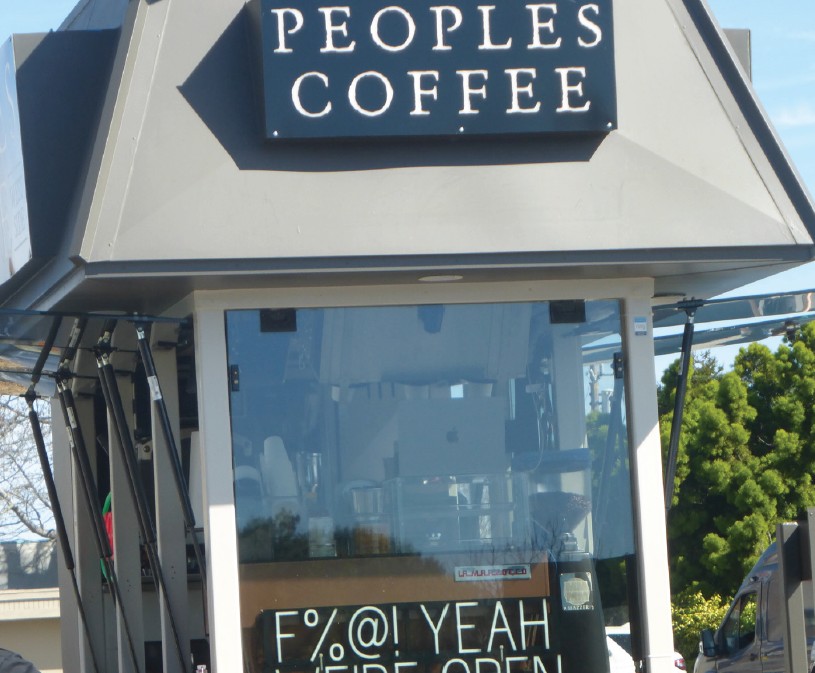
YES, WE’RE NOW OPEN Peoples Coffee at Mission Street and Almar Avenue speaks Santa Cruz. Love it. Photograph by Ross Levoy
GOOD IDEA
To strengthen college access and affordability, State Treasurer Fiona Ma, CPA, announced a coordinated initiative to help eligible community college students access their CalKIDS Scholarships.
State education leaders are leveraging existing student data systems to help community colleges pinpoint enrolled students who have CalKIDS Scholarships available to claim and use. The effort identified 40,000 community college students with approximately $20 million in scholarships available. Eligible California public school students automatically receive up to $1,500 in CalKIDS Scholarships. Info at Calkids.org.
GOOD WORK
After many years supporting the Capitola Library with a used bookstore at the Capitola Mall, the Capitola Library Friends bookstore is closing. The store opened in, 2018 and will close at the end of this month. Space for the shop was donated by the Mall.
“This support has enriched our programming and added to the long-term energy resilience of the library itself,” said Christopher Platt, Director of Libraries. The Capitola Library Friends initially focused on fundraising following the passage of Measure S to support the capital campaign for the Capitola Branch Library. With the completion of the library, the Capitola Friends set their next goal to fund the installation of solar panels and storage batteries.
QUOTE OF THE WEEK
“Wrong does not cease to be wrong because the majority share in it.” –Leo Tolstoy
Santa Cruz culinary legend Jozseph Schultz is trading the kitchen for Bali, guiding a food-focused journey through markets, temples and the deeper meaning of shared meals.
A recent notice about chromium-6 in local water has residents uneasy. But experts say the situation is more nuanced—and far less alarming—than it first appears.
Our skin is our largest organ. Our exoderm is an echo of our lifestyle choices, as all sun worshipers and sleep skippers eventually come to learn. Eating the right foods can make a big difference in the way you face the world.
In fact, research shows the Mediterranean Diet is consistently associated with slower skin aging, better elasticity, and fewer...
Virtuoso guitarist Charlie Hunter and vocalist Lo Steele bring groove, soul and fearless musical storytelling to Kuumbwa Jazz Center in Santa Cruz on March 16.
Legendary multi-instrumentalist Vicki Randle joins an all-star band celebrating the music of Sly and the Family Stone at Moe’s Alley, bringing decades of musical history—and hard-earned wisdom—to the stage.
A script falls from the sky in Matt & Ben, a clever comedy imagining how Matt Damon and Ben Affleck created Good Will Hunting. The two-woman show runs March 13–22 at Santa Cruz Actors’ Theatre.
Rob Brezsny’s Free Will Astrology offers poetic cosmic guidance for Aries, Taurus, Gemini and all zodiac signs, blending philosophy, humor and reflection for the week ahead.
Australian multi-instrumentalist Donny Benét brings his bass-driven “Infinite Desires” tour to the Catalyst, 1101 Pacific Ave., Santa Cruz, Sunday at 8pm.
The Watsonville Film Festival returns March 12–21 with more than 50 films across Watsonville, Salinas and Santa Cruz, celebrating “art as resistance” through powerful stories from Latine filmmakers.
Editor Brad Kava reflects on turbulent political times and highlights the Watsonville Film Festival along with a week of music, theater and culture across Santa Cruz County.