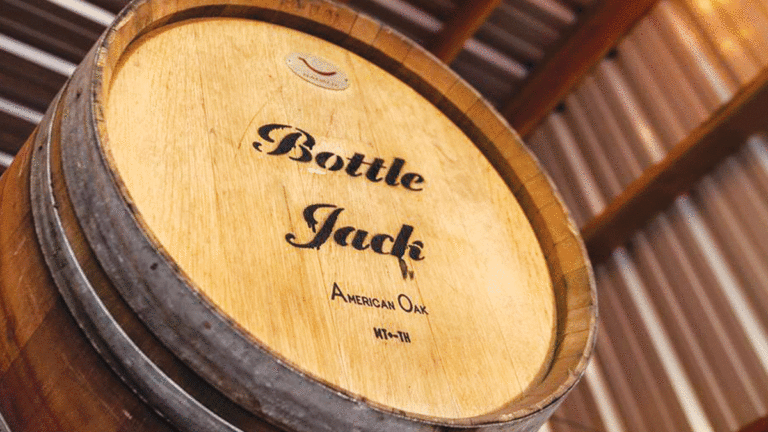
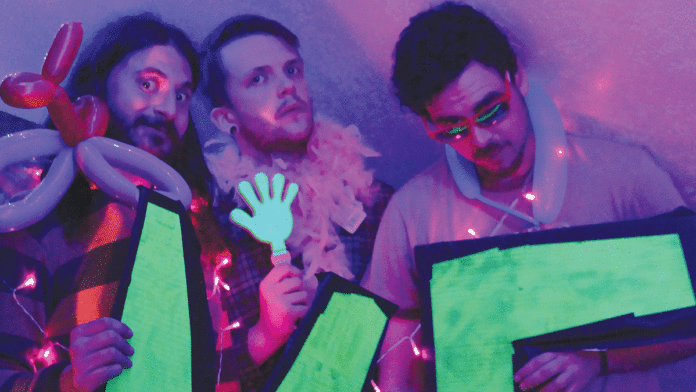
“Bottle Jack was founded on the idea of doing what we love and loving what we do,” says winemaker John Ritchey.
In partnership with his wife Katharine, their small family-run operation is turning out some very impressive wines. “It’s not our style to woo you with grandiose stories, fancy marketing lingo or extravagant terms of rare and exotic fruits, flavors or aromas,” Ritchey says. On the contrary, his wines are down to Earth and unpretentious.
The 2016 Firenze from Santa Clara Valley is one of my favorites. This luscious red is a blend of 71% Sangiovese, 25% Malbec, 2% Syrah, and 2% Merlot—a “super Tuscan blend,” Ritchey calls it. Laced with sour cherry, black raspberry, spiced plum, and cocoa, the Firenze ($30) has herbal notes of dill, oregano, tarragon, and tomato leaf. And the rich cherry pie mid-palate leaves a memorable fruity impression. It’s a bright and cheery wine to enjoy on any occasion.
Ritchey shares a tasting room with Silver Mountain Vineyards in the Swift Street Courtyard complex on Ingalls Street. How convenient to have an abundance of delicious wines to taste under one roof!
Ritchey is putting on a special event at 5:30 p.m. on Wednesday, May 29, for a Viognier seminar and tasting for $15 (RSVP required).
Bottle Jack Winery, 1088 La Madrona Drive (winery) and 402 Ingalls St. #29 (tasting room), Santa Cruz. 227-2288, bottlejackwines.com.
Forks Corks & Kegs
The first-annual Forks, Corks & Kegs festival promises to be a fun event in an even more fun location: the Kaiser Permanente Arena in downtown Santa Cruz. Presented by the Santa Cruz County Chamber of Commerce, look for local wineries, breweries, spirits, and restaurants serving up some tasty stuff. For more information on this June 1 event, visit santacruzchamber.org.
Muns Vineyard Tours
Ed Muns and Mary Lindsay are offering tours of their vineyard on June 2, 16 and 30. Enjoy springtime in their “vineyard in the sky” and dramatic views of the Santa Cruz Mountains and Monterey Bay. Contact ma**@**********rd.com or call 408-2342079 for reservations. Visit munsvineyard.com for more info.
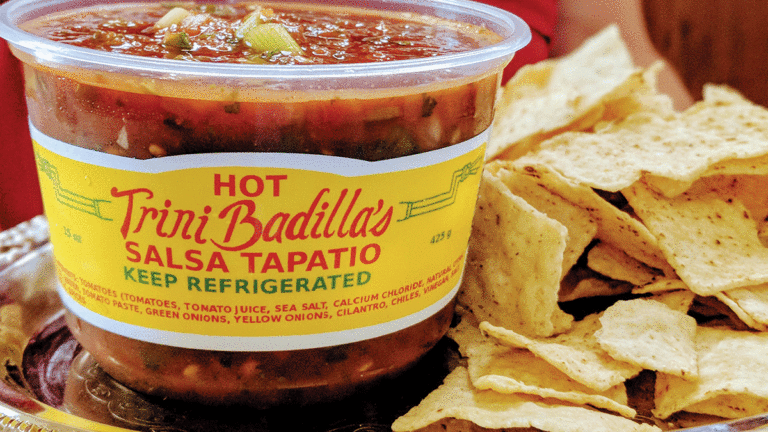
Trini Badilla’s Salsa is one of the longest-running locally owned salsa companies in the county.
It gets its name from the original owner’s great-grandmother, Trinidad Badilla, and has had a few owners since. Annie Daellenbach and her husband bought the company last year. They say it’s been a game of catch up getting the recipes just right and adapting to a commercial kitchen.
Why a salsa company?
DAELLENBACH: My husband and I both grew up in Santa Cruz, and when the opportunity to buy it came up, we really wanted it to stay local and keep moving forward. We are both cooks and foodies, and I love to work with ingredients that are really versatile. Salsa is a celebration food—everytime people are gathering they have a bowl of salsa, and it’s right in the middle of everybody, and I love that about it.
We learned how to make it and are just carrying it forward. It’s a dream of mine to have a greenhouse and be able to grow the peppers on site. We currently work with local distributors. We are happy to be able to bring Trini’s recipes to people 36 years later.
Did you ever meet Trini Badilla or her family?
I didn’t, no. It’s had several owners. The company is almost as old as I am. The very first owner of the company, her name is Jade, and Trinidad Badilla was her great-grandmother. We still use her recipes and methods to make the small-batch salsa, which is so special because it’s still honoring the past traditions. That’s kind of why we bought it. It was certainly a big part.
Do you have any new salsas you are hoping to release?
There are only three salsas right now. We do have a fourth, a green salsa, but it has never been in production or stores. We have the recipe and we will be getting it in stores, hopefully by this summer.
Trini Badilla’s Salsa will be at Forks, Corks and Kegs at the Kaiser Permanente Arena, 140 Front St., Santa Cruz, from 3-7 p.m. on Saturday, June 1. Their salsa is available at Staff of Life, Shopper’s Corner, New Leaf Markets and Safeways across the county. trinibadillas.com.
When the Redwood Mountain Faire brought Cracker and Dave Alvin to Roaring Camp as headliners in 2017, it drew a lot of people in Santa Cruz County who hadn’t realized that Felton has been home to a unique two-day festival for a number of years—or maybe hadn’t even been to Felton in the first place. Steering committee member Traci-lin Buntz says that beyond showcasing great music and raising money for a wide range of San Lorenzo Valley nonprofits (17 this year), that’s kind of the secret mission of the RMF, which celebrates its 10th anniversary this weekend.
“I think about it like it’s almost an open house,” says Buntz. “It’s a showcase for our area. Not just the physical beauty of the redwoods, but also the beauty of our community.”
That extends from the massive all-volunteer effort that makes the nonprofit Faire possible each year to the lineup of musicians. Even as the festival has begun to attract bigger groups, it continues to showcase bands from the area; this year, for instance, Americana favorite Jesse Daniel, cosmic honky-tonkers Edge of the West and Grateful Dead cover band the China Cats—who this year will play with Melvin Seals, a longtime member of the Jerry Garcia Band, as a headlining act—all perform Sunday. Also performing Sunday is Big Sam’s Funky Nation from New Orleans, led by Big Sam Williams, a former member of the Dirty Dozen Brass Band and founding member of the amazing Stooges Brass Band; Grateful Dead-adjacent Bay Area singer-songwriter Elliot Peck; Rainbow Girls; Felton Fillies and more. Saturday’s lineup is led by San Francisco bluegrass stars the Brothers Comatose, and also includes national-festival funkster favorites the Main Squeeze, L.A. Americana group Dustbowl Revival, local cover maniacs Coffee Zombie Collective and others. The Banana Slug String Band Duo returns to play the kids area both days.
The Redwood Mountain Faire will be held Saturday, June 1, and Sunday, June 2, at Roaring Camp, 5401 Graham Hill Rd., Felton. Tickets $25 advance/$30 at the door per day for adults, or $20 advance/$25 at the door for teens 13-17 and seniors 65 and over. Kids 12 and under free. redwoodmountainfaire.com.
Three levels into the game “Teenage Mutant Ninja Turtles: Turtles in Time,” the evil samurai Shredder makes his first appearance. “My patience is wearing thin,” the caped supervillain announces from within a sewer. “I’m banishing you to a time warp from which you’ll never return.”
The next instant, the dreaded Shredder emits a pattern of concentric circles from his forehead, forming a net around the Turtles. An aperture opens in the sky. Sucked in, our heroic reptiles are cast back through time, diverting them from their goal of defeating the evil brain Krang and returning the Statue of Liberty to its rightful place in New York Harbor.
But Shredder has been caught in a time warp of his own.
Though it was released almost 20 years ago, “Turtles in Time” has found a new home in the recent national arcade bar craze. In 2016, when Nintendo reissued the Nintendo Entertainment System as the NES Classic, it sold out instantly. Two years later, when they produced more copies, the humble device from 1983 outsold the XBox One, PS4 and Nintendo’s own Switch console. Arcade bars draw patrons who gleefully replay the titles they first mastered as preteens—only now they do so with a locally brewed IPA or craft cocktail in hand.
Born between the early ’80s and mid-’90s, the youngest members of the millennial generation are just getting out of college, while the oldest are buying homes, getting married and starting families. They are fully grown adults, with growing salaries and increasing amounts of expendable income. And all around the country, businesses, bars, and party promoters are cashing in on millennial nostalgia.
At the Santa Cruz Beach Boardwalk, the sound of the Free Friday Night Bands on the Beach concert series, which begins Friday, June 14, has always been nostalgic. It was ruled for many years by ’80s hitmakers like Eddie Money, Wang Chung and Berlin. But more recently, ’90s bands like Smash Mouth (June 21) and Everclear (June 28) have begun to take hold.
“I’ve noticed that the crowds have been bigger at our shows lately,” Smash Mouth bassist Paul Delisle tells GT. “I don’t know what the interest is, but I certainly wouldn’t have expected this 12 years ago.”
The phenomenon stretches beyond bars and live music. Recently, a French company called Mulaan opened a new plant for producing cassette tapes to capitalize on the slew of mainstream pop artists, such as Ariana Grande and Taylor Swift, who have been putting out albums on the retro format. Sony has issued a new Walkman (and, for that matter, Motorola a new flip phone). Even the music video style of the cassingle era is alive and well. Vampire Weekend’s recent “Harmony Hall” clip includes candlelit sets, a la Pearl Jam and Nirvana, and fish-eye camera shots straight out of “Mo Money Mo Problems.”
The past is back. So, in the words of 4 Non Blondes’ 1993 hit, “What’s going on?”
WARPED DAYS AND EMO NIGHTS
For Marcus Leonardo, founder of It’s Relative PR, becoming an event promoter was a natural transition—and so was tapping into millennial nostalgia. It’s been a part of his life since his days in bands, where he and his friends bonded over their love of emo and screamo, two genres that rose up out of the underground in the ’90s and found massive mainstream success in the 2000s.
“The nice thing is, this is music I grew up playing,” says 32-year-old Leonardo.
Leonardo sang in the emo band Roses For Ophelia, and filled in on vocals in screamo band Scary Kids Scaring Kids. By his count, he’s played three Warped Tours and two OzzFests. An L.A. native, Leonardo has been living in Sacramento for the past few years.
“Me and my friends would get together and listen to this music, either at our houses or at a party,” he says. “Eventually I thought, ‘Well, there’s enough of us; we can probably get a bar to play this music.’”
Their first venue was a small craft cocktail bar. Without a dance floor or a DJ booth, it was a plug-and-play night for Leonardo.
“I just curated a playlist and played it,” he says. “I didn’t really announce it. It was just for me and my friends. But word got out in Sacramento. Within two weeks of people knowing I was doing this, it went from like 12-14 people to 150.”
After outgrowing their first location, Leonardo relocated his emo nights to a dance club. They quickly outgrew that venue as well.
“I put the event up, and it was 1,000 people going to or interested at a bar that could fit 400 people,” he remembers. “Immediately. It was obvious that there was a need for this.”
PLAY IT AGAIN
By the time the Emo Night Tour started, promoters and fans all over the country had already caught on, or were beginning to pick up on the phenomenon.
Like many club nights, it started in New York and Los Angeles. Emo Night Brooklyn came first—followed by Emo Nite L.A., Long Island Emo Night, Emo Night Boston, and many more.
In 2017, the New Yorker described the phenomenon in an article titled “The Rise of Emo Nostalgia.” Writer Jia Tolentino astutely describes the music’s appeal: “There was a streak of playfulness in emo, but it was the genre’s spectacular sentimental indulgence that really got people on board. It also insured [sic] that emo’s biggest fans fell within a certain age range.”
“A lot of the people who come to our events are looking for the stuff they listened to in middle school, high school, college,” Leonardo says. “It is definitely a nostalgia trip for them.”
In fairly cynical terms, the New Yorker described this phenomenon by saying that, “Music made to help teenagers flail their way to adulthood provides an opportunity for adults to succumb to the histrionics of teendom again.”
Make no mistake, there are plenty of histrionics in the mainstream emo of the 2000s. Just look at any Dashboard Confessional lyric. But for Leonardo, it’s much more than that. All of this started out of a desire to share space with people who loved the same thing. It’s that desire for connection, and common ground, that he sees behind Emo Night Tour’s success.
“I’ve always felt like we’re disconnected as a generation,” he says. “Everything is social media, everything’s on your phone, your computer. A lot of people don’t do things together anymore. There’s a need to have a collective that comes together for something that they all love.”
RECLAIMED WOOD
Nostalgia comes around sooner or later for every generation. The Baby Boomers, it could be argued, perfected it—and are still at it. In 2017, the Monterey County Fairgrounds hosted the 50th anniversary of the Monterey Pop Festival, where contemporary acts mingled with musicians from the ’67 fest, when the Who trashed their amps and Jimi Hendrix torched his guitar.
In 2013, a study conducted by UCSC and Cornell found that young people form strong emotional attachments not only to the music they listen to while adolescents, but to the music their parents listened to when they were young as well. However, the fact that Leonardo kicked off his very first Emo Night at a craft cocktail bar highlights the uniquely patchwork nature of the nostalgia hitting this generation.
The resurgence of craft cocktails—which hit Santa Cruz in the last decade or so, and hasn’t let up—started in Manhattan in the 1980s, and can be traced to the reopening of the 1930s-era bar the Rainbow Room. After renovations, the bar took an esoteric approach and made the 1862 book How to Mix Drinks its bible. With the return of the classic cocktail, Manhattanites re-experienced something most living locals had never experienced in the first place.
That in 2019 we are paying almost $20 a pop for something conceived in the 1860s and revived in the 1980s is a little strange. Add to that the fact that today’s hip bars feature things like reclaimed wood from old barns and decaying craftsman homes; 1950s-esque, Alexander Girard-inspired wall patterns; LED-powered faux-Edison light bulbs; and bartenders who pair mid-’60s Don Draper hairdos with 19th-century Rutherford B. Hayes beards, and this generation’s style begins to look like a playthrough of “Turtles in Time,” each discrete era a different circle emanating from Shredder’s mind.
In 1981, this nostalgic mash-up was quantified by French philosopher Jean Baudrillard with his concept of the “hyperreal”—that is, the copy with no original.
“It is no longer a political economy of production that directs us, but an economic politics of reproduction, of recycling,” he wrote, as though from the future, in 1981. Already, in the 1980s Baudrillard saw hyperreality leading towards something he called “Absolute Advertising.”
“Today what we are experiencing is the absorption of all virtual modes of expression into that of advertising,” Baudrillard wrote. “All original cultural forms, all determined languages are absorbed in advertising because it has no depth, it is instantaneous and instantaneously forgotten.”
Fast forward to today. Viridian Wood, a restaurant supply company, is among the many businesses weaving vague homages to the past into mundane product descriptions. “Reminiscent of a bygone era, our all-American oak hardwood tables are reclaimed from time-worn barn siding,” the company’s website reads.
BEYOND THE POP PRINCIPLE
In recent years, a variety of news outlets have questioned the all-consuming nature of today’s nostalgia. In 2012, Slate used the subject as a springboard to ask, “Does the nostalgia cycle run on a 40-year cycle, a 20-year cycle, a 12- to 15-year cycle?” In the end, they concluded that, “Some cultural phenomenon can’t be explained away by simple rules.”
One constant across all these recent articles on nostalgia is a lack of introspection on the concept of nostalgia itself. Somehow nostalgia never warrants explanation. Rarely does anyone ask what it is, asking instead how it will appear, and when. But the “why” is perhaps most interesting.
The idea that nostalgia naturally occurs in every generation also seems supported by psychoanalysis. In 1920, while studying recurring dreams in patients with trauma, Sigmund Freud proposed that life is always driven to return to an earlier state.
“The manifestations of a compulsion to repeat,” he wrote in his essay Beyond the Pleasure Principle, “which we have described as occurring in the early activities of infantile mental life, exhibit to a high degree an instinctual character.”
In this “compulsion to repeat,” Freud saw something massive: an “urge inherent in organic life to restore an earlier state of things, which the living entity has been obliged to abandon under the pressure of external disturbing forces.” This instinct, he went on to suggest, is our earliest one, preceding impulses for pleasure, sex and companionship. Put simply, it is “the instinct to return to the inanimate state.” Freud dubbed this instinct “The Death Drive,” proposing it as one of the two competing forces at work in every person.
Despite this idea that people are always driven to return to an earlier time, nostalgia as a concept is a very recent phenomenon, and one with a very particular history.
First proposed in 1688 by Johannes Hofer, the term “nostalgia” is a mix of the Greek words nostos, meaning “homecoming,” and algos, which means “pain” or “longing.” Put simply, a “longing to return home.” At the time he coined this now-familiar term, Hofer was a 19-year-old French medical student living near the Swiss border.
A “longing to return home” sounds a lot like the nostalgia of “Nites,” like 90’s Nite and Emo Night, but Hofer’s nostalgia wasn’t just a desire to listen to music from your teens. For him, nostalgia was a full blown disease. One that, untreated, could even be deadly.
’90s ALL STARS Smash Mouth is one of the bands enjoying a comeback as part of pre-Y2K throwback events.
The subject of a new book by Columbia University professor Thomas Dodman, What Nostalgia Was, exposes the odd, often-contradictory history of nostalgia, beginning with its initial proposal as a deadly malady.
“In an advanced case, blood would begin to thicken and clot, hindering circulation and affecting the heart,” Dodson writes, citing Hofer’s original medical text, Dissertatio medica de nostalgia, oder Heimwehe. “If nostalgia was allowed to fester untreated, the ‘consumption of the spirits’ and inexorable weakening of the body would hasten death by exhaustion.”
Today, “death by nostalgia” seems laughable, but without it we likely wouldn’t know the word at all. It was only after making the rounds as a curiosity that nostalgia entered the public consciousness. Among 18th-century elites, Hofer’s medical text became a hit, a regular point of discussion in literary salons where people gathered to discuss recent ideas. There, nostalgia emerged into “a broader audience of Enlightenment figures intrigued by astonishing stories of ‘death by nostalgia,’” Dodson writes. Along the way, it evolved into the more benign, romantic notion we have today.
Central to Hofer’s original medical work is the fact that nostalgia was first seen as a Swiss disease, one primarily affecting mercenaries, paid soldiers from Switzerland fighting in the many armies of a war-torn Europe. Though causes of nostalgia were attributed to a variety of sources (a sudden change in climate, an imbalance in the body’s “humors,” the “symptom of a disordered imagination”), there was one constant in the lives of all its earliest sufferers: war.
“Nostalgia,” Dodson writes, “came into being upon the rapidly expanding and ever-more-gruesome battlefields of 18th-century Europe.”
THE 9/11 EFFECT
Around 2010, College of Saint Rose professor Karen McGrath began to notice a change in her classroom.
“It was the way in which we had to engage the students. We couldn’t rely so much on strict lectures anymore,” she says. “It had to be much more interactive.”
Sensing a generational shift, McGrath began looking into what people had begun to call “millennials.” Right away she saw fingers pointed, grievances aired. Millennials were killing industries, killing social niceties—even killing the family.
“The assumptions people were making about the millennial generation, we kind of disagreed with them, because they didn’t describe the kind of student we had in our classrooms,” McGrath says.
Setting out to correct the narrative, McGrath and her fellow professor Regina Luttrell decided to make millennials the subject of their own research. In 2016, they published The Millennial Mindset: Unraveling Fact From Fiction. In millennials, McGrath and Luttrell found a generation capable of great personal engagement, one much more willing to share their own experiences than previous ones had been, all while having hundreds of new distractions competing for their attention.
“With Gen X, for example, we didn’t have the internet growing up,” McGrath says. “We didn’t have social media at their age. I think that makes a difference. They’re growing up so much faster because they’re exposed to so much more earlier on in life.”
While researchers usually try to pin generations to year of birth (Baby Boomers 1946-1964, Gen X-ers 1965-1980), McGrath and Luttrell focused more on specific events.
“What we discovered in our research is that there were always these certain historical events that happened during someone’s childhood that really impact how they see the world, and what they want from the world,” McGrath says. “We think that 9/11 had a big impact on millennials, because that event was really when people realized they needed to be in touch with each other more regularly, because the world is a dangerous place.”
Highlighting 9/11 brings up a crucial point: The millennial generation is the first in modern American history to only know their country at war. Since 9/11, America has spent more than $6 trillion on war, engaging in conflicts in Iraq, Syria, Yemen, Libya, and Afghanistan—the latter of which is now seeing its second generation of soldiers. War, for the American millennial, is in the background at all times, fought by family members and friends, discussed on TV, embedded in online news clips, and increasingly figuring in fiction (Captain America: Civil War, Avengers: Infinity War, and its sequel Avengers: Endgame, to name just a few). It is no coincidence that Thursday, one of the biggest emo bands of the 2000s (and one of the heaviest hitters at Emo Night) titled their 2003 album War All the Time. In an interview given after the record’s release, singer Geoff Rickly said, “On the news every day there would be all these things about the war going on, and that terrified me.”
For millennials, war spills into every part of our lives, whether in the form of cyber wars, municipal police departments outfitted with military grade weaponry and heavy equipment, war advocates like John Bolton enjoying positions in a second White House administration, or weapons of war used in mass shootings.
This last item is especially difficult to overlook. At a recent ’90s Nite over the hill in San Jose, a woman near me screamed—not a whoop, not a shout, a full-blown scream. As it turns out, she was just excited because she had heard the opening notes of the Backstreet Boys’ “I Want It That Way,” but in a post-Columbine, post-Las Vegas, post-Pulse, post-Parkland world, I am increasingly aware of my surroundings in public. For a moment, that scream put me on edge.
In 2018, Business Insider found that Americans are now more likely to die in a mass shooting than from most traditional “fears.” Shark attacks, dog attacks, lightning strikes, tornadoes, cataclysmic storms, poisonous venom, accidents on public transportation, and attacks by foreign-born terrorists are all less likely causes of death (four times so, for that last item).
Surrounded by so much violence, era-themed events like Emo Night are an outlet for millennials—a way to cope. And advertisers are acutely aware.
One article in Forbes says it all.
“Aligning marketing strategies with emotion has already proven to be successful, but tapping into fond memories can be an invaluable tactic, especially for engaging millennials. Share a compelling blast from the past with a millennial and you’re likely to reach them on an emotional level—the holy grail of brand marketing.”
THE BLACK PARADE
A little before midnight at 90’s Nite, the Luniz’s “I Got 5 On It” erupts from the speakers. Today, under a gutted Affordable Care Act, it is hard not to hear the song in the context of a GoFundMe drive to cover a stranger’s medical bills.
“I would think that nostalgia would be very important to millennials,” McGrath says. “They’re really forced to grow up more quickly than before, so why not look back on some of the things that made us happy? Music in general can really help people connect to an important time in their lives. That nostalgic feeling gives us a moment to break away from the adult world a little bit and remember our youth.”
For Leonardo and the Emo Night Tour, breaking away from the adult world is exactly what they offer. But it’s not about avoiding responsibility; it’s about coming together.
“Almost every one of our events that we do, we have like a ‘Kum Ba Yah’ moment where we stop the music and we pull everybody in real close. We make sure that everybody is together—whether we have 300 or 1,000 people in the audience—and we all sing My Chemical Romance’s ‘Welcome to the Black Parade’ together. I mean full on, with sing-along and balloon drop and everything you can think of. That is kind of the pinnacle of our event.”
My Chemical Romance singer Gerard Way stated in 2005 that seeing 9/11 caused him to start the band. “Something just clicked in my head that morning,” he told Spin magazine. In the music video for “Welcome to the Black Parade,” a woman wearing a gas mask is known only as “Mother War.”
In its earliest hours, nostalgia was born out of a continent at war. For a generation where war is always in the background (and War All the Time is often on the stereo), it should be no surprise that millennials are seeking comfort in the past.
Back at 90’s Nite, a man on stage mimes playing the bass to Green Day’s “Longview.” A slow-burner, the song builds for almost three minutes before it reaches its climax: “When masturbation’s lost its fun, you’re fucking breaking.” Many in the crowd sing along, hopping up and down during the chorus that follows.
To the New Yorker, this might seem like the height of regressive, responsibility-denying teensploitation. But here’s the rub: Millennials as a generation are increasingly precarious, disconnected, marginally employed and overworked in a world constantly at war. And thanks to the burgeoning gig economy and the rise of telecommuting, work is now 24/7 without even the comfort of living, breathing coworkers. To one day be as free as Billie Joe Armstrong was in the ’90s is a millennial’s dream.
We may be going down. But—like Turtles cast back through time on an impossible quest to return to our own era—sugar, we’re going down swinging.
Growing up in Watsonville, brothers Brando and Kristian Sencion always noticed a void in their agricultural hometown.
“There’s nothing to do,” says Brando Sencion, a 26-year-old Watsonville High alum and staffer at the nonprofit Santa Cruz Community Ventures. “We’ve always gotta drive somewhere else.”
After years of traveling to nearby cities to try new food or find ways to entertain themselves, the Sencions set out last year to open their own local pizzeria and craft beer taproom called Slice Project. With older brother and chef Kristian, 30, planning the menu, the duo is shooting for a late-summer opening in downtown Watsonville’s 1920s-era Fox Theatre building—and they’re not alone in their quest to jumpstart the city’s sleepy commercial scene.
If all goes according to plan, Watsonville soon won’t just be distinguished by newcomers like Slice Project, Beer Thirty offshoot Beer Mule, the year-and-a-half-old Foreverfly Skate shop, and growing tech-job-training nonprofit Digital Nest. The city is also pursuing multiple avenues to add housing, improve local walkability and redirect planning resources to central neighborhoods that struggle to draw steady foot traffic.
“The city has been really stepping up,” Brando Sencion says, mentioning plans to reduce auto traffic on Main Street, expand sidewalks and add bike lanes downtown. “All that really excites us, because we’re gonna be in the heart of it.”
Reversing years of disinvestment is a tall financial order, but there are also questions like whether revitalizing downtown will exacerbate already fast-rising costs of living and concerns about gentrification. The median price of a home sold in Watsonville has jumped more than 60 percent in the past five years, to about $605,000 at the end of last year, according to real estate data site Zillow.
Beyond that, there’s the issue of reconciling the city’s reputation as a car-centric bedroom community with ambitions of adding new attractions reachable by bike or on foot. As of 2015, Watsonville was California’s most dangerous small city for pedestrians, when state traffic data showed that 39 people were killed or injured on city streets that year.
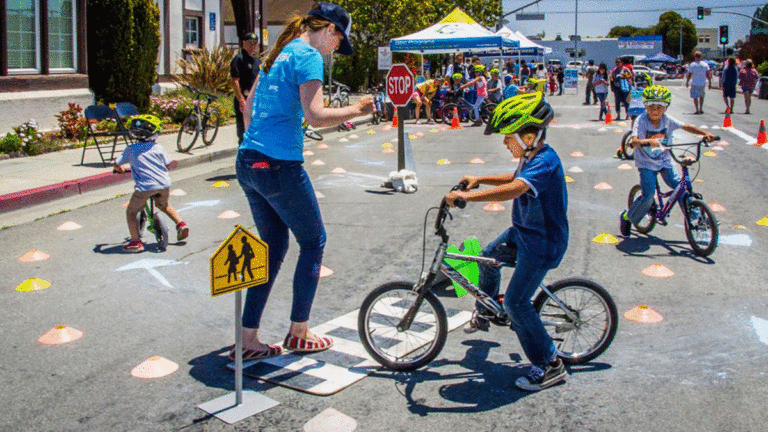
In January 2018, the city was the first in the county to sign onto a nationwide “Vision Zero” plan to end traffic fatalities. This weekend, on Sunday, June 2, the nonprofit Bike Santa Cruz County will host its fourth Open Streets Watsonville, featuring a kids’ bike safety rodeo and community organizations in a South County version of the event started on the Westside of Santa Cruz.
The entire county has “very blatant issues” with pedestrian safety, says Eric Guerrieri, event director for Bike Santa Cruz County and Open Streets. Though finding up-to-date crash data can be a challenge, the county tracked 197 bicycle injuries and deaths during the last full year on record in 2013, along with 98 pedestrian injuries or deaths.
“Open Streets may be a fun pop-up park, but it is something that we hope will raise awareness,” Guerrieri says.
At least two pedestrian deaths in Watsonville have been reported so far in 2019 as the city reviews plans to add or expand bike lanes on Main, Rodriguez, Lake, and Beach streets. Also on the table are proposals to remove one lane of auto traffic in each direction on Main and Rodriguez streets, and to alter area parking as part of a “downtown complete streets” initiative, for which Watsonville was awarded a $250,000 state grant in 2017.
“As long as it’s just a route for cars on their way to somewhere else, it will never be a community-oriented downtown,” one student wrote in a letter to the city council earlier this month. She described biking downtown as a “crazy, loud, polluted and scary experience.”
At the same time, the city is also grappling with deeply rooted questions about how to fit into a fast-changing Central Coast.
“Truthfully, gentrification worries me,” wrote Watsonville Mayor Francisco Estrada in a recent Santa Cruz Sentinel column. Estrada, a political newcomer, was elected to the city council last fall on a platform of reviving the city without pushing out longtime residents. Redevelopment, Estrada wrote, “must be an inclusive process.”
For the Sencion brothers, carving out a niche in the changing city is a long time coming. Kristian in the past sold pastries like donuts and cinnamon rolls at farmers markets in neighboring cities such as Monterey. Now, Brando says the brothers plan to hire other Watsonville residents and buy local ingredients, and they hope other businesses considering a Watsonville outpost will do the same.
“We’re not trying to make Watsonville something it’s not,” Brando Sencion says. “We want to definitely keep its character and integrity.”
For more info on Slice Project, search Slice Project Pizza on Facebook or Instagram. Open Streets Watsonville will take place Sunday, June 2, from 11 a.m.-4 p.m. around Union and Brennan streets. Free. scopenstreets.org/watsonville.
As skepticism grows around the idea of building more parking downtown, a new subcommittee will crunch the numbers and study lots of math.
One transportation expert steering community opinion has been Patrick Siegman, a former planner for Nelson\Nygaard, which frequently works with the city of Santa Cruz.
Siegman doesn’t think downtown Santa Cruz needs a new garage; he gave a presentation laying out his argument at a City Councilmeeting, and wrote a guest commentary in the Santa Cruz Sentinel. Rick Longinotti has been citing Siegman’s analysis ad nauseum, like a UCSC student reciting Bob Marley lyrics at his first party.
What no one’s talking about here—and what Siegman hasn’t been mentioning, either—is that he was fired from his planning job by Nelson\Nygaard. (Siegman told GT in the fall that the company cut him only after he developed repetitive stress issues, which slowed his pace of work, but Nelson\Nygaard hasn’t confirmed that.) Let’s maybe lay off trying to oversell his policy-wonk cred.
RIDING ON THE ISSUE
Jump Bikesis expanding in Santa Cruz, and the latest round of electric bicycles from the bike-sharing company features a more intuitive built-in lock and a QR code that would seem to make taking a bike for a ride easier than ever.
Unfortunately, the process is beset by glitches, as the Jump phone app gets merged with the one for parent company Uber—the sleazy, beleaguered the ride-hailing business, which bombed its recent public offering while employees partied hard at corporate offices, making its notoriously toxic workplace sound worse than ever.
At least the city’s transportation officials are taking complaints about improperly parked bikes seriously. Jump has suspended 120 user accounts for repeatedly parking bikes inappropriately (i.e. blocking sidewalks), according to a report from Transportation Planner Claire Fliesler at an April council meeting. Anyone who sees a poorly parked Jump bike can email su*****@******es.com with the time of day and bike number.
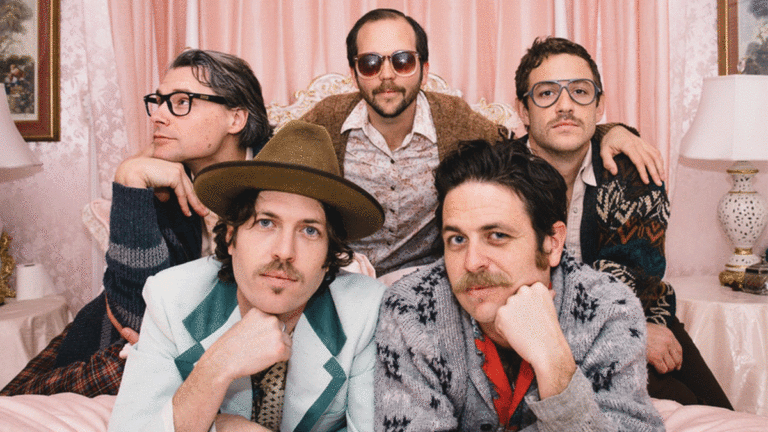
Portland-based Millennial Falcon is a band and a comic book series. They are also currently being pursued for their nearly finalized trademark application by Lucasfilm and its parent company Disney. Band leader Captain Contingency—part artistic savant, part prankster—trademarked the name to see how far it would get. Low and behold, when their application was in the final stages, some lawyers at Disney saw it and sent them a cease-and-desist letter. The dispute has now been going for a year.
The craziest part of this story isn’t that Disney is a ruthless hawk about anything that remotely resembles their own tightly held trademark, but that Millennial Falcon have been savagely parodying the very concept of large corporate takeover in their music and comic books since before this whole lawsuit started.
“This parody has become not only real life, the corporations have played into this parody and created this new reality in our world,” says Captain Contingency. “The fact that they’re playing right into the parody that we created from the start, it’s mind-blowing.”
That’s only a taste of how delightfully strange Millennial Falcon is. What does it even mean for a project to be both a band and a comic book? Well, it literally means that it’s a band that tours and plays high-energy, offbeat indie rock songs, but also a comic book series. The comic book features exaggerated versions of the band, and the band plays songs that roughly relate to the content in the comic books. It all meshes nicely.
In the world of comic books, corporations are the largest powers in the galaxy. Captain Contingency imagines a real-world version of Star Wars’ trade federation, and imagines that in reality it would probably be corporations running the galaxy.
The band’s spaceship in the comics, the intentionally terribly-named Millennial Falcon, is powered by music, which is illegal. This terrible name helps hide this ship. Captain Contingency and other galaxy washups who have been exiled from music by its governing Musical Space Empire, illegally travel the galaxy in search of freedom of self-expression. It’s kind of a crazy storyline, but it’s a lot of fun.
“It parallels what’s going on in this very real world,” says Captain Contingency. “We live in this post-ironic world right now where the sense of humor is lost, and everybody is up in arms all the time. It’s something that’s necessary to do, create something that makes you happy and makes people laugh—throw the monkey wrench into whatever. It sounds like small potatoes, but it’s not.”
The project began in 2016. Contingency and aspiring novelist Chris Castro started Fake Publishing Millionaires in 2014 to sidestep the industry. They released novellas and comics, mostly digitally. As of 2015, Captain Contingency started publishing his short stories and novellas with comic books and musical accompaniment. A year later, Millennial Falcon was created. The band Gorillaz was an inspiration for the format-breaking approach to music. “I always read comic books while listening to music myself. I think a lot of people do. There’s a lot of stuff that music can be involved in,” Contingency says. “We decided we would use it as a way to parody these giant corporations, which control art and all these other facets of our lives.”
One thing he didn’t want to do when creating this project was to create over-the-top characters. When Millennial Falcon performs, the show has crazy DIY performance art elements and handmade props and costumes, but the band members are themselves.
“We try to bring realism to everything—as opposed to being Gwar or the Aquabats. You can’t really have a tender moment with one of the Aquabats,” Contingency says. “They’re putting you on half the time. Not that I don’t love both of those bands. You become your character and then you have to stay that character.”
So far the band has released Millennial Falcon Comics Issue #0, a demo tape featuring an array of different artists and mediums. Issue #0 coincides directly with 2017 EP Hikikomori. The group’s newest album, Sativa Chemtrails, will be connected to the upcoming Issue #1. Millennial Falcon will be on tour promoting the presale of this Millennial Falcon Comics #1/Sativa Chemtrails bundle, expected out later this summer.
It sounds like a lot to take in, but live, it’s basically a great rock band that connect
with people through their music.
“We get up there and say, ‘We’re a spaceship powered by music, let’s just go,” Contingency says. “Sometimes people connect to the stage and they’re like, ‘Oh, you got a comic book?’ and they’re into that. If I try to talk to about comics and people aren’t into it, if they don’t like it, we’re probably not going to win them anyways. We just keep moving.”
Millennial Falcon performs at 9 p.m. on Wednesday, May 29, at the Crepe Place, 1134 Soquel Ave., Santa Cruz. $8. 429-6994.
ARIES (March 21-April 19): In the coming weeks, it will make good sense for you to travel down winding paths replete with interesting twists and provocative turns. The zigzags you’ll be inspired to pursue won’t be inconvenient or inefficient, but rather will be instrumental in obtaining the healing you need. To honor and celebrate this oddly lucky phase, I’ll quote parts of “Flying Crooked,” a poem by Robert Graves. “The butterfly will never master the art of flying straight, yet has a just sense of how not to fly: He lurches here and here by guess and God and hope and hopelessness. Even the acrobatic swift has not his flying-crooked gift.”
TAURUS (April 20-May 20): Has a part of you become too timid, docile or prosaic? Is there an aspect of your beautiful soul that is partially muzzled, submissive or housebroken? If so, now is a favorable time to seek an antidote. But listen closely: the cure isn’t to become chaotic, turbulent and out of control. It would be counterproductive to resort to berserk mayhem. Here’s a better way: be primal, lush and exciting. Be wildly playful and unpredictably humorous and alluringly intriguing. Try experiments that rouse your rowdy sweetness, your unkempt elegance, your brazen joy and your sensual intelligence.
GEMINI (May 21-June 20): I prefer live theater over movies. The glossy flawlessness of films, accomplished by machines that assemble and polish, is less emotionally rich than the direct impact of live performers’ unmediated voices and bodies and emotions. Their evocative imperfections move me in ways that glossy flawlessness can’t. Even if you’re not like me, Gemini, I invite you to experiment with my approach for a while—not just in the entertainment you choose, but in all areas of your life. As much as possible, get your experience raw and unfiltered.
CANCER (June 21-July 22): I’ve got a message for you from Cancerian poet Tyler Knott Gregson. Please read it every day for the next 15 days, including when you first wake up and right before sleep. Here it is: “Promise me you will not spend so much time treading water and trying to keep your head above the waves that you forget, truly forget, how much you have always loved to swim.”
LEO (July 23-Aug. 22): In 2003, a group of thieves in Antwerp, Belgium pulled off the biggest jewelry heist in history. To steal the diamonds, gold and other gems, together worth more than $100 million, they had to outsmart security guards, a seismic sensor, a protective magnetic field, Doppler radar, infrared detectors, and a lock. I mention this, Leo, because I suspect that in the coming weeks you will have a comparable ability to insinuate yourself into the presence of previously inaccessible treasures and secrets and codes. You’ll be able to penetrate barriers that have kept you shut off from valuable things. (P.S. But I hope that unlike the Antwerp thieves, you’ll use your superpowers in an ethical manner.)
VIRGO (Aug. 23-Sept. 22): In the northeast corner of Spain, bordering France, is an area known as Catalonia. With its own culture and language, it has a long history of seeking complete autonomy. On four occasions it has declared itself to be independent from Spain. The most recent time was in 2017, when 92% of Catalans who voted expressed the desire to be free of Spain’s rule. Alas, none of the rebellions have succeeded. In the latest instance, no other nation on Earth recognized Catalonia’s claim to be an independent republic. In contrast to its frustrated attempts, your own personal quest to seek greater independence could make real progress in the coming months. For best results, formulate a clear intention and define the precise nature of the sovereignty you seek. Write it down!
LIBRA (Sept. 23-Oct. 22): A Libran blogger named OceanAlgorithms wrote, “I’m simultaneously wishing I were a naturalist whose specialty is finding undiscovered species in well-explored places; and a skateboarding mathematician meditating on an almost-impossible-to-solve equation as I practice my skateboard tricks; and a fierce forest witch who casts spells on nature-despoilers; and a gothic heroine with 12 suitors; and the sexiest cat that ever lived.” I love how freewheeling and wide-ranging OceanAlgorithms is with her imaginative fantasies. In light of current astrological omens, I encourage you to do the same. Give yourself permission to dream and scheme extravagantly.
SCORPIO (Oct. 23-Nov. 21): Geologists aren’t exactly sure why, but almost 6 million years ago, the Strait of Gibraltar closed up. As a result, the Mediterranean Sea was cut off from the Atlantic Ocean, and within 1,000 years, it had mostly disappeared. Fast forward 600,000 years. Again, geologists don’t understand how it happened, but a flood broke through the barrier, allowing the ocean to flow back into the Mediterranean basin and restore it to its previous status as a sea. I propose that we invoke that replenishment as a holy symbol for the process you’re engaged in: a replenishment of your dried-out waters.
SAGITTARIUS (Nov. 22-Dec. 21): I invite you to meditate on this proposal from freelance writer Radha Marcum: “The spiritual definition of love is that when you look at the person you love, it makes you love yourself more.” I hope there’s a lot of that kind of action going on for you in the next four weeks. According to my assessment of life’s secret currents, all of creation will be conspiring to intensify and deepen your love for yourself by intensifying and deepening your love for other people. Cooperate with that conspiracy, please!
CAPRICORN (Dec. 22-Jan. 19): Is there a creature on earth that’s more annoying than the mosquito? I’ve never heard anyone gaze upon one of the pesky monsters sucking blood out of her arm and say, “Aw, what a cute little bug.” And yet every year, there is a town in Russia that holds a jokey three-day celebration in honor of the mosquito. The people who live in Berezniki even stage a “most delicious” competition, in which people allow themselves to be pricked by mosquitoes for 20 minutes, with an award going to whomever accumulates the most bites. I highly approve of the spirit of this approach for your own use in the coming weeks, Capricorn. If you have fun with the things that bother you, I bet they won’t bother you as much.
AQUARIUS (Jan. 20-Feb. 18): It’s the Forever Season, Aquarius. You have a poetic license to act as if your body will live for 100 years and your soul will live for all eternity. You are authorized to believe that in the coming decades, you will grow steadily wiser, kinder, happier, and wilder. During the Forever Season, you may have dreams like flying over a waterfall at sunset, or finding the lost magic you were promised before you were born, or discovering the key to healing you feared would always elude you. As you careen through this unpredictable grace period, your understanding of reality may expand dramatically. I bet you’ll get practical epiphanies about how to express yourself with greater effectiveness.
PISCES (Feb. 19-March 20): A musical historian from Cambridge University decided that it would be amusing to perform forgotten songs that were written in the Rhineland 1,000 years ago. His research wasn’t easy, because musical notation was different back then. But he ultimately reconstructed the tunes in ways that he felt were 80% faithful to the originals. He and other musicians subsequently performed and recorded them. I propose a somewhat comparable assignment for you in the coming weeks, Pisces. You will benefit, I believe, from trying to recover the truth about events that occurred a long time ago, and/or by trying to revivify old beauty that has new relevance.
Homework. Finish this sentence: “The one thing that really keeps me from being myself is _______.” Testify at tr**********@***il.com.
Not to be outdone by the burst of food, wine and retail expansion in Aptos, the Westside of Santa Cruz continues to amaze and delight its growing fanbase. I am hearing preliminary wows for even these early days at Vim on Mission Street. And now Sean Venus emails to tell me that his mighty Venus Spirits has finalized plans for a new 11,500-square-foot warehouse in the Delaware Addition.
The new location, next to the current Swift Street distillery and tasting room, will be able to produce and barrel-store up to 50,000 cases annually. But for those with inquiring taste buds, the real news is that the expansion will house Venus Spirits Cocktails and Kitchen, a new restaurant space that will be sculpted into sophisticated shape by Stripe Design Group.
A new innovative dining spot on the Westside sounds just fine to me, so here’s the deal. Venus plans a 100-seat restaurant focused on his brand’s spirits, plus cocktails made with them, complemented by creative snacks, small plates, salads and shareable entrees. After two years of planning, construction has finally begun. “I am so excited for the next phase of our business coming to life,” Venus says. “This new space will not only allow us to meet a growing demand for our spirits, but will allow us to deepen the connections with our community.” The target opening date for the new restaurant and distillery is winter/spring 2020.
To avoid the sorts of missteps made by others who tried to balance premium libation production with fine dining, Venus says he approached the new project, “based on what succeeds in our current operation. And that is a focus on distilled spirits and cocktails. The kitchen will be there to support the cocktail program and help educate people about our spirits. The atmosphere will be high end, but the food will be very approachable.” Venus admits that, “While we are a bit nervous about managing a restaurant, I see the biggest challenge—more even that our ability to win the public’s affection—is managing a far bigger staff than we currently have.”
Asked about the projected menu, Venus explained that while marketing his spirits over the last five years, “I have visited hundreds of restaurants across California, and there were lots of takeaways from these visits. I looked at cocktail menus, studied food offerings and took notice of the overall aesthetic in these establishments.” He plans to incorporate what he’s learned into the game plan of Venus Spirits Cocktails and Kitchen. So far, there’s no chef on board, but Venus says he’s looking for someone, “highly skilled, someone who shares our vision of simple foods prepared to perfection, and who can successfully manage a team.” That does sound like kitchen perfection, and I know he’s not the only restaurateur hoping to find that ideal person.
Part of the momentum for the Venus expansion came from the obvious—the need for more space: “We are currently busting at the seams, and this new space will allow us room to grow.” The man who makes exceptional gins and other hand-crafted, botanical-infused spirits maintains that he’s “still very focused on distribution, and this facility will allow us to make and store more product for the growing demand. The restaurant is designed not just to serve cocktails and food—we’ll also serve wine and beer, too—but allow us to bring our story directly to a lot more people.” And I thought there wasn’t a restaurant, café or saloon left in California that didn’t serve Venus Spirits.
We have two festivals this week, each a different developmental stage for humanity. The first, on Thursday, is the Ascension (Catholic, Pisces Age of love, hope, vision), the mountaintop experience in which the Christ (Pisces World Teacher) returned to the Father. (His Reappearance is said to begin in 2025). The Resurrection/Ascension Initiation (also our Initiation) is the theme of the three Spring festivals (Aries, Taurus, Gemini). We (the New Group of World Servers, NGWS) are preparing these days for the Gemini Festival of humanity on June 17.
Three energies are called forth at these three festivals—the Forces of Restoration (Aries), Illumination (Taurus) and Reconstruction (Gemini). The energies we call forth at each of the festivals, and the preparations we do together as part of the NGWS (outpost of the Hierarchy), are the energies that uplift and stabilize humanity, providing ideas that become great ideals within humanity. The new ideals lift humanity up so we can “ascend” into our true identity—that of World Disciples.
Monday is the new moon festival, 12 degrees Gemini. This new moon prepares us for the Gemini Festival of Humanity, occurring in two weeks, when the Forces of Reconstruction stream into the Earth. The Gemini festival is also the Festival of Distribution of intelligence, love and wisdom. Humanity awaits these events.
ARIES: Your main gift has been instinct, a practical way of being. However, intuition, a higher level of instinct, is emerging. It provides you with greater inner strength and a new faith. Many will be surprised as you become more easygoing, compassionate and concerned for others (not just yourself). A greater belief in yourself also comes forth, due to an anchoring of new spiritual ideals. Your new spiritual identity deepens. Don’t let divine discontent topple you.
TAURUS: Idealism is part of your nature, along with adaptability and flexibility. These virtues develop further in coming years. As you attempt to always keep the peace, you might discover you’ve lost awareness of your deepest hopes and wishes. You are to call them forth again. Connections with friends must always have a spiritual basis or you feel discontent. You are to develop all the arts. Why? Taurus personifies the art of living.
GEMINI: What does your intuition tell you about current world trends in business, the arts, humanity, education, politics? In coming years, you will develop a deep creativity and vision leading you to the arts, the media, writing, talking of things charitable, and of service. Work on maintaining a clear direction, lest goals and your calling in life are lost. You’re better than perfect. And you’re responsible. Know these things. Allow no misconceptions of self to be nurtured.
CANCER: It’s important to be practical with goals. You have a deep inner faith. It’s good to consider what you believe and why. Where did these concepts come from? It would be good to study different religions, or to even enter a seminary, becoming a minister or pastor. Higher education offers involvement with religious, philosophical or artistic fields. Travel beckons, too, but here you must be careful health-wise. Compassion becomes your teacher.
LEO: Are you experiencing spiritual longing, deep sensitivity, fantasies, ecstasy, warrior dreams? If not now, later. In the meantime, something from the past—a relationship, love, person, event—seems to be important once again. However, you choose not to contact or connect with them—a mistake. Where before the boundaries were blurred, you both have grown. Boundaries are intact now. Careful with money. Give it, don’t loan it. Love more.
VIRGO: So often, Virgo gives more than they’re able to receive. They seek a soulmate, one linked to them psychically. They see potential instead of reality at times, seeking others as they wish them to be, not as they are. Sometimes Virgos want to save or be saved (from themselves). These are all developmental stages. They can be confusing and difficult to understand (for a time), until you realize your potential extraordinary talents.
LIBRA: Daily plans, agendas and affairs (work) become so fluid that you may not know where you are at times. All routines seem to float out the door, replaced by chaos, confusion and a sense of helplessness. Know that when chaos appears, it’s announcing a new harmony attempting to come forth. Rearrange everything in your environments. Tend to health methodically. Interact with the animal, plant (nature) and mineral kingdoms with loving awareness. They bring a new order into your life.
SCORPIO: When people use the word drama, it’s usually disapproving, critical, disparaging, unsympathetic, and judgmental. However, some signs truly have ceaseless dramatic things occurring. We actually have little choice in the matter of our lives and behaviors. We have little choice in how people react and/or respond to us. Those experiencing drama in their lives are living life deeply, fully, creatively and with passion. It’s just their time. Your time is always.
SAGITTARIUS: Was home and family life as a child complex? Were (are) you sensitive, free-spirited, idealistic, philosophical? Do you need at this time to set limits? Do you long for a new home and sense of place? Do you alternate between being social while also seeking solitude? Do you at times isolate yourself? Is family challenging? And do you have many inflated dreams? A new identity will appear in the next 18 months, along with a new path.
CAPRICORN: Visualize all that you want to be and do—your future, where you’re called to live, the interior and exterior of your home, the environments calling to you, the gardens and kitchen. Do this on a detailed yet grand scale. Visualization creates a magnetic field, and what you envision (if it is yours) comes into manifestation. Then you can decide your true wants/needs. We become what we deeply imagine, we express what we can create, we encourage what we love. Do all of this with confidence.
AQUARIUS: It’s important to be balanced about money—not too strict, not too lax. It’s important to know the value of yourself and your work, presenting this to the world. Others may attempt to undervalue your worth and value. Follow your intuition and instincts concerning your use of money. Honor all debts. Value others and their work. Tell them of their value. Do not gloss over monetary details. Be generous. However, care for yourself. This is practical.
PISCES: A great sensitivity is surrounding Pisces. It’s as if you live in a dream—everyone else’s, actually. Others see you through their own projections. This can be confusing, at times hurtful. Reality for you isn’t what reality is for others. Tiredness can overcome you often. At times, dizziness, too. Tend to health very carefully. Moods come and go. Sleep more. Calcium needs Vitamin D (lots of it) to be absorbed. Magnesium helps us sleep. Begin painting. Neptune calls.