
Film Review: ‘Death of Stalin’

0

The year 2018 has made us all connoisseurs of misrule. Thus Armando Iannucci’s speedy farce, The Death of Stalin, has relevance. Still, at a recent San Francisco appearance, Iannucci stressed that he shot the film in the summer of 2016, lest viewers suspect it was some sort of allusion to the court of Trump. (Putin didn’t like it—it was banned in Russia.)

The movie finds comedy in the plight of shivering people, fearing the knock on the door in the middle of the night. And it lampoons that infuriating boredom that comes from serving a man who always, always must be right.

One evening in 1953, the highest executives of the USSR are socializing with Stalin. As played by Adrian McLoughlin, this enemy of mankind is smaller than you’d expect. He gathers his cohorts to watch an old cowboy movie in a language they don’t understand. Later that night, Stalin is struck by a brain hemorrhage; he’s flat on the floor in a large puddle of piss, which will soon be diluted by the crocodile tears of Stalin’s staff. No one wants to be the first to call a doctor, in case he wakes up. The dictator dies, and there is no clear designated successor.  However, the portly bespectacled Beria (Simon Russell Beale), head of the NKVD secret police, and a sadist and rapist who has kompromat on everyone, aims to be Stalin II.

The contenders are nervous weaklings. The darkest horse among them is the diplomat Molotov (Michael Palin, perfect in this part as a man corroded by tyranny). Molotov tries to stay on Beria’s good side even though the secret police chief arrested Molotov’s wife. Meanwhile, the weird, trout-faced Malenkov (Jeffrey Tambour) oversees the transition team, while fussing over his official portrait.

No one realizes that Nikita Khrushchev, not a prepossessing man, will be the most skilled of the plotters. Steve Buscemi is the last actor you’d think of to play a stocky, warty mid-century Soviet politician. Yet the cross-casting wins. He gives this comedy of terror some warmth and sanity.

Like Stalin, Khrushchev was a killer—he admitted later that he had blood on his hands (“up to the elbow,” he lamented). Yet Iannucci was intelligent to pick Khrushchev as the one we root for. There’s something about him that invites nostalgia—for a dictator, he was quite human.

Khrushchev just wanted to go to Disneyland, after all. Were Iannucci as soft as Capra or Spielberg, he could have staged Khrushchev’s real-life heroic moment, when he took the serious risk of telling the 20th Party Congress that they no longer needed to quake in terror in front of Stalin’s dirty underwear.

Buscemi burlesques this hard-headed boss as an antsy, anxious nebbish—able to fawn, while trusting no one. As on The Sopranos, he’s a jester to terrifying people. (He tries to entertain Stalin with a ridiculous story about how they used to play hot potato with live grenades back in winter in Stalingrad, just to keep their hands warm.) He has Woody Allen-worthy delivery when he introduces the fearsome Field Marshal Zhukov (Jason Isaacs); the officer makes his grand entrance, whipping off his cloak to show off a chest gleaming with medals. Khrushchev mutters, “He planted the flag on Hitler’s tomb or knocked out a bear with one punch, I forget which.”  

The hapless Khrushchev is volun-told, as they say, to stage Stalin’s funeral, a fiasco not just limited to the guest of honor’s casket, equipped with a plexiglass dome like a midget submarine.  The funeral is overstuffed with bushels of red roses, odd foreigners, bumpkins in fur hats, and even forbidden Orthodox bishops coming out of the woodwork. Meanwhile, Khrushchev desperately tries to protect Stalin’s children: Vasily (Rupert Friend), the boss’s incapable drunken son, who delivers a seriously egregious funeral speech; secondly, the pale, shell-shocked Svetlana (Andrea Riseborough, hardly recognizable from her part as the dreamy hippie love interest in Battle of the Sexes).  

Russian accents are the king of comedic dialects. Yet the cast keeps their own voices, for the same reason that actors perform Shakespeare in modern dress—so we can tell the posh people from the proles. (Isaacs’ Zhukov talks like a British army sergeant major—it’s a John Cleese interpretation of the hero of the war.) The natural accents add a level of comedic distance to this tale of woe and murder.

Like the ’60s British political comedies it resembles, The Death of Stalin may be too clever, too mordant. But it does have tang, Tom Stoppard-like wordplay and some big and surprising laughs. What’s best about this razory comedy is that just from the tone, you can tell the difference between what’s true and what’s too good to be true, and there’s more of the former than the latter.


The Death of Stalin

Directed by Armando Iannucci. Starring Steve Buscemi, Adrian McLoughlin and Michael Palin.

R; 107 minutes.


Is Chilled Water Really a More Healthy Choice?

“Good evening and welcome folks, I will be your waiter tonight,” I say to my guests as I greet them and pass out menus. “Can I get everyone started with some water?”

“Sure, I’m fine with regular ice water,” says the first patron to speak up. “Water is fine for me, too, but can I please have no ice?” another guest asks. “I’d actually like a hot water with lemon,” another guest chimes in. “And I’d like sparkling water,” requests the final person at the table.

It seems personal preferences for drinking water are just as strong as they are for the type of liquor, cocktails, or wine that people like, or how one’s steak is cooked. Which begs the question: from a health perspective, which is best? Is one type or temperature of water better or worse than the others?

There is evidence that different temperatures can confer both health benefits and drawbacks. Especially during exercise, scientific evidence suggests that cool water may be best. A 2013 study published in the International Journal of Clinical and Experimental Medicine found that 16 degree Celsius water (that’s cool tap water of about 61 degrees Fahrenheit) led to less sweating and higher water consumption in the exercising and dehydrated subjects, leading the authors to conclude that this temperature was best at mitigating dehydration.

While drinking ice water may help with weight loss, because the body uses energy (in the form of calories) to heat this water up to the homeostatic 98.6° F, the effect is quite small. Estimates, including one by the University of Arkansas for Medical Sciences and the University of Washington, state that the body will burn about eight more calories heating up a glass of ice water relative to a glass of room-temperature water. Multiplied over, say eight-10 glasses a day, this adds up to about 70 calories a day, or the equivalent of one egg.

Eastern medicine has long advised against cold water, as it may actually have adverse effects on wellness. Although common in America, ice water isn’t consumed nearly as much in other parts of the world. Both Ayurvedic and Traditional Chinese Medicine practitioners recommend drinking warm to hot water on a regular basis. This is based on the belief that warm water helps with digestion, and improves blood flow and circulation, whereas cold water constricts the muscles and blood vessels in and around the stomach, leading to sluggish digestion and other potential health problems. Cold water may also solidify fats in the stomach, further impeding proper digestion.

Beyond the temperature of water, another bubbling trend right now is sparkling water; industry data shows a major increase in U.S. consumption over the past decade. According to statista.com, a leading provider of consumer and market data, U.S. sparkling water sales were more than $3 billion in 2015, and are projected to double to more than $6 billion by 2021. This has been spurred largely by Americans’ desire for the pop of a carbonated beverage without the added sugar and calories in soda.

But what are the pluses and minuses of sparkling water from a wellness perspective? Well, if sparkling water is replacing a sugar-added beverage like soda in the diet, that’s like hitting the equivalent of a health home run right off the bat. Beyond that, sparkling water may provide multiple health benefits. A randomized double-blind 2002 study in the European Journal of Gastroenterology & Hepatology found that carbonated water was more likely to ease both constipation and indigestion than tap water. In another study published in 2004 in the Journal of Nutrition that focused on postmenopausal women, drinking sodium-rich carbonated mineral water led to lower levels of total cholesterol and bad (LDL) cholesterol, higher levels of good (HDL) cholesterol, and lower levels of fasting blood sugar—all of which confer a positive and preventative effect on cardiovascular disease and metabolic syndrome.

But the jury is still out on whether carbonated water increases or decreases feelings of satiety (fullness). The above-mentioned 2002 study found that carbonated water increased appetite, and other research suggests that carbonated water may raise levels of the appetite-stimulating hormone ghrelin. On the contrary, a 2012 study published in the Journal of Nutritional Science and Vitaminology found that carbonated water increased feelings of satiety in subjects. Perhaps more research is needed to truly determine an answer to the seemingly simple question: which type and temperature of drinking water is healthiest for our systems? In the meantime, experiment with your preferences, maybe try something new, and see what feels best for you.

Q&A: UCSC’s Jenny Reardon on Genomic Research

0

When Jenny Reardon was 11 years old, her father, a former Jesuit priest, told her, “Jenny, genetics is the future.”

Encouraged by her intellectually curious dad, she dove head first into the sciences, winning a prize from the General Motors International Science and Engineering Fair at age 14. Reardon double-majored in molecular biology and politics at the University of Kansas, and she fell into genomic research, as many molecular biologists did in the 1990s, before going on to get her doctorate. Now a sociology professor at UCSC, Reardon has authored her second book, The Postgenomic Condition: Ethics, Justice and Knowledge After the Genome.

An open letter from Reardon and 66 others argued that Reich dangerously misrepresented the science of genomics. I talked to Reardon, who’s currently in Germany, about ethical issues around genetic studies and the field’s complicated relationship with race—stemming partly from a history of white supremacy and eugenics. Reardon says that many people of color have been understandably hesitant to participate in research.

“When scientists have been interested in studying African Americans, it’s usually not because they’re interested in improving their health,” she explains. “It’s usually because they’re a helpful research tool.”


GT: What was your experience as a genomics researcher?

JENNY REARDON: I researched DNA when it was still pouring hot liquid between two plates of glass. It was not a very high-tech operation. It’s helped people to take my work seriously. I knew the language of genetics.

What are you doing in Germany?

I’m here with a group that’s formed in Freiburg to address questions of human genetic variation research, and there’ve been some new developments in Germany. Ever since World War II, it’s been a taboo against using DNA to try to identify the population an unknown person comes from. If there’s a criminal investigation into a cold case in the U.S., police would want to look at the DNA and say what race or population the person who committed the crime came from. In Germany, this has been illegal since 1997, but now they’re talking about reversing it. There’s this group here made up of population geneticists, sociologists, and historians who’re addressing this issue.

There was a death of a medical student here in Freiburg, and it launched the whole push to try to overturn the law because it was a cold case. They didn’t have any clues, and they wanted to be able to say, “Oh, this person was from Turkey,” or “This person was from Syria.” There are a lot of concerns about it, because it seems like it’s part of the backlash against immigrants.

Is testing for a suspect’s race a bad thing?

One of the first issues we took on at the Science and Justice Research Center, which I direct, came from a couple of grad students in a forensic anthropology laboratory. They came to me and said, “Hey, we’ve got a problem. Our job is to take these missing bodies the state of California brings us—say for instance, people who cross the border, and they didn’t make it. But they don’t know who these people are. They’re missing people.”

And they said to me that the state of California requires we assign a race to these bodies, but the database that was developed to do this work was developed in the American South, and the bodies they used were of people who have a different background. It’s different parts of the world. They were saying, “When we do this, and we assign a race, we’re actually throwing ourselves off the trail because the database doesn’t represent the people that we see here.”

So that gives you some sense of the problems of it. You can only say something about the ancestral background of someone if you’ve sampled those people. The use of racial categories in genetics poses lots of serious issues. Historically, it’s not gone well when we’ve used race to define people genetically.

After researchers sequenced the human genome, President Clinton touted the project for showing how much all people have in common. Will genomics do more to heal racial divisions or make them worse?

We’ve yet to see the answer. If it’s not going to make things worse, it’s going to require very careful thought about how genetics is interpreted.

Is it possible there are racial differences on the genetic level? Should we even want to know?

We have to remember that human beings created the concept of race, and human beings will always be deciding what it means and how it will be used. Genomics isn’t going to solve any of those things. It could aggravate or make them worse, because the problem is that people will too easily put genomics on a pedestal and say, “Oh, the science tells us this,” and forget that human beings made genomics. Human beings made the categories that human beings use.

What can a company do with someone’s DNA data?

One of my chapters is about 23andme. 23andme—if you read the fine print, which I did just do recently—they ask you to spit in a tube, and ostensibly they’re selling you information about you. But really what they want to do—and what their business plan has always been—is use your data to create the largest DNA database in the world that will be of interest to pharmaceutical companies. That has always been its business plan—but it’s not, of course, what they lead with.

There are various levels of 23andme. You can just spit in a tube and they’ll send you your information. They then ask you if you will participate in 23andwe. And most people say ‘yes’ to this. They frame it as “Hey, you can help other people.” And most people want to help and do research. At that point 23andme can use your DNA for research purposes, although keeping people anonymous these days is technically difficult in genetics. They tell you that they won’t release your data to the FBI or CIA, unless requested. It is legally possible that, once you’ve spit in the tube, that the FBI or CIA can end up with that data should they decide that this was an issue of national security or something like that. 23andme is quickly becoming the largest DNA repository in the world, and the federal government would like to be able to identify every resident in the United States genetically.

The other thing people don’t understand is that once you spit in that tube and they send you back the information, they do things like tell you whether or not you’re at risk for breast cancer. You are then responsible for telling your insurance company, “Yes, I’m at risk for breast cancer,” or you’re committing fraud. The importance of that in the United States is we have a law that says you can’t discriminate against people based on the genetic information when it comes to healthcare, but you can on long-term care or life insurance. People should think long and hard before they spit in that tube.

UCSC researchers led the push to sequence the human genome as quickly as possible. If they had moved too slowly, the private firm Celera would have tried to patent the entire thing. How would this conversation be different if that had happened?

We know a little bit about this because of the BRCA1 and BRCA2 [genes], which are the breast cancer genes. In that case, a company did patent it and did beat out the public effort. It was these two researchers from Utah who ended up creating a company, and that lead to Myriad Genetics. And Myriad Genetics cornered the market on BRCA1 and 2 testing until 2013, when the Supreme Court said gene patents are unconstitutional. To get your BRCA1 and 2 data you had to pay Myriad $3,000. BRCA1 and 2 is one of the few examples right now where the genetic information is, you could argue, very medically relevant. It has medical value, and for many, many years, women had to pay a high price to get access to that. Now the whole market’s been opened by the overturning of the gene patents. All of these new companies have come into this space. 23andme is in this space. And you see all this competition. I don’t think it ever would have happened, that anyone would have let Celera patent the Human Genome. We probably would have seen the Supreme Court case come a lot earlier.

It’s in nobody’s interest to have genomic data under patent. Who was against Celera being under patent? The pharmaceutical companies. They did not want genomic data to be locked up under a patent because they weren’t going to make any money off genomic data. They were gonna make money off the things developed from genomic data.

Anything else I should be scared of in the future?

I hate that framing! We shouldn’t be afraid of genetics. We should be informed about genetics—not put it up on a pedestal. The whole reason I wrote this book was to make the field of genomics more accessible to people so they could join in the conversation and not treat it like it’s some high priesthood, that you have to have some fancy degree or that you need to be some kind of really smart scientist in order to understand it and to participate.

Music Picks Apr. 11-17

Live music highlights for the week of April 11, 2018.


THURSDAY 4/12

BLUEGRASS

COFFEE ZOMBIE COLLECTIVE

Have you ever wondered what Taylor Swift’s “Shake It Off” would sound like as a bluegrass song? How about Wham’s “Careless Whisper,” or Guns ’n’ Roses’ “Sweet Child o’ Mine?” Well, just go check out local favorites Coffee Zombie Collective. They play high energy, sing-along bluegrass versions of all your favorite guilty pleasure karaoke songs, as well as obscure indie tunes. (“In the Aeroplane Over the Sea” by Neutral Milk Hotel, anyone?). The thing is, the group isn’t really technically bluegrass. With the standard string instruments and a ukulele, a trumpet, a kick bass drum, and a lot of unhinged fun, it’s just a blast in a very Santa Cruz, rule-breaking kind of way. AARON CARNES

INFO: 7:30 p.m. Michael’s on Main, 2591 S. Main, Soquel. $12/adv, $15/door. 479-9777.

THURSDAY 4/12

NERDCORE

MC CHRIS

For anyone rifling through the names of nerd rappers and looking for a good starting point, you can’t do much better than MC Chris, whose weird high-pitched voice, geek culture references, and DIY beats will have you basking in nerdiness in pure ecstasy. I mean, the multiple Star Wars-themed songs alone earn him a seat at the throne. AC

INFO: 9 p.m. Catalyst, 1011 Pacific Ave., Santa Cruz. $15/adv, $17/door. 429-4135.

THURSDAY & FRIDAY 4/12 & 4/13

HIP-HOP

SOB X RBE

SOB x RBE (which stands for “Strictly Only Brothers Real Boi Entertainment”) hail from Vallejo, and have blown up into international stars in just a few short years, starting with the release of last year’s self-titled mixtape. This year looks even more promising as the hip hop quartet released their debut full-length, Gangin, in February to critical acclaim and were featured on the Black Panther soundtrack, produced by the current king of hip-hop, Kendrick Lamar. MAT WEIR

INFO: 9 p.m. Catalyst, 1011 Pacific Ave., Santa Cruz. $30/adv, $35/door. 429-4135.

FRIDAY 4/13

JAZZ

DIANNE REEVES

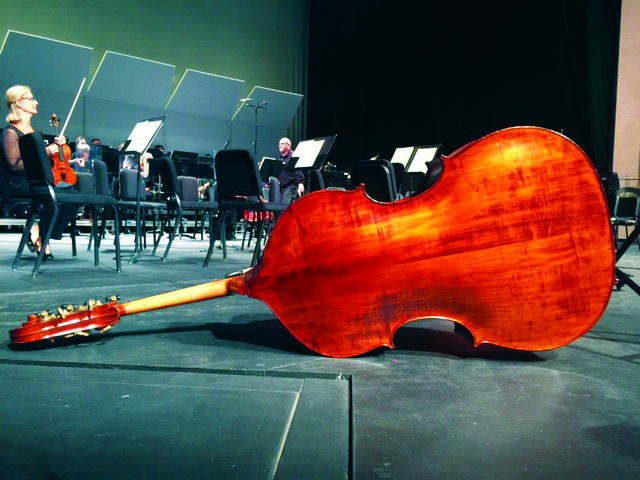
Friday the 13th is your lucky day. Lucky, that is, if you procure tickets to see newly minted NEA Jazz Master Dianne Reeves, a vocalist with a sound so sumptuously beautiful she banishes all thoughts of ill fortune. Usually heard in concert halls and theaters, Reeves rarely plays intimate spaces like Kuumbwa, a venue with which she shares decades of history. She’s joined by her incomparable band, including longtime pianist and music director Peter Martin and Brazilian guitarist Romero Lubambo, a jazz giant in his own right. ANDREW GILBERT

INFO: 7 and 9 p.m. Kuumbwa Jazz, 320-2 Cedar St., Santa Cruz. $45-$60. 427-2227.

FRIDAY 4/13

TRIBUTE

SUN KINGS

The Sun Kings pay tribute to the Beatles as authentically as possible by recreating the legendary band’s music, note for note, exactly as it was recorded. Rather than relying on costumes and caricatures, the Sun Kings rely on the members’ technical and melodic expertise and commitment to getting the songs just right. Considered one of the premier Beatles tribute bands in the country, the Sun Kings boast a repertoire of over 150 songs. The Kings are currently celebrating the 50th anniversary of The White Album with performances up and down the West Coast. CAT JOHNSON

INFO: 8 p.m. Flynn’s Cabaret, 6275 Hwy. 9, Felton. $22/adv, $25/door. 335-2800.

SATURDAY 4/14

FUNK

GHOST-NOTE

Drummer Robert “Sput” Searight and percussionist Nate Werth are the driving heart of the Grammy winning jazz and funk collective Snarky Puppy. They’re also the masterminds behind Ghost-Note, a “conscious funk” outfit that spotlights their tremendous skills and chemistry, and also gives the rotating cast of all-star band members plenty of space to do what they do best. With a combined resumé that includes work with Norah Jones, Snoop Dogg, Justin Timberlake, David Crosby, Q-Tip and more, these two are quiet powerhouses of the music world. CJ

INFO: 9 p.m. Moe’s Alley, 1535 Commercial Way, Santa Cruz. $12/adv, $15/door. 479-1854.

SUNDAY 4/15

JAZZ

REBIRTH BRASS BAND

The Rebirth Brass Band is steeped in the tradition of New Orleans jazz, and over the last 35 years has infused funk and hip-hop, among other genres, into its sound. The band’s unique swing has earned them special acclaim in pop culture, leading to an appearance on HBO’s Treme, and a 2012 Grammy Award. The members’ infectious playing commands even the grumpiest of people to shake their hips and swing their feet. MW

INFO: 8:30 p.m. Moe’s Alley, 1535 Commercial Way, Santa Cruz. $25/adv, $30/door. 479-1854.

MONDAY 4/16

COUNTRY

BIRDCLOUD

This Nashville duo plays twangy satirical songs, which isn’t necessarily anything new, but the brazen crudeness with which they do it is either unsettling or hilarious, depending on your personality. With songs like “Warshin’ My Big Ol’ Pussy,” “Saving Myself For Jesus,” “Indianer” and “Black Guys,” the twosome crosses the line of good taste a thousand times over, and lets the listener deal with their songs’ implicit irony without any wink-winks to ease the comic tension. AC

INFO: 9 p.m. Crepe Place, 1134 Soquel Ave., Santa Cruz. $12/adv, $15/door. 429-6994.

TUESDAY 4/17

ROCK

DIXIE DREGS

Formed in Augusta, Georgia in the 1970s, the Dixie Dregs helped shape a generation of boundary-pushing rock with a mostly-instrumental blend of hard rock, Southern rock, progressive metal, and classical music. Led by guitarist/composer Steve Morse of Deep Purple, and bass guitarist and composer Andy West, the Dregs remain a “loose collection” of former members who join forces for performances, studio projects and tours. CJ

INFO: 7:30 p.m. Rio Theatre, 1205 Soquel Ave., Santa Cruz. $50. 423-8209.


IN THE QUEUE

STELLA BY BARLIGHT

Standout local jazz vocalist and her band. Wednesday at Crow’s Nest

ROCK COLLECTION

All-star jam band led by Melvin Seals. Friday at Moe’s Alley

SCOTT BRADLEE’S POSTMODERN JUKEBOX

Contemporary pop hits reimagined as doo-wop, ragtime and Motown sounds. Saturday at Rio Theatre

ANDRE THIERRY & ZYDECO MAGIC

Acclaimed Zydeco act. Saturday at Michael’s on Main

ALBOROSIE

Italian reggae artist. Saturday at Catalyst

Giveaway: Tony Lindsay presents: Black Magic

0


Tony Lindsay barely needs an introduction for Bay Area music lovers. As lead vocalist for Santana for 25 years, and a multi-faceted bandleader in his own right, Lindsay is a familiar presence on the local scene. Lindsay’s latest project, Black Magic, sees him collaborating with an ace band, including standout blues guitarist Chris Cain. The band traverses blues, soul and jazz and shines a light on Lindsay’s award-winning vocal chops. 

INFO: 7 p.m. Thursday, May 3. Kuumbwa Jazz, 320-2 Cedar St., Santa Cruz. $25/adv, $30/door. 427-2227. WANT TO GO? Go to santacruz.com/giveaways before 11 a.m. on Tuesday, April 24 to find out how you could win a pair of tickets to the show.

Love Your Local Band: Pacific Roots

0

Drummer A.J. Aguayo can’t remember exactly when his reggae band Pacific Roots played its first show—he thinks it was 2015, but it might have been 2016. He does remember that the show—a local showcase—went really well. They sold $300 worth of tickets, more than any other band that night.

“We were the band that had the biggest crowd. We had a mosh pit. It was insane. It was probably one of the best shows I’ve played, and it was the first show of this band,” Aguayo says. “Right now, the gas pedal is to the floor—that’s how fast we’re moving.”

Of course, when Aguayo started the band with guitarist/vocalist Carlos Rubalcaba, he didn’t have high expectations.

“When we were first starting out, we did not think we’d be at this point where we’re at right here. When you’re starting out in a music group, you’re jamming out, it’s fun. And then we met Jake [White] and Jose [Picazo] and the structure came with it,” says Rubalcaba.

The band released its full-length debut about a year ago, which was produced by Max Peterson, the drummer in the Expendables. Aguayo reached out to him to jam, and eventually Peterson offered to record their music and make it sound “way better and for way cheaper.” Now, Peterson is the band’s manager, and he’s been scoring them some pretty great shows.

“We’re really excited about coming up with new music where all four of us are contributing,” says White. “We got some songs in the works right now that we want to record later this year, and we’re really excited about those. We’re getting really good feedback from the audience when we play them.” 

INFO: 8:30 p.m. Tuesday, April 17. Moe’s Alley, 1535 Commercial Way, Santa Cruz. $7/adv, $10/door. 479-1854.

5 Things to Do in Santa Cruz Apr. 11-17

Event highlights for the week of April 11, 2018.


Green Fix

‘Evolution of Organic’ Film Premiere

popouts1815-green-fixOrganic farming and food wasn’t always mainstream, and the documentary The Evolution of Organic is a time warp back to the late ’60s, when it was an act of rebellion to reject chemical farming and explore organic alternatives. The film tells the story of the earliest Alan Chadwick Garden farmers at UCSC, and their goal of making organic and sustainable agriculture and food accessible to everyone.

INFO: 6:30-9 p.m. Friday, April 13. Veterans Memorial Building, 846 Front St., Santa Cruz. brownpapertickets.com. $17/$20.


Art Seen

‘The Whole Ball of Wax’ Twisted Artist Reception

popouts1815-art-seenJoan Lowden a.k.a. “Bass Lady” is a woman of many facets. She is an encaustic artist, meaning that she works with wax and pigment to create visual art, and she is also a jazz bass musician—hence the nickname. She says jazz and encaustics go together because they are both improvisational; not surprisingly, her shows aren’t limited to just one of her artistic mediums. This show series will feature weekly themed music events, with local musicians alongside her encaustic visual art. Lowden will be playing with her jazz trio ‘Jazz With a Twist’ during the reception, to the beat of some twisted cocktails.

INFO: Reception 2-5 p.m. Sunday, April 15. Show continues through Sunday, April 22, with “Ragtime Wrap Up” from 2-5 p.m. Felix Kulpa Gallery. 107 Elm St., Santa Cruz. basslady.com. Free.


Friday 4/13

Aptos High Presents ‘Cinderella’

popouts1815-cinderellaEveryone knows the story of Cinderella, so Aptos High School has a bit of a twist to keep things interesting. The musical production will be ’80s themed, with some seriously big hair and totally tubular costumes—think Cinderella meets an ’80s workout video. Few things sound more entertaining than Cinderella right out of a John Hughes movie. The musical is directed by drama teacher Stacy Aronovici and Aptos High student Quinn Youngs, and features more than 50 students in the cast and crew. Puppetry and a full orchestra will add a bit more enchantment to the evening.

INFO: Opens 7 p.m. Friday, April 13 and runs through Saturday, April 21. aptoshs.net. $10/$11 general admission. $8/$9 students and seniors.


Saturday 4/14

Third Annual ‘Step Into Fashion’

popouts1815-step-into-fashionSpring is here, and for some that means a wardrobe refresher. But before you go to a department store or online, consider shopping for a cause. “Step Into Fashion” will feature more than 40 Bay Area designers selling affordable clothing, handbags, accessories, jewelry and more. Plus, a portion of all proceeds will go to Palo Alto Medical Foundation’s cancer prevention and care programs. To date, the event has raised more than $227,000 for cancer-related programs in Santa Cruz County. For fashion-forward questions, local television personality and fashion producer Joyce Anderson will talk about accessorizing, and Image Consultant Alyce Parsons will discuss incorporating the latest trends into your wardrobe.

INFO: 10 a.m.-4 p.m. Boardwalk’s Cocoanut Grove. 400 Beach St., Santa Cruz. stepintofashion.org. $15. Free parking.


Sunday 4/15

Kids Day Downtown

It’s adults day everyday, so isn’t it about time we stop being so selfish and focus on the next generation of Santa Cruzans? In celebration of kids everywhere, the Downtown Association has brought back ‘Kids Day,’ a fun-filled bubble bash in downtown Santa Cruz. There will be yoga, dance, facepainting and of course tons of yummy food for even the pickiest of eaters.

INFO: 11 a.m.-5 p.m. Downtown Santa Cruz, Pacific Ave., Santa Cruz. downtownsantacruz.com/kids. Free.


Mercury Direct and Aries New Moon

[dropcap]O[/dropcap]n Wednesday Venus trines Mars—our relationships become most important to tend to. Simultaneously, Sun conjuncts Jupiter—we have more love and compassion for others. Friday Venus sextiles Neptune as the Moon is in Pisces.

We seek authentic and intelligent friendships, able to spot illusion and glamours quite easily. Friday is v/c (Moon void of course) all day—so we remain solitary and keenly observant. Aries Moon begins late Friday evening.

Saturday morning, just after midnight, Jupiter sextiles Pluto. We have deep and expansive dreams. In the morning Mars sextiles Neptune—the dreams come true.

Sunday, Mercury is still in the sky, preparing to move forward at 4.47 degrees Aries. Mercury doesn’t reach its retrograde shadow until May 4. So, we proceed slowly forward. The new moon occurs Sunday at 6:57 p.m. (West Coast time), at 26 degrees Aries. The Sun and Moon are together in Aries, calling forth all fiery forms from the heavens. Calling forth the Divine Mind of God to impress humanity’s minds. “I come forth and from the plane of Mind, I rule,” says Mercury.

The Lords of Fire (Agni Lords) are present during the month of Aries, especially at the New and Full Moon times. These great beings hold the archetype (pattern) for the future race of humanity with the task of producing a harmonious and peaceful world to come.

The Lords of Fire participated in our initial creation, but for most of humanity, their work lies still in the future. The fires (Fohat) of their nature produce a purifying and illumined consciousness. This illumination ignites the presently sleeping original Divine Spark, or inner fire, of each individual, creating a burning ground that clears the illusions, mental distortions, and emotional fugues that are the barriers to clear perception to the Raincloud of Knowable Things (world of wisdom and intuition). These fires produce the discriminating personality, the illumined consciousness, and a fiery force field of radiation needed in our ascent, or resurrection, of consciousness back toward the Source.


ARIES: What are your financial realities and perspectives, how are they faring, are they safe, are they budgeted, and do you tithe? These are some of the monetary questions coming into focus. Also, of importance is the review, revision and recognition of your true values. What and whom do you value? Do you consider yourself as valuable? How? These days and nights shed light upon your true Aries self.

TAURUS: There could be confusion in communication with close friends, partners, friends, associates and intimates. There could also be questions concerning your possessions and their maintenance. Something important for day to day living may have stopped working. It’s possible that someone close may not understand you. There won’t be any compromise. Our life changes through the decisions we make, and often through what we can’t quite see yet.

GEMINI: Revelations may appear as your mind has an inner focus, quite compassionate at times, yet it could turn quickly to a Virgo criticalness. Be aware of this. Study the religious and/or spiritual. Alice Bailey’s book Service (a compilation) is good at this time. Have the intention for fairness, for non-judgment, clarity and “Let reality guide my every thought and Truth be Master of my Life.”

CANCER: During this time, we’ve all been returning to the past, to friends and/or family close to us, to those we need, love and cherish. Our family is our first and foremost experience of community and group work, where we grow, encounter and learn life’s lessons. Should sad or lamenting thoughts appear, think on them with forgiveness and begin writing them down in longhand. Eventually, healing takes place.

LEO: Communication confusions could have occurred at work, with colleagues, superiors, and others working around you. Awareness of this allows you to make concessions when speaking in the future. The focus for three weeks was on critical judgments concerning your work and other people’s work, everything professional and most importantly your life path. Shift the critical judgements to praise.

VIRGO: What are you thinking about in terms of education, travel, legal affairs and all communications with co-workers? Have there been delays in many areas of your life recently? Things will ease soon. Be very clear when discussing joint finances and decisions with professionals. Know that you may be hidden for a while, your actions therefore must be explained to others so they are understood. Use few precise words.

LIBRA: Be careful with resources, values, money and finances. Be acutely aware of where your money is being used, how much and when it’s coming in, and carefully jot down what you do with it (your money). Consider investments at this time in gold and silver, especially gold. Carefully assess your money as it finances your future. Tithe often … giving to those in need, in the clear light of day.

SCORPIO: One-on-one communication needs deep awareness, care and kindness. Previous partnership issues, concerning constancy, safety, money and security, arise once again, for re-evaluation. Messages may continue to be mixed. Be aware of this. Disputes call for negotiation. Perhaps this is too difficult for you. Make no decision till after Mercury’s shadow. Simply observe. Then follow the beauty, the bliss, the heart and your intuition.

SAGITTARIUS; You’re more sensitive than usual. Is that possible? Yes. Healthwise, for the next several weeks, it’s best to create daily routines that strengthen your well-being. Maintain a non-judgmental response to everyone, lest falling into old criticisms and sarcasms occurs. Criticism separates us. Then an existential loneliness emerges. Find silence, beauty, a sanctuary, an ashram, a sangha. Rest in one from new moon to full to new again.

CAPRICORN: Observe children, family and loved ones during these Mercury shadow days. Children and elders are especially sensitive to transits. In your observations, what do you see in terms of their ability to communicate, maneuver in their world of friends, school and studies? Help them (with you, too), create a Mercury Retrograde and Shadow Journal for later use. Observe yourself during these times, too. What are you remembering these days?

AQUARIUS: Things, thoughts, events are occurring about home. They have roots from many months ago. There’s a shift about what home means, and what you consider your personal foundation. This has been a time for assessment, review, re-evaluation and revelations concerning home—what you need, where and what home is for you. Assess how family can assist with your plans for a home. Ask them. They want to help.

PISCES: You will find that only patience assists at this time. It seems that emptiness has come to roost in all parts of your life and it is very hard to understand. Stand with that emptiness, become empty yourself, allow life to flow through you. Many will not understand this part of your life. It’s an initiation, very valuable, extremely difficult. You stand alone. No matter your actions, the emptiness remains. Expect nothing. Be still like nothing at all. Good.


Rob Brezsny Astrology Apr. 11-17

0

Free Will astrology for the week of April 11, 2018.

ARIES (March 21-April 19): Aries statesman Thomas Jefferson was the third President of the United States. He wrote one of history’s most famous documents, the Declaration of Independence. He was an architect, violinist, inventor, and linguist who spoke numerous languages, as well as a philosopher who was knowledgeable about mathematics, surveying, and horticulture. But his most laudable success came in 1789, when he procured the French recipe for macaroni and cheese while living in France, and thereafter introduced the dish into American cuisine. JUST KIDDING! I’m making this little joke in the hope that it will encourage you to keep people focused on your most important qualities, and not get distracted by less essential parts of you.

TAURUS (April 20-May 20): In the early 1990s, Australian electrical engineer John O’Sullivan toiled on a research project with a team of radio astronomers. Their goal was to find exploding mini black holes in the distant voids of outer space. The quest failed. But in the process of doing their experiments, they developed technology that became a key component now used in Wi-Fi. Your digital devices work so well in part because his frustrating misadventure led to a happy accident. According to my reading of your astrological omens, Taurus, we may soon be able to make a comparable conclusion about events in your life.

GEMINI (May 21-June 20): In the fictional world created by DC Comics, the superhero Superman has a secret identity as a modest journalist named Clark Kent. Or is it the other way around? Does the modest journalist Clark Kent have a secret identity as the superhero Superman? Only a few people realize the two of them are the same. I suspect there is an equally small number of allies who know who you really are beneath your “disguises,” Gemini. But upcoming astrological omens suggest that could change. Are you ready to reveal more about your true selves? Would you consider expanding the circle that is allowed to see and appreciate your full range and depth?

CANCER (June 21-July 22): Playwright Tennessee Williams once spent an evening trying to coax a depressed friend out of his depression. It inspired him to write a poem that began like this: “I want to infect you with the tremendous excitement of living, because I believe that you have the strength to bear it.” Now I address you with the same message, Cancerian. Judging from the astrological omens, I’m convinced you currently have more strength than ever before to bear the tremendous excitement of living. I hope this news will encourage you to potentize your ability to welcome and embrace the interesting puzzles that will come your way in the weeks ahead.

LEO (July 23-Aug. 22): Are you finished dealing with spacious places and vast vistas and expansive longings? I hope not. I hope you will continue to explore big, bold, blooming schemes and wild, free, booming dreams until at least April 25. In my astrological opinion, you have a sacred duty to keep outstripping your previous efforts. You have a mandate to go further, deeper, and braver as you break out of shrunken expectations and push beyond comfortable limitations. The unknown is still more inviting and fertile than you can imagine.

VIRGO (Aug. 23-Sept. 22): Between Dec. 5 and 9, 1952, London was beset with heavy fog blended with thick smog. Visibility was low. Traffic slowed and events were postponed. In a few places, people couldn’t see their own feet. According to some reports, blind people, who had a facility for moving around without the aid of sight, assisted pedestrians in making their way through the streets. I suspect that a metaphorically comparable phenomenon may soon arise in your sphere, Virgo. Qualities that might customarily be regarded as liabilities could at least temporarily become assets.

LIBRA (Sept. 23-Oct. 22): Your allies are always important, but in the coming weeks they will be even more so. I suspect they will be your salvation, your deliverance, and your treasure. So why not treat them like angels or celebrities or celebrity angels? Buy them ice cream and concert tickets and fun surprises. Tell them secrets about their beauty that no one has ever expressed before. Listen to them in ways that will awaken their dormant potentials. I bet that what you receive in return will inspire you to be a better ally to yourself.

SCORPIO (Oct. 23-Nov. 21): In the coming weeks, I suspect you will be able to find what you need in places that are seemingly devoid of what you need. You can locate the possible in the midst of what’s apparently impossible. I further surmise that you will summon a rebellious resourcefulness akin to that of Scorpio writer Albert Camus, who said, “In the midst of hate, I found there was, within me, an invincible love. In the midst of tears, I found there was, within me, an invincible smile. In the midst of chaos, I found there was, within me, an invincible calm. No matter how hard the world pushes against me, within me, there’s something stronger—something better, pushing right back.”

SAGITTARIUS (Nov. 22-Dec. 21): In 1936, Herbert C. Brown graduated from the University of Chicago with a bachelor’s degree in science. His girlfriend Sarah Baylen rewarded him with the gift of a two-dollar book about the elements boron and silicon. Both he and she were quite poor; she couldn’t afford a more expensive gift. Brown didn’t read the book for a while, but once he did, he decided to make its subject the core of his own research project. Many years later, he won the Nobel Prize in Chemistry for his discoveries about the role of boron in organic chemistry. And it all began with that two-dollar book. I bring this story to your attention, Sagittarius, because I foresee you, too, stumbling upon a modest beginning that eventually yields breakthrough results.

CAPRICORN (Dec. 22-Jan. 19): In 20 B.C., Rome’s most famous poet was Quintus Horatius Flaccus, known to us today as Horace. He prided himself on his meticulous craftsmanship, and advised other writers to be equally scrupulous. Once you compose a poem, he declared, you should put it aside for nine years before deciding whether to publish it. That’s the best way to get proper perspective on its worth. Personally, I think that’s too demanding, although I appreciate the power that can come from marshalling so much conscientiousness. And that brings me to a meditation on your current state, Capricorn. From what I can tell, you may be at risk of being too risk-averse; you could be on the verge of waiting too long and being too cautious. Please consider naming a not-too-distant release date.

AQUARIUS (Jan. 20-Feb. 18): Luckily, you have an inventive mind and an aptitude for experimentation. These will be key assets as you dream up creative ways to do the hard work ahead of you. Your labors may not come naturally, but I bet you’ll be surprised at how engaging they’ll become and how useful the rewards will be. Here’s a tip on how to ensure you will cultivate the best possible attitude: Assume that you now have the power to change stale patterns that have previously been resistant to change.

PISCES (Feb. 19-March 20): May I suggest that you get a lesson in holy gluttony from a Taurus? Or perhaps pick up some pointers in enlightened self-interest from a Scorpio? New potential resources are available, but you haven’t reeled them in with sufficient alacrity. Why? Why oh why oh why?! Maybe you should ask yourself whether you’re asking enough. Maybe you should give yourself permission to beam with majestic self-confidence. Picture this: Your posture is regal, your voice is authoritative, your sovereignty is radiant. You have identified precisely what it is you need and want, and you have formulated a pragmatic plan to get it.


Homework: In what circumstances do you tend to be smartest? When do you tend to be dumbest? Testify at Freewillastrology.com.


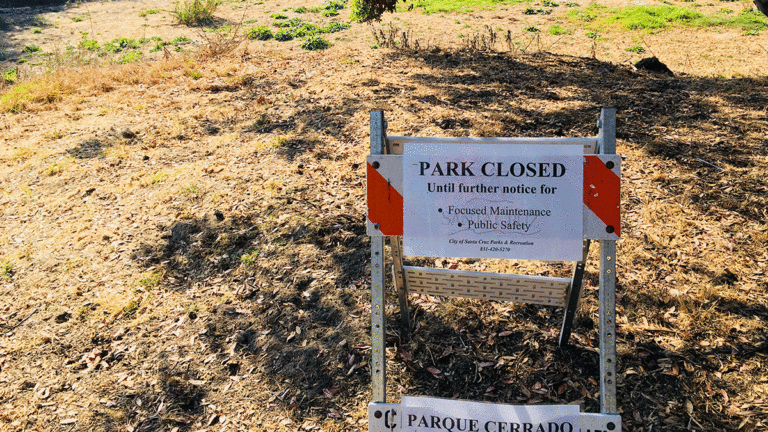
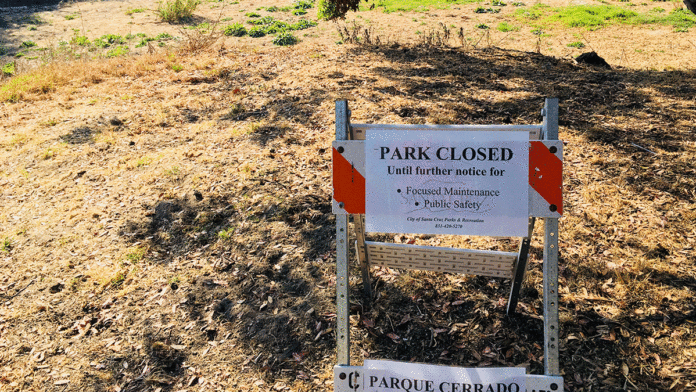
Wildfires: Why Santa Cruz is at Risk

[dropcap]E[/dropcap]ven 25 years ago, Santa Cruz fire officials were worried about the Prospect Heights neighborhood that adjoins the overgrown eucalyptus stands in DeLaveaga Park. In a newspaper article at the time, then-Fire Chief Ron Prince expressed concern that brush, downed trees and fallen limbs were four feet deep in some areas.

In the parlance of veteran firefighters, these accumulations of downed vegetation are called “fuel,” and they help a small ground fire crown into the treetops when the worst conditions align. A walk throug­­h the forest there today reveals it is still just as fuel-rich.

One of those veteran firefighters is Cap Pennell, who worked for 34 seasons with Cal Fire, mostly around Santa Cruz, and who retired from the state firefighting agency 15 years ago. He recalls the gallows humor in the fire stations about the fire that might start in Boulder Creek and get pushed by strong offshore winds down the San Lorenzo canyon, all the way to the Boardwalk.

The counter-argument to that particularly bleak outlook on the state of fire safety, Pennell recalls, was that there was a crossroad every quarter-mile which would stop such a blaze. The idea that this imaginary hedge would stop the spread of a major wildfire was proven wrong once again, he says, when the most recent fires in Santa Barbara and Santa Rosa crossed roads and even a six-lane freeway. A six-lane freeway, by the way, is all that separates Pennell’s home from the endangered Prospect Heights—a gap he knows could be easily closed by a fire pushed by strong winds.

“Convection and radiation usually makes fire go uphill,” says Pennell, “but the other factor would be adiabatic, where the winds come downhill. They are warm and dry, and they cause more extreme fire behavior.”

Prospect Heights isn’t the only neighborhood considered to be at great risk. The bottom line is that Santa Cruz firemen have long worried about the windy-day fire that would start in the forested hills and sweep down toward the urban flats—exactly what happened in Santa Rosa and Santa Barbara—and they say it’s more critical than ever that residents prepare for that possibility.


WIND FACTOR

The Bear Fire started in the steep San Lorenzo uplands on Oct. 18, 10 days after the start of the Santa Rosa fires. By then, the north winds had died down, so crews were able to contain it in 10 days. Rich Sampson, a Cal Fire division chief based in Felton, says that if the Bear Fire had started at the same time as Santa Rosa’s wildfires, the winds would have blown flames down to Boulder Creek and Ben Lomond, a particularly dangerous situation because so much of Cal Fire’s crew had already been sent up to Santa Rosa.

Sampson says similar risks exist for canyons with a north-south alignment above Aptos, Corralitos and Watsonville, where a fire could begin in the drier elevations above the inversion layer and pick up speed when it gets fanned by an offshore wind. Normally, at higher altitude, the temperature decreases due to the changes in air pressure. But in an inversion, instead of getting cooler, it is actually warmer at higher elevation. The flames would rush downhill, an example of the adiabatic fire behavior Pennell described.

The flushes of heavy rain in March and April have barely moved this season’s precipitation needle to 65 percent of normal, and the more generous rain last winter may have made things even more flammable, Sampson says. This was because the heavy rain last year was not enough to wet the bigger fuels after many years of drought and, besides, it stimulated the growth of lots of fine fuels—weeds and grass—which also dry out quickly.

wildfires santa cruz air drop Santa Rosa fire
EXTRAORDINARY MEASURES An air drop during the Santa Rosa fire. Normal firefighting methods can become impossible in wind-driven fires. PHOTO: JON LOHNE

As evidence, he cites 20-30 acres of intentional prescribed burning that Cal Fire had just completed to reduce hazardous fuel buildups near UCSC. The timing for the burn—in the middle of the winter—would never have been possible before the drought.

Jake Hess, a Cal Fire deputy chief based in Felton, says firefighters routinely sample fuels for moisture in their work, and are finding that, although heavy rainfall in 2017 had refilled reservoirs, a lot of the live fuels were clearly weakened, but not killed, and had not bounced back to their typical moisture level after one good year.

Hess says he’s seen every fire season outpace the previous year’s fires, and Cal Fire has moved more funding to each unit for increased protective fuels reduction. In the Santa Cruz area, this will mean two full engine crews doing this pre-fire work, six days a week.

Hess agrees that winds can be a dominant factor in fire behavior and said the 2008 Summit Fire between Santa Cruz and Los Gatos had winds so strong—80 miles per hour—that firefighting aircraft had to be grounded. Hess was headed to the Santa Rosa Fire when he got orders to turn around and head home to the Bear Fire.

He says strong wind is such a big factor in fire behavior that his agency increases crew strength whenever it is forecast. As fuel moistures have continued to drop from lack of rain and lack of snowpack every year, the fire season for Cal Fire Southern Region is all year now. Big fires late in the year in 2005 seemed an anomaly at first, but Hess says that lately they’ve added “a new mental component that our employees are having to deal with: burnout. I don’t see it changing; all the science says this is the new normal, and will increase.”


A NEW KIND OF FIRE

Tim Chavez, a Cal Fire field battalion chief from the Riverside area, was on the Thomas Fire near Santa Barbara for 16 days, and he remembers the offshore winds. “They came for 13 days straight. Usually they get them for three days, then the fog comes in and the fire stops spreading,” he says.

It would be hard to overstate the catastrophe of the wind-driven fires in the Santa Barbara and Santa Rosa areas. The Tubbs Fire in Napa, Sonoma and Lake counties had burned 36,807 acres by its containment on Oct. 31, 2017, and caused 22 deaths by fire. It burned 5,643 structures including 2,800 homes in the city of Santa Rosa, 5 percent of the city’s housing stock, with an estimated $1.2 billion of damage. It was the most destructive wildfire in California history.

The Thomas Fire in Ventura and Santa Barbara Counties started Dec. 4, 2017, and burned 281,893 acres, becoming the largest wildfire in modern California history. It destroyed 1,063 structures and was linked to the deaths of one firefighter and one civilian before it was contained on Jan. 12 of this year. Another 20 people subsequently died when rainstorms triggered mud and debris flows in the burn area.

One Northern California insurance broker says insurance companies are looking closely at brush and slope in issuing new fire policies and reassessing existing ones. He says the companies were “getting off a lot of their risks, even policies that they’ve held for 20 or 30 years. Fire with a wind, you aren’t going to stop it. We’re seeing policies that cost $1,000 a year coming back for $1,800, two grand.”

Many instructional materials for fire protection are designed for homes built in forested areas—what firefighters call the Wildland/Urban Interface, or WUI. These materials suggest clearing or seriously reducing vegetation and other fuels accumulations around a residence within a 100-foot perimeter. In most of the less-wildland neighborhoods of Santa Cruz County, this would amount to removing the next two houses on every side of your house.

Chief Hess observes that the wind-driven fire in Santa Rosa found fuel not just in trees but in buildings and vehicles, with embers from torched houses flying as far as a half mile in front of the advancing fire.

In conditions like those, ordinary firefighting becomes impossible, and the main strategy becomes evacuation. Jim Frawley, the chief of the Santa Cruz Fire Department, told a recent community meeting at DeLaveaga School that residents need to make themselves, their homes and their community better prepared for the catastrophic possibilities.

As part of his department’s fire-readiness campaign, representatives are going out into neighborhoods to form a Firewise Community, starting with the people who live near DeLaveaga Park. Materials aiding people and neighborhoods to prepare are available at https://goo.gl/oQ5k55.

Frawley says that at any given moment, his department has 17 firefighters on duty—enough for one house on fire. So, in the case of a wind-driven fire, it’s the preparation that comes beforehand—investment in non-combustible roofs, clearing rain gutters of debris so they are less flammable, and other actions aimed at fireproofing. Much of that information is available at the Ready, Set, Go program. See https://goo.gl/Tphe6w.

The “Go” step is evacuation. More than 100,000 residents were evacuated during the Thomas Fire. Frawley says that in a worst-case fire starting in the Eucalyptus groves, Branciforte Avenue and Morrissey Boulevard would be converted to one-way evacuation routes headed toward the ocean.

The fire districts in the county have cooperative agreements with Cal Fire to respond jointly to fires too big for any one department. Frawley says that the city government has also budgeted $100,000 per year to help reduce fuel buildups in overgrown areas like Delaveaga Park. His department is working with the city parks department to prioritize the work and to enlist other groups for resources that can help prepare for the next fire.

The county Fire-Safe Council has funds to bring in a chipper to chew up unwanted brush after it’s removed, and Cal Fire can supply convict crews to help handle the accumulations of fallen trees, branches and brush.

Frawley was a firefighter in Southern California before he came to Santa Cruz three years ago, and he says that dryness and wind conditions are not as bad in Santa Cruz as in Santa Rosa or Santa Barbara, but adds, “To say ‘never’ is wrong. So we need to be aware of it, to plan for it and to bring in the community.”

As a step in that direction he moderated the well-attended meeting in November at Delaveaga School. The neighborhood had already had an early warning when a fire broke out near DeLaveaga Golf Course in early July.

Ed Silveira from Friends of DeLaveaga Park, welcomed the fuels treatment in the park to reduce fire danger, but also questioned the amount of money being appropriated for the job. “It’s interesting that the City Council came up with close to $300,000 to remodel the city golf course restaurant, but the fire chief only gets $100,000 for public safety in this area.”

Bill Maxfield, another homeowner near the park, said, “Besides the terrible fires in Sonoma, Napa, Ventura and Santa Barbara, we’ve had a couple of scares in DeLaveaga Park, including one in 2017 that required helicopter drops [of water and fire retardant] and a small fire within the last couple of weeks that happening during a rainstorm—both are thought to be human-caused. I’m really thankful that city leaders are paying attention to this issue. The question is, what can the city do to help, and how can neighbors participate in a solution that cuts the fuel load and helps us prepare our homes and families in the case of a major fire in the park? I’m optimistic that it can be done. Clearly the interest is there.”

Cal Fire and local firefighting groups called another public meeting since then to study lessons learned from the Bear Fire above Boulder Creek, which burned nearly 400 acres before containment. It was a mountainous, heavily forested area with less housing but more vegetation. Joe Christie from the Santa Cruz Fire Safe Council says 80 people attended.

Christie says that prevention efforts in the area are complicated by the network of access roads, overgrown by vegetation, and by rural residents who value privacy and are concerned with the prospect of increased code enforcement.

The lack of egress is a problem, not just on a neighborhood level. It is a similar challenge on a larger scale for fire managers in Santa Cruz and across the West. There’s no easy way out of this expanding fire risk; fuel buildup, drought and climate change have all been piling up for decades. It’s especially a problem when strong winds shift the main fire response strategy to flight, rather than fight.

Stuart Carlson worked 35 seasons for Cal Fire before recently retiring as a station captain in Corralitos. He says the reality of fire danger in Santa Cruz County is part of California’s natural landscape, and will require continually evolving vigilance.

“The Lockheed and Summit fires were wind-driven fires initially, also the Oakland Hills Fire in 1991,” says Carlson. “These areas have histories of burns, these are areas where plants are adapted to fire—knobcone pines, called fire pines, manzanita—fire is a part of their ecology. And part of it is that we live in these areas.”

Malcolm Terence has been a firefighter with the U.S. Forest Service and a reporter for the ‘Los Angeles Times’ and other papers in California. His new book, ‘Beginner’s Luck, Dispatches from the Klamath Mountains,’ is being published by Oregon State University Press next month.


Film Review: ‘Death of Stalin’

Death of Stalin
Hilarious ‘Death of Stalin’ has fun with Cold War game of thrones

Is Chilled Water Really a More Healthy Choice?

chilled water healthy ice water better for you
The science behind iced, room temperature, hot and sparkling water

Q&A: UCSC’s Jenny Reardon on Genomic Research

Genomic Research Jenny Reardon, a UCSC sociologist and former genomics researcher
Reardon, a sociology professor and former genomic researcher, on ethical questions about race and science

Music Picks Apr. 11-17

Dianne Reeves
Live music highlights for the week of April 11, 2018.

Giveaway: Tony Lindsay presents: Black Magic

Win tickets to Tony Lindsay presents: Black Magic on Thursday, May 3 on Kuumbwa Jazz

Love Your Local Band: Pacific Roots

Pacific Roots
Pacific Roots plays Tuesday, April 17 at Moe’s Alley

5 Things to Do in Santa Cruz Apr. 11-17

Mental Health
Event highlights for the week of April 11, 2018.

Mercury Direct and Aries New Moon

risa's stars
Esoteric Astrology as news for week of April 11, 2018

Rob Brezsny Astrology Apr. 11-17

Astrology, Horoscope, Stars, Zodiac Signs
Free Will astrology for the week of April 11, 2018.

Wildfires: Why Santa Cruz is at Risk

Tubbs fire rubble, wildfires santa cruz
Retired firefighter Malcolm Terence on the new patterns of recent wildfires and how Santa Cruz is at risk—from the mountains to its urban center
17,623FansLike
8,845FollowersFollow