Adrian Cavlan has been playing music in local bands for a long time. Well, there was about a 15-year gap where he wasn’t. But when he returned to music, he noticed that if the leader of the band decided to end the project, a guitarist like himself was kind of screwed.
“I was very tired of being in bands with other people who are the essential ingredient to keep the band going. I was like, ‘If I ever do this again, I want to be that guy,” Cavlan says.
But he couldn’t sing, so what were his options? Then one day a friend suggested he check out instrumental L.A. surf band the Slacktones, and he had an epiphany. If he started an instrumental surf band, he could be that guy.
Songs immediately started pouring out of him. He noticed that all of these other elements like punk and prog-rock were popping out into the mix, too. So he just went with it.
“There’s a lot of shading and coloring that goes on in our music, as opposed to just plain straight, bouncy, fun, surf dance music,” Cavlan says.
The band has been chugging along for nine years, and has written so many originals that it can play for hours. They know some surf standards, too, just in case they get booked for a corporate gig and want to give them some popular favorites.
Over the years, the songwriting has slowed down, but just recently Cavlan has been “visited by the muse again,” and has a whole new batch of tunes to flush out.
“I’m very excited about that. It’s been a long time since I’ve been that prolific,” Cavlan says. “This band is basically a bunch of guys who are a little bit older who still like playing music. It makes it easy if you have friends who are talented.”
Live music highlights for the week of September 26, 2018
WEDNESDAY 9/26
BLUEGRASS
SHAKY HAND STRING BAND
Is there a difference between mountain-grass and standard old-timey bluegrass? This is the debate you will be having if you check out Colorado’s beloved finger-pickin quartet the Shaky Hand String Band. Instrumentally, these guys pluck with the finesse of the suit-wearing, cowboy-hat sporting traditionalists. But it’s just a wee bit more laid back. After all, these guys do call the Rocky Mountains home, and have a certain lifestyle that comes through in the song. Their bio describes it as “dogs, food, love, drinking, and all life’s questions.” Hey, that sounds an awful lot like Santa Cruz-grass! AARON CARNES
At the age of 19, Al Di Meola was hired to play with jazz giants Chick Corea, Stanley Clarke and Lenny White. What better way to start off an amazing four-decade-long career? Now recognized as one of the world’s top jazz guitarists, Di Meola has recorded dozens of albums, collaborating with a who’s who of musicians from all over the world. On Sept. 26, he’ll be joined by Jordan Rudess—voted “Best Keyboardist of All Time” by Music Radar magazine—for a night of two stars burning bright. MAT WEIR INFO: 8 p.m. Rio Theatre, 1205 Soquel Ave., Santa Cruz. $39/gen, $52/gold. 423-8209.
THURSDAY, 9/27
FOLK/COUNTRY
JOHN DOE FOLK TRIO
Musicians who survive their youth often wind up in a whole other genre. For John Doe, that has been a step away from incendiary punk and a return to the rural sounds of his youth: country, folk, and the wisdom of a dusty road. Since the last X record in 1993, Doe has released 11 solo albums (more than X’s whole discography), all of which show the continued relevance of his poetic songwriting. With his folk trio, Doe reorients the scrappiness of punk in the desert landscapes of his growing modern canon. MIKE HUGUENOR
The Smoking Flowers’ 2018 album Let’s Die Together plays like a Southern gothic, country-rock version of a famous Hunter S. Thompson quote. You know, the one about how we should arrive at the end of our lives used up, worn out, and thinking, “Wow! What a ride!” Two decades of marriage will do that to a couple. They certainly know how to express the grit and beauty of two lives lived in unison. The band’s musicality melds the best of roots music, blues and punk, creating a sound full of raucous energy, scratchy-voiced harmonies, and sweet duets, like Bonnie and Clyde celebrating the heist of the century. AMY BEE
San Francisco’s Geographer makes easy-going synth-pop. Frontman Mike Deni does it with semi-personal, and occasionally lovesick lyrics, but keeps a certain distance with his sultry voice and playboy charm. The music reigns in epic synth overtones with sincere piano riffs and the occasional snapping of fingers for percussion. It keeps the whole endeavor genuine without being too vulnerable or sentimental. Fans are sure to get lost in the slow-moving rhythms as they nod their way across the dance floor, feeling sensual and connected as the vape smoke surrounds them. AB
Since its debut in 2010, the Human Experience has built a discography of unique electronic music that defies boundaries. From collaborating with folk musicians like Rising Appalachia to switching his live performances between a DJ set and a live band, David Block is constantly leaving his audience guessing. MW
In their most recent music video, Fayuca are luchador-masked rebels, leading a warehouse of protesters against an oppressive regime. The video for “Por Que Seguir” is a timely statement, coming shortly before the Trump administration moved millions of dollars from FEMA into the coffers of border-trawling ICE. And for a group of Latinx musicians from Phoenix (home of Sheriff Joe Arpaio), it isn’t just art—it’s their lives. Fayuca’s blend of dub, reggae, punk, and Latin rock comes off sounding like a natural outgrowth of their home, culture, passions, and beliefs. Si se puede. MH
INFO: 9 p.m. The Catalyst Atrium, 1011 Pacific Ave., Santa Cruz. $10/adv, $15/door. 429-4135.
MONDAY 10/1
JAZZ
LOGAN RICHARDSON
Restlessly creative alto saxophonist Logan Richardson had already established himself as a powerful voice on the New York jazz scene with his 2016 major label debut Shift, a startlingly confident session featuring guitar legend Pat Metheny as a sideman. A native of Kansas City, where he absorbed jazz and blues history firsthand from legends such as Jay McShann and Claude “Fiddler” Williams, Richardson has been based in Paris for several years. He kicks off a West Coast tour celebrating the release of his sci-fi inspired new album Blues People in Santa Cruz with a killer young quartet from Kansas City including guitarist Igor Osypov and drummer Ryan J. Lee (who both play on the album) and electric bassist Dominique Sanders. ANDREW GILBERT INFO: 7 p.m. Kuumbwa Jazz, 320-2 Cedar St., Santa Cruz. $: $26.25/adv, $31.50/door. 427-2227.
THURSDAY 10/2
CELTIC-FOLK
HERON VALLEY
If you want a taste of the modern Celtic-influenced music currently coming out of Scotland, mark your calendars for Heron Valley’s upcoming show at Michael’s on Main. The five-piece has an exciting, emotive sound that is just a couple hairs away from what a lot of indie-folk bands here in the states are strumming. Just add some bagpipes and a whistle, and let your imagination fill in the blanks. AC
INFO: 7:30 p.m. Michael’s on Main, 2591 S. Main St., Soquel. $17/adv, $20/door. 479-9777.
For a mere $15, you can get a terrific bottle of 2017 Pinot Grigio from Soquel Vineyards. Medium-bodied and richly textured, this easy-drinking white wine is good to have on hand for the rest of summer and into fall.
Winery owner partners Peter and Paul Bargetto (who are twins) and Jon Morgan say, “This is our first venture into making Pinot Grigio, and it’s a great one. Full of floral aromas with notes of pear, apple and grapefruit, and a clean citrus finish, our Pinot Grigio is elegant, refined and true to varietal characteristics.” It’s also richly textured, and pairs well with poultry and seafood. With its easy-to-open screw cap, it can be your go-to bottle.
A recent visit to Soquel Vineyards’ welcoming tasting room and beautiful outdoor patio led me to the tasty Pinot Grigio—a refreshing libation with its tangy and layered mouthfeel. Many of Soquel Vineyards’ wines have won gold medals, and I think the Pinot Grigio deserves one, too.
Soquel Vineyards is a delightful place to visit—and to be surrounded by lush vines as you take in the view of the Monterey Bay.
Taste of Carmel is an action-packed food and wine event featuring something for every palate. With a theme of “Wild Wild Fest,” you can bring out your Western gear and have a down-home good time. The event is 6-9 p.m. Thursday, Oct. 4 at Carmel Mission Courtyard, 3080 Rio Road, Carmel.
Visit tasteofcarmel.org for more info.
Farm-to-Table Dinner at Chaminade
There’s still time to get tickets for the last of Chaminade’s al fresco farm-to-table dinners on Friday, Sept. 28. This one features the wonderful wines of Alfaro Family Vineyards & Winery, with ultra-fresh produce from Route 1 Farms. Hors d’oeuvres are served at 6 p.m., with dinner at 6:30 p.m. Tickets are $86 per person, plus tax and gratuity. An abundance of good food is served, with plenty of wine to accompany every course.
Chaminade Resort and Spa, One Chaminade Lane, Santa Cruz, 475-5600. chaminade.com.
This week’s cover story gave me an unsettling case of déjà vu. When I was starting out at the Register-Pajaronian in the ’90s, I did some reporting on the fight against the use of the methyl bromide in the Pajaro Valley strawberry fields. There was a lot of activism in and around those fields back then; I covered huge United Farm Workers marches that pushed their way onto the front page every day with the thousands of workers and supporters they drew to the streets of Watsonville, and the dangers of pesticide exposure was one of their central concerns.
What made it so frustrating to report on methyl bromide back then was the general lack of scientific understanding about how pesticides affect human health. Workers feared that they were in danger, and that their health problems were related to pesticide use, but there wasn’t a lot of research that wasn’t done by chemical companies with an obvious conflict of interest.
Watching Georgia Johnson do exhaustive research on her cover story this week, trying to get concrete answers about the problems teachers in Pajaro Valley perceive with their close proximity to pesticides, I realized that some things have changed since then—but some things haven’t. Yes, methyl bromide is mostly out of circulation; and yes, there is now some startling medical research about pesticide danger. But what struck me most is what hasn’t changed, especially the fear and uncertainty that people who work close to the fields still feel. It’s a powerful and important story, and I hope we’re not writing it again in another 20 years.
Measure L appears as an advisory measure in support of a bicycle and pedestrian path over the Capitola Trestle. By itself, that would not be a bad thing, although it is an expensive way to support something the approved Regional Transportation Commission Master Plan already envisions. Unfortunately, Measure L also ties the hands of the elected Capitola City Council when it comes to planning what bike riders and pedestrians will be able to do until the trestle is made safe enough and wide enough to carry some form of transit and the bike/pedestrian path. Trail users will just have to decide for themselves what to do when they are riding or walking on the trail and it comes to the Capitola Trestle. If Measure L passes, Capitola will be prohibited from doing any planning or spending any money on signage, temporary road or sidewalk improvements. Vote No on L.
Mike Rotkin | Santa Cruz
ALTERNATIVES MUST CO-EXIST
The letters last week regarding the railroad tracks suggested that the sensible thing to do would be to pave over the tracks, and also that trains are of the past and not the present and future. Both assertions are wrong.
The sensible thing to do would be for this county, in a public/private enterprise, to improve the tracks so that a modern light-rail system could operate on it. Anyone who would want to take the time should look at Campaign for Sensible Transportation’s website, in which there are videos which portray the latest state-of-the-art electrically operated rail vehicles and cars that are currently in use in various cities in the nation and Canada. The need is for real alternative transportation to automobiles, and a bike-and-walk trail certainly can co-exist with the tracks along much of the branch line.
LD Freitas
Aptos
Re: Scooters
If someone stole or destroyed Bird scooters, are they destroying or stealing private property? Is it a crime? If I left a bunch of my things all over the city, and gave everyone instructions on how to use my stuff, can I expect the city to guard my stuff? I’m curious what sort of weird precedents will come from legal battles on this topic.
— Peter
My wife and I rented these in Jack London Square in Oakland last month, and went around Lake Merritt. Though we were on paths most of the time, we did have to get into a bit of traffic. These things do not have shocks, and they don’t provide you helmets, though everything you signed releases liability of an accident. But don’t hit a pothole! They can reach up to 18 miles an hour, so they tend to tick off pedestrians if you’re at the higher speeds. Especially on West Cliff, if we started mixing up electric scooters, too many Jump bikes, pedestrians, dog walkers with leashes, joggers and baby carts, we are going to have more accidents and aggression on what should otherwise be a lovely stroll. I am super all for these alternative forms of transportation, but we need designated paths for them instead. There’s enough aggression on the roads between anybody who drives these days, whereas walking on the cliffs should be relaxing. Often, Jump bikes are ridden by tourists, that don’t have a lot of regard for pedestrians. I’d like to see them off heavily traffic paths, as they’re too fast here.
— Brian Anderson
PHOTO CONTEST WINNER
Submit to ph****@*******es.sc. Include information (location, etc.) and your name. Photos may be cropped. Preferably, photos should be 4 inches by 4 inches and minimum 250dpi.
GOOD IDEA
It can be difficult to keep track of all the Santa Cruz City Council candidates. This year, with 10 individuals running, it may look especially tempting to pick candidates with a dartboard. Lucky for us, Ron Goodman has assembled a surprisingly comprehensive chart of everyone in the race. His chart, available at santacruzcitycouncil.org, lets the candidates respond to 13 different questions. Some candidates declined to answer certain questions, and some responses make more sense than others, but it’s a great starting place.
GOOD WORK
The Santa Cruz American Association of University Women (AAUW) just celebrated the 20th Anniversary of its Tech Trek program with a Seascape luncheon. The weeklong camp targets middle school girls who might otherwise not be encouraged to pursue science or math. Six girls have earned scholarships for the upcoming summer, when they’ll learn about marine biology, coding and forensics. The local branch has been raising money to send seventh-grade girls to camp since 1989. To learn more, visit santacruz-ca.aauw.net or email je*************@*****il.com.
QUOTE OF THE WEEK
“I’m concerned more about the death of a bee than I am about terrorism. Because we’re losing hives and bees by the millions because of such strong pesticides.”
We are in Libra now, sign of seeking balance and harmony, sign of relationships (“I and Thou”) and of equal receiving and giving.
Libra offers humanity an Interlude, a time to choose; a direction is taken, and this choice determines our future. Libra is Ray 3 (Divine and Active Intelligence, actions, the economy). Libra enters our world in between the ages (2,500 years long), a time of great transition. Each age calls humanity to cultivate a new developmental stage.
We are presently between the Ages of Pisces (Rays 2 and 6) and Aquarius (Rays 5 and 7). Note the loving even-numbered Rays of Pisces and the intelligent odd numbered Rays of Aquarius—two different worlds, two purposes, one following the other. In between the ages the world turns upside down, there is tumult and travail. There is a pull to maintain the past (which must fall away) and a pull toward the future. Note: the heavens (planets, stars, etc.) support the future movement.
In between the ages, Libra streams into our world, helping us with balance, helping us view our collective experience and its outcome with spiritual intelligence. We are in a most important crisis at this time, not unlike the crisis that preceded the Atlantean floods. Both the change of the ages and Libra itself stimulate in humanity a crisis of balance. This means we are given two polarities, and we must choose between the two. They are two opposing forces–representing old ways/beliefs and the new uncharted ways of knowledge, the new era. One must be surrendered for the other (example: personality to the Soul).
It is the Libran task of choosing which leads humanity to the crisis, moving us from a state of chaos to a state of self-direction, equilibrium and balance—and finally, if we choose rightly, to harmony. So the question these days is what are we choosing? (For continuous daily esoteric and astrological studies, see my Facebook page.)
ARIES: You will find yourself becoming more aware of relationships, how you behave in them, your give and take, what energies you place in relationships and how you experience them. Thus, intimate interactions become a focused level of learning via commitments, marriage, business partnership. Everything good and bad comes out in relationships so that we can learn about ourselves and find love along the way. Love underlies everything.
TAURUS: Work, acts of service, small animals, tending and caring for the self, the area in which we earn money every day are in focus. Your ability to think, discern and discriminate become refined, enhanced, expanded and perfected. Tend carefully to daily workings, agendas, digestion, health, hygiene and nutrition. Remember that our work is to bring us joy.
GEMINI: There is a great need for you to feel love and care from another. Love allows you to bring forth your deepest self-expression and hidden creativity. We are all at one time or another like children. And like children we learn to be comfortable with having fun, learning how to be dramatic, gathering hobbies, having play and amusement. What would these be for you? Tell the one(s) you love about them. Invite them to lay with you.
CANCER: It is good to recognize where on the planet and with whom you feel a sense of belonging and have the capacity to receive nurturance. So often we live within a state of difficulty and alienation. Adults, like children, continue to need nourishment in the form of a sense of security, being cherished, encouraged and cared for. When these are supplied, Cancer doesn’t need to retreat into its shell so often. Where and with whom do you feel safe?
LEO: When we are given true information, then we have true understanding. You seek your true community. Maybe that is siblings or neighbors, maybe you find friends on short journeys through emails, letters, texts—or maybe even through rumors. You have deep rational thinking and want to educate people about harmony, balance and how to serve and care for the other kingdoms—animal, plant and the Earth itself. Take daily walks around the neighborhood. There’s something to discover there.
VIRGO: All of your values will come into focus. Inner resources and outer resources. Becoming aware of values allows for a greater sense of self-awareness. As you feel so many emotions, there will be an attempt to bring a balance into and poise to all responses. We become what we value. Our values are what we are attracted to, what we are attached to, what we love. Know that whatever you focus upon, think and talk about, you also attract. We also become what we praise.
LIBRA: How you look, dress, act and speak will have profound effect on those around you. Your communications, therefore, should be chosen very carefully. You are definitely a thinker. Not everyone has the ability to think with logic or clarity. Always you must have beauty around you, or your energy level lessens and falls away. You may need more rest each day, more sleep each night. Is that possible? Neptune calls you to dream more, too.
SCORPIO: Careful to maintain balance and poise. I say this because you also may be feeling impulsive, a bit aggressive and idealistic. You may act a bit like an adolescent for a while. Romance may be a bit vague. It’s important to have spontaneity whatever you do. But not to overdo it. The play of conquest is very tempting. Christianity refers to temptation as “jezebel.” So many things are tempting these days. You can be part of the game of love. But make no final decisions. Read Tagore.
SAGITTARIUS: Perhaps you have collected a great circle of friends and acquaintances. All from different areas of life. You like to have many choices and you like what’s unconventional. Your self-expressions are very artistic. Sometimes it’s hard to show feelings and emotions. Try not to be aloof in personal relationships when feeling hurt. Communicate instead with truthfulness. Be willing to sacrifice pride in order to be understood. Religion, prayers, like-minded groups, resources and friends are most important these days. Tend to them with care.
CAPRICORN: You want to use your mind, your days and your time in practical ways. Yet you want to also have visions and time to contemplate. Here are some of your exceptional virtues. You are cautious, persevering, careful, serious, reserved, pragmatic, organized, discriminating, resourceful, somewhat traditional, aware of limits and very responsible. Love is in there, too. When we bring our virtues out into the world, we step upon the Path of Holiness, called the Golden Path. Golden light everywhere.
AQUARIUS: Your mind roves here and there. It’s a very versatile mind that aspires, and is often restless. You need to explore, travel, have intellectual stimulation. You attempt to understand very deep principles of life. The outdoors is a source of vitality for you. A new pathway is forming towards your future. Stay open to new possibilities. Your heart heals.
PISCES: More and more, your intuitive faculties come forth. At times, the information flowing into your mind can be forceful. Your physical body can feel its intensity. Use this force as a resource to understand others. It can be penetrating and dynamic offering answers to mysteries, revealing the essence of events and the psychology of others. Use this gift with care. Only to you has it been given. There is no why. There is simply the gift.
Free will astrology for the week of Sept. 26, 2018.
ARIES (March 21-April 19): Do you have any skills at living on the edge between the light and the dark? Are you curious about what the world might look like and how people would treat you if you refused to divide everything up into that which helps you and that which doesn’t help you? Can you imagine how it would feel if you loved your life just the way it is and not wish it were different from what it is? Please note: people less courageous than you might prefer you to be less courageous. But I hope you’ll stay true to the experiment of living on the edge between the light and the dark.
TAURUS (April 20-May 20): According to Popbitch.com, most top-charting pop songs are in a minor key. In light of this fact, I encourage you to avoid listening to pop songs for the next three weeks. In my astrological opinion, it’s essential that you surround yourself with stimuli that don’t tend to make you sad and blue, that don’t influence you to interpret your experience through a melancholic, mournful filter. To accomplish the assignments that life will be sending you, you need to at least temporarily cultivate a mood of crafty optimism.
GEMINI (May 21-June 20): Gemini regent Queen Victoria (1819–1901) wore crotchless underwear made of linen. A few years ago, Britain’s Museums, Libraries, and Archives Council accorded them “national designated status,” an official notice that means they are a national treasure. If I had the power, I would give your undergarments an equivalent acknowledgment. The only evidence I would need to make this bold move would be the intelligence and expressiveness with which you are going to wield your erotic sensibilities in the coming weeks.
CANCER (June 21-July 22): I’ve taken a break from socializing, my fellow Cancerian. In fact, I’m on sabbatical from my regular rhythm. My goal for the coming days is to commune with my past and review the story of my life. Rather than fill my brain up with the latest news and celebrity gossip, I am meditating on my own deep dark mysteries. I’m mining for secrets that I might be concealing from myself. In accordance with the astrological omens, I suggest that you follow my lead. You might want to delve into boxes of old mementos or re-read emails from years ago. You could get in touch with people who are no longer part of your life even though they were once important to you. How else could you get into intimate contact with your eternal self?
LEO (July 23-Aug. 22): Here’s a quote from A Map of Misreading, a book by renowned literary critic, Harold Bloom: “Where the synecdoche of *tessera* made a totality, however illusive, the metonymy of kenosis breaks this up into discontinuous fragments.” What the cluck did Harold Bloom just say?! I’m not being anti-intellectual when I declare this passage to be pretentious drivel. In the coming days, I urge you Leos to draw inspiration from my response to Bloom. Tell the truth about nonsense. Don’t pretend to appreciate jumbled or over-complicated ideas. Expose bunk and bombast. Be kind, if you can, but be firm. You’re primed to be a champion of down-to-earth communication.
VIRGO (Aug. 23-Sept. 22): A data research company, Priceonomics, suggests that Monday is the most productive day of the week, and that October is the most productive month of the year. My research suggests that while Capricorns tend to be the most consistently productive of all the signs in the zodiac, Virgos often outstrip them for a six-week period during the end of each September and throughout October. Furthermore, my intuition tells me that you Virgos now have an extraordinary capacity to turn good ideas into practical action. I conclude, therefore, that you are about to embark on a surge of industrious and high-quality work. (P.S.: This October has five Mondays.)
LIBRA (Sept. 23-Oct. 22): Biologists are constantly unearthing new species, although not new in the sense of having just appeared on our planet. In fact, they’re animals and plants that have existed for millennia. But they’ve never before been noticed and identified by science. Among recent additions to our ever-growing knowledge are an orchid in Madagascar that smells like champagne, an electric blue tarantula in the Guyana rain forest, and a Western Australian grass that has a flavor resembling salt and vinegar potato chips. I suspect you’ll be making metaphorically comparable discoveries in the coming weeks, Libra: evocative beauty that you’ve been blind to and interesting phenomena that have been hiding in plain sight.
SCORPIO (Oct. 23-Nov. 21): There is no such thing as a plant that blooms continuously. Phases of withering and dormancy are just as natural as phases of growth. I bring this fact to your attention to help you remain poised as you go through your own period of withering followed by dormancy. You should accept life’s demand that you slow down and explore the mysteries of fallowness. You should surrender sweetly to stasis and enjoy your time of rest and recharging. That’s the best way to prepare for the new cycle of growth that will begin in a few weeks.
SAGITTARIUS (Nov. 22-Dec. 21): If you were ever going to win a contest that awarded you a free vacation to an exotic sanctuary, it would probably happen during the next three weeks. If a toy company would ever approach you about developing a line of action figures and kids’ books based on your life, it might also be sometime soon. And if you have ever had hopes of converting your adversaries into allies, or getting support and backing for your good original ideas, or finding unexpected inspiration to fix one of your not-so-good habits, those opportunities are now more likely than they have been for some time.
CAPRICORN (Dec. 22-Jan. 19): An 81-year-old Capricorn man named James Harrison has donated his unique blood on 1,173 occasions. Scientists have used it to make medicine that prevents Rhesus disease in unborn babies, thereby healing more than 2.4 million kids and literally saving thousands of lives. I don’t expect you to do anything nearly as remarkable. But I do want to let you know that the coming weeks will be a favorable time to lift your generosity and compassion to the next level. Harrison would serve well as your patron saint.
AQUARIUS (Jan. 20-Feb. 18): On a spring morning some years ago, a smoky aroma woke me from a deep sleep. Peering out my bedroom window into the backyard, I saw that my trickster girlfriend Anastasia had built a bonfire. When I stumbled to my closet to get dressed, I found my clothes missing. There were no garments in my dresser, either. In my groggy haze, I realized that my entire wardrobe had become fuel for Anastasia’s conflagration. It was too late to intervene, and I was still quite drowsy, so I crawled back in bed to resume snoozing. A while later, I woke to find her standing next to the bed bearing a luxurious breakfast she said she’d cooked over the flames of my burning clothes. After our meal, we stayed in bed all day, indulging in a variety of riotous fun. I’m not predicting that similar events will unfold in your life, Aquarius. But you may experience adventures that are almost equally boisterous, hilarious and mysterious.
PISCES (Feb. 19-March 20): I’ve got three teachings for you. 1. Was there a time in your past when bad romance wounded your talent for love? Yes, but you now have more power to heal that wound than you’ve ever had before. 2. Is it possible you’re ready to shed a semi-delicious addiction to a chaotic magic? Yes. Clarity is poised to trump melodrama. Joyous decisiveness is primed to vanquish ingrained sadness. 3. Has there ever been a better time than now to resolve and graduate from past events that have bothered and drained you for a long time? No. This is the best time ever.
Homework: Make two fresh promises to yourself: one that’s easy to keep and one that’s at the edge of your capacity to live up to.
Daniel Aguirre has been running the Happy Dog Hot Dogs food cart for five years now.
For most of that time, he’s been in front of Santa Cruz Auto Body on River Street, usually around lunch hours.
This past summer, Happy Dog was named the best hot dog place inCalifornia by Travel + Leisure and one of the10 best in the country by TIME. Both lists were based on Yelp ratings. Aguirre’s secret may be in the sauce, as he keeps his condiment selection stocked with a wide variety of toppings, some of which he makes himself.
What’s your favorite condiment?
DANIEL AGUIRRE: We’ve got our own beer mustard that’s fantastic that we make. We also make our own kraut, and then I’ve got an aioli that’s fantastic. It’s a garlic aioli. It goes well with the Corralitos sausages and the Polish. People also put it on their all-beef.
How many condiments do you have? 20?
We’ve got 15, 18 mustards. Sometimes I bring several different flavors of aioli. I make a smoked chipotle aioli. We’ve got mayonnaise, two types of relishes, banana peppers, jalapeno peppers. We’ve got three types of ketchup, sweet dill relish.
How many condiments can you reasonably fit on one hot dog?
People try to put everything on there, but the star of the show is the dog. We encourage people to remember that the condiments just enhance the flavor. We know that in New York, you tell them what you want—“Give me a dog with slaw and mustard.” And they dress it for you. But out here, it seemed like people would enjoy making their own dogs, so we want them to have fun. We don’t put a cap on anything. We let them come back as many times as they want. Just have fun with it. with a hot dog, you can try different bites of flavor. That’s why we have so many.
Are your hot dogs really the best in California?
I’m truly blessed to have been mentioned. I can tell you we’re the best on our block! There’s nobody else there.
When third-grade teacher Melissa Dennis started working at Ohlone Elementary in Watsonville, she pictured her students playing in the adjacent strawberry fields, picking berries and running through rows of strawberries. But the more she talked to other teachers, the more she realized the reality might not be so idyllic.
“I started hearing about teachers in the past who had been organizing against pesticide use,” Dennis said. “I started thinking maybe I should be careful about drinking the water. But I never thought about the air.”
Ohlone Elementary was built right in the middle of farmlands. No one seems to knows why this location was chosen; the fact that surrounding farms use hundreds of gallons of pesticides and fumigants annually would make it seem less than ideal. Scientific findings on the dangers of pesticide exposure are complicated and sometimes confusing, but for residents, teachers, and farmworkers, the proof is in their experience and stories.
“When you read the label on the products, it says ‘these pesticides are toxic for small mammals, insects, frogs, birds,’” Dennis says. “They use thousands of pounds of this stuff all around us. What are human children but small mammals?”
Dennis eventually joined Safe Ag Safe Schools (SASS), a Salinas-based subgroup of Californians for Pesticide Reform (CPR), with a few other Pajaro Valley Unified teachers who say they have witnessed multiple cases of brain tumors, neurological problems and severe respiratory illness in young children at their schools. Just yards away from many of these schools, tarps stretch across pesticide-treated fields and teachers keep the windows of their classrooms shut.
“I’ve noticed how many students are coming down with cancers, and how many teachers have cancer, and I was scared to get cancer from those pesticides,” Former Hall District Elementary and Ohlone teacher Karin Wanless says. “I feel like if I had stayed, I would have had to come to terms with acknowledging that I could get cancer doing the job I love.”
In 2016, more than 1.54 million pounds of pesticides were sprayed on crops in Santa Cruz County, according to the California Department of Pesticide Regulation (CDPR), and nearly half were on strawberry fields. The main pesticides used in Santa Cruz County in 2016 were chloropicrin—or tear gas, at over 640,000 pounds—and 1-3 dichloropropene (also known as Telone) at over 288,000 pounds. Chloropicrin is a lung-damaging agent, and Telone is classified as a “probable human carcinogen” by the U.S. Environmental Protection Agency (EPA). According to the CDPR, as long as the pesticides are applied correctly, in the right dosage, with all of the proper safety precautions, there is little chance of major health impacts.
Many of the people working near these pesticides are far from convinced.
“I was scared for my own health and scared for my life. I developed asthma after teaching near the fields,” Wanless says. “I lived and worked in fear.”
Way Back When
In spring of 1992, Ohlone teacher Teri Ketchie took 60 students on a field trip down to Elkhorn Slough. It was about a 45-minute walk, and they cut through the fields to get there. Once at the slough, they learned about the ecosystems of the wetlands, native grasses and habitats. On the way back, they looked across the field and saw a brownish cloud rising up from the fields. The farmers were fumigating, and the cloud was drifting toward them.
“It started coming, we could see it, and we hunkered down with the kids behind an embankment,” Ketchie, who has since retired, remembers. “We sat there and read until we could hear that the tractor had moved on. The kids were so calm, and we waited there about 25 minutes.”
Now there are fences closed off from the path, and students and teachers don’t walk through the fields because they know about the pesticides.
“That was one of the pivotal experiences for me, that day. I realized that farms aren’t friendly places, they aren’t safe places,” Ketchie says. “We were really naive. It was back when we just didn’t associate poison with food.”
ROOM WITH A VIEW Longtime Pajaro Valley Unified teacher Casimira Salazar keeps her back window shut since the fields are only yards away. PHOTO: JULES HOLDSWORTH
Ketchie never found out what pesticide it was that she and her class were exposed to. But at the time, teachers and activists were rallying around banning methyl bromide, a colorless odorless fumigant widely used on crops, particularly strawberries, and now proven to cause not only severe neurological damage in humans, but also deplete the ozone layer.
Methyl bromide has been phased out of most agricultural use, though many believe that it’s replacements aren’t much safer.
“One of the replacements that companies created for methyl bromide was methyl iodide,” says Mark Weller, co-director of CPR. “Methyl iodide was actually a research chemical that scientists used to induce cancer in lab rats. Because of public outcry, the maker of methyl iodide pulled the product in 2012.”
The most recent replacements in Santa Cruz County are Telone and chloropicrin, and methyl bromide is not legally allowed to be used on agriculture except in a few cases, says Santa Cruz Agricultural Commissioner Juan Hidalgo. “There are some allowances that are extremely limited. There is still the potential for methyl bromide to be used for quarantine purposes.”
Chemicals on Trial
But there are many more pesticides that have proven dangerous health effects. Just last month, a San Francisco jury awarded $289 million to a former school groundskeeper Dewayne Johnson. Johnson claimed that he developed terminal cancer from using glyphosate-based weed killers, including Monsanto’s RoundUp. The jury found that Monsanto had failed to warn Johnson and other consumers of the cancer risks posed by its weedkillers.
In September 2017, the U.S. EPA concluded a decades-long assessment of glyphosate risks and found that the chemical was not likely carcinogenic to humans. But the World Health Organization’s cancer department in 2015 classified glyphosate as “probably carcinogenic to humans.” Monsanto is facing at least 5,000 similar lawsuits, and has since appealed the decision in Johnson’s case. Glyphosate is used Santa Cruz, and according to Hidalgo, in 2017 local agriculture used more than 3,517 pounds of it.
A farm next to T.S. MacQuiddy Elementary, Los Amigos Harvesting, was fined the largest amount in county history last year. Hidalgo fined them $56,000 for unpermitted pesticide application, among other offenses, that resulted in drift. Around 20 farmworkers were sickened—eight needed professional medical treatment.
The U.S. EPA estimates that “10,000-20,000 physician-diagnosed pesticide poisonings occur each year among the approximately 2 million U.S. agricultural workers.” In 2015, CDPR reported nearly 400 complaints of people being affected by agricultural pesticides in California, 13 of whom were in Santa Cruz County.
“I want to know how this is all still happening,” Teri Ketchi says. “We fought over this years ago, how is it still going on?”
Pesticide Soup
CDPR doesn’t conduct its own studies. Rather, a pesticide manufacturer, like Monsanto or Dow Chemical, is the one responsible for funding and conducting safety studies. Their conclusions will be presented to the CDPR and U.S. EPA. To some, this would appear problematic, perhaps creating a conflict of interest, where the companies in charge of testing a new pesticide for safety are the same ones who stand to profit from it.
CDPR spokesperson Charlotte Fadipe doesn’t see it that way.
“If they are not the ones to fund the work, who should do it? The taxpayers?” she asks. “If Dow or Monsanto wants their product used in California, then we say ‘go show us that it’s safe, show us the data.’ Sometimes we return it and make them do it again if they don’t meet the requirements or our scientists have concerns. It gets very expensive, and who should pay for that research? The companies should bear the brunt of the expense, and then we make sure that their research work fulfills our criteria.”
Fadipe says that the department has sent many studies back to the manufacturers when they don’t meet its standards, and that California in particular has stricter requirements for pesticide safety compared to other states and even the U.S. EPA.
Weller says that isn’t an excuse, and the studies need independence in order to be done correctly. “That’s what the taxpayers are for, to make sure that we aren’t overrun but private corporate interest,” Weller says.
CDPR factors in many other studies, other than just the manufacturers’ report, including scientific university studies and literature. The majority of pesticide studies use animals, mainly rodents that get exposed to a single pesticide in order to determine its effects and the threshold at which it starts to be harmful. But these tests don’t account for the multitude of pesticides that residents and local schools are exposed to. It’s difficult to know what the combined effect is of exposure to several pesticides at the same time.
IN THE OUTFIELDS Students at Amesti Elementary School in Watsonville go to class each day near tented fields. PHOTO: JULES HOLDSWORTH
A 2016 UCLA study found that the combination of common strawberry fumigants chloropicrin, Telone and metam sodium, pose a greater threat to human health and cancer risks when used together than when used individually. Although the study was theoretical, the report states that the pesticides may interact to increase the overall damage to cells. The Sustainable Technology and Policy Program at UCLA recommended that the CDPR take further action to protect people from the exposure of multiple pesticides.
CDPR says that it reviewed the UCLA study, and based upon their own research, determined that in order for pesticides combinations to be potentially more harmful than individual pesticides, they would have to pose the same type of hazard. For example, a known specific carcinogen would have to match up with another specific carcinogen, otherwise the effects of the mixture remain individual.
“It was interesting on a theoretical basis but putting it into practice it was difficult,” says CDPR scientist Dr. Shelley DuTeaux. “The science is an interesting idea, and is fairly new, but not at a level that the EPA or DPR could start to use it.”
However, when combined, even if the exposure remains the same, the pesticide mixture’s potential health risks multiply based upon the individual chemicals used. In adherence with a new regulation, neighboring farms distribute pesticide lists to Pajaro Valley Unified Schools that includes the pesticides they could potentially use within a quarter mile of the school. The lists do not doesn’t specify when exactly they will be applied.
“So basically, it goes like ‘here is the poison that we are going to apply sometime. We won’t tell you when—just sometime,’” Weller says. “The pesticides on these lists, this is just what’s promised. If the growers use a pesticide not on that list, they need to give one person at the school 48 hours notice.”
The list sent to Amesti Elementary in April, for example, includes 460 pesticides that growers are expected to apply within a quarter mile between July 2018 and June 2019. The list includes Telone, chloropicrin, chlorpyrifos, glyphosate and malathion, all either known carcinogens, or known to cause hormonal and respiratory problems at certain levels of exposure. Though health effects have been studied, little is known about the combination of these pesticides. A similar list of 185 pesticides was sent to Ohlone this year, also listing Telone, chloropicrin and glyphosate.
“We know that the fumigants are mostly used between August and November, usually,” Weller says. “Some others are used more year round. Still, this secretive use is concerning, and it gives us no time to prepare.”
Pre-School
One chief concern with pesticide exposure is the long-term effects of pesticides on mothers and children. There are many women who become pregnant while working in the fields, or who live nearby. Their proximity to some of the pesticides used could potentially harm their unborn children—a charge that seems to be backed by the Center for the Health Assessment of Mothers and Children of Salinas (CHAMACOS) study from UC Berkeley.
The study is particularly unique because it’s a “longitudinal birth cohort study”; unlike many other studies on pesticides, it has tracked pesticide impacts on children from the womb. It began around 2000 and enrolled 601 pregnant women living in the agricultural Salinas Valley, and has tracked the children to measure their exposures to pesticides and determine if this exposure has impacted their health.
According to CHAMACOS, children who have been exposed to organophosphate pesticides—including Telone, chlorpyrifos, chloropicrin, and glyphosate—in utero, meaning their mothers were also exposed to those pesticides, had lower average IQs, poorer cognitive functioning and shorter attention spans than children who were not. Likewise, the women had shorter pregnancies.
There are over 600 families from the Salinas Valley, mostly farmworker families, currently voluntarily participating in CHAMACOS, and researchers plan to follow participants through 18 years of age for at least another three years.
“One of the ways that we know about the health effects of pesticides is because in a laboratory a toxicologist would feed pesticides to a rat and see what that does to the rat. That’s how we first get our hints about the effects,” says CHAMACOS researcher Kim Harley. “But people aren’t rats, so you can only get so much information from that before you have to start looking at real human populations.”
The current federal administration has proposed a “Strengthening the Transparency of Regulatory Science” action, which would exclude the consideration of studies that do not provide freely available data and information of those studies. Since the CHAMACOS study is bound by privacy protections and confidentiality of their patients, it risks exclusion from the U.S. EPA’s study review if this proposal goes into effect.
Although CDPR says they do review the study and take it into account, they adhere to animal and computer studies because of their repeatability.
“We like to see things that we can repeat over and over again and get the same results,” Fadipe says. “That way we know for sure that it’s correct. We mostly use the animal base studies or computer modelling.”
“But we are moving to start using modelling and in vitro data so that we can get away from using tons of animals,” says DuTeaux.
Degrees of Cancer
Ohlone teacher George Feldman remembers a six-year-old female student he had three years ago who developed a brain tumor. She had a very limited field of vision, and a never-ending list of prescriptions. She was taken to Stanford’s Lucile Packard Children’s Hospital, and although she lived, her vision will never be the same.
“It’s remarkable the number of people whose babies are having brain surgery and spending the next several years in special ed or receiving special services,” Feldman says.
Feldman says at the same time his student was diagnosed with a brain tumor, there were seven other students ages five to 11 undergoing treatment for some variety of cancer at Ohlone.
“I have cared for many women who have come to us because of fetal anomalies from both Salinas and Watsonville,” says a longtime maternity nurse at a Northern California Teaching Hospital, who asked to remain anonymous. “I would say in general we see a lot of fetal anomalies from the Latino population coming out of Salinas. If you asked a nurse offhand, ‘do you feel like there are a lot of anomalies from that population?’ I can assure you that they would say yes. It’s something that we see in high proportion from the patients in that area.”
FIELD RESEARCH South County’s large migrant farmworker population is at the center of the conversation about studying potential health impacts linked to pesticides.
But Dr. Paul Fisher, Chief of Division of Child Neurology, Beirne Family Professor of Pediatric Neuro-Oncology at Lucile Packard Children’s Hospital at Stanford says he has not observed any such anomalies.
“At Lucile Packard Children’s Hospital Stanford, we have not seen or associated any neurological disorders with pesticides in our patients,” says Fisher. “Regarding brain tumors, we have not observed any pattern, bump, cluster or run in patients from Santa Cruz, Watsonville or Salinas.”
Many teachers still fear that their own health is at risk. “My wife and I both work at this school, and I question how it is going to affect my long-term health,” Feldman says. “Last year when they came by offering extra insurance for cancer, I’m unusually underinsured because the odds are I am going to lose on it, but for this I knew we would use it. We both got cancer insurance, and we are pretty much likely to turn a profit on it.”
Improvements
This year, a new regulation went into affect preventing farmers from spraying within a quarter-mile of schools during school hours. Pesticide application can now only be done after school hours, before 6 a.m., after 6 p.m. or on weekends. Santa Cruz Agricultural Commissioner Juan Hidalgo considers this new regulation an overall success.
“Now we are not getting many complaints about spraying during school hours, whereas in the past we used to get more complaints about applications near schools,” Hidalgo says.
Because the urban and agricultural interface in South County is comparatively close together, and the schools and communities are right next to fields, the Agriculture Commissioner’s Office has taken extra precautions beyond the state regulations. For chlorpyrifos, Telone and chloropicrin, the commissioner’s office has additional requirements, such as additional signage and notifications.
“There are some exceptions to that,” says Hidalgo, “which has to do with the type of application equipment. Or if you are using equipment that is low pressure and close to the ground—like a boom that is close to the ground for strawberries—because that has less of a potential for drift. But you still have to stay 25 feet away from a school.”
RoundUp, for example, can still be used legally within 25 feet of a school, if it is being applied by a non motorized backpack sprayer. Unless the pesticide is a fumigant, it can be applied within the quarter-mile buffer on weekends, evenings and early mornings. For Telone and chloropicrin, application must be on Saturday mornings, or 36 hours before the next school day. Likewise, because of the specialized equipment needed, Santa Cruz County growers hire specialized pest control businesses.
Compared to Monterey County, SASS members say that Hidalgo is much more receptive to their concerns. He is willing to meet with them as well as answer questions and implement further restrictions beyond what is required.
“Juan may be the best of all of the agriculture commissioners as far as responsiveness to the community, relatively,” Mark Weller says. “He’s been the only agriculture commissioner to put extra restrictions on chlorpyrifos use in the county. As far as I know, no one else has done that.”
But SASS isn’t entirely happy with the actual restrictions in place in the county. They have been continuing to push for giving 72 hours notice of a chlorpyrifos application, as well as a one-mile buffer zone instead of just the current quarter-mile.
“The quarter mile is a brand new restriction and seems to be working at this point. It’s making it so that everyone has to follow the same requirements all the time. It’s making it more even across the board,” Hidalgo says. “Our growers have always been diligent to try and time their applications to minimize the impacts on the schools. They understand that if they are next to a school, they need to stay a safe distance away and complete it before school starts.”
When fumigants are used, they are covered with plastic tarps to prevent pesticide leaching into the air. According to the commissioner’s office, the tarping prevents health risks. However, on windy days, tarps often come loose.
“Pesticides drift far more than a quarter mile,” Weller says. “This stuff drifts far, at dangerous levels. The minimal protections that the state and county require right now provide unfortunately not a lot of protection.”
There is some good news for Ohlone specifically—the neighboring farm announced it would be converting the nearest crops to organic.
“The farmer invited the children out to plant strawberries when they went organic,” Dennis says. “It was almost like a dream come true. It was just like what I’d imagined.”
Coal Mines
Just outside of MacQuiddy teacher Casimira Salazar’s classroom, a chain link fence separates the crops from the children’s playground. Sometimes for P.E. the children run laps to and from the fence. Salazar, who is also a member of SASS, says she never opens the field-facing window—even when a skunk sprayed under her room, it stayed closed.
“The teachers that have retired sometimes come back and say, ‘What? You are still fighting this? I thought we took care of it in the ’90s,’” Salazar says. “But you know, the kids never get away from the pesticides. After they leave elementary school they go to a middle and high school in Pajaro. They are always exposed to it.”
Sometimes there are notices about nearby pesticide spraying, though Salazar says the notices aren’t always visible and there are some parents who can’t read.
“The farmers say, ‘it’s not our fault, why do they put the schools in the growing areas?’” Salazar says. “They get upset, because it’s part of the industry here. But we feel that if this was happening in the North County, where the children are Anglo, this would not be happening. It’s a social injustice. We are the canary in the coal mine, just like Cesar Chavez said.”
Taking short, rapid puffs off a cigarette, Jay Gregoric tries to remember which of his many pockets his so-called “ground score” is in. After a few minutes of searching, he pulls out a quarter-sized piece of white paper, folded up tightly. “I found this this morning,” says Gregoric, who’s homeless. A ground score is what it sounds like—a score of drugs that someone finds on the ground.
The bag has 20 bucks’ worth of what Gregoric calls “daytime” wrapped up in crisp white paper that he says he found under a picnic table at the park. It was a nice way to start his morning.
Gregoric, who grew up in Santa Cruz, is sitting by the railroad tracks near Depot Park. Those who hang out here call it Desolation Row. In the distance, giggling and joyous soccer players celebrate a goal, and children skip excitedly up Center Street, dragging their parents toward the Santa Cruz Beach Boardwalk on this hot Friday afternoon. Draped in oversized military fatigues, Gregoric resembles a pyramid-like pile of filthy laundry as he sits slumped under a tree, near some portable toilets.
Gregoric, a longtime drug user, knows the ins and outs of where to score.
“Daytime is meth. It’s everywhere on the Westside,” Gregoric explains, massaging the plain white package between his thumb and index finger. “The Westside is all daytime people. Most of them don’t do heroin anymore. “‘Nighttime’ is heroin—it’s mostly downtown. ‘Daytime,’ ‘nighttime.’ It’s the lingo down here. Everyone knows that. Even the cops know that.”
On the streets of other cities, users may know heroin as “black” and meth as “white.” “It’s a Santa Cruz thing. It’s a small town,” Gregoric says.
During his one year at the helm of the Santa Cruz Police Department, Police Chief Andy Mills says he has witnessed an “ever-worsening epidemic” of drug use among the homeless population of Santa Cruz County. “Meth and heroin offer different types of highs,” he says. “Heroin has certainly been on a surge here in Santa Cruz. A lot of people use multiple drugs—all of the above. This is so dangerous. With heroin, the danger is using it, OD’ing, and then dying. Meth, to me, is the most destructive drug physiologically.”
Gregoric’s life as a drug addict began with crystal meth, but he says that his main addiction these days is heroin. He has become a hybrid user. “It kind of sucks. It has to be both at the same time. A certain quantity of each,” says the 29-year-old, who’s wearing pink sunglasses, and a backward green baseball cap. He also keeps an intimidating metal baton, technically classified as an illegal weapon in the state of California. “Take a little bit of heroin and a little more of day—mix them together. It’s called a ‘goofball’ or ‘speedball.’”
According to the2017 Homeless Census, 41 percent of the county’s homeless struggle with addiction to drugs or alcohol. For years, local homeless drug users gravitated toward cheap, readily available crystal methamphetamine, but recently, a wave of inexpensive, high-quality heroin from Mexico has changed things on the streets.
Mills says he read recently that four-fifths of heroin addicts are homeless. “I call it the story of the chicken and the egg,” says Mills. “Are they using heroin and they’re homeless, or are they homeless and using heroin?”
The habit of hybrid using is particularly dangerous, and several of Santa Cruz County’s high-profile overdoses in recent years have stemmed from cocktail mixtures of drugs.
After more than six years as a homeless addict, Gregoric says he wants to get clean, but there are few addiction services for users like him in Santa Cruz County.
Rudy Escalante, Capitola’s former police chief, is CEO of Janus of Santa Cruz, the only licensed withdrawal management facility in Santa Cruz County. He says he sees “more people abusing substances now than ever before.”
“Our program has expanded,” Escalante explains. “But it’s not enough. There’s a need for more. Addiction is a societal issue that is getting worse. Meth and heroin are the two drugs we see the most issues with.”
Mills, who has served in two other departments in California, says services are of particular importance in Santa Cruz County, where drug and alcohol abuse are among the worst in the state. “We have absolutely no beds available for juvenile addictions and very limited beds for adults with addiction. There is a six-to-eight-week waiting list for a bed,” Mills says. “When you are sick, you want that bed right now and not in eight weeks. The issue becomes capacity, and it’s serious.”
Other than a skateboard and his billy club, Gregoric doesn’t keep many possessions. He doesn’t lug around a shopping cart filled with clothes or a backpack. He doesn’t have a tent or sleeping bag.
“I literally will sleep on the road, in a parking lot sometimes, in a porta-potty, I’ll sleep anywhere,” he says. Earlier this morning, when rummaging through a fly-infested dumpster behind Ferrell’s Donuts, he discovered his new set of dirty, military fatigues.
When Gregoric first became homeless at age 23, he says, it didn’t always seem like a bad life. He always enjoyed the weather in his hometown. He enjoyed hanging out at the beach and checking out girls. Over the years, he’s learned some lessons. “Do you know what D.A.R.E. really means to me?” he asks, referencing the acronym for Drug Abuse Resistance Education, made famous in the bumper-sticker slogan “D.A.R.E. to Keep Kids Off Drugs.”
“Drugs Are Really Expensive!”
“Drugs are a very, very expensive habit,” says Mills. “It’s simply not sustainable through normal means. The homeless beg for money, use public assistance, and there’s a lot of theft. There’s certainly a lot of theft on the street because of drugs.”
On Desolation Row, I ask Gregoric how it is that he’s able to survive.
The question is met with silence, and then, softly, “I get by, man.”
The debate over a proposed $28 billion hospital mega-merger arrived in Santa Cruz this week. Tensions were high during a wide-ranging hearing Monday on the deal’s potential local impacts at Dominican Hospital.
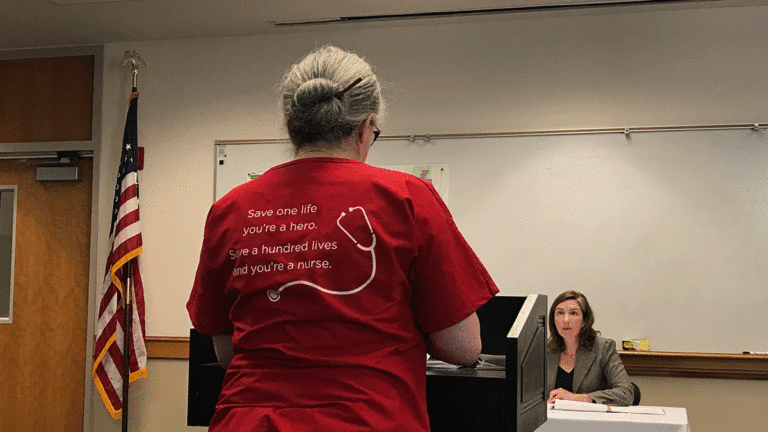
A standing-room-only meeting in a community room at the Santa Cruz Police Department drew comments on everything from abortion and IVF to tattoo removal and insurance bureaucracy. The central question: whether or not a plan to combine Dominican owner Dignity Health with fellow hospital operator Catholic Health Initiatives (CHI) poses a threat to local jobs and medical services.
“Bigger is not always better,” said Lila DeVito, one of several nurses at Dominican who spoke in opposition to the merger currently being reviewed by regulators, at least without strict conditions. On top of voicing concerns about losing “local control” of the hospital, DeVito asked for an explicit 15-year moratorium on any possible hospital closures or restructuring that could affect Dominican or other facilities—rather than an initial five-year commitment.
Dominican President and CEO Nanette Mickiewicz, who was there with other Dignity Health and hospital executives, maintained that the current plan already contains sufficient safeguards to combine San Francisco-based Dignity Health’s 39 hospitals in three states with Colorado-based CHI’s 104 medical facilities in 18 states.
“We do not expect any jobs to be reduced,” Mickiewicz said, noting that union collective bargaining agreements would remain in place. “I want to be crystal clear: There will be no reduction to any service.”
Despite assurances—and the fact that the new Dominican ownership group is expected to be non-Catholic in affiliation—multiple speakers expressed concern about health services for women and LGBT residents. Specifically, speakers asked for more concrete guarantees on local access to abortion and in-vitro fertilization, along with availability of the morning-after pill for rape survivors.
If the merger is approved by the state attorney general, Dominican and other affected hospitals in California would be owned by a new nonprofit health group called Integrated Healthcare Operations. The name was one of several reminders of the increasingly business-centric health care industry, with Dignity Health speakers referencing “alignments,” “synergies” and “regional and subsidiary corporations.”
For residents and regulators, the focus is on whether efforts to consolidate major hospital systems in pursuit of efficiency and savings will result in better access to care—or more confusing red tape after years of debate about health care reform. Dominican, first opened in 1941, currently offers 222 hospital beds, employs more than 1,600 people and generated more than $1.8 billion in total revenue last year.
“Health care is changing,” Mickiewicz said. “This will allow us to continue caring for communities.”
While such nationwide shifts are much bigger than Dominican or any one facility, Monday’s speakers said that Santa Cruz is a prime example of the need for models to serve vulnerable populations. They mentioned homeless services, substance abuse rehabilitation and human trafficking as “social determinants of health” that all providers must be aware of.
To that end, several speakers from nonprofits that have helped fill increasingly wide gaps in the local social safety net expressed optimism that the merger would not affect longstanding partnerships or grant funding from Dignity Health. Representatives from Second Harvest Food Bank, Janus of Santa Cruz and Salud Para La Gente all supported the merger, along with Santa Cruz Mayor David Terrazas.