Virginia Becker Documents the Bittersweet

When Gigi turned 4, her heart turned 3. But she has no memory of the transplant, or the nine months she spent linked to a plastic pump that kept the blood flowing until doctors found her a new heart.

“Can I show this to Gigi?” Virginia Becker asks the girl’s mother, Monadella Vidales, who nods in approval.

Becker crouches down and flips a glossy image toward the girl.

“Do you know who that is?” Becker coaxes.

Gigi smiles shyly and shakes her head, but her brown eyes widen in curiosity.

“That’s you,” Becker says, pointing toward the picture she snapped three years before. “Look how tiny you were.”

The blown-up portrait shows Gigi at little more than a year old—a thick, black mop of hair, gap-toothed smile and one chubby leg kicked in the air. Atop a cloud-like pillow, she’s covered in plastic tubes, wires and bandaging. Protruding from her tightly wrapped midriff is a “Berlin Heart,” a German-made device drawing blood from her failing ventricles to a chamber outside the body before pushing it into her lungs.

“How about we take a new picture to show how strong you are,” Becker suggests.

After changing into a long white dress, Gigi poses for Becker in a sunlit lobby of the Ronald McDonald House in Palo Alto, where dozens of families stay indefinitely while their critically ill children undergo treatment. In one picture, Gigi sits by an antique typewriter with a sheet of paper that reads, “I love my new heart!” In another, she holds a bouquet of white roses. Next, she’s the Queen of Hearts, with a heart-tipped scepter and a heart-adorned felt crown.

“Let’s do the before and after now,” Becker announces, handing her the baby portrait.

Gigi, seated against a white backdrop, props up the photo with her right hand.

“Do you have a special heart?” Becker asks, popping her head up from behind the camera. “Can you show us?”

Gigi pulls down her dress collar to reveal a thick, shiny scar.

“Beautiful,” Becker coos. “That’s your special heart.”


Opening Doors

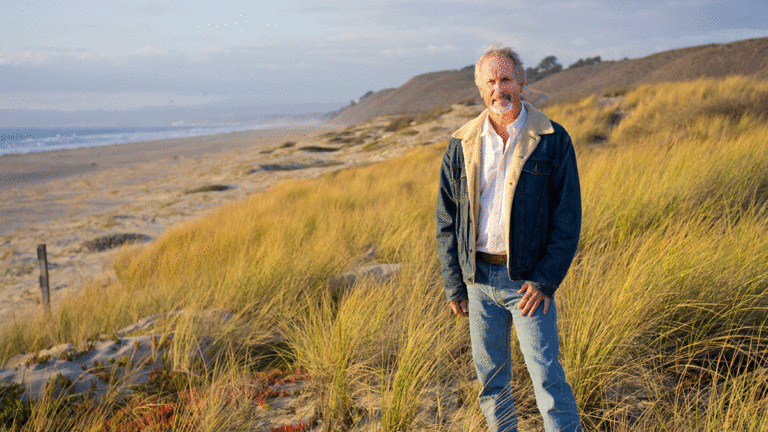
Virginia Becker, 62, founded the Family Album Project to photograph milestone moments of society’s most vulnerable—the sick, bereaved, elderly, homeless and destitute. Since launching the nonprofit seven years ago with her husband, 68-year-old Albert Becker, she’s given away tens of thousands of studio-quality prints for free.

“When I started, I knew why I wanted to do this without knowing how,” says Becker, who lives in the mountains south of Los Gatos.

The gregarious, infectiously upbeat former schoolteacher’s interest in photography stemmed from a deeper sense of purpose, which came to her while helping a friend whose mother died.

“We were preparing for the service and noticed that there were so many photos from when she was younger, but nothing from the last 10 years of her life,” Becker says. “Nothing since the digital age.”

Though smartphones have led to an epidemic of over-sharing, such snapshots are no substitute for the art and intention of a good portrait.

“I wanted to give people something to hold and to share, to put in a shoe box and pass to new generations,” Becker says.

After learning the basics of photography, Becker and her husband began mining their personal connections for people and places to shoot. Early referrals brought them to a senior center in Novato, to the Ronald McDonald House by Stanford University, to foster youth and low-income apartments, to youth camps for cancer survivors and high school proms for students with special needs.

“The camera opens the doors into all these lives, and all these places you might never have gone to,” Becker says.

The Family Album Project has also memorialized moments that might otherwise have been forgotten. With Becker behind the lens and her husband behind the laptop, the couple began photographing those marginalized and struggling—critically and terminally sick children, seniors grappling with loneliness and isolation, families struggling to keep a roof over their heads and people without any home at all. In each photograph, Becker tries to convey the subject’s personality, strength and dignity.

“You don’t see a lot of portraits of children with extensive medical equipment,” Becker says. “You don’t see a lot of portraits of the homeless, or seniors or low-income families who can’t afford to pay a photographer.”

Last month, inspired by their weekly sessions with the Downtown Streets Team—a nonprofit that offers job training to the homeless—the Beckers trekked to a Salinas shantytown for another photo shoot. Among the many people photographed at the homeless encampment, called “Chinatown” by the locals, was a young man in his twenties who went by the name of Little Mike. In one image, his arms are crossed over his chest, but he’s relaxed, smiling.

That night, he was shot in the face—the victim of one of several shootings in Chinatown that week. As far as Becker knows, he survived. But that photo became the last visual record of Little Mike unmarred by a bullet.


Perspective Shift

Last week, Vidales, a 32-year-old mother of six, flew down from Oregon for Gigi’s annual checkup at Stanford’s Lucile Packard Children’s hospital. When they found out the Beckers were staging one of their biweekly photo shoots at the Ronald McDonald House a day after their planned trip home, Vidales delayed her flight.

“We didn’t want to wait until next year,” Vidales says. “Virginia became a big part of our lives. She caught every memory that we had here.”

Not three days after diagnosing Gigi with cardiomyopathy in March 2014, doctors sent her from Oregon to Lucile Packard to await a new heart. Vidales barely had time to pack before being transported on a medical flight with Gigi and her siblings in tow.

When Vidales and her brood arrived, Gigi was swollen, round and hairy, still an infant but pumped full of medication and steroids to keep her alive.

Becker’s portraits of little Gigi, her mom and her siblings during their agonizing ordeal in 2014 now decorate the walls of the Vidales home in Oregon.

“They remind me how much we’ve changed as a family,” she says. “We learned how to live day by day and just appreciate the time we have with each other, with Gigi. Even now, you never know if she may need a new heart tomorrow.”

King City Backs Out of Monterey Bay CCE

1

A hugely popular renewable energy program sounds like nothing but fun in the sun to most government leaders, but a couple communities are now signaling they may pass on the chance to join the party.

King City and Del Rey Oaks are the only two municipalities out of 21 that have voted not to join Monterey Bay Community Power (MBCP), a green alternative to Pacific Gas & Electric (PG&E) that will begin auto-enrolling customers this summer.

While grassroots efforts have convinced Del Rey Oaks council members to re-agendize the matter later this month, King City’s majority sounds like a much firmer no. That isn’t stopping King City Mayor Pro-Tem Carlos Victoria, one of the two votes in favor of joining MBCP last month, from trying to get it back on the agenda.

“MBCP is already established, and will be productive,” says Victoria. “Everyone’s doing it, and there has to be a reason for that.”

Seventeen municipalities, including Santa Cruz, have voted to sign on so far, and their residents should be receiving cheaper and greener electricity by spring of 2018, proponents of community choice energy (CCE) say. Two other outstanding municipalities, Carmel and Pacific Grove, have votes coming up.

While he researched alternatives to MBCP, King City Mayor Mike LeBarre came across Lancaster’s single-city CCE model in Southern California and suddenly felt inspired enough to create the state’s smallest CCE program. “Even though we’re a small little town, we are trying to reduce our costs and address environmental issues,” says LeBarre.

Virginia Johnson, project manager for MBCP, says the group formed to reduce costs of electricity, while addressing reducing greenhouse gas emissions. Compared to MBCP, King City’s CCE program will be more expensive for ratepayers and offer significantly less renewables.

While MBCP plans to start its program at least 3 percent cheaper than PG&E, King City will be only 1.5 percent cheaper, according to government reports. And while MBCP plans to offer ratepayers renewable options of 50-60 percent and 100 percent during its first year, King City would offer just a 35 percent renewable package—the same as PG&E. King City would also shoulder massive administrative costs, instead of sharing them with MBCP, a nonprofit.

The company that would likely set up King City’s CCE, Pilot Power, has never run such a program, and got sued for breach of contract in March 2015. During a Feb. 28 presentation to the King City Council, even Pilot Power indicated that the size of King City is smaller than optimal, and that the city should partner with other jurisdictions to save on costs.

If it were to join MBCP, LeBarre says King City’s influence and bargaining power in the group would be tiny, especially because the Monterey County town has a population of just 13,000 people.

The other—and perhaps primary—reason for splitting off is that the city could use a portion of surplus revenue for unrelated projects, like installing LED or solar street lights, whereas all of MBCP’s surplus revenue will go toward reducing rates and expanding its renewable portfolio.

Daniel Nelson, director of government affairs for Santa Cruz-based GreenPower, questions LeBarre’s motives, and equates King City’s justification to a tax levied on citizens without asking.

“They want to have a pot of money that doesn’t benefit the ratepayer and is effectively a tax on residents,” says Nelson. “They’re thinking of CCE as a way to generate money for things besides benefiting ratepayers.” 


RE: BROADCAST

Keith Rozendal, broadcast advisor to the KZSC 88.1 FM radio station, called GT last week after reading our news coverage about the efforts of fans of the late KUSP to raise money for a new community radio station (“Wait for the Signal,” GT, 4/12). He stresses that Santa Cruz does have community radio right now in the form of “The Great 88,” which is launching a drive of its own.

“The timing of this is a little awkward,” Rozendal suggests, “because we have a fundraiser coming up on the 28th.”

Community members may assume that all things KZSC—which broadcasts out of UCSC—are subsidized. The school does pay his salary, but he has to raise enough money to cover other costs, including two additional positions, he says. And the university taxes the station at every turn. UCSC takes a 6-percent cut of each donation, and when it comes time for the station to do maintenance required by the school, KZSC has to pay the university monopolistic prices—something he says most people don’t realize. Does the station need a sign painted? That will be $64 an hour.   

“Just because we’re up here, people assume we have deep pockets,” he says.

For more information, visit kzsc.org. JACOB PIERCE

Santa Cruz Dance Week Celebrates its 10th anniversary

0

Ever tried bungee moon dancing?

Lisa Christensen’s invention at the 418 Project connects the buoyancy of bungees with a climbing harness affixed to the ceiling so you can dance, bounce, spin, orbit, and leap as if you were free from gravity.

Her aerial bungee moon dancing class allows users to go with the flow, says Christensen, and it’s just one of the hundreds of classes offered as part of this year’s 10th anniversary Santa Cruz Dance Week, April 20-28, for a $10 all-access pass to studios all over the county.

This year’s week-long movement celebration is all about community participation, taking over downtown Santa Cruz with highly anticipated pop-up performances on the streets and in “unlikely places.”

Abra Allan, founder and director of Santa Cruz Dance Week, says that this year organizers are stepping back to let the community of dancers take the lead.

Kathak, an ancient storytelling tradition of traveling bards in northern India, and contra dance will make their debut at the kick-off event, “Dancing in the Streets,” on April 20—where there may be an extra large birthday cake for the 10-year anniversary, says Allan.

Throughout the day, dancers from all different studios will perform on three stages set up in downtown Santa Cruz—an evening of more than 50 performances from every imaginable genre. For those looking to let go, the Community Ecstatic Dance Party will take place on April 20.

When Allan first considered presenting a local iteration of National Dance Week—which celebrates the art of dance with street events and open classes across the nation—in 2007, she wasn’t sure how the community would receive it.

Allan says gauging the reaction an hour into the first kick-off event, it quickly became clear to her: Dance Week was here to stay.

Whether as creativity, fitness, fun, socializing, or spiritual practice, she says, there is a deep love of self-expression through movement in Santa Cruz.

“There is something instinctual about dance, if—but only if—you get out of the way and let it happen,” Allan says. “That is something that we struggle with culturally.”


Info: April 20-28. scdanceweek.com. “Dancing in the Streets” 5:30-9 p.m., April 20, Cooper Street and Pacific Avenue, Santa Cruz.

Film Review: ‘Gifted’

0

It’s a good thing Chris Evans didn’t follow W. C. Fields’ famous advice for actors: “Never work with children or animals.” Otherwise, Evans might have turned down the lead role in Gifted, a low-key but moving tale about love, family, genius, childhood, and the struggle to reconcile all of the above. Yes, Evans is required to spend much of his onscreen time with a spunky 7-year-old girl and a mellow one-eyed cat, but the good news is that Gifted gives the Captain America star one of his best, most persuasive roles as a normal human being.

Directed by Marc Webb (500 Days of Summer), from an original script by Tom Flynn, the movie takes place in a small town on the Florida coast. Evans stars as Frank Adler, a single, self-employed boat repairman raising his little niece, Mary (Mckenna Grace), the daughter of his late sister. They live in a cottage they rent from their friend and landlady, Roberta (Octavia Spencer), along with their orange cat, Fred. As the story begins, Frank is getting the reluctant Mary ready for her first day of second grade—which is also her very first day in a public school.

The daughter and granddaughter of math geniuses, Mary is herself a mathematics prodigy who has so far been home-schooled. But Frank is determined to give her as normal a childhood as possible, so he insists that she go to school, if only to learn how to interact with other kids.

But it doesn’t take long for Mary to stand out among her peers. Her teacher, Bonnie (Jenny Slate), egged on by her principal, tells Frank they want to enroll her in a nearby school for gifted children, but Frank is adamant; he doesn’t want Mary put in a “special school for different kids.” Her brain power is one thing, but he also wants her to have a chance to develop into “a decent human being.”

The plot thickens with the arrival of Frank’s mother, Evelyn (Lindsay Duncan), the grandmother Mary has never met. Once a math whiz herself who gave up the rarefied world of mathematical problem-solving to marry and have children, Evelyn has shown little interest in Mary—until the girl’s talents are made known. Now, Evelyn, a wealthy, patrician Boston Brahmin, weighs in on the side of sending Mary to a special school. When Frank continues to refuse, she takes her son to court in a nasty custody battle.

Acting in counterbalance to the mother-vs.-son showdown is the fate of Mary’s mother, Frank’s sister, another math genius raised to follow in Evelyn’s footsteps. This subplot is introduced early on, when Bonnie googles Frank to learn his history, and continues throughout the story in a series of well-timed revelations. (Information-gathering is a big part of the story; there are so many onscreen Google searches, you’d think the company financed the movie.)

But what elevates the movie far above the standard courtroom drama is the tender relationship between Frank and little Mary. This is the heart of the movie, not an afterthought, and the filmmakers take all the time they need to get it exactly right. Mary can be sassy and disdainful, and their scenes together are sometimes contentious, but their affection for each other is genuine, and good-humored. When they collect Fred the cat and go for a spin on one of the boats Frank is repairing, or stroll along the beach at sunset, deep in conversation, while Mary climbs all over Frank like a jungle gym, their bond is irresistible.

As Mary, Mckenna Grace manages the fine line between arrogance and vulnerability. There are only a couple of moments when her precocity feels forced, more the fault of the script than the skillful young actress, who quickly recovers her place in our hearts. Meanwhile, the serious story is handled with plenty of droll dialogue. (When Evelyn tells Frank that her current husband, an investment broker, is coping with midlife crisis by buying a ranch, she calls him “The man who shot Liberty Mutual.”)

Not just for math nerds, this movie’s human element makes for a winning formula.


GIFTED

*** (out of four)

With Chris Evans Mckenna Grace, Lindsay Duncan, and Octavia Spencer. Written by Tom Flynn. Directed by Marc Webb. A Fox Searchlight release. Rated PG-13. 111 minutes.

A DIY Soda Recipe

Taking a month off from drinking alcohol was harder than I expected. My strongest craving would hit in the afternoon, when I would normally have a glass of wine or beer to relax after work. Rather than fight my Pavlovian habit, I decided to trick myself with a beverage that felt special sans alcohol: homemade soda.

The combination of fructose, phosphoric acid and artificial sweeteners in traditional soda is one cocktail I’ve never enjoyed. But making soda at home is simple, requires four ingredients, 24 hours, and no special equipment. Plus, you can be creative with flavors. Ginger and Meyer lemon is my favorite, but blueberry-thyme, pomegranate, and strawberry-basil are also delicious.

First, fill a clean plastic 2-liter bottle with a cup of sugar, water, flavoring and 1/8 teaspoon of champagne yeast. That may sound like a lot of sugar, but a portion of it will be metabolized by the yeast to produce the bubbles. Using less sugar doesn’t yield the same results. A packet of champagne yeast can be purchased locally at Seven Bridges Organic Brewing Supply for $1.25; it will make a dozen batches of soda and keep in the fridge for months. It will produce the same delightful fizz in your soda that it does for champagne. Do not use baking yeast.

Flavoring can be grated fresh ginger and four or five fresh-squeezed lemons, or a cup of your favorite juice—it’s hard to go wrong. It’s a fun activity to do with kids because it lets them invent their own soda flavors. Conventional root beer and cola flavorings can be found at Seven Bridges, too.

Combine the ingredients and give the bottle a good shake, seal it and leave it on the counter. By the next day, the pressure will have built up inside and you won’t be able to push in the plastic. Put it in the fridge. When it’s cold, slowly open the cap a bit at a time to release the gas, and enjoy. Best of all, the champagne yeast will continue to slowly turn sugar into fizz in the fridge, so it won’t go flat if it takes you a week to drink the whole bottle—but I doubt that will be an issue.


Soda-making books and equipment can be found at Seven Bridges Organic Brewing Supply, 325 River St., Santa Cruz

Brandon Armitage, Pinot Extraordinaire

When it comes to Pinot Noir, expert winemaker Brandon Armitage makes some of the best. If you’re a Pinot lover, I highly recommend you stop off at the tasting room, where only Pinot is sold, and try the ones made by Armitage. The tasting room is right next to Starbucks in Aptos Village.

Armitage’s Pinot Noir 2014 ($48) is a Pinot extraordinaire. Grapes are harvested from the Heart O’ the Mountain estate in Scotts Valley, a premium grape-growing property where famous movie director Alfred Hitchcock once had a home. Starting with a harvest of fine fruit is key to producing excellent Pinot—and, with Armitage’s winemaking expertise, the result is a superb Pinot with flavors of vanilla, caramel, spice and clove. Aromas of cherry, strawberry, clove and leather round out the wine’s warm layer of characteristic earthiness.

An acquaintance stopped me in a store recently and asked if I’d tried Armitage Wines’ Pinots, saying how much he loves them. We ended up talking for 20 minutes about premium local wines.

Just as Armitage is dedicated to making wine, tasting room manager Jeanne Earley has her own thing going with the grape. Not wanting to waste anything from the production process, she has saved the must (freshly pressed grape juice that contains the skins, seeds and stems of the fruit) from fermentations to make wine grape flour and wine grape jellies from both Pinot Noir and Chardonnay fruit, both of which are for sale only at Armitage Wines. Gift baskets are also available at Armitage tasting room for about $150, containing wine, grape jellies, wine charms, a copper wine stopper, wine bottle marker, and Brix chocolate.

Armitage Wines, 105c Post Office Drive, Aptos, 708-2874. armitagewines.com.


Los Gatos Wine Walk

An opportunity to try Armitage Wines will be at the downtown Los Gatos Wine Walk from 1:30-5:30 p.m. Saturday, April 22. Many of our wonderful local wineries will be pouring that day in an “open house atmosphere.” Tickets are $50 and include a souvenir wine glass. Visit losgatoschamber.com or call 408-354-9300.

UCSC Grads on the Cutting Edge of Social Justice Activism

UCSC graduate Carmen Perez returns to Santa Cruz on April 28 to give the keynote address at this year’s Alumni Weekend, after having co-chaired the Women’s March on Washington in January. Meanwhile, another UCSC graduate (and former City on a Hill writer), Amelia McDonell-Parry, has also stepped onto the national stage as a co-host of Undisclosed, the popular criminal-justice podcast that this year is taking on perhaps its most controversial episodes with ‘The Killing of Freddie Gray.’ The two Santa Cruz alum spoke to us about their different approaches to the fight for social justice.


When I reach Carmen Perez on the phone, she is in transit between meetings on the noisy streets of New York City. Since 2010, she’s been the executive director of Gathering For Justice, a political action nonprofit with a mission to end child incarceration and eliminate the racial inequities in the criminal justice system that enliven mass incarceration.

As a national co-chair of the Women’s March on Washington on January 21, Perez is, naturally, full of excitement and fire when I ask her about the event—famous not just for inciting shortages of pink yarn across the country, but also for having one of the most radical platforms ever released for a march. Its uniting principles, which Perez was responsible for defining (following several weeks of dialogue with 24 experts) consist of: promoting environmental justice, and reproductive, LGBTQIA, worker, civil, disability, and immigrant rights, and an end to violence.

While the march—which drew half a million to the capital and an estimated 5 million worldwide—is over, the movement hasn’t gone dormant. Rather, it’s in a re-grouping mode. At press time, there had been more than 5,448 “huddles,” or small groups holding informal conversations, across the country, as part of the march’s 10 Actions for the First 100 Days campaign.

Between the car horns and sirens, a smile shines on the other side of the line when I ask Perez about Santa Cruz.

“From the moment that I walked off UC Santa Cruz to the present day, it’s all prepared me to have been the national co-chair of the Women’s March,” she says.

After graduating UCSC with a psychology degree in 2001, Perez went to work advocating for young women and men in the county’s criminal justice system. It was here that she founded the youth leadership program R.E.A.L. (Reforming Education, Advocating for Leadership) and co-founded the Girls Task Force, which helps to improve services for at-risk girls in Santa Cruz and discourage juvenile incarceration. In 2006, Perez went to work for the Santa Cruz County Probation Department as a bilingual probation officer with a female-intensive caseload. She also worked with Barrios Unidos, where founder Daniel “Nane” Alejandrez took note of the driven young Perez, and became her mentor, introducing her to civil rights activist and singer Harry Belafonte. Belafonte founded The Gathering for Justice in 2005, and brought her in in 2009.

“All the organizing that I did on a local level, on a statewide level, on a national and international level … and all the wisdom that I received [from mentors in Santa Cruz] led me to really ensure that the march was not only a success but also had a lot of grounding in intention,” says Perez.

Along with Nane and Belafonte, Perez names UCSC feminism professor Aida Hurtado and UCSC psychology professor Craig Haney as early influences in her career. Haney will be introducing Perez during UCSC’s Alumni Weekend when she will give a keynote talk at the Cocoanut Grove at 7 p.m. on Friday, April 28.


Somewhere around 70 percent of the Women’s March participants around the globe are said to have been marching for the first time. What does that mean to you, and what does that say about activism today?

I think one of the great things about the Women’s March is that we were extremely intentional about creating entry points for all people to get involved. We understood that at the time many women, many people, felt defeated, specifically because of the election, and so we wanted to make sure that if people were not able to be physically present in Washington D.C. that they were able to march in their local city. And so there were people organizing locally to ensure that they also were connected to the larger mission and vision of the Women’s March. And so for me, I think sometimes I’m in awe of what we were able to accomplish, but I know we worked extremely hard to make sure that people from different walks of life and from different groups felt as if they were included … In the beginning when we were talking to different organizations to come on and partner, for the first three weeks what we were hearing from people was “do you have a permit?” And “what are the risks?” “Should we bring our children?” But as soon as we were able to demonstrate that we did have our permit, the conversation shifted to “what are we marching for?”


In what ways do you think the march was successful?

National co-chairs of the Women's March on Washington Linda Sarsour (left) and Carmen Perez (center) with honorary co-chair Gloria Steinem (right).
A WOMAN’S PLACE National co-chairs of the Women’s March on Washington Linda Sarsour (left) and Carmen Perez (center) with honorary co-chair Gloria Steinem (right).

I think the march was a huge success before it even started. To have so many women feel that they want to show up the day after the inauguration, and then allow four women co-chairs—three of the four women being of color—lead them, and also the intentionality through conversation, through relationship-building, teaching the women that had never organized before who were working with us, who had been seasoned organizers. And then also being able to hold space around different issues and conversations online, through Facebook Live, that addressed white privilege, that addressed different issues—for me, that was a success. Showing up the day of, on January 21st, was just mindblowing, I still remember the morning that we arrived at 4 and there was already a sea of pink hats. There were so many people telling us that they were marching with us … we turned on the TV the night before, and they were marching in different countries. We were able to use the six principles of nonviolence that were really from the ideology of Dr. King and Kingian nonviolence. We had our elders that were part of the honorary co-chairs, that we would have conversations with and they would share with us what they had gone through during their times, so it was also future generational, the children that we saw out on January 21st. So for me there were so many successes, and I think that the way in which the movement is going to continue, is if we continue to be intentional, if we continue to create entry points, and if people continue to show up for one another.


We saw continued demonstrations at airports, in protest of the travel ban on Muslims—a sign that people are continuing to show up for each other. In what other ways do you see the momentum of the march continuing?

What we launched immediately after the march were 10 actions in 100 days, and so we are now on our seventh action. You can go to our website [womensmarch.com] to see what actions we put together continuing to elevate our partners, to ensure that people know that the work just didn’t start on January 21st, but there have been so many organizations doing this work for so many years that we need to support. We were able to bring together so many people for A Day Without a Woman [strike], where we created three entry points. One was for women and men and families to wear red in solidarity if they cared about women’s issues. The second was if you have to buy anything, purchase from local and women-owned businesses. The third was not to go to work. There were so many people that participated. And to this day the color red has been a symbolism of resistance. And it comes from our elders—Dolores Huerta and Cesar Chavez …

We just did a Facebook analysis, and there were 88 million people that knew about our strike, and so we’re seeing people continue to show up. I think people need to connect with one another. Just because we’re not physically seeing people in a march doesn’t mean that people are not showing up, doesn’t mean that people are not active. It’s not visible, and so we continue to encourage people to act locally, think nationally.


How can people use multiple approaches—strikes, direct action, boycotts—to make progress in social justice?

I completely believe in a multi-pronged approach. It is the work I’ve done throughout my life. I believe that we need to organize our communities and give power back to the people, I believe that we also need to be at the tables where policies are being made. I also believe in civil disobedience. I believe also in withdrawing your money from certain entities that are oppressive. And so I believe that a strike, I believe that a boycott, I believe that a civil disobedience and direct action, policy change, organizing, training, need to all be used in order to be effective and to also create the change that we want to see. It can’t be one or the other. We cannot just say that one of these tactics works, because I have seen the power of all of them working simultaneously in order for us to change the injustices happening in our communities.


What was your time like at UCSC, and working at Barrios Unidos?

My time at UC Santa Cruz was one of your typical, I think, farmworker child—not being able to really focus on school because you’re having to work while you’re in college, and not having the tradition of support. I think my family supported me as much as they could, but I was the youngest of five, and I was the first to go away to go to college. And I had also just lost my sister, so I was dealing with a lot of grief. But I met women like Aida Hurtado, and I’d heard about women like Angela Davis. And Aida was somebody that, for me, was who I wanted to become. She was that example, she was a Mexican-American woman, Chicana, teaching chicana feminism and psychology. And also through Barrios Unidos, I worked at Y Corps and I was working with youth that were coming out of the juvenile justice system, and that’s really where I feel I got my bearings in the community. I got trained in the strength-based approach and I was creating detention alternatives, and I was also the founder of the Girl’s Task Force in Santa Cruz County, so before I even entered or stepped into Barrios Unidos I had already been organizing local youth around detention alternatives.


Daniel “Nane” Alejandrez, a mentor to you and the founder of Barrios Unidos, introduced you to Harry Belafonte. What was that like?

So I didn’t really necessarily know who Mr. B was, Mr B is 50 years older than me, he’s of a different generation, I never really heard his songs, with the exception I had learned that he had sang the song that was in Beetlejuice. And so my mentor Nane really respected him, and really looked up to him, and felt that it was important that I learned from somebody like him. So Nane really had opened so many doors for somebody like me who was coming fresh out of college, who was already involved in the community. So he saw something in me and he told me he did. And so he had me traveling with him to different places, and it was also in my second encounter with Mr. Belafonte where I was now a part of a youth executive committee to help build the organization that I’m now the executive director of. And so I’ve been with Mr. B for close to 13 years. And I try to continue in the tradition of all that he has been a part of and create a pathway for young people to see themselves as leaders as well. It’s been hard because I am 50 years younger than him, and I think that sometimes our elders, you kind of forget that, because he certainly walked beside Dr. King. And I’ve learned so much.


How has your mission as an activist changed with the 45th president now in office, if it even changes at all?

I think for me we’re going to have to continue to organize whether it’s number 45 in office or it was President Barack Obama. I think that our communities are always suffering, specifically black and Latino. And we just can’t ease up. We have to put the pressure on the ground, we have to put political pressure, we’re also fighting statewide battles, we’re fighting local changes, local policies, and so I think as an organizer, what it did for others, it woke them up, and so it’s my responsibility to organize those that just woke up, and again create the entry points, but also say welcome, I’m here to support you in your process, and your leadership, and your activism. And so I know not many people are down for that, because they’re like where have you been all these years? We’ve been suffering? There’s no telling unarmed black men, or unarmed black Latino men, but I’m just of a different school. Mr. Belafonte always said you have to meet people where they’re at, and change their hearts and minds and champion them to your cause. And so it’s also about meeting with the people who don’t agree with you, and having that courageous conversation about what does this really mean and what are the implications for our community under a presidency of someone like Donald Trump. But also understanding that Donald Trump is only one human being, and he’s truly the reflection of a whole country. He got elected. So we have to dismantle the institution of racism and oppression in our country by using different tactics. So it’s not just about attacking him, it’s actually about making sure that we stand up for something.


What would you tell people who are new to activism but want to get involved and stand up for human rights or the environment?

I would say stay alert, educate yourself on previous movements, from the American Indian movements to the Chicano movement, United Farm Workers, to the Black Liberation, to all these different movements. Do your due diligence. Learn about community. Go and meet with your neighbor and say hello. Go to your local community-based organization and volunteer. What we ask so many people that are new to activism, you don’t have to be an activist, it’s actually what do you love to do? What do you do well? And how could you bring that to the movement and share your gift with others?


Amelia McDonell-Parry

Exposing the failings of America’s criminal justice system on ‘Undisclosed: The Killing of Freddie Gray’

By Steve Palopoli

[dropcap]I[/dropcap]n 2014, Serial brought podcasts into the mainstream when millions of listeners obsessed for 12 weeks over its coverage of the murder of Hae Min Lee. The question at the core of its first-season episodes was whether Adnan Syed, an ex-boyfriend of Lee’s who is serving a life sentence for her murder, was wrongly convicted.

'Undisclosed' podcast team including ucsc grad Amelia McDonell-Parry
POD SQUAD The team for the ‘Undisclosed’ podcast’s series on ‘The Killing of Freddie Gray’ is reaching more than a million listeners each week. Left to right: Marcia Chatelain, Amelia McDonell-Parry and Rabia Chaudry. Not pictured is a fourth co-host and investigator, Justine Barron.

Many of those same listeners were immediately drawn to Undisclosed, a podcast that arose in the wake of Serial’s first season that featured three lawyers—Rabia Chaudry (who had originally brought Syed’s story to the attention of Serial’s producers), Susan Simpson and Colin Miller—digging even deeper into mistakes and subterfuge on the part of Baltimore police officers and prosecutors in the case against Syed. Undisclosed’s profile skyrocketed last year when one of the Undisclosed team’s findings became the basis for a Baltimore circuit judge’s dismissal of Syed’s conviction.

In the meantime, Undisclosed has continued their work to expose the failings of the American criminal justice system, including a season about the case of Joey Watkins, who they argued was wrongfully convicted for the 2000 murder of Isaac Dawkins in Georgia, and a shorter arc of episodes about South Carolina’s Jamar Huggins, who had the only witness in the bizarre armed robbery case against him recant in court, only to be convicted and sentenced to 15 years despite any evidence against him.

For their new arc of episodes, “The Killing of Freddie Gray,” Undisclosed has flipped its own script, both because the case of the Baltimore man who died on April 19, 2015—after being fatally injured in police custody—is already well-known, and because this time they are examining whether there should have been convictions in the cases against the six Baltimore police officers indicted in Gray’s death.

To do so, Undisclosed—which reaches over a million listeners each week—has added to its core team. One of the new members is Amelia McDonell-Parry, a 2001 UCSC graduate who began digging into the Gray case with fellow journalist Justine Barron last year. What they found impressed the Undisclosed team so much that they brought them on to co-host and write the new episodes, along with Chaudry and historian Dr. Marcia Chatelain. The New York-based McDonell-Parry spoke to us about her work on Undisclosed, and what she’s uncovered about the Freddie Gray case.

You’re a few episodes into ‘The Killing of Freddie Gray’ now. Do you feel like you’ve been accepted by ‘Undisclosed’ listeners?

AMELIA MCDONELL-PARRY: Yeah, we have been getting good feedback. I was a little nervous because the first two seasons were the same core team of Rabia, Susan and Colin. Rabia’s one of our hosts, but this was going to be three people they hadn’t heard from, at least not in this way. I’d done an addendum before. So yeah, I was a little bit worried about that, because there are real diehard fans of that team, but people have been really awesome about it, actually. I think they understand that it’s not always possible for Susan, Rabia and Colin to align their schedules perfectly, and it takes them a lot of time to investigate wrongful conviction cases. So it’s not like they can do one season and then just quickly spit out another. And I also think they just have their pet projects sometimes, too, like Colin did his four-episode arc on Jamar Huggins, which was great.

That mini-arc on Jamar Huggins was really a turning point for ‘Undisclosed.’ It was the first time they took a step away from the ‘Serial’ model and started experimenting with new ways to examine and critique the criminal justice system.

It was exciting for us when they were interested in turning the work that we were doing on the Freddie case into one of their sort-of “mini-seasons.” Myself and Justine, who’s another co-host and my co-investigator—she and I have done the bulk of the real deep dive into every single little shred of evidence in this case—we were kind of doing it as a labor of love before this. When Undisclosed was interested in turning it into one of their seasons, we were stoked, because, first of all, it’s a built-in audience for the story, and what we cared about more than anything was just having people hear it. We knew that this was the first time someone was doing a deep investigatory dive into this case. There was lots of coverage of it shortly after Freddie died, and throughout the trial, certainly, but there’s so much that you can do with the benefit of hindsight. Looking back on this case has allowed us to look at the timeline of how everything happened from the very, very beginning. Not even just starting with the foot chase, but starting with Freddie’s history with Baltimore police from before that, his growing up in Baltimore.

One way you seem like a good match with the ‘Undisclosed’ team is they made their name by digging into incredibly minute details of their cases, and then showing why those were crucial. The way you’ve broken down each stop of the police van during Freddie’s arrest, for instance, or what each surveillance camera shows at exactly what time, reflects that same belief that the ‘devil is in the details.’

I was always interested in true crime. You know, I like a mystery, I like that kind of thing. But with Serial, I was obsessed. And then Undisclosed, I would say, actually kind of changed my life in this weird way. I ran a women’s website for nine years. Don’t get me wrong, I was incredibly lucky to have that job, and it was an incredible experience. But toward the end I was burnt out. I stuck around because I didn’t really know what I wanted to do with my life. But I felt really passionately about the Adnan case, and I started getting more and more into looking at wrongful conviction cases. And more than anything, I really respected Undisclosed’s approach to journalism. I’d blogged, but I hadn’t done reporting in a really long time. I started to write a lot about the Adnan case, and I started to see how frequent cases like his are, and how, if you look at … any case, probably, you will see the same kind of recurring problems. Whether it’s somebody being convicted of something they didn’t do, or a crime not being thoroughly investigated. And I don’t mean to be completely dismissive of all law enforcement, by any means, there are obviously some brilliant detectives out there. But it’s not just detectives who do police work, and it’s just sort of shocking when you start to look at how evidence is collected, and how much people’s own personal biases influence which things they end up pursuing. You could say the same thing about prosecutor and state attorney offices. All of these criminal justice issues are intertwined. I’ve learned so much doing this project, not just about what happened in this horrible case of Freddie Gray dying in police custody, but also just the micro-violations that happen daily in poor communities of color at the hands of police.

How did you first connect to the ‘Undisclosed’ team?

I had started covering Adnan’s case when I was at the Frisky. This was after I had quit as editor-in-chief, but I was still doing some writing for them. I went to Baltimore and covered Adnan’s post-conviction hearing. I had never done any sort of trial reporting before, and I’m not a lawyer. But I have this need to be really detailed—I like to cut off trolls at the pass by trying to answer any of their possible questions or criticisms in advance. So I was doing these exhaustingly detailed recaps of every day of the hearing. Adnan’s attorneys read some of my recaps and liked them, so I became friendly with him. That’s how I met Rabia, and it sort of naturally developed as not only a friendship, but also a professional connection. I just liked her a lot.

I know you and Justine came together on this project because you both had a passion for this case, but had you known her long before you started working together on it last summer?

We had never met. We still haven’t met! She lives in California. I always joke that she’s like my podcast wife, because we don’t ever see each other, but at the same time we weirdly know each other so well. And sometimes we bicker like married people. But we became really invested, and we had other jobs, and we quickly realized “holy shit, this is so much work.” I mean, you have six defendants, dozens of witnesses, six stops—which are questionable—20-something CCTV pieces of footage to review. That was a huge undertaking. There’s just so much. We’re still completely immersed in investigating at the same time that we’re writing episodes.

What has the investigative process been like for you for this podcast?

Only four of the cases went to trial, but that’s four trials to listen to. And that’s just what made it into court. Before that, a lot of this case was litigated through motions prior to trial. So that’s a mountain of paperwork to go through. And before that, the state’s attorney allegedly did their own investigation, and there was a police investigation to look into. There’s all of the media reporting. And then there’s just putting all of that aside and trying to figure out, without any of the noise, what happened that day, and then how the narrative of what happened that day came together. That’s a huge part of what this is about. Where we get the benefit of hindsight is that we can see, for example, stop three—the stop that Goodson, the driver, didn’t alert dispatch about: When did that come about? When did police learn about that? How did they learn about that? What is the proof of that stop, and does it hold up? A big part of this was also trying to figure out what happened with the case when [Baltimore State’s Attorney Marilyn] Mosby charged the six officers. I remember watching that and being blown away that she had charged six; I mean, it was just incredible. I was thinking, “Holy shit, this woman is a badass.” But then fast forward to the [Baltimore Police Officer William G.] Porter trial, eight months or something like that, and you have a mistrial. And a few months after that, the [Officer Edward] Nero trial—he opted for a bench trial, and that went his way, and he was acquitted. After that, every other officer was choosing a bench trial, and that changes the state’s attorney’s case. Because presenting a case in front of a judge is very different than presenting in front of a jury.

How has your investigation been different from how the mainstream media covered the case while it was happening?

I think about the CCTV footage, for example. I’m sure that journalists in Baltimore watched it, but they probably watched it all once or twice. I’ve watched the CCTV footage [from each camera] at this point over 100 times, and all of them a couple of times, at least, frame by frame. And there are things to see—they are chock full of things that just refute things that the officers said.

Has your opinion of what happened at those police trials or during Gray’s arrest changed because of what you’ve discovered doing the podcast?

In some ways, my overall feelings have stayed the same. I don’t think that Freddie’s death was an accident, in the sense that I don’t think that he fell and hit the wagon and that’s what did it. So in that sense, my feeling has stayed the same. But my feelings on the prosecution’s case, and more than anything the prosecution’s narrative for this case, which is essentially the police department’s narrative, how that came together—when you start looking at this case, you realize “Hold on, that’s what they went with? Is that really what happened?” It’s interesting, because it really has challenged some of my convictions. Because I firmly believe that if there is not evidence to convict, there should be no conviction. And I see why, in some ways, a number of the defendants were acquitted. In many ways, I don’t necessarily blame Barry Williams, the judge, for going in the direction that he did. I also admire Mosby for bringing charges—I just wish they had been better, and more thoughtfully considered.

You’ve said a larger issue in this case is how the state allowed the police to completely shape the narrative of what happened to Gray—you could almost say the prosecution put the defendants in charge of building the case against themselves. How do you hope the podcast will change how people see Gray’s story?

For me, one of the more infuriating things about this case is the way witnesses to the first and second stops were largely ignored after that first week. Detectives interviewed some of them; the people I’ve talked to about that have said that they felt like the detectives just didn’t believe them. What those witnesses allege they saw at stops one and two, I don’t know whether those actions by the police ultimately led to Freddie’s fatal neck injury. But to me, that doesn’t make those things irrelevant at all. Those things still matter. What those people saw still matters, and I loathe the fact that the media narrative and the state’s narrative and the police narrative for this case gaslighted that entire community. They were given attention in the media for a week or two, and then they were ignored the minute it was determined that “what happened, happened in the van.” … When I first started going around and talking to people, I heard from a number of them, “What’s the point? Nobody listened to us before.” And I want people to listen to them. Regardless of what it says about how Freddie died, I think what they saw has something to say about the ways in which Freddie had to live. And I feel that’s just as important to telling the story as anything else.

You and I were at UCSC at different times, but we share a mentor who taught there: Conn Hallinan, my journalism hero.

He’s the best. For me, I know a lot of certain ethics I have about how journalism should be pushing boundaries came from him. One of the things I always think about is how he taught us that there’s really no such thing as an unbiased reporter. How you frame a story, who you give your kicker quote to, headlines, all of that kind of stuff conveys—whether you want to admit it or not—your perspective. So it’s better to be conscious of that. And then also, not every story has two equally valid perspectives. Climate change is real, period, no matter what some people say. I just so appreciate that, because it’s been a big guiding principle for me. Sometimes it’s okay to have an opinion, because there’s truth, and there are lies. There’s fact, and there’s fiction. Journalism needs to be able to point out when something is fiction.

Ecology Action Helps Disadvantaged Communities Cut Back Water

0

The first time Cynthia Padula knocked on someone’s door to try to convince them to install low-flow showerheads and faucet aerators, she didn’t know what to expect—or, really, what she was doing.

“It took a while getting used to knowing what to say and getting inside houses,” says Padula, an environmental consultant who works as a field manager for WaterLink, an Ecology Action program that brings water-saving help to lower-income communities. “But people were very, very welcoming. They offered food and drinks all the time.”

That was a surprise, and not just to Padula.

“It’s funny, because we didn’t know if people would let us into their house, period,” says Kirsten Liske, vice president of community programs for Ecology Action. “And then secondly, ‘can we come into your bathroom?’ Think about the state of your bathroom right now, or mine. In these neighborhoods, people are really welcoming, and they offer us empanadas, and we get to meet their grandkids. It’s a really cool experience.”

Under the program’s policy, team members would not accept food, Padula says, but sometimes they would leave with a few bottles of water on scorching-hot South Bay Area afternoons, when their hosts insisted.

Ecology Action launched WaterLink in East San Jose last summer, and this year the Santa Cruz-based nonprofit announced it had won a $5 million grant to grow the effort—it will expand over the next few months into Watsonville, Salinas, Santa Clara, East Palo Alto, Hayward, and Daly City. The money comes from revenue out of the state’s cap-and-trade program that funds sustainability programs.

With WaterLink, Liske says that Ecology Action targeted communities that rely on groundwater—a resource hit hard by five years of drought—as well as areas that California recognizes as “disadvantaged.” State law requires that 25 percent of the cap-and-trade revenue go toward communities that historically sit lower on the totem pole, where residents face more obstacles to success. Using an algorithm called the CalEnviroScreenTool, the state identifies the 25 percent most challenged communities—taking into account income, language, education, pollution and water quality—requiring that a quarter of the money go there.

“It’s all from really simple measures, but a lot of these folks don’t get the upgrades from their landlords, or they can’t afford them,” Liske says. “And honestly, we all probably could do better in our own homes.”

In addition to aerators and showerheads, WaterLink will give away 100 dishwashers or washing machines, and Liske says teams will award them to “neighborhood leaders” who refer 10 other people that sign up. If a home has a substantial leak, WaterLink can pay up to $300 toward fixing it.

Ecology Action estimates the program will save customers $1.5 million each year on water costs, while serving 15,800 homes.

WaterLink also works with businesses, offering them brand new pre-rinse spray valves, or rebates toward new dishwasher systems. Between businesses and homes, Ecology Action projects the whole program will save 3.6 billion gallons of water annually.

Liske says the people they met care deeply about conservation, but simply don’t have the resources, time or information to do much about it. In Watsonville, 40 percent of the service area’s demand comes from low-income housing, according to a letter in support of WaterLink from the city’s Public Works Director Steve Palmisano to the Department of Water Resources.

In the afternoons, field teams gather in public parks for meetings and use a mapping software which helps them keep track of which homes they already visited. When team members enter houses, they strike up conversations about saving water with curious residents, who often follow them through various rooms to see what work they’re doing. When people aren’t home, WaterLink crews leave behind flyers with contact information or a time they’ll be returning.

Last year, an eclectic blend of team members covered six languages—English, Spanish, Vietnamese, Portuguese, Tagalog, Mandarin, “and we ended up using them all,” Liske says.

Ecology Action assumed this would be a grueling operation. “We really trained the team to do a sales pitch,” field manager Mariana Ivancko says. “They didn’t need to work so hard. The communities were very receptive to our program.”

Teams learned some interesting lessons along the way. Certain neighborhoods that ended up in WaterLink’s walks appeared to be more middle-class than others, and those were the ones where people appeared least keen—and less likely to open the door for strangers.

Some mobile home parks made the outreach job especially easy—perhaps because they have tighter-knit communities, and are used to talking to neighbors, Ivancko says.

Padula expected to be back at her environmental consulting gig this summer, but found herself getting drawn back in for a few more months of field work. Originally from Argentina, Padula first applied for the position last year to get a different kind of work experience.

“Something that I really discovered is that I really enjoy working with people,” she says. “I get all this energy—rejuvenated.”

Tracey Helton Mitchell Comes to Bookshop Santa Cruz

Most of the addicts in the 2000 documentary Black Tar Heroin: The Dark End of the Street are dead now, but Tracey Helton Mitchell is very much alive. She was picked for the film at a needle exchange in the Tenderloin district, and though she was off drugs when it came out, it was not a story about recovery. After all, recovery is anything but one size fits all. Mitchell knows this all too well, and from the vantage point of having rebuilt her life, she shares how she went from darkness to light in her book The Big Fix: Hope After Heroin. We recently talked about her journey and the larger issues around addiction.  

You survived a brutal life on the streets. How?

TRACEY HELTON MITCHELL: My mother was very supportive. We have addiction in our family, so she knew the right things to say to me. Other providers were also kind. They told me I deserved a better life, and even though I didn’t believe it at the time, I held on to that thought. For whatever reason, I felt like someday I’d go back to school. That dream kept me alive.

Depression and anxiety contributed to your addiction. How have you learned to cope without drugs?

I went to therapy for seven years. I’ve tried yoga and meditation. Whatever your recovery is, it has to be flexible over time. If something’s not working, I try something different.

You’re a wife, mother, and health program coordinator in San Francisco. How has your recovery affected these roles?

I got clean when I was 27. At that point, I needed approval from others. Now it’s about having a fulfilling life, which isn’t necessarily attached to people’s opinion of me. I’m more empathetic now too, and I draw upon that in my public health role. As a mother, I try to be honest, whereas I think my parents struggled with it. Sharing the truth with my kids to the degree that they can understand it is important to me.

What are the ongoing challenges of recovery?

Heroin continues to impact my life. One of my mentees died this year from an overdose after a decent period of sobriety. I’ve had multiple friends relapse. It crosses my mind every day. There are people who can use hard drugs and then after a period of time, drink alcohol and smoke pot socially, but I’m not one of them. When I speak to groups, I say, “You only have to give up this one thing—drugs—to get everything else.” Instead of looking at what I lose, I keep in mind what I’m gaining. It shifts my perspective.

What’s the current state of addiction and recovery services in the U.S.?

We used to deal with overdoses, but we didn’t have people instantly dying from them, which is very common now. The anti-overdose drug Naloxone is becoming more widely available, along with needle exchanges, but drug companies keep raising their prices, and there are many places where people still can’t get a clean syringe. We have a lot of work to do, but opinions are changing. I was in Ohio and Kentucky recently, where they’re dealing with high numbers of overdoses, and these are very conservative states. Now it’s those mothers who go to Washington D.C. and say, “you have to do something.”

What can the rest of us learn from drug addicts?

You can use anything outside of yourself to distract you—food, relationships, drugs—but it won’t cure your problems. It just pushes them to the side and adds new ones. We spend so much time with our distractions. What are we afraid of? Maybe it’s just spending time with ourselves. I think part of the reason we have such a big opioid problem is because we’re so disconnected from each other. I’ve worked with people who can’t talk on the phone. They only communicate through text messaging. To a certain extent, that’s just existing; it’s not living or interacting. What I hope people get from my story is that the process of trying to get back to yourself is a lot of hard work, but it’s worth it.


Tracey Helton Mitchell will sign and discuss her new book at 7 p.m. on Wednesday, April 19 at Bookshop Santa Cruz, 1520 Pacific Ave., Santa Cruz, 423-0900. Free.

Preview: Aoife O’Donovan to Play Kuumbwa

0

For 40-plus years, Garrison Keillor hosted A Prairie Home Companion, the wildly successful radio variety show that pairs comedy skits, news from Lake Wobegon and spoof ads with top-notch roots music.

Recently, Keillor handed over the reigns of the show to mandolin virtuoso Chris Thile of Nickel Creek and the Punch Brothers. There was a question among the show’s fans of whether Thile would be able to fill the void left by Keillor’s departure, and the first couple of shows felt like the new host was doing his best to imitate Keillor—an impossible job for anyone. But Thile has since found his hosting groove, and brings more music to the show than ever before, including a new, original tune he writes each week. Singer-songwriter Aoife O’Donovan, who has been a guest on the show many times, sees the new show as different, but equally inspiring.

“I’ve been especially lucky because I’ve gotten to work so much over the years with Garrison,” she says. “To be part of the new incarnation has been very special. I know a lot of people who didn’t necessarily love Garrison Keillor, but you can respect that he’s a total genius. I think the same is true of the new incarnation. It might not be your thing, but you can’t really knock it down.”

O’Donovan is no stranger to Thile’s musical brilliance, or the type of music he plays, which gets placed under the progressive bluegrass and folk umbrella—much like O’Donovan’s one-time group, Crooked Still. As frontwoman for the band, she helped establish it as a pioneering act of the progressive bluegrass movement, blending folk and roots with jazz, rock and a mission to forge new musical territory. She also emerged as one gifted roots singer with a clear, gorgeous voice.

In 2010, O’Donovan left Crooked Still to launch a solo career. Almost immediately, she established herself as one of the most innovative artists on the roots scene, with unexpected chord changes and nontraditional rhythmic structures in the spirit of trailblazing artists such as Joni Mitchell.

“I’ve always just seen music as something that doesn’t have to stay in one zone,” she says. “I’ve always been attracted to unusual chord changes. I think applying that to folk music is a natural progression.”

O’Donovan’s folk music roots run deep, and span the Atlantic. Her dad has an Irish music show on WGBH in Boston, and the artist spent her childhood summers in Ireland singing songs with her extended family.

“I spent my time getting immersed in the folk music of the ’60s and ’70s that my parents and aunts and uncles listened to,” she says. “It was a very formative time. We would sit around and sing songs pretty much every night.”

With her Irish roots, O’Donovan saw firsthand the connection between Celtic music and American roots music. She talks knowledgeably about how Celtic music traveled from Ireland and Scotland to the Appalachian Mountains to become old-time music, and into Kentucky, where it mixed with rock ’n’ roll, jazz and blues to become bluegrass.

O’Donovan didn’t pick up the guitar herself until 2010, when she struck out on her own—but to see her play now, you’d think she’d been doing it her whole life. She moves up and down the fretboard in unexpected patterns with an easy grace and rhythm. Her non-traditional melodic style has moved her beyond roots music into cross-genre experimentation, including collaborations with Yo-Yo Ma, the Punch Brothers and bassist Edgar Meyer.

The next few months are a nonstop flurry of performances and projects for O’Donovan. (On April 21, she’ll play the Kuumbwa with guitarist Julian Lage, and Chris Eldridge from the Punch Brothers and the Infamous Stringdusters.) At the heart of all the hustle and bustle is O’Donovan’s humble reworkings of what constitutes American roots music.

“I try to not be bogged down by traditional song form,” she says. “Not every song has to have a verse and a bridge and a chorus. You can really get outside the box.”


Aoife O’Donovan will perform at 7 & 9 p.m. on Friday, April 21. Kuumbwa Jazz, 320-2 Cedar St., Santa Cruz. $30/adv, $35/door. 427-2227.

Virginia Becker Documents the Bittersweet

by Photographer Virginia Becker
Photographer behind the Family Album Project captures milestones among society’s most vulnerable

King City Backs Out of Monterey Bay CCE

Monterey Bay Community Power
One city takes controversial stand to create separate Community Choice Energy program

Santa Cruz Dance Week Celebrates its 10th anniversary

Santa Cruz Dance Week - Shakti Bhakti Ensemble
Why this year’s Dance Week is going to be better than ever

Film Review: ‘Gifted’

film review Gifted
Heart, humor, drama, add up in math prodigy story ‘Gifted’

A DIY Soda Recipe

DIY soda recipe - It's easy to make soda at home
Making soda at home is easy and healthier

Brandon Armitage, Pinot Extraordinaire

Pinot noir grapes from Armitage Wines
A Pinot Noir 2014 grown on Alfred Hitchcock’s former property

UCSC Grads on the Cutting Edge of Social Justice Activism

Carmen Perez
Carmen Perez, national co-chair of the Women’s March on Washington, and Amelia McDonell-Parry, of the podcast ‘Undisclosed,’ speak to GT

Ecology Action Helps Disadvantaged Communities Cut Back Water

waterlink low-flow spray valve
With new funding, WaterLink program expands across Watsonville, Salinas and Bay Area

Tracey Helton Mitchell Comes to Bookshop Santa Cruz

Tracey Helton Mitchell
Tracey Helton Mitchell’s new book offers ‘Hope After Heroin’

Preview: Aoife O’Donovan to Play Kuumbwa

Aoife O’Donovan
Former Crooked Still frontwoman has established herself as one of the most innovative artists in roots music
17,623FansLike
8,845FollowersFollow