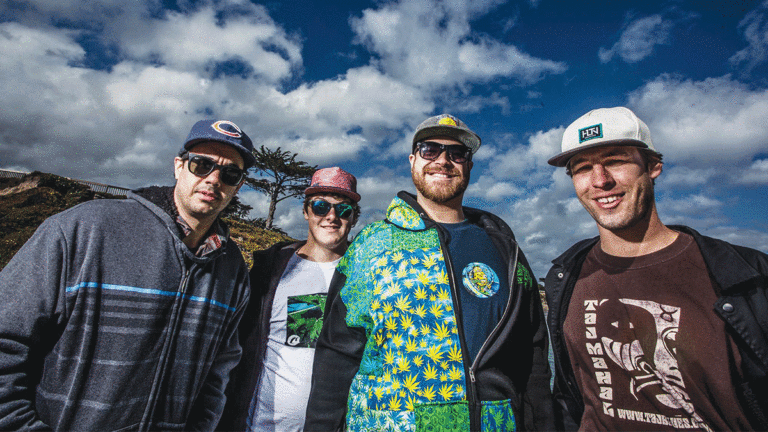
Guitarist Dan Guzman and drummer Logan Tyler originally began jamming in 2011, two years before they formed LIGHT The Band. At the time, it was more of a side project for them, as both were playing full-time in legendary local funk act 7 Come 11. When creative differences led Tyler and Guzman to quit 7 Come 11, the guys put all of their effort into LIGHT the Band, and never looked back.
“Dan and I just have this comfortableness,” says Tyler. “When we’re on stage we always make it happen.”
Their funky four-piece delivers improvised jams sewn throughout structured songs that flow through rock, soul and more. And like many jam bands, LIGHT has gone through several lineup changes, with an array of different instruments and musicians coming in and out of the group. In addition to Tyler and Guzman, they currently boast James Tashnick on bass and Patrick Blizinski on the Hammond B3 organ, creating a full and funktastic sound that dares feet not to dance. And of course, their name would be misleading if they didn’t also provide a killer light show.
In 2015, they became the house band at Bocci’s Cellar playing weekly events, which they recently switched to every other week.
At the end of last year, the boys released their debut, self-titled album. From Phish-esque songs like “What Was Her Name?” to jams like “Maddy’s Jam”—dedicated to eight-year-old Madyson Middleton, who was murdered near their practice space in 2015—the 15-song endeavor moves between studio and live recordings to give the listener a tasty sample of all that LIGHT can do. In a move reminiscent of the Grateful Dead, they also record all of their live performances, often uploading sets to their Soundcloud and Facebook page. The prolific quartet is hoping to release its second album by the end of the year, with all of the songs currently waiting to be recorded.
“I think the music has evolved to become a lot more laid-back and funk,” Tyler ponders. “It’s become a lot more thoughtful.”
Besides the band’s bi-monthly spot at Bocci’s, fans can catch LIGHT the Band on Sept. 1 at Don Quixote’s, where they’ll team up with Afro-Latin Groove band Judo No, and Santa Cruz hip-hop jazz group Beat Tapes.
INFO: 9 p.m. Friday, Aug. 25. Bocci’s Cellar, 140 Encinal St., Santa Cruz. $5. 427-1795.
While a certain temporary resident of the White House and his cronies are doing everything they can to undermine and defund educational opportunities, along comes a movie like Step to explain in vivid terms how education can transform lives, families, and communities. This engrossing documentary examines the stakes for three young black women, high school seniors from inner-city Baltimore, as they strive to be the first members of their families to go to college.
The subject is serious, but the mood of the film is affirmative and joyful. Director Amanda Lipitz filters the academic story through the girls’ experiences on the school step team—the percussive, foot-stomping, hand-clapping, synchronized dance drills that are so integral to these girls’ lives. Step is “making music with our bodies,” as one team member says. Or, more simply, “Step is life!”
We find out right off the bat that this is no ordinary school. The Baltimore Leadership School for Young Women is a charter school established for the sole purpose of shepherding its 120 female students through the educational system and into college. Lipitz’s film begins in the fall of 2015, as the members of what will be the school’s first graduating class begin their senior year. The school takes students from grades six through 12, and Lipitz spotlights three girls who have been there since the start.
Blessin Giraldo founded the step team back in the sixth grade. Bright, charismatic, and brimming with personality, she’s a demon on the step floor. But she’s so used to coasting by on charm, she’s let her grades slide, and her future is in jeopardy. Cori Grainger calls herself an introvert (“I’m everything that step is not,” she jokes), but says “those parts come out of me when I step.” Her grades are terrific, and she dreams of going to Johns Hopkins University—if her mom and recently-laid-off step-father can pay for it.
Tayla Solomon is the daughter of a Baltimore policewoman who loves to come to step rehearsals and cheer on the team. Although her exuberance often embarrasses Tayla, her mom is wholeheartedly committed to the program as a way for girls who she says are “lost” to succeed. Also prominent in the film is the new, no-nonsense step coach, “Coach G,” and tough-love counselor Paula Dofat, who instills the motto, “No excuses,” into her girls’ lives.
As the girls apply for college admissions and financial aid, while rehearsing for their last big Baltimore step competition, they cope with family dynamics and challenges like empty refrigerators and power outages. Director Lipitz sets their story in the context of the police shooting of Freddie Gray, which happened in the girls’ junior year, portraying both the volatility of their urban life, and the infectious joy of their solidarity as they study and step their way to survival.
Lipitz is in a unique position to tell this story. A Baltimore native whose activist mother was instrumental in helping to found BLSYW in 2009, she has known these girls since they were 11 years old and watched them grow up. Her unprecedented access to these students, their families, and the administrators determined to get them to move forward in their lives, make the movie at once more relaxed, and yet more urgent than if a dispassionate stranger were telling their story.
In a pre-credit prologue at the beginning of the film, a quartet of its stars appear onscreen to welcome the audience. “Our goal is to turn this film into a movement,” they tell us. We all know the result when doors of opportunity are slammed shut. Step reminds us what can be achieved when “a group of powerful women come together” to succeed.
STEP
*** (out of four)
With Blessin Giraldo, Cori Grainger, Tayla Solomon, Gari McIntyre, Paula Dofat. Directed by Amanda Lipitz. A Fox Searchlight release.
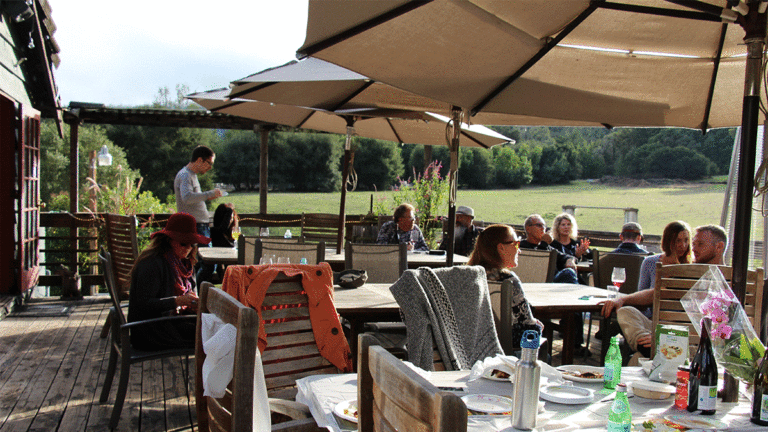
It’s hard to watch footage of a factory farm operation—the conditions are cruel, and often downright alarming. But anyone in Santa Cruz who wants to eat local, organic, humanely-raised chicken and pork can simply go to Fogline Farms, a small operation owned and operated by Caleb Barron. Based in Soquel, Fogline’s meat can be purchased every Wednesday at the Downtown Farmers Market and every Sunday in Live Oak. Barron gave GT a peek behind the curtain of his operation.
How does Fogline Farms operate?
CALEB BARRON: I raise certified organic, pasture-raised broiler chickens, which are chickens for meat. We have our own commercial kitchen, and my own in-house butcher on payroll. We sell whole animals wholesale to restaurants. And we sell the butchered pork and chicken at the Farmers Market. The chickens are raised in small batches, very stress-free. At three weeks they go outside, and they’re outdoors for the rest of their life. We handle them, and try to raise them as humanely as possible. We try to transport them and take care of them as responsibly as possible. They’re outdoors and moving around on fresh ground every day, and they’re fed certified organic feed with no added hormones or antibiotics. They have fresh air, fresh sunshine. Fresh bugs. In the springtime, they have fresh grass.
How would you compare the taste to conventional grocery store chicken?
It’s more tender. It’s got flavor, as opposed to just being bland. I haven’t had anyone else’s chicken in years. Our feed is a super high quality. We pay a premium on feed. That’s why our product is expensive. There’s herbs and minerals in the feed, as well as your basic ingredients. It’s just a happier, healthier bird. Being stress-free really affects the quality of the meat. It’s fresh because it’s not trucked all over the state from big factory farms.
What got you interested in the meat business?
I moved out here for the UCSC Farm and Garden program. And that’s strictly veggie. I wanted to farm, do something agricultural. I learned all about growing veggies. Then I went and apprenticed at Pie Ranch in 2008. They had some goats and chickens and veggies. And I just got really into taking care of the chickens and goats. When I was thinking about the next step, I was thinking, “I want to focus on livestock and not veggies so much.” I like building fences, and the problem solving around livestock as opposed to tractor work and weeding and harvesting veggies. I just decided to start with some chickens and some pigs, really small, and every year just saw the demand increased and kept going, and here I am.
For those going the organic route, here is an ideal wine for you. Made by the organic arm of Hallcrest Vineyards, Organic Wine Works’ 2013 a’ Notre Terre is a rich and fruity blend of three different varietals—Zinfandel, Carignane and Barbera.
“The palate leads off with wild berry, exotic oak and cola,” says expert winemaker John Schumacher. This easy-drinking wine also features “undertones of peppermint, anise and chocolate, progressing into a finish of candied wild berry.” A mere $18, I marvel at how such a good wine—and organic at that—can be so reasonably priced.
Schumacher will be participating in the Scotts Valley Art & Wine Festival (see info below) where you can sample his excellent wines, including those of Hallcrest Vineyards, or try the full range in the tasting room at 379 Felton Empire Road, Felton, 335-4441. Visit hallcrestvineyards.com for more info.
Scotts Valley Art, Wine & Beer Festival
A fun day out is guaranteed at the 18th annual Art, Wine & Beer Festival hosted by the Scotts Valley Chamber of Commerce. At a preview party last month, I tasted many wines from participating wineries and they are: 37th Parallel, Armitage, Kissed by an Angel, Pelican Ranch, Partage, Wargin Wines, Direct Cellars, Hallcrest, and the newly resurrected Skov Winery. More than 150 artists and vendors will be selling their creations—including Sally Bookman (paintings), Popi Nikolaou (jewelry), and California Jam Queen—and food will be available from Kiss Catering, the recently opened Ambrosia India Bistro (Scotts Valley location), and many others. The event is Saturday & Sunday, Aug. 19 & 20 and admission is free. Visit svartfest.com for more info.
British Toffee Jacks
Rany Prambs, who hails from England, makes delicious British Toffee Jacks and British Munchie Jacks—both creations made with only four ingredients—whole-grain organic rolled oats, butter, evaporated cane juice, and organic brown rice syrup. The Toffee Jacks all made by Prambs in her home kitchen – and she will be selling them on Aug. 19 & 20 at the Art, Wine & Beer Festival in Scotts Valley. Visit culinarytable.com or email yu**********@*****il.com for more info.
[dropcap]T[/dropcap]he summer of 1977—at least in my memory—was golden, culturally transcendent, incomparable. Santa Cruz seemed to be oozing with creativity and passion in every aspect of its being: music, food, dance, poetry, film, politics, conversation. One moved through the Santa Cruz scene that summer with a pulsating sense of wonder and urgency.
It’s hard to imagine how the ravages of global capital have impacted our little burg, but that summer, rents were cheap. Music was everywhere, and I do mean everywhere. I recently counted more than 50 venues where live music was played in the county on a regular basis that year, and that’s not counting smaller coffeehouses and cafes.
Jazz wizard Don McCaslin and Warmth held court daily at the Cooper House in the margarita sunshine. David Crosby was slated to play at the Civic that summer; so was Bob Marley (only to have to cancel after being diagnosed with melanoma). Dave Mason was booked to play something akin to “A Day on the Green” at Cabrillo College. Jerry Jeff Walker was also performing at the Civic. Even Black Panther Party leader Eldridge Cleaver, author of the polemic Soul On Ice, was coming to town to deliver a speech. The place was absolutely alive.
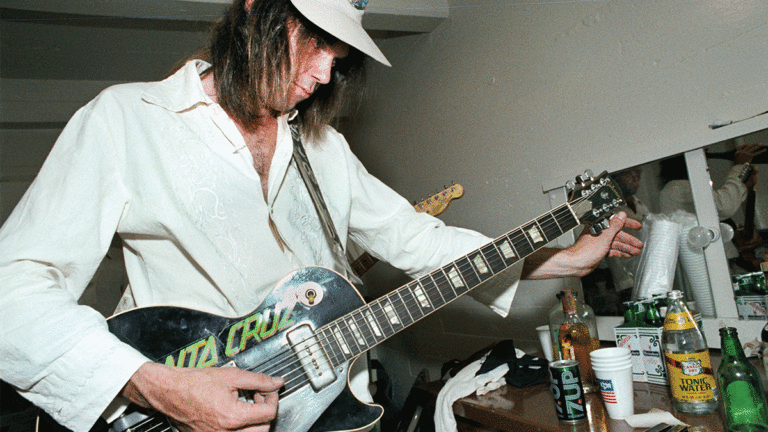
And then the rumors started shortly after the Fourth of July: Neil Young was reportedly on his way to Santa Cruz to join forces with a band led by country-folk-rocker Jeff “Buck” Blackburn, of Blackburn and Snow fame. The band also included bass player and singer-songwriter Bob Mosley, who had most recently been in Moby Grape; and local drummer Johnny Craviotto, the hometown wunderkind and surfer boy out of Santa Cruz High, better known simply as “Johnny C.”
I asked Craviotto, an old family friend, if the rumor was true, and he just winked at me and smiled that million-watt Johnny C. smile of his. He didn’t say a word, but I somehow got the drift: game on.
[dropcap]L[/dropcap]ike a lot of rock ’n’ roll lore, the history of Neil Young and the Ducks—the band with which he played here during the summer of 1977—is wrapped in myth and nostalgia. Some of it’s true, some is no doubt bullshit, and much of it is in between. There were plenty of good drugs in town that summer, and no shortage of whiskey and tequila, and they definitely took a serious toll on the collective memory.
Sherry Snow and Jeff Blackburn, of Blackburn and Snow fame, performing at the iconic Fantasy Fair and Magic Mountain Festival in June of 1967. A decade later, Blackburn provided the centrifugal force that brought the Ducks together in Santa Cruz.
Last year, before he died unexpectedly of a heart attack at the age of 68, Johnny C. and I scheduled an interview about his summer-long tenure with the band.
“To be honest,” he said with a chuckle, “I don’t remember all that many details. It’s all pretty vague.” Indeed, there was one gig where Johnny C., who never met a party he didn’t like, passed out in the middle of a set from drinking just a tad too much.
All pretty vague, indeed.
I’ve heard a zillion versions of the legend—accounts vary wildly and considerably. And I was there for some of it. I’ve gone back to the original sources, and here’s the best I can come up with: The fledgling band played their first semi-gig on Saturday, July 9, at the Back Room bar in the New Riverside Hotel, at what was billed as a birthday party for legendary guitarist Jerry Miller of Moby Grape fame.
Performing on stage that night were several well-known musicians, including bassist Jack Register, keyboardist Dale Ockerman (from one of my favorite local bands of the era, Snail), singer Juanita Franklin, trumpet player John Maritano, Blackburn, Craviotto and Mosley. Young came out to play the final three songs.
From that point on, the Ducks played more than two dozen more shows (sometimes they played two shows a night) including at the Back Room, the Crossroads (a sweet little club at the Old Sash Mill), the Catalyst, the Veterans Hall, and the Pacific Coast Steamship Company (in Harvey West Park), until their final shows on Labor Day weekend at the Civic.
It was a wild time. There was no advertising for any of the club concerts, as I recall; news travelled simply by word of mouth. Remember, kids, this was before the advent of Facebook and Twitter. Locals took to carrying duck calls around their necks and blowing on them when word of a new gig was circulated—although the rumors weren’t always reliable. I recall hearing once that they were going to play at the Back Room, only to arrive and find a large crowd, but no show.
Fans of Young flocked in from around the Bay Area, and, really, from around the world (my dad, who had left town long before, attended a show with my cousin and me at the Back Room). With cover charges of only a couple of bucks—sometimes there was a code word for getting in free—the shows were a steal.
It was said that because of contractual obligations that Young had with his longtime back-up band Crazy Horse, the Ducks were restricted to playing gigs solely within the city limits of Santa Cruz, but I’ve never been able to verify this. A handful of the shows were apparently recorded in some fashion (I recall a huge sound truck at one), and while several sessions can be found on the internet, no formal recording has ever been released—though rumors that one is impending have circulated for years, and continue to this day.
[dropcap]O[/dropcap]ne aspect of the Ducks’ lineage that has long been overlooked is that the roots of their magical convergence extended back to the Bay Area in the 1960s. In a certain sense, it was the Summer of Love: Take Two—just a little further on down the road.
Blackburn, who grew up as a bit of a nomad in Texas and Bakersfield, had been the first to hit the big time—in 1964, as one half of the popular folk-rock duo Blackburn and Snow. They released a couple of singles in the mid-’60s that generated national attention, including “Stranger in a Strange Land” (written by David Crosby under a pseudonym).
The duo played on the bill at the iconoclastic Fantasy Fair and Magic Mountain Music Festival in June of 1967, held on Mt. Tamalpais in Marin, that also included the likes of Wilson Pickett, the Doors, the Jefferson Airplane, the Byrds and Moby Grape. The festival is largely viewed as kicking off the Summer of Love in San Francisco, and it was there that Blackburn developed friendships with a host of legendary musicians, including Bob Mosley, Moby Grape’s talented bass player.
Young at that time was playing with Buffalo Springfield, which had formed in L.A. and included Stephen Stills. A native of Toronto, the enigmatic Young had bounced around Canada before winding up in California.
Santa Cruz hometown boy Johnny C. also had considerable musical pedigree. The charismatic percussionist came up as a kid fresh out of Mission Hill Junior High with Corny and the Corvettes (featuring Cornelius Bumpus, later of Doobie Brothers fame), and played drums for the likes of Ry Cooder, Buffy Sainte-Marie, Moby Grape, Captain Beefheart, and Arlo Guthrie.
[dropcap]B[/dropcap]y the spring of 1977, Blackburn, Mosley, Craviotto and guitarist Eddie James were all playing in the Jeff Blackburn Band, after briefly joining up in a precursor ensemble called Soquel. James, a schoolmate of Craviotto’s at Santa Cruz High, was a superb lead guitarist who himself had gained national attention with the soft-rock band Harpers Bizarre in the late 1960s.
James, then in his late 20s, was feeling the weight of familial responsibilities, and was working days for the City of Santa Cruz. Playing in the band was just “too much,” he recently told me, so he bowed out. Blackburn was disappointed because “I thought we were playing very tight … there was some magic there.” Word spread quickly that the band was in need of a replacement.
Johnny Craviotto, Jeff Blackburn, Neil Young and Bob Mosley in July of 1977, leaning against Young’s 1948 Packard woodie. PHOTO: DAN COYRO/GOOD TIMES
Down in Los Angeles, Young and longtime Bay Area artist and psychedelic lighting guru Jim Mazzeo were living together in Malibu near Trancas Canyon. Both had lots of connections with the scene in Santa Cruz (Mazzeo and Mosley were friends with the Grape), so some phone calls were made, and Young and Mazzeo made their way north in Young’s renovated 1948 Packard woodie. They stayed first with Blackburn at his spread on 38th Avenue (dubbed Duck Landing) before eventually taking up residence in some bungalows overlooking Castle Beach (directly across from the city’s Natural History Museum).
Young—who had purchased a ranch near La Honda earlier in the decade and was a frequent visitor to Santa Cruz during his stays there—immediately replaced James in the band’s starting lineup. They began rehearsing at Blackburn’s spread in Pleasure Point, while Mazzeo started to negotiate the band’s booking arrangements, which had previously been handled by Blackburn.
Again, stories vary, but the general consensus is that the band’s name came from an incident that had taken place near Twin Lakes in the mid-1960s. A transplanted surfer from Southern California, Dave Puissegur, had killed some ducks while driving on East Cliff, resulting in a “curse” on the community that would not be lifted until the ducks were sufficiently honored by a collective homage from the citizens. Hence the Ducks were so named.
I recently tracked down Puissegur’s “incident,” which occurred in the spring of 1963, and while the account made no mention of any ducks, “erratic driving” was indeed cited, along with a certain level of adult beverages having been consumed. Of such cloth are legends made. So much for a curse.
Nonetheless, Ducks mania soon overtook the community. Duck hats and duck calls were seen and heard everywhere. Young changed the name of his classic woodie to the Duckmobile. At the band’s performances, duck puns and references were the meme du jour, and many of them were bad. Young would muse about “quacking up,” or say to the audience, “you won’t believe it when you see the bill.”
[dropcap]I[/dropcap]f the jokes often fell flat, the music was magnificent. While Young was clearly the main draw for the Ducks, he did not hog the spotlight. There was an egalitarian nature to the band’s set lists.
Johnny C. throttled the house each night with rock ’n’ roll standards from the Chuck Berry school, like “Tore Down” and “Bye Bye Johnny,” and he sang a couple of songs Mosley had composed, including the beautiful ballad “Don’t Let ’Em Get to You.” I adored his performances.
Mosley, who has yet to receive full recognition for his enormous musical talents, fronted Grape classics like “Gypsy Wedding.” He says he was “just happy to be working all the time. It was great to be constantly busy making music.”
While I was (and remain) a die-hard Young fan—songs like “Helpless” and “Pocahontas” and “Thrasher” form part of the soundtrack to my life—I was especially taken by the performances of Blackburn that summer. Young may have been a superstar, but it was Blackburn who provided the band’s gravitas, and whose presence held the band together. My favorite songs of his were “Silver Wings” (played as a hard Southern rock ballad), “Deeper Mystery” and “Wild Eyed and Willing.” I also delighted in his rhythm guitar riffs on “Windward Passage,” which the Ducks turned into a psychedelic surf rocker.
Young, for his part, performed a handful of his classics—“Mr. Soul,” “Are You Ready for the Country,” “Comes a Time,” “Long May You Run”—and also showcased a new song that summer, “Sail Away,” written in Santa Cruz and which would later appear on his album Live Rust.
There’s a road stretched out between us
Like a ribbon on the high plain
Down from Phoenix through Salinas
‘Round the bend and back again.
There was a pair of notable musical footnotes to Young’s Santa Cruz sojourn. In late August, he joined with David Crosby and Graham Nash for a memorable reunion performance that served as a benefit for the United Farm Workers’ Service Center. He also filled in for headliner Dave Mason at Cabrillo College Stadium when Mason didn’t show up for the highly anticipated event. Young, as reported by my Soquel High pal and then Sentinel music writer Greg Beebe, was brilliant at both performances. “Part of the magic from that summer,” says Blackburn, “is that we were all so young and passionate and intense. That was the common denominator with the band. And the passion and intensity made it magical.”
[dropcap]S[/dropcap]hortly after the Ducks formed, Santa Cruz photographer and music writer Dan Coyro got into the Duckmobile with Young & Co. for a lengthy interview. “I’m starting to get back that certain feeling for playing my music,” Young told Coyro for his piece that was published in Good Times. “We’re in a place right now where we’re pure … it’s like being born again. We’re young and we need the safety of a small town to grow in. We’re self-contained right now, but maybe when we get bigger, we may move on … the possibilities are there. But right now, the Ducks are just developing, and I’m just one of the Ducks.”
For the past several years, Young had lived a peripatetic lifestyle, traveling across the country, always on the run. “Moving into Santa Cruz is like my re-emergence back into civilization,” Young told Coyro. “I like this town.”
From left: Bob Mosley, Johnny Craviotto (on drums), Jeff Blackburn and Neil Young at the Crossroads in the Old Sash Mill, July 1977. PHOTO: DAN COYRO/GOOD TIMES
Young, as it turned out, was apparently not pleased by a particular passage in the story. Coyro had quoted Young as saying: “If the situation remains cool, we can do this all summer long. I just hope the people in San Jose don’t find out about it … ”
According to Coyro, that last line set Young off. When Coyro went over to Young’s beach bungalow, Young threw him out of the house. An agitated Young complained about him “slamming people” in San Jose, and expressed concern about offending his San Jose fan base. “He was really pissed,” Coyro recalls. “I was wondering, ‘Are we gonna throw [get into a fight]?’”
They didn’t—and, according to Coyro, Young later apologized.
The “maybe” that Young mentioned in his interview never happened. There would be no “moving on” for the Ducks—just for Young. At one point late in the summer, it was reported that Young’s bungalow in Seabright was broken into, and several items were stolen, including one of his guitars. Then the hood ornament to the Duckmobile was stolen. Young was furious. The good vibes had ended.
The Ducks played two final gigs on back-to-back nights at the Civic Auditorium on Labor Day weekend in early September. Shortly after, Young reportedly drove off to Nashville, and that was it.
Young didn’t mention his stint with the Ducks in his highly praised 2012 autobiography,
Waging Heavy Peace: A Hippie Dream; he did, however, briefly recount the tale of the band in its 2014 sequel, Special Deluxe: A Memoir of Life & Cars. He alluded to the Puissegur Curse (misspelling it Pussinger) and also recalled the theft of his woodie’s “beautiful winged bird” ornament. “That sad event broke [the Ducks’] spirit,” he wrote. “Since that criminal act was committed, Santa Cruz, California, Surf City, has long suffered from transients, homelessness, street crime, an active drug trade, and some well-known unsafe areas where the Pussinger [sic] Curse still remains particularly strong to this day. Santa Cruz is now considered one of the most crime-ridden towns in all of America.”
I’ll leave that for others to deconstruct. Maybe Young Neil (as my dear and dyslexic mother always called him) knows something about Santa Cruz that I don’t. Bitter is as bitter does, I suppose. I’ll always remember the magic of the moment, the pulsating music and unforgettable performances, the spontaneity, the beauty of it all.
[dropcap]E[/dropcap]arlier this month, on a warm Sunday at the Steel Bonnet Brewing Company in Scotts Valley, with the ghost of the Ducks long behind him, Jeff Blackburn is still pursuing his passion, playing once again as Blackburn and Friends at intimate venues throughout Santa Cruz County. His repertoire, at least at this show, is made up primarily of songs he’s written over his remarkable 50-year career as a performing musician.
His significant other, JoJo Fox (who, in the interest of full disclosure, is a cousin of mine) plays bass, Ron Green backs up on percussion and, occasionally, Harpin’ Jonny Troutner (who performed with the late Larry Hosford) sits in on harmonica.
Legendary Santa Cruz artist Jim Phillips handled all of the Ducks’ graphic arts that summer, including this goodbye. COURTESY OF JIM PHILLIPS
Playing backup guitar is his old sidekick Eddie James—the very same guitarist who Neil Young replaced in the Ducks—and I discover it’s the first time that Blackburn and James have played together, in public anyway, since James packed up his guitar case 40 summers ago.
It’s something of a nostalgic moment for me. I first saw James more than a half century ago, when he was with the Tikis (my first favorite Santa Cruz band), and I have always marveled at his talents as a guitarist.
Blackburn, for his part, is every bit as wiry and sure as he was back in the summer of 1977, and maybe a bit more solid. He’s had more than his share of hard miles under his hood, which gives his voice more authority, more resonance, as he makes his way through many of his old standards—“Deeper Mystery,” “Wide Eyed and Willing” (which he identifies as his “theme song”) and “Cartune.”
James performs magnificent solos on many of the songs. He tells me that he’s a little rusty, not quite as agile as he used to be with his fingers, but there’s a feeling, and perhaps wisdom to his playing that resonates deeply.
One of the steady themes of Blackburn’s oeuvre is the passage of time, and if he was aware of its passage “back in the day,” as he says, he’s clearly even more aware of it now. He closes his final set with “Fork in the Road,” which he says he wrote “sometime in the ’70s.”
I know my time, it is not long
Still my feelings are so strong
I’ll leave it all behind
Going to see what I can find
Coming to that fork in the road
And, then, with perfect ease, Blackburn segues into the rock ’n’ roll classic he co-wrote with Young during the summer of the Ducks, and which became Young’s anthem during his punk-flavored Rust Never Sleeps era in the late 1970s, following his days in Santa Cruz.
Hey hey, my my
Rock and roll can never die
There’s more to the picture
Than meets the eye
Hey hey, my my …
The audience grows respectfully silent and takes it all in. There may be a little rust, but no one is fading away. Forty years since the summer of 1977, the passion and magic of the Ducks lives on.
Jeff Blackburn & Friends
Upcoming performances:
Saturday, Aug. 19, 7 p.m., Bella Vista Italian Kitchen & Bar, Aptos
Thursday, Aug. 31, 6 p.m., Bargetto Winery, Soquel
Sunday, Sept. 17, 6 p.m., Bella Vista Italian Kitchen & Bar, Aptos
Prayer, meditation and eating chocolate are three ways to increase levels of anandamide—one of the body’s endogenous (that is, manufactured in the brain) cannabinoids, or endocannabinoids. I start with anandamide because, for one, it is known as the “bliss molecule”—its name derived from the Sanskrit for “inner bliss.” Acting similarly to THC and CBD (cannabidiol)—two of more than 150 cannabinoids found in the cannabis plant—it dulls pain, and helps us to quickly forget it. It’s responsible for runner’s high, for instance. I also begin with this molecule because its discovery in 1992—by Raphael Mechoulam of Israel, 30 years after he discovered THC—helped shed light on the body’s endocannabinoid system, or ECS.
The ECS acts as a homeostatic buffer, and helps to keep our neurotransmitter levels in proper balance. In the words of Michael Pollan in Botany of Desire, it seems to exist as a natural curative for the “routine slings and arrows of life.” It does this via cannabinoid receptors found throughout the body—predominantly in the brain, central nervous system and the immune system.
“Just to put it into perspective,” says local chiropractor Dr. Michelle Bean, “we don’t have receptors on our brain that directly bind Vitamin B. Or Omega 3s.” There is no other known plant extract, she says, that can directly bind receptors on the brain and have an immediate and direct influence on the brain and central nervous system.
But if our bodies are already equipped with their own natural endocannabinoids, why should we need the aid of a plant’s cannabinoids? This is one of many questions addressed by Bean and LeTa Jussila, licensed acupuncturist and herbalist, in their free weekly classes about CBD.
One answer is that our ECSs are being compromised by depleted diets, environmental toxins and stress. Too often these days, we’re living stressed-out lifestyles, says Bean. “It’s like having one foot on the gas and one foot on the brake. We are not designed to do that. The fight-or-flight system in our body is designed to be used quickly, and then come back to rest. The sympathetic nervous system and the immune system do not operate at the same time.”
Ethan Russo, M.D. has been studying CBD for two decades, and in 2001 introduced the concept of clinical endocannabinoid deficiency. “If you don’t have enough endocannabinoids, you have pain where there shouldn’t be pain,” said Russo in a recent interview with Project CBD. “… a number of very common diseases seem to fit a pattern that would be consistent with an endocannabinoid deficiency; specifically these are migraine, irritable bowel syndrome, and fibromyalgia.”
In other words, explains Bean, “When we don’t have a healthy endocannabinoid tone, our pain threshold starts to diminish. So stimuli that would typically not induce pain or disease starts to induce pain and disease.”
One of CBD’s many benefits to the human system is that it slows the breakdown of anandamide, extending the bliss molecule’s effects. It also ignites pathways of arachidonoylglycerol, or 2ag, another endocannabinoid responsible for modulating many systems—including shutting down inflammatory processes in the body, a leading cause of disease, says Bean.
A 2012 study published in the British Journal of Pharmacology found that CBD altered the expression of genes, upregulating 680 gene probe sets and down-regulating 524 to help the liver and body’s systems detoxify, and countering inflammation.
Bean and Jussila began their research of CBD after Bean saw it change her mother’s life. After three spinal surgeries—the last of which left her with a fused spine and a cocktail of painkillers, her mother was in constant pain. “I stayed away from CBD and cannabis for the longest time, because I always thought of it as a drug. Then they added the word ‘medical’ to marijuana, and that got my attention,” says Bean. “Within two days of administering different types of CBD and THC, her pain dropped from a chronic 15-year cycle of 10-plus to about a six. At the end of the week, she dropped down to a zero,” says Bean. It helped her to cut down considerably on pharmaceutical painkillers.
The list of ailments that CBD is showing promise in helping is long, and in addition to mitigating pain, includes help with seizures, Parkinson’s disease, brain inflammation, depression, anxiety, sleep and mood disorders, and inhibiting growth of cancerous tumors.
As CBD becomes widely available at health food stores, Bean cautions consumers to choose organically-sourced, non-GMO products. She also raises a point that is all too relevant to medicinal plants in the face of big pharma: “We have to know, especially in countries like ours that are so reductionist, that the cannabis plant has more than 150 cannabinoids for a reason—terpenes and flavonoids that work synergistically. The fear is we’re going to start extracting just the CBD, synthesizing it in labs, and giving it in pill form to people. It’s already happening with two pharmaceutical companies.”
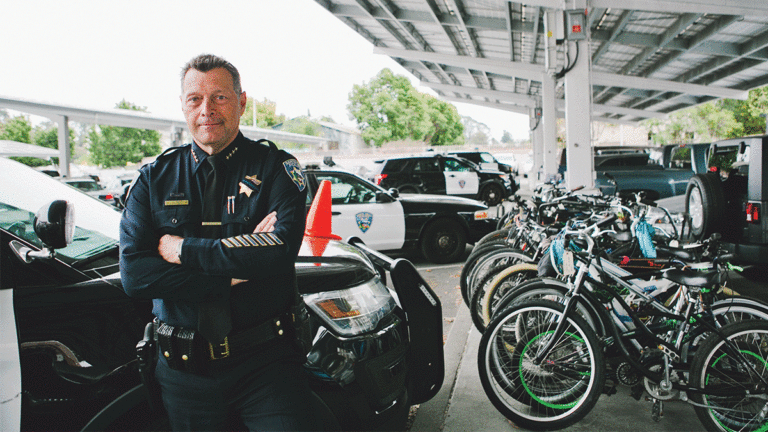
Andrew Mills, the new chief of the Santa Cruz Police Department, was sworn in on Monday, Aug. 7. He began his policing career in San Diego, where he was an officer for 20 years, and then served as police chief for Eureka for the next four. Santa Cruz offered him a position in early June, after a long hiring process that involved a special committee.
As he begins his tenure, Mills talked to GT about his sometimes surprising perspectives on law enforcement issues, and his vision for the SCPD.
You’ve been speaking with community members, civil rights groups and neighborhood activists. What are you getting out of that?
CHIEF ANDREW MILLS: I’m trying to understand what they expect from the police chief and the police department. I want them to have a face, where the chief of police is a phone call away, so I give them my cell phone. Also, anybody in the community is welcome to visit me Mondays from 9-10:30 a.m. I would highly encourage people to make an appointment with my executive assistant Kimberly Steele and come in and talk with me. I’ll listen to anybody.
You’ve mentioned a plan to tackle mental health issues. How should the SCPD prepare officers for encounters with the mentally ill?
We call it the three T’s: time, talk and tactics. And if we can make these [encounters] go past five to six minutes, get into the 15-minute realm, things can normally straighten out a little bit. I’m going to task one of my lieutenants to put this tactical de-escalation training together for this department. All 104 officers will go through this process. It will take one to two days, and we will use simulations. We have a guy sitting on a porch with a gun under his chin—now you have to deal with this guy. We have Health and Human Services with us, coaching us, and [saying], “If you talk with them this way, you may get a better result.” You see, in one of these incidents, a guy with a knife and a bunch of cops standing around. What do you hear? “Put the knife down, put the knife down.” OK, you told him that 20 times. He’s obviously not hearing you, can we now think about talking about something else? “Hey buddy, what’s wrong?” Again, you’re trying to calm these things down, rather than spin them up. That’s what the sense of most people is: why can’t the cops just talk with the guy?
You’ve said that a collaborative relationship in Eureka led to housing 300 people. What approach do you envision for Santa Cruz’s growing homeless population?
I know every community likes to think they’re the worst in terms of the amount of homeless and all this kind of thing, and I’ve heard these numbers bantered about frequently. So 2,200 countywide—people are saying it’s the worst biggest homeless population in the state. Well, it’s not. San Francisco has many more. Los Angeles has many more. San Diego has many more. San Jose has many more. Per capita, we may be up there. Because what happens is you get small numbers and a large group of people—it shows [up] very high. Eureka had 2,200 homeless per 100,000 population, now that has since reduced. A lot of cities are struggling with these issues. The question is, “How do you plan to deal with this?” The answer is “I don’t know yet.” Because what we have to do is come out here and do the analytics, to pull data—not only police data, but community data from the homeless information management system, in terms of the numbers. We need to tear apart the point-in-time count to figure out what are they seeing in terms of homeless, and how confident are they in these numbers? It seems here that there is a lot of pitting against one another: “This is how I believe.” It almost reflects the presidential election. My job is to pull as many people to the center; not the center ideologically, but the center of collaboration, so we can all work together. ’Cause I know one solution isn’t going to fix this problem. This is a very diffused or dispersed model of homelessness. Oftentimes you get these intense locations where you have hundreds of people in one location, maybe driven by services or comfort, but in Humboldt, we had a marsh with 300-plus people. Here, it’s literally all over the city. Consequently, what you get is everyone is impacted by this problem.
You’ve said that you plan to tackle drug addiction in Santa Cruz. What can you tell us about your strategy?
I believe in problem-oriented policing. You look at the problem, and you do as much analysis as you can on that specific problem. For instance, you have a crack cocaine market at a certain location. That’s a very different problem than a methamphetamine problem being sold through a network of tweakers, or a heroin problem being brought in via pongo boats. All of those are different problems that you have to analyze and figure out how to abate. My expectation is that I want our officers to identify those problems, and come up with creative, innovative solutions for each of those problems.
For instance, when I was in San Diego, we had an open-air drug market at 38th and University. It was all crack cocaine, they were using prostitutes to market the drug. And we started an operation called Operation Hot Pipe and Smoky Haze. Our goal was to create the haze of “Are the police here, are they not here? Is this a market, is this not a market?” So we engineered a marketing campaign targeted toward that location, put up billboards, did signs, talked with the prostitutes, told them police are going to be doing a big sweep on Monday. We do a sweep, and then come back a half a week later say, “Hey, police are doing a big sweep on Thursday.” After they see the first sweep, we didn’t do the sweep. Creating this confusion, it became an untenable market for those people, and it abated that location. People who are addicts are going to go someplace. So the other side of that is that you have to market to people to get help. One of the things that we need to do here is make sure there is enough space in programs to help people come off of opioid addiction when they’re ready.
What do you think of the trend of police departments getting more military-style equipment—whether through the 1033 program that circulates excess military vehicles, or through government grants, which is how Santa Cruz got is BearCat vehicle?
We’ve got to be very clear with our officers. What is the purpose of the military? To take life. What’s the purpose of local police? To protect life. They’re the exact opposite. Now occasionally, you’re forced into situations where to protect life you have to use high levels of force. What we need to communicate with our officers is that we’re not the military. Yes, you have to use equipment that is similar to the military because you’re trying to protect life. And I know the BearCat was a significant debate here, and we’re not going to get rid of our BearCat. However, I will, within the first few months here, invite people in to think through the policy. And so, to me it’s much more important that you have the policies squared away and well-thought through and make sure we are on the same page with the communities’ expectations on that policy. There are just enough violent people in our society—active shooters, masked shootings—that we are going to need to have some upper-level of armored protection.
How will SCPD respond to protests?
In a democracy, that’s part of how people express their views to government. So if you have the police there to suppress or to intimidate people from expressing their view, that doesn’t make a whole lot of sense to me. Here’s when we come into conflict. If there is a group, and we see online that they’re there to create violence or to bust out windows, I can’t allow that to occur. We still have to have order in society, so we will have a police presence. If it’s a large group of people, then we need to have some logistics to help. We may need to shut off a street or re-direct traffic. I’m 100 percent supportive of that, as long as it’s well thought-out and planned. My goal is to communicate with the organizers whenever possible. And there are times that they want to do civil disobedience and get arrested. We will facilitate that, help them get arrested. Walk them around the corner, give them a cite, as long as they don’t go back and create problems again. If you’re there to disrupt the community and create violence, we just can’t allow that. Again, depending on the level, you also may want to talk with them and say, “Hey, what are you looking for?” “We’re going to block this intersection to get arrested.” “Great, let’s work on that together and look at the logistics to make that happen.” But the BearCat will never be deployed on a civil protest or a civil group of people. That cannot happen. Nor will drones or anything else.
Any plans to promote transparency?
Yes, you’ll see some movement on that. Some significant movement toward transparency. Just this morning I told Joyce [Blaschke], my PIO, that I want to have a portal on our website that is called the transparency portal, where anyone can go to get information on policy and procedures, on what we’re doing, on good stuff as well as bad stuff. We just have to have it there so people can examine it themselves. That will be a work in progress. It’s not going to be perfect, but I want people to have confidence that we will be as transparent as possible.
What can you promise will be underway or accomplished by August of 2018?
We will have tactical de-escalation training done. We will create a leadership plan that identifies what the priorities are of this police department, and then how we move in unison with the community. Part of my listening tour is that the first 90 days, I am taking copious notes, listening to people. I’m getting feedback, and then we will create a plan to move forward with the community that we will publish as part of the transparency portal to see if we are gaining or losing ground as a community. And it’s not always about crime. That’s important, but it’s also about the quality of life.
In 2013, Seattle indie band Pickwick released its first proper record, Can’t Talk Medicine. The album did well, and the band toured, but then they kind of disappeared. Since then, they’ve recorded two follow-up albums, but scrapped both. Now they’ve finally returned with Lovejoys—and a very different sound.
Lead singer Galen Disston says that Lovejoys was done reasonably quickly, but the process leading up to it involved the band spinning their wheels for long periods of time.
“It felt like a waste of time,” Disston says. “We were coming at it from a real heady perspective, like ‘let’s try to mimic this,’ or ‘this could function well.’ All those exercises were totally fruitless. The songs were stale. We got rid of them all.”
Those two failed records were quite different from each other. One was garage-rock. The other was in the vein of alt-rockers Arctic Monkeys.
“It wasn’t genuine. We’re not punks. We’re not garage-y guys,” Disston says. “We love the Sonics. That’s as close as we could get while still being true to ourselves. We can be campy and rompy like the early R&B rock ’n’ roll, but we can’t really fuck with Thee Oh Sees. They’re amazing.”
Lovejoys is a space-y, dance-y record highly influenced by ’70s soft rock, pop and disco. It’s a nice fit for the group, and definitely not garage rock.
Before they started to write it, one of the band members quit, and of course they had scrapped a lot of songs they’d been working on. It might have seemed a low point for the group, but by then it had been so long since the previous record that they started to feel liberated.
“We put a lot of internal pressure on ourselves. Like, ‘Oh, we’re going to lose our touring fan base. We have to get out and build on the touring work that we did nationally.’ As soon as the pressure from all that stupid bullshit was gone—mostly ’cause we’d taken too long—then the songs came again,” Disston says.
The band has switched gears in the past; sometimes it’s worked in their favor, and sometimes it hasn’t. Pickwick’s earliest roots go back to 2005, when it was a solo project by Disston, who’d recently moved to Seattle from Santa Cruz. He slowly built the band up with the members who would populate the 2013 record. For most of those years, the band played indie-folk, and didn’t have much of a fanbase.
Then Fleet Foxes blew up. That put a wrench in Disston’s plans.
“They did everything that I’ve ever dreamed of doing, a thousand times better than we ever could,” Disston says. “Seattle was pretty folky at the time. It was like, what can we do? It led to a more R&B sound. We weren’t afraid to be poppy and fun. That’s when people started coming to our shows.”
That led to Can’t Talk Medicine, which led to some touring. The band didn’t blow up, but they did manage to draw whenever they went out of town, which is why they felt so much pressure to make an even better follow-up record.
Once they were finally in the studio recording Lovejoys, they worked with producer Erik Blood to create some of the textures. Disston says Blood was integral in helping them create the sound of the record. They all discussed several touchstone artists to draw from, like Funkadelic.
“He helped us dial in some of those aspects that were working, and some that weren’t,” Disston says. “I think a lot of the ’70s treatments worked, like the Fleetwood Mac and ABBA touchpoints.”
Perhaps the biggest factor was the band’s new appreciation of ’70s pop music, which prior to the making of the album wasn’t something they connected with. Once they opened up to it, the creativity flowed. Even just enjoying disco was something they hadn’t done before.
“I started to enjoy Marvin Gaye’s ‘What’s Going On’ in a way that I couldn’t really before, because I thought it was kind of cheesy,” Disston says. “I think it’s all cool. It was like, ‘I guess we can ride the disco-funk line as much as we want.’”
Sad news for all of us who celebrate the only-in-Santa Cruz ambience available in a dwindling handful of local landmarks. Hang on tight: Caffe Pergolesi, home to students, lovers, and coffee aficionados for more than 25 years, is closing. Hard to take, following so close on the heels of Logos. I have spent countless hours, and conducted dozens and dozens of interviews in this rambling sanctuary of bohemian vibes. The porch with its bowers and cool summer shade. What a loss!
Maybe it’s time you asked yourself just why Santa Cruz residents look the other way as an influx of non-taxpaying street denizens drive away customers from downtown retail, food, and social centers. Are we caving in to aggressive and unpleasant pop-up occupiers? Or are baby-boom retail owners simply hitting retirement age? Food for thought.
Mark your calendar for Saturday, Aug. 26. That’s the last day that the endlessly funky, wonderful, completely unique Caffe Pergolesi will be serving coffee. Owner Karl Heiman, who also owns Mr. Toots in Capitola is calling it quits for the coffeehouse that also served as a study hall, trysting spot, and site of many a chess match and spontaneous poetry readings.
“The happiest part of my time with Pergolesi was offering a space where people could come and sit, and feel at home and have a good cup of coffee that wasn’t super expensive,” Heiman told me last week. “I wanted it to be a place for the community to enjoy. I’ve owned it for 14 years, and I wish I could keep it open,” he says, with a noticeable sadness, “but I’m being backed into a corner. The transients are out of control. My customers don’t like it, people are afraid to walk by the building now. I’ve written to the city council and to the police—but nothing has been done.”
Heiman reassured me that his Capitola outpost of bohemian coffee, Mr. Toots, is absolutely staying open. “It doesn’t have the transient problem that Pergolesi suffered,” he says.
Graced with idiosyncratic architecture of Winchester Mystery House proportions, his incarnation of Pergolesi took over the Dr. Miller House, a gingerbread Victorian built in 1886, and hosted pretty much every single person who ever lived in or passed through Santa Cruz. Deliciously mismatched furniture—including the popular church pew—and candy-colored rooms with high ceilings and ample natural light made for memorable, and lengthy visits. Great coffee, tons of attitude, and those incredible cupcakes, plus the space to simply sit, read, and meditate—Pergolesi had it all.
The original Caffe Pergolesi, which brought hip urban atmosphere to a location behind what is now Lulu Carpenter’s, was home to poets, intellectuals, and creative gadflys until the earthquake of 1989. Advertising itself as “the oldest coffeehouse in Santa Cruz,” Pergolesi was the epitome of local, and several generations of UCSC students owe their bachelor’s degrees to long hours of study in the house’s welcoming, non-judgmental ambience. More recently, alas, it had attracted droves of aggressive panhandlers setting up house along the sidewalks and architecturally intricate front porch of the sprawling old Victorian.
On the last day, Aug. 26, Heiman will be offering Pergolesi wares at 1973 prices, “prices from the old days,” as a fond farewell and “thank you” to the many who have supported the coffeehouse over the years. Get on over there and soak up the unforgettable atmosphere one last time. 418 Cedar St., Santa Cruz.
When we started Senior Project a couple of years ago, we wanted to smash the antiquated notions of what a magazine for seniors is supposed to be. We wanted to talk about how 60 is the new 40, 70 is the new 50, and 120 is the new 99 (OK, we haven’t gotten into that last one too much yet). Santa Cruz comedian and writer Richard Stockton provided what almost served as a mission statement in that first issue, with his story about why the Baby Boomer generation refuses to get old. Last issue, he wrote a very personal piece about his battle with sleep apnea. This time around, he combines the generational scope and personal feel of his past pieces for a moving and very funny story about meeting Janis Joplin, and how the Boomer generation came of age. It’s my favorite piece yet by one of Senior Project’s signature voices.
Also hitting a new high is another regular in this magazine, June Smith, whose story about the Go Game pulls back the curtain on a world of real-time senior role-play on the streets of Santa Cruz that most people don’t know is happening around them. Andrew Steingrube explores a new Zen approach to healing at Dominican Hospital, and Cheryl Huguenor considers whether we’re all really getting older and wiser … or just older. This issue of Senior Project has a lot to say about life after 55—which is possibly the new 35. We’ll check that out and get back to you.









 When we started