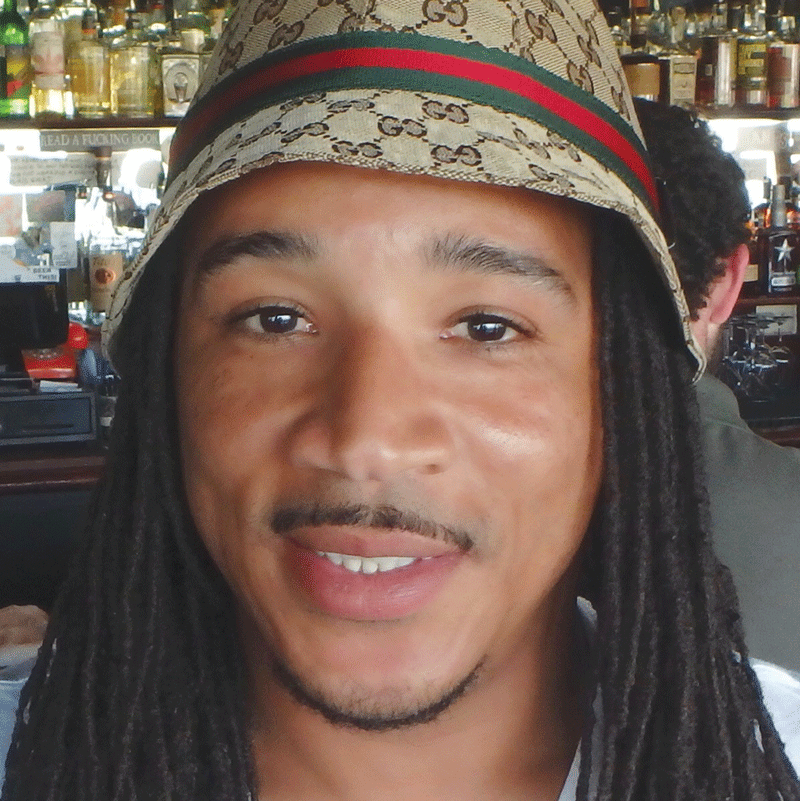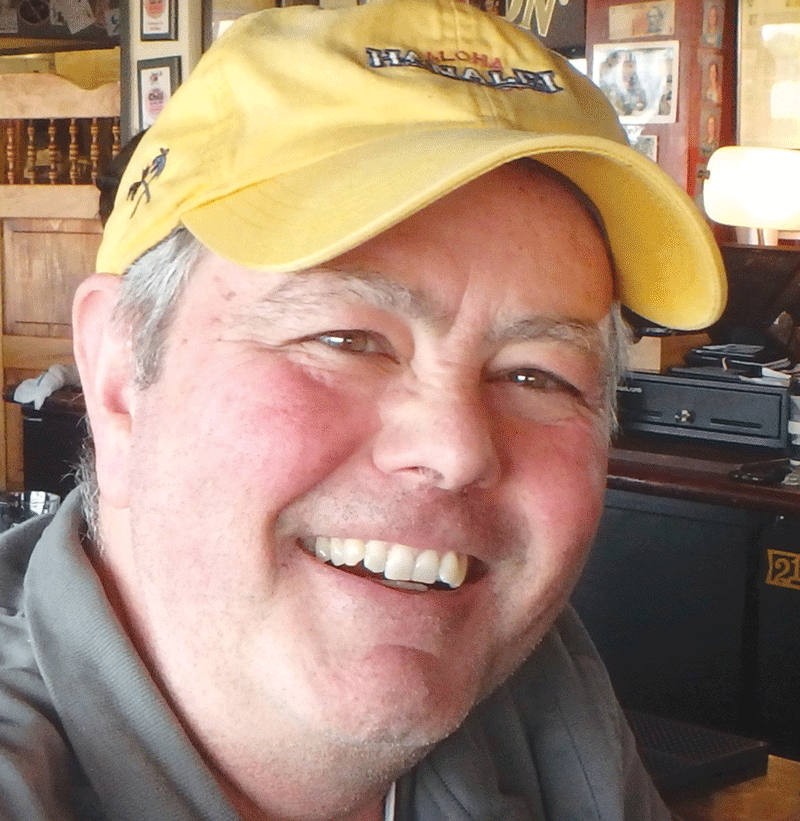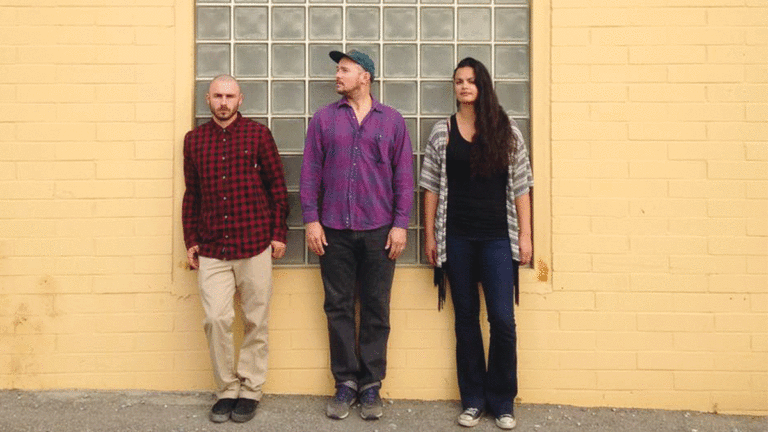



On a Thursday night at Aptos St. BBQ, families and couples sit eating cornbread and pulled pork while Preacher Boy’s raw and raspy growl assaults their ears. As he beats his long leather boot, four to the floor, his National steel guitar slides and spits a devious storm of gothic Americana and gritty country blues.
He’s a tall, lean, grisly white guy who sings theatrical Delta blues, so the typical comparisons have been made: Captain Beefheart, Tom Waits, Nick Cave. But he’s got Blind Willie Johnson, Skip James, and Bukka White covered, too. Preacher Boy’s fiendish and quirky take on the genre is a testament to his many influences. “I don’t like shuffle-y, weedily guitar, Chicago blues stuff. That’s not my bag … what I really like about the Delta country blues tradition is its weirdness. It’s not codified,” he says. “It’s individualized music created by people who produced, against all odds and for no discernible reason, really odd music. Strange, colloquial poetry with a lack of structure.”
Preacher considers his weekly gig at Aptos St. BBQ a “direct enactment and reminder of where [blues] music comes from. Roots, Americana, folk, bluegrass, country, all of that stuff. It’s not theater music. It’s music for people to enjoy when they get together, eat and hang out.”
The early, communal blues performances were traditionally an inclusive, democratic and cathartic experience: “The musician wasn’t put on a pedestal, but nor were they denigrated as the irresponsible drop-out,” he says.
Since the early ’90s Preacher Boy has been touring overseas; he’s co-written gold albums and played with everyone from Robert Lowry to the Pogues. He’s seen his name in fancy lights, but doesn’t require an audience’s undivided attention to deliver. That backyard fish-fry aspect—the Delta blues demand it.
J.K. Rowling’s ingenuity, now freed from the walls of old Hogwarts, gets a real work out in Fantastic Beasts and Where to Find Them. Credited as scriptwriter and co-producer, Rowling has a new backdrop, the New York of 1926. She and director David Yates, a longtime vet of the Harry Potter series, charm us with the critters in question—from a Roc-sized, golden-pink Arizona thunderbird to a sentient chunk of lucky bamboo with stick arms and opposable thumbs.
We get a lot of beasts in the digital age of cinema, but Rowlings and Yates really hook us with the characters, an appealing mix of types. It’s a warmly cast comedic take on the switched-suitcase plot, mixing a British amateur cryptozoologist; a busted-down former police officer for the world of magic; her sister, a ravishing if ditzy mind-reader; and the baker Kowalski (Dan Fogler, excellent in a dapper stout-man part, dignified and calm).
TARDIS-wise, the battered leather suitcase of Hogwarts dropout Newt Scamander (Eddie Redmayne) is bigger on the inside than the outside. It’s stuffed with critters that he’s collected on his travels. One of Newt’s menagerie escapes—a mischievous mystical echidna that loves to stuff treasure into its pouch. Trying to retrieve the thieving monotreme from a bank’s vault, Newt’s suitcase gets switched and he has to track down the hapless Kowalski.
The copper-busted-down-to-clerk Porpentina Goldstein is played by pretty, sad-faced Katherine Waterston; she hauls Newt into custody for breaking quarantine laws, and this delays the rescue of the portable zoo. Though the film is set in the 1920s, it seems like the Depression, thanks to Waterston’s air of tragedy. Depression-era movie star Sylvia Sidney once said “I should have been paid by the tear,” and Waterston acts with something like Sidney’s sadness.
Enter Miss Goldstein’s glamorous sister Queenie (Alison “Fine Frenzy” Sudol)—such a doll that you can see why the ordinarily pretty Porpentina is depressed to live with her; Queenie thinks the portly Kowalski is on the cute side, even if his mind is going to need to be “obliviated” (washed, that is) once their adventure is over. Is it coincidence that Queenie was the name of a New York witch in everyone’s favorite muggle/magus romance, Bell Book and Candle?
As usual, there’s admirable Dickensian supporting work in this Rowling saga. Samantha Morton is an Aimee-Semple-McPherson-type street preacher who sermonizes in front of a banner emblazoned with a pair of large hands snapping a magic wand. Ron Perlman plays a trollish speakeasy proprietor who looks like a demon version of H. L. Mencken. Colin Farrell is magically evil as a top executive in the wizard’s world, dressed in spotless evening clothes with scarves and overcoat. It’s been a while since Farrell was this much fun, taunting a wretched orphan (Ezra Miller) whom he’s recruited as an assistant.
It’s also surprising how much feeling Yates brings to Fantastic Beasts, and how the emotions flow strong through it, particularly after the problems of wrestling the unwieldy last episodes of the Potter saga together. The little moments sing, like Queenie materializing a delicate transparent umbrella out of the point of her wand, so she can lean in for a kiss. But there are wilder effects: the flying attacks of a living ball of flaming rage, in which the effects get almost abstract—it’s like an animated version of one of Anselm Kiefer’s charred paintings. Wizards rapt away prisoners into a scribble of whirling black lights, and their wands sound off like .45 revolvers. A thwarted execution is particularly chilling in the way a pair of kind, sad nurses escort their captives to the witch-drowning pool, streaky with rust and mildew.
You’d want to see Philippe Rousselot’s photography on an IMAX screen if possible, to take in the immaculate New York City landscapes, with their pomp and squalor. The effects dazzle, but you may need an obliviation spell to forget having seen similar ones in Doctor Strange—the buildings that repair themselves, or the apple that eats itself while floating in the air.
Most people don’t know that cherry pits, garlic, avocados, and apple seeds are all poisonous to dogs— and that doesn’t even come close to encompassing the whole list of foods that can hurt or even be lethal to our four-legged companions. That’s why McShane’s Nursery & Landscape Supply is hosting a workshop on pet-friendly gardening for dog owners to learn what to plant in their gardens without endangering their beloved canines.
The Santa Cruz Mountains Holiday Makers Market has an array of handmade goods from clothing, jewelry, toys and woodwork to up-cycled items, pottery, cakes, jams, and more. The SCM folks want to make holiday shopping a stress-free experience with live local music featuring Taylor Rae, Joshua Lowe, Patti Maxine, and the Swirly Girls. Info: 10 a.m.-5 p.m. Saturday, Nov. 26. Felton Community Hall, 6191 Hwy. 9, Felton. scmmakersmarket.com. Free.
Thursday 11/24
Veterans Thanksgiving
Veterans Thanksgiving on Thursday, Nov. 24
Veterans Day has come and gone this year, but Thanksgiving can be an especially difficult time for people who have made sacrifices for their country and did not receive sufficient support when they returned home. To celebrate them, Vets and the Friends of Thanksgiving have organized a dinner for the whole community. Meals are first-come, first-served and every dollar donated ensures that a person in need will have a place at the holiday table.
Info: Noon. Santa Cruz County Veterans Memorial Building, 846 Front St., Santa Cruz. gofundme.com/VetsHallDinner. Free.
Wednesday-Sunday, Through 12/23
Small Works Exhibition
Small Works Exhibition Wednesday-Sunday, Through 12/23
Can’t make it to the mountains for the holiday makers market? Fear not, whether you need last-minute Thanksgiving housewares or early holiday gifts, Santa Cruz has got its own celebration of artisans and craftspeople. Shop local and small with the works of 12 local artists creating handmade wearables, gifts, and housewares in the spirit of “giving art.” Rachel Riot, Jewelry Toolery, Ann Hazels, and Chance Lane are among some of the artists, makers and designers who will be represented, along with live music by Jess Autumn.
Info: Noon-5 p.m. plus special holiday events. Radius Gallery, 1050 River St., Santa Cruz. radius.gallery. Free.
Through November
New Leaf’s 10th Annual Smart Giving Program
New Leaf’s 10th Annual Smart Giving Program through November
Throughout November, for every 10 pounds of Smart Chicken that is purchased at any New Leaf location in Santa Cruz County, one pound of nutritious, air-chilled poultry will be donated to Second Harvest Food Bank. Last holiday season, New Leaf donated 2.5 tons of Smart Chicken to Second Harvest, which is the oldest food bank in the state and the second-oldest in the nation. Smart Chicken is 100-percent all-natural, free-roaming, grain-fed chicken raised without byproducts, antibiotics or hormones.
Info: New Life Community Markets, 1101 Fair Ave., Santa Cruz. newleaf.com.
Saturday 11/26
Fourth Annual Santa Cruz Stache Dash 5k/10k
You’ve slept off the tryptophan and digested the pumpkin pie. Now it’s time to shake off some of those calories (to justify the leftovers over the next two weeks, of course). So lace up those running shoes and grow your beards in support of no-shave November to raise awareness for prostate cancer. Walk or run to raise funds for prostate cancer research, even if you can’t or don’t want to grow the facial hair (we hear they make stick-ons nowadays). Runners will receive a finisher medal and a beer token to Santa Cruz Mountain Brewing, where the run ends, and the top male and female finishers will have their names etched into the plaque at the brewery.
Info: Noon. Swift Street Courtyard, 402 Ingalls St. Suite 27, Santa Cruz. santacruzstachedash.com. $10.
Wednesday 11/30
Echo Fabric at Crow’s Nest
Echo Fabric at Crow’s Nest on Wednesday, Nov. 30
They’re the new Santa Cruz band of seasoned jazz musicians and they’re formulating fresh, upbeat music with electronic sounds and traditional jazz tunes. Echo Fabric’s founder, Jon Lukas, started out wanting to bring in familiar jazz elements combined with exciting and original work—a combination that brings out some reflective, instrumental pieces with rhythmic and danceable partners. Echo Fabric plays at the Crow’s Nest on Wednesday, Nov. 30.
Info: 7:30 p.m. Crow’s Nest, 2218 East Cliff Drive, Santa Cruz. $3.
In the uncomfortable, surreal aftermath of the presidential election, a somber weight settled over much of the country like volcanic ash. For millions of Americans, the initial shock at having elected an unqualified buffoon known for his hate rhetoric and spoiled-child demeanor has given way to feelings of fear, apprehension, anger and embarrassment. As Inauguration Day ticks closer, the only seed of hope I have found (other than the hope that this is only a bad dream) is in the actions we can still take as citizens.
I’ve noticed, in the past two weeks, a strong embrace of nature (maybe because we know that it too is threatened), as people take to the forests for solace and reflection. And whether it’s done publicly in the streets or in their homes, people are coming together for support.
Meanwhile, local government and nonprofits stand as totems of people’s power, the last arenas where meaningful change can be fought for and won. As of last week, more than 125,000 people donated to Planned Parenthood—20,000 of whom donated in the name of anti-choice Mike Pence. (Visit mikepence.co for a breakdown of ways to give to Planned Parenthood of Indiana and Kentucky.) In the week following the election, the American Civil Liberties Union announced $7.2 million in donations over a five-day period, compared to $27,806 in the same five-day period in 2012.
Actually, the whole world appears to be jumping in: the Trevor Project, a nonprofit that offers suicide prevention services for the LGBTQ community and struggled before the election, reported more than $165,000 from donors in 20 countries after the election. So it seems fitting, as websites like ragedonate.com continue to materialize, that GT is rolling out its Santa Cruz Gives project. Now in its second year, SC Gives offers a crowdfunding platform for making online donations to support your choice of 33 local nonprofit organizations, all of which are doing amazing work in our community.
While the holidays usually see an uptick in consumerism—and a 25-percent increase in household waste between November and January, according to the U.S. Environmental Protection Agency—this year’s spending may have a different flavor. After all, allocating funds to help others doesn’t just empower the organizations and movements that need it most, it helps the giver, too: In 2010, the social psychologist Liz Dunn found that cortisol levels (that notorious stress hormone linked to ill health) were lower in people who gave money away rather than hanging on to it.
But if you don’t have disposable income to donate to a cause, don’t worry—the benefits of altruism extend beyond the realm of dollars and cents. Not only do researchers call it part of a “healthy psychological reward system,” the spirit of generosity may also prolong the length of our lives. While science has long since established that social isolation and stress are significant predictors of mortality and morbidity, the link between giving and a lowered risk of early death was first revealed in 2010, in a five-year multi-institutional study led by Michael J. Poulin, Ph.D., at the University of Buffalo. The study, which followed 846 subjects, monitored both stressful life experiences as well as tangible assistance—errands, housework, childcare, transportation—given to friends and family members, and found helping behaviors to be a significant buffer in the association between stress and mortality.
“We don’t know what the active ingredient is. Nobody has captured that yet,” Poulin told NPR last December. Compassion and caregiving have been shown to release oxytocin, the “love hormone” believed to drive social attachment and maternal behavior, which may be helping to curb stress. “When you’re thinking about helping other people, you’re simply not thinking as much about yourself and your problems. In essence, it’s a kind of distraction, but a more satisfying distraction than surfing the Web or binge-watching House of Cards.” Or sitting on Twitter or Facebook, growing orange with rage. Here’s to smiling at strangers, going for more hikes, and, if your wallet is fat, visiting santacruzgives.org to give to a cause that will directly touch the lives around you.
Last week at Hidden Peak Teahouse, I finally turned my phone off. I needed a break—these last few weeks, the internet has been loud and emotional, and my mind has been racing. But in a courtyard just steps away from Pacific Avenue on a busy weekday afternoon, the dominant sound was the soothing burbling of a fountain.
One of my friends, a frequent visitor to the downtown tea house, recommended that I participate in a gung fu ceremony. She claims that the rhythmic flow and repetition of the traditional tea pouring ritual forces you to slow down, and becomes a kind of meditation. Plus, Hidden Peak Teahouse is a digital-free space, which means no laptops, phones or contact with the virtual world of any kind. I was immediately into the idea—it sounded like a back rub for my brain.
The server arrived with a bamboo box about the size and shape of an intimidating novel, with slots carved into the lid. She set down a small brown teapot, a glass pitcher, a doll-sized teacup and a thermos of hot water.
At my request, she went through the steps of the ceremony, which turned out to be pretty simple. First, the server rinses the tea with hot water, pouring this first run through the slots of the box (it’s actually a tray). Then he or she pours more hot water into the teapot, and lets it brew for 30-ish seconds before decanting it into the little glass pitcher, from which the teacup is filled. Sip. Contemplate. Lather, rinse, repeat.
Over the course of an hour, maybe longer—it’s hard to tell because my phone is also my clock—the repetitive ritual did quiet my mind. I read a few stories from my favorite magazine, and noticed how the color of the tea changed from a light Pinot Noir to dark rosewood, depending on the length of the steep. The taste of the pu-erh was more complex than I thought it would be: peaty, softly vegetal, with a nutty sweetness. Pour, steep, pour, pour, sip.
I knew the world and all its noise was still out there, but my little clay teapot held dozens of mini moments of peace. I wondered to myself: Is this what Zen feels like?
1541-C Pacific Ave., 423-4200. For more information on events, including a Tea Talks series every other Tuesday, visit hiddenpeakteahouse.com.
The Kuumbwa Jazz Center is not only a popular music venue, it’s also a good place to enjoy a libation and some tasty food. I usually get a bottle of wine to enjoy throughout the show, and I shared my bright Storrs Winery 2014 Chardonnay with friends at a recent concert—and even offered some to an out-of-town visitor as an introduction to local wine.
One of the better-known wineries in the region, Storrs’ award-winning wines are easily found in local liquor stores and supermarkets. Winery owners Steve Storrs and Pamela Bianchini-Storrs have been producing fine wine for almost four decades, and their skillful winemaking shows in every bottle.
The 2014 Santa Cruz Mountains Chardonnay, which sells for about $24 at the Storrs tasting room and elsewhere, is a blend from several vineyards and aged in Burgundian oak for 10 months. It’s a full-bodied mouthful of deliciously complex Chardonnay, which, not surprisingly, won Best Chardonnay of Region and a gold medal at the California State Fair 2016. Speaking of accolades, their 2013 Santa Cruz Mountains Pinot Noir also won gold and Best Pinot Noir of Region at the same fair, as well as the editor’s pick in the November issue of Wine Enthusiast magazine—garnering a hefty 94 points.
Storrs Winery tasting room is open noon to 5 p.m. daily at 303 Potrero St., No. 35, Santa Cruz, 458-5030. storrswine.com.
Saratoga Holiday Wine Stroll
If you’re looking for a fun wine-tasting event over Thanksgiving weekend, then head to the Holiday Wine Stroll in downtown Saratoga from 2-5 p.m. on Saturday, Nov. 26. The village is set to come alive with fine wine, musical groups, caroling, Father Christmas, holiday lights, and special food—with a City of Saratoga tree-lighting ceremony at 5:30 p.m. Tickets are $40. Call 408-867-0753 or visit saratogachamber.org.
Mountains to the Bay Wine Tours
A group of us from the Good Times went on a fun wine tour recently. Many thanks go to Alfaro Family Vineyards & Winery, Soquel Vineyards and Silver Mountain Vineyards for hosting us—and to Seth Kinman, owner of Mountains to the Bay Wine Tours, for driving us around in his comfortable bus.
Thursday is Thanksgiving—the feast of gratitude and giving. Sagittarius Sun, Libra Moon. Libra is Right Relations with others. Libra brings Goodwill to the table on this day. Libra has three rulers: Venus (uniting opposites), Uranus (new ideas) and Saturn (the Teacher asks us to have manners). Working with astrology, we can bring the energies of the planets and signs to the Thanksgiving table, and thus bring heaven down to Earth. Love of Venus, new ideas of Uranus, and manners and tradition of Saturn. Sag loves and appreciates food. Often they are both chefs and musicians.
Turkey, corn (or maize), pumpkins, and cranberry sauce represent the first Thanksgiving foods. In 1988, a Thanksgiving ceremony took place at the Cathedral of St. John the Divine in New York City, where more than 4,000 people gathered on Thanksgiving night. Invited were Native American tribes from all over the country and descendants of ancestors who had migrated to the New World. The ceremony was a public acknowledgment of the “first people’s” role in the first Thanksgiving 350 years ago.
On gratitude, from the Tibetan Djwhal Khul (paraphrased): “Gratitude is a scientific and occult releasing agent. It is a service. Gratitude releases us from the past and directs us toward a future path—to the new culture and civilization and to the rising light of Aquarius, the Age of humanity, friendship and equality. The Hierarchy lays great emphasis upon gratitude.”
Advent begins Sunday; advent means “something’s coming.” Tuesday is the new moon festival, 8 degrees Sagittarius. Sag’s keynote is “Let food be sought.”
ARIES: There’s so much in your life to be thankful for. This week it’s that your mind can go here, there and everywhere, filled with goals, plans, ideas, aspirations. You hear a call to travel, to wander and to be in places far away. Music and culture is needed in your day to day life. But then you feel responsibilities. Fret not. Something will come and take you away. It’s intelligent, loving, and shifts you into the future.
TAURUS: You continue to work day and night preparing for the future. Some Taurus folks are focused upon the well-being of their community, not wanting to have a future lacking basic needs and comfort. You are sensitive to all the needs of others (physical, emotional, mental, spiritual). Money may be needed soon for a spiritual endeavor. Know the cosmic law that when we serve others the resources to continue that serving appear unexpectedly. Carry on gratefully.
GEMINI: Are you planning to flee somewhere? Are you and a partner or colleague, friend or close associate thinking of moving or is there discussion concerning travel, goals, spiritual or philosophical needs? Is there love or disagreement? Know that flurries of conflict are purposeful. Tensions create new understandings. Heated discussions and conflict help the mind seek harmony. Keep discussing. Connection is the groundwork for gratitude.
CANCER: Cancer’s moods change following the tides and phases of the moon. Soon you’ll be seeing what’s undone and swing into action tending to this and that. However much you want to complete things, you may become overworked and overtired. Should pain or inflammation flare-up, remember turmeric (in capsules) and cayenne (sprinkled over food) are naturally anti-inflammatory. Begin new habits now. Be grateful that you can.
LEO: The personal planets (Sun, Mars, Mercury) are in your sphere of creativity, of big plans that bring forth beauty. So now you must learn how to make a home through rebuilding, reconstructing, and redesigning. Notice how you are speaking these days. Your words are to have love and kindness and the fragrance of kindness. These stabilize you and everyone around you. Give thanks ceaselessly. You need a party with friends from far away.
VIRGO: A depth of creativity emerging, outward from within, is about to begin. While family and friends gather, your mind works overtime with goals and philosophical ideas. These you attempt to communicate but notice that some understand you and others don’t. That’s OK. Focus only on gratitude and seek to bring love and harmony (through intentions for Goodwill) to all interactions. Wounds then heal. People listen.
LIBRA: Whenever you communicate in coming weeks, many will be listening in order to learn philosophical and spiritual truths. You are the steward of this opportunity. Your words will be able to deconstruct the past, offer new information about the present/future, help people feel sustained, and offer pathways of harmony for those deeply seeking direction. You’ll do your best. Venus stands with you.
SCORPIO: The Sun, Mercury and Saturn are partners these days—so profound messages stream through your mind uplifting you to another dimension. Messages continue to be given. Do you hear them? To tend to any financial issues we must ask permaculture questions concerning money: who is your banker, where do you bank, and what is your money used for? The answers demonstrate our values. Make a list of all resources. Attach words of gratitude to each.
SAGITTARIUS: Happy Birthday, Sag. It’s a very good time for you. Actually, because of Jupiter, it’s always a very good time for all Sags. However, if you’re on the Path it may feel rocky at times. But behind all of the shifts, filled with challenges and obligations, toward the mountain of Initiation, there is always joy. Joy comes from the Soul. Happiness from the personality. Understand the differences, recognizing when they occur. One sings, the other … well, is learning.
CAPRICORN: The weeks have been rather frantic, filled with preparations, plans, people, and perplexity at times. The coming weeks are slower, calmer, filled with more repose which you need. Choose comfort, solitude, and a prayerful state that honors self-care. Pluto, bringing complete transformation, has been affecting your life—bringing thoughts and experiences of dearth. You are in a state of life as profound. Power has arrived too, in all forms, but especially from within. You did your job well.
AQUARIUS: The planetary energies are focused in your sphere of friends, future, hopes, wishes, and everything you’ve ever wanted to be and do. So, who are your friends, how do you see your future, what do you hope and wish for, what are your visions and dreams, and what do you need? I wrote need, not want. Needs are possible. Wants are secondary. And most importantly, what are you thankful and grateful for? Then the key turns.
PISCES: You’ll either be called to religious life or assume more professional responsibilities in the world. This leads to greater discipline and recognition. Swim out from under the water lilies, allow yourself to be seen and heard to those seeking direction. Confidence grows with each step, statement and word. Use your focused will(ingness), your love and intelligence. To assist others. You have prepared for this for lifetimes. We are grateful.
ARIES (March 21-April 19): “Creative people are at greater risk,” said psychiatrist R. D. Laing, “just as one who climbs a mountain is more at risk than one who walks along a village lane.” I bring this to your attention, Aries, because in the coming weeks you will have the potential to be abundantly creative, as well as extra imaginative, ingenious, and innovative. But I should also let you know that if you want to fulfill this potential, you must be willing to work with the extra tests and challenges that life throws your way. For example, you could be asked to drop a pose, renounce lame excuses, or reclaim powers that you gave away once upon a time.
TAURUS (April 20-May 20): Taurus musician Brian Eno has been successful as a composer, producer, singer, and visual artist. Among his many collaborators have been David Byrne, David Bowie, U2, Coldplay, Laurie Anderson, Grace Jones, and James Blake. Eno’s biographer David Sheppard testified that capturing his essence in a book was “like packing a skyscraper into a suitcase.” I suspect that description may fit you during the next four weeks, Taurus. You’re gearing up for some high-intensity living. But please don’t be nervous about it. Although you may be led into intimate contact with unfamiliar themes and mysterious passions, the story you actualize should feel quite natural.
GEMINI (May 21-June 20): You are free! Or almost free! Or let me put it this way: You could become significantly freer if you choose to be—if you exert your willpower to snatch the liberating experiences that are available. For example, you could be free from a slippery obligation that has driven you to say things you don’t mean. You could be free from the temptation to distort your soul in service to your ego. You might even be free to go after what you really want rather than indulging in lazy lust for a gaggle of mediocre thrills. Be brave, Gemini. Define your top three emancipating possibilities, and pursue them with vigor and rigor.
CANCER (June 21-July 22): Have you been feeling twinges of perplexity? Do you find yourself immersed in meandering meditations that make you doubt your commitments? Are you entertaining weird fantasies that give you odd little shivers and quivers? I hope so! As an analyzer of cycles, I suspect that now is an excellent time to question everything. You could have a lot of fun playing with riddles and wrestling with enigmas. Please note, however, that I’m not advising you to abandon what you’ve been working on and run away. Now is a time for fertile inquiry, not for rash actions. It’s healthy to contemplate adjustments, but not to initiate massive overhauls.
LEO (July 23-Aug. 22): “Everybody is dealing with how much of their own aliveness they can bear and how much they need to anesthetize themselves,” writes psychoanalytic writer Adam Phillips. Where do you fit on this scale, Leo? Whatever your usual place might be, I’m guessing that in the coming weeks you will approach record-breaking levels in your ability to handle your own aliveness. You may even summon and celebrate massive amounts of aliveness that you had previously suppressed. In fact, I’ll recklessly speculate that your need to numb yourself will be closer to zero than it has been since you were 5 years old. (I could be exaggerating a bit; but maybe not!)
VIRGO (Aug. 23-Sept. 22): Do you periodically turn the volume down on your mind’s endless chatter and tune into the still, small voice within you? Have you developed reliable techniques for escaping the daily frenzy so as to make yourself available for the Wild Silence that restores and revitalizes? If so, now would be a good time to make aggressive use of those capacities. And if you haven’t attended well to these rituals of self-care, please remedy the situation. Claim more power to commune with your depths. In the coming weeks, most of your best information will flow from the sweet darkness.
LIBRA (Sept. 23-Oct. 22): One of your vices could at least temporarily act as a virtue. In an odd twist, one of your virtues may also briefly function like a vice. And there’s more to this mysterious turn of events. A so-called liability could be useful in your efforts to solve a dilemma, while a reliable asset might cloud your discernment or cause a miscalculation. I’m riffing here, Libra, in the hopes of stimulating your imagination as you work your way through the paradoxical days ahead. Consider this intriguing possibility: An influence that you like and value may hold you back, even as something or someone you’ve previously been almost allergic to could be quite helpful.
SCORPIO (Oct. 23-Nov. 21): Between now and the solstice on Dec. 21, you will have extraordinary power to transform into a more practical, well-grounded version of yourself. You may surprise yourself with how naturally you can shed beliefs and habits that no longer serve you. Now try saying the following affirmations and see how they feel coming out of your mouth: “I am an earthy realist. I am a fact-lover and an illusion-buster. I love actions that actually work more than I like theories that I wish would work. I’d rather create constructive change than be renowned for my clever dreams.”
SAGITTARIUS (Nov. 22-Dec. 21): Despite your sign’s reputation, you Sagittarians don’t always require vast expanses to roam in. You aren’t ceaselessly restless, on an inexhaustible quest for unexpected experiences and fresh teachings. And no, you are not forever consumed with the primal roar of raw life, obsessed with the naked truth, and fiercely devoted to exploration for its own sake. But having said that, I suspect that you may at least be flirting with these extreme states in the coming weeks. Your keynote, lifted from Virginia Woolf’s diary: “I need space. I need air. I need the empty fields round me; and my legs pounding along roads; and sleep; and animal existence.”
CAPRICORN (Dec. 22-Jan. 19): “If you can’t get rid of the skeleton in your closet,” said George Bernard Shaw, “you had best teach it to dance.” This advice is worthy of your consideration, Capricorn. You may still be unable to expunge a certain karmic debt, and it may be harder than ever to hide, so I suggest you dream up a way to play with it—maybe even have some dark fun with it. And who knows? Your willingness to loosen up might at least alleviate the angst your skeleton causes you—and may ultimately transform it in some unpredictably helpful way.
AQUARIUS (Jan. 20-Feb. 18): “No pain, no gain” is a modern expression of an old idea. In a second-century Jewish book of ethics, Rabbi Ben Hei Hei wrote, “According to the pain is the gain.” Eighteenth-century English poet Robert Herrick said, “If little labor, little are our gains: Man’s fate is according to his pains.” But I’m here to tell you, Aquarius, that I don’t think this prescription will apply to you in the coming weeks. From what I can surmise, your greatest gains will emerge from the absence of pain. You will learn and improve through release, relaxation, generosity, expansiveness, and pleasure.
PISCES (Feb. 19-March 20): The less egotistical you are, the more likely it is that you will attract what you really need. If you do nice things for people without expecting favors in return, your mental and physical health will improve. As you increase your mastery of the art of empathy, your creativity will also thrive. Everything I just said is always true, of course, but it will be intensely, emphatically true for you during the next four weeks. So I suggest you make it a top priority to explore the following cosmic riddle: Practicing unselfishness will serve your selfish goals.
Homework: What famous historical personage were you in your past life? If you don’t know or weren’t really, make something up. Testify at freewillastrology.com.
When we started Santa Cruz Gives last year with the Volunteer Center of Santa Cruz County, we hoped to bring something new and innovative to the idea of a holiday donation drive. But it was only after analyzing last year’s results that we really started to understand the potential this campaign has to evolve charitable giving as we know it in Santa Cruz County.
To start with, Santa Cruz Gives is the first countywide crowdsourcing website for local fundraising. And what we discovered is that most donors were going to santacruzgives.org and taking advantage of the ability to contribute to more than one nonprofit; in fact, they gave to an average of four. The nonprofits who participated last year also reported an influx of new donors, and of young donors—two growth areas that are essential not only for Santa Cruz Gives’ groups, but also for the future of charitable giving.
So when we say we see Santa Cruz Gives as a “new way to give,” we mean it. This year, we’ve expanded the number of nonprofits participating in Santa Cruz Gives, which runs through Dec. 31, and we hope you’ll read here about these groups and the projects they want to fund with your donations, and then go to santacruzgives.org and make it happen.
Click on the name of the non-profit to visit its Santa Cruz Gives page.
The Agricultural History Project promotes knowledge about agriculture in our region in an engaging way that helps visitors experience daily life on farms and ranches, both past and present. AHP preserves, exhibits, collects and builds community awareness of the economic, cultural and ethnic aspects of agriculture in the area.
Big Idea: Children’s Activity Center
Children are thrilled to pump and make the water flow at the AHP’s water-pump activity station.
This attraction can be used more fully to educate children and families about the broader issues of water use for growing food—from the mechanics of pumping and moving water to the protection of this limited natural resource. AHP also plans to build several vegetable garden boxes that demonstrate several different irrigation practices, from historic redwood runways to today’s state-of-the-art methods. By bringing families closer to the source of their food, we hope to create lasting impressions that grow into a full appreciation of agriculture’s role in a healthy society. It’s time to retrofit this station into an education exhibit complete with interpretive bilingual signage.
To provide children facing adversity with strong and enduring, professionally supported one-to-one relationships that change their lives for the better, forever. Over the past 34 years, Big Brothers Big Sisters has positively changed the lives of more than 6,000 local children.
Big Idea: Recruiting Caring Mentors to Change the Lives of Children in Santa Cruz
Big Brothers Big Sisters helps children facing adversity in Santa Cruz County reach their highest potential by creating, supervising, and supporting mentor relationships with caring adults. Mentoring has a proven positive impact on youth who face a wide range of challenges, and demand for this program is high. Big Brothers Big Sisters has an average wait list of 70 to 75 children. They believe there are many adults in the Santa Cruz County community who could serve as excellent mentors for these waiting children, and their goal is to find mentors for at least half the children on the waiting list.
Mentoring is extremely rewarding for the adults involved; many matches result in lifelong friendships. Big Brothers Big Sisters’ plan for 2017 is to ramp up mentor outreach and recruiting efforts with a community-wide campaign to reach potential mentors, including the use of current and past mentors to share their experiences and the rewards of mentoring.
Court Appointed Special Advocates (CASA) is a child’s voice in dependency court, providing advocacy, stability and hope to children in foster care who have been abused, neglected or abandoned. The volunteer advocate ensures that children receive health services, educational and vocational assistance, tutoring, therapy, and support to heal and grow into healthy, successful adults.
These children will be placed in a permanent, loving home more quickly and are far less likely to return to the foster care system than children without an advocate.
Big Idea: Birth to 5 Program
The brain grows at its fastest rate during the first five years of life, rendering children in the welfare and dependency court system especially vulnerable to biological and environmental stressors. The attempts by families in crisis to achieve health and safety are often hindered by poverty, historical trauma, substance abuse, and minimal education, to the detriment of the infants and toddlers in the family.
CASA’s newly launched Birth to 5 program addresses the most vulnerable children in the child welfare and dependency court system. CASA will offer specialized training to volunteers tailored to the special skills needed by these advocates, with a focus on developing the relationship between the child and their primary caregivers. Advocates provide support in accessing resources for both caregivers and child, and build rapport with caregivers to encourage them to build strong bonds with the child so that the child can thrive.
In response to the declining health of watersheds in the Monterey Bay region, the Coastal Watershed Council formed to protect coastal watersheds through community stewardship, education and monitoring.
We partner with schools, community organizations, and local government agencies, and emphasize hands-on learning—getting community members out into the watershed to learn about water quality, riparian and wetland ecosystems and the solutions affecting our watersheds.
Big Idea: San Lorenzo River Revitalization
The San Lorenzo River is the primary source of drinking water for nearly 100,000 residents. It is critical habitat for endangered Coho salmon, threatened steelhead trout, birds and other wildlife. Coastal Watershed Council works to make the river feel more like a park than a back alley.
Despite the important resources the river provides, it is plagued with a negative reputation resulting from pollution and neglect. CWC leads the San Lorenzo River Alliance, a coalition of local agencies and organizations, to revitalize the river, and to improve water quality and the way in which we interact with this natural community space in the heart of downtown Santa Cruz.
Input from residents helped to create these goals:
River Health: Improve San Lorenzo River water quality by 25 percent by the end of 2018 (compared to 2014 bacteria levels)
River Revelers: Increase joggers, walkers, families, seniors, bikers, and picnickers visiting the Santa Cruz Riverwalk by 15 percent by June 2017
River Talk: Maintain media focus on the San Lorenzo River; increase positive press mentions about the river by 10 percent by the end of 2016.
We rely on the river, we impact it, and it can improve our daily lives.
To create lasting oral health for underserved local children and adults.
Big Idea: Give Kids a Smile Day
Dientes aims to make prevention more common than treatment so that kids can focus on school instead of a toothache. This day of free care helps identify and serve kids who would otherwise fall through the cracks—families who don’t qualify for Medi-Cal, and can’t afford expensive or even discounted dental care at local clinics.
Dientes’ 13th annual Give Kids a Smile Day gives free dental care to 40 uninsured children from low-income families in Santa Cruz County. The event serves kids that would otherwise fall through the healthcare cracks, and instills healthy dental habits and positive experiences with the dentist. This way, kids can continue their good oral health throughout their life.
To empower local youth and families to build and sustain healthy food, farming, social and natural systems. Farm Discovery provides year-round opportunities for people of all ages to learn to grow and prepare healthy, plant-based, organic foods through hands-on programs such as summer camps, field trips and community events.
Big Idea: Summer Farm Camp Scholarships for Low-Income Youth
Farm Discovery’s goal is to provide scholarships for 50-60 local, low-income youths to attend Farm Discovery Summer Camps at Live Earth Farm’s 150-acre patchwork of working organic farm, riparian corridor, oak and redwood forest in Pajaro Valley.
Farm Discovery aims to positively transform young people’s relationship to food and the environment as they learn about the importance of taking care of their bodies, environment and communities. Campers plant, pick, preserve and cook fruits and vegetables; save seeds; make compost; create healthy snacks; and feed and care for chickens, dairy cows and goats.
One in four low-income Santa Cruz County children ages 5-19 are obese, according to the Santa Cruz County Community Assessment Project, and summer learning loss inequitably affects economically disadvantaged populations. Farm Discovery wants more kids to have access to its educational programs, regardless of ability to pay.
To support the Santa Cruz City-County Library System, in order to promote literacy and a thriving, informed community. Friends of the Santa Cruz Public Libraries does this through fundraising, volunteer services and advocacy.
Big Idea: Guarantee Another 150 Years of Community and Freedom in Santa Cruz
Local historian Geoffrey Dunn said it well: “Even in the Age of the Internet—and perhaps because of the Internet—libraries remain a cornerstone of civilized society. They are at once democratic and collective institutions that feed and support civic goals and values. Libraries are power. Libraries are freedom. Libraries are strength. Libraries are community.”
Libraries have evolved to meet changing needs. Attendance is up, and support is needed to enhance programs. This year, Friends of the Santa Cruz Public Libraries are asking that donors help to:
Foster a library system that builds community: New parents connect at storytime hours held at each branch; this year, branches will host story hours held in Spanish as well as English.
Foster library branches that are centers for the arts: Donations will ensure free art classes for children and adults alike through craft programs, creative writing workshops, and monthly free classical music concerts.
Build a library system that is a free university for many: Support programs that promote discussion, such as monthly book club meetings and frequent author talks—or hands-on courses.
Nourish a library system that champions youth: From toddler storytime and craft hours to the teen “Battle of the Bands” and other programs at our Teen Centers, donations will encourage youth to explore, interact and imagine.
A RIVER RUNS THROUGH US Coastal Watershed Council is working to revive the San Lorenzo River. PHOTO: COASTAL WATERSHED COUNCIL
Friends of the Watsonville Animal Shelter works to reduce pet overpopulation and improve the treatment of pets in Santa Cruz County. In 2013, the organization opened a low-cost spay-neuter clinic in Watsonville, which has significantly reduced the number of stray and abandoned pets in South County.
In partnership with the Santa Cruz County Animal Shelter, the FOWAS clinic performed 769 cat spay/neuter surgeries and 473 dog spay/neuter surgeries in 2015, in addition to providing free humane education programs for local schools and free pet supplies each month at the Watsonville Farmers Market.
Big Idea: Help Needy Pets Through Education Outreach
Last year, the Santa Cruz County Animal Shelter took in 5,000 stray and abandoned pets, but there is still more work to be done to curb pet overpopulation and animal mistreatment and neglect.
In partnership with the county shelter, FOWAS’ 2017 project includes a comprehensive plan to educate the community about pet care, while also providing free pet supplies and free spay/neuter services for cats and dogs. FOWAS seeks support to help continue its free humane education programs in local schools, which build empathy for animals. Last year, the organization presented 139 lessons to local school children, as well as scholarship money for students to attend after-school programs and summer camp at the Santa Cruz County Animal Shelter.
The organization will focus on outreach to low-income residents in the southern part of the county, which sees the most stray and abandoned pets.
Grey Bears improves the health and well-being of seniors through food distribution, volunteerism and community participation. Their vision is that all seniors live healthy, meaningful lives.
Big Idea: Brown Bag Program
After a devastating fire in 2014, construction is underway on a new 3,000-square-foot thrift store at Grey Bears’ Chanticleer campus. The profits from the group’s thrift store, electronics store and bookstore fund the Brown Bag Program, which delivers a bag of fresh produce and healthy staples weekly to 4,200 low-income seniors (1,000 are homebound). That adds up to two million meals each year.
From the simple act of sharing garden produce with senior neighbors in 1973, Grey Bears has grown into one of the most resourceful food distribution and recycling nonprofits in the U.S. Local, vital and multifaceted, the group’s programs sustain seniors, our community and our environment.
The Homeless Garden Project is an urban farm and garden that provides job training, transitional employment, and support services to people who are homeless. With an emphasis on creating a thriving and inclusive community, as well as growing the local food system, the project provides people with the tools they need to build a home in the world.
The Homeless Garden Project also supports the broader Santa Cruz community with a Community Supported Agriculture program (CSA), and an education and volunteer program that blends formal, experiential, and service-learning.
Big Idea: Expanded Social Enterprises
The HGP is taking its organic farmworkers to the next level by teaching people to create more than 30 value-added products from the organic farm, including flower wreaths, beeswax candles, salves, lavender shortbread and more. The group needs funds to scale up its production of these goods and to purchase workshop materials, including containers, locally-sourced beeswax and organic ingredients for baking mixes.
This project is a social enterprise aspect of our transitional employment program that helps individuals experiencing homelessness build job skills.
To improve the quality of life for children with cancer and their families. Since 1998, Jacob’s Heart has been at the side of more than 600 local children with cancer and more than 3,000 family members as they have navigated the journey from diagnosis through an uncertain future, and beyond.
Our vision is to create a community where every child with a serious or life-threatening condition has a supported and informed family empowered to fully participate in their care. The no-cost services are funded entirely through community donations. Jacob’s Heart receives no government support or reimbursement for services.
Big Idea: Camp Heart and Hands
Having cancer is isolating and scary, especially if you’re a child. Camp Heart and Hands is a life-changing weekend camp where families of children with cancer can forget about their disease and create bonds with other families enduring pediatric cancer. The camp is staffed by pediatric ICU nurses and oncologists from Lucile Packard Children’s Hospital at Stanford and includes campfires, support groups, movie night, a climbing wall, a skateboard park, a carnival, music, dancing, healthy food, art, swimming, games, magic, and pony rides.
Jacob’s Heart needs to raise funds so that the camp is free of charge.
By providing emotional, practical, financial and peer support to children and their families, Jacob’s Heart aims to create a support network and serve the unique needs of each child and family battling cancer.
The mission of Shane’s Inspiration is to create inclusive playgrounds and programs that integrate children of all abilities, fostering acceptance, friendship and understanding.
Big Idea: An Inclusive Playground
A playground is a child’s creative classroom. It is where one learns to negotiate, share and communicate; strengthens one’s imagination and muscles; and learns to trust oneself and others. While we would never deny a child entrance into a classroom, children with disabilities are routinely prevented from entering life’s classroom: the playground.
Shane’s Inspiration is working with the Santa Cruz Playground Project and the County of Santa Cruz to design, fundraise and build the county’s first inclusive playground: LEO’s Haven at Chanticleer Park. The capital campaign includes funding the inclusive playground, restrooms, and a parking area. Even today, with Americans with Disabilities Act guidelines in place, most playgrounds only provide an accessible path from the parking lot to an inaccessible play structure that is usually surrounded by also-inaccessible sand or wood chips.
An inclusive playground provides an ideal opportunity to prevent bias from taking root at an early age in able children by providing a place for them to play with children who have disabilities. LEO’s Haven will be a permanent legacy of compassion and inclusion in our community.
The Mental Health Client Action Network of Santa Cruz County is a clean and sober mental health community center and a peer-run organization that supports both children and adults struggling with mental diagnoses and challenges through numerous services with an emphasis on providing a voice for peers in all matters. Advocacy, peer networking, addressing treatment disparities, creating programs created by peers, and educating the public about mental health issues are key.
MHCAN provides a day center for the severely mental health diagnosed in Santa Cruz and a safe space to socialize, celebrate lives and survive times of intensity.
Big Idea: Shower Room for Members
The vast majority of MHCAN members are housed and have access to showers and baths. A small minority, whether or not they are housed, have issues with daily living skills involving hygiene to the point where they make a negative impression on those around them. Often this mindset and lack of self-care comes from a history of child sexual abuse. As adults, some of us don’t like to change clothing because of the vulnerability, and don’t like to look in the mirror to groom because our own reflection is painful.
They need funds for a permit and to remodel a small room into a beautiful shower room designed to make people feel good about themselves. Taking inspiration from spas and retreats, the organization hopes to develop a reassuring space for people who may be coming from backgrounds of trauma, so users will feel safe enough to take a shower and practice self care. In addition to a non-institutional style shower and mirror, hygiene supplies will be provided, which are usually in short supply.
Good hygiene can go a long way toward self-confidence and finding one’s rightful place in the world.
The National Alliance on Mental Illness of Santa Cruz County exists to educate, advocate and support those affected by mental illness, their families, friends, and our community.
With a focus on education, support and promoting public understanding, the organization offers free classes, presentations, leadership guidance, support groups, initiatives to advocate for better services for county residents and more.
Class topics include managing crises, communicating effectively, handling stress, supporting children’s issues with compassion, impacts on the family, advocating for a child’s rights, current treatments, understanding the difference between “bad behavior” and symptoms of a mental health condition and understanding public mental health care, school and juvenile justice systems.
Big Idea: Reducing Stigma—Focus on Youth and Their Families
One in five kids experience a mental health condition at some point in their development, and only 20 percent get help. Early identification and intervention is key to minimizing a crisis. By empowering youth, teachers and parents, NAMI’s programs in schools make a lasting difference.
For youth experiencing emerging mental health issues, navigating school, friendships, and family life can be even more frightening and challenging than for other children. NAMI seeks to ease those challenges and bring hope to all through free classes, support groups and access to resources for parents.
Next year, the organization aims to provide more than 2,000 students and teachers with dynamic “Ending the Silence” and “Teachers and Parents as Allies” presentations that offer inspirational real-life stories from young adults and parents who have survived a mental health crisis. These real-life experiences equip young people with new ideas and offer resources that help to prevent mental illness from escalating.
Nourishing Generations is dedicated to educating children, families, and people of all ages about cooking and eating a healthy, whole foods diet and enjoying regular exercise. They aim to maximize optimal health and minimize disease.
Big Idea: Cooking for Health
Nourishing Generations brings together chefs, nutrition educators, fitness specialists, and community members who are passionate about motivating children, teens, and adults to eat better and be more active. In recent years, the group has offered a dynamic six-week series of engaging classes at one of the Mid-Peninsula Housing sites each year, but this program has been so successful that they have been asked to increase their class offerings to five affordable housing communities in South Santa Cruz County in 2017.
The weekly program will consist of a healthy snack, engaging nutrition activity, hands-on cooking, fun fitness activity, and food sharing during a two-hour session. Staff prepare and present lessons such as rethinking your drink, a balanced plate, and reading nutrition labels. Nutritionists present the lessons, chefs help the children prepare healthy meals, and fitness instructors help kids have fun while moving.
Celebrating its 32nd year, Pajaro Valley Arts continues to bring exemplary art exhibits and arts education to a richly diverse multicultural population. Their mission is to bring the community together through the arts. Annually PVA presents six to eight rotating visual art exhibits and cultural events in partnership with guest curators, schools, city government and local organizations.
PVA believes that every person deserves to have access to the arts, and conducts programming year-round at no cost to the public to fulfill this vision.
Big Idea: Photojournalism for Impact
In spring of 2017, Pajaro Valley Arts will produce a six-week gallery exhibit around the theme of photojournalism, featuring the work of some of their most beloved local photojournalists: Bob Fitch, Shmuel Thaler, and Tarmo Hannula, all of whom are well-known for their artistry and craftsmanship, as well as their contributions to journalism.
Fitch’s nationally-known work speaks to issues that resonate today throughout our communities, such as nonviolence, labor rights, and economic and racial equality. Because these photojournalists have lived and worked in Santa Cruz County, reflecting life here on a daily basis both in the news media and through social activism, their work has had a continuous impact on Santa Cruz County. They have focused attention on critical social issues, as well as bringing awareness of the beauty and uniqueness of our local area. In this exhibit, PVAC will turn the focus to the extraordinary work of these artists.
To assist Santa Cruz County homeless women, children and families in obtaining stable housing through temporary shelter and services.
Big Idea: Ending Family Homelessness, Building Skills for Self-Sufficiency
PVSS inspires and supports families as they build skills to move out of homelessness and into self-sufficiency and stable housing. Funds from the Santa Cruz Gives campaign would go toward housing families while they go through PVSS’ program to build financial and emotional stability. The organization is asking for support to go toward their case management services to guide families experiencing homelessness in gaining the skills they need to become independent.
Planned Parenthood Mar Monte provides excellent, affordable reproductive health education and services. Since 1964, it has remained committed to compassionate, nonjudgmental family planning and health care, and to presenting the knowledge and opportunity to make every child a wanted child, and every family a healthy family.
A diverse group of 30,000 patients are seen annually in Santa Cruz County—and many come from out of the area for trans care. Education includes parent-child communication workshops and a Farm Worker Family Health Program.
From reducing unintended pregnancies to promoting responsible behavior and communication related to sexuality and health, PPMM is an essential resource for women, families, teens and communities who may not otherwise have access to such health care.
Big Idea: Stronger Than Ever
“Stronger Than Ever” is the theme uniting thousands of PPMM’s patients and supporters in response to an increase in attacks by anti-reproductive rights legislators and zealots around the country, whose goal is to shut down PP’s services for those who cannot find excellent, affordable reproductive health care elsewhere.
In 2017, Stronger Than Ever aims to see more patients, increase education programming for teens and young adults, and provide enhanced health care services—including behavioral health counseling, family medicine health care, and transgender services at its Coast health centers.
PPMM will also rally thousands of new supporters to advocate on its behalf, while demonstrating how attempts to block access to contraception, cancer screenings and education only proves how very necessary PPMM is. Outreach will fortify PPMM’s ties with communities committed to ensuring that the organization remains, stronger than ever.
Salud y Cariño opens doors for girls to take action and gain confidence through physical activity and healthy choices to live their best lives now and in the future. By supporting and empowering girls, they strengthen the community for generations to come.
Big Idea: Leadership Surf Camp for Girls
Mentoring is proven to have a lasting impact on both the mentor and mentee. Salud facilitates these meaningful connections at a one-week leadership camp where girls learn to surf and develop a wide range of healthy habits that they can pass on to younger girls two years later.
Eighth-graders who have been with the organization since sixth grade will participate in the leadership camp in summer of 2017, where they will develop the confidence and leadership skills to return as Junior Facilitators to lead and inspire incoming sixth graders. The camp will include leadership modules, nutrition, and surfing in alignment with their mission to use physical activity and healthy choices to enable girls to live their best lives.
To promote, support, and enable the development of a rail with trail transportation system in Santa Cruz County.
Big Idea: Help Build the Trail
Imagine a community where thousands bike to work and school each day separately from car traffic. Right here in Santa Cruz County, a 32-mile paved bicycling and walking path along the coast from Davenport to Watsonville is underway, and Friends of the Rail and Trail are asking donors to help finish this project.
This big-picture legacy project will benefit hundreds of thousands of residents and visitors for decades to come. It will set an example for other environmentally progressive cities to follow. With unparalleled coastal views and proximity to local schools, beaches and towns, the Rail Trail will provide substantial environmental, health, economic, and quality-of-life benefits for the Monterey Bay and San Francisco Bay regions for generations.
Save Our Shores mission is to care for the marine environment through ocean awareness, advocacy, action and access.
Big Idea: Summer of Clean Beaches
Through their Summer of Clean Beaches program, Save Our Shores keeps the shores of the Monterey Bay National Marine Sanctuary clean and healthy for all to enjoy. SOS activates nearly 5,000 volunteers to educate beachgoers, hand out trash bags, and encourage everyone to do their part to leave beaches clean in their wake. They also run more than 50 cleanups throughout the summer months to ensure debris that visitors failed to pack out is removed before the tides wash it into the Sanctuary. Additionally, they run weekly cleanups on this area’s most-visited shores and on days after holidays. The Summer of Clean Beaches culminates with the Annual Coastal Cleanup each September, which includes 80 sites (sloughs, levees, river watersheds and beaches) where more than 3,500 volunteers pick up trash from Waddell Creek to Big Sur.
To end hunger and malnutrition by educating and involving the community. Through a network of more than 200 community partners, nutrition programs and emergency food distributions, Second Harvest delivers 8.2 million pounds of healthy food—including fresh fruits and vegetables—to local children, seniors, working families and individuals in need every year.
With community wellness as the organization’s focus, Second Harvest also provides 600 healthy living classes across Santa Cruz County and acts as a community hub where volunteers give 42,000 hours each year and 5,000 individuals are directed to the nearest food resource.
Big Idea: Fill a Virtual Barrel with Food for $25
Second Harvest Food Bank’s efficiency at buying and distributing food in volume means they can serve a lot more families than ever before. This year, they are introducing the Virtual Barrel for the holidays: for $25, donors can fill a barrel and provide 100 meals for families and seniors in need in Santa Cruz County.
Second Harvest has grown to operate as a hub that works with 200 smaller nonprofits and program sites throughout Santa Cruz County—food pantries, soup kitchens, shelters, churches—that reach deep into our neighborhoods where food is most needed. Their partners don’t simply hand out food, but work to eliminate the root causes of hunger, homelessness, substance abuse, and mental health issues for the healthy future of Santa Cruz County.
Senderos is an all-volunteer organization that forges pathways to success for Latino youth through the performing arts, and fosters educational opportunities that would not otherwise be available. Since its founding in 2001, Senderos’ music and dance programs grew from serving seven to 80 youths, and established cultural pride in the face of racism and gang involvement.
Big Idea: Creating Pathways for Youth
Senderos’ 2017 project is to meet the demand for its free after-school dance and music instruction for Latino youth, many of whom are low-income. The classes promote family unity, push for academic success leading to higher education, and enhance self-esteem. There are now more than 20 community and school performances annually, seen by more than 10,000. There is a need for instruments to expand the instrument lending library, and for traditional dance outfits for Senderos’ young performers.
The results reverberate into the community by fostering creative thinking, confidence, problem-solving, accountability, relationship building, communication, adaptability and dreaming big.
WADING IN Shared Adventures’ Day on the Beach event provides ocean recreation to more than 120 children and adults with disabilities. PHOTO: SHARED ADVENTURES
Senior Citizens Legal Services provides free legal services to elderly residents with an emphasis on those who are low-income, disabled, minority and geographically isolated.
SCLS focuses on advocacy to ensure that seniors have access to health care, decent housing, a liveable income and a life free of physical, emotional and financial abuse.
For low-income seniors, meeting basic needs of food, clothing, shelter and medical care is a daily challenge, putting the services of a private attorney for legal matters far out of reach. SCLS is the only local, nonprofit law firm offering legal assistance at no cost (including representation in superior court and administrative law judge proceedings) to these members of our community.
Big Idea: Protecting Senior Citizens from Scams and Elder Abuse
Senior citizens are the fastest growing population in our county, and they are particularly susceptible to predatory scams. In 2017, SCLS will focus on education for both staff and clients to protect senior citizens from scams and to protect their rights after they have been defrauded.
SCLS will use funds raised to create and deliver presentations on elder abuse prevention to empower older people in our community to recognize and protect themselves from predatory scams.
Founded on the belief that recreation, challenge, fun and access to the outdoors are essential parts of a fulfilling life, Shared Adventures is dedicated to improving the quality of life for people living with disabilities.
We create opportunities for social and recreational interaction that encourage:
Personal growth and self-confidence
Cooperation, decision-making, and leadership skills
Outdoor skills and environmental awareness
Increased level of happiness
Big Idea: Day on the Beach
Next year is the 25th anniversary of Day on the Beach, the foundational event of the Shared Adventures program, and they hope to make this one truly memorable. Day on the Beach creates an opportunity for disabled individuals to participate in ocean sports such as kayaking, outrigger canoeing, and SCUBA diving, as well as cruising in the sand on beach wheelchairs. Approximately 6,000 square feet of plywood on frames will be constructed over Cowell Beach to enable those with mobility issues to travel over the sand all the way to the water.
More than 120 children and adults with disabilities will experience an ocean sport, while hundreds more join in for the festivities. For the day, a city on the beach comes alive with live music, free food, and beach games for all to enjoy.
Many who have physical and mental challenges rarely have the chance to cross over the sand to the water, something that able-bodied people have constant access to. By offering this event in a safe, accessible environment, individuals are able to forget any obstacles they may have and be free to enjoy the beauty of our coast from a new perspective.
SPIN helps children with special needs achieve their full potential by empowering their families and the professionals who serve them through information, support and resources.
When someone feels they are the only one going through the experience of raising a child with special needs, it can be debilitating. The moment they feel they are not alone, a huge burden is lifted in a way that has been described as miraculous. SPIN helps families maintain a healthy outlook on life while living with a child with special needs. This is done through various programs, including parent support groups in English and Spanish, educational training, a resource library and networking opportunities.
Big Idea: Mentor Parent Program for Parents of Children with Disabilities
The Mentor Parent Program matches parents who are dealing with a child’s disability—whether it is physical, cognitive, developmental, medical, learning, neurobehavioral, or emotional—with volunteer “veteran” parents, or mentors, who have traveled a similar journey.
There can be medical, emotional, financial, and social issues that impact an entire family. SPIN mentors are experienced with what can be an overwhelming and isolating experience. It is a profound contribution to receive emotional support and information to new parents embarking on a difficult journey.
Teen Kitchen Project brings about healthier people, healthier communities and a healthier environment through healing food, empowerment of the next generation, and love.
Big Idea: Expansion of Teen Kitchen Program
Teen Kitchen Project is the county’s only prepared-meal delivery service for those in crisis due to illness and is also the only nonprofit offering free, healthy cooking instruction for young people each week. Youth volunteers at TKP have been preparing and delivering meals to families in need in Soquel, and the organization expanded to South County in March of 2016 thanks to generous donations from Santa Cruz Gives in 2015.
In order to meet the increasing need for their services, the goal for 2017 is to engage 50 percent more teens to generate 20 percent more meals. Delivery “angels” provide a weekly connection and a friendly face during a time of isolation and recovery from illness, and can be a powerfully transformative experience for a young person as they serve the community in a meaningful way.
UnChained pairs at-risk youth with homeless dogs in need of training and adoption. The youth prepare the dogs for adoption, and in the process develop respect, responsibility and compassion for themselves and others, while improving the chances of adoption for the dogs by 50 percent.
Teachers have reported that participating youths were more engaged academically and that their truancy rates were down.
Big Idea: Canines Teaching Compassion
The Canines Teaching Compassion program offers an innovative way of instilling positive values in at-risk youth. In the upcoming year we hope to expand this successful eight-week program by adding three more programs in Santa Cruz County.
UnChained offers an affordable, effective solution to reducing violence among youth through dog training and relationship building. The youths train the dogs using reward and praise versus force and punishment. This method supports positive interpersonal relationships with humans, as well. When youths are given the opportunity to change the lives of homeless dogs who share similar experiences of neglect, abandonment or abuse, they can begin to see the possibility of their own second chance.
To transform the community through volunteerism, empowering everyone to be the difference.
Big Idea: Expansion of Reading Buddies Project and Senior Tech Day
Being of service to others is one of the most rewarding experiences in a person’s life. Young people have an unbridled passion for making the world a better place, but they are consistently told they can’t contribute because they are too young.
Our YouthSERVE program provides adult supervision and guidance to more than 300 young people each year who share their time and talents to be the difference in our community.
The Volunteer Center seeks to expand the efforts of two of YouthSERVE’s most successful initiatives, Reading Buddies Project and Senior Tech Day.
Reading Buddies project volunteers mentor K-2 students to help them develop a love of reading and succeed in school. We are excited to add a new location at Schapiro Knolls, an affordable housing complex in Watsonville.
Senior Tech Day matches youth volunteers with seniors to teach them how to use tech devices so they can stay connected to their friends and family. This year, it will expand to the San Lorenzo Valley, where SLV middle school students will tutor seniors in Felton.
Walnut Avenue Family and Women’s Center provides support and services so that women, children, and families will have the opportunities and skills to thrive.
Programs in child care, youth development, parenting, domestic violence prevention, and advocacy are their primary focus. Many families served are from underserved populations due to poverty, early pregnancy, homelessness and domestic violence.
Big Idea: Financial Empowerment Education for Survivors of Domestic Abuse
Financial abuse remains one of the most common ways of keeping survivors of domestic violence trapped in abusive relationships. Walnut Avenue Family and Women’s Center would like to offer two series of workshops on financial management to participants in their Services for Survivors of Domestic Violence programs. The curriculum was established by the Allstate Foundation specifically with survivors in mind, and the goal is to provide survivors with the financial management skills that will increase their likelihood of not just “getting by,” but actually thriving after an abusive relationship.
Warming Center Program has taken a strong stand to reduce and end hypothermia for those who sleep outside. On the coldest and wettest nights of the year, Warming Center Program provides a warm, safe place to sleep for anyone who needs it and can adhere to a simple set of rules.
The program serves a large unmet need in the county, and includes an activation alert system, a community awareness campaign, several site locations, a large stock of floor pads, clean bedding, volunteer coordination, an emergency phone hotline, a shuttle van and shuttle stops, soup and coffee all night, and a small breakfast.
Big Idea: Shuttle and Soup Stop
Loss of Homeless Service Center’s drop-in emergency shelter and the traditional location of the Winter Shelter at the Armory means Warming Center Program will work to expand capacity this winter, using different locations throughout the winter.
A centrally located pop-up Shuttle and Soup Stop is set up when the shelter is activated. The population of people who sleep outside, as well as the community-at-large, need to be aware of it and know how and when they can access it.
They need resources for an emergency hotline, printed materials, banners and street signs, print advertising, street team outreach, structural elements, food heating and serving, and shuttle pickups that occur until 2:30 a.m.
The organizers of the Watsonville Film Festival believe that film is a catalyst to spark conversations, expand possibilities and transform communities. Their mission is to share films that inspire and engage their diverse community, encourage conversations between filmmakers and audiences, empower local youth through video production and film culture as a way to transform the world, and promote economic and cultural development of the Monterey Bay region through the cinematic arts in Watsonville.
Big Idea: Celebrating This Region’s Multi-Dimensionality
Reopening the historic Fox Theater to host the Watsonville Film Festival in 2016 was a breakthrough for the local community. The group’s focus in 2017 will be to establish a cultural destination in the heart of Monterey Bay and to make their interactive program ongoing.
This will be done through creating a permanent home in downtown Watsonville; acquiring their own equipment; screening local as well as international films rarely seen in our region; creating a platform to support unique films, including many produced by local youth that portray underrepresented communities; encouraging post-film conversations between filmmakers and the audience; and promoting entrepreneurial development of this region through the cinematic arts in Watsonville.
They also offer programming for schools, bring directors to the classrooms and actively engage youth to volunteer, attend the festival and gain experience by covering our events through social media. The theater will also be used for events — from live music and Batucada parades to regular film-centric gatherings that spark intercultural conversations among the disparate people of the region.
Youth N.O.W. is a place of new beginnings that provides after-school resources for underprivileged youth, ages 10-18, in the Watsonville area. At the heart of the mission is engaging young people in a nurturing community where they succeed personally and academically through participation in individualized programs that cultivate critical life skills.
Nearly 300 students per year participate in a variety of programs including one-on-one tutoring, enrichment classes, college field trips, and more. These programs increase educational-attainment levels, reduce after-school risky behavior, and increase local hiring for high-skilled jobs.
Big Idea: Pathways N.O.W.
The Pathways N.O.W. program provides college and career readiness for high school students. The program is created in partnership with the Santa Cruz County Office of Education and Your Future is our Business.
It’s designed to give youth an opportunity to have a long-term, one-on-one mentoring relationship with an allied adult. These relationships provide mentees with support, guidance, and a sense of belonging to a community of caring individuals to which they may not otherwise have access.
The impact on the youth, their families and the community is positive in the short-term, and will also benefit generations to come.
It’s a few months until local business icon Bill Tysseling retires, but he’s already nostalgic about his 27 years in Santa Cruz. He began working on local economic development in 1989, after the Loma Prieta earthquake, then directed programs at UC Extension in Silicon Valley and later Iowa State University, routinely flying out from Santa Cruz and staying for several days.
But his roots are in Central Iowa, where he was a young lawyer and magistrate in Ames, not far from where he was raised. He fondly remembers the barn raisings from his childhood, which taught him about building community.
“You get this warm feeling. All these people turn out for a day, sometimes for a weekend—hundreds of people, families, and they build a barn on somebody’s homestead. It just felt like this act of grace, and I still think that’s true,” says Tysseling, now 69. “But at some point I realized—it was really one of those cathartic moments—that this was necessary. This was what it was to have a successful economic community.”
Tysseling plans to retire this spring from his post as the chamber’s executive director, which he’s held for 10 years. This vision of a collaborative economic community is what he’s tried to achieve at the chamber, he says.
Tysseling has spent much of his career responding to economic crises, first with the 1989 earthquake, then the 2002 dot-com bust.
After the 2008 recession, he led the Santa Cruz Chamber of Commerce through difficult budget cuts. The chamber’s classes on social media, technology and finance brought people together, Tysseling said.
“We had a community of people who would show up at 7:30 in the morning. A lot of them were in stress, struggling to find confidence in their business and around their job,” says Tysseling. “The education piece was good, but as much as anything, it was a community. People could come and feel like everybody was struggling and we were doing it together.”
Tysseling’s departure opens a new discussion on what directions the chamber should take next. The chamber is searching for his successor, who must deal with a local economy in which growth hinges on housing, transportation and water, he says.
The city has plans to address water sustainability with the 2015 Water Supply Advisory Committee report, and transportation with the pending passage of Measure D, an initiative the chamber supported that is currently ahead by 1,500 votes.
Housing is a trickier issue, Tysseling says. In September, Santa Cruz was named the second most unaffordable city in the U.S., behind Brooklyn, New York—something he says needs to change in order for Santa Cruz to be what he calls “an independent economy” that’s home to all kinds of workers.
If the city can’t fix its housing crisis, then it will become a vacation home community for wealthy people who live elsewhere, Tysseling says. “We’ll have to depend on a very significant part of our wealth coming from outside of the county,” he says, such as social security, savings and federal and state education funding.
“So it really changes the character of the community. There’ll be agriculture over the next 50 years. Agriculture will survive because we’re pretty dedicated to it. And our tourism—the place is just too beautiful not to have visitors, but it’s not impossible that the character of visitors changes, that it becomes higher-end.”
To sustain a working community, people must have a “sufferable commute” to their jobs. Time to destination also determines Santa Cruz’s competitiveness as a retail community, Tysseling says.
“We’re losing the ability to have, for instance, speciality shops, you know?” says Tysseling. “You can have a beautiful lamp store, but if only people who are within three miles of you can get there in less than 15 or 20 minutes, you start to lose customers. You can’t have specialty. You have to be general, and we become less interesting and then people drive over the hill to go shopping.”
Douglas Hull, a Santa Cruz marketing consultant and fundraiser who has been involved with the chamber since 2011, says Tysseling’s positions on housing and economic development are sound, but that the chamber has not acted on them. Local business leaders, Hull says, have failed to represent and capture the creative energy and talent that’s already here.
At Monterey Bay International Trade Association luncheons in 2012 and 2014, Rep. Sam Farr urged local businesses to brand the region by highlighting its strengths: agricultural technology, marine science, academic research and natural beauty. But no real leader came forward and progress hasn’t been made. The chamber was the natural candidate, Hull says.
“The chamber caters to a small, tight coterie of businesses. It is not representative of important communities who define the professionals who make this area home and attract Silicon Valley managers: artists, healers, among others,” Hull tells GT via email. “The Chamber is a conventional chamber, focused on traditional memberships and old-fashioned objectives, and does not tap into the resources that make the region so unique.”
Charles Eadie, principal at Santa Cruz planning firm Eadie Consultants and former board president at the chamber, says the chamber has a clearer brand than it did in the past.
“The next step is probably to take that further and to promote the community in a broader context,” Eadie says. “And I don’t know that it’s something that I think has been failing. I would just say that you have to take things one step at a time.”
Eadie says that going forward, the chamber could do more to attract younger people, women and people of color. Millennials approach civic engagement differently and are less likely to join a chamber, Eadie says, adding that the chamber has to adapt to how young people communicate, and find ways to create a diverse membership.
Greg Carter, Tysseling’s predecessor at the chamber and an Aptos attorney, says that unlike other chambers which have a conservative, corporate bent, Santa Cruz’s chamber has both small business owners and large corporations. Tysseling, he notes, inherited a chamber that had many talented locals who had lost tech jobs when the dot-com bubble burst, but stayed in Santa Cruz to start their own businesses.
“The chamber is a conduit of information to the business community, and the more players you’ve got and the more diverse the business community is, the more challenging efficient distribution of information becomes,” Carter says.
Luckily, communicating with all types of business owners has been one of Tysseling’s strengths, Carter says.
“It’s part and parcel of what that position is,” Carter says. “You spend your time balancing being strategic and proactive and getting ready for the next economic wave, and then adjusting as you go forward.”