

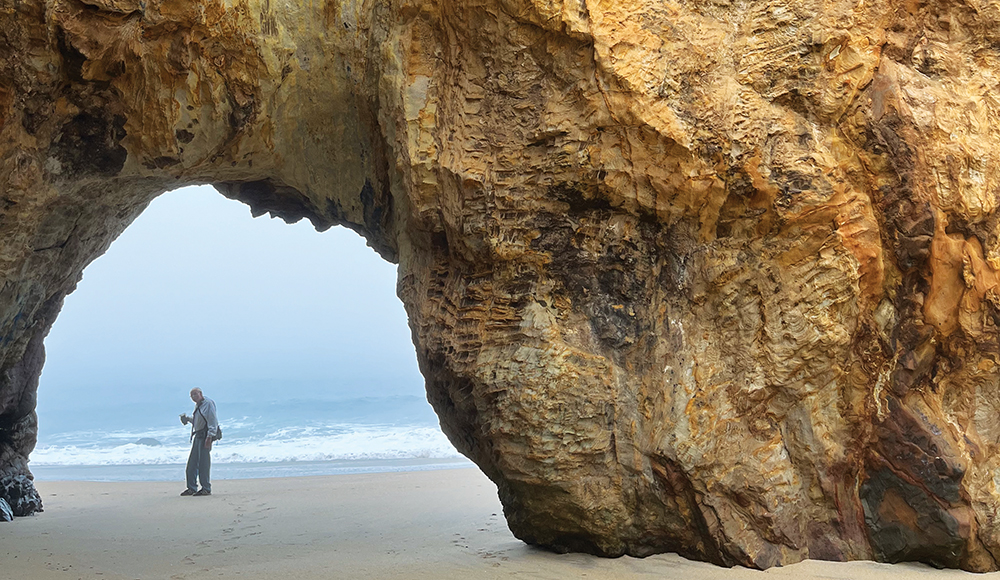
The ocean warned us, but we ignored it.
Not because we were reckless or stoned. Not because we were taking a selfie. We ignored it because we forgot.
The day before two young women were swept into the ocean and drowned at Panther Beach, my hiking group, The Pillars, was standing at the exact spot where they would later be carried away.
We were there for geology. Geologist Dwight Harbaugh was explaining how the stunning, psychedelic cliff formations at Panther Beach graphically show the volcanic eruptions, tectonic collisions, sandstone laminations, and the deep ocean mudstone of millions of years of California history.
Dwight, Ben Rice and I stood with our backs to the ocean, staring at the cliff. Then a wave hit us. It wasn’t a giant wave; it didn’t knock us down. It didn’t take anyone with it back out into the Pacific. It soaked us and left us feeling foolish. Three experienced hikers had forgotten Rule Number One: never turn your back on the ocean.
Twenty-four hours later, Fremont residents Harshita Nair, 21, and Mahial Sran, 20, were swept into the water at Panther Beach and died. The tragedy raises a difficult question. If experienced hikers can momentarily forget the ocean behind them, how do ordinary beachgoers recognize danger that doesn’t look dangerous?
According to Michael Horn, CAL FIRE information officer, lifelong Santa Cruzan, former lifeguard and water-safety expert, that’s exactly why sneaker waves are so deadly. “They sneak up on people who aren’t expecting them,” Horn says.
Not rogue. Sneaker.
In the April 24, 2026 Good Times weekly column, Take a Hike (goodtimes.sc/columns/take-a-hike), I called them rogue waves (“Don’t Turn Your Back on the Ocean”). Horn prefers another term.
“I think calling it a rogue wave is just demonizing what it really is. A sneaker wave is one of the bigger waves in a set,” he says. “The ocean will be flat for a little bit, or have really small waves, and then a big set will come in.”
The key danger isn’t necessarily the size of the wave; it’s the surprise. A beach can look calm for 10 minutes and people relax, walk closer to the water, sit on driftwood. They stop paying attention, then one larger wave arrives. “The reason it’s called a sneaker wave is that it sneaks up on people,” Horn says.
Meteorologists note that big winter storms can kill fewer people than moderate surf conditions. Massive waves frighten people away; sneaker waves are more insidious because they arrive when people feel safe.
Why Panther Beach is different
Panther Beach is among the most beautiful stretches of coastline in Santa Cruz County. It’s also one of the most unforgiving. It is a steep beach, and Horn says that can move an enormous amount of water in and out with every wave.
“If it’s really steep when a big wave comes in, that’s a lot of wave,” he says. “And when the wave goes back out, that’s a lot of water that’s going to pull you with it.”
Panther Beach has a tunnel through a rocky section known as the Keyhole. At very low tide, people can access areas of beach beyond it. We decided to go for it and walked through. As tides rise, that exit back through the Keyhole can disappear. Visitors can find themselves trapped. “They’re cut off,” Horn says.
That appears to have been a factor in the June 10th tragedy. Authorities still don’t know exactly what happened to Nair and Sran. Were they napping? Horn says their backpacks and towels were found completely dry further up the beach, so the napping theory is less likely. Maybe they were going for a dip when they got trapped on the ocean side of the Keyhole. Horn believes it is more likely that the women were exploring the beach, became isolated by rising water, and were struck by larger waves. “Once the wave hit them, they were probably tossed and turned until they became exhausted,” he says.
He says that the ocean near the cliffs can become a washing machine of colliding forces. Incoming waves rebound off rock walls while new waves continue arriving. “I’m an excellent swimmer,” Horn says. “And I’ve been tossed like that to the point where I almost needed rescue.” This isn’t necessarily about swimming ability; strong swimmers drown in surf every year.
Five rescues in a month
Horn says Santa Cruz County Fire has responded to five water rescues in the last month. Everyone he has spoken with considers that unusually high.
“We had some great weather in May, and then we had this gnarly wave storm that came from the South Pacific or from the equatorial Pacific, where there was a couple of hurricanes that created some waves. I go to Harbor Beach all the time, but I haven’t seen waves break over the jetty in years. It happened last night. It’s been happening every day for the last week and a half.” That’s why so many water rescues: more people, more exposure, larger surf.
Three rules that matter
Horn repeatedly returns to three simple ideas.
First: Never turn your back on the ocean. Sounds simple but it is not. The Pillars forget. Thousands of beach visitors forget every year. Even a few seconds of warning can matter.
“If you can see it, at least you know it’s coming,” Horn says. “The further up the beach you get, the safer you’re going to be.”
Second: Know what the ocean is doing before you arrive. Check tide charts, check surf forecasts, check weather advisories. Look for warnings from the National Weather Service. Horn says modern smartphones make this easy.
I ask him, “If you had a relative going to Panther Beach, what would you tell them to look up?”
“Sunrise, sunset, high tide, low tide. Storm surges.”
Third: Read the beach. If the sand is wet, the ocean has already been there and will be back. Steep beaches deserve extra caution because water rushes both in and out with tremendous force. Flat beaches offer more room to react; steep beaches offer less. Panther Beach is very steep.
The ocean is not a toy
One of Horn’s most useful observations is that ocean safety should be treated the same way we treat weather. He says that nobody steps outside naked during a snowstorm because they looked outside once and saw sunshine. Check forecasts, prepare: look at tide charts and surf forecasts to see whether conditions are changing. Know whether your exit route may disappear. Most of all, don’t assume the next ten minutes will look like the previous ten minutes.
A place worth visiting
During a Good Times editorial discussion, one question emerged: “If Panther Beach is dangerous, why should we encourage people to go there?”
Fair question, but maybe the wrong one. Driving to the trail is dangerous, hiking is dangerous, yet millions of people safely enjoy it by paying attention. Horn isn’t telling people to avoid the coast; he’s telling people to respect it. Panther Beach remains one of the most spectacular places in Santa Cruz County. The geology of the cliffs is astonishing; the beauty is unforgettable. But the ocean is a powerful natural force that occasionally reminds us who is in charge.
“The ocean is not a free toy,” Horn says. “It’s a very big, serious thing that can cause a lot of harm.”
The day before two young women died at Panther Beach on June 10th, The Pillars received a harmless warning. The difference between those two outcomes may have been nothing more than a single wave arriving at exactly the wrong moment, which is why the oldest rule on the coast remains the best one: never turn your back on the ocean.









Thank you for explaining how this horrific accident happened. As a regular visitor to the Coast, I appreciate the reminder & helpful criteria for keeping safe. Many years ago, I almost fell victim to a sneaker wave. Fortunately, there were people around me & it didn’t pull me completely out to the ocean. So very, very sad to hear of these young girls passing away.