


Plop.
Then another. Then ten thousand more in the space of a minute.
In Santa Cruz, rain does not merely fall. It occupies. It drums the roof with a force you can feel in the studs. We know the sound so intimately we almost stop hearing it.
That may be the problem.
Because in most places, rain arrives like a gift and leaves like a mistake. It hits the roof, slides into the gutter, disappears into a storm drain, joins a river, then hurries itself out toward the bay. We built entire cities around that assumption: let it go, call it weather, move on.
Danny Wright hears something else entirely.
He hears supply.
His idea starts with something basic: the sky is a delivery service. Every day the sun lifts water off the oceans and leaves the salt behind, and gravity carries it back down – free, metered by no one – to every roof on Earth. Water is the one resource every system depends on, and it arrives upstairs. Put those two facts together, and the old plumbing starts to look less inevitable.
In Danny’s world, the water doesn’t leave.
It lands on the roof and enters a system. The gutter feeds a tank. The tone changes as the tank fills – hollow first, then rounded, then full. A first-flush valve has already sent the storm’s dirty opening minutes down a separate drain. A small pump stands ready to send the rest anywhere the building needs it.
No pipeline. No treatment plant. No pallets of bottled water. Just the sky, doing what it has always done – and a building, finally ready for it.
“It’s pretty much a giant Brita filter,” Danny told me, describing the system that started it all – a simple system he installed 10 years ago in Nepal that captured rain at a school, stored it off the ground, and used gravity-fed filters to deliver it safely to students to quench their thirst.
We already have the technology to make rainwater drinkable.
What we’ve been missing is a system.
Catch water before it becomes runoff.
Pressurize it, and treat it close to where it lands.
Put the whole building on rain.
Scale it across rooftops.
That’s the idea.
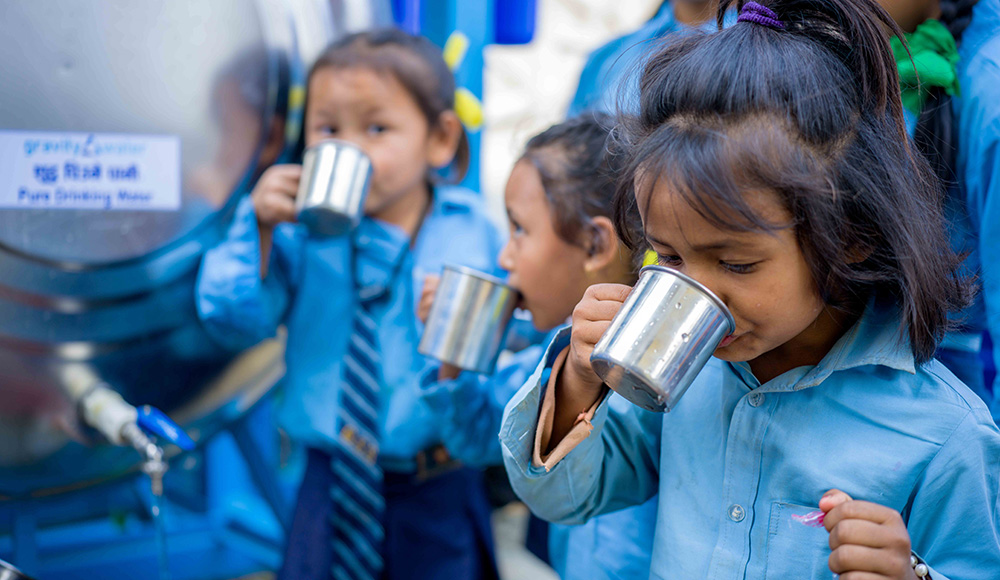
Wright is the founder of Gravity Water, a Santa Cruz-born nonprofit bringing safe, climate-resilient water systems to schools across the Asia-Pacific. He’s also the founder of Cloudwell, a for-profit company built to scale the same technology into broader markets. That dual structure tries to answer one of the hardest questions in technology right now: how do you scale something meant for the public good without compromising it?
Gravity Water holds the mission.
Cloudwell handles the scale.
And somewhere in between, rooftops start turning into infrastructure.
THE FIRST QUESTION
The story did not begin with a company. It began with a contradiction.
On a UC Santa Barbara field studies program in Belize, Danny spent time in rural communities where farm chemicals had contaminated the river and the local well. People were hauling unsafe water in a rainforest, under a sky delivering clean water to their roofs again and again.
“The biggest challenge was accessing safe water,” he told me. “They were going down to this river to get water. And they also lived in a rainforest.”
Why walk past water to collect water?
The question followed him. After graduate work in watershed science and policy at CSU Monterey Bay, Danny raised a few thousand dollars on GoFundMe and got on a plane to Nepal, where a massive earthquake had left schools open but their water buried, broken, or unsafe.
In February 2016, with local welders and materials from local markets, Gravity Water completed its first installation: over a thousand liters of safe drinking water a day. No electricity required – which mattered, in a country where the grid had just collapsed. Danny designed around what a village already had: local hands, local materials, and a power source that never fails. Water wants to fall, and gravity will move it.
Before this, rainwater harvesting had mostly stalled out at what he called “a glorified trash can.” Collection wasn’t the breakthrough. Delivery was.
Gravity Water’s first systems combined rooftop collection, elevated storage, and gravity-fed filtration – a tank up high, clean water at a tap below, a safe drinking source where there had been none.
Then, three years in, came the realization that changed the company: nearly every school they worked with had electricity. Gravity had gotten them started, but by itself it couldn’t scale to a whole building. A small pump could. Take the pre-treated rain off the first flush, pressurize it, run it through the filters, and it stops being a tap in the courtyard. It becomes supply behind every faucet on campus: sinks, toilets, showers, kitchens. Storage tanks can shrink. Electric valves can automate the switch between rain and utility water. And the mission grows with the plumbing: not just safe drinking water anymore, but climate resilience – drink the sky through the wet season, when runoff spikes and surface water is at its foulest, and bank the groundwater for the months when the sky gives nothing.
“Sometimes innovation isn’t about creating something new,” Danny says, “but seeing a thousand-year-old practice in a new way.”
Gravity is still in the company’s name, and it still handles the one leg of the journey nobody bills for: the sun lifts the ocean, and gravity delivers it to every roof on Earth. The pumps just cover the last hundred feet.
On average, the systems now provide more than half of a school’s annual water demand.
Then came the RainBox, a unit about the size of a small water heater that sits between a building’s storage tanks and its plumbing. Inside are sensors, multi-stage filters, first-flush diversion, pressurization, valves, and a controller. When it’s not raining, utility water passes through. When it starts raining, the whole building switches seamlessly over to treated rain.
“If you started showering and it started raining outside, half the bath would be utility, and half of it would be treated rain,” Danny said.
Not a barrel. Not a backup. A system.
Solar changed how we see roofs. It turned them into power plants.
Rainwater might do the same for water.
THE LAYER WE’RE MISSING
Rainwater has a built-in advantage: collected before it hits the ground, it avoids many of the contamination pathways that make surface water dangerous. “Prevention is way more sustainable than treatment,” Danny said. Don’t let water become a problem in the first place.
And this is where something unexpected enters the picture.
Artificial intelligence.
Right now, AI mostly enters water stories as the thirsty neighbor. A June report from the United Nations University warned that by 2030, the water footprint tied to data centers could equal the basic annual needs of all 1.3 billion people in Sub-Saharan Africa. Outside Atlanta, reporting on Newton County, Georgia, has put the local version in plain numbers: data-center cooling can run to hundreds of thousands of gallons a day, with one large facility accounting for roughly a tenth of the county’s daily water use.
But intelligence can run the other way: modeling rainfall, predicting storage, forecasting shortages, telling a city exactly what its rooftops did last winter.
AI doesn’t replace the rain.
It makes it legible.
The early version already exists. In the first year of Gravity Water’s UNICEF partnership in Vietnam, monitoring caught 112 maintenance problems across the new systems – clogged filters, worn parts – and closed out every one of them. That is the difference between hundreds of scattered tanks and one utility: somebody can see the whole board.
Because water doesn’t compete with AI. It runs underneath it – cooling the chips, carrying the heat away. No water, no compute.
Intelligence multiplies outcomes.
Water makes outcomes possible.
THE HYBRID MODEL
Gravity Water started as a nonprofit. That made sense: schools needed water, and communities needed trust. But at a certain point, the same structure that enables impact can limit growth.
“As a nonprofit, that actually became our biggest barrier to scale,” Danny said.
So in 2024, he built Cloudwell. The idea is straightforward: keep the mission anchored in the nonprofit, and use the for-profit to handle capital, patents, technology, and expansion. Cloudwell builds the plug-and-play systems and sells them into markets that can pay. Danny’s framing is almost absurdly large and completely literal: bring rainwater harvesting to all public infrastructure.
There’s room for it. Across Asia – some of the rainiest geography on Earth – only about two percent of communities use rainwater for drinking. The sky is full and the cup is empty.
This kind of hybrid is not unusual in theory. It’s just difficult in practice – and this spring, the same basic question was being fought over in an Oakland courtroom. Elon Musk accused OpenAI of drifting from its founding nonprofit mission; OpenAI’s lawyers argued that a for-profit structure can still serve a public-benefit aim. In May, a federal jury ruled against Musk after roughly two hours of deliberation – not on the merits, but on timing. Musk had waited too long to sue. He is appealing.
So the case may move on, but the question is still wide open. For-profits can do public good. The structure isn’t the sin. The drift is.
Danny’s answer is structural, not rhetorical. The 501(c)(3) still exists. Cloudwell licenses the technology from it. The kid in West Java, Indonesia doesn’t get billed; the resort hotel in Bali might. The market pays for the mission. The mission keeps the market honest.
But capitalism is a powerful tool, not the whole toolbox. Pretending it is, is how we end up with half-trillion-dollar AI companies and still no clean water in places where the sky is literally giving it away.
The early results suggest the hybrid has something to stand on. Gravity Water says it has reached more than 485,000 people across over 675 communities, provided more than 105 million gallons of clean water, and spared schools an estimated $3.3 million in water costs. Last year, its first UNICEF project brought safe water to nearly 21,000 people across Vietnam’s Dien Bien province, most of them children. And it pulled in $500,000 through Blackstone’s Gives Back Challenge as the social-impact partner of AirTrunk, a data center operator – even the industry drinking the water is helping fund the rain.
In late 2024, a panel with judges from the World Economic Forum and the Clinton Global Initiative named Gravity Water the City Solution of the Year in the QBE AcceliCITY Resilience Challenge, out of more than 740 entrants from 70 countries – a $100,000 prize and a pilot track aimed at city governments. A room full of people whose job is judging urban infrastructure looked at rooftops, tanks, and rain, and saw a utility.
Apple, UNICEF, and UN agencies are partners.
These aren’t pilot numbers anymore. They’re early infrastructure numbers. And Danny isn’t hiding the size of the bet: ten million people on harvested rain by 2030.
THE PATH OF A DROP
What does it actually take to make rain drinkable? Less than you’d think, and more than you’d guess.
Rain itself is a small miracle of distillation. Water lifts off the oceans, leaves the salts and sediments behind, and falls back as something close to pure. By the time it reaches your roof it has picked up a little dust, a little dissolved CO2. The rain is cleaner than the river it’s about to become.
The trouble starts on the roof: bird droppings, pollen, whatever has settled since the last storm. A first-flush diverter dumps the dirtiest opening burst of every storm down a separate drain. After that, the water arriving in the tank is far cleaner than the runoff it would have become.
Far cleaner is not good enough. I learned that the hard way a few years ago, when a compromised water supply – water I’d been showering in, brushing my teeth with, washing dishes under – put me on the bathroom floor for three nights with E. coli. I thought it was bad sashimi. It was the water.
Danny told me something in passing that reframed how I think about contamination. “There can be E. coli from birds and others,” he said, “but that E. coli isn’t as dangerous to humans.” He pointed to a study of the San Lorenzo River where samples showed E. coli at ten times the legal limit – and no public health crisis, because the strain traced back to birds. Source matters as much as count. The strains that hurt people most often come from mammal waste reaching a water source: a leaky septic line, a cattle ranch upstream. In poorer parts of the world, such as Nepal, the math is brutal – one in three children gets a diarrheal illness from contamination like this before they turn five.
Rainwater can bypass much of that. It is collected before it touches the ground. Properly collected rainwater is classified by the WHO/UNICEF monitoring program as an improved drinking-water source; after Danny’s systems treat it to government drinking-water standards, what comes out of the tap has crossed exactly zero of the pathways that made me sick.
For thousands of years, people have been polishing mostly into yes. “It’s one of the world’s oldest technologies,” Danny said. “I’ve seen schools using split bamboo stalks to collect water from roofs.” Sand, gravel, charcoal – and now sub-micron filtration: pleated polypropylene cartridges with pores so small that bacteria, protozoa, and microplastics literally cannot fit through. Add activated carbon for taste and a UV polish where it’s called for, and a Nepalese thunderstorm becomes something a kindergartener can drink straight from the tap. Cheap, reliable, and boring – exactly what you want from infrastructure.
What makes Danny’s design different from the municipal version is the address. The water is treated a few feet from where it fell and used a few feet from where it was treated – no miles of aging mains, no city-scale single point of failure. The earliest systems were pure gravity: a tank above head height, filters below, not a single watt burned. In post-earthquake Nepal, that was precisely the right amount of technology. But gravity can’t push water up to a second-story bathroom, so the team retired its original towers and built around a small pump – off-the-shelf parts, skills that already live in town, nothing to overcomplicate. By the time the water reaches the tap, it has passed through the same basic barriers a municipal system would use.
A redwood pulls fog water out of the air twenty minutes from downtown. A school in West Java does the same thing at institutional scale, with rooftop rain moving through local materials, local hands, and filtration built for everyday use.
Same physics. Same rain. Different decade.
PLENTIFUL
Here is the part we don’t say out loud often enough: water is not optional. Not for the kid in Dien Bien Province. Not for the kid sleeping in a tent on the San Lorenzo levee. Not for the deer on Empire Grade, or the redwood that has been quietly making rain for a thousand years and asking nothing back.
Every human being on Earth deserves clean water. Every creature does. That is the floor – and we are moving away from it, not toward it. In 2025, Tehran – a capital of nearly ten million people – came close enough to Day Zero that Iran’s president floated moving the capital itself. And still, in places around the world, children get sick before they’re five for one reason: they’re drinking contaminated water under skies that are begging to be caught.
So let me take you somewhere.
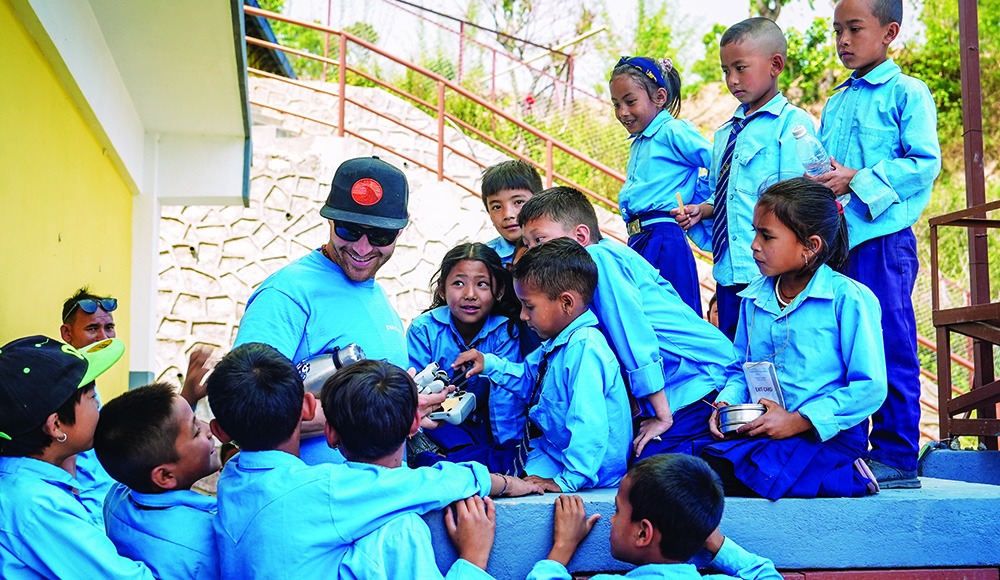
A schoolyard in West Java at recess. Two hundred kids spill into the courtyard, past a tank rising up the wall like plumbing furniture, and line up at a tap to fill their bottles. The water they’re drinking fell two days ago in a thunderstorm none of them remember.
A municipal building in Phoenix with a Cloudwell system in the basement. The few storms it gets each year are no longer drainage emergencies. They’re deposits.
A levee camp in San Lorenzo Park where someone, finally, has put a small RainBox beneath the deck of a footbridge, and people who haven’t had reliable clean water in years have a tap.
A redwood and a rooftop, finally on the same team.
This is the world Danny is building toward, methodically, one welder at a time. Nearly half a million people already get their water from roofs his team has plumbed. “We have a ton of momentum,” he told me. “We’re positioned to take this thing global. If I got them in a room for twenty minutes, I could get them there.”
He just needs more people to walk in the room.
I’ll go first. This article is my 20 minutes.
I worked alongside Danny in the service industry – hotel shifts at Seascape, the water-glass refills, the wine pours, the late closes. I saw the perseverance back then, the steadiness that didn’t need a stage. I had no idea what he was going to build. But the bones of it were already there.
Now he’s standing up the systems he spent fifteen years sketching on whiteboards and in dirt-floor schoolrooms. The bones held.
Every shift like this begins the same way: someone decides a thing is worth backing before it’s obvious. “A teacher named Ann Marakovich did it for me when I was a struggling teenager at Aptos High. Strangers on GoFundMe did it for the first tank in Nepal. A panel of infrastructure judges did it with a hundred-thousand-dollar check. Belief, then infrastructure,” Danny told me.
“I think rainwater harvesting is the next solar,” Danny said.
After spending time with him, I’m no longer sure that’s a prediction. It may simply be a delayed realization.
If so, the shift won’t arrive with spectacle. It will arrive quietly. As a storm at night. As tanks filling in the dark. As a valve turning behind a wall. As one more kid not getting sick. As one more rooftop quietly doing the work of an entire civic system.
Progress not as invention, but as recognition.
And if the bet pays off, here is the world you wake up in ten years from now. Roofs that earn twice – kilowatts on top, gallons underneath. A generation of kids in Nepal and Vietnam and Malaysia who assume the tap works the way you assume the lights come on. Cities that read a storm forecast the way they read a budget: as income.
It’s July in Santa Cruz now, and the roofs have gone quiet until fall. But in Nepal the monsoon is in full swing – and at the schools Danny’s local team plumbed, that drumming on the roof isn’t weather anymore. It’s the year’s supply, arriving on time.
Rain hits the roof.
It runs.
This time, it stays.
And we drink from it.
■ Joshua Logan is a writer, magician, and creative technologist based in Santa Cruz. He writes about technology, culture, and the people shaping both for Good Times









Faubulous, inspiring story. Thank you. Wish we had such a setup on our house — though we might need a fog catcher to collect much of anything.
It’s a massive bummer to see a clearly AI-written article in the Good Times. There are so few available writing jobs in the world for humans already, and you outsource this to a machine? What a shame.
Fantastic article and such a cool local story.
Go Gravity!!
I wonder how this system deals with mosquitoes? I heard that rain water catching systems are prone to becoming mosquito breeding grounds. Especially in southeast asia where there are lots of mosquitoes. Would be interesting to hear a follow-up on how the company handles this particular issue.