
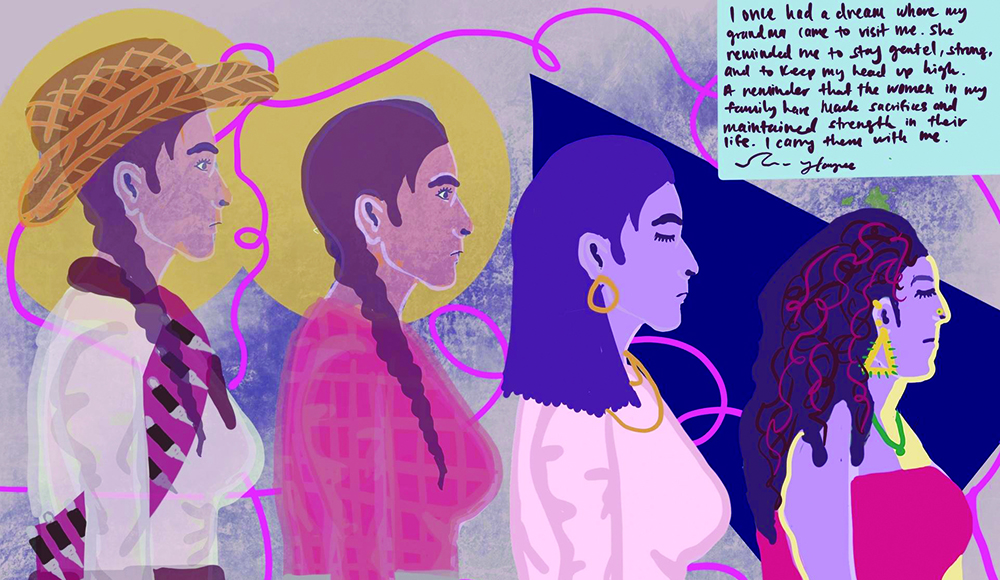
Four women appear in profile, a pink thread winding through their shared space. Above them, a handwritten recollection tells of a grandmother who returned in a dream, reminding the artist to stay strong and hold her head high. “I carry them with me,” the inscription concludes.
Houyee Chow-Jiménez’s mixed-media work, I Carry the Strength of all the Women Before Me, gives resilience a family history. The women who came before remain present, their sacrifices and strength traveling with the generations that follow.
That sense of what people carry, and what allows them to carry on, runs through LatinXperiencia 2026: La Resiliencia, which opened Sept. 28 at Cabrillo Gallery. The fifth installment of the gallery’s annual series brings together 24 Latino/a/x artists from across the country, working in painting, textiles, sculpture, assemblage and photography.
Juror Alyssarhaye Graciano, visual arts curator at San Jose’s MACLA/Movimiento de Arte y Cultura Latino Americana, selected the works from submissions responding to the idea of resilience. A textile artist and published author herself, Graciano has built a curatorial practice around artists of color and stories that have received little attention.
Her exhibition statement places memory, internal struggles and collective strength among the concerns connecting the works. Resilience emerges as an ongoing process of adapting and rebuilding as the conditions of life change.
The gallery’s announcement supplies some of those conditions: threats to immigrants, authoritarianism, economic crises and war. It also brings the subject home to illness, parenthood, a change of jobs or the loss of someone loved. The scale varies; the need to find a way forward persists.
In Oscar Lopez’s Quien Llena Tu Plato? Who Fills Your Plate?, agricultural workers bend over their harvest while hands in the foreground hold plates of food. The composition brings the field and the dinner table into the same frame. Its question leaves the viewer with the task of accounting for the labor between them.
Luka Amaru Fernandez works on burlap, its exposed edges and hanging threads becoming part of the image. A spotted feline stretches across the lower portion, beneath an opening onto darkness and a small light. The fabric gives the scene a physical vulnerability: an image with edges that can fray.
Across its five exhibitions, LatinXperiencia has made room for different ways of approaching identity, belonging and the forces that shape a life.
In 2022, Pilar Agüero-Esparza’s Stratum drew on her family’s shoemaking traditions and a palette of skin tones to examine inequalities of race, gender and class. The following year paired Victor Cartagena and Enrique Chagoya, whose works addressed migration, displacement, colonialism and prejudice through approaches ranging from testimony to satire.
Tessie Barrera-Scharaga’s Emotional Alchemy followed in 2024, exploring the connections between personal experience and social, political and environmental realities. Last year, Ana Teresa Fernández’s TransPollination of Eden brought viewers into a sculptural ecosystem of mirrored surfaces, plants and pollinators, inviting them to consider their own place within it.
The series’ stated purpose is to foster connections across cultures and encourage conversation within the college and beyond. This year, that conversation begins with a question many visitors will recognize: What sustains us when life requires more than we thought we could give?
LatinXperiencia 2026: La Resiliencia runs Sept. 28–Oct. 27 at Cabrillo Gallery, in the campus Library building, Room 1002, 6500 Soquel Drive, Aptos. Hours are Monday–Friday, 9am–4pm, plus Wednesday and Thursday evenings, 6:30–8pm. Admission is free. Information: cabrillo.edu/cabrillo-gallery.