
During President Donald Trump’s first term in office his administration proposed a sweeping plan to open nearly all U.S. coastal waters to offshore oil and gas drilling.
Those plans were thwarted amid opposition from local, state and federal officials and residents.
But the threats of offshore oil drilling and seabed mining have grown more dire under Trump’s current administration, in what U.S. Rep. Jimmy Panetta describes as “Trump 2.0.”
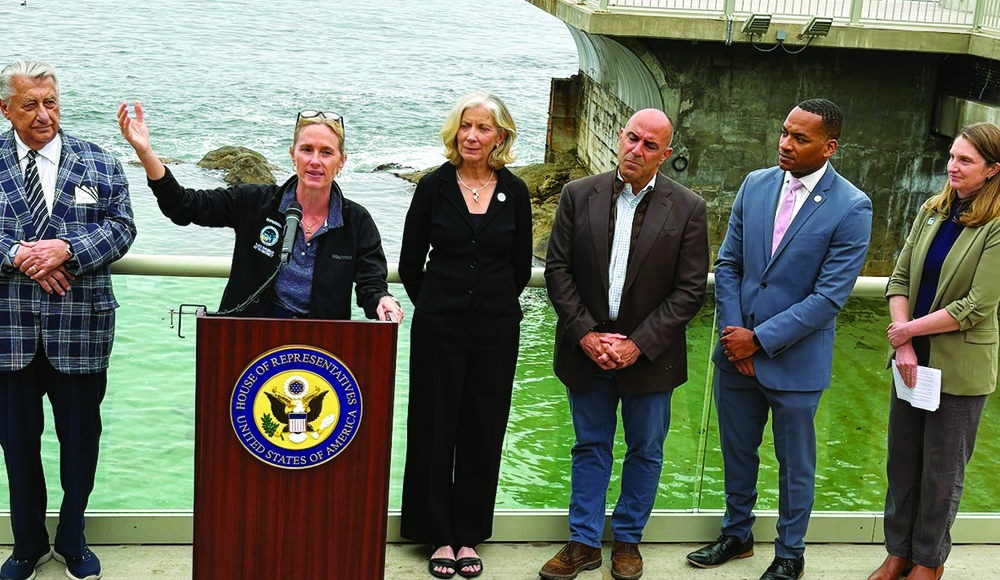
During a news conference last week on the back porch of the Monterey Bay Aquarium, Panetta said the U.S. Department of the Interior recently released a draft proposal making it clear that “all options are on the table” when it comes to offshore oil drilling and mining.
Panetta joined several local elected officials and nonprofit leaders in vowing to continue opposing those plans.
“That’s why we stand here today, with everybody at the table, with all of our options on the table, to let this administration know that our Monterey Bay National Marine Sanctuary will not be the East Wing of the White House,” Panetta said.
Gesturing to a tide pool behind the aquarium, Monterey Bay Aquarium CEO Jenny Gray said children later that day might have their first snorkeling experience in the pristine waters.
“And I think that is why we’re here today,” she said. “To spend a moment thinking about what it is like to put your head under the water and to see the incredible creatures that live in our ocean.”
Panetta told the crowd that, with the “chaos and the craziness and the uncertainty and some absurdity coming out of Washington, D.C.,” it can be easy to become disheartened and divided.
But he pointed to Federal Register records showing that more than 300,000 people opposed the previous plans during the public comment period.
“We stand at the ready to do it again when the next comment period occurs, once the administration releases the updated plan,” Panetta said. “And we must continue to engage. We must continue to unite. And, yes, we will continue to fight as we stand up to protect our coastline.”
Monterey County Supervisor Kate Daniels said an accident during drilling could cause catastrophic damage.
“… we know collectively that one oil spill threatens everything,” she said. “It’s not just the ocean behind me, but it is the economy, it is the food that we eat, and it is the place that so many people have the opportunity to come and visit and experience.”
Ted Balestreri, CEO and chairman of the Cannery Row Co., agreed, saying such a disaster would severely affect Monterey’s tourism industry, which draws 6.3 million people annually.
That includes the hospitality industry, he said.
“I want you to know this is what the industry of America is all about,” he said. “And to impede it, to put oil drilling out here, it’s like destroying the Mona Lisa.”
Save Our Shores Executive Director Katie Thompson said her organization is ready to fight drilling off the coast, as it did four decades ago when it was formed to fight federal offshore drilling proposals.
Thompson said the federal government is proposing new offshore oil and gas development, including six lease sales off California, two of them on the Central Coast.
“… We fought it back then, we won and we’re ready to fight again,” she said. “Californians have made the position clear. We do not want offshore drilling.”
The state is already strengthening its so-called “Blue Wall,” a series of local ordinances along the coast intended to hinder offshore oil drilling.
That includes Assembly Bill 1448, which, if signed by Gov. Gavin Newsom later this year, would prohibit oil companies from using existing land-based infrastructure to support new offshore oil extraction.
Currently, state law prohibits oil companies from building new infrastructure for that purpose.
Ashley Blacow-Draeger, Oceana’s Pacific policy and communications manager, called the pending legislation “a critical piece of legislation that will help fortify California’s coastline from the escalating risks of expanded offshore oil and gas drilling.”
Janine Chicourrat, managing director of the Portola Hotel & Spa, said she remembers swimming in the ocean as a child in Southern California — where offshore drilling occurs — and having to clean oil from her body that had leaked from offshore oil operations.
Chicourrat called the idea of offshore drilling on the Central Coast an “absolutely ridiculous concept” that would decimate the fishing industry, decrease property values, cause spills and damage the fragile ecosystems at attractions such as Point Lobos State Natural Reserve.
“We’re made up of a lot of small businesses, and that would kill us,” she said.
County News Briefs
Local officials: We will not cooperate with ICE
Law enforcement, education and human services leaders from Santa Cruz and Monterey counties joined Rep. Jimmy Panetta at Cabrillo College Tuesday to reassure immigrant families that local agencies will not aid federal immigration enforcement. “Law enforcement does not cooperate with ICE,” District Attorney Jeff Rosell said, adding that fear is hampering prosecutions. Cabrillo reported a 23% drop in California Dream Act applications, and officials said students have missed school over fears of detention or family separation.—The Pajaronian
Pajaro Valley braces for wet winter
With forecasts trending toward a strong El Niño, the Pajaro Regional Flood Management Agency unanimously approved nearly $740,000 in contracts and spending to clear vegetation, remove sediment and strengthen the Pajaro River levee before storms arrive. The largest item is a $586,393 increase to the agency’s contract with Atlas Tree Service. “We’re going to hope for the best, but we need to be prepared for the worst,” Executive Director Mark Strudley said, cautioning that Central Coast forecasts remain uncertain.—The Pajaronian
Panetta vows to fight ‘Trump 2.0’ offshore drilling
At a Monday news conference at the Monterey Bay Aquarium, Rep. Jimmy Panetta said a new federal draft proposal puts “all options on the table” for offshore oil drilling, reviving first-term plans. Save Our Shores said the government is proposing six lease sales off California, two on the Central Coast. Business leaders warned of the stakes for a tourism economy drawing 6.3 million visitors a year. “Our Monterey Bay National Marine Sanctuary will not be the East Wing of the White House,” Panetta said.—The Pajaronian
Steam pilot to test alternative to pesticides
Santa Cruz County will test steam as an alternative to chemical soil fumigation on about 25 acres of Pajaro Valley farmland this fall under a $175,000 state-funded pilot led by the county Agricultural Commissioner’s Office. Steam injected into the soil is intended to suppress pathogens without chemical fumigants, though Commissioner Dave Sanford cautioned it is not yet a proven replacement. The first community meeting is 5:30pm Aug. 18 at the South County Government Center, 500 Westridge Drive in Watsonville.—The Pajaronian
Scotts Valley city manager announces resignation
Scotts Valley City Manager Mali LaGoe has submitted her resignation after more than four-and-a-half years on the job, the city announced Aug. 7. She will remain through September. Administrative Services Director Stephanie Hill will serve as interim city manager while the City Council conducts its search. “I am proud of what we have accomplished together,” LaGoe said. Mayor Donna Lind thanked her for her service, calling the city “fortunate to have Mali’s leadership.” —Press Banner
Voters to decide half-cent sales tax in November
The Santa Cruz County Board of Supervisors has placed a temporary half-cent transactions and use tax on the Nov. 3 ballot and declared a state of fiscal distress, citing federal and state funding cuts to safety-net services. If approved, the measure would raise an estimated $27 million a year for five years to offset reduced support for health care, emergency medical services, nutrition assistance and behavioral health. Officials estimate recent federal and state actions will cost the county and its partners more than $150 million over five years. “Today’s action gives the people of Santa Cruz County the opportunity to decide whether they want to be part of a local response,” Board Chair Monica Martinez said. The measure is contingent on Senate Bill 762, which cleared the state Senate Aug. 3 and awaits action by Gov. Gavin Newsom.—Press Banner