

Symphony orchestras tend to be large in scale. From 50 musicians for a Beethoven Symphony to more than 100 players in the pit for a Wagner opera. Hence the big oceanic sound we crave from a symphony.
But small groups of musicians, such as string quartets, allow each player to in essence, become a soloist. And each instrument can be heard and followed distinctly. The listener can watch the movements of musicians, follow the sights and sounds very, very closely.
Writing about the kind of music rarely heard in the Catalyst or Moe’s Alley, I’ve experienced a stunning number of small professional ensembles that perform at the highest level. They are as good as it gets anywhere. Mind-blowing expertise, performing insanely gorgeous and often rarely-heard music of charm, edge, and complexity.
These ensembles create music as exciting as a Michelin-starred dining experience and as compelling as the next season of ‘Slow Horses”. There are many more than I can fit into a single article, but here’s a snapshot of some of the top groups.
In smaller groups, each instrument can be heard and followed distinctly. The sound can be as sweeping as that of a symphony orchestra, but it is always more specific. Listeners can follow each theme closely.
We have long been favored with the presence of musicians from all over the country who perform new creations by living composers at the Cabrillo Festival of Contemporary Music. And for over 50 years we’ve hosted a lively Baroque Festival devoted to the works of composers who flourished more than 300 years ago.
In writing about classical performances in Santa Cruz I’ve experienced a stunning number of small professional ensembles that perform at the highest level, programs of charm, complexity, and often rarely-heard music.
Santa Cruz Chamber Players has for 47 years fashioned unique seasons in which concerts emerge each with its own director, featuring different combinations of instruments performing divergent styles and distinct historical periods. Conductors may yield the baton to new leadership. Maestro John Anderson’s Ensemble Monterey flourishes now under the guidance of clarinetist Erica Horn. And with the passing of founding matriarch Linda Burman-Hall several years ago, the Baroque Festival recruited German organ master and Baroque baritone Jörg Reddin as its new Artistic Director. Lars Johannesson, whose mastery of flute repertoire has him booked from now until the Apocalypse, has directed Espressivo since distinguished conductor Michel Singher relinquished leadership of this elite chamber orchestra.
Small ensembles—many of whom perform in Monterey as well as in Santa Cruz— offer a deep bench of professional musicianship and a heady array of stunning performances. Here’s a snapshot of some top companies.
Santa Cruz Opera Project is the newest musical idea in our region, the brainchild of sopranos Jordan Best and Lori Schulman who share Artistic Director roles.
Founded in 2022 in Santa Cruz, with its first production of Le Nozze di Figaro, SCOP’s mission is to make quality opera that is thrilling and accessible, says Schulman. We create intimate, immersive opera experiences in non-traditional venues, she says, pairing high-quality performance with a welcoming approach that brings audiences face-to-face with the action. We plan three events per year, including fully staged operas and special programs.
Repertoire: Repertoire spans Baroque through contemporary opera, with adaptations in English, reduced orchestrations, and immersive staging. Wishlist includes exciting site-specific performances, more contemporary works, bilingual opera, and new chamber operas written specifically for intimate spaces. We would love to program Poulenc’s Dialogues of the Carmelites in the near future and dream of a production of I Pagliacci at the Santa Cruz Boardwalk!
Specialties: Immersive opera, chamber-scale productions, gender-blind casting, English adaptations, and site-specific performances featuring regional artists. We strive to strip opera down to the core of its value and give audiences the chance to feel deeply—to laugh and cry.
Weirdest concert: Probably Bach’s Coffee Cantata staged in a working coffee shop—with coffee tastings built into the recitatives. But then again, we also got our start with a production of Figaro set in the 1970’s with the retro bar at the Elk’s lodge as our stage.
Most challenging music: Producing full operas with reduced forces in unconventional spaces—balancing vocal demands, acoustics, and storytelling without a traditional theater safety net.
Long-term goal: To deepen community representation and access through fresh, new interpretations of classic works, bilingual opera, family programming, and educational outreach—while staying intentionally small enough to keep opera personal, immediate, and human.
_______________________
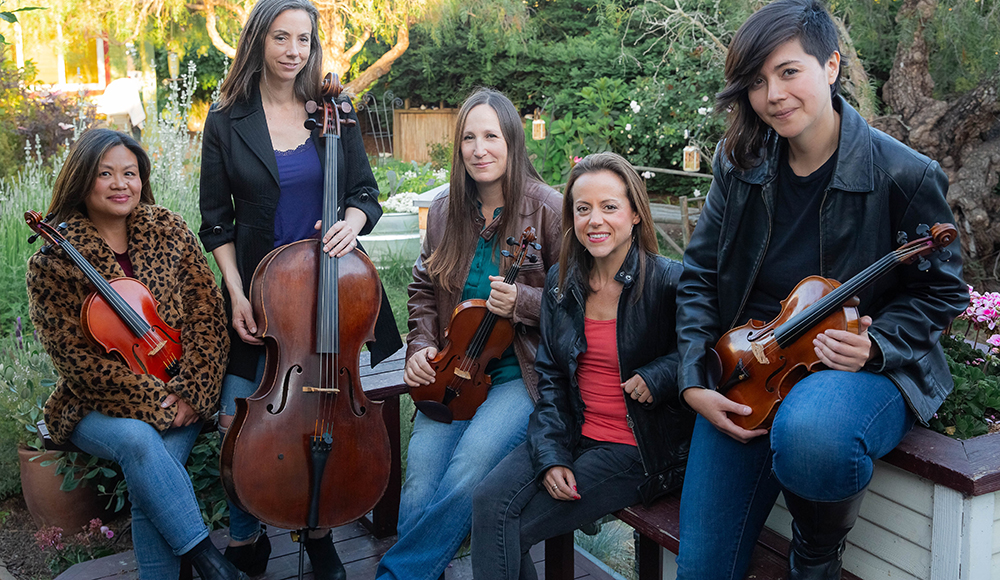
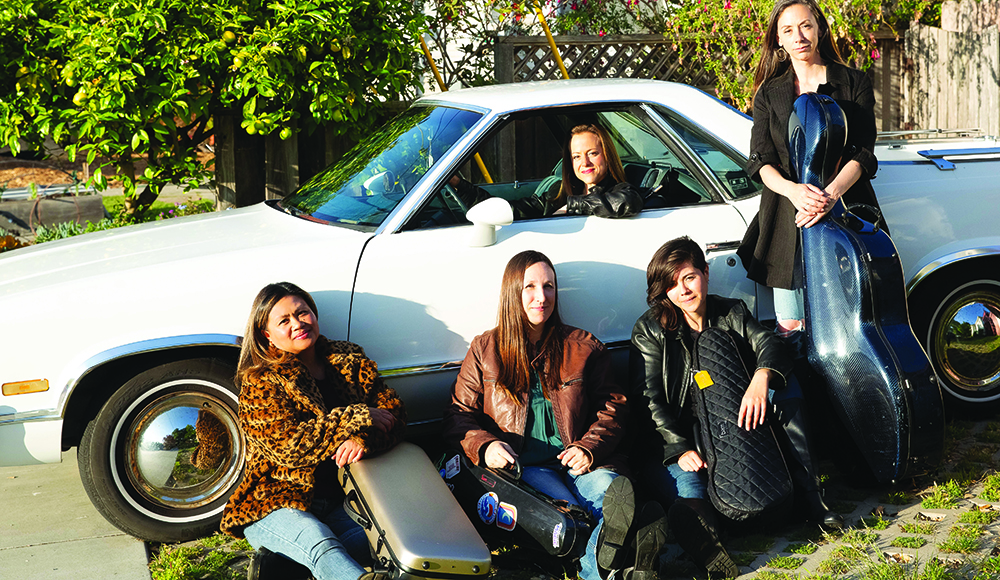
Marea Ensemble is another newcomer, designed to perform exciting music from classics to alternative and adventurous. Now two years old, the Marea Ensemble is a chamber music quintet featuring Shannon D’Antonio (violin), Samantha Bounkeua (violin), Rebecca Dulatre-Corbin (viola), and Kristin Garbeff (cello), plus vocalist Lori Schulmann. The genre-bending ensemble is rooted in classical training but driven by outside-the box curosity. Marea performs 4-5 concerts per year, often as a featured ensemble within New Music Works and Santa Cruz Chamber Players seasons.
Repertoire: Our current repertoire, says Bounkeua, centers primarily on contemporary and living composers, with classical works woven in as points of contrast and conversation. We move fluidly between newer voices—ranging from Caroline Shaw to Elvis Costello—and 20th-century pillars like Shostakovich and Beethoven. This spring, we are offering a world-premiere commission written specifically for Marea from composer Chris Pratorius Gómez and poet Kristen Nelson.
Wishlist: Song cycles and vocal-forward chamber works such as Schoenberg’s String Quartet No. 2 with soprano, lieder by Clara Schumann, and Jake Heggie’s Camille Claudel: Into the Fire. And—unsurprisingly—anything and everything by Caroline Shaw.
Specialties: Repertoire written for voice and strings. We intentionally curate programs that explore emotional and social themes—identity, belonging, resistance, and transformation. We work with several living and regional composers.
Weirdest concert: The Juliet Letters. Rather than a traditional sit-and-listen format, this self-produced concert was designed as a participatory experience: candlelit, hosted in a winery/coffee bar, with wine, food, and intentionality built into the program for the audience to actually write letters during the performance.
Most challenging: One of our greatest challenges was performing the Alex Temple Behind the Wallpaper with live electronic effects during our program Lullabies and Nightmares as the featured New Music Works ensemble in October 2025. We met virtually with the composer several times to refine/elaborate on how the live performance could more accurately follow the album recording, which included a mix of delays, reverbs and formant shifting, which required rehearsal with our brilliant live sound engineer, Andy Zenczak.
Long-term goal:To deepen and document our current work. We’re planning our first recording, developing a full program of newly commissioned works by living composers, and expanding beyond the Bay Area through a regional tour.
_____________
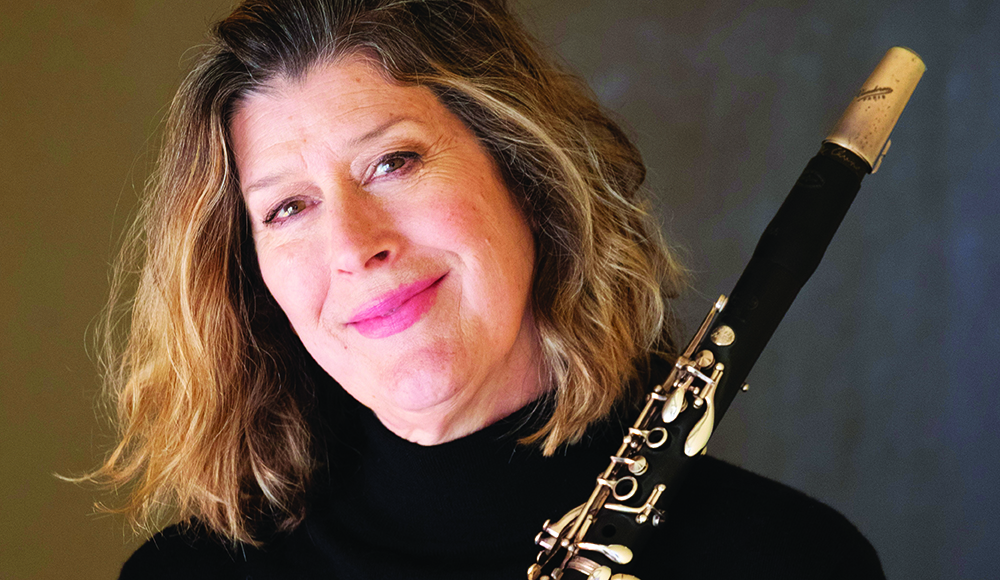
Ensemble Monterey, founded in 2013, performs a season of programs split between Santa Cruz and Monterey. Erica Horn, clarinetist, is the Board President and acting Artistic Director along with oboist Peter Lemberg.
Ensemble Monterey was founded in 1992 by John Anderson to present outstanding works for chamber ensembles of up to 25 musicians, works that are seldom performed because of the number of players required, says Horn, or because they are unusual and outside the repertoire of pieces most often performed by chamber ensembles. We present 4 concerts per year.
Repertoire: Work that’s somewhat traditional in form, if not often played. Pieces like Mozart’s Gran Partita, or the Schubert Octet grace the stage, as well as wildly adventurous and new works, including works by local composers like John Wineglass, Steve Tosh, Steve Ettinger and just this season young, Syrian-born, locally raised, Ealaph Tabbaa.
Most memorable concert was the Britten War Requiem with vocal soloists and choirs (for a drastically reduced orchestra of about 20). We are flexible and adventurous.
Weird: One extraordinarily fun concert was on Halloween featuring bassoonist, Amy Duxbury, in a John Adams work called Dead Elvis. Amy rode into the hall on the back of the Harley Davidson driven by our leather-clad board president. Amy wore the famous white jump suite of older, Vegas-style Elvis. (It’s in the score that the bassoonist must dress like Elvis.)
Most Challenging:
I think this last concert’s Prokofiev Quintet opus 39 in G minor was the most challenging and difficult piece I’ve played in a long time. (In terms of difficulty it’s right up there with Stravinsky’s Rite of Spring and Ravel’s Daphnis and Chloe.) We musicians were laughing about how we’d love to get do it again, but also were relieved to not have to! So difficult! So worth it!
Goal: Our immediate goal is to find our voice in a new era, post John Anderson. I think we are well on our way! We have an opportunity to think about where we want to go and we have a great team in place, both on the stage and on the board. We are in good shape! Long term we want to really resonate with our community. We love connecting with our audience.
__________
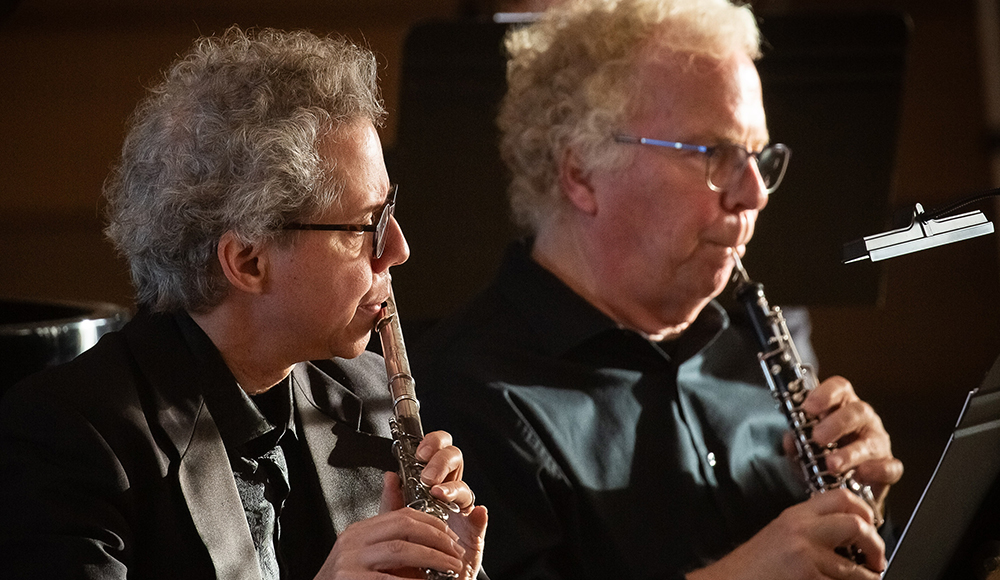
Espressivo showcases elite musicians and surprising programs currently under the directorship of Swedish-born Lars Johannesson, who teaches and performs with numerous Bay Area ensembles and orchestras. A tireless and in-demand expert on classical and Baroque flute, Johannesson came to Santa Cruz after studies in Europe and San Francisco.
I heard about the group after the first season in 2013, and contacted Michel Singher with an interest in playing in his group. Since then Espressivo was one of the patchwork of ensembles I regularly play with. Espressivo was founded about 13 years ago by Michel Singher, and since his retirement performs with guest conductors such as Salinas-native Alan Truong. Core musicians Peter Lemberg, Erica Horn, Shannon D’Antonio, and Kristin Garbeff (and others) are also frequent collaborators with Marea Ensemble, New Music Works, and Ensemble Monterey.
Playing three concerts a year, Espressivo’s core repertoire is Romantic through 20th century music, for somewhere around 12 players, but we have also performed some 18th century repertoire.
Specialties:
No real specialty, but what we perform is generally defined by the size of the ensemble, which at the core is about 10-15 players. This lends itself to performing works that are neither chamber music nor large orchestra pieces, but leans toward chamber music. There is quite a bit of 19th- and 20th Century repertoire to choose from; Octets, Nonets, Dectets and other pieces specifically written for, say 13 players (for example, Aaron Copland’s Appalachian Spring, original version, which we are performing in June).
Weirdest concert:
Probably the one including Airs from Another Planet by Judith Weir (1986). We don’t really do “weird” much.
Most challenging:
All of it. Our music tends to require a lot of practicing, and/or is tricky to put together. The Enescu Chamber Symphony we just performed was a bit of both. Schoenberg’s Chamber Symphony no.1 would likely qualify here as well.
Long-term goal: Develop an audience in Monterey so we can perform the concert twice, which is nice after all that work putting it together. I also want to pay the musicians better, but this is a tricky money balance, and we increased pay for this season already. Also I hope to increase audience interest in music beyond Bach, Mozart, Beethoven etc. Along the lines of, “despite not recognizing any of the composer names, if they came, they would like it!”.
________________
New Music Works Now in its 47th season, under the baton and Artistic Direction of Philip Collins, NMW presents an annual fall-through-spring concert series featuring a resident core ensemble often conducted by Michael McGushin. Seasons typically include 4 or 5 concert events, and encompass a wide range of perspectives and collaborations involving internationally, as well as regionally based, artists.
The presentation of new chamber works by living composers is the prime focus of our
performances, says Collins. Concert themes have encompassed geographic, environmental, historic, and stylistic perspectives. Our venues include intimate chamber theatre, public performance art and environmental installations.
New chamber works by area composers are a frequent highlight in our programming, and the near annual presentation of “Night of the Living Composers” is devoted exclusively to new music of regional vintage. A few of the regional composers we have featured are Steed Cowart, Pablo Furman, Hyo-shin Na, Terry Riley, Jon Scoville, Scott Stobbe, and (the late) Allen Strange.
Wish list: To present a program of Native American composers from early to contemporary. (Next season). Present a night concert of Native American music/culture at UCSC Quarry amphitheater. To Cabaret Verité, and Pacifica Rondo—Lou Harrison’s orchestral suite with works by composers of diverse Southeast and Far East countries.
Weirdest concert: “Halloweenworld” @ the Rio; Oct. 26, 2013, where 40 costumed audience members line-danced the “Electric Slide” to Stravinsky’s Dance of the Adolescents, from the “Rite of Spring,” performed by NMW Ensemble.
“SoundSites 1995”: At the SC Wharf: Live- amplification of Sea Lions under the wharf, processed by San Jose State Electronics class, directed by Alan Strange. Collins’ duet “At SEA” for Trumpet and Tuba in separate motor boats, circling the wharf.
Death of the Avant Garde 1983 at Art Center Theatre: blindfolded audience, and guided them across the River Styx.
Most Challenging: Most difficult music: Black Page, Frank Zappa.An eine Aolsharfe, Hans Werner Henze.It’s a long list and I am sure I am forgetting some of the toughest
Long-term goal:
Coordinate more collaborations with Cabrillo and UCSC music, dance, art and technology programs. Develop music making programs (composing/improvising) for K-6 schools. And to grow organizationally: to sustain a professional staff and location, with storage.
Upcoming Concerts
Santa Cruz Baroque Festival – March 7, 6pm Peace United Church, SC, scbaroque.org
Ensemble Monterey – March 8, 7pm; April 12, 7pm Messiah Lutheran Church, ensemblemonterey.org
Santa Cruz Chamber Players featuring Marea Ensemble www.mareaensemble.org— March 21, 7:30 pm & March 22, 3 pm, Christ Lutheran Church, 10707 Soquel Dr., Aptos, scchamberplayers.org
New Music Works – April 25, 7pm, Peace United Church, SC, newmusicworks.org
Espressivo – June 6, 4pm, Peace United Church, SC (June 7 in Monterey), espressorch.org
PULL QUOTE: We have long been favored with the presence of musicians from all over the country who perform new creations by living composers at the Cabrillo Festival of Contemporary Music. And for over 50 years we’ve hosted a lively Baroque Festival devoted to the works of composers who flourished more than 300 years ago.







Newsletter please