

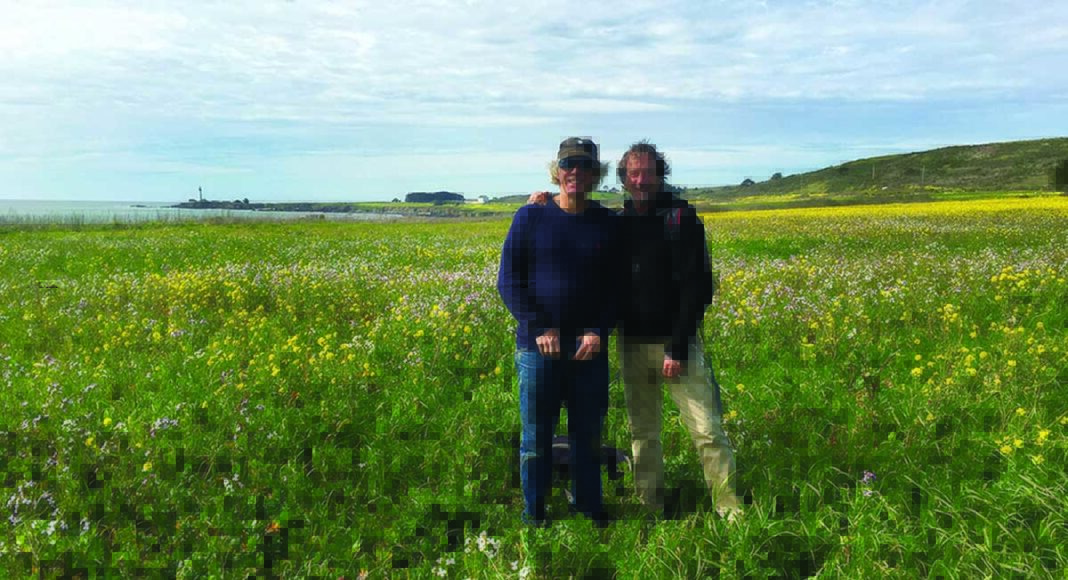
Stand on any bluff from Santa Cruz to Año Nuevo and you can take in everything that moves, which is everything. The edge of the continent belongs to you, and you belong to it. Be warned, the uninterrupted horizon can overwhelm you as it shows the curvature of the earth, and when the sun’s rays set a placid Pacific ablaze, you don’t know whether you need a fire extinguisher or to fall to your knees in worship. Or give Mother Earth four stars—note limited parking—and dock a point for the wind.
The winds from the northwest upwell nutrient-rich seas to make Monterey Bay some of the most fecund waters in the world. Wind doesn’t recognize property lines. Nor does the ocean.
Tectonic plates crash together under your feet to make the marine terrace you stand on literally lift you higher as Mother Earth does not have time for boundaries. Turn your head to the south and the north wind can give older men a comb-over. Spring on the coast is exploding for Earth Day, and we inhale coastal sagebrush, Mother Earth’s booty call, strong, earthy, medicinal.
And yet, when you are compelled to press forward into that north wind, a different reality emerges: a stretch of trail that simply stops. A fence where the map suggests continuity. A locked gate where people have walked for ten thousand years.
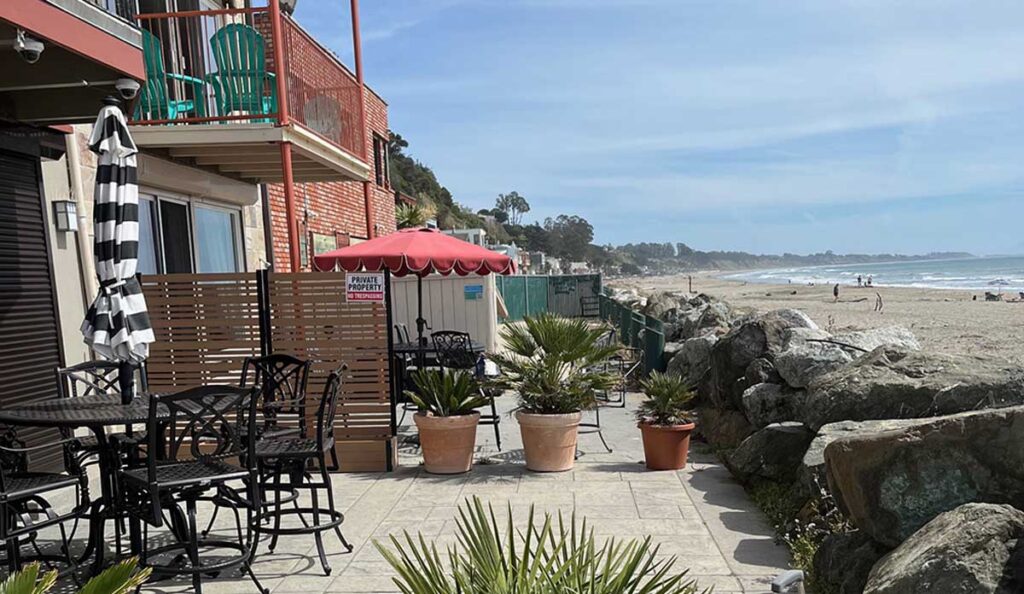
A quiet understanding that you can go this far, but no farther, a phrase that does not inspire people to calmly turn around. Before trail signs and parking lots were built, hikers, surfers, fishermen, bird watchers and lovers found the coast by instinct. We would follow faint paths through the grass, climb down cliffs, slip through gates, and go over and under fences. Landowners called it trespassing. We called it California.
A COAST YOU CAN WALK IS A COAST YOU PROTECT
Why would anyone want to walk the coast? Well, there is the financial benefit, free travel. I can start hiking and when I stop, I’m someplace else. Lodging, I’m free to pass out anywhere.
I’m in a hiking group that sarcastically calls itself The Pillars, unmoored rebels without a compass, who have walked in five-mile increments over beaches, igneous rock, and scaled cliffs from Santa Cruz to San Francisco, twice. Over the last 15 years, we have protected each other from stoned-stumbling-sideways over ledges, collected a mountain of garbage, placated furious landowners; we’ve crossed sections of path that had fallen away from erosion by pulling each other over the abyss and twice shared the sore-footed triumph of staggering across the Golden Gate Bridge.
And now, our leader, El Jefe Sleepy John Sandidge, has called upon the Pillars to do it again. With an 87-year-old face that is cracked like an improperly fired pottery bowl made in an art class for chimpanzees, Sleepy John announces that the Pillars will begin walking for a third time as close as we can to the ocean, to incrementally day-hike from Santa Cruz to San Francisco.
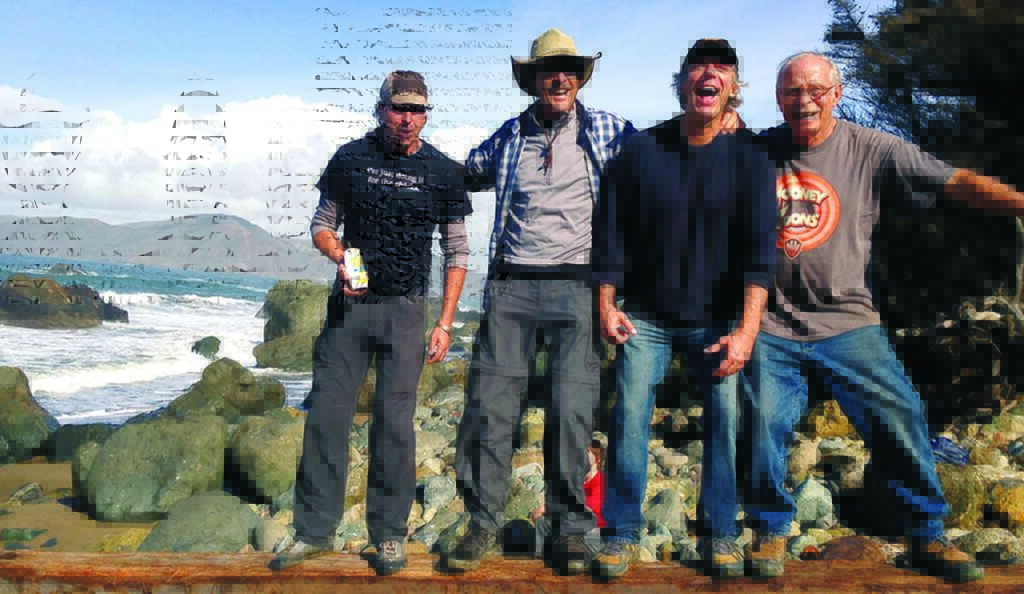
With the years, the meniscus ligaments around our knees have ripened, as has our memory, so just what makes these chronologically endowed hippies think they can do it again? One answer is my favorite Stephen Wright joke, “Anywhere is within walking distance if you have the time.” I think we can do it because we have an unfading faith that hiking will keep us forever young. That certainly is not happening, but we have faith. Our balance sucks and that’s where faith comes in handy.
I pose the question to the Pillars, “Why would anyone in their right mind do this?”
Sleepy John says he wants to hike to the Golden Gate Bridge for a third time to see if he still can.
Ben Rice can speak loudly while grinning from ear to ear. “Bullshit! I come on these hikes because I need to keep you hoodlums out of the slammer.”
We begin in May and I plan to post Take a Hike stories of natural majesty on the CCT, along with our trudges on Highway One, where the trail has gaps. We walk to transcend structure, be it laws or time or our physical decline. We just walk.
How is such a trail even possible? By the tireless work of organizations like Coastwalk California, California Coastal Trail Association, California Coastal Commission, the California State Coastal Conservancy, the Wildlands Conservancy, and many others. The cliffs north of Santa Cruz look wild today, but the wildness is not an accident. It is the result of half a century of arguments, negotiations, and improbable alliances that slowly pushed development back 1,000 yards from the edge. It started in 1972 with the citizens of California and their stubborn Proposition 20 law, when the voters decided: the edge of the continent belongs to everyone.
SURFRIDER CALIFORNIA – JENNIFER SAVAGE
Jennifer Savage is the California Policy Associate Director for the Surfrider Foundation, where she leads statewide efforts to protect ocean water quality, expand beach access, and advance coastal climate policy. Jennifer is a surfer, engaged with all things Coastal Act. She helps turn California’s love of the ocean into rules that protect it (santacruz.surfrider.org).
“A lot of people don’t know that the coast belongs to everybody. Anywhere where there’s wet sand, that belongs to the public, right? From the high tide line to the ocean, that is all public. So, any time somebody tells you, ‘You can’t go to the beach’, they are very likely wrong and giving you bad information and trying to privatize the coast, which you can’t do in California.”
It’s not like this elsewhere. Comedian/journalist DNA says, “I grew up going to the Jersey Shore. Depending on where you end up, Wildwood down south or Long Beach (the notorious LBI) or wherever, from the sand to the water was owned by different entities, you would have to pay to enter. And you’d wear a pin, a beach badge, to show you paid for “Jones Beach”. You were to stay in your area. You couldn’t walk across the middle of the beach. Some beaches, like Atlantic City had free beaches, but the better beaches were pay-to-play. California blew my mind.”
Jennifer Savage says Surfriders is also engaged with the California Coastal Commission to deal with sea level rise, to preserve our beaches as far into the future as possible, because if there are no beaches left to go to, which is the path we’re on, there won’t be any beach to access for anybody.
“There are a lot of cities and counties that are trying to create loopholes in the Coastal Act laws for more coastal armoring (building seawalls that protect houses and kill beaches). We’re really pushing back against that. The main access battle right now really is making sure that we have beaches to go to. Surfrider is working up and down the state of California to stop new sea walls, but also to restore areas using what’s called nature-based solutions; a lot of dune restoration, as opposed to armoring. We do field restoration, removing invasive species, planting native species so that the dunes can really take hold and become reestablished.”
Waves crashing into rocks are a violent fray. The violence is so real it gives us sand, even junk food slurping tourists know that a beach is the ultimate destination because of sand, the galaxies of remains of the eternal battlefield of water throwing itself against rock.
California promises coastal access, but the land in between belongs to someone. The California Coastal Trail isn’t being built mile by mile. It’s being negotiated parcel by parcel, lawsuit by lawsuit.
CALIFORNIA COASTAL COMMISSION – LINDA LOCKLIN
Linda Locklin is the California Coastal Commission Coastal Access Manager. A lot of trails exist on paper; Linda helps make them exist on the ground. She works with private landowners, local governments, and state agencies to protect, negotiate and expand public access to the shoreline.
She negotiates opening access easements across private property and holds developers’ feet to the fire to deliver promised public access. And when there are locked gates or blocked trails, I hear she can play hardball. She’s the real deal; she’s a hiker.
“I started my career with the Coastal Commission in 1977,” she says. “In 1990, I took over management of the public access program. So, I’ve been managing this program statewide since then. A long time.” The program she manages includes the California Coastal Trail, but her work is about whether the public can physically reach the coast it legally owns. “I have a passion for the coast,” she says. “And a passion for making sure that everybody has the ability to get to and use the coast.”
The CCT is stitched together in pieces. “About 70% of the Coastal Trail is completed,” Locklin says. “We have about 30% to go.”
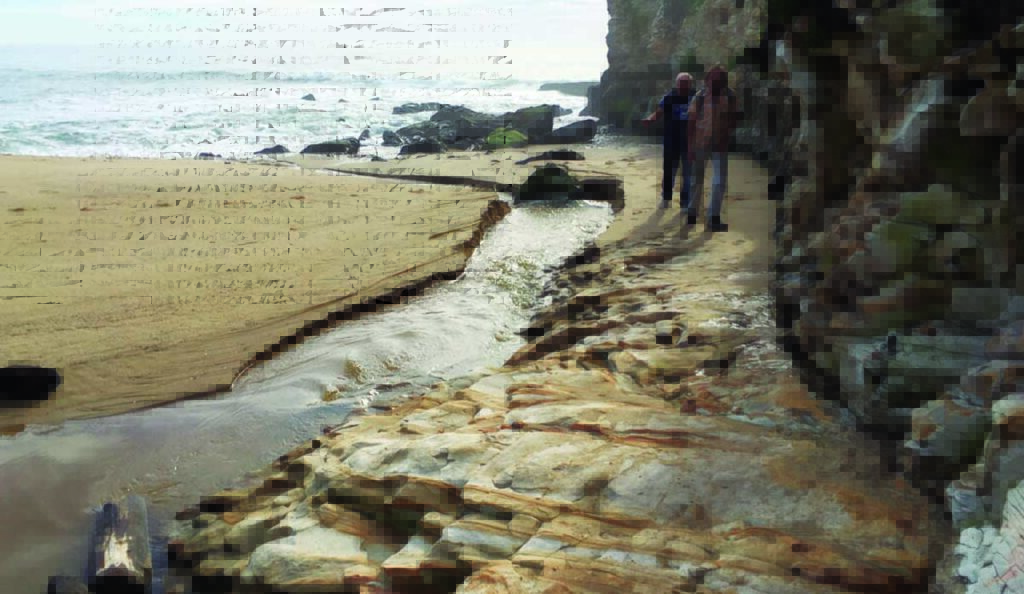
That 30% is what this story is about. What remains are the complicated stretches. The missing miles. The places where the trail runs into something less cooperative than open space. I ask Linda what the biggest obstacle is.
“Mostly private property. If there’s a window and if the property owner wants to sell,” Locklin says, “the state can buy it if the price is right. and that’s one way how we can secure it.”
Other times, the access comes through legal agreements, documents that establish a public right to pass through a specific corridor. “We can secure it through recording legal documents that say the public has a right to walk in this geographic area.”
Sometimes those negotiations take decades to resolve, or never. To the north of Santa Cruz, Wilder Ranch and Coast Dairies have long, uninterrupted stretches of trail on the bluffs, the ocean is always in sight. “That area is comprised of a lot of state and federal property,” Locklin says. “So, we’ve been able to get Coastal Trail segments in there. You look to the south… that’s a lot of private land,” she says. “It’s much more difficult to get trail segments in there.”
Sometimes the Coastal Trail runs right along the edge within “the sight and the sound and the smell of the coast,” as Locklin puts it. “Then there are places where it’s a sheer drop on an eroding cliff,” she says. “It’s just not feasible to put a trail there.” The trail moves inland there, sometimes a lot. “You may end up with a continuous trail,” she says, “but it may be high above the coast… or inland of the coastal highway. But things can change. There might be a landslide… and suddenly there’s a new opportunity.”
The Coastal Trail is not managed by one agency or patrolled by a unified system. It passes through a patchwork of jurisdictions: state parks, county parks, transportation corridors, land trusts, each with its own rules and responsibilities. “You could be in a state park for 10 miles,” Locklin says. “Then a county park. Then Caltrans property. Then open space land. There are times when the public is rerouted,” she says. “Or can’t come through at all. You need to make sure that people aren’t causing harm.”
SAVE OUR SHORES – DAN HAIFLEY
Dan Haifley is much more than an environmentalist; he was a public access advocate at a time when that idea was still being fought out along the coast. Although he is technically retired from his longtime executive roles, Haifley writes commentary about ocean and coastal policy, serves on the Monterey Bay National Marine Sanctuary Foundation board and is deeply immersed in the current fight against Trump’s latest push for offshore drilling. Haifley says that the idea behind Proposition 20, approved by California voters in 1972, was to enshrine public access for the California coast, so that all people, regardless of income, would be able to access the coast affordably or for free. “Ultimately, we wound up with the California Coastal Commission. One of the things this initiative did was to put in writing the idea of a California Coastal Trail, a network of trails and access points.”
Haifley says you can enter a negotiation with the property owner to create an access point.
“If somebody wants to build a hotel on the coast, say in Half Moon Bay, and they’re dealing with the Coastal Commission to get permitted, one issue regarding the development of this hotel would be public access for those not using the hotel.
“They would be able to get to a trailhead in their car without having to go to the hotel. The land could belong to the hotel owner, but it would be permitted for public use as a permanent easement for public use.”
Haifley says it’s good for the proposed hotel, it’s good for the public, and it provides public access, whereas before you may have just had private land that nobody really had a way to utilize in terms of getting to the coast.
“People do get emotional because they’ve worked hard and invested a lot of resources, but it’s possible to have private property hold and enhance its value, while at the same time providing public access, even on your own property. You can certainly have both.”
TAKING THE NEXT STEP
I’d like to thank Jennifer Savage, Linda Locklin, Dan Haifley, and the thousands of dedicated Californians who work hard to braid this invisible trail-in-progress together, so me and my fellow Pillars can stumble forward, to babble with brooks, to smell the sun, to pick up garbage.
You’ve probably already been on the CCT; West Cliff Drive in Santa Cruz is part of it. Things are changing so fast, who knows what may happen to our hikes? Androids marching behind us to carry our backpacks and light our joints? Electronic-assisted footwear using sensor-driven systems with calf-mounted motors to power us up hills?
Will the Pillars be able to walk to San Francisco again? What hangs in the balance for us is our balance. What hangs in the balance for free access to the coast is our will to protect it.
This time, the Pillars will be aided by super scoutmaster Sven Davis; while a hiking minimalist, he carries duct tape, rope, and a crosscut saw in his backpack (he made crutches deep in the Big Sur wilderness when Laurence wasted his ankle.) Plus, we will have the gris-gris voodoo knowledge of Grammy Award-winning zydeco record producer John Leopold, who reportedly can read signs of birds flying wrong.
I can’t tell you why you should hike the California Coastal Trail, but I can tell you why I do. I get a sense of the colossal size of the world. I get to find out how far my patience, fortitude and energy can go. I get to go home.
coastal.ca.gov/coastalvoices/coastaltrail.html Or a hard copy of the California Coastal Access Guidebook.









I love this idea, I’d love to know more about the Pillars. For example, how does one join the walk?
Hey Raven,
For more about the Pillars, we just posted “Don’t Turn Your Back On the Ocean” on our online Take a Hike column. Pillars are in that piece: [Link deleted]
Richard
I would love it if you’d send me a link to the Take a hike Column searched and searched couldn’t find anything.
Weirdly, I didn’t get anything via email. I came back here and saw that you had replied.