

It was only our second day in Japan, just the second day of our three-month family adventure in Asia late last year, and we were trying to find our way to a subway stop in the Asakusa neighborhood of Tokyo. My wife Sarah hurried on ahead, happy to guess at a route, but our daughters Coco and Anaïs —11 and 9 —waited with me as I asked a nice-looking Japanese woman in her forties to point us in the right direction. Her English was not good, but her heart was.
The woman and I exchanged words, she understood me enough to get that we were looking for the nearest subway stop, and she smiled and pointed and smiled some more and spoke in Japanese. I thought that was all, and thanked her, and started walking away. But with Coco and Anaïs and me in the middle of a wide crosswalk, the nice Japanese woman came running after me and gestured and smiled and urgently tried to convey something to me that I, alas, could not understand. Once again, we parted ways. That had to be the end of it.
Then, half a block later, I heard the sound of a bicycle bearing down hard on me from behind. More out of curiosity than alarm, I turned to take a look and saw this very same nice Japanese woman bearing down on us on her bicycle, briefly bringing to mind scenes from The Wizard of Oz. But she was not there to menace us. She was there to smile and try to help. She had thought about it, after I’d left, and decided she wanted to try one more time to help us on our way. She and Sarah stood together talking for several minutes, all of it mostly pointless, except that the woman was giving of herself in a way that felt wondrous and beautiful and inspiring. We were all smiling, broad smiles.
This was the pattern that repeated itself. People were not just nice; they went far out of their way to help us. My wife Sarah and I did not have a single sweeping reason to take this trip, pulling our daughters out of Live Oak Elementary, enrolling them instead at Ocean Alternative, so that we as a family could take a three-month trip through Japan, South Korea, Thailand, Laos and Cambodia.
It was partly about fun, about joy in living, about staying alive to the moment, but Sarah and I also knew that for both of us, travel has been an indispensable ingredient of life, sometimes a catalyst, sometimes a portal, sometimes just a change of pace. We wanted to keep doing what we ourselves loved, and we wanted our daughters to see in travel the same beautiful sense of possibility that we felt.
We were on a mission to eat as much street food as we could, and we did, and also tried things we never even knew people ate—like bee larvae. Overall, this was budget travel, less expensive living than if we stayed home in Santa Cruz, but we did have the occasional splurge meal.
One evening we had dinner at a restaurant called Friendly in the beautiful mountain city of Nikko, Japan, and asked the proprietor when the next bus was going back to our onsen (hot springs) hotel higher up in the mountains. We thanked him and left and walked outside and stood on the wrong side of the street, forgetting that in Japan forward traffic takes the left lane.
The proprietor of Friendly came rushing out the door to smile and tell us we needed to catch a bus on the other side of the street or we’d go the wrong way. Once we were in place at the correct bus stop, he refused to go inside, standing there keeping a gentle, protective eye on us. Only when Sarah and the girls and I had boarded and our bus surged past him, all of us exchanging waves and smiles, did this man head back inside to his restaurant and customers.
Six months later, I look back on moments like those from Japan and the other countries we visited on the trip and am a little shocked at how emotionally vivid they remain for me, as if the experiences had such a quality of being singular and unforgettable that I was freer at the time to live them fully and freer now to pull back the memories and have them envelop me.
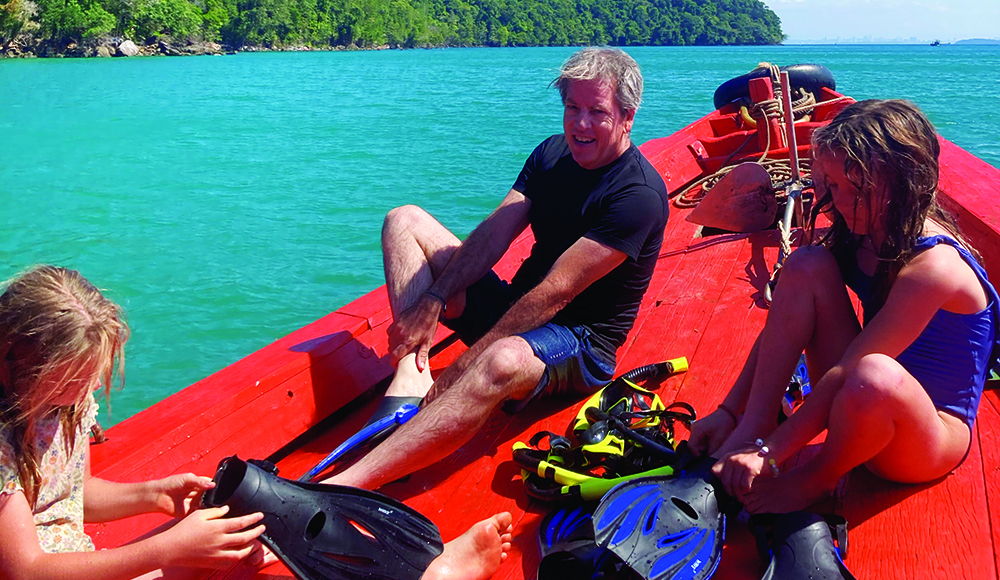
We took our days as they came, giving ourselves room to be spontaneous, and soaked up some of my favorite family time ever, but we also hoped that when the trip came to an end and we were back home, the girls might find themselves fortified by skills and perspectives they did not have when we left.
Our message to our two daughters really boiled down to one imperative: Go live. Go out into the world and explore. Go places where you meet people who open themselves up to you, gentle of heart, gentle of smile, and leave you with a more joyous sense of humanity. We were rewarded a thousandfold.
We bought one-way tickets from SFO to Tokyo Narita and figured we’d wing it from there. If we wanted more time in Tokyo in early October, we’d take more time in Tokyo. If we wanted to take a bullet train and check out a hot-spring place in the mountains, where monkeys came up to the windows in back to stare at us, then we’d do that. If we found food we liked and wanted to eat it again and again, like the black pork on Jeju Island in South Korea, then that was what we would do. This open-ended spirit of the trip helped infuse individual days with a similar extra feeling of flexibility and possibility in the moment. This feeling stayed with us even after we were back home in California. Every day still felt a little more singular, a little more special, a little more memorable.
I would urge all of you out there, parent or not, to consider trying to shake off a certain lethargy or maybe it’s exhaustion that seems to plague just about all of us in these strange years, grappling with a world hurtling in unpredictable directions, and just go for it in some way. Create memorable, singular experiences, whether it’s a drive down the coast to Big Sur, maybe a meal up the slope at Nepenthe, or a spontaneous trip to L.A. or Portland, or maybe a ride in a train across British Columbia.
It’s a great way to wake up from the half-sleep that tries to claim all of us from feeling fully alive. It’s a great way to check yourself. Sometimes, late at night, when I’m out on I-5 after meetings in LA, trying to drive home, I slap myself in the face, hard, to wake up. Maybe we all need more slaps in the face to wake ourselves up. I’m here to report the reset, which can be achieved through bold experiences of travel, including with kids, matters more than ever in helping overcome the mind-rot of our times.
For three months, from the day the four of us lugged our new backpacks onto a flight to Tokyo, until the girls and I flew home from Ho Chi Minh City, every single day had a quality of fresh discovery, like taking a picture with a Polaroid camera and watching, in slow motion, as it develops in front of your eyes. There were times when we fell into a kind of routine, as if this was our new life, from the weeks in northern Laos volunteering in a day-care center for low-income young Laotian children to our blissful interlude on a small Cambodian island with a very chill beach vibe going on, but even then, our recall was vivid and sharp because so much was happening all the time.
I understand that in our typical day-to-day lives, here in Santa Cruz or wherever, it’s natural to fall into a routine of having limited room for flexibility or spontaneity. Even when people socialize, it seems a loud ticking clock is always metaphorically present. It’s hard simply to insist on pushing down into the moment in a way that brings freedom, freedom to keep a moment going, freedom to change it up.
Many of my favorite moments on the Asia trip with my family had in common the element of unexpected detours. One afternoon in Luang Prabang in northern Laos, we rented bicycles and rode north of town, following the Mekong River, and at about the same time, we all decided we were thirsty. Sarah, riding first, decided that a house up ahead deserved to be explored. So we stopped and went inside and it turned out to be a restaurant, a wonderful restaurant, with very nice people, where we later took a family cooking course. The feeling of peace and calm inside the place was striking.
This was something I used to do often in my earlier years as a traveling reporter. I’d visit a new city or town and walk around to explore and just trust my instincts and try a place out. Now the temptation to read Yelp reviews first is always strong.
We did have our hectic moments on the trip. On the day we were leaving South Korea, bound for Bangkok, Sarah and I had agreed we would leave early for the airport, giving ourselves almost three hours. We rode the subway, and as we got closer to the airport, I had a sinking feeling that something wasn’t right. We left the subway station at Gimpo and slogged along toward the International Departures terminal, but when I consulted a departures screen, I couldn’t see our flight listed.
I was wearing a backpack and carrying three smaller bags. The more I walked, the hotter I got. My glasses started slipping down my nose, and my growing exasperation only heightened the effect. Everything seemed off. Finally, I asked someone for guidance.
“Wrong airport!” we were told.
There was another airport in Seoul?
“To the taxis!” I said. “We’ll make it.”
It seemed impossible, but we all knew only a positive attitude would pull us through. The good news was we were loaded up in a taxi in no time and on our way to the other airport, and this driver, unlike on our earlier ride to Jeju International Airport, was your standard-issue pedal-to-the-metal cabby. The bad news was that his taxi stank. We all opened our windows while we could, but then on the highway, our driver closed them and we couldn’t say anything. Coco, blessed or cursed with an astonishingly acute sense of smell, hid under her jacket and tried not to breathe. She said it smelled like “cigars and some kind of alcohol, like whisky.” Anaïs said it smelled like “two-hundred-year-old rum.” From my spot up front, I kept looking at my window, wishing I could open it up.
“When I got out, it was so nice!” Anaïs said later.
We made it to the airport just over an hour before departure and checked in. Then, as the attendant handed over our tickets, she handed me a card that said it would take us “50” minutes to get through security and take a shuttle across the airport and that our gate would close at 11am sharp. In other words: We had to run. We had to haul ass.
Sarah sprinted ahead, Coco trailing behind her, and I was left as the trailer, there to encourage Anaïs. “I can’t do it,” she would say, but kept on keeping on, never flagging. I shuffled along in the kind of graceless loping run one expects of a 63-year-old man wearing a backpack and carrying another 20 or 30 pounds in three different tote bags. I was sweating up a storm like some latter-day Neal Cassady, crying out “Yass!” and grinning at the sheer wild energetic rush of it all. It still seemed, at that point, about a 50-50 chance we’d make it.
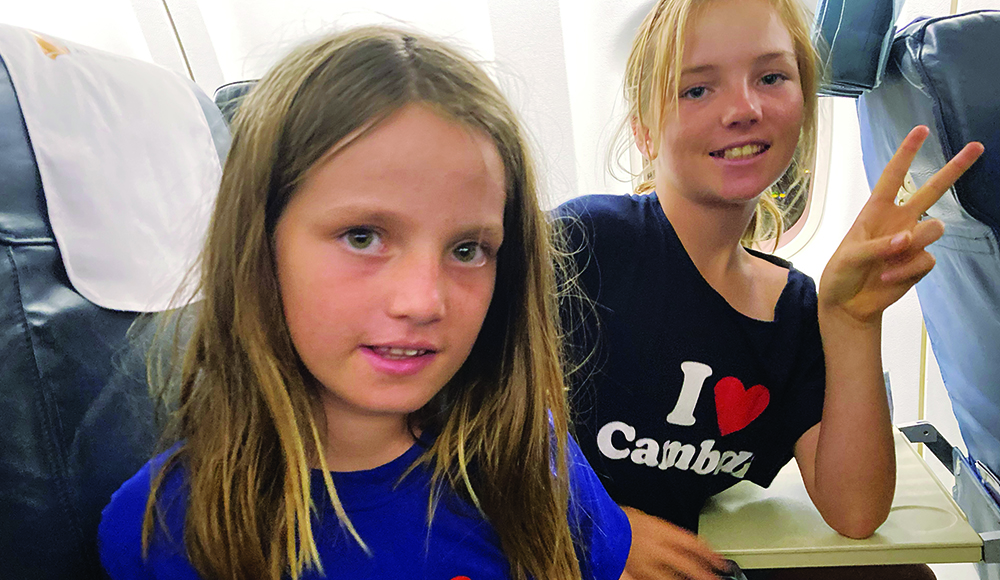
We somehow got to our gate with fifteen minutes to spare. I had time to go splash water on my face a few times, patting dry with a small forest of paper towels, then repeating the whole operation two more times, to restore myself enough that I would not necessarily flag any airport protocols about being on the lookout for wild-eyed, heavily sweating individuals clearly up to no good and stashing them away somewhere in a small windowless room. We all sunk into our seats on the plane once we boarded, blood pumping, eyes wild, on our way somewhere new, never wanting the trip to end.








Fantastic piece, and the spirit of “It’s a wide world—get out and take a look” is contagious. I’ve had the luck to house-sit in various places in the world (not enough places yet though), where when you stay for a month or two at a time, you get a different feeling from that of being a tourist. Hope to do it again.
Thanks for the renewed inspiration!
Steve, this is a wonderful piece. I spent years running a company that brought thousands of international students to the United States, and I’ve always encouraged American students to study abroad. You took it a step further by sharing that experience with your children—something I deeply admire.
I’ve been fortunate to live, work, and travel in many countries, but most of that came after my children were grown and off to college. Reading your story made me wish I had started earlier and included them in those experiences.
In a way, I’m finally doing that now—my daughter and I are heading to Italy in two weeks. Better late than never, and your story makes me appreciate this trip even more.