
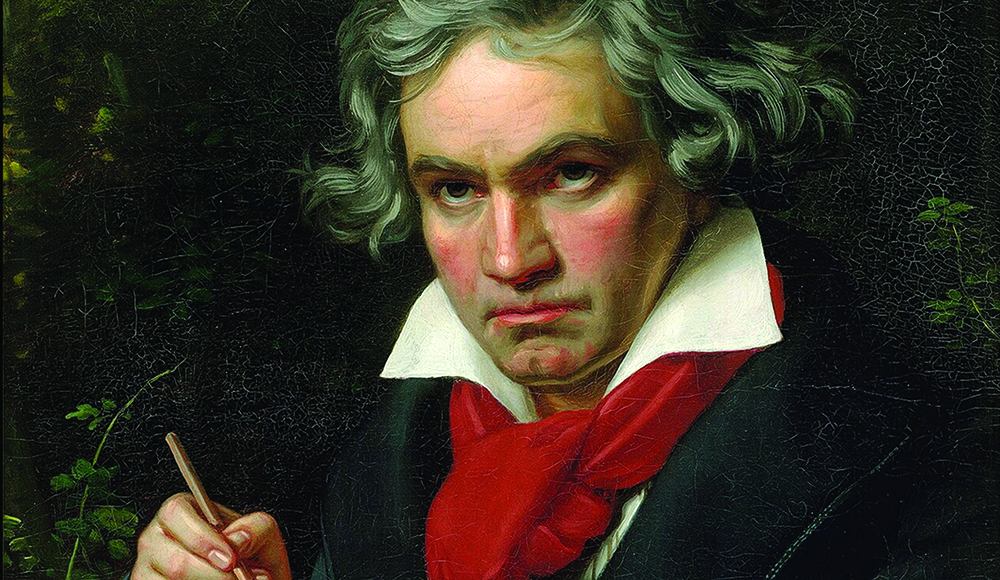
Firmly committed to the idea of adventurous programming, the Santa Cruz Symphony is about to unleash its final classical concert of the season on May 2 and May 3. Avoiding the predictable, the powerful program offers a premiereby ethnomusicology techie Jaro Lanier and the mighty Symphony No.9 by Ludwig van Beethoven. The concert begins with a charmer by Antonín Dvořák, Carnival Overture, Op. 92, guaranteed to set an exuberant tone. Beethoven’s Ninth has been, since its debut in 1824, one of the all-time influential masterworks of Western music. With maestro Daniel Stewart on the podium, the performance will showcase the full throttle skill of the orchestra, joined by a quartet of exciting guest soloists in collaboration with the Cabrillo Symphonic Chorus.
One of Beethoven’s big surprises, back in 1824, was his addition of voices for the fourth and final movement. Daring, yes. Successful? Absolutely. A huge chorus, plus a quartet of soloists, bring the symphony to a thundering conclusion. Featured in the final movement are Soprano Dani Zhang, an award-winning artist from the New England Conservatory; Mezzo-soprano Ginger Costa-Jackson from the Metropolitan Opera’s Young Artist Development Program; Tenor Joshua Stewart, formerly with Munich’s Bavarian State Opera Studio and a Symphony favorite; and Baritone Edward Tavalin, an emerging Bay Area artist who has also performed with the Opera Project.
Easily one of the most demanding and exciting pieces of music ever composed, Beethoven’s Ninth rewards the mind as well as the senses. Why perform it now? After all, it was composed 200 years ago. Well, most Western orchestral music can be seen as a response to Beethoven, in much the way that most modern painting lives in the shadow of Picasso.
It challenges orchestras and conductors alike. Emotional depth, complex instrumentation, and best of all, the 9th acts as a musical embrace intended to include nothing less than all of humanity. The symphony oozes innovation, the repetition of musical phrases with varying instruments and time signatures, and intertwining themes requiring incredible variations.
There’s just no way to wrap your head around the onslaught of sounds, the array of sonic power. No one ever leaves this piece of music unchanged. It is simply too much to comprehend in words. That’s why music is the queen of the arts.
Perhaps the most important reason to be transported by Beethoven’s ultimate creation is its original inspiration, a hymn in praise of humanity and compassion. The time is right to be reminded of our collective bonds of connection. An Ode to Joy in troubled times couldn’t be more relevant.
Before the Beethoven, Maestro Stewart opens with a delightful Carnival Overture by Antonín Dvořák, followed by something in the key of unusual, a composition for the Laotian khaen pipe, composed by tech pioneer Jaron Lanier and arranged for orchestra by Daniel Stewart. The music created for this traditional multi-piped instrument was premiered at the WRO 2000 Media Art Biennale in Warsaw and spotlights Lanier’s eclectic blend of technology, immersive virtual environments, and atypical instruments. The piece was intended to interact with virtual reality, a field of which Lanier is considered a pioneer. What’s new in this concert is the arrangement of Khachaturian’s Concerto for orchestra, by Daniel Stewart.
An international and very colorful figure in the tech world, Lanier has been active as a composer and performer of new classical music for almost 50 years. A Santa Cruz resident since the pandemic, Lanier keeps winning acclaim as a musical collaborator and as a computer scientist and futurist.
For more insight, come an hour before each concert for comments about the compositions from Dr. Don Adkins and Kiefer Taylor. Free open rehearsal is set at the Civic Auditorium on Thursday, April 30, at 7:30pm.
Tickets are moving swiftly. Cross your fingers and purchase tickets online at santacruztickets.com