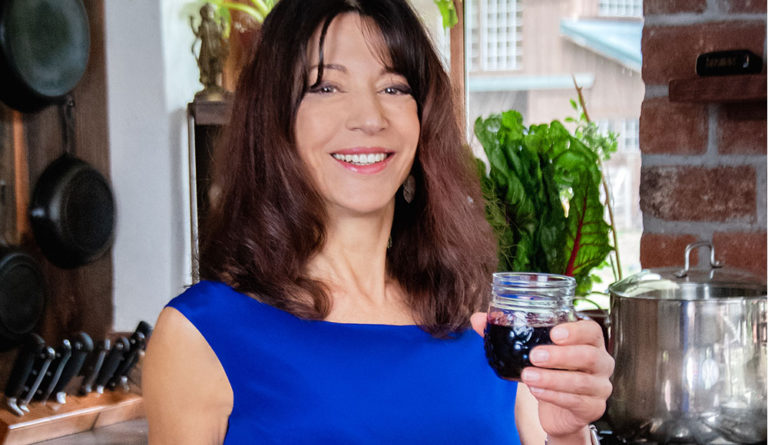
There was an oft-repeated phrase by the grandmother of author Elizabeth Borelli, whose release party for her new Mediterranean plant-based cookbook and guidebook to the gut, Tastes Like La Dolce Vita, will be Saturday, Dec 14 at the Museum of Art&History.
“Rushing makes me go backward.”
In the book she tries to channel her Italian side, awakened by a 2023 trip to Tuscany that had her reexamining her American habits around cooking and eating, specifically the speed at which she did both. But this wisdom was not from her nonna.
”That’s my Grandmother McCarthy,” Borelli laughs. Perhaps partly at the memory of the character who said it, and also at my assumption she was from the Boot.
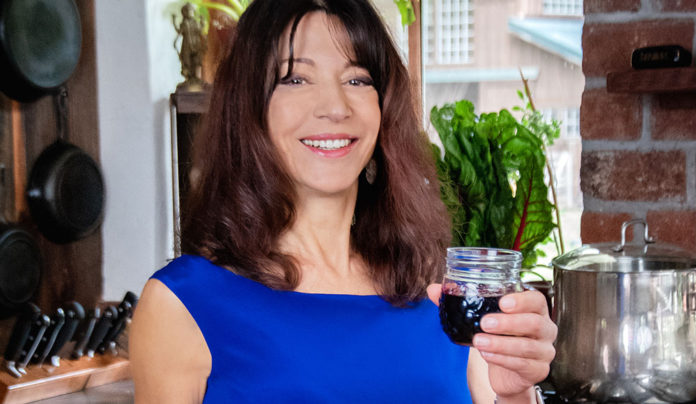
Borelli has invited me to her home to talk, to cook and eat together at the same deliberate pace as Italians. But when I arrive, an airy space brimming with natural light not far from the Aptos Montessori campus, much of the prep is underway or complete. I plant myself against a pillar rising to the ceiling from her countertop, a half-circle rounding towards the high-ceilinged living room, as she makes recipes from her 6-Step Mediterranean Makeover workshop and from her archives.
Chefs are by and large territorial—I know because I am one—but at no point does she make me feel in the way, or oppress me with a frantic energy, the way some chefs repel you from their roost. The only remotely bad vibration comes when one of her electric burners decides to take a nap in the middle of a sautée.
She moves about her kitchen with assurance, pausing to sing praises of various snacks and hacks she keeps on hand to elevate her dishes: a vegan jerky pulsed in the Vitamix into bacon bit-size; sun-dried tomatoes softening in Extra Virgin Olive Oil for a “savory dimension;” a jar of cashews that have been soaking in water overnight, ready to puree into angelic, dairy-less cream.
She gestures for me to put my hand out and pours into it spruced-up pumpkin seeds.
”They’re so good and so easy to make,” she says. “Just a little bit of Braggs amino acids, baked in the pie plate, then I sprinkle some herbs.”
Today she used Trader Joe’s Salmon Rub, “for that barbecue-y flavor,” but she also favors their Everything But The Bagel Spice.
Consume enough of her new book and you’ll hear a non-judgmental authorial voice, someone who, yes, had a transformative epicurean experience in the Tuscan countryside, but isn’t trying to make the reader recreate that in their home using life savings to do so, importing the finest sourced olive oil or preserved tomatoes grown in guaranteed Italian soil. She is realistic about the web of “childhood influence, environment, and convenience” we all face when trying to change our behavior around food, and is purely out to raise our awareness about the Mediterranean capacity for mindful eating.
Choose to do that in the most economical way you see fit.
After all, she plunked down money for an espresso machine back in the States after falling in love with the one in her rental villa. Even Italian gas stations have one. And what was its eventual fate?
She cracks up.
“Now I don’t even know where it is.”
Organic Aspirations
Borelli doesn’t write like an insufferable foodie. She’s not on a purity trip. Organic is aspirational to her. Finding the freshest ingredients is a goal, not an edict.
The book is part travelogue, part-time travelogue and family heritage study, part plant-based interpretation of Italian cuisine, part Mediterranean diet direction, all told in her joyful teacher voice that evangelizes for ethical hedonism, realistic that humans are “hardwired to choose pleasure and avoid discomfort.” She writes with forgiveness for you wandering from the path before you even get on it. Her exclamation points, used liberally, feel like affirmation.
Dialoguing with her is like being teammates in Charades and she’s so excited that you’re about to give the correct answer but she has to allow you to get there on your own. When I synthesize several of her findings in her book, she leads me gently.
”So, slow chewing releases more serotonin, so more pleasure…”
“Mmhmm…”
“And having a glass of wine with friends means more time for digestion because it’s more conversational and there’s less likelihood for overeating because it’s spaced out…”
”Mmhmmmm…”
She’s letting you know she’s actively listening, but she’s also excited about your epiphanies. The way she nods is similar, as if to say, “You’re getting it…”
She wants you to talk to your body the same way. Listen without condescension, don’t assume you know what it needs.
That same warm, encouraging tone is all over the page. Some readers may already be familiar with it from her regular health and fitness column in the Good Times, where she draws on her background as a certified plant-based nutrition expert and yoga teacher.
She writes: “Even when you know there’s a habit you should change, it doesn’t mean making that shift is easy.”
Isn’t that a refreshing contrast to all the thought leaders framing their onerous lifehacks as simple? Just wake at 4am if you want to increase your productivity. Just buy a chest freezer and convert it into an Artic dunk tank if you want to burn fat.
They condescend to their viewers, who condescend to their bodies.
She warns in the book that, “like any ecosystem, the biome in your belly will always seek regularity, or your personal version of normal,” so removing something with no nutritional value, even with the best of intentions, is a bit like telling your body “I know best.” It will rebel.
“You’ll obsess, you’ll crave and you’ll feel like nothing else will satisfy you until you give in,” she writes.
Even in our bodies, Nature abhors a vacuum.
“Your gut acclimates to whatever your norm is,” she says, ambiently stirring the contents of several pans. “Your digestive system is looking for homeostasis, no matter how unhealthy. So if you’re used to eating a ton of sugar, it not only is emotional, with dopamine gratification, your gut is going to crave that short-term high that ends up being a long-term low.”
She illustrates with vegan doctor Dr. Joel Furman’s efforts to change patients’ habits. If he told someone they had to give up the pack of cigarettes they smoke per day, they might retort in a childlike manner, “‘Well then, what are you going to give me?’”
Borelli advocates “listening to your inner signals of hunger, satisfaction, fullness, cravings, fulfillment, and pleasure.”
There is no mileage in self-recrimination, but neither is there in invalidation. Think of your gut as your inner child. Retorting “You’re not actually hungry right now” is dismissive parenting.
Sorry, We’re Closed
Borelli is mother to two girls, Talia and Hayden, who accompanied her to Tavernelle, where the travelogue portion of her book is set. The three experienced wide-eyed the ways Italy does things radically different: no eggs or protein to start the day, just a pastry; portions half the size of our own; and between 1-3pm, restaurants close so the staff can go home and eat.
By contrast, Borelli writes, “Lunch in the US is a drive-by, something we squeeze into our day to prevent hangry behavior and avoid passing out.”
In California, employees working more than six hours are entitled to one 30-minute unpaid lunch, and two 10-minute rest breaks, tops.
In Italy, it’s an event. Wine. Friends. Family. Borelli recounts a lunch she and her girls were treated to when they took a gelato-making class on a lark after tasting the restaurant’s ravioli “dotted with savory basil gelato,” a delectable temperature contrast, then spotting a flyer advertising the tutorial. This kismet moment is a crucial catalyst in the book that encourages Borelli to cast off her overscheduling shackles and embrace improvisation.
Many Americans think of food the way they think of retirement: something to look forward to at the end of all their toil. They are not wired to take care of themselves, they work jobs that likely forbid it, and “they think they’re not going to live as long as they are.”
This is why it’s essential we develop healthy eating habits now and make what adjustments we can while we still can.
The Land of Good & Plenty
Borelli shows just as much curiosity about me as I for her. We bond over parallels. We both have Mediterranean blood from our patriarchs, she Italian, myself, Croatian. Both households were guided by silence: a stroke stole her nonna’s voice, and my dido’s (Croatian for grandfather) voice box was removed to halt his throat cancer. I think fondly of his waist-high arugula growing like Jurassic ferns when she writes about her “sweet, close-knit comunita” in Westerly, Rhodes Island eating what they “grew, canned and stored.”
Her parents kept up that same tradition and pace in southeast Connecticut, dutifully gardening in conducive months and preserving at summer’s close, but she and her sisters felt “deprived,” feeling the constant “allure of American habits.” They wanted the junk food and TV dinners their peers had.
Older generations had their own unhealthy habits to master. As much as she loves her “loud, opinionated, wonderful” aunts who “own the space they occupy” in opposition to how as an American girl Borelli was encultured to “be smaller,” Scarcity exists as generational trauma so that whoever lived through it teaches their offspring who teach theirs that the plate must be cleaned.
“I don’t want any leftovers,” my nana would say.
Borelli’s Italian father taught her how to cook, but not Italian food.
”Crepe Suzette,” she says. “Sweet and Sour chicken. We lived near Johnson and Wales Culinary School, RISD, Brown; universities bring a lot of diversity in cooking. We were always going out to dinner and trying to recreate what we’d had at home.”
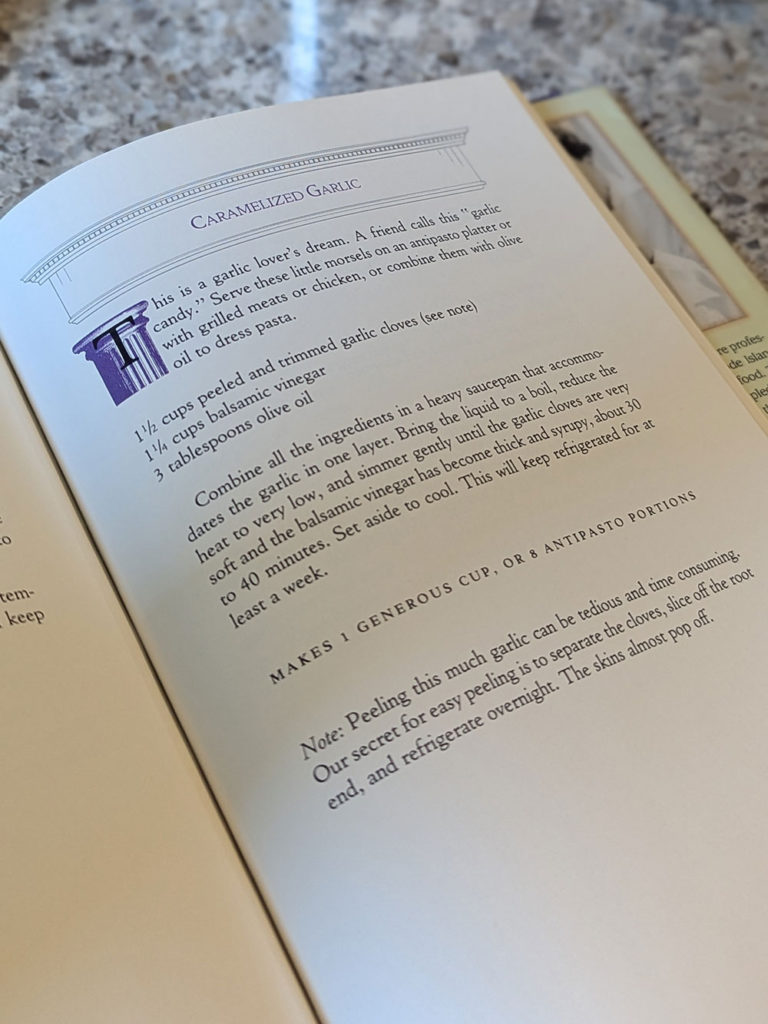
She brings out their cookbook, beaming. I mind the binding, failing from loving overuse, remarking on the signature inside, flipping serendipitously to a recipe for Carmelized Garlic, just the kind of condiment Borelli likes to stock.
The arrival of her own book could not come at a better time. Many of us are disequilibrated by the recent election, some by the results, but most everyone by the process itself. Borelli had a column about that very topic, how to soothe your limbic system on Election Day.
We talk about the sway food costs had over this election, the validity of voting for your wallet, but how that’s complicated by the American insistence on having everything we want, all the time. Produce picked underripe by international labor, trapped in slow transit, should be paid dearly for on both sides of the plate. Obliterating seasons does not make our food taste better. Globalization may have allowed for the incredible circulation of goods, but some nutritionists argue that obeying our region, and eating what it can produce when it can produce it, leads to better gut health.
In Italian small-town grocery stores, Borelli found “freshly baked bread stacked in wicker baskets,” and wedges of cheese “neatly displayed to announce its origin in a way that seemed important.” There could be no doubt of its derivation, the distance it traveled to her plate.
Think Global, Buy Local
Finding a market back home in Santa Cruz like the ones she patronized in Italy is futile. Does anyone come close?
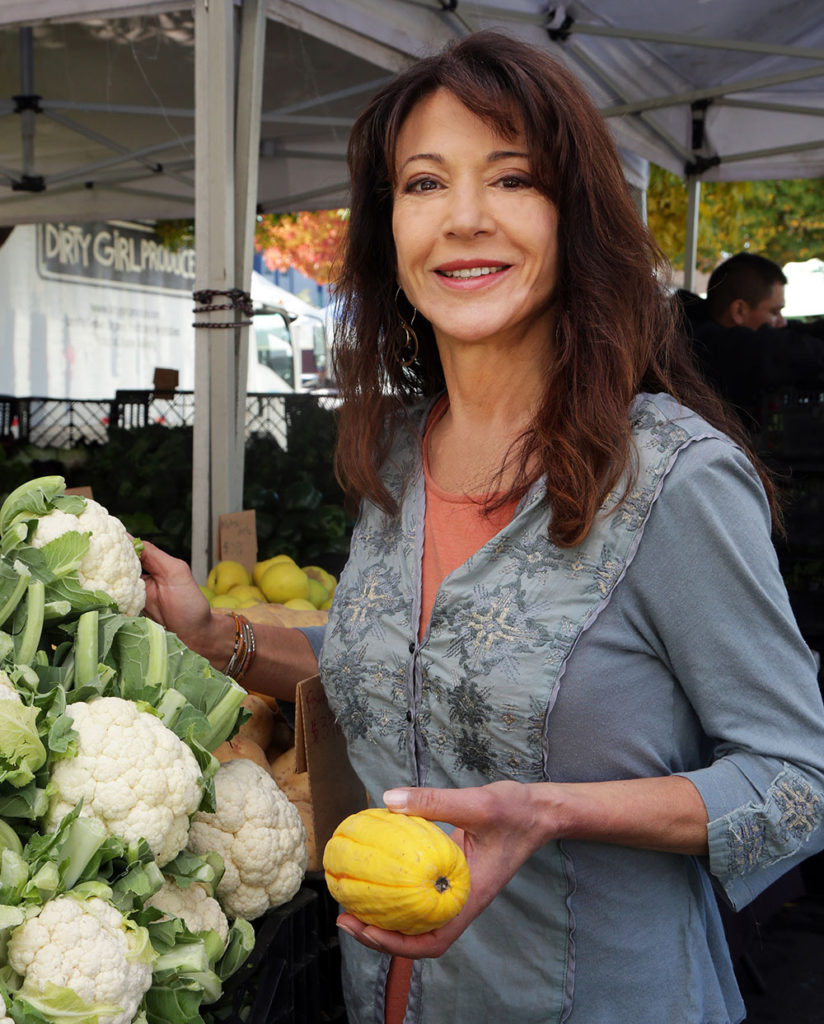
The Cabrillo Farmer’s Market, she says definitively. “I go to Cabrillo every Saturday. They have the most variety. Pinnacle is a huge grower and their produce is less expensive or the same as a grocery store. And no farmers market these days can compete with the grocery stores.”
And how about our beloved brick and mortars?
“If you’re just going to go to one place, I would say Shopper’s Corner. If you eat fish, they have a great selection and they’re not astronomically expensive. It’s really fresh. They have a huge variety of fresh produce, a lot of it’s local, and local small producers of olive oils, vinegar.”
“I really like Staff of Life for a couple of reasons. Number one is their bulk selection. Nuts. Grains. Flour. I got our beans for less than two dollars a pound. They have probably 15 or 20 different kinds. They’ll have organic peppers for really cheap because they get it from Pinnacle. I got some super nice Italian broccolini below market prices.”
She douses beautiful ivory beans in water, shaking them in a fine mesh colander.
“The fresher local beans you don’t have to rinse as much or cook as long.”
Any suggestions for anyone feeling squeezed by sticker shock?
“Batch cooking and freezing. Buy in bulk. Always shop the sales. Buy the store brand.” She gestures toward the bubbling tagine. “This whole dish [serving two people at least] cost probably five dollars.”
One to One
It’s time to eat. By chance it’s 2pm, square in the Italian window.
We carry the food to the table in handsome earthenware as she tells me one woman’s recommendation to her: “‘When I want to lose weight, I make everything as beautiful as possible. And when I do that, I don’t just eat, because the meal is so much more satisfying.”
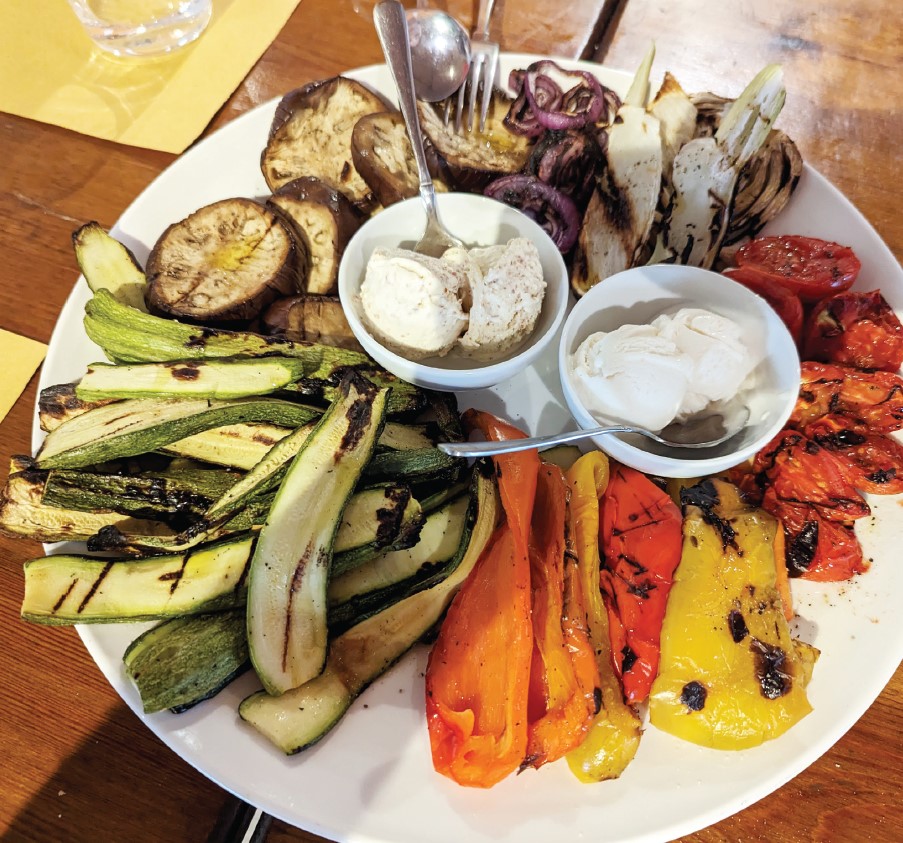
Our meal is immensely satisfying: a spicy Caesar and a trio of greens she sliced with scissors; a kind of rapid-fire cassoulet with white beans and chard that marries the vegan jerky and sun-dried tomatoes; and the tagine, tasting as luscious as it smelled.
[NOTE: The reader should prepare themselves, especially in the early sections, by reading her book on a full stomach. Borelli is not only a skilled cook but knows how to describe food in the most desirous terms.]
She pours wine and our conversation returns to addressing cravings. Borelli recommends sublimation over subtraction, using something close to a one-to-one replacement. We both laugh when we recall the carob craze of the ’90s, when people—some for allergies or sensitivities, but most for weight loss and calorie-counting reasons—thought they could swap chocolate for carob. For chocolate, there is no substitute.
”If the person has diabetes and they have to stop eating chocolate for that reason, there’s a lot of really good alternatives right now. We’re so lucky, because it used to be if you wanted to eat sugar-free or low-sugar candy, it was horrible.”
I mention the bitter high-cacao options gracing a lot of higher-end grocery stores.
“Exactly.”
There is that cheerleading again.
“If you’re going to eat your chocolate, sit down and make sure you’re getting a full experience. Then you don’t have to eat a tremendous amount to get the same feeling of satisfaction.”
I raise my wine glass and ask how one would replace its contents. If not turned back into water, what does pinot noir become?
She tells me about a travel partner trying to quit drinking when they were together in Portugal. More and more bars offer mocktails, and bartenders aren’t skimping on creativity when it comes to their creations, but this friend got a special kick out of the NA wines “because they come in a wine bottle.” Taste is one thing, but the art of substitution extends to the visual delivery.
”She will use a wine glass so she feels like she’s getting that behavior part of the experience, just not the part that doesn’t work for her.”
Much of the book is Borelli identifying what doesn’t work for her, and interpolating that for the reader.
Consapevole, Abbondanza
Helpfully, pizza is the same in English as Italian. This comes in mighty handy when, early in her Tuscan adventure, Borelli and her daughters wander haplessly and map-lessly to restaurant after rural restaurant shut for private events before seeing that word calling out like a beacon in a dusty parking lot.
When I ask her what words she knew in Italian before writing the book, the first one is abbondanza. The direct translation is, of course, “abundance,” but its usage is fluid—to well wishes, and living a life of plenty, even some might think that is too much. A kind of invitation: “go for it.” When your plate is empty and you’ve had seconds but there is still more food, Abbondanza!
When I ask her if there is an Italian phrase for mindful eating, she says that that’s redundant. Rather than a double negative, a double positive.
“They just always eat mindfully.”
With her book in your hands, you can, too.