Watching the Biden announcement on social media in real time, followed by the ascension of Kamala Harris to the top of the ticket, was a rather dizzying affair.
First came the despair: everybody took it as a major defeat. But then, within minutes, came the flood of endorsements by Democratic leaders from across the spectrum: the Clintons, Sen. Elizabeth Warren, Rep. Ilhan Omar, and on and on.
On top of that, the Republicans, led by Donald Trump, were flailing, clearly caught by surprise even though people had been talking about this possibility for weeks. And within an hour, it was already clear that the campaign had been re-energized. Hope was restored. Some measure of it, anyway.
Given the vice president’s pedigree and background, this might seem somewhat surprising. Harris is a middle-of-the-road Democrat, and such people are supposedly politically toxic these days. And, like most middle-of-the-road Democrats, she has throughout her political career tended to equivocate and “flip-flop.” That’s as true of her stance(s) on cannabis as it is of any other topic.
But “flip-flopping” isn’t always a bad thing. We want politicians to have principles, but we also want them to be flexible and to change with the times. This is an inherent tension in democratic politics, but it’s a needed one.
Within that tension, the work of governing gets done. It’s where compromise happens, and compromise is needed in a democracy, or it’s not a democracy. But it’s not easy: flip-flop too much, especially on core principles, and you’re ineffective. Stick to your principles regardless of social change or your constituents’ desires, and you’re even more so.
Cannabis policy, as important as it is (especially to people it directly affects) most often isn’t a core principle. “Not throwing people in jail for possessing weed” is a core principle, but beyond that, everything about cannabis is open to debate.
Harris has, in the past, shown signs that this wasn’t a principle for her. But as with Joe Biden and the Democratic Party as a whole, she has evolved on the issue, as on other issues. Meanwhile, the Trump administration did nothing on weed and in fact (likely at the behest of Senate Majority Leader Mitch McConnell) rolled back and blocked some reforms.
Recall that Biden was once one of the most stalwart drug warriors in Congress. He spent most of his career opposing any kind of reform. He repeatedly referred to weed as a “gateway drug,” and he did that even after the theory had been roundly debunked. (Pot doesn’t “lead to” the use of stronger drugs like heroin for most people. Or, when it does, it’s just because pot is the most widely available and safest illegal substance.) Now, Biden seems at least open to decriminalization at the federal level and maybe even full legalization.
Harris’s evolution is at least equally pronounced. As a prosecutor in California at both the state and local levels, she got just short of 2,000 people convicted for cannabis crimes (it was, after all, her job; yet she seemed to go at it with vigor). But Harris is now fully on board with Biden’s stances, and she was instrumental in getting pot reclassified so that it will become Schedule III drug rather than a Schedule I drug.
Harris hasn’t weighed in on full legalization, but at least some observers are saying that she’ll likely come out in favor during the campaign. She’s no fool, and she realizes that she’ll gain a lot of votes for it, and lose very few if any at all.
“No one should be in prison simply for smoking weed,” she has recently said, echoing Biden. The implication of this, of course, is that it shouldn’t be illegal, or at least shouldn’t be a criminal offense. As rescheduling was being worked on, she repeatedly called pot’s Schedule I classification “absurd” and “unfair,” most auspiciously at a White House event on the subject in March, which she hosted along with rapper Fat Joe.
The important thing for cannabis advocates to remember, even if they think of Harris as a “cop” (which many do), is that she, like Biden, would be way better on this issue—and all issues—than Donald Trump would be. Authoritarian governments don’t tend to be reformers.
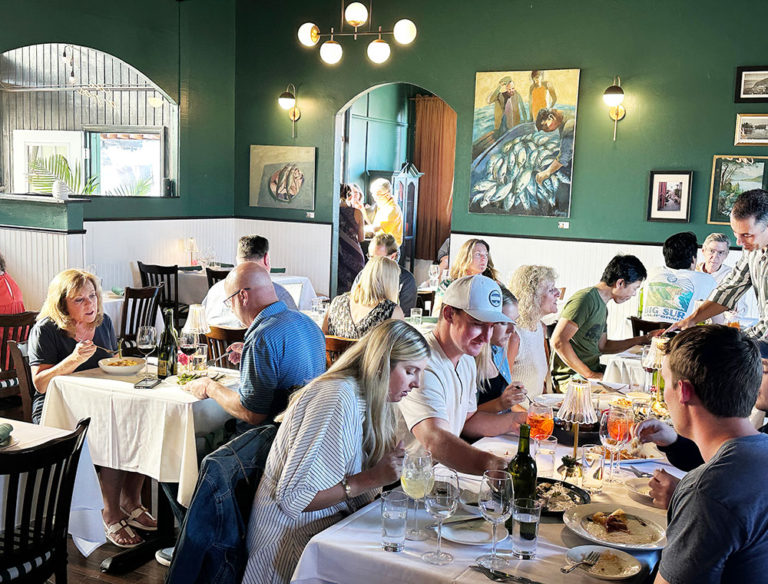
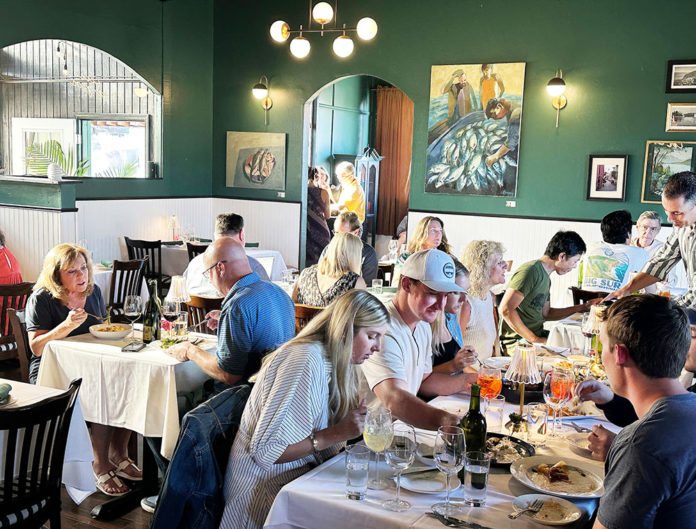
Authentically Italian, from the vibes and welcoming service to the food and décor, Lago Di Como seeks to transport guests straight to Italy upon walking through its doors. Co-owner Lindsay Rodriguez and her husband, Matteo, partnered with executive chef and founder Giovanni a year ago, and she says their complementary skill sets make a perfect match.
Rodriguez’s industry career is extensive and international; she was a server during college in San Francisco before studying and serving/bartending abroad in France and Spain. She then returned to Santa Cruz and managed several local spots before taking the ownership dive with Lago Di Como.
The menu blends northern and southern Italian cuisines with a nod to Sardinia, best begun with appetizers like the fritto misto, with local calamari and large head-on white shrimp, and the smoked beef carpaccio, with caperberries, shaved parmesan and balsamic reduction.
A flagship entrée is the branzino, a whole Mediterranean sea bass marinated in fresh herbs and baked in a wood-fired oven. A ruffled-edge macaroni served with sautéed guanciale and fresh local artichokes is another favorite, as is the bone-in, dry-aged porterhouse steak.
The menu’s authenticity ends with the seada, a classic not-too-sweet Sardinian dessert of pastry dough filled with soft, fresh pecorino then flash-fried and drizzled with honey.
How would you compare service here and abroad?
LINDSAY RODRIGUEZ: I think the difference is that in Europe, service is more customer-driven. It’s not as much about fostering a personal relationship; it’s more about creating an experience and facilitating an amazing time. It’s really not about the server, and can be very humbling in that sense. Being an American abroad in the service industry, I found people really responded to my kindness, warmth and American-driven sense of personal customer service.
Tell me about your concept.
What we’re going for here is bringing a genuine Italian experience to Santa Cruz that most people wouldn’t find outside of Italy. Our menu changes frequently, but we always feature scratch-made in-house pasta as well as traditional, popular dishes in Italy that aren’t often found in the U.S. We have nightly diverse and seasonal specials, as well as an extensive and eclectic Italian-focused wine list that is unrivaled locally.
Dark on Tuesdays, hours are 5-9:30pm. 21490 East Cliff Drive, Santa Cruz, 831-454-8257; lagodicomoristorante.com
The upcoming Strawberry Festival isn’t the only thing zinging in Watsonville
Some berry fun facts for your consideration. Strawberries aren’t technically berries—they’re what’s called an aggregate fruit.
Strawberries are the only fruit with seeds on the outside. Each strawberry has about 200.
Strawberries are the largest and most valuable crop in the Pajaro Valley.
Then there’s perhaps the funnest strawberry fact of the summer: The Watsonville Strawberry Festival takes over the heart of the Dubville’s downtown Aug. 2-4.
That means strawberry tacos and strawberry tamales, strawberry pizza and strawberry paletas, strawberry shortcake and strawberry churros, plus strawberry twinkies, strawberry waffles and strawberry smoothies.
Oh, and live music, dance performances, carnival rides, fun runs and zero admission.
The weekend originally came about in 1994 to help fund recovery from the Loma Prieta earthquake. The event continues to provide a swath of nonprofit organizations like Friends of Watsonville Parks and Community Services and the Rotary Club of Freedom the opportunity to raise funds for—and public awareness of—their work.
So the Romans were onto something when they assigned medicinal powers to the singular strawberry.
WHILE WE’RE HERE
By working with the city and the Chamber of Commerce, Watsonville Public House (625 Main St.) helped create a local beer and cider showcase in the Strawberry Festival’s adult beverage area. The Public House, Santa Cruz Cider, Fruition Brewing and Buena Vista will all pour, helping raise money for the nonprofit CoC.
WPH will also be featured at “Beer with Friends” this Friday, July 26, at Lupulo (233 Cathcart St., Santa Cruz), when WPH pointman Robby Olsen will be there talking beer, and Lupolo will have three of Public House beers on tap.
Meanwhile, back in Watsonville, Olsen et al. are building out their events calendar with bands, karaoke, salsa dancing (with a live band) and line dancing nights. watsonville.pub
PROOF POSITIVE
Venus Spirits could rest on its laurels, including Best of Class, Double Gold and Best Other Agave Spirits at the Sunset International Spirits Competition for its El Ladrón Yolo. Instead it keeps swirling a brisk calendar. This week presents a biggie, as Venus Spirits Cocktails & Kitchen Westside (400 High Road, Santa Cruz) celebrates 10 years of craft distilling with five hours of block party programming noon-5pm on July 27: A special anniversary menu lines up smash burgers, lobster rolls, and oysters; the Frans Lanting Studio and Gallery hosts a mid-summer open house with celebrated nature photographer Lanting and his partner Chris Eckstrom; two stages present live music from Rodeo Gulch and DJ sets by Techno Tony, with further music curated by Redwood Records; Independent, Mob Grip, Bronson and Slime Balls present a five-obstacle skate contest with free entry and cash prizes; a Vendor Village brims with unique local finds; and Group Open Air Training leads a free cycling class. Bonus note: Venus Beachside (131 Esplanade) is now open additional hours—5-9pm Monday-Tuesday—in Aptos. venusspirits.com
TURBO TASTES
Farmers market coffee roaster Hidden Fortress has opened a new outpost in Santa Cruz, inside Cruzio coworking space (877 Cedar St.), hiddenfortresscoffee.com…Now until Aug. 8, the Santa Cruz Beach Boardwalk does special summer promotions on the daily: Mondays and Tuesdays mean free live music; Wednesdays and Thursdays welcome in magicians and acrobats; Fridays roll out free movies on the beach; and Saturdays and Sundays drop a DJ dance party, beachboardwalk.com…Unfun fact: Bottled water is the best selling beverage on Earth, which is wack…Ground us, please, legendary oceanographer/anti-plastic pollution advocate Sylvia Earle: “It is the worst of times, but it is the best of times, because we still have a chance.”
I wasn’t looking for a new way to spend time and money, but then this link crossed my laptop: “Discover the benefits of red light therapy in helping to preserve youthfulness.”
They had me at youthfulness, and since the email came from a trusted source, I clicked.
The article described a laundry list of conditions said to improve through red light exposure, ranging from mending torn muscles and wrinkled skin to reducing depression and inflammation.
It sounded too good to be true, yet the news was compelling. In July of last year, a study published by the National Library of Medicine was headlined “Reverse skin aging signs by red light photobiomodulation”—aka red light therapy.
So I did a local search for red light therapy in Santa Cruz, and up came the only result: Santa Cruz Light Therapy, with a special for new clients. I signed up for three sessions.
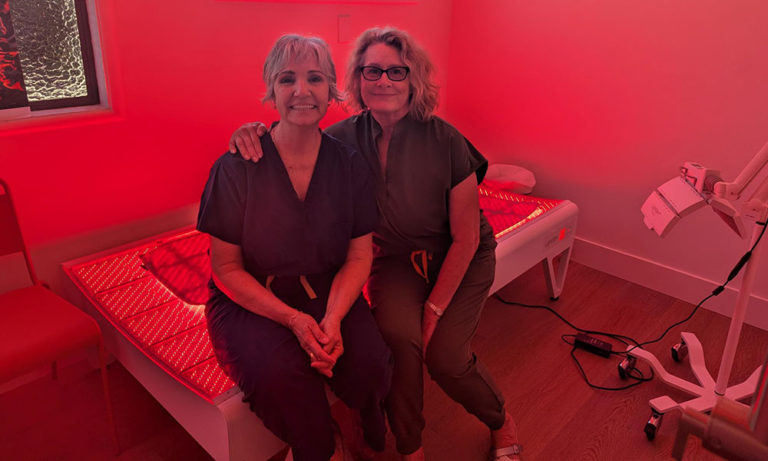
I arrived at an inconspicuous building across from the Shopper’s Corner parking lot. One of the co-owners, Julie Bettencourt, asked what I knew about red light therapy. She was eager to fill me in, sharing her personal story of healing. She says it started with a trip to the vet when her dog tore an Achilles tendon—which, thanks to the use of red light therapy, healed quickly.
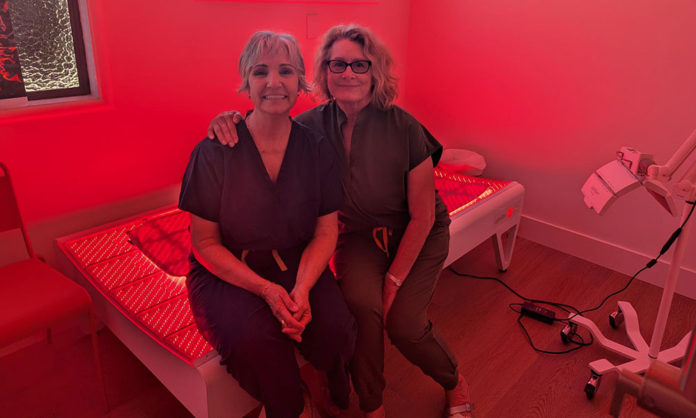
Bettencourt remembered the therapy when she tore her meniscus, prompting her to invest in a hand-held device. In a string of coincidences, she learned her friend Donna Cherie was dealing with a similar tear. Cherie, a licensed aesthetician, had recently seen LightStim red light therapy beds on display at a trade show. After they compared notes, they formed a partnership and set up shop.
And now here I was ready to lie face down on the clear acrylic panel resembling a red-hued tanning bed with a massage-style face cradle extending from the top.
Forty very warm minutes later, I sat up and noticed right away that my right mousing arm no longer hurt. It was a pleasant surprise.
The next day another shopper at New Leaf remarked on my healthy glow, nodding at the bunch of kale I was holding.
Duly encouraged, I wondered whether other people were on to the red light approach. I began asking around, and eventually I connected with Adora Deva, the former partner of Mellen Thomas Benedict, whom she calls the inventor of red light therapy.
Adora first met Mellen in Los Gatos in 2006, when she agreed to participate in a research trial on wrinkle reduction. The technology wasn’t all she was interested in, and the two began dating in 2007. For the next ten years Deva worked closely with Mellen, assisting him as he traveled the world sharing the findings, lecturing on the mechanics and developing more prototypes.
Eventually a larger company bought the prototype, now named Dreamspa, and added two features to the original design: a sound option for brain balance, and gamma wave. And the research continues.
This same machine was just tested by Dr. Peter Newsom’s team at Stanford to study the healing effects of gamma waves on brain fog and long Covid. Meanwhile one prominent LA aesthetician, Dr. Michael Galitzer, relies on it for celebrity wrinkle reduction.
Since Mellen’s passing in 2019, Adora has stayed true to the work. Today she uses several of the machines in her business, Life Spirit Healing. Along with the original light chair, Deva combines treatments using near infrared technology and red and blue light therapy. Depending on the client’s needs, she uses different lights to treat a range of issues from anxiety and depression to acne and joint pain.
Deva explains that light “bathes our connective tissue. It’s fiber optic so it carries the light to the mitochondrial level, producing ATP, the life source. Mellen was 20 to 25 years ahead of his time.”
Although the technology is now gaining traction for not only anti-aging but also a whole host of inflammation-related issues, it has decades-old roots in Santa Cruz.
The light therapy practitioners I spoke with are more than proponents of the technology. It’s not a stretch to use the word enamored. And with good reason: They and their clients find it works. How often, for how long? Those questions seem based on the individual, but for now, I’m looking forward to my next session.
Any minute now the Cabrillo Festival of Contemporary Music will start filling the Civic Auditorium with what Music Director Cristian Măcelaru calls “tomorrow’s music.” Always impossible to characterize, this festival is known for chance-taking surprises, for music you’ve never heard of.
This season, Music as Movement, strongly highlights the journeys of tribes, individuals, nations transmuted into world premieres by young living composers. The theme of movement will also play itself out through an experimental commission called Creative Lab.
Embodying the spirit of this season, the inaugural Creative Lab project, Parhelion, will play with acoustical architecture, special visual design interwoven with vocals and heightened sonics.
I spoke with Riley Nicholson, the festival’s new executive director, about his expectations for this season, and also with composer Bora Yoon and video programmer Joshue Ott about their immersive collaboration, Parhelion.
THE EXECUTIVE DIRECTOR
WEARING MANY HATS Executive director Riley Nicholson works collaboratively with the music director and the board. Photo: Cabrillo Festival of Contemporary Music
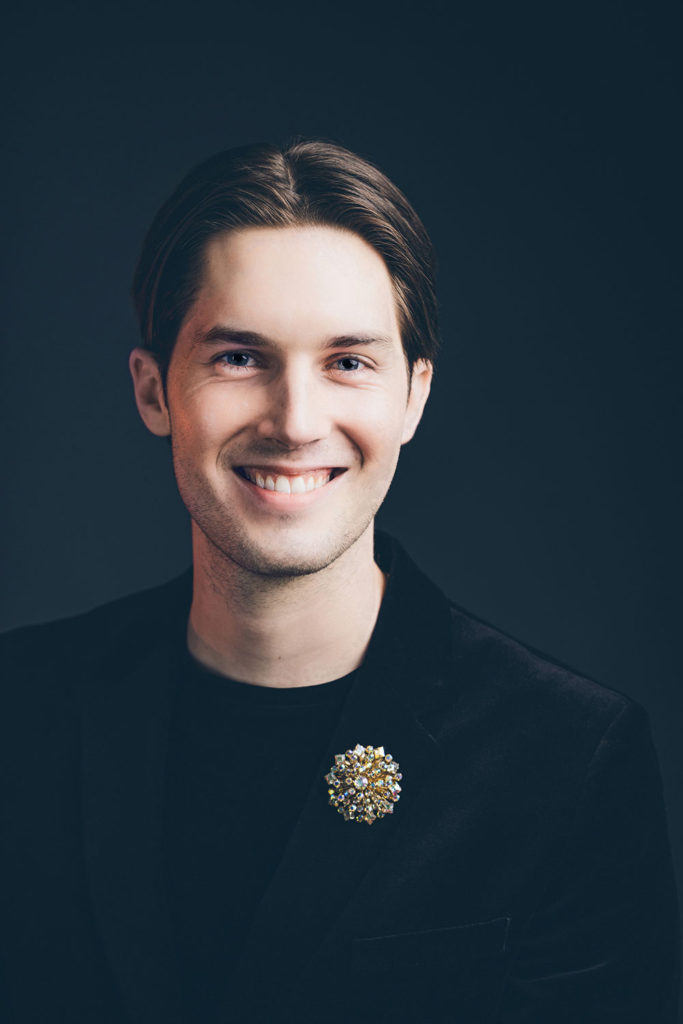
Riley Nicholson, well-known as a pianist and composer in the Bay Area, has most recently led the Symphony of Northwest Arkansas in expanding its offerings in living music, before being tapped last autumn as our festival’s executive director.
Can you tell us a little about Creative Lab?
Riley Nicholson: The Creative Lab is a new commission, but something more. With a typical commission, composers deliver a score, they maybe have a conversation with [music director] Cristi, and then they collaborate during rehearsals, which is beautiful and wonderful, but we wanted to take it a step further. We wanted to give the composer even more creative and curatorial control over the entire experience, the latitude to design an entire experience and not just notes on a page. In a way, this is beyond the orchestra.
Bora Yoon is really interested in technology and multimedia and creating an experience through production design, and we told her, here’s the orchestra, here’s the hall, it’s your play space. So, for example, at one point Bora’s placing some of the musicians around the entire perimeter of the venue. There’s a strong spatial aspect to this piece. And her producer Annie March will be working with our production team to think about lighting design, and there might be some props and projections and things like that.
What fills most of your time as incoming executive director?
Nicholson: It’s a little bit of everything, especially wearing many hats, which is often the case with nonprofits. So it’s very, very collaborative. I have my hands in all the different buckets, and that’s good, because it’s my job to be able to zoom in and zoom out. I need to be able to see the big picture, see where we’re headed, see maybe threats in the future, opportunities in the future, but also be able to manage the mechanics of the everyday administrative operations and subtly shift those over time to get us where we need to go.
That’s kind of the most exciting and most challenging thing, being able to do the little pieces and get your hands dirty, so to speak, but also work collaboratively with the music director and the board to really think big picture about the organization. And of course a big piece of that is fundraising. Fine tuning this season was a great test run of our collaborative relationship, finding ways to craft the season together. But it’s still very much Cristi’s vision.
THE COMPOSER
Bora Yoon: “Everybody shudders when you say electronics, But I also think that it can be tastefully done.” borayoon.com
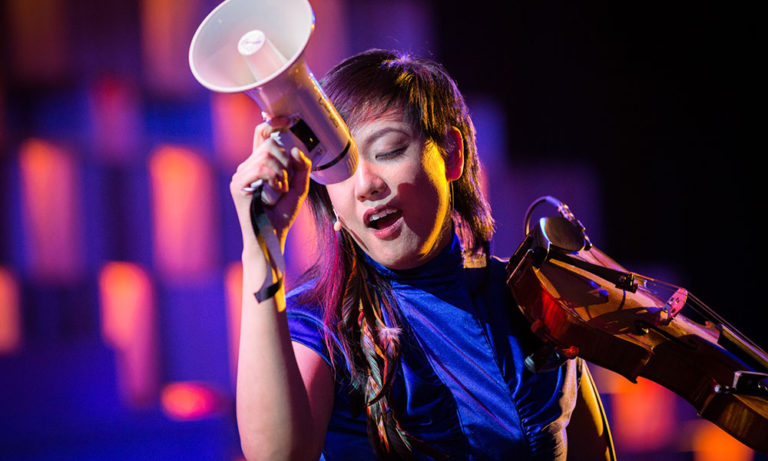
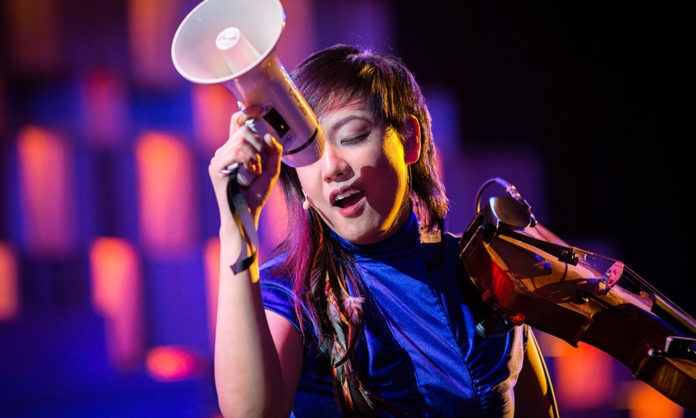
Korean-American composer and sound artist Bora Yoon brings her commissioned work to the Aug. 10 concert: Parhelion, an immersive sound experience work in collaboration with Joshue Ott’s Interval Studios and Visual Endeavors for multimedia and visual design.
Talk a little about Creative Lab and what kind of parameters you were given for this commission.
Bora Yoon: I’m really honored to be asked to be the first composer in this new initiative. And I think it’s also a really exciting time for symphonic new music. I think what the Creative Lab is doing in a post pandemic world is re-envisioning how we see orchestral music moving into the 21st century. It was very much an open invitation to bring my exploratory and kind of adventurous approach to soundscape work. I have worked on theater scores and dance scores. I don’t necessarily always blend them together. But it’s special about when you can bring two seemingly disparate fields together. Everybody shudders when you say electronics, But I also think that it can be tastefully done. Not using electronics for what the orchestra can do, but for the things that are irreplicable in the orchestra, like the sounds of wind or the sounds of water, environmental sounds. Knowing how to balance the acoustic ocean of sound that the orchestra is.
It’s a challenge scoring for orchestra as well as found, manipulated and digital sound.
Yoon: I understand the challenge. I actually feel like that’s maybe why they trusted me because I do have a vast musical language that goes beyond the orchestral world, but I do know the protocols of the orchestral world, how it works. But to be asked to actually synthesize them all skillfully and to make something new was a real challenge.
How did you work with the Civic’s acoustics?
Yoon: This work was proposed two years ago. Last year a piece of mine was performed at the Civic, so I knew the acoustics. And it was great to get to know the festival, understand the space, and the culture of the festival. I was able to compose the work knowing all those things in advance. It was really intelligently planned by Ellen Primack [the festival’s former, longtime executive director] that way. I got to hear the same conductor and the same ensemble. And knew that all these players are down with doing weird things. That’s not always the case for orchestra. But the Cabrillo orchestra players are on the composer’s side. They’re totally down to try their adventurous things.
You already have a working relationship with Joshue Ott.
Yoon: Yes, he’s a longtime collaborator, maybe 10 years of working on projects. So I take care of the sound realm and he takes care of the visual realm, with a beautiful custom software that he created himself, called Super Draw. It works in real time, and I remember seeing it for the first time and my jaw just dropped. It’s gorgeous.
He and I have toured so we already have a working language together, sound worlds to visual worlds. Whenever I compose anything, I truly do think of music very visually. So whether it’s the image of the man, the image of the place that I’m painting, or whether it’s a narrative, there’s always some kind of visual component. This is an orchestral commission, but I think of it as a kind of a show sequence with many different vignettes, significant and small vignettes, or scenes and interludes.
What can we expect with Parhelion?
Yoon: The beginning is kind of an acoustic outer space, kind of soundscape of sirening sounds or Doppler effects of sound. There’s all these different kind of metals that pulsate at different frequencies. It starts with this cosmos that’s very open, not necessarily metered. A lot of the instruments that have belled horns, like trumpet and clarinet and my voice that’s going to come through the microphone, will all be in Doppler effect so the audience is surrounded by acoustical design. We’ll be using the balcony spaces of the Civic to kind of lighthouse the sound, moving from left to right. Then there’s these kind of brass fanfares that happen throughout the piece, initially as a foreshadowing of what’s coming. Then we’re going to get much more granular. So we go from light that’s very pulsating and very distant and aerial to string harmonics and crystalline metal sounds, bells, maybe the sound of writing. The orchestra is going to do this collective breathing. A lot of white sounds.
I’m using Josh’s visuals as a way to jam with the orchestra. The plan is that the orchestra will continue playing through a particular composed movement that’s been designed so that the video collaborator can follow the movements of Cristi’s baton, follow the bowings of the violin sections to generate visual graphics. They will be responsive to each other, orchestra and visual design.
And there will be audience engagement in this performance, in the sound of things like the rustling of newspapers, wings, bird calls, to spatialize the sound field. We’ll have little LED diodes so it will look like a vast field of stars. These are all ideas that we’re still talking about in production meetings, but the vision is to get people to be part of the atmospheric experience.
THE DESIGNER
TECHNOLOGIST Joshue Ott says, ‘If we’re at our best, we are creating something that is sort of beyond sound or beyond visuals.’ PHOTO: Shannon Greer Photography
Joshue Ott, of Interval Studios and Visual Endeavors is light designer and programmer, and collaborator for Yora Boon’s Parhelion. Ott is a New York-based software designer specializing in time-based interactive experiences.
What got you into a light design?
Joshue Ott: I’m a creative technologist as well as a visual artist. I went to art school and studied computer graphics. My interest was always in abstraction and abstract forms. And I just started making this visual software. I started going to these weird jam sessions in New York City in the early 2000s where everybody would bring all of their technical toys and jam out together. That was very inspiring. And I got inspired to make my own software. And that piece of software became something that was the source of many, many collaborations, one of which was with Bora. I started making visuals for her. Bora and I have a really nice working relationship, where it’s almost like we’re completing each other’s creative sentences.
Does your work respond to acoustic prompts?
Ott: Actually it doesn’t. It’s not actually responding to any audio or anything like that. It’s completely controlled by a human being. I built it to be an instrument like a violin or a guitar. And my goal was to make it as responsive and as malleable, as the guitar or as a violin. Those instruments are capable of a very wide range of incredible sounds and rhythms. So I wanted to do that with visuals and a computer and abstract art. For Creative Lab I’ve designed the instrument with all these visuals, and I’m sending a good friend of mine, Nathan Wheeler, who is going to play this instrument.
How is it not a light show? Light shows were freestanding, abstract works of art made of oil, water, and pigment forming the colorful backdrop rock bands. In what way is this different or the same?
Ott: I think it’s actually quite similar. I think that’s a very good description of what’s happening, more than just a VJ set. But I think the way it’s different is that I have so much control of the software and the choices that we make can be more extreme. And if it’s doing its job, if we’re at our best, we are creating something that is sort of beyond sound or beyond visuals. It is intertwined in a way that you can’t really take it apart. And at its best, it’s giving the audience more information and more to think about, and a new understanding of what you’re hearing and experiencing.
So the other difference is that my software, SuperDraw, also produces audio. Some of the sections of Parhelion will have audio actually generated by my software that blends with the orchestra. I’ve been doing this for 20 years like I said, it’s changing all the time. I’m actually working on a new version of the software that may make it to this piece, so I’m really excited about that.
It’s all in that same magical place where it goes beyond what a projector does or what theater lighting does. It’s sort of something new and volumetric that exists outside the space that we’re in. My goal is to bring this ethereal other space into existence through these pieces, through this software. ■
Recently a relative let me know the Good Times awarded the Hippo Tree the weirdest Santa Cruz landmark. … Awesome !!!! I put it together 10 years ago for our grandkids, Big Boy and Mr Kane. I call it a LiBear (cross a mountain lion and bear). I recently brought it back to its original condition. It’s nice to know that our community gets a kick out of it too. Thanx for joining with me in a little weirdness……. Ha !
–Hodge
FOOTLOOSE HERE
We have a swing dance friend, Thorin, who approached the City of SC and the SC Wharf people (not sure who) a couple of years ago to find out about renovating the funky stage/dance area near the end of the wharf, near Ollita’s restaurant. They agreed that if he got a volunteer crew together and provided all the materials to rebuild that old stage, they could use it for events. He and his crew of volunteers did a great job. Thorin has been lugging his equipment out there once a month and teaching free swing dance lessons for a year.
The city decided to rent it for fairly big bucks (I think it may be $60 an hour) to him, and to at least one other group. Everyone who teaches the free lesson and DJs (myself included) do it for the sheer joy of the event, bringing together people of all age groups to dance and chat.
And many people come just to watch. Passersby and tourists always stop to enjoy the event. People often suggest that the dance should be every week!
But it’s all he can do to finance the event once a month. It’s a really great community event, and Thorin mentioned to us that he’d love some publicity. He said the wharf people are 100% behind him and someone in the city has decided about the $.
This stage made no money for the city prior to Thorin’s renovation, and we think at the very least he should get a good discount. For free would be ideal! People sometimes do leave tips, but not nearly enough to finance the actual cost of having the dance and lessons.
The planned reading at Bookshop Santa Cruz of a 1935 play about the spread of fascism—the subject of our cover story—has been moved to a larger venue.
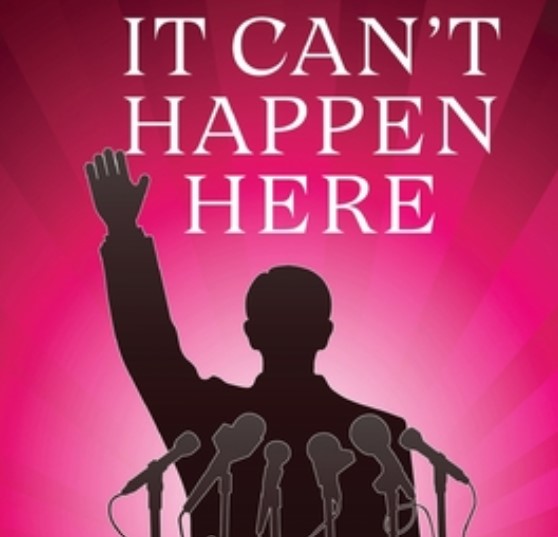
That’s the good news. So many people are fearful that it can and maybe is happening here that they want to participate in spreading awareness by reading aloud the theatrical adaptation of Sinclair Lewis’s It Can’t Happen Here.
Thank you, Bookshop, and everyone involved. The reading is also going on in 62 other places in 22 states.
If you are wondering what the fuss is about, a good place to start is Googling “Project 2025,” a 900-page document outlining what the right wing Heritage Foundation, staffed by members of Donald Trump’s administration and his advisors, plan to push for if a Republican is elected president.
If you prefer watching a video, search “John Oliver and Project 2025.”
The comedian, who has become a potent and enlightening journalist, shows the creators of the project celebrating it and outlining their plans.
The project gives the president more power than was spelled out in the Constitution–as was seen in the recent Supreme Court judgment that a president can’t be held accountable for crimes in office. It calls for retribution against those who speak out or oppose the administration, the very definition of fascism.
The document calls for eliminating funding for research and investment in renewable energy, and calls for the next president to “stop the war on oil and natural gas.” It also calls for the dismantling of NOAA, the National Oceanic and Atmospheric Administration, which monitors weather and the oceans, because NOAA scientists support research on climate change.
It suggests a dismantling of the process of selecting government employees, who are non-partisan, in favor of those who would be loyal to the president. It eliminates school lunches and, Obama–care.
It throws out gay marriage and transgender protections, in favor of “a biblically based, social science-reinforced definition of marriage and family.” It also cuts abortion rights.
There are 900 pages of changes, which strongly suggest that it can and is happening here.
The word about this 2023 document took off on June 30 when BET Awards host Taraji P. Henson twice referred to it in the show, which reached 3 million viewers.
“Pay attention, it’s not a secret, look it up,” she said. “They are attacking our most vulnerable citizens. The Project 2025 plan is not a game. Look it up!”
She added: “Do the research. Look up ‘2025 agenda,’ because next year this time could look very different if you don’t vote.”
Is it happening here?
On the lighter side: read Elizabeth Borelli’s column on the prescriptions for getting off screens and outdoors; check out the proposed ban on filtered cigarettes, which make up so much beach litter; read about a new chicken roost, Chubbs; and definitely don’t miss the lowdown on Pedro the Lion, whose latest album is inspired by our town.
Thanks for reading.
Brad Kava, Editor
PHOTO CONTEST
FLYIN’ HIGH Shot at TAC Skimblast competition, a skimboarding competition that takes place every year. PHOTO: Mary Patino Mota
GOOD IDEA
Congressmember Jimmy Panetta secured a new federal investment in local initiatives to boost electric vehicle charging. Rep. Panetta announced $1.5 million in federal support for the Monterey Bay Electric Vehicle Climate Adaptation will receive $1.5 million.
The Monterey Bay EV CAR is a collaborative effort that will create a roadmap in the Monterey Bay Area to ensure the buildout of EV charging infrastructure to increases resiliency in the face of climate change.
“Through this federal funding we’ll make it easier and attractive to switch to electric vehicles and reduce our carbon emissions,” said Panetta.
GOOD WORK
Dominican Hospital, in collaboration with Morehouse School of Medicine, have announced their first family medicine is proud to announce the first Family Medicine resident graduates. This significant milestone marks a crucial step in addressing healthcare disparities in Santa Cruz, the hospital said. Eight medical residents are set to embark on a rigorous three-year program dedicated to nurturing “culturally humble” family physicians, commencing in July 2024.
QUOTE OF THE WEEK
“Moderation in temper is always a virtue; but moderation in principle is always a vice.” —Thomas Paine
When word circulated a couple months ago that Bookshop Santa Cruz would join a national effort to warn voters of impending dangers with a live reading of the Sinclair Lewis classic It Can’t Happen Here on July 19—one of 62 readings in 22 states that day organized by Writers for Democratic Action, just after the Republican National Convention—not everyone was electrified by the news.
Politically active younger people, focused more on the horror unfolding in Gaza, found it hard to fathom why they should care about the imaginative vision of a white male who nine decades ago summoned the specter of an American dictator. In short: Big yawn.
What a difference a few weeks of domestic political news can make: By the time Bookshop Santa Cruz sent an email to its mailing list on July 9 announcing the event, interest had soared. Between a Supreme Court session that pushed a right-wing agenda to new extremes to detail about the Project 2025 blueprint former Trump officials laid out to rip loose key guardrails of democracy, the sulfur smell of danger is in the air.
More recently, shots fired at a Trump rally and the raised-fist instant-T-shirt image of him mouthing “Fight” with his bloodied ear, the attempt in the aftermath to blame Democrats for inciting the violent action of a young registered Republican and Aileen Cannon’s Monday-morning bombshell of dismissing the Trump classified-document case.
Bookshop Santa Cruz owner Casey Coonerty Protti sees the store’s July 19 event—in local Congressman Jimmy Panetta, Santa Cruz Mayor Fred Keeley and others will read aloud from the play Sinclair Lewis helped adapt from his own 1935 novel—not so much as a warning as a call to action.
DARK TIMES Set in the fictionalized version of 1930s United States, this novel features an American politician, Berzelius “Buzz” Windrip, who becomes the country’s first outright dictator. PHOTO: Federal Art Project
For Coonerty Protti, the live reading can function as the beginning of an effort to find new ways to work together to save our country. “In times of chaos, and today definitely qualifies as that, the most important thing we can do is come together as a community,” Coonerty Protti said in an interview. “What I’m seeing in this event is something that has historical meaning and allows us to come together and make plans and decide where we go from here.”
The surge in interest has been dramatic. “I was wondering if people would show up, and we put out one email and all of a sudden we have 300 people who want to come,” prompting a decision to move the event to a larger venue, the 418 Project on River Street, she said. “What that tells me is people want to take action and they need a place to start. In my mind, Bookshop’s mission is to create those types of moments where you can bring together history and ideas and community and action and partnership.”
Yes, it very much can happen here, and in fact, at this point, a range of political experts I’ve canvassed on the subject put it at better than 50-50 that it will happen here this year. Barring a surprise plot twist or two, there is a strong likelihood that we will find our country sucked into the muck of authoritarianism with Donald Trump back in the White House next January. A would-be dictator can be a risible self-caricature with a hilariously bloated ego and still be very, very dangerous.
“In 1936, It Can’t Happen Here, a stage adaptation by Sinclair Lewis of his own bestselling novel, opened simultaneously on 21 stages in 17 states across America on October 27, one week before that year’s presidential election,” Writers for Democratic Action explains at its homepage, writersfordemocraticaction.org. “It served as a warning against the rise of fascism in America. It Can’t Happen Here—Again by Writers for Democratic Action is both an homage to the 1936 production as well as a call to action now, in 2024. Thank you for joining us for your own version of this reading.”
James Carroll, a National Book Award-winning author and a founder of Writers for Democratic Action, discussed in a phone interview the sense of panic running rampant this month about the chances of defeating Trump. “There are surprises ahead of us,” Carroll said last Friday, before subsequent events dramatized the accuracy of his prediction. “There are things that we cannot imagine that will happen in the next 100 days. Trump is golden at this moment, but the shadow is going to fall on him.”
Everyone has an opinion on what ails us and I’ll offer mine, updating a memorable Strother Martin line from Cool Hand Luke: What we’ve got here is failure to imagine. I’m serious: For reasons both obvious and hard to fathom, all of us, from creative types who write books and think way too much to someone taking your coffee order and teachers and students on the hill at UCSC, find our ability to imagine, freely and in color, to be grievously impaired.
I think of it a little like having too many apps open on your computer, sucking up bandwidth. A shutoff valve is activated. Which we tend to understand. But a hidden cost of that shutoff is a down-powering of imagination.
“We’re so inundated with information, no matter what that information is, it can be exhausting,” Jimmy Panetta, one of the readers for the Sinclair Lewis event, said in an interview. “That can lead to people disengaging. That’s exactly what our democracy is not about. We are a nation of ‘We the people,’ so therefore it is up to we the people to determine our future. That’s why an event like this is important.”
Panetta makes a point about the failure of imagination defining our times: It starts with a failure of memory. For example, on the same day President Joe Biden endured a fraught press conference in which he earned plaudits for his knowledge of foreign policy and headlines about a slip-of-the-tongue he quickly corrected, a messenger boy visited Trump’s Mar-a-Lago compound, like Sal Tessio in The Godfather bringing a message from the Big Boss.
I’m referring of course to Hungarian prime minister Viktor Orban, who had just met with Vladimir Putin. To see the threat of Putin in vivid, blood-curdling imaginative detail, it helps to have a working knowledge of Stalin and his runaway regime early in the short, bleak history of the Soviet Union. Absent that, it’s all just reality TV. Personalities. Quick takes. Funny mustache! He was short! The millions dead? Hard to fathom.
Panetta, first elected in 2016, the year Trump won, would like to focus on some more recent history. “For one, we can take a moment to remind people of the chaos we went through, my first year as a Congressman, 2017, and dealing with someone like Donald Trump in the White House, his narcissism and what we’re hearing about his plans for retribution, in addition to some of his policy positions.”
And, sure, how about remembering some facts about more recent history? The old guy in the White House, whatever his future, has in fact overachieved as President in terms of actual, tangible policy accomplishments.
“We have to find a way to give people another sort of memory about what has been done when it’s not Trump, the major investments this administration has done,” Panetta continued. “And in a very bipartisan way, bringing Democrats and Republicans together to get us through Covid and reenergize the investment that was needed in our infrastructure, and to bring back manufacturing, especially when it comes to silicon chips.”
OK, that’s a Democratic Congressman talking up the accomplishments of his President, including appointing the first African-American woman to the Supreme Court, but Panetta does have a point that the unending focus on doom-and-gloom gets old and there has to be other ways of seeing.
“An event like this can remind people of how bad it can be but also remind people of how good it can be,” he said. “We need to put people in office who know it’s not about themselves. In order to do that, it takes us getting involved. The more we engage, that’s how our democracy endures. To remind people, but also to get them reinvigorated as to the responsibility of living in our democracy.”
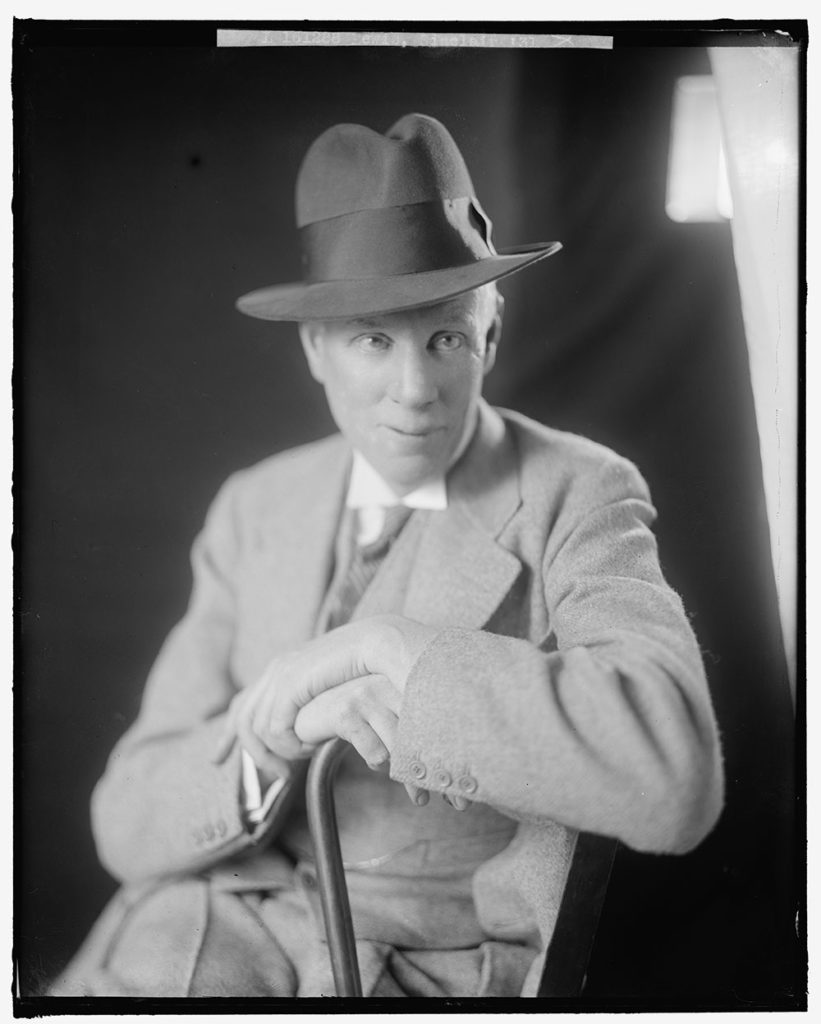
NOBLE NOBEL Harry Sinclair Lewis (Feb. 7, 1885–Jan. 10, 1951) In 1930 was the first U.S. author to receive the Nobel Prize in Literature. Photo: Harris & Ewing Collection/Library of Congress
I myself am an optimist. I think that with every passing week before Election Day a sense of urgency will build and people will get involved. The reaction so far to the nationwide Sinclair Lewis readings has been over-the-top positive.
“The places where people are holding these readings are overbooked,” Carroll told me. “There are five of these things happening in Milwaukee, because that’s where the convention is. The people of Milwaukee are on fire with this thing. We’re on to something—and it’s not going to end on July 19.”
Here’s where we come back to Casey Coonerty Protti’s point about shrugging off all the doubt and worry and putting your energy into action, potentially positive, constructive action. I for one am going to help Carroll and Writers for Democratic Action do more organizing. I believe in the power of story-telling and story-framing to make a difference.
I asked Carroll how he thought those of us opposed to a Trump takeover could break through to more people on the stakes of this election. “All I can tell you is open your eyes and look,” he said. “It is so blatant. We are in the thick of just a major, major assault on what is most important in this country and our capacity for denial is just breathtaking, breathtaking, but we have the capacity to wake up. Suddenly life slams you in the head with a two-by-four. What is it going to take? I cannot believe this country is going to elect Donald Trump. I do believe we might have such a divided election that Trump will be able to exploit the cracks.”
Here’s the Writers for Democratic Action game plan: “This is all part one of a two-part plan,” Carroll said. “We’ve hired a social media team to put together a stunning video based on the film we get from different folks on July 19 (reading from It Can’t Happen Here), and we’re going to use that as the basis for a social-media campaign targeting young people in particular.”
Then in October, more readings/productions will take place all over the country—and you can get involved and help organize one in your community. “The focus is on high school seniors and drama departments and amateur theater groups,” Carroll said. “The whole thing is going to happen again.”
There are limits to what anyone can do, obviously. Not long after Trump was elected in November 2016, I reached out to Bookshop Santa Cruz and suggested that we partner on a live-reading of George Orwell’s classic novel 1984 as a warning about Trumpism.
As I wrote in these pages four months after that election, “On Nov. 9, we all woke up to find that we had jumped inside a book, and the clocks had finally struck 13. Reality as we knew it had shifted on its axis, and we were living in a garish comic-book version of George Orwell’s masterpiece of a novel, 1984. Only if we overcame our shock and revulsion and came to terms with the specter of a petty, petulant Big Brother holding sway over our lives could we possibly aspire to change the plot of this nightmare story.
Months later, most of us continue to play catch-up, still baffled and demoralized by the inescapable feeling that our reality has been hijacked, bracing for a long struggle of fighting for our beliefs, and opposing bigotry and authoritarianism.”
As the one who came up with the idea, and given my role as co-director of the Wellstone Center in the Redwoods writers retreat center, I had the honor of reading the opening of the book to start our live-reading at Bookshop Santa Cruz. It was a great day, we brought the community together, and yet, reading the words I wrote at the time now brings me a sickening feeling of not much having changed. We are still living with the nightmare of Trumpism. We are all overwhelmed and strung out.
“There’s so much stuff coming at us,” Jimmy Panetta told me. “I say that not just as a representative, but as someone who lives in this society with so much overload, I really think it prevents people from having the bandwidth to look back at history. If you don’t have that sense of what can happen, you sort of are dismissive of what we are seeing, going down that line. It prevents you from sparking that memory and therefore that fear of: We need to watch this! And we need to do something about this. Versus just kind of thinking, I don’t like either candidate. People aren’t voting based on their knowledge of history. They’re voting based on their gut. It’s our responsibility—in part with events like this—to help people think beyond our gut and think about the future.”
I find Lewis an oddly perfect voice to turn to for inspiration in this national crisis. He was born in Minnesota and educated at Yale, but the fiery sense of justice and disturbingly fecund imagination that would make him the first U.S. winner of the Nobel Prize in Literature (in 1930) seem to have ignited during his years living here in our part of the world, starting in September 1908 when he moved to Carmel. (“He was one of these people who lived in the fledgling artist colony in Carmel, California, back in the 1900s,” Panetta says. “You can only imagine what that was like!”) By the next year Lewis was a staff reporter for the San Francisco Bulletin.
Lewis used fiction as a lens through which America could help see itself, and it was often a painful look. That was true in his breakthrough novel Main Street (1920), zooming in on small-town America, which sold an incredible 180,000 copies its first six months, and Babbitt (1922) and Elmer Gantry (1927), the mere mentions of which, for some readers, still stir devastating satiric portraits. May this round of events spur future Sinclair Lewises to take an (even more) painful look at the America of today.
Due to overwhelming demand, the 7/19 event “It Can’t Happen Here—Again” will now be hosted at the 418 Project (155 River St. in The Galleria). This venue change means additional seating and an improved event experience for more folks who want to attend. Tickets cost $3 at tickettailor.com.
Open Road is John Palmer and Lucia Comnes, two musicians with years of experience and a longstanding connection to folk music. Palmer and Comnes met while apprenticing in Nashville with the legend Rodney Crowell, and their collaborations have the ring of deep roots South. With clear voices and swift fingerpicking, Open Road creates a sonic landscape evoking their name: windows down, music blasting, nothing but a long stretch of freeway ahead. When folk music is done properly, it makes the listener feel glad to be human, and Open Road’s songs do just that. JESSICA IRISH
Lego and Barbie and Bratz, oh my! Come along with Kansas resident Dante, his dog Toto and his trusty Barbie doll as they go over the rainbow and down the Lego brick road to make new friends and learn life lessons in this plastic-fantastic take on L. Frank Baum’s timeless classic The Wonderful Wizard of Oz. In this latest in a long line of adaptations, Oz is populated by wicked Bratz dolls, GI Joes, Transformers, flying sock monkeys and more of you and your children’s favorites. Toys are for everyone. Runs through July 28. KEITH LOWELL JENSEN
INFO: 7pm, Park Hall, 9400 Mill St., Ben Lomond. $15-$35. 336-2278.
FRIDAY
AMERICANA
Jake Xerxes Fussell PHOTO: Kate Medley
JAKE XERXES FUSSELL Georgia-born and now hailing from Durham, North Carolina, the singer, guitarist and “folksong interpreter” Jake Xerxes Fussell performs a night of traditional “folk” songs from the American South. Known as much for his intimate knowledge and appreciation of the source material as for his big vocal presence and guitar proficiency, Fussell promises to bring essential American Southern music to life in the here and now. Another talented Georgian pianist and songwriter, Robin Holcomb, opens the show. KLJ INFO: 8pm, Felton Music Hall, 6275 Hwy 9, Felton. $22/adv, $27/door. 704-7113.
TALK/LECTURE
IT CAN’T HAPPEN HERE—AGAIN
When a country is in peril, events that include readings, activism and community building become more crucial than ever. Based on Sinclair Lewis’ 1936 novel about the rise of fascism in America, It Can’t Happen Here—Again is just such a night of community action. Scheduled to take place the day after the Republican party nominates its presidential candidate, this event will feature prominent local and national political figures, including US Rep. Jimmy Panetta and Councilmember Martine Watkins. Consider it an invitation to make a mark on an uncertain future looming in November by turning the tides toward hope. JI
INFO: 7pm, Bookshop Santa Cruz, 1520 Pacific Ave., Santa Cruz. Free. 423-0900.
SATURDAY
ROCK
SAWYER HILL
Arkansas-bred musician Sawyer Hill promises “sounds you’re familiar with, but with a delivery and composition you haven’t heard before.” He does a fusion of alt, pop and prog rock with a Southern twang and deep, moody tone. After touring with his band through the South in his teens, he started his solo project several years ago with a stream of singles, culminating in releasing his EP, Look At The Time. On the extremely catchy title track, he asks, “’Cause when you say that I’m the only one/did you mean that I’m the closest one around?” ADDIE MAHMASSANI
Now in its fourth year (one “R” for each year!) Purrrrfest has become a fun, yearly fundraiser for a good cause. Hosted by local musician Jesse Kenneth Cotu Williams, the event started as a benefit concert for the Santa Cruz County Animal Shelter and has evolved and changed over the years to an all-day event. This year, it’ll benefit the Laurie Roberts Bogey Fund by promoting the adoption of black cats, which are at a higher risk of human attack and neglect and are the last to be adopted because of silly superstitions. We don’t deserve animals; the least we can do is try to give them the best existence possible. MAT WEIR
INFO: 4pm, Blue Lagoon, 923 Pacific Ave., Santa Cruz. $20 donation. 423-7117.
TUESDAY
PUNK
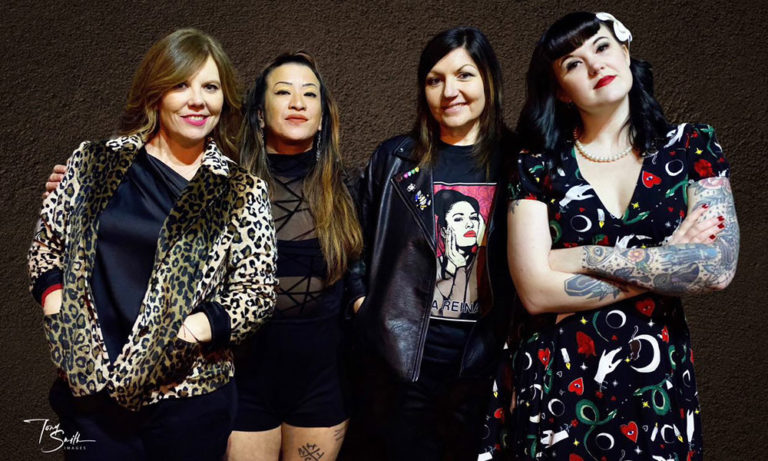
BAD COP BAD COP
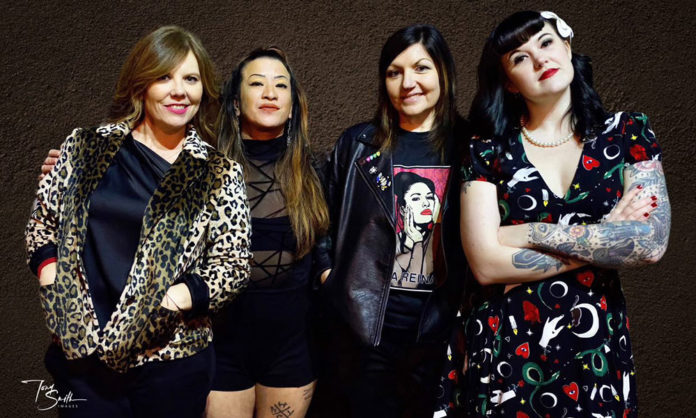
In 2017, the riot grrrl quartet Bad Cop Bad Cop unleashed a wave of rage in reaction to the election of Donald Trump with their album Warriors. Well, now it’s 2024, and while the upcoming election doesn’t inspire any less rage, the band has moved on from that particular vibe. Signed to Fat Wreck Chords, they released The Ride in June to much fanfare in their current hometown of LA and beyond. Singer and guitarist Jennie Cotterill told Alternative Press, “I think this album is more like a response than a reaction.” The new angle has given the band more power than ever. AM
Hailing from Austin, Texas, Farmer’s Wife is an indie-psych trip into a dark fantasy world of horned narrators, bears and revenge. Or at least those are the subjects of their album There’s a Monster, which dives into the world of dark fairytales. Yet, past the grunge exterior, Farmer’s Wife has a pop sensibility captured by Molly Masson’s more-sugary-than-Waffle-House-sweet-tea voice. Combine that with the melodic turmoil of the guitars, drums and bass, and the result is haunting, moody and delightfully angsty. Big ’90s underground vibes here for fans of Sonic Youth, shoegaze and wearing sundresses with combat boots. Joining them are two local bands in the newly flowering Santa Cruz scene, Casino Youth and Grad Nite. MW
INFO: 8:30pm, Vets Hall, 846 Front St., Santa Cruz. $20/adv, $25/door. 454-0478.
WEDNESDAY
WORLD
Ladysmith Black Mambazo PHOTO: Courtesy of Management
LADYSMITH BLACK MAMBAZO
Overwhelming joy and love is the best way to describe the experience of seeing Ladysmith Black Mambazo live. The group has been hailed as the cultural ambassador to the world for South Africa by Nelson Mandela and is considered the most popular group from South Africa. Each performance is filled with such love and charm that it will undoubtedly warm your heart. The group started as a form of peaceful protest against apartheid but continues to perform their vocal harmonies over 50 years later. Their take on gospel and a cappella give the feeling of being in a small church, coming together to learn lessons of peace, love and harmony. ISABELLA MARIE SANGALINE
INFO: 7:30pm, Rio Theatre, 1205 Soquel Ave., Santa Cruz. $47.25/adv, $57/door.
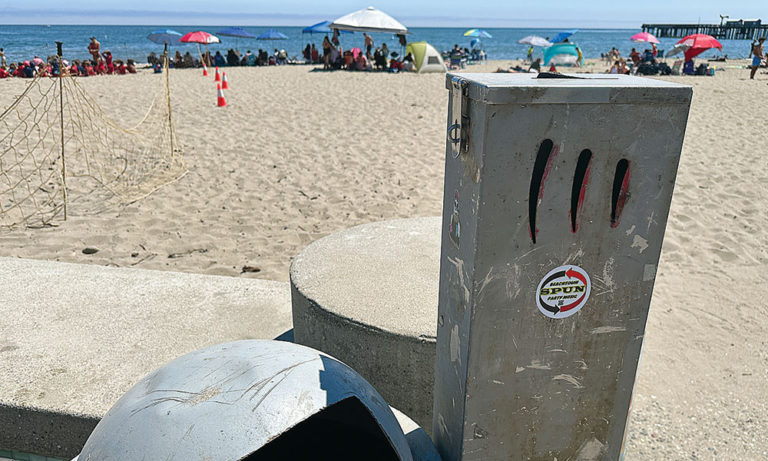
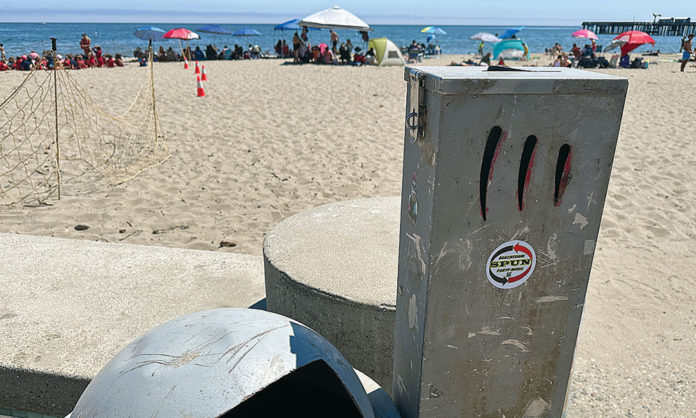
In the decade between 2013-23, volunteers and nonprofits picked up 439,358 cigarette butts from Santa Cruz County’s beaches and natural areas, accounting for a quarter of all litter found here.
That’s according to Save Our Shores, a Santa Cruz-based nonprofit that works to support the ecosystems of the Monterey Bay.
In response, the organization is teaming up with other nonprofits and local elected leaders to craft an ordinance that would ban the sale of filtered tobacco products in the unincorporated parts of the county, as well as the cities of Capitola, Watsonville, Scotts Valley and Santa Cruz.
“We’re targeting this item not to prevent people from smoking, but because it’s one of the number-one items we find in the environment,” said SOS Program Manager Krista Rogers.
That’s a problem, Rogers said, because the filters are made from non-biodegradable plastic, which takes more than a decade to break down. And when they do, it turns into microplastics, which have been found throughout the environment, including in marine animals.
Worse, the filters leach dangerous chemicals such as arsenic and nicotine into the environment.
“If you drop a cigarette butt in a fish tank, it will kill all the fish,” Supervisor Manu Koenig said.
The proposed “Ban the Butt” ordinance—still in the pre-planning phase—is not unprecedented in its scope.
In May 2023, the board unanimously passed a resolution recognizing tobacco waste as a threat to health and the environment, and to form an ad-hoc committee to study the issue.
The county banned single-use plastic bags in March 2012, and followed suit with a ban on single-use plastic shampoo bottles at hotels in November 2018.
“This is in keeping with our environmental legacy already, and the data shows pretty clearly that cigarette butts are the number-one most littered item,” Koenig said.
The move is almost certain to garner attention from the tobacco industry, which spends millions of dollars every year to quash public health policies.
According to Action on Smoking and Health, the industry in 2023 had 262 lobbyists at the federal level.
But that is not a deterrent to the supporters of the ordinance, which is expected to be considered in the fall after a publicity campaign.
“That actually just makes us work harder,” Rogers said. “We believe in the mission of our organization and the work we do, and we see the effects of this item first-hand. We definitely do recognize that we are going up against a giant lobbyist, and that’s why we want to start small.”
Authentically Italian, from the vibes and welcoming service to the food and décor, Lago Di Como seeks to transport guests straight to Italy upon walking through its doors.
Along with the original light chair, Deva combines treatments using near infrared technology and red and blue light therapy. Depending on the client’s needs, she uses different lights to treat a range of issues from anxiety and depression to acne and joint pain.
We have a swing dance friend, Thorin, who approached the City of SC and the SC Wharf people...to find out about renovating the funky stage/dance area near the end of the wharf...
The planned reading at Bookshop Santa Cruz of a 1935 play about the spread of fascism—the subject of our cover story—has been moved to a larger venue. That’s the good news...
In 2017, the riot grrrl quartet Bad Cop Bad Cop unleashed a wave of rage in reaction to the election of Donald Trump with their album Warriors. Well, now it’s 2024...