Buzz Osborne talks fast. Whatever the subject, he spews knowledge with the velocity of hummingbird wings.
Before our interview, he’s just finished a round of golf—you read correctly—one of Osborne’s favorite things to do when he has the time. Fourteen years ago, some rock and roll buddies invited him to play a small three-par course, and he’s been hooked ever since; he’s still coming off the high of playing Pebble Beach after the band’s last tour was “shitcanned.”
Most of those “rock and roll buddies” who introduced him to golf no longer play.
“All except one have quit playing because it wasn’t easy right away,” Osborne, aka King Buzzo, says from his Los Angeles home. “I just kept playing.”
Osborne, known for the crop of salt-and-pepper springs blooming from his dome, approached golf—no lessons, no instruction—the same way he learned how to play guitar.
There’s nothing predictable about Osborne’s approach to anything—including the Melvins, the band that he’s led for 39 years and counting. The Melvins scored a big record deal, with a guarantee from the label that the band would have 100% control over the music but were dropped after just three records. While their 1994 psych-metal meets industrial noise rock LP, Stoner Witch, sold decently, the 1996 follow-up, Stag, which did garner some critical acclaim for its fearless exploration—it’s loaded with experimental instrumentation, studio effects and various styles and avoids cohesion like herpes—Atlantic knew by then that the group would never generate sales comparable to the grunge goldmine that had been dominating popular music.
“Lots of people aren’t going to like what we do, and I get that,” Osborne says. “But that doesn’t rule my life.”
Ironically, many of the bands that were generating hundreds of millions for major labels at the time cited the Melvins as a significant influence. The Melvins’ variety of heavy sludge metal—carried by Osborne’s post-punk riffs, simple power chords and notes of cheekiness hidden in plain sight and often mistaken for pure dread—has even been credited for kickstarting grunge. Osborne and Kurt Cobain grew up in Montesano, Washington, and were close friends long before Nirvana. Cobain considered King Buzzo a musical mentor. Osborne attacks his guitar without overthinking melodies, which helped shape Nirvana’s style as much, if not more so, than the Pixies’ soft-loud-soft format.
“It’s great,” Osborne says of the credit Cobain was always quick to give the Melvins. “On the other hand, I wish [Cobain] was unsuccessful and still alive—my life has been filled with [death] in one form or another.”
Major label or not, the Melvins—Buzzo, drummer Dale Crover and a laundry list of bassists and lofty guests—have churned out over 30 records since 1984, which doesn’t include compilations, side projects, reissues and detours. Osborne emits grunge intuition, implying he doesn’t need to ask permission. And Ipecac Recordings, co-founded by Greg Werckman (former manager of Jello Biafra’s Alternative Tentacles label) and Mike Patton (Faith No More, Mr. Bungle), has been the perfect label for Osborne and the Melvins to do that since their brief stint with Atlantic.
“We’re determined and not afraid to do things differently or change,” Osborne says. “Dale and I are a good partnership. We like to play live. We make our living playing music and figure out how to make that work. That’s our whole deal. Whether people like it or not is anybody’s guess, but I think they should.”
Success, or lack thereof, has no bearing on Osborne’s prolific nature. Nor does a pandemic. Just before Covid, the Melvins released the ambitious and underrated A Walk with Love and Death, a double album featuring two distinct albums: Love is a 14-track soundtrack to a movie that hadn’t been made, and Death is simply a nine-track album.
The fire seemed to burn white-hot under Buzzo’s ass during the pandemic: In 2021, the Melvins released two records, including Five-Legged Dog, a whopping quadruple album—36 songs spanning four records and nearly three hours—featuring acoustic reworks of the band’s classics, including “Edgar the Elephant,” “Revolve,” “The Bit” and “Billy Fish,” with some covers intertwined, including Alice Cooper’s “Halo of Flies” and the Stones’ 1971 nugget, “Sway.”
“I approached [Five-Legged Dog] as if I was going to do a cover song of another band,” Osborne explains. “I’m not that precious with [our songs]. We just did our best with what we had, and it came out good. When we had enough stuff to do a whole album, I was like, ‘We should do a double album.’ But it seems like many people do double albums, so I said, ‘Let’s do something bigger—let’s do four albums.’ Do people care about this? That remains to be seen, but I was very excited about it. I thought it worked out great. I know that we could do a whole tour like that. But it’s been so long; it’s time to play loud guitar.”
Meanwhile, Working with Godis the ultimate record to “turn up to a 11.” When you need a pick-me-up after a shitty day, it’s the ideal pandemic album to blast so loud that your neighbors can enjoy “Fuck You,” the amplified tribute to Harry Nilsson’s “You’re Breakin’ My Heart” and “Fuck Around,” the Beach Boys’ punk stepchild of “I Get Around.” Overall, the record radiates with the Fugs’ biting, dark humor.
“If you listen to our entire catalog, there’s a vast array of nightmarish shit going on,” Osborne says. “That’s kind of what’s kept us going. I’m not afraid of hard work.”
In addition to music and golf, Osborne is an avid street photographer—also self-taught. His debut photography book, Rats, is coming out soon. If you doubt his photog skills, his work featured on Instagram (@realkingbuzzo) will squash that disbelief—Osborne notes that his book won’t include anything from his Instagram account.
“Photography is one of my favorite things,” he says. “I shot Mike Patton for a cover of Revolver, so that proved I could do it, which is nice.”
Maggot Brain Magazine—Mike McGonigal’s quarterly glossy zine published by Third Man Records—recently included Osborne’s photographic tour diary, which he shot on a fixed-lens Leica D-Lux (Typ 109) camera.
“I was determined to play guitar; I was determined to take pictures and I was determined to play golf,” he says. “You put discipline into anything, and it works.”
The Melvins (We Are the Asteroid and Taipei Houston open) perform Friday, Sept. 9, at 8pm. Felton Music Hall, 6275 Hwy. 9, Felton. Sold out (Add name to the waitlist.)
Sure, there have been some amazing local Latinx rock bands—most recently, La Plebe and Los Dryheavers come to mind—and the now-defunct Appleton Grill in Watsonville once served as the local spot to see the best in underground Latinx rock. But the scene for such bands has never quite come together in Santa Cruz County.
Now one local group is trying to turn that around, one show at a time.
“We wanted to do this to say, ‘Hey, when you hear Latin American bands, you need to go see them because that’s what’s really going on,’” says Denny Joints, guitar player and one of the singers for local group Los Darks. “We see it every weekend. This is the real Santa Cruz music.”
The “this” he’s talking about is a Spanish-language-centric show Joints helped organize for Sept. 3 at Urbani Cellar in Santa Cruz. Along with Los Darks, it will feature Latin ska band La Maldita Cruda (from San Jose), Santa Cruz Latin-infused surf-psychobilly-rock trio Fulminante and local rock act Death Department.
“We wanted to do this to show we support everyone,” says Pepe Bárrio, Los Darks’ lead singer.
Bárrio grew up in a musical environment, hailing from Puebla, Mexico–the same city as Alex Lora, lead singer for one of the largest Mexican rock bands of all time, El Tri. It’s his deep roots that anchor his writing.
“Where I grew up was a very intense city, very violent,” he says. “But a lot of support from friends and family.”
Bassist Salome Cruz says the bands are already active here, but they need more exposure.
“We want to get more people into the scene,” she says. “I would like to bridge the gap between punk and rock, especially in Spanish. Like Fulminante, they’re amazing and a great example.”
Fulminante released their self-titled debut album in 2018; they continued to play live even during the pandemic, joining a number of other artists for the SoFA Music Festival livestream. However, a series of setbacks and medical issues put the three-piece on a 10-month hiatus from September of last year until July.
However, Fulminante says they’re back and ready to blend genres and simmer in the sauce of rock ’n’ roll once again.
“Our friend Sophie says [our shows] are one of the only places you’ll hear a Manu Chao cover with a Dramarama cover,” jokes singer and drummer Josue Monroy. “And that’s just us. There’s a core–a certain vibe–to the music, but it’s also pretty diverse.”
“Growing up, that was the soundtrack to my house,” agrees Fulminante singer and guitar player Brenda Martinez. “It was oldies, Mexican music, blues, hip hop, everything.”
Despite this, both Martinez and Monroy agree the Spanish-language music scene is severely lacking in Santa Cruz.
“When I was growing up, Santa Cruz never catered to these bands,” Monroy says. “We’d always go to San Jose or house shows in Watsonville. Santa Cruz always felt musically segregated in that way.”
So when they were asked by Los Darks to play the show at Urbani Cellar, it was an opportunity they knew they had to take.
“Even though it’s easier to access other types of music, when it comes to actual shows things tend to stay within certain scenes,” explains Monroy. “And that means you’re perpetuating the same thing.”
“There are people out there who want a Latin scene,” Martinez agrees. “And it can be an eclectic scene, not just rock or punk in español.”
It’s this type of mentality that also drives Los Darks, who draw their inspiration from—and even cover—classic Latin songs and traditional styles. Yet at the end of the day, they are rockers through and through.
“We just want to play our favorite music the way we want to play it,” Joints says. “Pop music we can feel good about.”
Los Darks plays Saturday, Sept. 3 at 8pm. $10. Urbani Cellar, 140 Encinal St., Santa Cruz. urbanicellar.com.
Farnaz Fatemi lives a double life. Born in California to two Iranian immigrants, she has found herself engaged in poetry as a tool of archaeology, sifting through memories, words and places to find the key to her sense of self. In her first book of collected poems, Sister Tongue, the winner of the 2021 Stan and Tom Wick Poetry Prize selected by Pulitzer Prize winner Tracy K. Smith, she puzzles over her identity as Persian-American, and as a twin. The book of poems and sensitive travel notes traces Fatemi’s odyssey on a return visit to Iran as an adult, threading her way between Farsi and English with love and trepidation. Fatemi spoke to me about the new collection.
If I had to locate the heart of this collection, it would be this line: ‘I want the foreigner in meto meet the foreigner in me.’ What does it mean to you?
FARNAZ FATEMI: Writing those lines was an attempt to name something that I knew wasn’t just personal. It was an attempt to capture something about my childhood and adulthood which the book itself hopes to pay attention to. It’s not just Farnaz paying the attention—it’s the speakers in these poems considering what foreignness means, and how it changes through a lifetime. Taking the question as a personal question: yes, as a child I was incredibly alienated from myself. I didn’t understand what my own wishes and hopes were because I was so worried about everyone else’s. I felt different because of my Iranian family. I felt far from language, I felt different from other girls and from my twin sister. You could say much of how I have learned to be in the world evolved from a feeling of foreignness.
You are a twin in two senses, biological and cultural—as Tara’s sister, and as an American Persian. Did these twin challenges (pun intended) power the creation of this book?
There is no question they did! I also feel like I should have noticed a lot sooner than I did the way so many of my poems about relationships are inherently about the way I am a twin in this world. I also feel like I should have noticed the tensions you’re raising and the way they are, in a way, parallel to each other. The process of making this book certainly demanded that I explore them. And demanded that I find language that reflects the liminality of twinness and of being bicultural, to express what that liminality feels like.
Has your sense of identity shifted over time? Depending upon whether Persian or American is ascendant, do you always long to be the other?
I long since stopped wanting to be one or the other. I think that’s reflected in some of the reconciliation that happens in different poems in Sister Tongue. More importantly, though, I benefited from learning, in my twenties, the Farsi phrase do rageh, which means, literally, two-veined, and is used to reflect people like me—people raised here in the United States with strong Iranian ties or with family who culturally stays connected to Iran. I know what made me me, and it’s very much a healthy mess of being the daughter of Iranian immigrants, exposed to a diversity of pop cultures, coming of age in Southern California in the ’80s and more. What’s important to me is the way the poems in Sister Tongue want to make room for that possibility.
The Hive Poetry Collective presents Farnaz Fatemi’s new poetry collection, ‘Sister Tongue,’ with Danusha Lameris, Ingrid LaRiviere, Frances Hatfield and Lisa Allen Ortiz. Tuesday, Sept. 6, at 7pm. Free. Bookshop Santa Cruz, 1520 Pacific Ave., Santa Cruz. bookshopsantacruz.com.
Why do the folks from Santa Cruz Cares feel that this city has an obligation to allow RV dwellers to live on neighborhood streets, when there are over a dozen RV parks in the Santa Cruz/Watsonville area that can accommodate them? Oh, but wait … these parks actually charge a fee for their facilities! Many who choose this vagabond lifestyle have no jobs, few resources and bring little or nothing to the community, yet still feel that Santa Cruz should provide them with a place to park their rigs and allow them to live here for free. Where does responsibility to provide for oneself enter the picture here, if at all?
A friend of mine once lived in a RV because that’s all he could afford on his meager SSI income. He liked this area but knew he couldn’t afford to live here, so what did he do? No, he didn’t just park on the street somewhere and start calling it home like many do here, but instead, found himself an affordable RV park in King City. No, King City certainly isn’t Santa Cruz, but that’s all he could manage. Despite his pared-down lifestyle, he maintained a sense of personal responsibility and didn’t expect others to provide for him. Maybe all the RV “campers” who feel that this community owes them something could take a page from his playbook and start being responsible for their lives instead of expecting a free ride from the city.
Jim Sklenar
Santa Cruz
These letters do not necessarily reflect the views of Good Times.To submit a letter to the editor of Good Times: Letters should be originals—not copies of letters sent to other publications. Please include your name and email address to help us verify your submission (email address will not be published). Please be brief. Letters may be edited for length, clarity and to correct factual inaccuracies known to us. Send letters to le*****@*******es.sc
Re: “Lived to Tell” (GT, 8/3): Yesterday afternoon (Aug. 7), along with about 50 other interested parties, I watched the 90-minute film documenting the CZU fire as told by rescue people and the victims of the amazing, frightening fire.
My heart was heavy and full of awe for the victims of this tragedy. Families told of losing everything, their shock, sadness and anger. Anger at the insurance companies’ many lies and, of course, the Santa Cruz County office’s many barriers to people getting rebuilding permits.
We heard from many victims who had left the area in sadness—a grief that I have never felt.
My heart went out to the families who after years of living in this lovely paradise in the woods had lost everything. Losing their beloved home after a lifetime of hard work making it a happy place of welcome, a place their family and friends loved.
Families endured the empty county promises to help those who lost everything and make it “reasonable” to rebuild—all lies. The county put these people through hell. Victim’s identities, their lives, their families and community—all abused by bureaucracy, red tape, egos and a sense of bullying.
My prayer is that someday people working in insurance companies and the county of Santa Cruz will realize what they have cost these poor victims; the lives they have destroyed by being so heartless and not doing the “right thing” as promised.
I left right after the film, stumbling to my car in tears!
Pearl Mendes
Ben Lomond
These letters do not necessarily reflect the views of Good Times.To submit a letter to the editor of Good Times: Letters should be originals—not copies of letters sent to other publications. Please include your name and email address to help us verify your submission (email address will not be published). Please be brief. Letters may be edited for length, clarity and to correct factual inaccuracies known to us. Send letters to le*****@*******es.sc
Despite living and working in Santa Cruz for the better part of three decades by 2015, I had no clue about the Hawaiian origins of Santa Cruz surfing—all surfing in the U.S. mainland—until Geoffrey Dunn wrote a cover story about it for us in July of that year.
Recounting the day in 1885 when Hawaiian princes David Kawananakoa, Edward Keliiahonui and Jonah Kuhio Kalaniana’ole took their “surf-boards” (as the local press called them at the time) into the water at the mouth of the San Lorenzo River, Dunn’s wonderful piece traced the legacy of their visit, its unique moment in history as “the first account of surfing anywhere in the Americas,” and the wild story of how two of their boards found their way back to Santa Cruz. It also kicked off a summer of celebrating the Santa Cruz-Hawaii surfing connection, as the Museum of Art and History hosted an exhibit featuring those original redwood olo surfboards. There was a paddle-out marking the 130th anniversary of the event, and a number of other commemorations.
Seven years later, Dunn delivers the sequel to that cover story in this issue. It builds on a single, one-line mention in the original piece about “legendary Hawaiian surfer Duke Kahanamoku, who was close to the princes and visited Santa Cruz three times during his career.” That name probably didn’t register with most readers at the time, but after you read Dunn’s cover story, you won’t forget it. Kahanamoku’s history is every bit as fascinating as that of the three princes, and the mark he made on Santa Cruz will surprise you. Mahalo for reading!
STEVE PALOPOLI | EDITOR
ONLINE COMMENTS
Re: Water Street Housing
Please just approve and build already! I am a full-time-working Santa Cruz local, and I can barely afford rent in a shared bedroom occupancy! Truly terrible times we’re living in these days.
— Chanel
PHOTO CONTEST WINNER
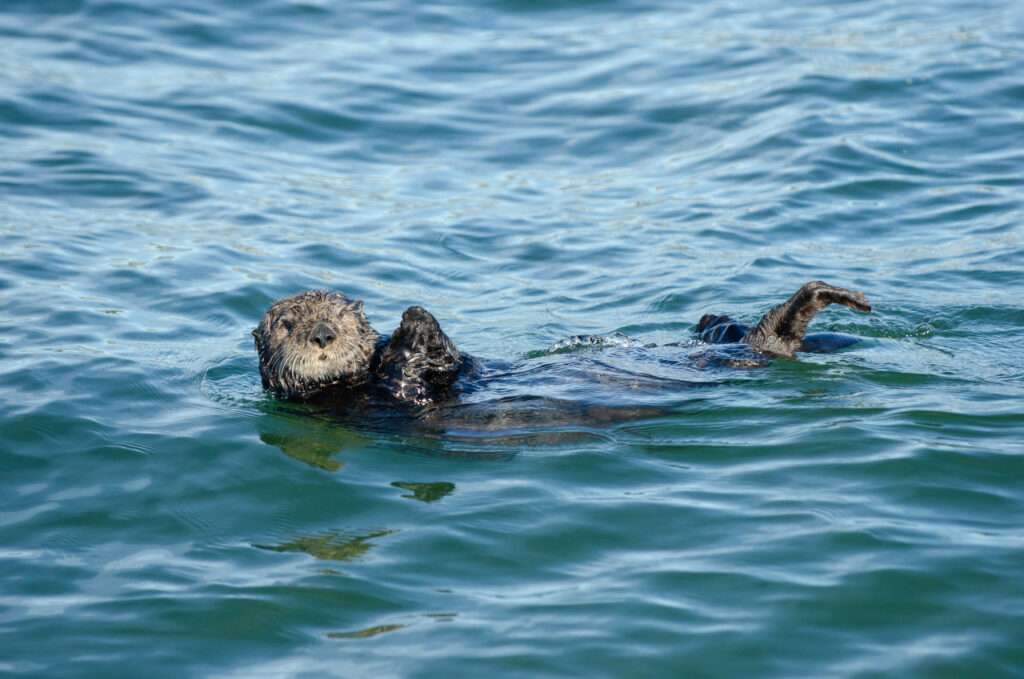
BUT THEY OTTER Many people don’t know that Elkhorn Slough has the highest concentration of southern sea otters along the California coast. Photograph by Rich van der Linde.
Submit to ph****@*******es.sc. Include information (location, etc.) and your name. Photos may be cropped. Preferably, photos should be 4 inches by 4 inches and minimum 250dpi.
GOOD IDEA
FLOWERING MEMORIES
This Labor Day weekend, join in on Capitola’s tribute to its famed Begonia Festival. For 65 years, the nautical parade of floats with multi-colored begonias filled Soquel Creek and floated into the beach lagoon. In 2017, the colorful floats sailed one final time, as the next year the Golden State Bulb Growers ceased its begonia bulb business. But now, we have the chance to relive that era, with festival memorabilia, stories and more at the Capitola City Hall and the Museum. Find out more at capitolavillage.com.
GOOD WORK
REPURPOSING WITH PURPOSE
Wilder Ranch State Park had a little makeover recently: the historic doors on its horse barn have been restored and secured, and the barn is ready for locals to see. The two doors on the 1890s-era barn were rehung thanks to the hard work of State Parks staff, who removed rotten wood and replaced 20 percent of the old doors, sourcing lumber from CZU-fallen trees. The ranch’s livestock can sleep easier at night thanks to the added security.
QUOTE OF THE WEEK
“No one has family in Hawaii. Everyone is family in Hawaii.”
The summer of 1938 was promising to be an auspicious one for the seaside community of Santa Cruz. Well before the coming of the tourist season, newspapers across California were announcing a star-studded lineup of international swimming champions, races, acrobatic acts and Hawaiian musicians who would be convening at the Santa Cruz waterfront for a magical summer.
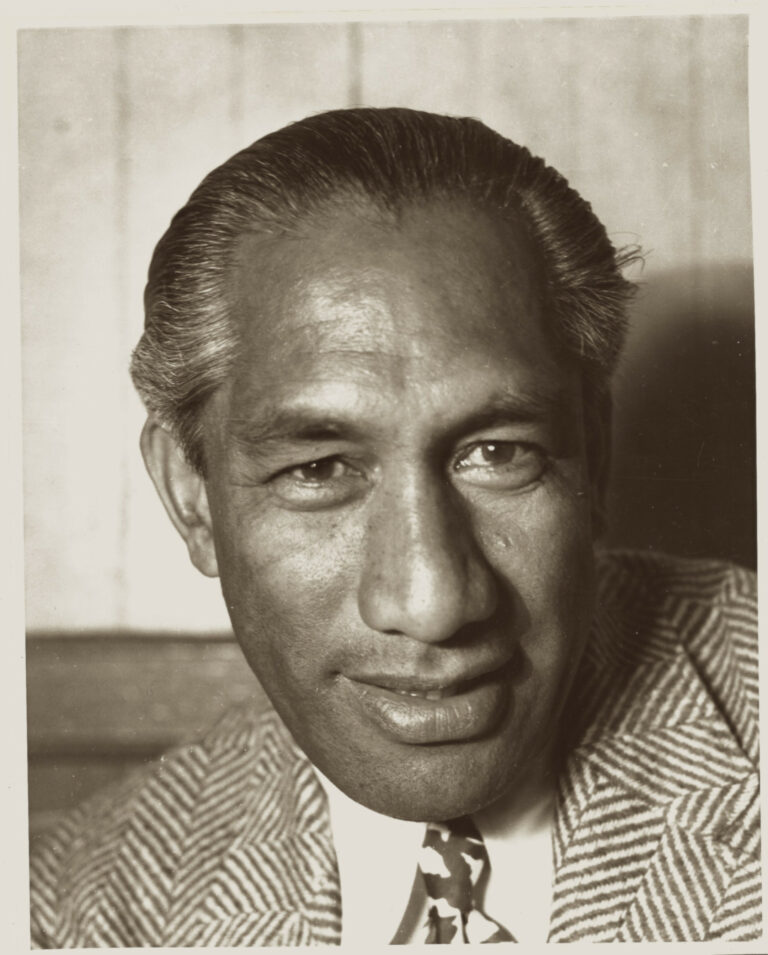
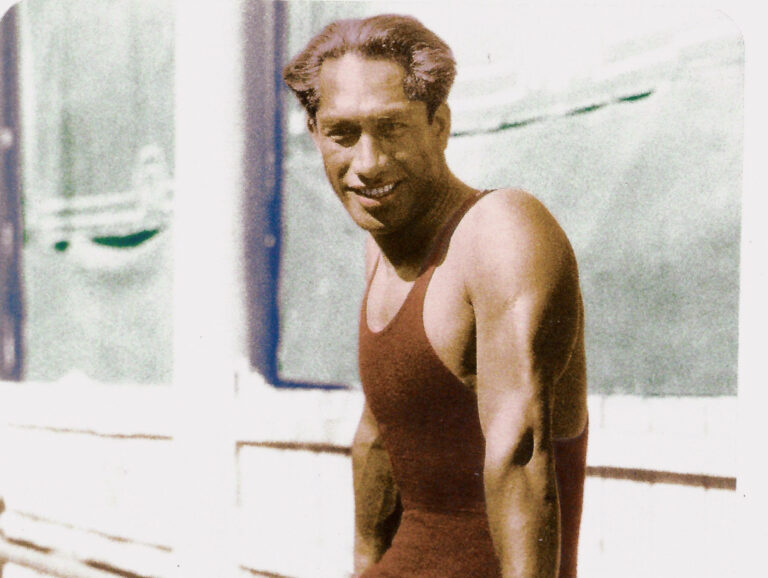
Headlining the extravaganza would be none other than one of the great Olympic athletes of all time—swimming legend Duke Kahanamoku, who was among the most famous sports figures in the world. The Duke had set countless world and national records, and had spectacularly won three gold and two silver medals in a trio of Olympiads, in Stockholm (1912), Antwerp (1920) and Paris (1924). At the age of 41, he was named as an alternate to the U.S. water polo team for the 1932 Olympics in Los Angeles.
Moreover, he was widely considered the world’s greatest surfer, an international and regal ambassador of the waves.
As the Great Depression wore on into the late 1930s, and global war seemed imminent, Kahanamoku’s arrival in Surf City promised a bright light in a decade of economic doom and looming geopolitical darkness. By June of 1938, the Amateur Athletic Union in Honolulu had named an All-Hawaii swim team—composed of six men and three women—to join Kahanamoku on his California jaunt. Several venues from San Diego to Los Angeles to San Francisco were added to the Kahanamoku itinerary, with the Duke’s culminating California appearance slated for Santa Cruz on July 16 and 17.
By the beachfront’s booming Independence Day weekend, posters featuring the Duke were plastered throughout town proclaiming Kahanamoku’s arrival at the “Greatest Water Carnival Ever Presented.” The posters were both designed and composed by the Boardwalk’s legendary impresario Skip Littlefield, an inimitable one-man promotion machine, who had produced the waterfront’s famed Water Carnivals since the late 1920s.
“Witness in action the Greatest Swimmer of All Time, The Mighty Hawaiian Natator, Who Revolutionized & Astounded the Aquatic World for Twenty-five Years,” Littlefield’s poster declared. “Positively the Greatest Aquatic Show Ever staged on [the] Pacific Coast.”
Littlefield was a carnival barker at heart, and hyperbole ran through his veins. In a bylined article in the Santa Cruz Sentinel promoting his own event, Littlefield declared, “The arrival of the Duke signals the zenith in aquatic spectacles at the famed beach natatorium.” Locals were getting a glorious taste of the islands and Hawaiian culture, Littlefield asserted. “To seaside folk it seems in the light of present programs that the famous beach of Waikiki has moved in spirit to the Santa Cruz strand.”
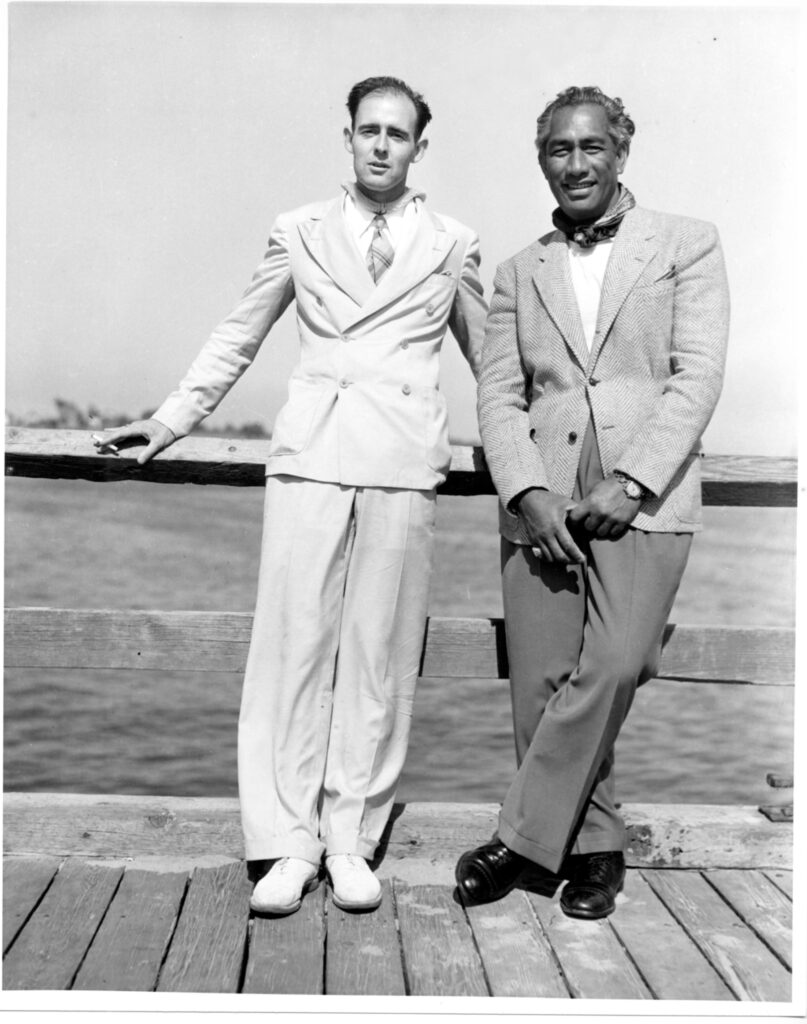
Kanahamoku (right) with the Beach Plunge’s inimitable impresario Skip Littlefield, left, on the old Pleasure Pier during the final weekend of Duke’s visit in July of 1938. PHOTO: GEOFFREY DUNN COLLECTION
The Duke and his aquatic all-stars crossed the Pacific on the luxury ocean liner Matsonia and disembarked on June 29 in Wilmington, at the Port of Los Angeles, quickly making their way to San Diego for their first exhibition. They stayed three days in the southland, where the Los Angeles Times greeted the Hawaii contingent with banner headlines and large pictures of the Islanders practicing at the Olympic Swim Stadium, where a “model sports girls review” was woven into the competition—it was L. A. after all.
For the next two weeks the Hawaiians performed to swollen summer crowds, with a penultimate stop at the Del Monte Lodge in Monterey before their final jaunt to Santa Cruz. A huge banquet and awards ceremony was scheduled at the Palomar Hotel for Friday night, but at the last moment, the promoters in Monterey pulled a fast one, scheduling a second show on Friday (the demand for tickets had been enormous) and forcing a cancellation of the dinner Littlefield and the local Rotary Club had painstakingly planned.
“It was a great disappointment,” Littlefield told me years later, in his smoke-and-scotch saturated voice straight out of a Dashiell Hammett novel. “I can’t deny it. But the following nights produced two of the greatest aquatic shows this waterfront, or anywhere else for that matter, has ever witnessed. Standing room only! Spectacular!”
On Saturday night, a packed crowd witnessed new records set by Hawaiian swimmers at the Plunge—the massive salt-water pool that was part of the Boardwalk from 1907 to 1963—in the 50-yard freestyle and the 100-yard backstroke. When the Duke himself took to the pool, he showcased a number of freestyle techniques, including the Australian crawl and his own stroke that he developed during his teen years. He also, according to the Sentinel, exhibited “the art of paddling a surfboard without benefit of ocean breakers.”
Sunday, it was more of the same. By the time the weekend was over, the Hawaiians had set several new Plunge records and had come close to breaking world marks. Two young swimmers from Stockton also made their presence known, with Paul Herron setting tank records in the 220 and 440-yard freestyle races, and Fred Van Dyke taking two seconds off the standing record in the 100-yard backstroke.
But perhaps the most significant historic event of Kahanamoku’s visit took place away from the Plunge, on a surf break south and west of the Main Beach, though precisely where on the coast remains uncertain.
Front-page headlines in the Sentinel declared that “Santa Cruz Will Break Out Surfboards for Hawaiians,” reporting that “Surfboard riding off the breaker lines of Santa Cruz by Duke Kahanamoku and his golden merrymen from Hawaii is expected this weekend to bring a flood of newsreel cameraman and a flood of heartening publicity for this city.”
Ever since the famed three Hawaiian princes—David Kawananakoa, Edward Keliiahonui and Jonah Kuhio Kalaniana’ole—first surfed at the San Lorenzo Rivermouth in 1885, Santa Cruz had a fledgling but persistent surf culture that would come to full fruition in the late 1930s and early 1940s with the Santa Cruz Surf Club, whose members would include the likes of Harry Mayo, Bob Rittenhouse, Doug Thorne, Bill Grace, Hal Goody and Don “The Mighty Bosco” Patterson, the latter of whom was also a perpetual star in the Boardwalk’s Water Carnivals.
It was reported that a “long Philippine mahogany board was procured for the Duke during his visit here, and several other hollow-type boards will be pressed into service for other members of the Hawaiian swimming delegation.” Many, if not all, of the boards had come from members of the surf club, and other non-members such as Leland “Scorp” Evans and Andy Caviglia who had made their boards in a Santa Cruz High woodshop class earlier in the decade.
Evans later told surfing historian Kim Stoner and I that he had ridden with Duke and other members of the Hawaiian contingent on a break west of Cowell’s Beach (he actually pointed his arm in that direction), which I assumed was a reference to Indicators. However, Herb Scaroni, a pioneer North Coast rancher, told Stoner that Duke and the local contingent actually surfed the break at Four Mile, just down the coast from his family’s old dairy ranch.
Unfortunately, the newsreel footage of the Duke’s surfing expedition referenced in the newspaper accounts has never been located, nor have any photographs, so the precise 1938 Kahanamoku surf spot remains something of a mystery. The closest we’ve come is Evans waving his arm toward a phantom direction of his memory.
Duke Paoa Kahinu Mokoe Hulikohola Kahanamoku was born in Honolulu in 1890, a politically tumultuous time for his native island nation. Within just a few years of his birth, U.S. business interests—with the backing of the U.S. government—staged a coup d’état against the Kingdom of Hawaii, then presided over by Queen Liliʻuokalani. The Americans established a temporary government, with the primary purpose of protecting their business interests, and following a shameful political Keystone Cop routine of unbridled imperialism, the U.S. formally annexed the islands in 1898, establishing Hawaii as a U.S. territory, and by 1900, making the 10-year-old Duke an American citizen.
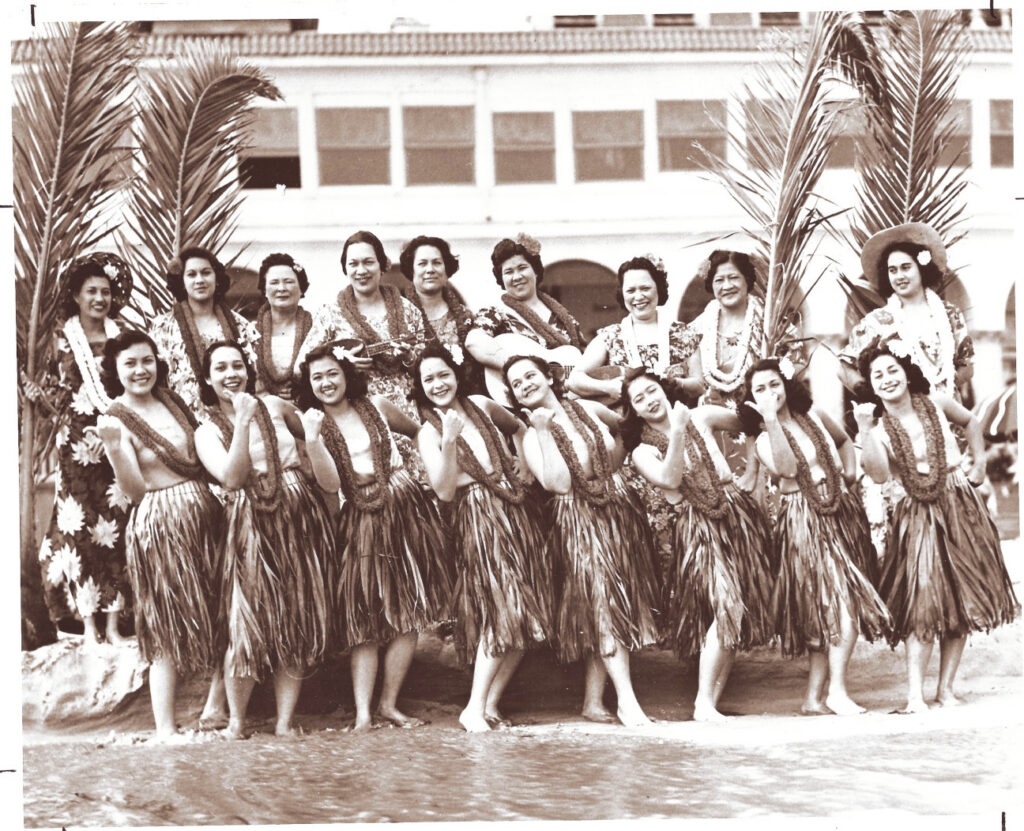
The Royal Hawaiian Girls Glee Club, pictured outside the Plunge, was a chorale group from Honolulu who headlined at the Boardwalk during the summer of 1938. PHOTO: GEOFFREY DUNN COLLECTION
While he claimed indirect lineage to King Kamehameha I, “Duke” was neither a nickname nor an official title, but rather the given name of his father, who had been bestowed the appellation after a visit to the islands by Prince Alfred, the Duke of Edinburgh. As a boy, according to his biographer David Davis, his family and friends called him Paoa to distinguish him from his father (who worked as a police officer in Honolulu).
An uninspired student throughout his youth, Duke excelled in childhood games and physical activities, both on land and in the Pacific waters surrounding his homeland. By the age of four, he was an avid swimmer, and soon began to dive, body surf, board surf, sail and handle his position paddling an outrigger canoe. He also excelled in football, baseball (a popular sport in the islands) and boxing.
Kahanamoku’s great love, however, was always at the beach at Waikiki, where great and well-formed waves rolled in daily from several different breaks as far out as a mile from shore. As a result, the young Duke developed a freestyle stroke that made him the best swimmer of the Waikiki beach boys, who had revitalized the art of surfing.
In the summer of 1911, the Duke was timed in the 100-yard freestyle in 55.4 seconds, crushing the existing world record. The haole officials in the Amateur Athletic Union centered in the U.S. mainland refused to honor the time, claiming that Kahanamoku must have been aided by Pacific currents or imprecise watches.
A year later, Kahanamoku put those myths to rest. In February of 1912, he boarded the SS Honoluan for San Francisco and continued by train to Chicago (along the way he would see his first snow), then on to Pittsburgh and New York, where his swimming performances in a variety of meets would earn him a spot on the U.S. Olympic team in both the 100-freestyle and the 4×200 relay.
Duke’s arrival on the East Coast in the middle of winter presented a myriad of challenges for him. He was used to swimming outdoors, in the ocean, without the confines of a swimming pool. He had to learn to navigate a completely foreign culture, not to mention split-second turns in a concrete pool. His life and virtually every movement on the mainland was dictated by a clock; not by the rhythms of nature, as they had been in Hawaii.
By the time he got to Stockholm, Sweden, site of the 1912 Summer Olympics, he was ready for his first shining moment on a world stage. In an outdoor facility constructed specially for the Olympics in Stockholm Harbor, and with King Gustaf V and his wife Queen Victoria in attendance, the 21-year old Kahanamoku cruised to an easy victory in the 100 meter freestyle, setting a new world’s record and winning a pure gold Olympic medal.
He later picked up a silver medal on the 4×200 U.S. relay team—which lost, despite a gallant effort by Duke, to an Australian team that also set a world record in the event. And he apparently attempted a surf session in Stockholm’s Strommen River, a relatively unknown event that was recorded at the time by the Stockholm newspaper Dagens Nyhet. Kahanamoku had begun what would be a lifelong career as an ambassador of surfing around the globe.
Original poster from the summer of 1938 featuring Duke Kahanamoku.
PHOTO: GEOFFREY DUNN COLLECTION
In the aftermath of his initial Olympic glory, Kahanamoku—with his dark thick hair, handsome bronzed features and million-dollar smile—became a worldwide media darling. He was invited to swimming exhibitions in Moscow, Algiers and Hamburg, then back across the Atlantic for a surfing exhibition in Atlantic City, where the Duke first introduced the sport of kings to the eastern seaboard. Thousands of visitors crowded in to Atlantic City’s Steel Pier to witness the event.
The following year, he travelled back to California—this time as a destination, not a pass-through, as it had been on his way to his first Olympic tryouts. During the summer of 1913, he absolutely dominated swimming meets at San Francisco’s famed Sutro Baths as well as at the city’s Olympic Club.
During the final week of July, Kahanamoku and an Hawaiian swimmer identified in newspapers throughout the west as “Bobby Kawaa” ventured to Santa Cruz, where they raced in the Plunge before standing-room crowds of more than 2,000 spectators (Kahanamoku set a world’s record in the 50-yard freestyle), and also gave exhibitions in surfboard riding.
Despite claims by various surf historians that Kahanamoku had surfed in Southern California in 1912, this would have been Kahanamoku’s first recorded account of surfing on the West Coast. While in Los Angeles earlier that month, Kahanamoku had told a reporter for the Los Angeles Times that the waves in Southern California weren’t strong enough to ride. He was looking for a little surfing “to remind him of home.”
Apparently he and his partner found some surf here. On Monday, July 28, the Evening News reported that “Bobby Kawaa gave fine exhibitions of surf riding and presented his surf board of the tournament to Manager Wilson of the Casino.”
The 1916 Olympics, slated for Berlin, promised to feature a 25-year-old Kahanamoku in his athletic prime, but were cancelled because of the outbreak of World War I. In 1920, Kahanamoku, on the eve of his 30th birthday, was again selected to represent the Olympic team in a pair of races slated for Antwerp, Belgium (a city severely damaged by the carnage of the Great War).
On his way to the Olympics, Kahanamoku and six other members of the Hawaiian swim club arrived in Santa Cruz and participated in races at the Plunge. Kahanamoku dominated his signature 100-meter freestyle, while his teammates won most of the other races as well. Once again, the Duke and his colleagues took to the surf.
“The … Hawaiians attracted much attention Sunday after the swimming meet,” the Sentinel reported, “when they came outside and for a time were riding on the breakers, at which they are adept. They were seven in number, and after finishing their engagement on the coast are to go to Chicago for the tryout for the great athletic meet at Antwerp.”
This time, the Duke emerged with a pair of gold medals in the Olympics, setting yet another world record in the 100-meter freestyle and this time claiming first place on the 4×200 relay team.
Kahanamoku’s Olympic victories following the brutalities of World War I made him an international celebrity. He toured Europe to widespread acclaim, then returned to Hawaii, where he was received as royalty, but spent frustrating days seeking out a living in Honolulu catering to Waikiki tourists. A few years later, he moved to Los Angeles, where he tried his hand at a movie career (he had bit parts in several films) and finally discovered Southern California waves to his liking.
In 1925, using a surfboard, he rescued eight men from a fishing vessel that had capsized off Newport Beach. That effort led to many life guard units—including those in Santa Cruz—employing surfboards as standard equipment for their rescue units.
By the end of the decade, Duke gave up on his Tinseltown dreams and returned to Hawaii. In 1932, he was elected Sheriff of Honolulu—a position that he held until 1961—and which allowed him to tour the world as an ambassador of the aquatic arts. He remained a master waterman until the time of his death in 1968, a beloved and revered figure worldwide.
His 1938 sojourn to Santa Cruz, however, would be his third and last. In advance of his visit, Skip Littlefield, his pal from the Boardwalk, penned a profile in his honor. “Other champions have come and gone and their fame has most generally been forgotten,” Littlefield wrote. “But to the youth of many generations the name and greatness of Duke Kahanamoku is like the surging seas off his own paradise isle—never ceasing and never ending.”
Special thanks to Kim Stoner and Barney Langner for supportive research on this article.
The move to district elections that was supposed to bring more Latinx representation to Santa Cruz City Council might instead produce a drastically less diverse body of elected leaders in its debut.
Ultimately, this led to the city’s shift to district elections earlier this year. Santa Cruz was split into six districts that will determine their representatives in upcoming elections, with an at-large elected mayor.
But despite the stated goal of increasing diversity among local elected officials, all but one of six candidates for the two city council seats up for grabs in the upcoming Nov. 8 midterm—the city’s first cycle using district voting—are white.
In addition, the council could also become less diverse after the 3rd District Santa Cruz County Supervisor race between councilmembers Justin Cummings and Shebreh Kalantari-Johnson.
Whether he wins the supervisorial seat or not, Cummings will leave the council at the end of the year, as his first term is set to expire in December—in order to focus on the supervisor race, he did not file for reelection. Kalantari-Johnson’s term doesn’t expire until 2024, but if she bests Cummings in November, she will have to vacate her seat on the city council. Santa Cruz would then have to host a special election to fill the vacancy.
With the council potentially losing a woman of color and a Black man, depending on how the supervisor race shakes out, some worry about how this election will reshape the demographics of the council. Currently, it features a more diverse range of councilmembers than the city has ever seen, with three Black members, one gay member and six women serving.
The lack of diverse candidates is one of the primary reasons that Hector Marin, the only Latinx candidate for city council, was inspired to run to represent District 4—which encompasses downtown and the Beach Flats and Mission Street neighborhoods. He hopes to give the Latinx community, which makes up 20% of Santa Cruz residents, representation.
If elected, Marin would be just the third Latinx candidate to serve on the council in the past quarter-century.
Looking at the make-up of the candidates that are running, Marin doubts that the move to district elections will result in its intended goal of bringing more Latinx representation.
As researchers continue to study the relatively new concept of district elections leading to more minority representation, more people are questioning the link, and whether all cities are fit for such electoral systems. Some wonder about the intentions behind the legal threats levied against cities, and whether district elections can have the opposite intended effect, resulting in less diversity in local political offices.
“I’m the only Latino candidate, period,” says Marin. “That’s crazy when this whole change [to district elections] was arranged so there can be more representation for the Latinx community. Now, we see the opposite of that within Santa Cruz.”
Behind the Scenes
In the past two decades, more than 150 cities have transitioned to district elections, due to lawsuits that claim violations of the CVRA.
It costs cities upwards of $1 million to challenge these lawsuits. Santa Monica is fighting the allegation that its voting system is racially polarized, and has already spent more than $8 million. That case is still underway—and to date, no jurisdiction has been successful in challenging a CVRA violation lawsuit.
Robb Korinke says he wouldn’t be surprised if every city in California soon switches to district elections, even if the move doesn’t always result in more minority local officials.
Korinke is the principal director of GrassrootsLabs, an organization that researches and collects data analysis on state and local government issues. District elections came on Korinke’s radar in recent years, as their prevalence accelerated across the state—from 2002 to 2016, cities with district elections nearly doubled.
What Korinke wanted to find out was if this switch led to the results that the lawsuits intended: more Latinx representation.
“Is a conversion of districts a guarantee to increased Latino representation? Our research shows that no, it is not,” says Korinke.
There may not be a guarantee, but what his team found by looking at cities transitioning to districts in 2016, 2018 and 2020, was a measurable increase in Latinx representation.
From 2015 to 2021, the percentage of Latinx representatives across those cities jumped from 7.5% to 18%.
Still, Korinke says his research found a few cities where Latinx representation in that time frame was lost after the switch to district elections. That happened in eight different cities across California. In those instances, the Latinx representative lost to someone who was not from a minority background.
Korinke says that regardless of whether district elections are the solution for more Latinx candidates being elected to local government, the business of threatening cities with a CVRA lawsuit is a profitable one, because attorneys never lose.
“It became a cottage industry for attorneys to go and sue cities and force them and compel them into districts,” says Korinke. “The legislature actually passed a law that reduced the damages, or the legal fees paid out to the lawyers. But there are a handful of attorneys that have really taken this and made it a central part of their business.”
Attorney Kevin Shenkman is one such lawyer making a name for himself by threatening cities with lawsuits over at-large elections. Even though Shenkman estimates that he has filed hundreds of complaints against cities, he says he’s not in it for the money. But Shenkman does acknowledge that some attorneys in this industry are less interested in more diverse representation, and more interested in monetizing the system.
He finds it interesting that Santa Cruz was hit with the lawsuit, as he says his firm looked into Santa Cruz not too long ago but decided against pursuing any legal threats related to voting rights violations. Shenkman doesn’t remember the exact reasoning behind this decision, but he guesses his firm likely did not find enough evidence that Santa Cruz’s at-large election system was diluting the Latinx vote.
Shenkman says that his firm uses experts to determine racially polarized voting, usually by analyzing data from past elections. Some other things Shenkman considers before pursuing legal actions are what percentage of the population is of Latinx descent, how many of those people are registered to vote, if that population is clustered in one area and, lastly, the city council’s racial make-up.
The Santa Cruz complaint was brought forward by Santa Barbara-based Fargely Law on behalf of Travis Roderick, an area resident who also brought a similar claim to Santa Cruz City Schools, which consequently shifted to district elections.
The lawyer who filed the civil complaint, Micah David Fargey, is now suspended from practicing law. In April of this year, the State Bar Court of California found he had failed to perform his duties in competence on behalf of one of his clients. When he filed the lawsuit in May of 2020, Fargey was a licensed attorney, and at this point, it would be too late to change course, city officials say.
Santa Cruz City Manager Matt Huffaker says that even with this development, Santa Cruz’s fate is sealed: the move to district elections is underway.
Overall, Korinke says that district elections aren’t a fix-all. Bigger cities with higher concentrations of minorities in specific areas have a better chance of using district elections to increase the diversity of city officials, he says. While district elections do decrease financial barriers to running campaigns, and also diversify the candidates geographically, he says, there are too many factors for them to guarantee more diversity.
“They’re not a silver bullet. It is not a guarantee that your city is moving to districts based on a lawsuit that they must increase Latino representation,” says Korinke. “If a community is underrepresented, historically, districts are an important tool to try and correct that.”
Tracking Trends
Santa Cruz’s neighbor to the south, Watsonville, is also facing a diversity shift in its city council that might lead to fewer Latinx representatives after its midterm elections.
Watsonville has had district elections for decades, and even helped perpetuate the notion that this system increases the chances of producing Latinx elected representatives. According to the 1980 Census, people of Latinx descent made up 36% of Watsonville’s community, but there was only one Latino on the city council in 1989. Locals sued the city for inadequate Latinx representation in their elected leaders, and the case went all the way to the Supreme Court, which found that the city’s at-large elections were, indeed, diluting the Latinx vote.
At the time, this was a huge win for voting rights activists like Celia Organista, who was a member of the organization behind the effort to change the district elections.
Now, some 30 years later, two white candidates are running unopposed to replace two current Latinx representatives. These changes—and the result of the Fourth District Supervisor race between Felipe Hernandez and current councilmember Jimmy Dutra—could produce a Watsonville City Council with just three people of Latinx descent, the fewest since 2000. Since the turn of the century, the Watsonville City Council—which represents a constituency that is now more than 85% Latinx—has had four to five Latinx council members out of the seven seats.
Organista acknowledges that district elections aren’t all she had hoped for, and don’t hold the key to unlocking more Latinx representation—it’s more nuanced than that, she says.
“The more you kind of look at what it takes to do those kinds of local political roles, the more you see why it’s hard to engage Latinos,” says Organista. “People shy away because they don’t have the support that sometimes people who have more money have, they don’t have the time, they’re working full-time jobs.”
That’s also what Watsonville Councilmember Rebecca Garcia, a Latina who will be “termed out” of office in December, encountered when trying to recruit Latinx people to run to replace her. People are recovering from the pandemic, and don’t have the time to prioritize running for office, Garcia said via email. The candidate running unopposed in her district, Casey Clark, is white.
Time is a challenge that Marin has to contend with. He’s working two jobs in addition to running for election. He says he doesn’t have the luxury of dropping his jobs and campaigning 24/7.
“Privilege is 100% a factor in the way that we elect people into office,” says Marin. “There is privilege in race, also privilege in class.”
In some ways, having one district to focus on helps Marin tackle time and financial restrictions—his spending is centralized, and he has a pocket of roughly 10,000 residents to focus on, rather than the city’s overall population of roughly 64,000.
But it’s not necessarily an equalizer.
“Is it easier to run in district elections than had this been the at-large system? Um, I believe that’s a strong maybe,” says Marin.
ARIES (March 21-April 19): In his poem “Autobiographia Literaria,” Aries-born Frank O’Hara wrote, “When I was a child, I played in a corner of the schoolyard all alone. If anyone was looking for me, I hid behind a tree and cried out, ‘I am an orphan.'” Over the years, though, O’Hara underwent a marvelous transformation. This is how his poem ends: “And here I am, the center of all beauty! Writing these poems! Imagine!” In the coming months, Aries, I suspect that you, too, will have the potency to outgrow and transcend a sadness or awkwardness from your own past. The shadow of an old source of suffering may not disappear completely, but I bet it will lose much of its power to diminish you.
TAURUS (April 20-May 20): In his poem “Auguries of Innocence,” William Blake (1757–1827) championed the ability “to see a World in a Grain of Sand. And a Heaven in a Wild Flower. Hold Infinity in the palm of your hand.” According to my reading of the astrological omens, Taurus, you are primed to do just that in the coming days. You have the power to discern the sacred in the midst of mundane events. The magic and mystery of life will shine from every little thing you encounter. So I will love it if you deliver the following message to a person you care for: “Now I see that the beauty I had not been able to find in the world is in you.”
GEMINI (May 21-June 20): “The time you enjoy wasting is not wasted time,” said philosopher Bertrand Russell. I will add that the time you enjoy wasting is often essential to your well-being. For the sake of your sanity and health, you periodically need to temporarily shed your ambitions and avoid as many of your responsibilities as you safely can. During these interludes of refreshing emptiness, you recharge your precious life energy. You become like a fallow field allowing fertile nutrients to regenerate. In my astrological opinion, now is one of these revitalizing phases for you.
CANCER (June 21-July 22): “My own curiosity and interest are insatiable,” wrote Cancerian author Emma Lazarus (1849–1887). Inspired by the wealth of influences she absorbed, she created an array of poetry, plays, novels, essays and translations—including the famous poem that graces the pedestal of America’s Statue of Liberty. I recommend her as a role model for you in the coming weeks, Cancerian. I think you’re ripe for an expansion and deepening of your curiosity. You will benefit from cultivating an enthusiastic quest for new information and fresh influences. Here’s a mantra for you: “I am wildly innocent as I vivify my soul’s education.”
LEO (July 23-Aug. 22): Blogger Scott Williams writes, “There are two kinds of magic. One comes from the heroic leap, the upward surge of energy, the explosive arc that burns bright across the sky. The other kind is the slow accretion of effort: the water-on-stone method, the soft root of the plant that splits the sidewalk, the constant wind that scours the mountain clean.” Can you guess which type of magic will be your specialty in the coming weeks, Leo? It will be the laborious, slow accretion of effort. And that is precisely what will work best for the tasks that are most important for you to accomplish.
VIRGO (Aug. 23-Sept. 22): “Now that I’m free to be myself, who am I?” Virgo-born Mary Oliver asks that question to start one of her poems. She spends the rest of the poem speculating on possible answers. At the end, she concludes she mostly longs to be an “empty, waiting, pure, speechless receptacle.” Such a state of being might work well for a poet with lots of time on her hands, but I don’t recommend it for you in the coming weeks. Instead, I hope you’ll be profuse, active, busy, experimental and expressive. That’s the best way to celebrate the fact that you are now freer to be yourself than you have been in a while.
LIBRA (Sept. 23-Oct. 22): In her book Tales From Earthsea, Libra-born Ursula K. Le Guin wrote, “What goes too long unchanged destroys itself. The forest is forever because it dies and dies and so lives.” I trust you’re embodying those truths right now. You’re in a phase of your cycle when you can’t afford to remain unchanged. You need to enthusiastically and purposefully engage in dissolutions that will prepare the way for your rebirth in the weeks after your birthday. The process might sometimes feel strenuous, but it should ultimately be great fun.
SCORPIO (Oct. 23-Nov. 21): As a Scorpio, novelist Fyodor Dostoyevsky was rarely guilty of oversimplification. Like any intelligent person, he could hold contradictory ideas in his mind without feeling compelled to seek more superficial truths. He wrote, “The causes of human actions are usually immeasurably more complex and varied than our subsequent explanations of them.” I hope you will draw inspiration from his example in the coming weeks, dear Scorpio. I trust you will resist the temptation to reduce colorful mysteries to straightforward explanations. There will always be at least three sides to every story. I invite you to relish glorious paradoxes and fertile enigmas.
SAGITTARIUS (Nov. 22-Dec. 21): Author Zadie Smith praised Sagittarian writer Joan Didion. She says, “I remain grateful for the day I picked up Joan Didion’s Slouching Towards Bethlehem and realized that a woman could speak without hedging her bets, without hemming and hawing, without making nice, without sounding pleasant or sweet, without deference and even without doubt.” I encourage Sagittarians of every gender to be inspired by Didion in the coming weeks. It’s a favorable time to claim more of the authority you have earned. Speak your kaleidoscopic wisdom without apology or dilution. More fiercely than ever before, embody your high ideals and show how well they work in the rhythms of daily life.
CAPRICORN (Dec. 22-Jan. 19): Capricorn novelist Marcia Douglas writes books about the history of her people in Jamaica. In one passage, she writes, “My grandmother used to tell stories about women that change into birds and lizards. One day, a church-going man dared to laugh at her; he said it was too much for him to swallow. My grandmother looked at him and said, ‘I bet you believe Jesus turned water into wine.'” My purpose in telling you this, Capricorn, is to encourage you to nurture and celebrate your own fantastic tales. Life isn’t all about reasonableness and pragmatism. You need myth and magic to thrive. You require the gifts of imagination and art and lyrical flights of fancy. This is especially true now. To paraphrase David Byrne, now is a perfect time to refrain from making too much sense.
AQUARIUS (Jan. 20-Feb. 18): To be the best Aquarius you can be in the coming weeks, I suggest the following: 1. Zig when others zag. Zag when others zig. 2. Play with the fantasy that you’re an extraterrestrial who’s engaged in an experiment on planet Earth. 3. Be a hopeful cynic and a cheerful skeptic. 4. Do things that inspire people to tell you, “Just when I thought I had you figured out, you do something unexpected to confound me.” 5. Just for fun, walk backward every now and then. 6. Fall in love with everything and everyone: a D-List celebrity, an oak tree, a neon sign, a feral cat.
PISCES (Feb. 19-March 20): A blogger who calls herself HellFresh writes, “Open and raw communication with your partners and allies may be uncomfortable and feel awkward and vulnerable, but it solves so many problems that can’t be solved any other way.” Having spent years studying the demanding arts of intimate relationship, I agree with her. She adds, “The idea that was sold to us is ‘love is effortless and you should communicate telepathically with your partner.’ That’s false.” I propose, Pisces, that you fortify yourself with these truths as you enter the Reinvent Your Relationships Phase of your astrological cycle.
The Soquel Creek Water District received a grant of nearly $21 million for its Pure Water Soquel Groundwater Replenishment and Seawater Intrusion Prevention Project this month. The funds came from the U.S. Bureau of Reclamation, as part of President Joe Biden’s Bipartisan Infrastructure Law.
The federal WaterSMART Title XVI program supports water recycling and reuse projects in western states. This month, it provided $54 million in funding to projects along the Central Coast, including Soquel.
“We are so grateful for this $21 million grant which, when added to the prior $9 million grant awarded under this program, represents a benefit of $2,000 per each of our 15,000 customer accounts,” said Tom LaHue, president of the water district’s board of directors, in a statement.
Soquel Creek Water District serves more than 40,000 local residents using groundwater from the Mid-County Groundwater Basin. For several years, users pumped water out of the basin quicker than it could naturally refill, and seawater began to creep into the space left behind.
The basin was officially categorized as “critically overdrafted” in 2015. The Pure Water Soquel project aims to help remedy that by pumping recycled water back into the ground to create a freshwater barrier against seawater intrusion.
Wastewater will go through advanced purification to drinking water standards before getting injected back into the basin at three seawater intrusion prevention wells.
“The more than $20 million in federal funding that we just got from the bipartisan IIJA for the Soquel Creek Water District will not only help bolster the productivity of the project but also demonstrates the will of the federal government to help us buoy our drought resiliency and water sustainability on the Central Coast,” said Congressman Jimmy Panetta in a press release.
The project is currently in the construction phase, with eight miles of pipeline going underground between the Westside of Santa Cruz and Aptos. Construction also includes nine monitoring wells, three injection wells, additions to the Santa Cruz Wastewater Treatment Facility and a new water purification center in Live Oak.
The project is estimated to cost around $90 million, and Soquel Creek Water District has taken advantage of several state and federal funding opportunities. In addition to the new $21 million grant, the agency received more than $52 million in grants from the state and $9 million from the U.S. Bureau of Reclamation, in addition to low-interest loans from the State Seawater Intrusion Control Loan Program and the U.S. Environmental Protection Agency’s Water Infrastructure Finance and Innovation Act program.
The water district plans to complete construction and begin operations by early 2024.