Jimmy Panetta on Impeaching Trump Twice and Threats to Democracy

In the days after the pro-Trump mob stormed the U.S. Capitol building on Jan. 6 in an attempt to overthrow results of the November election, U.S. Rep. Jimmy Panetta (D-Carmel Valley) received a letter from lawmakers in El Salvador.

Assemblymember Damian Alegria, who wrote the letter, expressed concern about the violence. “As I watched your Congress being overrun and the seat of your democracy being vandalized, I was saddened for you and for the world,” the letter stated. 

The backstory to the letter goes back nearly a full year. El Salvador witnessed a troubling use of force of its own in February 2020, when its president and a group of soldiers occupied the capitol in a show of force. In the days that followed, Panetta wrote his own letter to U.S. Secretary of State Mike Pompeo, calling attention to the action and condemning it. Eighteen members of Congress, including Alexandria Ocasio-Cortez (D-New York) and Ted Lieu (D-Torrence), signed on to the letter. 

When rioters broke into the U.S. Capitol after being incited by President Donald Trump and his allies, the parallels were all too striking for Alegria and his colleagues. “You’re just like us,” he wrote. 

January has been an eventful month in American politics. Panetta made some time Thursday afternoon to talk with us about the riot at the Capitol, the impeachment of Trump, the letter from El Salvador, and what comes next.

Where were you when the looters broke into the Capitol building? Were you in your office?

JIMMY PANETTA: That’s correct. they had advised members who weren’t part of the states that were being challenged—so at that point it was mainly Arizona—to remain in their offices. They said you could go watch in the gallery. But based on that advisory, I had already scheduled a Zoom call with some constituents about vaccine distribution, so I had work to do. And in the middle of that call, U.S. Capitol Police came knocking on the door loudly and advising us that we had to leave. I went ahead and sent my staff out with them. But I stayed in my office because I had to finish that call! Then I had some other stuff to do as well, so I stayed holed up in my office the whole time.

Was that scary?

It was not scary. I was not scared. If anything, Jake, I was really pissed off. I was more angry than anything—watching the scene on TV unfold, getting text messages from my colleagues, who had then been ushered into a secure location in the Ways and Means Committee Room. I was not scared. They were not scared, or at least the ones I spoke to. If anything, we were really angry, upset. Then, as we saw the president was involved in the incitement, obviously it became distressing—that he played such an integral part of this, with the constant lies prior to it and then the incitement immediately before it. That’s what led to our vote yesterday and his second impeachment from the House of Representatives within four years.

When you supported Trump’s impeachment in 2019, did you think there was any possibility that you might end up impeaching him again before his term ended?

Look, you don’t ever go into this job thinking that you might have to impeach a president, you know what I mean? So it’s obviously something you don’t want to have to do, but it’s part of our responsibility to hold a president—especially like Donald Trump, who acts in the manner that he does, when it comes to causing disruption and violence—[accountable].

This second impeachment—I actually felt better about it than the first one. Similar to the first one, but more so in this one—you had strong evidence. It wasn’t just a phone call. It wasn’t just a transcript. This is something we saw play out on TV from right at the end of the November election all the way up to the day of Jan. 6. From his action and his incitement before the riot to his inaction and his failing to lead before the riot and then his thinking that it was appropriate, subsequent to the riot. I hope that the Senate not only feels the same way, but does the same thing, based on the evidence that’s out there. As a former prosecutor, you look at the facts, you look at the law, you apply the facts to the law, and that’s your verdict.

We’re not in a court of law. The Senate’s not a court of law. It’s a political courtroom. Therefore, they take in other political considerations, as we saw with the first impeachment. Let’s hope with new evidence and the drip-drip-drip of new videos, new information that’s coming out, that they feel not only is the evidence there but, politically, it’s the right thing to do to convict this president.

Would you have preferred that the Trump administration officials instead use the 25th Amendment to remove Trump from office?

No, I would have preferred that he just did the right thing and stepped down. Now, he obviously did not do that. We called on Vice President [Mike] Pence to step up and invoke the 25th Amendment by gathering the cabinet members and having them conclude that the president was unable to perform his duties. Now, Pence wasn’t able to do that. So we in the House of Representatives stepped up and impeached him.

Some Salvadoran legislators sent you a very powerful letter after the attempted coup at the Capitol. How long have you known those lawmakers?

Just during my time in office. There were a few members who came to Capitol Hill. Then, obviously, when I found out about the Feb. 9, 2020, incident, where [President Nayib Bukele and armed soldiers] stormed their legislature, I wanted to show our support to the members that we have members of Congress here in the U.S. who support them and their efforts to fully exercise their democracy and ensure that they don’t cower to threats of democracy, as I believe they tried to do when he and that group stormed the congress. So I wanted to send a letter to them, letting them know they had our support. They sent a letter back to us [this month], letting us know that we have their support. 

They did the right thing, in that they didn’t back down. And we did the right thing on the morning of Jan. 7, showing that we weren’t gonna back down. Despite the violence that was perpetrated on the Capitol, we got right back on the same House floor that they tried to storm, and we did our job. We certified the electoral college count, so that there will be a transition of power on Jan. 20. I appreciated that they sent me that letter, inspiring us that we would continue to do our jobs, just like we did to them.

The letter, written by Assemblymember Damian Alegria, ends with the passage, “I never imagined that anything like that could happen there. You’re just like us. We will be praying for you and your country.” Do you remember how you felt when you read that?

I took that to mean, ‘Look, we are not going to back down to any sort of violence or threats of violence when it comes to exercising our duties to uphold our constitution and to ensure that our democracy moves forward.’ They didn’t do it. We didn’t do it, and I believe that’s how we continue to move forward as a country. Our history has been riddled with more bad times than the good times. But the way we’ve been able to get through it is to do our jobs and uphold the U.S. Constitution and move forward. And this is one of those times. It’s obviously difficult  right now. There’s a lot of corrections that we have to make, but that’s one of the things that makes this democracy one of the greatest in the world. We can self-correct. We can make ourselves the more-perfect union that we’re supposed to be.

We could all use some of that optimism right now. However, the letter shows a lot of concern for the U.S., and obviously we have seen some Central American countries, like El Salvador, encounter real threats to their democracies. The letter expresses fears that the U.S. is trending in that direction, that our democracy is in danger—that maybe we’re no better off than they are. Do you share those concerns at all?

What you have to realize is that democracies are very fragile. It gives us a framework. But it’s up to individuals; it’s up to the people to make sure that we continue to make that framework strong enough to hold our house, our government, our country. What people need to understand is that politics flows down from morality. So when you are electing people to office, no matter what the position is, you need to make sure that they are the right character to reinforce and work for our democratic values.

As I said on the House floor, American exceptionalism is not guaranteed. We constantly have to work for it. We have to make it better. But like I said, that’s the good part, that we can make it better. Yes, we may have incidents like this, horrific incidents like we saw the sixth of January. But we damn well better be able to correct it and move forward, if we’re going to uphold our democracy, and I believe we will.

By very narrow margins, we’ll see a Democrat-controlled government when former Vice President Joe Biden assumes the presidency Jan. 20. What are you expecting?

It’s going to help that you have Joe Biden and Kamala Harris in the White House. You’re going to have a Democrat-led Senate and, of course, a House of Representatives led by Speaker Nancy Pelosi. Obviously, that’s a good foundation. But as you mentioned, based on the narrow majorities, it demonstrates [the need for] what I believe Joe Biden ran on. And that’s his ability to get things done and his ability to work together to get things done. I think that’s what people are yearning for after four years of a president who didn’t get much done. I believe it’s going to be refreshing. It’s going to be a sense of normalcy. That is exactly why President Biden won. So I’m very optimistic—in the sense that he will put together a national strategy on fixing Covid-19, basically making sure that the vaccines are distributed properly. We just had a briefing about the economic stimulus package he put forward. We will put forward an immigration package. We will put forward an immigration reform package. These are all big things that President Trump could have done, but clearly based on a lack of leadership didn’t do.

County’s Equity Measures Show Watsonville’s Struggles to Quell Covid-19

0

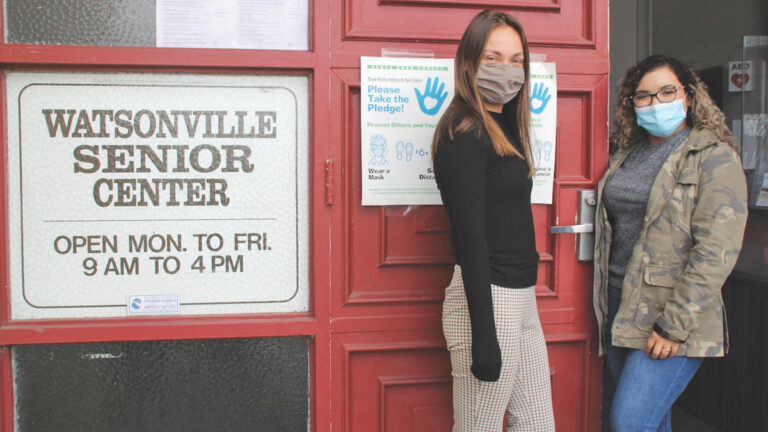
Current positivity rates in Santa Cruz County’s low-income and disadvantaged communities are among the worst in the state and Bay Area region, according to data reported by the California Department of Public Health.

The county’s “Health Equity Quartile Positivity Rate,” or test positivity rates in its most disadvantaged neighborhoods, was 22.7% on Wednesday, much higher than the overall county positivity rate of 12.3%. Only hard-hit counties in the Southern California and San Joaquin Valley regions have higher Health Equity positivity rates.

The Health Equity number, according to the state, focuses on the positivity rate data of test results coming from census tracts that have “low health conditions” as determined by the state’s Healthy Places Index.

The county’s troubling health equity numbers underscore the impact the pandemic has had on Watsonville, a primarily Latinx community with three census tracts that are in the bottom fourth of the Healthy Places Index range.

More than half of the county’s 11,447 cases have been identified in Watsonville, despite the city accounting for less than a fourth of the county’s population. The county’s Latinx residents, about a third of its population, have also been disproportionately affected by Covid-19, making up more than half of the area’s cases.

There have been roughly 6,100 cases in Watsonville since the start of the pandemic, meaning about one out of every nine residents in the city of some 55,000 has had Covid-19.

That trend is not unique to Santa Cruz County. According to state data released Jan. 6, Latinx Californians have accounted for 55.1% of Covid-19 cases and 47% of deaths related to the disease. White Californians, the second largest demographic in the state, have accounted for 20% of cases and 31.6% of deaths.

To try to make up for this and other inequities, counties are required to implement a Targeted Equity Investment Plan detailing their efforts of how they planned to promote “an equitable recovery.” Santa Cruz County’s most recent plan detailed a five-pronged attack that sought to improve testing, contact tracing, isolation support, data collection and community engagement, especially in South County.

In all, that plan distributed about $8 million worth of grants and other investments to various organizations such as UCSC, Santa Cruz Community Ventures, Pajaro Valley Community Health Trust, the South County Communications Task Force and Salud Para La Gente.

Despite that, cases in Watsonville—and the rest of the county—have continued to rise. And county officials say the next two weeks will be the most trying time of the pandemic.

The current surge, which began in early November, is starting to plateau as cases county officials believe were spread during Halloween and Thanksgiving gatherings have slowed. But cases resulting from Christmas and New Year’s gatherings, says Santa Cruz County Health Officer Dr. Gail Newel, are beginning to arise.

“Our case counts and test positivity rates are extraordinarily high right now and we would expect those to rise in the coming weeks as we absorb a surge in cases from the holidays,” she said in a prepared statement. “It is extraordinarily important—more important now than ever—that people stay home if possible, wear masks if they do go out in public, and especially avoid gathering with others outside your household. Don’t put yourself and your loved ones at risk.”

There were about 2,800 active cases in the county Wednesday, and the death toll continued its climb to 111 county residents. More than 8,500 residents have recovered from the disease, and about 330 have required hospitalization. That includes the 79 patients in county hospitals as of Wednesday, 14 of which were in the ICU, according to state data.

There were no ICU beds available in the county Wednesday, a statistic that closely mirrored the rest of the Bay Area region, which will be under the stay-at-home order until conditions improve, the CDPH announced this week.

Second Stimulus Bill to Support Arts and Culture Venues

On March 10, 2020, the Kuumbwa Jazz Center in Santa Cruz held a live performance, complete with a large audience, full band, and an open kitchen and bar.

What staff, musicians and patrons didn’t know at the time was that the concert would be the center’s last live event for more than a year. The pandemic brought everything to a halt, shutting Kuumbwa and all other venues like it to slow the spread of the virus.

“Suddenly, we didn’t have any more ticket or cafe sales, no promoters renting our space … all local events just came to an end,” said Kuumbwa’s Executive Director Bobbi Todaro. “It was shocking.”

Help for venues like Kuumbwa might finally be coming thanks to the new $900 billion Covid-19 Relief Act, which was signed into law on Dec. 27. The act includes a $15 billion funding package meant for independent arts and cultural venues through the Save Our Stages (SOS) Act.

SOS was passed thanks to a lobbying effort led by the National Independent Venue Association (NIVA), a coalition of more than 1,200 live venues across the U.S. The program, to be handled by the Small Business Administration, will assist live venue operators, promoters, theatrical producers, performing arts organizations, museums, movie theaters and talent representatives.

“It’s a remarkable story, what NIVA has accomplished,” Todaro said. “This funding is going to help so many.” 

Kuumbwa, a nonprofit which also works with county schools on music education, was able to apply and receive a loan from the Payroll Protection Program (PPP), which was part of last year’s Coronavirus Aid, Relief, and Economic Security (CARES) Act. But unlike PPP loans, SOS funding is grants-based, meaning venues will not need to pay back the amounts.

This will greatly help live venues, which even after the pandemic will not be able to open immediately—instead, they have to wait for the touring industry to return to somewhat normal operations. Artists, crews and more will all need to be rehired.

The SOS act allocates funds for payroll, employee benefits, rent and mortgage, insurance and other business expenses, incurred during the period from March 1, 2020 through Dec. 31, 2021. The funds cap out at $10 million to each establishment selected.

Todaro said she and other local venue owners have been connecting regularly, discussing which funding opportunities were available. They’ve received help from Santa Cruz County Bank, the Small Business Development Center, and Arts Council Santa Cruz County, as well as national organizations such as Americans for the Arts.

“Having these relationships goes a long way,” she said. “It really helps make sure we know who to talk to about what.”

In addition to the SOS grants, other assistance such as PPP loans and tax write-offs are expanding this time around, giving opportunities to small, independent businesses and organizations. For example, PPP loans will be limited to companies with fewer than 300 employees. 

This includes 501(c)(6) organizations such as chambers of commerce, which were not eligible for CARES funding. Shaz Roth, CEO of the Pajaro Valley Chamber of Commerce and Agriculture, called the aid a “game-changer.”

“It will really just help us stay afloat,” Roth said. “We haven’t been able to have events or fundraisers. Businesses are not renewing their memberships, which is what we mainly rely on. This is going to help out a lot.”

Kuumbwa, which celebrated its 40th anniversary in 2020, has done its best to remain engaged with the community during the pandemic, kicking off a weekly virtual concert series filmed at their venue.

“I hear from people all the time that live music is what they miss the most,” Todaro said. “Being together with a lot of people in one room who share the same values, having a meal and a glass of wine …. Concerts are a great expression of joy. This [funding] will help guarantee we can do it again.”

California Counties ‘Flying the Plane as We Build It’ in a Plodding Vaccine Rollout

In these first lumbering weeks of the largest vaccination campaign in U.S. history, Dr. Julie Vaishampayan has had a battlefront view of a daunting logistical operation.

Vaishampayan is the health officer in Stanislaus County, an almond-growing mecca in California’s Central Valley that has recorded about 40,000 cases of covid-19 and lost 700 people to the illness. Her charge is to see that potentially lifesaving covid shots make it into the arms of 550,000 residents.

And like her dozens of counterparts across the state, she is improvising as she goes.

From week to week, Vaishampayan has no idea how many new doses of covid vaccines will be delivered until just days before they arrive, complicating advance planning for mass inoculation clinics. The inoculation clinics themselves can be a bureaucratic slog, as county staffers verify the identities and occupations of people coming in for shots to ensure strict compliance with the state’s multitiered hierarchy of eligibility. In these early days, the county also has provided vaccines to some area hospitals so they can inoculate health care workers, but the state system for tracking whether and how those doses are administered has proven clumsy.

With relatively little help from the federal government, each state has built its own vaccination rollout plan. In California, where public health is largely a county-level operation, the same departments managing testing and contact tracing for an out-of-control epidemic are leading the effort. That puts an already beleaguered workforce at the helm of yet another time-consuming undertaking. A lack of resources and limited planning by the federal and state governments have made it that much harder to get operations up and running.

“We are flying the plane as we are building it,” said Jason Hoppin, a spokesperson for Santa Cruz County. ”All of these logistical pieces are just a huge puzzle to work out.”

It’s a massive enterprise. Counties must figure out who falls where in the state’s multitiered system for eligibility, locate vaccination sites, hire vaccinators, notify workforce groups when they are eligible, schedule appointments, verify identities, then track distribution and immunizations administered.

Some of that burden has been eased by a federal program that is contracting with major pharmacies Walgreens and CVS to vaccinate people living in nursing homes and long-term care facilities, as well as a California mechanism that allows some large multicounty health care providers to order vaccines directly. As of this week, some smaller clinics and doctors’ offices also can get vaccine directly from the state.

But much of the job falls on health departments, the only entities required by law to protect the health of every Californian. And they are doing it amid pressures from the state to prevent people from skipping the line and a public eager to know why the rollout isn’t happening faster.

As of Monday, only a third of the nearly 2.5 million doses allocated to California counties and health systems had been administered, according to the most recent state data available. Gov. Gavin Newsom has acknowledged the rollout has “gone too slowly.” Health directors counter it’s the best that could be expected given the short planning timeline, limited vaccine available and other strictures.

“I would not call this rollout slow,” said Kat DeBurgh, executive director of the Health Officers Association of California. “This isn’t the same as a flu vaccine clinic where all you have to do is roll up your sleeve and someone gives you a shot.”

It has been one month since the first vaccines arrived in California, and just over five weeks since the state first outlined priority groups for vaccinations, then passed the ball to counties to devise ways to execute the plan.

Like most states, California opened its rollout with strict rules about the order of distribution. The first phase prioritized nursing home residents and hospital staffs before expanding to other broad categories of health care workers. In the weeks after the vaccines first arrived, state officials made clear that providers could be penalized if they gave vaccinations to people not in those initial priority groups.

Multiple counties said there had been little in the way of line-skipping, but stray reports in the media or complaints sent directly to community officials need to be chased down, wasting precious public health resources. The same goes for reports of vaccine doses being thrown away. One of the vaccines in circulation, once removed from ultra-cold storage, must be used within five days or discarded.

State officials have since loosened their rules, telling counties and providers to do their best to adhere to the tiers, but not to waste doses. On Jan. 7, California officials told counties they could vaccinate anyone in “phase 1a,” expanding beyond the first priority group of nursing homes and hospitals to nearly everyone in a health-related job. Once that wide-ranging category is finished, counties were supposed to move to “phase 1b,” which unfolds with its own set of tiers, starting with people 75 and older, educators, child care workers, providers of emergency services, and food and agricultural workers before expanding to all people 65 and older.

Mariposa and San Francisco both said they would be vaccinating people in the first 1b categories this week. That means residents will start seeing inequities among counties, said DeBurgh, noting that some counties had not yet received enough vaccine doses to cover health care workers while others are nearly finished. Stanislaus County, for example, had received approximately 16,000 first doses as of Jan. 9, but estimates it has between 35,000 and 40,000 health care workers for phase 1a.

And the orders are changing yet again, forcing counties to pivot. On Tuesday, U.S. Health and Human Services Secretary Alex Azar said the Trump administration would begin releasing more of its vaccine supply, holding onto fewer vials for second doses; and he encouraged states to open up vaccinations to everyone age 65 and older. In response, California officials said Wednesday that once counties are done with phase 1a, people 65 and older are in the next group eligible for vaccines.

Some local health directors expressed dismay at the prospect, saying they welcome the influx of vaccines but need to prioritize people 75 and older who represent the bulk of hospitalizations. They also noted that states already offering broader access have had their own challenges, including flooded health department phone lines, crashed websites and fragile seniors camping out overnight in hopes of securing their place in line.

While sensible in theory, California’s phased approach to the rollout has proved cumbersome when it comes to verifying that people showing up for shots fall under the umbrella groups deemed eligible. In Stanislaus, for example, 6,600 people qualify as in-home support workers. Someone from another county department has to sit with health department staffers to verify their eligibility, since the health department doesn’t have access to official data on who is a qualified member of the group.

Complicating matters, about half the county’s in-home workers are caring for a family member, and many are bringing that person with them to get vaccinated. The county is required to turn those family members away if they don’t meet the eligibility criteria, Vaishampayan said.

A range of other hiccups hampered the rollout. Across the state, uptake of vaccination slowed to a crawl from Christmas to New Year’s. Health workers, particularly those who do not work in hospitals, were on vacation and enjoying a few days off with family after a tough year, several county officials said. Many chose not to get vaccinated during that time.

Others are choosing not to get vaccinated at all. Across the state, health care workers are declining vaccinations in large numbers. The health officer for Riverside County has said 50% of hospital workers there have declined the vaccine.

And in Los Angeles and Sonoma, officials described software challenges that prevented them from quickly enrolling doctors’ offices to receive vaccines and perform injections.

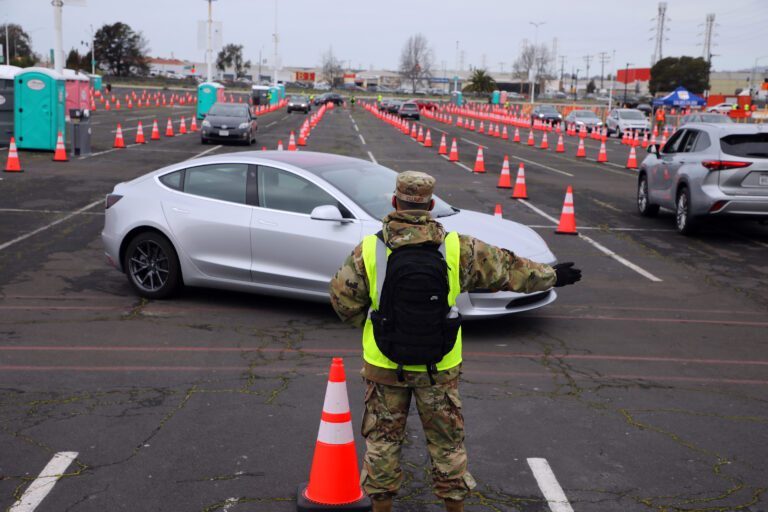
Still, statewide, officials said they were confident that the pace would pick up in the coming days, as more doses arrive, data snags get sorted out and more vaccination sites come on board. Los Angeles County announced this week it would convert Dodger Stadium and a Veterans Affairs site from mass testing sites into mass vaccination clinics. Similar plans are underway at Petco Park in San Diego and the Disneyland Resort in Orange County. Officials hope Dodger Stadium alone can handle up to 12,000 people a day.

The move solves one problem, but potentially exacerbates another: The two Los Angeles sites have been testing 87,000 people a week, according to Dr. Christina Ghaly, Los Angeles County Department of Health Services director. That will put new constraints on testing, even as covid cases in the nation’s most populous county continue to rise and hospitals are beyond capacity.

KHN (Kaiser Health News) is a nonprofit news service covering health issues. It is an editorially independent program of KFF (Kaiser Family Foundation), which is not affiliated with Kaiser Permanente.

Watsonville Brillante Extends Open Call for Local Artists

0

Watsonville Brillante, the ongoing community mosaic project spearheaded by Community Arts Empowerment (CAE), has extended its deadline for art submissions to Feb. 10.

Organizers are looking for local artists’ work to be featured on the six-story parking garage on Rodriguez Street, which is attached to the Watsonville Civic Plaza.

The project, which includes four large vertical pieces by Watsonville-born artist Juan Fuentes, has been moving forward during the pandemic. But Executive Director of CAE Kathleen Crocetti says they have not had enough entries for the 184 smaller, horizontal sections. 

“We’ve only received about 10 entries, and we’ve had the call out for a year,” Crocetti said. “This is the third time we’ve extended the deadline. We want people to know they can still submit work.”

CAE aims to represent in the mosaics the various cultural backgrounds of Watsonville’s population: Mexican, Filipino, Slavic, etc. They offer a list of cultures on their website, but anyone can add to it.

There is no age limit to submit—student work will also be considered. Crocetti says they have developed curriculum materials for local art teachers, and are hoping this will encourage their students to get involved.

“We really like to promote student work,” she said. “We’re trying to push to get classes involved.”

The open call is for anyone living in or within a 10-mile radius of Watsonville, including places such as Pajaro, Corralitos and Freedom. Artists can submit a maximum of five pieces. Organizers are looking for designs such as patterns, textiles, tattoo designs or symbols such as crests and seals.

“Whatever drawing is submitted, it will be translated into tiles,” Crocetti said. “So stay simple, limit your color range. We can’t do things like ombré.”

After submissions are in, the organization will invite the community to vote on a group of semifinalists. The public voting will be anonymous. The selections will need to go to the Arts commission for approval before August, when CAE will begin fabricating the tiles and hand out prize money. 

Crocetti hopes Watsonville Brillante will help keep artists inspired when creative spaces, including CAE’s headquarters, remain shuttered during the pandemic. 

“We will hopefully open up once we are down into the red tier,” she said. “We are eager to do art together again. But this is a way you can do it now, too.”

For more information, visit communityartsempowerment.org/local-artists-invitation.

Downtown Watsonville Mixed-Use Apartment Complex Moves Forward

0

The Watsonville Planning Commission at its first meeting of the year Monday recommended the city council move forward with a mixed-use apartment complex in downtown.

A project from local developers Bill and Neva Hansen, The Residence at 558 Main is a proposed four-story, 50-unit apartment building that, if approved, will be nestled into the historic corridor near the corner of E. 5th and Main streets. Along with apartments, which will include 10 affordable units, the project will also feature about 2,000 square feet of retail space on the first floor, and a small dog park and a courtyard for residents.

There will be six two-bedroom units, 29 one-bedroom units and 15 studios. Market rate apartments will range from $1,750-2,650 per month, according to the project’s website. That includes internet access, cable television and utilities. The affordable units will include median, low, very low and Section 8 rates, as written into the city’s housing ordinance.

The commission recommended approval by a 5-1 vote—one seat sat vacant. Commissioner Ed Acosta was the lone “no” vote. He voiced concern about the proposed entrance and exit from the 56-space, ground-level parking lot of the complex, a 20-foot alleyway running behind the East Fifth Plaza and that spills out onto Brennan Street. He said that adding more traffic to that already busy area would be an “accident waiting to happen.”

“We’re really running gung-ho on this,” he said. “This is not good.”

City of Watsonville staff said it is requiring the Hansens to make several improvements to the alleyway before it can receive approval. That includes installing lane striping and several signs, as well as a sound and light alert system for pedestrians and a convex mirror for drivers to better see oncoming traffic.

Some commissioners asked about the possibility of removing some street parking spaces that obstruct visibility for drivers exiting the alleyway and the nearby business complex.

Bill Hansen also said that, according to a traffic study conducted pre-pandemic, the apartment complex would produce fewer trips through that alleyway than the previous owners of the 558 Main St. property, which included a bank and a pharmacy.

There was also confusion about the secondary access route to the property’s parking lot. According to Hansen and City staff, an existing easement would allow residents to enter and exit through the parking lot off East Lake Avenue that runs behind several Main Street properties. But Edward Newman, a lawyer representing the owner of that lot at 13 East Lake Ave., disputed that there was an easement through that parking lot that would allow access.

“The concern from our client’s standpoint is of course safety and liability,” he said.

Hansen rebuked those claims and said he was willing to work with Newman to resolve the issue. Watsonville Community Development Department Director Suzi Merriam also said presenting proof of the easement is one of the conditions of the approval needed for the project to move forward.

“We’ll get through it, otherwise, it’s real simple, Mr. Newman will sue us,” Hansen said. “I’m not making an assertion that he’s going to sue us. I am saying he has that lever. So we want to make sure that we’re providing whatever information that he needs.”

The proposed three-quarters of an acre location has been surrounded by a cyclone fence ever since the previous structure was razed in 2019.

Pacific Coast Development, a company of the Hansen Family Trust, purchased the property in February 2019. Before it was demolished it had sat empty since ANSR Pharmacy closed in 2017. The since-destroyed 8,000-square-foot Spanish-style building was originally constructed for Bank of California in 1967 at a cost of $200,000, according to a Pajaronian article from December of that year.

The exterior and interior look of The Residence closely resembles that of another nearby Pacific Coast Development project completed in 2018: The Terrace at 445 Main St., a four-story development that features 54 apartments, a Togo’s sandwich shop and other business space on the first floor.

The Residence, Hansen said, is looking for a local sushi restaurant to fill the first floor retail space.

Biden’s Debt Forgiveness Plan Would Help Millions of California Students

 Lea este artículo en español.

Millions of Californians could get one of the biggest transfers of money in this country’s history as lawmakers and the incoming president duel over competing plans to rid the nation of ten of billions of dollars in student debt.

If President-elect Joe Biden follows through with his campaign promise to forgive $10,000 in federal student debt, as many as 1.3 million Californians could see the balance on their federal college loans totally wiped out.

The plan, which would make good on a once fringe progressive goal of student forgiveness that’s gone mainstream in the past five years, would benefit a total of roughly 3.9 million Californians who combined owe $140 billion in federal loans used to pay for college.

But a chorus of Congressional Democrats, including Sens. Chuck Schumer, Elizabeth Warren and California U.S. Representative Maxine Waters, wants Biden to expunge up to $50,000 in federal student debt. Debt cancellation of $50,000 would clear the federal student debts of far more Californians ­— between 2.9 and 3.3 million people, according to a CalMatters analysis of U.S. Department of Education data. 

What that could mean for California

Recent California college graduates with typical federal loan debt would see more than half of their undergraduate loans waived under the Biden plan, and lower-income students who qualified for the federal Pell grant would see a larger share of their debt forgiven. 

Students with Pell grants graduating with bachelor’s from California’s public and private nonprofit universities typically have $18,000 in federal loans — slightly less than the $19,370 in federal loans borrowed by students who didn’t receive Pell grants, according to data crunched by The Institute for College Access & Success for CalMatters. This doesn’t include debt students can accrue as they continue their educations.

Nationally, college graduates generally owe more. The typical debt among graduates nationwide is about $27,000 for Pell recipients and 23,000 for those without Pell. That California funds the largest state aid program in the U.S., the Cal Grant, plus aid its colleges award, likely limits how much students need to borrow. 

Experts are split on the potential economic impact of wiping out more than half of the typical California college graduate’s debt.

On the one hand, economists like Christopher Thornberg don’t think it would make much of a dent in the overall economy. “If you can’t pay back $10,000 in debt, you ain’t making a lot of money,” said Thornberg, a founding partner at Beacon Economics, a Los Angeles-based consulting firm. “And if you’re not making a lot of money, you’re not, what I would call, a macroeconomic driver.” 

On the other hand, some experts think debt forgiveness could boost the economy by helping young people afford more goods, take business risks, and get closer to buying homes

Then there’s the impact debt forgiveness can have on career choices. “Students with a lighter or no debt burden may feel free to pursue careers, especially in the public interest, that pay less –– but benefit everyone more,” said Jonathan Glater, a law professor at UCLA who studies debt relief.

Is debt forgiveness good policy? 

Critics say any debt cancellation, especially as high as $50,000, is a middle- and upper-class giveaway. The argument goes that because college-debt holders tend to be more affluent, and already have federal repayment programs that reduce monthly payments to a portion of one’s income if they don’t earn a lot, wiping out some or all of their debts is a regressive move. 

“We’re proposing to help only people who went to college, forget about those people who didn’t. I find that incredibly inequitable and not a progressive policy,” said Sandy Baum, a scholar on student debt, in an interview. Baum presented her research at a December meeting on student debt held by the California Student Aid Commission, which oversees the Cal Grant and helps to establish financial aid policy in the state. 

She supports targeted debt relief, such as partial forgiveness for every year a borrower is unable to make any payments and for parents living below the poverty line who borrowed on behalf of their children

Backers of comprehensive debt relief say debt forgiveness can close the racial wealth gap. While white borrowers largely pay off their student loans after 20 years, Black borrowers have barely made a dent in theirs, a recent study shows. Next, comprehensive debt forgiveness is much more meaningful to people with lower incomes because they get the largest relief relative to their economic situation, others have shown.

Current debt relief programs lag

Even with programs like income-driven repayment, which exist to reduce how much borrowers have to pay monthly if their incomes are low relative to their debt, Californians still struggle. Less than a quarter of California borrowers in repayment on a federal loan have incomes below $40,000, but those people account for more than half of borrowers who have fallen behind on a federal student loan in the state, according to the Student Borrower Protection Center, a group that supports debt forgiveness and crunched data from the Federal Reserve for CalMatters. 

Debt forgiveness may also spare tens of thousands of Californians from going into default on their student loans, a problem that can plague communities of color in particular.

Part of the problem is that too few low-income borrowers struggling to repay their federal student loans either can’t access or don’t know about income-driven repayment, even though the loan relief programs have been in full force since 2009. Another criticism of debt forgiveness is that it may help past students, but incoming students will endure the same higher-education costs that plagued past borrowers. Biden has two solutions for that

One is doubling the maximum award of the Pell Grant, which currently sits at around $6,300. Nearly a million California students receive a Pell Grant, according to the latest U.S. Department of Education data. Such a move could move the purchasing power of the grant closer to its glory days of 1975 when the maximum Pell Grant covered three-quarters of a student’s in-state tuition and housing costs at a public university. Today, it’s down to 28%.

The President-elect also campaigned to make public colleges tuition-free for students from families earning less than $125,000.

CalMatters.org is a nonprofit, nonpartisan media venture explaining California policies and politics.

Watsonville Responds to Recent Uptick in Homicides

Two people were shot and killed in a span of just more than 48 hours in Watsonville, raising concerns about an uptick of violence in Santa Cruz County’s southernmost city.

Watsonville police are investigating the shooting deaths of 19-year-old Fancisco Mora and 30-year-old Octavio Varela who were killed on Jan. 9 and 7, respectively.

Watsonville Police Department Sgt. Mish Radich said there are no indications that the two shootings are related. He also said detectives are looking into the possibility that they are gang-related.

The homicides are the county’s first and second of 2021. They come just three months after a spate of shootings during a late-October weekend that left two people—Rafael Salcedo, 44, and Aaron Lucio, 26—dead.

Police say they found Mora suffering from a gunshot wound around 7pm on Jan. 9 at the end of Walker Street near the Pajaro River levee. He died at the scene.

Two other people were also shot near that location in October 2020. Both survived, and no arrests have been made in connection with that shooting.

WPD spokeswoman Michelle Pulido said Varela was driving west on South Green Valley Road toward Main Street near Hope Drive around 8pm when he was shot in the upper torso.

“In less than a minute, [an] officer was at the scene performing CPR on the victim,” Pulido said.

He died at the scene.

There have been no arrests in either homicide case, and police have not yet identified any possible suspects.

The recent uptick in homicides comes after Watsonville for the better part of five years saw the number of homicides dwindle. Last year, there were three reported homicides, including the death of Brenda Becerra, who police say was murdered by her husband Cesar Hernandez. But 2019, 2018 and 2017 all saw only one homicide reported, as overall crime rates dropped in each year.

WPD Assistant Chief Tom Sims called the recent shootings “random acts of violence,” and said that the department would not increase the number of officers on patrol in response to the incidents. Instead, he said the department will focus on trying to solve those homicides with its Special Investigations Unit, and that they are working with the Santa Cruz County Anti-Crime team, a task force of officers from agencies around the county supported by local, state and federal agencies.

“We’re doing everything in our power right now,” he said. “Increased patrols aren’t necessarily going to prevent crime …. One or two extra officers out there is probably not going to make much difference, but one or two officers assigned to our detective bureau can make a tremendous amount of difference in helping solve [these cases].”

Erica Padilla-Chavez, the CEO of Pajaro Valley Prevention and Student Assistance (PVPSA), a nonprofit that provides counseling and other services to the area’s young people, said that her organization for the last few weeks has had conversations about the recent uptick in violence—even before the most recent shootings. PVPSA is concerned, Padilla-Chavez said, about the impact the rash of violence will have on the community, and the vulnerable position many young people are under because of the pandemic.

“We recognize that with distance learning and the lack of prosocial in-person activities because of the pandemic that there’s increased probability of seeing yet more young people potentially involved in behaviors that can be a danger to themselves and to others in our community,” she said.

Padilla-Chavez said the issue has also been a topic of discussion in a recurring meeting of South County leaders from various organizations that formed after stay-at-home orders were imposed in March of last year. WPD, Padilla-Chavez said, has assigned a police captain to work with members of that group to understand the data of the recent uptick in violence, and to create actions that can help strengthen the intervention and prevention services PVPSA and others are providing during the Covid-19-era.

Padilla-Chavez says it is important to contextualize the uptick with the dire conditions that some families are under as a result of the pandemic. County unemployment rates have seen record highs over the past nine months as business restrictions—especially in the service industry—have shuttered many employers. Unsurprisingly, the number of people depending on food banks to feed their families has also increased drastically.

Although WPD has not directly linked the recent acts of violence to the resulting economic and social hardships related to the pandemic, Padilla-Chavez says that research has shown that communities under those circumstances tend to have an increase in potential criminal activity.

“We need to understand the environment that people are swimming in right now,” she said. “I can just speak to what we’re seeing in our agency and that I hear echoed by many community organizational leaders …. We are seeing families challenged financially. We’re seeing families challenged with food insecurity. We’re seeing families challenged with trying to understand how they’re going to pay their housing costs.”

She added: “The impact of this pandemic is being felt in multiple ways.”

In these trying times, Padilla-Chavez says, it is important for neighbors to continue to check in with each other in responsible ways—through social media apps or phone calls—and stay connected despite the pandemic.

“All of those day-to-day activities that we take for granted in a non-pandemic environment, they’re so important right now,” she said. “Neighborhoods are what ultimately make up communities.”

Watsonville Mayor Jimmy Dutra agreed with Padilla-Chavez and said the only way for the community to pull itself out of the recent spike of crime is to work together.

“We can’t do it alone as a city,” he said. “This is something that we need to work together with our nonprofits, our community leaders and community members. Right now, everyone is pushed to our limits.”

Dutra said the City will over the next few weeks begin holding roundtable discussions with various community leaders to try to address the spike in crime. He began coordinating those conversations shortly after taking office for the second time last month.

He also said that it would be wrong to mischaracterize the rise in crime as strictly gang-related. Some incidents have been associated with gangs, he said, but many, such as thefts and other property crimes and domestic issues, have not.

“These times have not been easy on a lot of people and many of them are turning to crime,” he said. “We’re not the only community that’s suffering right now. A lot of communities are facing these same struggles.”

Dutra said he was confident the community would work through the recent violence and once again become one of the “safest cities” in the area. He pointed to the city’s turnaround after a deadly 2014, when there were eight homicides—the most the city has seen in recent memory.

“We’ve seen this before and we’ve overcome these challenges,” said Dutra, who was first on the city council from 2014-18.

Anyone with information about the Jan. 9 homicide is asked to call Det. Salvador Mendoza at 831-768-3357. Those with information about the Jan. 7 homicid are asked to call 831-471-1151 or WPD’s anonymous tip line at 831-768-3544.

Pajaronian reporter Tarmo Hannula contributed to this story.

Philanthropic Rossis of Scotts Valley Receive Community’s Support

0

Mari and Ed Rossi are well known throughout Scotts Valley and beyond for their generosity, whether providing free meals to disadvantaged students, dropping Christmas gifts off at the Rebele Family Center or offering scholarships for the Boys and Girls Club.

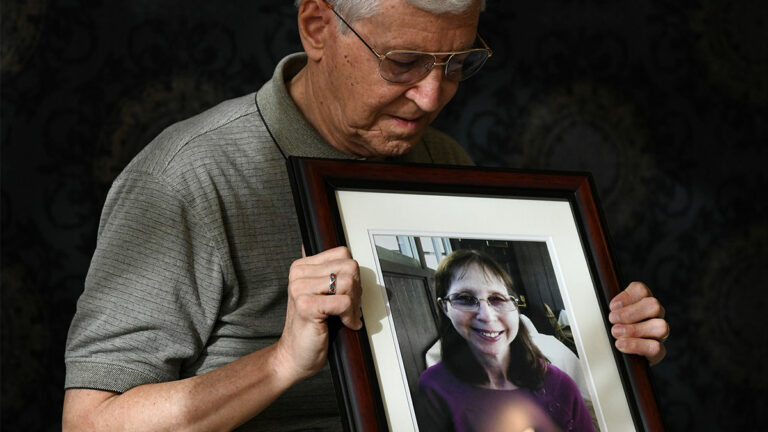
Recently, the couple has fallen on hard times and now needs the community support they once provided. The Rossi’s may be forced to relocate from their home during Ed’s treatment for Hodgkin’s lymphoma if they can’t pay off their lease.

Joanne Guzman, a friend of the Rossis and local business owner, offered to start a GoFundMe when she learned of their troubles.

“Mari immediately said ‘no.’ I wasn’t surprised; she is a giver, and people who are givers usually aren’t able to easily accept help,” Guzman said.

After some thought, Mari reconsidered, although she “still feels weird about the GoFundMe.”

“I don’t want to take people’s money,” she said. “We’ve been giving for so many years, and this feels like what I donate to, not what people donate to for me.”

The account, “Our Local Heroes Need Our Help,” went live on Jan. 5 and has already raised more than $16,000 of the $45,000 needed to keep the Rossi’s in their current home. The Guzmans also plan to host a fundraiser at Bruno’s Bar and Grill for the Rossi’s when Covid-19 restrictions loosen.

Guzman recalls when she first met the Rossis gathering Christmas gifts for families in the Rebele Shelter.

“Mari was busy going around to every station to make sure each family had all of the things the children and parents asked for. Not just a few of the items on their Christmas list, but every single item they asked for,” she said. “And she wanted them to have more. There were gift cards for groceries, clothes, and restaurants …. I walked up to Mari and asked where I could help; she told me to wait and disappeared for a moment. Then she came back carrying a gift bag for me to say thank you. I was surprised that she’d even thought of the helpers in her generosity.”

Throughout their time in Scotts Valley, the philanthropic couple have donated ten of thousands to many causes such as the Boys and Girls Club, the Senior Center, Twin Lakes Church and School, the Fallen Officer’s Foundation, the Special Olympics, Young Life, the Rebele Family Shelter, the Scotts Valley Dare program, the Moose Lodge, Meals on Wheels, the Scotts Valley Kiwanis Club, Scotts Valley Recreation, The Scotts Valley Education Foundation, Music in Skypark and numerous local family owned businesses.

“So many of my friends have said, ‘Well, if you hadn’t given all of your money away to all these causes, you wouldn’t be in this situation,’ and I told them, ‘I wouldn’t change a thing. I did what was right.’ I don’t feel bad about that,” Mari said.

Hardship, much like what they currently face, inspired their philanthropy. In 1997 Mari suffered a brain aneurysm in her sleep. After months in a coma on life support, she awoke and relearned to walk, talk, and eat again.

“That’s why I don’t waste a day and try to do everything that I can,” she said. “I would still be doing it if I could, but our lives just collapsed when this happened.”

Now Mari spends her days taking care of her mother with Alzheimer’s and Ed as he begins treatment for his cancer.

“This will be a tough week,” she said. “He starts heavy duty chemo and [doctors will] take bone marrow tests on Wednesday. They’re moving really aggressively to try and save him. I’m really glad we have such wonderful doctors, but it’s really scary. He’s already pretty sick and the chemo is going to make him a lot sicker. It would be nice to be able to stay in our house.”

Mari said she looks forward to Ed’s recovery.

“When we get back on our feet, we will continue to keep doing the work we’ve been doing,” she said.

Until then, she said she’s proud of the community for stepping up in their place.

“It makes me happy to see everyone coming together to support each other right now. I am so moved by the community that’s stepping up for us,” she said. “It’s amazing and humbling.”

Donate to the GoFundMe for the Rossis at gofundme.com/f/our-local-heroes-need-our-help.

Newsom Proposes Plan to Resume In-Person Classes in February

California Gov. Gavin Newsom on Dec. 30 released a plan under which schools could reopen as early as February.

The plan, which streamlines the process of applying for a waiver to bring students back for in-person instruction, is bolstered by a $2 billion package of incentives to help schools pay for testing, ventilation systems and personal protective equipment.

Newsom says that the State Safe Schools for All plan is supported by evidence that children are less at risk for contracting Covid-19 than adults. It is also based on the notion that in-person learning is critical for young people. 

“As a father of four, I know firsthand what parents, educators and pediatricians continue to say: in-person is the best setting to meet not only the learning needs, but the mental health and social-emotional needs of our kids,” Newsom said in a press release. “In the midst of this pandemic, my administration is focused on getting students back into the classroom in a way that leads with student and teacher health.”

Under Newsom’s proposal, some elementary schools could offer hybrid schedules, starting with transitional kindergarten through second grade, followed by grades three through six. 

Newsom added that returning to the classroom is particularly important for the youngest kids, those with disabilities, those with limited access to technology at home and students who have struggled with distance learning.

But the plan has raised concern among some school officials, who say that it would be difficult to implement it so quickly.

Santa Cruz County Office of Education Superintendent of Schools Faris Sabbah says that many details—such as increased testing and vaccines—have yet to be hammered out.

Perhaps the most difficult hurdle, Sabbah says, is that teachers and other school employees have expressed concern about coming back to the classroom while the number of people infected with Covid-19 is so high.

“An important part of our work is to get support from our school community,” he said. “So being able to move forward with the plan without support from our teachers and our classified unions would be challenging.”

Another challenge is how teachers will deliver a hybrid model of instruction—both distance learning and in-person instruction—since it is almost certain that some families and teachers will not want to send their children back to school during the pandemic.

Pajaro Valley Unified School District scrapped a hybrid learning plan in November when the infection rate began to grow.

Sabbah said these plans could include a dedicated distance-learning teacher. They could also include offering streaming content.

“It is definitely challenging, but it is also something we have been working on and looking at,” he said.

Out of the $2 billion, PVUSD will be allocated $450 per student, totaling about $8.1 million, says district spokeswoman Alicia Jimenez. The district can apply for lower grants every month, she says.

Before Newsom made his announcement, PVUSD was already providing in-person instruction to small groups of students in seven “safe spaces” throughout the district.

These students are considered special needs, including those who were unable to successfully take part in distance learning.

Superintendent Michelle Rodriguez says that the district’s contingency plan already includes the Covid-19 safety measures suggested by the governor, including providing personal protective equipment, requiring physical distancing and providing hand-washing stations.

Moreover, the district has paid $4 million for upgrades to its heat, ventilation and air conditioning systems, and window replacements. Nearly all of this was covered by $20 million from the Coronavirus Aid, Relief, and Economic Security Act, also known as the CARES Act.

Also, student desks will include three-sided barriers when they do return to class.

Still, Rodriguez was hesitant about bringing students back to the classroom by Newsom’s Feb. 16 date. She said that, while the district plans to meet the Feb. 1 deadline to meet his guidelines, it is unlikely that classes will resume in February.

“While we agree with the governor’s need for in-person instruction and for appropriate mitigation strategies, we are concerned with the timelines of the new requirements, including weekly testing of staff and students,” Rodriguez said in a prepared statement. “PVUSD teachers, staff and administration want to provide in-person instruction to our students and we commit to doing so when local health conditions permit.”

Sabbah said on Monday that Newsom’s plan is not currently feasible, because it requires a case rate of 28 per 100,000 people or lower. Santa Cruz County has a case rate of 41 per 100,000, Sabbah said.

Also, Newsom’s requirement for more testing would be a “tenfold increase in our current surveillance testing capacity,” Sabbah said. 

He pointed out that schools that have reopened for small-group instruction have shown few examples of in-school transmission. 

“For these reasons, Santa Cruz County Superintendents and Santa Cruz County Public Health have concluded that weekly testing of students is not feasible nor is it necessary,” Sabbah said.

Currently, county schools offer Covid-19 testing at two locations, with a maximum capacity of 1,500 per week. The county is currently developing a vaccination plan for teachers and school staff, Sabbah said.

Jimmy Panetta on Impeaching Trump Twice and Threats to Democracy

Carmel Valley Congressmember
Letter from El Salvador highlights the stakes for U.S. democracy

County’s Equity Measures Show Watsonville’s Struggles to Quell Covid-19

More than half of county’s cases have been in Watsonville

Second Stimulus Bill to Support Arts and Culture Venues

New funding is grants-based, so venues will not need to pay back the amounts

California Counties ‘Flying the Plane as We Build It’ in a Plodding Vaccine Rollout

Counties must figure out who falls where in multitiered system for vaccine eligibility

Watsonville Brillante Extends Open Call for Local Artists

Organizers look for local artists’ work to feature on six-story parking garage

Downtown Watsonville Mixed-Use Apartment Complex Moves Forward

Four-story, 50-unit apartment building would include about 2,000 square feet of retail space

Biden’s Debt Forgiveness Plan Would Help Millions of California Students

Roughly 3.9 million Californians owe combined $140 billion in federal student debt

Watsonville Responds to Recent Uptick in Homicides

Recent uptick follows years of declining homicides

Philanthropic Rossis of Scotts Valley Receive Community’s Support

Fundraiser seeks to help Rossis keep their home amid hard times

Newsom Proposes Plan to Resume In-Person Classes in February

Plan raises concern among some local school officials
17,623FansLike
8,845FollowersFollow