Covid-19 Closes Santa Cruz County Businesses; ICUs Ready for Surge

Businesses all over Santa Cruz County are getting ready to close down or reduce their operations as a new stay-at-home order takes effect.

The order goes live at 11:59pm Thursday, now that the Bay Area region hit a threshold wherein less than 15% of its intensive care unit (ICU) beds are available.

In a press conference Thursday, Public Health Officer Dr. Gail Newel acknowledged that the restrictions mean hardship not just for businesses, but for everyone in the holiday season. “It’s a really hard time not to be with the people that we love,” she said.

Under the state-mandated Covid-19 restrictions, all in-person dining must stop, and retail businesses must not operate above 20% capacity. Vacationing in hotels, motels and short-term rentals are forbidden. Everyone is supposed to stay home, except to take essential trips like outdoor exercise and trips to the grocery store, although people may drive around to look at Christmas lights or go to drive-in movies, Newel said.

Indoor dining has already been closed for weeks. Now, Patrice Boyle, who owns Soif and La Posta restaurants, says she and her team are prepared to savor one last night of patio dining Thursday evening. Both restaurants will remain open for pickup orders, but she hopes the new restrictions don’t last much longer than three weeks.

“We aren’t structured to survive on takeout. No dine-in dinner house is,” she says.

Boyle adds that some Soif and La Posta servers will be transitioning into being delivery drivers.

“Restaurants have been taking it on the chin from a closure standpoint and from an economic standpoint,” she says. “We’ve had a lot of support from the community, and we need continued support. I encourage everyone to order dinner out at least two or three times a week from a local restaurant. If we want to have that part of our social network continue, they need support.”

In a statement to Good Times, Economic Recovery Council Chair Kris Reyes says he fully understands that the community and the country are in a state of crisis and that it’s important to get a handle on the pandemic in order to save lives. Still, he worries that the new restrictions unfairly punish small business owners, restaurants in particular.

“The evidence demonstrates that the spread of Covid-19 is happening most frequently from close contact, mixed household gatherings such as parties,” writes Reyes, who is also a spokesperson for the Santa Cruz Seaside Company, which owns the Beach Boardwalk, which was barely open this year at all. “Given the evidence, I’m not sure how it makes sense that it’s OK to go inside a Best Buy to purchase a TV but we can’t support local restaurants by sitting outside while masked and properly spaced. I hope Gov. [Gavin] Newsom knows what he’s doing with these new restrictions on small businesses. So far, I think that’s debatable, and local businesses may be running out of time.”

SHOT IN THE ARM

Covid-19 is surging nationally, across California and in Santa Cruz County, right in the middle of the winter holiday season that’s normally marked by shopping and gathering with family.

There have been a few bright spots, however—some of which Newel highlighted Thursday. Three weeks ago, the county doubled the capacity of the OptumServe testing site in Watsonville. A new free walk-in OptumServe site will open Monday, Dec. 21 in North County, although Newel said it was too early to offer any specifics, including the location. “We’re in the final phases of finishing up that contract,” she said.

Also, some eligible health care workers got their first dose of the Covid-19 vaccine Wednesday. The county has begun part one of the first phase of vaccine distribution. The second phase will include other critical workers, like police officers.

Deputy County Health Officer David Ghilarducci said in Thursday’s press conference that he expects the vaccine to be ready for widespread distribution by the spring or summer months.

“That will really, I think, be the turning point for this vaccine,” he said.

There have been 6,455 known Covid-19 cases in Santa Cruz County, of which 1,724 are known active cases, according to information last updated Wednesday night by county health officials. Sixty-four people in the county have died from Covid-19, 270 have required hospitalization, and 4,668 have recovered.

Statewide as of Wednesday, there have been 1,723,362 Covid-19 cases and 21,860 deaths, according to the California Department of Public Health.

LITTLE WIGGLE ROOM

The official count for state-licensed ICU beds in the county is 22, Newel said—with 16 at Dominican Hospital and six at Watsonville Community Hospital.

Those are the figures that the state uses as part of calculating the regional trigger for the new stay-at-home order. The county’s actual surge capacity to create more ICUs on an emergency basis could be much larger—although it’s unclear just how much larger. “There’s lots of ways to measure this,” Ghillarducci said.

Newel said she can count four ways to measure ICU availability:

  1. The first is the state-licensed ICU capacity which is 22 beds—16 at Dominican Hospital and six at Watsonville Community Hospital.
  2. The second is what’s called “flex capacity,” which is the amount of beds that the state has licensed the county’s hospitals to grow to; that number is 26 countywide, including 20 at Dominican.
  3. Beyond that, hospitals have a larger “surge capacity” that they may expand to—provided they have adequate staff and also on ventilators, beds, cardiac monitors and other equipment.
  4. There’s also a maximum capacity, which is closer to 60, a number that the county provided earlier in the year, based only on the supply of equipment, not staff.

Health Services Agency Director Mimi Hall said, however, that it’s really staff that’s the limiting factor at this point.

“You can have beds and ventilators. The limiting factor we’re experiencing is not enough staff,” she said, “because ICUs require a different kind of proportion of staff to patients. As Covid spreads in the community, it’s also spreading to healthcare workers. So that really is the limiting factor, more so than the number of beds or space or ventilators.”

Hall said that, as the size of the pandemic grows, it becomes increasingly likely that hospital staff will come down with Covid-19 themselves and be unable to take care of others.

Ghillarducci says hospitals already experienced staffing problems over the summer due to summer wildfires that displaced many county residents and put a strain on resources. Now, he worries about workers who may have to miss work to take care of loved ones if they should fall ill with Covid-19. 

As the tough year draws to a close, Newel says some workers may want time off for the holidays. Others may be less likely to accept overtime assignments.

Meanwhile, the pandemic is surging, all while hospitals feel these other staffing pressures —a complicating factor that Ghillarducci, Hall and Newel have all spent a lot of time thinking about. Under these circumstances, one mistake could be incredibly costly.

When asked about a possible outbreak among Dominican Hospital nurses stemming from a trip out of the country taken by employees, Newel confirmed to reporters that she had heard a rumor about such an incident, but she could not confirm its veracity.

“Like any other essential workers or any other members of our community, health care workers have some lapses in judgment or make decisions that aren’t in line with the legal guidance—it happens to everyone,” Newel said. “We just need to move on from there.”

Claire Henry, a Dominican Hospital spokesperson, did not confirm or deny any information this week, citing health privacy guidelines. She did not respond to an email seeking clarification by deadline Thursday.

A new law, Assembly Bill 685, will require California employers to release information to their employees and local health agencies when they encounter a positive case in the workplace. The new law takes effect in January.

The county already saw one high-profile outbreak recently—at the Santa Cruz Main Jail.

Newel said after Thursday’s press conference that contact tracing has shown the recent cluster of Covid-19 cases among Santa Cruz County correctional officers stemmed from three separate gatherings, not one event. 

“So we can’t pin the positives even on one event,” she said. “It was three separate exposure events.”

Sheriff Jim Hart has said his office will do its own investigation following the contact tracing process. No Santa Cruz County inmates have tested positive for Covid-19 since the pandemic began.

Local Nurses Call for Safe Patient Ratios Amid Covid-19 Pandemic

A group of about 30 nurses at Watsonville Community Hospital held a demonstration Wednesday asking that management keep nurse-to-patient ratios at their present level.

The demonstration came five days after the California Department of Public Health sent a memo to the state’s general acute care hospitals, allowing them to increase the ratios in response to the influx of patients from the Covid-19 pandemic.

According to nurse Roseann Farris, the memo would allow hospitals to increase each nurse’s patient load by two, which she said is a concern in a time when many patients need critical care.

“Our ratios are the cornerstone and the heart of safe patient care,” Farris said. “If you disregard that, especially in regard to how sick these patients are, it’s going to be very dangerous.”

Farris says that Watsonville Community Hospital management has not yet said whether it plans to increase the ratios. Dan Brothman, CEO of Halsen Healthcare, which owns the hospital, declined to comment.

Farris said Wednesday’s action was a way to publicize the issue.

“We are tired from working this pandemic for the last nine months,” she said. “But we are always going to come out to the streets and so whatever we have to do to make sure that our patients are safe and our community is safe.”

In a prepared statement, Dominican Hospital said that “the health and wellness of both our patients and our employees is our number one priority.”

“Dominican Hospital does not plan on exercising any change to our nursing ratios unless we are in crisis mode and have exhausted all other options.” the statement said.

The California Nurses Association (CNA) in a statement accused hospitals of “exploiting the pandemic” as a way to roll back nurse-patient ratios and cut costs.

CNA President Zenei Cortez says the increases will lead to more hospital-acquired infections, and to more nurse, healthcare worker and patient deaths. 

“Larger patient assignments sharply cut the time nurses can provide individualized patient care, properly monitor a patient’s condition, and increase the likelihood of mistakes, as studies have documented for years,” Cortez stated in a press release. “In a pandemic, that’s an open invitation to increase the risk of spreading the virus to other patients and other staff.”

Law Enforcement Prioritizing Education With Stay-At-Home Order

Most counties throughout California have now imposed some version of stay-at-home orders, which consist of a series of requests and requirements by local leaders and are designed to slow the spread of Covid-19.

Gov. Gavin Newsom on Dec. 3 said that new orders keeping residents at home would be enacted when intensive care unit (ICU) capacity in any of the five state-designated regions dropped below 15%.

Monterey County preemptively enacted its own orders on Dec. 9.

Monterey County Health Officer Dr. Edward Moreno cited government codes 26602 and 41601, and Health and Safety code 101029, which give local law enforcement the authority to enforce the orders of health officers.

Monterey County District Attorney Jeannine Pacioni announced Monday that her office will enforce the order in that county, where hospital leaders say their capacity is “well beyond” 100%.

Santa Cruz County and the rest of the Bay Area region will fall under the state’s stricter stay-at-home order starting at 11:59pm Thursday, Dec. 17, after ICU capacity hit 12.9%.

Violations in both Santa Cruz and Monterey counties are punishable by a $1,000 fine and/or six months in jail.

But just how far will law enforcement officials go to enforce the orders? Most simply want to inform residents what the rules are.

“We’ve taken an educational stance for a majority of the eight or nine months this has been going on,” Santa Cruz County Sheriff’s Office spokeswoman Ashley Keehn said. 

Most of the time, Keehn added, people have been willing to comply, and many have said they were unaware of the restrictions.

Keehn said that no citations have been handed out recently.

“If enforcement action is needed to be taken, we’ll take it,” she said. “But we’re not going out and automatically giving citations to anyone. There has to be a good solid reason for it.”

Monterey County Sheriff’s Chief Deputy John Thornberg says that the majority of enforcement from that agency has been unpermitted gatherings such as large parties.

When that happens, he says, deputies inform the revelers of the restrictions, and ask that they break it up.

Repeat offenders could face arrest and prosecution, Thornberg said.

California Highway Patrol Officer Sam Courtney says that the mission for the officers patrolling the state’s highways remains unchanged.

“We will continue to patrol throughout California,” he said. “The hope is that people will self-regulate and adhere to the requirements.”

Enforcement will likely not include stopping people suspected of violating travel restrictions, Courtney, Keehn and Thornberg all said.

“Are we going to pull someone over just because we think they violated the stay-at-home order?” Courtney asked. “The answer is ‘no.’”

But travelers should be aware that, in counties with stay-at-home orders in place, most hotels and other lodgings cannot accept out-of-town visitors.

In Watsonville, calls to the police department reporting violations of the various orders put in place to curb the spread of the virus have waned over the past few months, said Watsonville Police Department (WPD) spokeswoman Michelle Pulido.

According to Pulido, there have been 36 total calls related to violations of the stay-at-home and masking orders since the beginning of the pandemic. Most of them came during the first few months after the orders were put in place in March.

There was a more recent “spike” of 13 calls over August and September, said WPD Assistant Chief Tom Sims, but every month since then has seen only “one or two” calls.

Sims said the low number of calls was a sign that most Watsonville residents were respecting the orders.

“I think our community is great, and I think they’re, for the most part, complying with what is asked of them,” he said. “Even though it’s difficult, they’re complying to the best of their ability and when they don’t we address it.”

WPD has yet to hand out a citation for order violations, Pulido said. The department’s policy for violations has been education over enforcement, Sims said.

“However, there are always those exceptions when that education falls on deaf ears and we have to make a second and sometimes a third visit,” Sims said. “At that point, we just issue a citation. We’re done talking. Sometimes money makes a difference when it’s coming out of their pocket.”

Sims said that most calls concerning order violations are low priority, as the department prioritizes dispatches from the 911 center and other serious crimes over the violations. He did, however, say that WPD officers do respond to every call for service.

“Everybody is just frustrated and tired with going through this,” Sims said. “But I also think that there is some light at the end of the tunnel, there is some hope that’s been pushed out these last couple of weeks with the vaccine coming soon.”

Pajaronian Managing Editor Tony Nuñez contributed to this story.

Farmworkers Worked Despite Positive Covid-19 Tests for Fear of Job Loss

Many Monterey County farmworkers are going to work despite testing positive for Covid-19, and some of those laborers are doing so because they are concerned about losing their job, their pay or because their employer told them to.

That’s according to the preliminary findings of a study led by researchers at the UC Berkeley School of Public Health and Dr. Maximiliano Cuevas, CEO of the Clinica de Salud del Valle de Salinas (CSVS).

The study, titled “Prevalence and Predictors of SARS-Cov-2 infection among Farmworkers in Monterey County,” found that more than half (58%) of farmworkers were going to work when they had tested positive and showed symptoms because they felt well enough to work. A quarter of those respondents, however, did not quarantine themselves because they feared financial loss.

“These findings validate concerns from researchers, public health professionals and community advocates that farmworkers would suffer from the Covid-19 pandemic in California,” Joseph Lewnard, assistant professor of epidemiology at UC Berkeley and a member of the study team, told Berkeley News. “We have failed to protect this population, while they have continued to engage in essential work through the pandemic.”

The study from mid-July to November asked hundreds of farmworkers that visited CSVS’s network of clinics for a Covid-19 test—and a few dozen others found through community outreach—several questions about their household demographics, including main language spoken at home, employment information and their Covid-19 risk factors and safety practices at home, in the community and in the workplace, among other things.

Roughly 20% of those surveyed by the end of October had tested positive for the antibodies to Covid-19, meaning they had previously been infected. In addition, 24% of respondents said the virus had an “extremely negative” impact on their life.

The goal of the study, Cuevas said, was to find out why and how so many farmworkers in the Salinas and Pajaro valleys were testing positive for Covid-19 and what could be done to slow the spread. The data collected, he said, paints a picture of where the spread is happening, and the next steps needed to be taken.

Where is the disconnect?

The study found some employers (45%) are not properly screening farmworkers for Covid-19 symptoms or high temperatures before they began their shift. However, it also found that the vast majority of employers were doing well in keeping farmworkers safe in the workplace.

Nearly all (99%) of farmworkers reported that their employer provided handwashing stations and liquid soap and paper towels. In addition, most employers provided hand sanitizer (91%), frequently cleaned surfaces (86%) and provided face coverings (85%). They also reported that the majority of employers have educated them about how to protect themselves at work (97%), been told to social distance (96%) and been informed of the importance of staying at home when sick (93%).

The trouble, Cuevas says, is that some farmworkers were not aware that they can qualify for replacement income and emergency housing in order to quarantine when they have tested positive. About 72% of respondents said their employer told them about where they can get a Covid-19 test, and 69% said their employers had explained how to access sick leave.

That education and information gap, paired with cramped housing situations that have plagued low-income farmworkers living on the pricey Central Coast for years, has exacerbated the pandemic in those communities, Cuevas said.

“Overcrowded living conditions is a huge factor here,” he said.

What is being done?

Monterey County, which has a population of roughly 435,000, has conducted more than 150,000 Covid-19 tests. But Cuevas says that is not enough to understand the true scope of the outbreak and what areas of the county need more attention and resources.

“In reality, we should be closer to half a million tests for a county our size,” he said.

CSVS has tried to close that gap by offering testing at its 11 clinics throughout Monterey County, and the organization is also hosting pop-up testing sites throughout the week in King City (Monday), Soledad (Tuesday), Salinas (Thursday and Friday) and Las Lomas (Saturday). All of them are located at community markets, bringing testing directly to those communities.

In Monterey County, there are four community testing sites run by the state and OptumServe where anyone can get a test for free, even those without insurance. Most Doctors On Duty locations, CVS pharmacies, county hospitals and several clinics are also offering testing, but with various restrictions—some charge around $140 for a test while others require insurance and for a person to be showing symptoms.

“We need a broad testing program,” Cuevas said. “It needs to be expanded big time.”

And on top of providing more access to testing, Cuevas and the research team at UC Berkeley recommend that a comprehensive education campaign be developed that goes “beyond educating about the virus and ways to protect oneself at work, in the community, and in the home.”

“It should educate workers and their employers about farmworker benefits and their ability to remain at home awaiting test results or if sick and receive replacement income,” the study’s white paper reads.

Congressman Jimmy Panetta in a letter to national lawmakers urged them to include more funding for such education programs in future Covid-19 relief packages, citing the results of the UC Berkeley and CSVS study. The funding, the letter read, would be used to provide personal protective equipment, more widespread Covid-19 testing and additional education resources.

“Since the beginning of this bruising pandemic, I’ve continued to push my colleagues in Congress to play our part to help reduce the impact of Covid-19 in farmworker communities,” Panetta said in a press release. “My California colleagues and I know that more needs to be done to keep farmworkers safe, especially as these essential frontline workers continue to suffer from this virus at a disproportionate rate. As we work to get through this pandemic and get on to the road to recovery, we’re trying to ensure that our congressional leadership continues to consider the urgent needs of our agricultural workers.”


What Santa Cruz Westsiders Think of New Rail Trail Segment

9

A segment of the Coastal Rail Trail, a planned bike/pedestrian path that could one day connect Watsonville to Davenport, officially opened last week. 

Due to the Covid-19 pandemic, the Dec. 10 ribbon-cutting for the rail trail Segment 7/Phase 1 was streamed online. 

This new 1.2-mile section of asphalt trail, which is 12- to 16-feet wide, runs from Natural Bridges Drive to Bay Street and California Street on Santa Cruz’s Westside. Graniterock built the trail segment, which features 10 bright green bicycle crossings, several new pedestrian crosswalks, signage, and new fencing. One goal of the trail is to provide a safe connection between schools, activity centers, parks and businesses.

“This is my very first day to walk on the trail,” said Sara Walsh, who lives nearby, as she strolled Segment 7. “I love it. I try to do walks two times a day, so this will be perfect because this area is in my regular loop. It feels safe, and I think it will make the neighborhood feel more comfortable.” 

The Santa Cruz County Regional Transportation Commission (RTC) has been handling high-level planning for the trail, which is part of the Monterey Bay Sanctuary Scenic Trail Network. For years, the RTC has been studying the possibility of introducing transit, like a commuter train, alongside the trail, an idea that’s been met with mixed reception over its feasibility, projected ridership and its possible costs.

The rail trail project is divided into 20 segments—one and a half of which have now been built. The city of Santa Cruz is wrapping up the design phase of the second phase of Segment 7.

The first completed section of rail trail, Segment 9, includes the bike lane outside the Santa Cruz Beach Boardwalk and an extension of a bridge over the San Lorenzo River that opened in January of 2019

At the ribbon-cutting, Santa Cruz County Supervisor Ryan Coonerty, an RTC commissioner, praised the $9 million Westside trail project.

“It’s an incredible way to get across town,” he said. “Soon we will have a 32-mile bike and pedestrian path across Santa Cruz County.”

The new section of trail called for 600 tons of asphalt, mostly made up of asphalt grinding from recent road projects.

Kevin Winch, who’s lived near the adjoining railroad tracks for the past 20 years, welcomed the addition as he toured it by bike.

“Yes, I will definitely use it,” he said. “I used to ride along the tracks on the dirt all the time so this is nice; I like it. Graniterock did a nice job. As you can see, it’s certainly getting used.”

After cutting the ribbon, Mayor Cummings ran through a long list of thank yous for making the project happen, including for the RTC, Pacific Crest Engineering of Watsonville, former Congressmember Sam Farr, county supervisors, the Coastal Conservancy, Ecology Action, and Bike Santa Cruz County.

The trail is designed to welcome people with disabilities, walkers, bikers, and parents with small children.

In South County, work is moving ahead on the south section of the trail off of Ohlone Parkway in Watsonville. There the trail will tie into the more than six miles of slough trails.

Watsonville Hospital Workers Among First to Receive Covid-19 Vaccine

Working as an environmental services aide at Watsonville Community Hospital, Benjamin Lamsen cleans rooms in the Emergency Department and the intensive care unit. That work has been challenging, he says, since the Covid-19 pandemic began its spread across the globe.

In addition to increased numbers of patients needing care, he and his colleagues must constantly worry about contracting the virus.

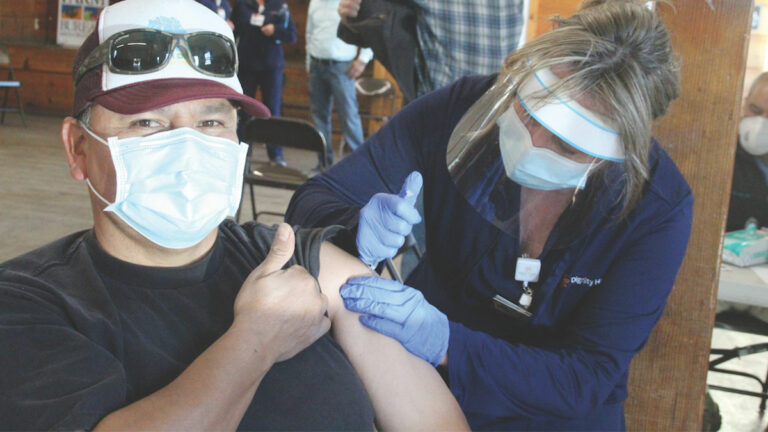
On Wednesday, Lamsen became one of the first people in Santa Cruz County to receive a Covid-19 vaccine.

“I’m excited,” he said. “I want to be protected, as well as my family.”

Lamsen was among the frontline workers across the U.S.—a group that includes doctors, nurses and other medical professionals—who are receiving the first doses of the vaccine from Pfizer drug company.

Several employees at Dominican Hospital also received a vaccine.

Out of the 656 employees at Watsonville Community Hospital, about 400 are considered frontline. They will be given their vaccines over the coming weeks, says Assistant Administrator Matko Vranjes. 

Receiving the vaccine is voluntary, but most employees are signing up for theirs, he said.

“Our staff is taking this very seriously,” he said. “They are excited that the vaccine is available.”

Respiratory Therapist Travis Stevens, who has worked at Watsonville Community Hospital for 20 years, says the influx of patients has been a challenge.

“I’ve never seen anything like this before,” he said. “Now, I’m happy in a way that I can protect myself a little bit.”

Emergency room doctor David Claypool, who was also receiving a vaccine, says that he sees patients every day who have the virus. While some have mild symptoms, those considered medically vulnerable are at much greater risk.

“It ravages the body,” he said. 

Claypool says the vaccine is 90% effective, a significant number compared to the influenza vaccine, which is 40-60% effective.

“This is a very effective vaccine,” he said. 

As the vaccine began to be delivered the California, Gov. Gavin Newsom on Monday introduced the “Vaccinate all 58” campaign, to assure the vaccine is fairly distributed across the state’s 58 counties. 

Even with the vaccines likely going to the general public sometime next year, Claypool says that everyone should still wear masks, practice social distancing and comply with other measures created to slow the spread of Covid-19.

“This is not going to stop the surge,” he said. “But hopefully this will prevent future surges as we get more and more vaccinations out there into the community.”

Stricter Stay-at-Home Order Triggered for Santa Cruz County

3

Growing strain on the health care system has triggered a stricter stay-at-home order for Santa Cruz County and the rest of the Bay Area region.  

Intensive care unit (ICU) availability in the Bay Area region, which includes Santa Cruz County, reached 12.9%, according to the latest state data, triggering the stricter stay-at-home order recently issued by California Gov. Gavin Newsom. The order will require further closures of local businesses and services by 11:59pm Thursday, Dec. 17. It will remain in effect for at least three weeks. 

The order comes with more stringent restrictions for businesses amid the ongoing Covid-19 pandemic. Outdoor dining and some other services will be forbidden, and retail businesses will be reduced to 20% capacity.

The state implemented the restrictions, Newsom said, because the number of available ICU beds has been falling across the state as more Californians test positive for Covid-19.

There are 54 people in Santa Cruz County hospitals with Covid-19, with 10 people in the ICU, according to state data. That leaves two ICU beds available in the county.

Sixty-four Santa Cruz County residents have died from Covid-19 directly or with the disease as a contributing cause, according to the county. 

WHAT DOES THE ORDER MEAN?

The following sectors will have modifications in addition to masking and physical distancing:

  • Outdoor recreational facilities: Allow outdoor operation only for the purpose of facilitating physically distanced personal health and wellness through outdoor exercise, without any food, drink or alcohol sales. Additionally, overnight stays at campgrounds will not be permitted.
  • Retail: Allow indoor operation at 20% capacity, and 35% of capacity for standalone grocery stores, with entrance metering and no eating or drinking in the stores. Additionally, special hours should be instituted for seniors and others with chronic conditions or compromised immune systems. 
  • Shopping centers: Allow indoor access at 20% capacity with entrance metering and no eating or drinking in the stores. Additionally, special hours should be instituted for seniors and others with chronic conditions or compromised immune systems.
  • Hotels and lodging: Allow for Covid-19 mitigation and containment measures, treatment measures, provide accommodation for essential workers, or providing housing solutions, including measures to protect homeless populations.
  • Restaurants: Allow only for take out or delivery.
  • Offices: Allow remote only except for critical infrastructure sectors where remote working is not possible. 
  • Places of worship and political expression: Allow outdoor activities only.
  • Entertainment production: Industries, studios, and other related establishments such as establishments that provide content for professional broadcast can operate without live audiences.

The regional order will force the following sectors to close (except to the extent that their operations fall within critical infrastructure):

  • Hair salons and barbershops
  • Personal care services
  • Museums, zoos, and aquariums
  • Movie theaters (except drive-in)
  • Wineries, bars, breweries, and distilleries
  • Family entertainment centers
  • Cardrooms and satellite wagering
  • Limited services

Learn more about the regional stay-at-home order on the state’s website here: covid19.ca.gov/stay-home-except-for-essential-needs/#regional-stay-home-order

Fire at Former Sobering Center in Santa Cruz Kills One

0

UPDATED Dec. 16, 10am

A woman died early Wednesday in a two-alarm fire that broke out in the former Sobering Center in Santa Cruz.

Around 2:30am on Dec. 16, 911 dispatchers received numerous calls about a fire spreading through the two-story Victorian wood building that had been boarded up since the onset of the pandemic. Santa Cruz County spokesman Jason Hoppin said the center closed shortly after the pandemic began. 

The building was “boarded up for security,” Hoppin said. “People had been entering the building before we did so.”

When the first fire crews arrived, they immediately called for a second alarm, drawing further emergency support from outlying agencies.

As their attack got underway, firefighters were met by several people staggering out of the smoky building into the cold night air.

Santa Cruz Fire Battalion Chief Josh Coleman said firefighters found a person down inside the building and hauled her to safety. Fire radio traffic described a woman who died at the scene. 

It appeared people in the building were illegally trespassing, Coleman said. 

Firefighters staged several attacks, including one on the ground floor where flames could be seen through several windows that had been bashed out by firefighters.

Coleman said the fire was strong enough at one point that firefighters had to back off and go into defensive mode. Firefighters were eventually able to work their way back inside and upstairs, where the flames had crept into the attic. 

Meanwhile, another crew ran a 100-foot aerial ladder over the mountain of smoke for another vantage point with a water stream.

One firefighter was injured and was in stable condition as of 8am, according to Coleman. 

Santa Cruz Police closed off a section of Water Street and portions of Ocean Street.

The former Sobering Center, at 265 Water St., is owned by Santa Cruz County and stands directly in front of the Santa Cruz County Jail. 

Firefighters had to pry off several sheets of plywood to gain access to the building. Officials from Pacific Gas & Electric were called in to shut off power. American Medical Response staged several ambulances for more possible injuries. Sheriff’s deputies were also out in numbers dealing with the incident.

Coleman said 44 firefighters were called to the incident. 

Around 4am, one man approached police at the scene and told them he was inside the building when the fire started and that he had information about the fire.

The cause of the fire is still under investigation. 

Meanwhile, as workers arrived between 7 and 8 am at the Santa Cruz County Building and Courthouse across Water Street, they were greeted with a heavy layer of smoke that enveloped the entire building and surrounding grounds throughout the morning. Flames were still visible inside the Sobering Center past 9am, and smoke continued to rise out of the building. A large portion of the roof caved in. Coleman deemed the building a “total loss.”

This story is developing and will be updated. 

Allegretto Wines’ Crisp and Full-Bodied White Trio 2018

On a recent three-day trip to Paso Robles, we visited several wineries. There are plenty to choose from, and new ones are springing up all over.

But for those who seek wine tasting with ambiance, then look no further than Allegretto Vineyard Resort—complete with its own vineyards and tasting room. It’s simply magic to experience not only their beautiful wines, but also their outstanding hospitality.

Outside on comfortable lounge seating, my husband and I were brought a flight of wonderful wines. We were impressed with a delicious 2018 Trio ($34), a superb blend of 39% Viognier, 39% Vermentino and 22% Roussanne. Beginning with violets and jasmine on the nose, this crisp and full-bodied white wine has notes of young peaches—finishing with a peak of acidity. Another terrific wine we appreciated is Allegretto’s Tannat, with grapes from their own vineyard.

Sitting under the cozy warmth of heaters, we were delighted to see a fellow over on a nearby couch get down on one knee and propose to his lady friend as he slipped a diamond ring on her finger. There’s romance in the air at Allegretto.

We loved the Trio blend so much that we ordered it with dinner in Allegretto’s welcoming Cello Ristorante—a perfect pairing with our calamari and salmon.

Allegretto is an upscale resort with incredible grounds. We stopped by the next day to take time to experience the world’s first sonic labyrinth and all the superb artwork and sculptures, much of it gathered by proprietor Douglas Ayres on his extensive trips around the world. He has poured his heart and soul into this unique resort and winery—and it shows.

Allegretto Vineyard Resort by Ayres, 2700 Buena Vista Drive, Paso Robles. 805-369-2500, allegrettovineyardresort.com.

Sculpterra Winery and Sculpture Garden

Another don’t-miss winery is Sculpterra. The winery’s gardens are filled with sensational sculptures and artwork—and it pays to give yourselves plenty of time to enjoy both wine and art. The crisp 2019 Sauvignon Blanc and the estate 2018 Viognier were my absolute favorites.

Sculpterra Winery, 5015 Linne Road, Paso Robles. 805-226-8881, sculpterra.com.

Things To Do in Santa Cruz: Dec. 16-22

A weekly guide to what’s happening.

ARTS AND MUSIC

BANFF CENTRE MOUNTAIN FILM FESTIVAL VIRTUAL FESTIVAL This year, bring the adventure home! Fluff up your couch cushions, grab a snack of choice, and make sure you have a good internet connection, because the Banff Centre Mountain Film Festival World Tour is going virtual! For the first time ever, travel to breathtaking destinations, embark on daring expeditions, and celebrate some of the most remarkable outdoor achievements, all from the comforts of your living room. The Covid-19 pandemic has created extraordinary circumstances around the world and many of our live World Tour screenings have been postponed or canceled. While we can’t replicate the experience of seeing the Banff films on the big screen of your local theatre, surrounded by friends and your community, these curated programs of amazing outdoor films will inspire you to live life to the fullest … however that looks these days! Please visit riotheatre.com for more information about the online programs and how you can support your local screening. 

VIRTUAL HOLIDAY ART AND CRAFT FAIRE Santa Cruz County Park’s annual Holiday Art and Craft Faire is going virtual for 2020! For the month of December, join us online at scparks.com to find and support amazing local artists and craft-makers! Our webpage will feature over 40 artists who offer a broad range of holiday gifts ranging from glasswork, prints, cards, jewelry, and more!

NUTCRACKER THE MOVIE Agape Dance presents “2020 Nutcracker the Movie!” See a beautiful one-hour performance of the holiday tradition, “The Nutcracker Ballet,” in the safety and comfort of your car at the Santa Cruz Beach Boardwalk Drive-In Theater. Featuring gorgeous local alumna and professional dancers with fun community leaders in this amazing, locally filmed, family-friendly movie by Indigo Productions. A wonderful way to enjoy the holidays. A portion of the ticket sales benefits Jacob’s Heart Children’s Cancer Services. Tickets only available at agapedance.com. Cancellations due to inclement weather will allow online viewing of the movie. Friday, Dec. 18, 5:30pm and 7:30pm. Saturday, Dec. 19, 5:30pm and 7:30pm. Sunday, Dec. 20, 5:30pm and 7:30pm.

SALSA SUELTA IN PLACE FREE ZOOM SESSION For all dance-deprived dancers! Free weekly online session in Cuban-style Salsa Suelta for experienced beginners and up. May include Mambo, ChaChaCha, Afro-Cuban Rumba, Orisha, Son Montuno, Cuban-Salsa. Ages 14+. Contact to get Zoom link SalsaGente.com. Thursday, Dec. 17, 7pm.

TOY TRAINS WINDOW DISPLAY Get whisked away into the whimsical world of Toy Trains and enjoy the 15th year of this beloved annual pop-up exhibit at the MAH. Members of the Golden State Toy Train Operators will be on hand to once again share their amazing collection of toy trains through the windows of the MAH’s atrium. Watch from outside in the Secret Garden as the trains chug through the festive beach town in this new storefront display. We’re excited to continue this holiday tradition safely for both you and the train operators. Toy Trains will be on display Dec. 18-27. Toy Trains will run until 5pm with the exception of Dec. 24 at 3pm and Dec. 25 when the museum is closed. When outside, please keep at least six-feet distance and wear a mask. 

COMMUNITY

2020 HOMELESS MEMORIAL GATHERING Join us for a gathering to remember and pay respect to all of our neighbors whom we have lost while homeless in 2020. On or about the longest night of the year–the Winter Solstice–communities across the country gather to remember neighbors who have died homeless in the past year. This year marks the 22nd year for the remembrance gathering in Santa Cruz County. Friday, Dec. 18, 10am.

WOMENCARE MINDFULNESS MEDITATION Mindfulness Meditation for women with a cancer diagnosis. Meets the first and third Friday, currently on Zoom. Registration required. 831-457-2273. Friday, Dec. 18, 11am-noon.

WOMENCARE: LAUGHTER YOGA Laughter yoga for women with a cancer diagnosis. Meets every Wednesday, currently via Zoom. Registration required. 457-2273. Wednesday, Dec. 16, 3:30-4:30pm.

GROUPS

OVEREATERS ANONYMOUS All our OA meetings have switched to being online. Please call 831-429-7906 for meeting information. Do you have a problem with food? Drop into a free, friendly Overeaters Anonymous 12-Step meeting. All are welcome!. Sunday, Dec. 20, 9:05-10:15am.

VIRTUAL YOUNG ADULT (18-30) TRANSGENDER SUPPORT GROUP A weekly peer support group for young adults aged 18-25 who identify as transgender, non-binary, genderqueer, agender, or any other non-cisgender identity. This is a social group where we meet and chat among ourselves, sharing our experiences and thoughts in a warm, welcoming setting. Our meetings will be held on Discord during the shelter-in-place order. For more info, contact Ezra Bowen at tr***@*************er.org.

LGBTQNBI+ SUPPORT GROUP FOR CORONAVIRUS STRESS This weekly LGBTQNBI+ support group is being offered to help us all deal with stress during the shelter-in-place situation that we are experiencing from the coronavirus. Feel free to bring your lunch and chat together to get support. This group is offered at no cost and will be facilitated by licensed therapists Shane Hill, Ph.D., and Melissa Bernstein, LMFT #52524. Learn how to join the Zoom support group at diversitycenter.org/community-calendar

WOMENCARE TUESDAY SUPPORT GROUP WomenCARE Tuesday Cancer support group for women newly diagnosed and through their treatment. Meets every Tuesday currently on Zoom. Registration required: Call WomenCARE at 831-457-2273. Tuesday, Dec. 22, 12:30-2pm.

OUTDOOR

MYSTERY SPOT HOLIDAY TOURS Register for special Mystery Spot Holiday Tours, running Monday through Friday at 6pm from Dec. 21-25. We will be serving delicious coco, cider and coffee to enjoy either before or after your tour. You can also enjoy our beautiful Christmas lights in the garden while you sip on a hot drink and listen to holiday tunes. Our Mystery Spot guides will be giving out candy canes in addition to our famous Mystery Spot stickers at the end of every tour. Please make a reservation online if you would like to visit us during these holiday times. Come enjoy this special holiday event with us at The Mystery Spot and savor this joyous time of year. 831-423-8897. mysteryspot.com.

SATURDAYS IN THE SOIL Every third Saturday at the Santa Cruz Museum of Natural History: It’s time to get your hands dirty! We’re excited to relaunch Saturdays in the Soil, a monthly volunteer program in our native plant garden. Learn about local ecology, native plants, and sustainable gardening while coming together as a community (in a physically distanced manner!) to steward Tyrrell Park through the City’s Adopt-A-Park program. Email vo*******@*************um.org to let us know you’re coming. Saturday, Dec. 19, 10am-noon.

WOMENCARE ARM-IN-ARM WomenCARE ARM-IN-ARM Cancer support group for women with advanced, recurrent, or metastatic cancer. Meets every Monday. Currently on Zoom. Registration required. All services are free. 831-457-2273. womencaresantacruz.org. Monday, Dec. 21, 12:30pm.

DOWNTOWN SANTA CRUZ MAKERS MARKET Come out and celebrate local art as Pacific Avenue between Water and Locust streets becomes a pedestrian mall for the Makers Market! Free admission and free live music! Now on the third Sunday of every month! Stroll beautiful Pacific Avenue while shopping local with more than 40 local Santa Cruz County artists and crafters! Plus, live music at Memorial Plaza (in front of Jamba Juice) from 12-3pm! Don’t forget to stop in and visit the downtown merchants. Check out our website, scmmakersmarket.com/markets to see the full lineup of artists. Sunday, Dec. 20, 10am-5pm.


Covid-19 Closes Santa Cruz County Businesses; ICUs Ready for Surge

Economic council leader hopes governor knows what he’s doing

Local Nurses Call for Safe Patient Ratios Amid Covid-19 Pandemic

Demonstration follows state guidance allowing higher nurse-to-patient ratios

Law Enforcement Prioritizing Education With Stay-At-Home Order

How far will law enforcement officials go to enforce stay-at-home order?

Farmworkers Worked Despite Positive Covid-19 Tests for Fear of Job Loss

Study sought to find out why so many farmworkers were testing positive for Covid-19

What Santa Cruz Westsiders Think of New Rail Trail Segment

New 1.2-mile section of asphalt trail runs through Santa Cruz’s Westside

Watsonville Hospital Workers Among First to Receive Covid-19 Vaccine

Frontline workers receiving first doses of Covid-19 vaccine

Stricter Stay-at-Home Order Triggered for Santa Cruz County

Stay-at-home order will be in place for at least three weeks

Fire at Former Sobering Center in Santa Cruz Kills One

Several people were in boarded-up building that caught fire

Allegretto Wines’ Crisp and Full-Bodied White Trio 2018

Allegretto Vineyard Resort offers beautiful wines and outstanding hospitality

Things To Do in Santa Cruz: Dec. 16-22

Toy trains, laughter yoga, the ‘Nutcracker’ ballet, and more things to do in the week ahead
17,623FansLike
8,845FollowersFollow