

If you felt at home in the retro living room ambience of Cafe Bene for all those years, then you’ll love the coffee house’s reincarnation as Tabby Cat Cafe, which was opened a few weeks ago by former Bene barista Lisa Curran and Jeb Purucker.
The ambience is matchless, the coffee is exceptional, and I might even be willing to say that the macchiato I had at T-Cat this week was the best I’ve had in Santa Cruz. Strong, smooth, without bitterness, and served in a beautiful miniature coffee mug.
Light floods the vintage space, lending the front alcoves and main reading room a welcoming vibe. I once wrote film reviews in an office above Tabby Cat, and have fond memories of this location, close to downtown yet tucked away from the crowds.
We ordered a macchiato and a regular house blend coffee, plus one of those cranberry scones from Black China Bakery that I always loved when I visited in the past, then took a seat at a corner table marked “Reserved” for the Santa Cruz French club. We would be gone before their meeting time.
We glanced at the newspapers and watched the large-scale industrial action across the street while awaiting our coffees. As regulars came in—and it seems that Tabby has inherited a full roster of fans from the previous administration—they were personally greeted. It feels like you’ve entered the front parlor of a private home, calm and mellow. The atmosphere is a welcome alternative to the hipster frenzy of many other downtown coffee spots. Conversations are possible, and so is reading and writing—those arts from the pre-iPhone era.
The new owners are clearly at home behind the eclectic front counter. Posters still cover the cabinet wall beside the condiment table. And regulars still stash their favorite mugs on a high shelf. In the larger room, mismatched couches offer old-school coziness for interviews, meetings and just hunkering down for a morning coffee. Not designer, but not generic, the old footprint—brick floors, wainscotted walls—provides a funky elegance that is pure, 100 percent Santa Cruz.
A large assortment of bagels and toppings, plus an array of inviting quiches and soups, make it a great lunch option, as well as a morning caffeine mainstay. A good Wi-Fi connection, too.
Tabby Cat Cafe, 1101 Cedar St., Santa Cruz. Soft opening hours 7 a.m.-4 p.m. weekdays, 9 a.m.-6 p.m. weekends.
New Avanti
I met new Ristorante Avanti co-owner Jonathan Glass last week at my first lunch since a change in the ownership lineup.
Now we can look forward to a special sandwich and a burger added to the lunch menu. Last week, it was a robust version of the East Coast Italian meatball sandwich. Rita and I loved our beautiful plate (new plates, too!) of seared scallops with crisp roast potatoes and arugula salad. The lunch scene looks, and tastes, familiar. Updates are already underway, with ergonomic new chairs and patio dining enhancements. Wishing Jonathan and Tatiana Glass good luck with their Westside venture.
If you’ve got a product for the shelves of the new Aptos location of New Leaf Community Market, make sure you hit the vendor fair planned for next Wednesday.
New Leaf plans to join the Aptos community this spring with a store in Aptos Village. Interested vendors will want to come to New Leaf’s corporate office.
Feb. 13, 9 a.m.-2 p.m. New Leaf office, 1101 Pacific Ave., Suite 333, Santa Cruz. newleaf.com/vendorfair.
Losar (the Tibetan word for “new year”) is an ancient new year’s festival predating Buddhism and celebrated in Tibet, Bhutan, Nepal, and India. It begins on the first day of the lunisolar Tibetan calendar (Feb. 5) and lasts for 15 days. Like Chinese New Year, 2019 is the year of the yin (female) earth pig or boar. Losar is a fragment of the winter-incense-burning custom of the ancient Bon religion (8th century), when the people of Tibet gathered at a spring and made offerings to Naga (water spirits), a ritual of gratitude to the water element/spirits.
At Dharamshala (Dalai Lama’s palace in India) during Losar, the Dalai Lama consults the Oracle, a trained medium able to communicate with spirits and see the past, present and future. The Oracle is responsible for the health, healing and protection of the Dalai Lama.
The rite of the Oracle, mediating between two worlds, is ancient, and involves detailed preparation of evocative (calling in) invocations (responses),fanfare, dance, sounds, drums, horns, mudras and mantras to invoke the Oracle (non-physical spiritual being in the Buddhic field). The sounds and movements allow a spiritual being to temporarily enter the physical mind/body of the medium, providing wise and insightful counsel, prophetic predictions and precognition of the future—a form of divination.
In Tibetan homes during Losar, flowers decorate the rooms, walls are painted with sun, moon and the wheel of life symbols. Cedar and juniper branches burn for incense. Debts are settled, quarrels resolved, new clothes acquired, and special foods (kapse—sweet bread, shaped into twists) and drink (chang—barley beer) are offered. In the fields, peach trees are beginning to bloom. Before the measurement of time, the people knew it was Losar when the peach trees budded. Tashi Delek (Tibetan for happy new year) everyone.
ARIES: Recognizing the vital and initiating work you are to bring forth, it’s time to learn how to participate in groups with intelligent and heartfelt cooperation. You are to help fashion part of the new era, culture and civilization. Are you aware of this? Are you conscious of the needs of humanity? You’re called to awaken again for the time when those who plan and lead boldly, take risks and see into the future. Working with both heart and mind, you will be summoned. Prepare.
TAURUS: The architecture of your participation in life is changing. Previously you dreamed big dreams and pondered many realities, not concerned if anything took shape. Now you’re competently leading boards and groups, preparing the components of the new world era. Taurus has an enlightened mind that can see humanity’s present/future needs. You know that in a breakdown phase, seeds of the new must be sowed. You’re synthesizing all realities so others can understand.
GEMINI: Many forces are at work in your life. As a Gemini, you always attempt to resolve polarities—higher/lower, here/there, light/dark, self/others, soul/personality. This is a vital and difficult task accomplished by the proper cultivation of the mind principle (calming the emotions) and the right course of study that allows no illusions, distortions, confusions or maya. So you can walk the Path with others. Aquarius calls you to develop all seven levels of your mind. The Soul is on the mental plane.
CANCER: Always we feel some form of conflict. Know that conflict and chaos are useful. They give us the ability to observe tensions and to express hurts, needs and fears. For some, there is a great battle going on between the soul and personality. The soul calls us to right relations, right action and right service. Many times, we don’t know what these words mean. Ask the soul. The answers will be released into your mind. When asking, we always receive.
LEO: Relationships are vitally important at this time, so often you feel disconnected to anything or anyone. You’re in a place of balancing and choosing, an interlude state. Your inner beliefs about relationships and how you function in them are being modified so that you can display right relationships while still expressing your unique creativity. Allow opposing forces to flow through you. A greater awareness then emerges. Love flows unobstructed once more. Love is your gift.
VIRGO: New revelations stream into your mind concerning how to order and organize daily life. How we function in daily life prepares us for the new dimensions and structures slowly emerging in the new Aquarian era. Receive with devotion and acceptance all new ideas impressed upon your mind. Be aware if pain or remembrances or weariness occur. As you ponder upon these things, your perspectives shift, change and are uplifted.
LIBRA: Although, under the veil of Libra’s charm, you are a strong and powerful force, a greater level of love/wisdom must begin expressing itself through you. It begins with acceptance and gratitude for everyone and everything (small and great, childhood to present) that has occurred in your life. Here is your new mantra to recite unceasingly: “Love expresses itself through me always, and wisdom follows.” Then your life and relationships proceed with protective love and healing care.
SCORPIO: Notice times of solitude when you think things great and small. Create an environment that nurtures in all ways the physical, emotional, mental and spiritual aspects of yourself. Be in touch with the kingdoms—mineral, plant, animal, human, Soul. Love must be combined with your great intelligence. This will form a foundation for the new life emerging all around you. It begins where you live. Later you’ll be asked to explain this time to others.
SAGITTARIUS: You should have a very good year. Especially if you blend two realities—your personality and soul. This produces harmony for a time. Then the soul leaves and divine will enters, and your personality harmonizes with will. Not easy. Will is a fire. Your career rises and falls and sometimes makes a big splash. In these ups and downs, always be thoughtful, or you will lose much. Remember each day that “wisdom is knowledge gained through experience and implemented by love.”
CAPRICORN: Whatever it is you hope for, radiate it with love from your Ajna (third eye) center. This is where a diamond light of direction streams forth. Then new life takes root expressed as harmony, beauty and peace (a process). Your love eases any disharmony and conflict whenever it arises. You remember that harmony always attempts to emerge through conflict and chaos, yes? Harmony is the shadow of the object.
AQUARIUS: This year, you have great energy and potential. As new sources of income and ways of living are sought, be sure to control impatience. If you’re not aware, you could be thought of as thoughtless toward others. Remember to be courteous and kind, and show sympathy to those who have less than you. A new self-identity continues to emerge. Be sure it includes goodness, generosity and love. We experience that which we offer others.
PISCES: You have begun the arduous task of observing, noting and understanding feelings, thoughts, aspirations, actions, and vulnerabilities. Much of your life has been treading the pathway of service and sacrifice. A new beneficent cycle has begun, expanding your courage and strength of character. This may not be acceptable to some. Maintain privacy, walk away from disharmony, don’t believe criticism. The stars protect you.
All you have to do to know there’s something rotten in the state of the world is look at this year’s slate of Oscar-nominated short films. Endangered children, old age and regret, racism, irresponsible parenting, and random homicide all figure in the five live-action shorts nominated for a 2019 Academy Award. The companion program of animated short films is not all that more upbeat, touching on themes of dysfunctional psychiatry, dementia, divorce, and death, among other things.
Call it a sign of these dire times, but grim seems to be the pervading tone among this year’s crop of fledgling filmmakers singled out by Academy voters.
As in recent years past, once the Academy nominations are announced, the contending short films are packaged for theatrical release. There are two separate programs (with two separate admissions), one for the five live-action shorts, and one for the five animated shorts (with a couple of bonus films thrown in to stretch out the animated program to feature-length).
But unlike years past, there’s only one overt comedy in all 10 nominated shorts, the animated psychiatry satire Animal Behavior. Funny animals (including a timid leech and an ape with anger-management issues) attempt to sort out their problems with an avuncular, bespectacled dog therapist in this cheeky effort by Alison Snowden and David Fine. The gag wears a little thin, but crisp dialogue keeps it amusing.
In the live-action program, Marguerite, by French filmmaker Marianne Farley, is a beautifully acted tale of the bond between an elderly woman and the younger woman who is her visiting caregiver. It’s an oasis of tenderness and compassion amid a bunch of films devoted to violence and perversity.
The program begins with Vincent Lambe’s harrowing Detainment. Written largely from police transcripts, this true story follows the events that led two 10-year-old Liverpool schoolboys to become the youngest defendants ever convicted of murder in the UK. Marvelously well-acted (especially by its young stars) and discreet about how much of the crime it chooses to show onscreen, it nevertheless drags viewers along in an atmosphere of non-stop dread.
This is followed immediately by Jeremy Comte’s Fauve, another tale of two boys (French Canadian, this time) running amok out in the countryside that comes to an abrupt and horrifying conclusion. (After that double-whammy, distressed viewers might be forgiven for going out for popcorn and never coming back.) Films are presented alphabetically, and yet it’s questionable to lead off this program with two films so similar in their bleak nihilism.
Rodrigo Sorogoyen’s Madre is a taut mini-thriller about a woman grappling with a cell phone call from her 6-year-old son in jeopardy. The filmmaking is crisp and intense, but Sorogoyen has no exit strategy; the story just stops. And the final live-action entry, Skin—set in America’s pick-up-driving, shotgun-toting yahoo country—explores deeply ingrained racism and its consequences in a manner better suited to The Twilight Zone.
The animation program is more user-friendly. Louise Bagnall’s lyrical, emotionally stirring Irish entry Late Afternoon, beautifully rendered in fluid pastel watercolors, features an older woman diving deep into the well of memory to piece together fragments of a life she’s forgotten. One Small Step, from Andrew Chesworth and Bobby Pontillas, charms with its tale of a plucky Asian girl in San Francisco and her cobbler single dad who does everything he can to support her dream of becoming an astronaut.
The annual Pixar/Disney entry, Bao, by Domee Shi, is a metaphorical fable about a a Chinese woman who forms a maternal attachment to a dumpling. And Trevor Jimenez’s Weekends is an artfully constructed tale of a young boy shuttled back and forth between his divorced parents during a year of changes.
There are many lovely and intriguing moments in both programs— especially the animated offerings—but there’s not one E-Ticket item here that just grabs you by the lapels and leaves you awestruck. Maybe next year.
Clear as spring water and and mellow as Kentucky bourbon, their voices take us back to a time and place somewhere in the American heartland. Working in close harmony through vintage bluegrass, Appalachian folk songs and classics by masters like Hank Williams, Bill Monroe and the Stanley Brothers, Sister Brothers casts a sweet spell.
Although their public concerts are rare, they’ve already won a cult following for a broad and haunting folkloric repertoire. Experience has produced the effortless harmonies of Dan Landry, Heidi Rentería and Jim MacKenzie—Landry singing with the Ariose Singers, and Rentería in countless singing camps and the UCSC Concert Choir. MacKenzie, who met Landry while singing Gregorian chants, started playing guitar and singing in barbershop quartets and trios as a teenager. At an Oregon singing camp in 2011, Landry and Rentería discovered how well their voices worked together.
“We invited Jim to come over and sing the following year,” Rentería recalls. “The trio format, supported by Jim’s guitar, quickly clicked, and the Sister Brothers were born.”
The three singers focus on music rooted in backcountry traditions where close, three-part harmonies are key—and, as Landry puts it, “full of memories of the singing of friends and family.” They work arrangements out collaboratively by ear. “Each of us takes turns at singing lead, and who sings which harmony part, above or below the melody line, changes from song to song,” says Rentería, who says she loves this music “most of all for the fabulous lyrics.”
“There’s such real emotion, because it’s about universal feelings,” she says. “It’s about feeling lonesome and blue and hearing a train at midnight. But some of the songs we sing are lighthearted, witty, even funny. I am really amazed that as different as our individual voices are, we have found that we can blend beautifully.”
MacKenzie, who plays guitar with the group, explains the vocal range spanned by the trio. “Dan sings the really high vocals. My range is bass through baritone to middle tenor. It’s a pretty broad range, but I can’t really reach that super-high vocal range that bluegrass singing especially calls for.” As for the versatile Rentería, “sometimes I’m singing the lowest part, sometimes the middle, more frequently the top line. We think that including solo and duet parts, passing around the lead and the harmony parts, and varying the accompaniment keeps our audience from getting bored.”
The music they make together is undeniably powerful. “I think the appeal of our music stems both from the emotional content of the songs we select to sing and from our close vocal harmonizing,” MacKenzie says, “As an adolescent and well into my 20s, I sang in duos and trios and loved it. Being able to do that again now has been an extremely gratifying and fulfilling experience,” he adds.
“Giving close attention to these songs and discovering new ways to use the voice,” says Landry, “reveals how flexible and expressive it can be.” Renteria sums up the joy of singing harmonies as “the physical breathing together, the intense being in the moment, listening to each other and to ourselves, trying different ways of treating a line or a word or a note, constantly influencing each other. Singing harmonies, you know you’re alive!”
All three singers bring fierce discipline, energy and miles of insight to this music that burrows deep into the heart of the American experience. And each agrees that it is the emotional depth of even the simplest tunes and plainest lyrics that casts Sister Brothers’ lingering spell.
Sister Brothers will perform a sit-down concert of American songs from the mid-1800s through the first half of the 20th century from songwriting masters like the Delmore Brothers, Bill Monroe, the Everly Brothers and more. Feb. 9, 3 p.m. r.blitzer Gallery, 2801 Mission St., Santa Cruz. Free. rblitzergallery.com.
Long before recording began, guitarist-songwriter Steve Gunn knew he wanted his new album The Unseen in Between to have a vibe similar to early Dylan and Neil Young records. “They all have that feeling like you’re in the room with them. It’s loose, spontaneous and it gives the music a kind of heightened energy,” Gunn says by phone from his Brooklyn home.
But there was a problem. Neil Young had Crazy Horse. Dylan had the Band. When Gunn and his producer started talking through the album, he didn’t even know who was going to play on it. It’s one thing to want a “loose, live” energy for an album, and another entirely to have the band to pull it off.
Though he rose to attention as the guitarist for Kurt Vile’s band the Violators, Gunn’s solo work (now a staggering 15 albums deep) has long been in the tradition of artists like Dylan and Young, a breed of folk music that is pensive, kaleidoscopic, full of soft psychedelia and a subtle, unfurling melodicism. And while 2016’s Eyes on the Lines had a certain breezy looseness to it, what Gunn was looking for this time was something more visceral.
That’s when an unlikely encounter with a guy named Tony Garnier, who was hanging around the studio, led to what is arguably Gunn’s strongest work to date.
“There was another session happening before we started working on the record, kind of like a ‘who’s who’ of folk music doing this compilation of songs,” Gunn says. “And Tony, one of the bass players, was in there for a few of the days.”
Garnier, though far from a household name, has an impressive resume. In 1989, after a stint in the Saturday Night Live band, he joined Dylan’s band as bass player. As of 2018, he is now the longest-running collaborator of Dylan’s career, having become the band’s unofficial musical director.
“We just started shooting the shit, and he was just like, ‘Hey man, if you need a bass player, I’m around. I would love to come in.’”
Recorded over a few isolated sessions in 2018, The Unseen in Between—which was released last month—is calm, confident and made up of Gunn’s best songs thus far, the whole thing buoyed by the assured performances of Garnier and drummer TJ Maiani.
“We didn’t want to overthink it—it’s not this complicated thing. It’s all about the feel. They weren’t necessarily that familiar with the music, but they were like, ‘What’s the key,’ played it a few times, and kind of got the feel for it,” Gunn says, describing—almost to the letter—the kind of session he had always intended for the album.
Adding to it all is Gunn’s own performance, which was captured entirely live.
“The way I made albums before, it was always like adding other guitar parts after the fact, doing vocals after all the tracking was done,” he says, describing the normal process for most contemporary musicians.
This time, however, Gunn sang and played the songs in a single take with his band, putting on tape the song exactly as it was played.
“We did overdubs, of course, but the core of the songs, it’s like a performative approach. Before the sessions, I was going to my little studio and sitting for a full day and playing. Playing and playing and playing. Getting them up to speed, and getting them ready.”
As a result of that preparation, the playing on The Unseen in Between is close to impeccable. Diverse in mood and feel (and, at times, spare), there is a vitality to the performances on the album that lifts Gunn’s already distinctive songwriting, in a live, loose sort of way. On songs like opener “New Moon,” Gunn’s pendulous baritone emerges from within the performance, bobbing to the top of the mix like another instrument. “New Moon” is followed by “Vagabond,” which plays like a New York folk version of the Smiths’ “There is a Light That Never Goes Out.” A descending lick Gunn plays on the acoustic at the end of each phrase of the verse is worth the price of admission alone.
“All releases adhere to kind of a schedule now,” Gunn says, before we hang up. “It’s been a lot of waiting, but now I’m ready. It’s exciting for me and the band to get out there and play.”
Steve Gunn performs at 9 p.m. on Sunday, Feb. 10 at Moe’s Alley, 1535 Commercial Drive, Santa Cruz. $15 adv/$20 door. 479-1854.
For UCSC’s Adam Millard-Ball, it all started with a thought experiment. The associate environmental studies professor asked himself how a self-driving car might find parking within a downtown area in the coming decades, and he wondered how the resulting changes might affect traffic.
He believes the cars of the future will be programmed to find the cheapest parking options available, and will have no need to park near their destinations after dropping their owners off. So will an autonomous vehicle drop off its passenger in a busy downtown metropolis and then park somewhere on the city’s outskirts for free? Will it drive back home, only to return downtown to pick up its owner again later in the day? Or will it simply seek out a two-hour parking spot and then move just before the two hours is up?
Millard-Ball found that the answer to each of those questions is yes, after using game theory and a traffic simulation model to come up with his predictions. What surprised him, however, was the most common scenario the cars would choose, according to his experiment. Millard-Ball found that many cars will simply “cruise” around nearby until their owners finish with their downtown errands. The cars will coast around the streets, instead of looking for a spot, and create massive traffic jams in the process. His report argues the cars would “have the incentive to seek out and exacerbate congestion—even gridlock—in order to minimize costs to their owners.”
Unless mitigated by significant changes in transportation or urban planning policy, he says that traffic could be disastrous for the quality of life in cities, like San Francisco, as well as university campuses like UCSC.
Millard-Ball’s experiment created quite a stir on the internet on Friday. Someone posted a UCSC press release about the news to Reddit, where it catapulted to one of the site’s top three posts, quickly earning more than 70,000 upvotes via the forum’s science tab. The top commenter wrote, “Instead of parking lots, there will just be a giant ‘lazy river’ of cars.”
Millard-Ball likes the analogy. “That’s a really great description of what I’m modeling,” he says. Although several publications have blogged about his findings, he says GT was the first to call him up for an interview.
He notes that, generally speaking, some urban planners have started to call for cities to start thinking about converting some downtown parking lots to higher uses, like housing, in light of autonomous cars and other expected transportation changes. But Millard-Ball believes it’s time to start thinking about how to mitigate the resulting traffic problems that he says are also coming.
To be sure, it’s still unclear just how quickly self-driving cars will hit the streets—or how, exactly, the future of cars will look. A chart known as the Gartner Hype Cycle maps the level of enthusiasm that many tech trends tend to follow. According to that theory, interest spikes early, with a bump known as the “peak of inflated expectations,” and it’s followed by a cratering “trough of disillusionment.” Things pick up, the theory goes, after that, as innovations then start trickling in, perhaps a little later than expected—ultimately leading to a slow, steady stream of breakthroughs before progress plateaus.
Although many transportation experts are optimistic, self-driving cars could follow a similar trajectory. As theWashington Post reminded everyone recently, Tesla CEO Elon Musk said that one of his cars would be able drive itself across the country by 2018. This past fall, one crashed backing out of a garage.
Millard-Ball has a solution for the downtown traffic jams that he’s predicting. It’s called congestion pricing, the process of charging drivers per mile that their cars travel on busy metropolitan streets.
He foresees two challenges to doing that. The first is technological, although he believes barriers will go away once autonomous vehicles become widespread. The second is political. That’s why he says that government officials should act now to implement new regulations, at least on self-driving cars before they start popping up everywhere at once.
”People don’t like paying for something that they’ve been used to getting for free,” he says, “and that’s just as true for roads as it is for anything else.”
Update – Feb. 5, 2019: This story has been corrected to reflect the accurate spelling of Millard-Ball’s last name.
Live music highlights for the week of Jan. 30, 2019
WEDNESDAY 1/30
AMERICANA
AMIGO THE DEVIL
After a hard day at the office, nothing beats uncorking a bottle of wine, lounging in the bathtub and listening to songs about serial killers, gruesome spousal abuse and necrophilia. If that sounds like you—particularly if you imagine banjo-plucking murder ballads—then Amigo the Devil is your new Elvis. Don’t get me wrong, Amigo doesn’t glorify the darkest of human impulses. He approaches his subjects with the kind of deep curiosity you might get from a gripping Netflix true-crime docuseries. AC
For a century, the blues has weaved its way in and out of pop culture, avoiding exact definition. So when we say Catfish Keith and Preacher Boy are the real deal, playing their time-honored and fine-tuned mix of country and Delta acoustic blues, we aren’t messing around. Combined, Catfish and Preacher Boy have nearly 65 years of experience, endless stories and non-stop finger flying pickin’ that will knock the dust of any regular Wednesday. MAT WEIR
INFO: 7:30 p.m. Michael’s on Main, 2591 Main St., Soquel. $12 adv/$15 door. 479-9777.
THURSDAY 1/31
AMERICANA
MARGO CILKER
Margo Cilker’s soft and soulful country-acoustic meanderings portray a being craving the familiarity of comfort and a longing for change. Or maybe the longing for comfort and familiarity of change? This tinge of grass-is-greener runs through all of her songs, as well as hues of regret and shades of sorrow. All these conflicting aspects are wound up in her expert singing-vagabond hands. But does every hopeful homecoming inevitably include a fond farewell? AMY BEE
In 2016, Mojo magazine declared James Hunter the UK’s “greatest soul singer.” The 56-year-old singer has been working hard in British clubs since the mid-’80s, even sparking a friendship (and collaborative relationship) with Van Morrison. But it wasn’t until Hunter’s incredible and high-energy R&B 2006 album People Gonna Talk that he broke through to a larger audience. In the tradition of a lot of Daptone artists, he’s a lost gem of old-soul purity that we were all lucky enough to have emerge in his later years and add a little sunshine to our lives. AARON CARNES
Swaggering and cool, RJD2’s production work has seeped into many cracks in the American consciousness. Emerging on El-P’s Def Jux label in the early 2000s, his beats were forward-thinking with classic NY cool, mixing jazz, cinema scores and world music in ways that always found their leading edges. Since then, L.A. has become a more pronounced influence on his work, as on 2016’s Dame Fortune, which charts a journey across hip-hop, EDM, prog rock, and soundscape. Also, he wrote the theme for Mad Men. MIKE HUGUENOR
INFO: 9 p.m. The Catalyst, 1011 Pacific Ave., Santa Cruz. $20 adv/$25 door. 429-4135.
AMERICANA
BLAME SALLY
Hot take: Sally didn’t do anything wrong. I’m a Sally supporter. Why? Because if Sally did something to bring about SF Americana quartet Blame Sally, I say we should thank her, not blame her. Sally, thank you. Thank you for almost 20 years of the transcendent and ruggedly femme rock of Blame Sally. Thank you for the effortless guitar playing of Renee Harcourt, and for the cajon-rocking rhythm of drummer Pam Delgado. MH
INFO: 7 p.m. Kuumbwa, 320-2 Cedar St., Santa Cruz. $35 adv/$40 door. 427-2227.
FUNK
KATDELIC
San Francisco’s Katdelic is so much more than a funk band. Led by Grammy-winning artist Ronkat Spearman (ex-Parliament/Funkadelic), Katdelic is a musical experience with booty-shaking beats, choreography, interstellar jams and even some EDM mixed in. If Parliament brought us the funk on the Mothership Connection, then Katdelic opens the doors and guides us to explore their sensual sounds of interstellar bass. MW
Country music has always had an element of the rascally and mischievous, but is it capable of surprising with the unexpected? After listening to Buck Meek’s self-titled album, I’d say yes. His pared-down melodies are an odd composition, his vocal notes willy-nilly with lyrics both absurd and poetic, with no easy-access hook in sight. One might completely miss the country part of Meek’s songs if it weren’t for his unmistakably nasally Texas twang. Meeks brings vivid, half-told stories and strange one-liners to life by refusing to decrypt whatever muse is keeping him up at night. AB
As a founding member of the influential and creatively fecund band Kneebody, tenor saxophonist Ben Wendel has earned a vaunted reputation as an improviser with a sleek, ingratiating sound and surfeit of ideas. Last October, he displayed both attributes on The Seasons, a remarkable series of 12 compositions inspired by Tchaikovsky’s compositions. “The Seasons is not only a representation of the passage of time but a statement on how technology has changed the way artists communicate and share art,” Wendel writes. Wendel performs with pianist Aaron Parks, guitarist Gilad Hekselman, drummer Eric Harland, and bassist Matt Brewer. ANDREW GILBERT
INFO: 7 p.m. Kuumbwa Jazz, 320-2 Cedar St., Santa Cruz. $31.50 adv/$36.75 door. 427-2227.
After 15 years of being a solo singer-songwriter, releasing five CDs, and even gaining some attention with some locally focused songs about Highway 17 and the Starlite Drive-In, Michael Gaither decided it was time to find some “New Best Friends.” Initially, he just liked how fun this inclusive name was for a backing band, but after a year-and-a-half of being in his new group, Michael Gaither and His New Best Friends, he’s finding that the name is actually quite true.
“We see each other every week and we trade Christmas gifts. We check in even when we’re not playing,” Gaither says. “It’s been a really nice experience to get to know these people better, and to have four new best friends.”
The band is essentially playing the same material that Gaither played as a solo artist. Before, he would play alone, or with one or two musicians backing him to give a little bit of depth to the songs. Now it’s transformed into a full-on, Americana-rock outfit.
“Now I can add a great lead guitar player and a full rhythm section and a female harmony singer. So it gives the songs a whole new sound and breath,” Gaither says. “It’s still mellow enough for a brewery, and big enough for a venue or a festival.”
One of the biggest unexpected benefits of the group is that it’s broadened where Gaither is able to perform his music. Even with the brewery scene, for instance, he could play some of the smaller ones before, but not the larger ones, like Santa Cruz Mountain Brewery. This year, he’s hoping to get out there as much as possible with his new best friends—and hopefully make some more.
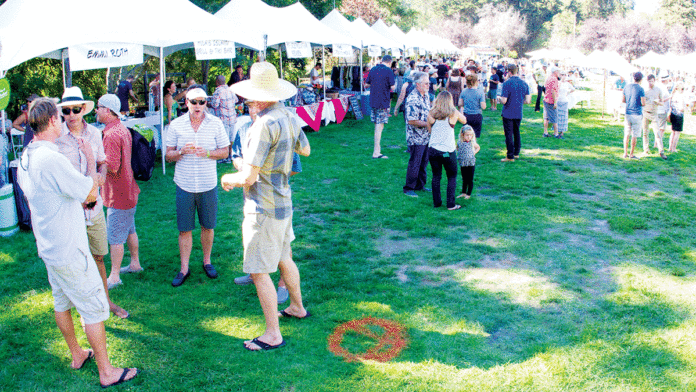
For those taking a break from alcohol during “Dry January,” there is a light at the end of the tunnel: San Francisco Beer Week returns on Feb. 1 with a week of craft beer events that spill down the Central Coast.
There will be 14 distinct events at breweries and beer-centric businesses in Santa Cruz County to showcase special suds through Feb. 10. Here are a few highlights. The full list of events for the “coast” region can be seen at sfbeerweek.org.
Saturday, Feb. 2 – Sabado Gigante at Lúpulo Craft Beer House: Local personality Tom Lopez and his alter ego El Borracho will host his infamous Lotéria card games, aka Mexican Bingo, throughout the day at Lúpulo, where a special menu of select beers will be on draft.
Tuesday, Feb. 5 – Santa Cruz Brew Cruz Hazed & Confused Tour at Burger in Aptos: Local craft brewery tour company Brew Cruz is hosting two public tours during SF Beer Week. The Hazed & Confused Tour starts at Burger in Aptos and travels through South County, stopping at Corralitos Brewing, Elkhorn Slough Brewery and Ranch Milk to taste some truly dank IPAs.
Wednesday, Feb. 6 – Good Time Lady Friends Tap Takeover at Aptos Street BBQ
Friends and brewery owners Fran Fitzharris of Brewery Twenty-Five, Adair Paterno of Sante Adairius Rustic Ales and Emily Thomas of Santa Cruz Mountain Brewing will bring beers from their respective breweries for a tap takeover at Aptos Street BBQ.
Friday, Feb. 8 – Twisted Tasting 2019 at Santa Cruz Civic
The Grand Dame of local SF Beer Week events, this year’s Twisted Tasting promises to blast guests’ taste buds into outer space with a galactic theme. Breweries, beverage businesses and local food purveyors bring their most twisted, creative brews and bites for an always-spectacular event that benefits the Arts Council.
If you’re still in the mood to expand your taste buds after Twisted Tasting, head over to Shanty Shack for their annual release of a mulled ale heated with butter and spiced with cinnamon and nutmeg. Yes, it’s served warm. They promise that it’s good!
Sunday, Feb. 10 – Pucker Up Sunday at Lupulo Craft Beer House
For those who like a beer that bites back, you won’t want to miss this competitive lineup of funky, sour and tart beers.
One morning at the Live Oak Farmers Market, Carin Fortin looks me in the bleary, coffee-sipping eyes and says, “Good things take time.”
Her eyes are a leveling gray blue; a lifeline, if you need it, to an oasis of calm. And like any village herbalist worth her salt (and that’s what I’ve come to think of her as), her slips of wisdom can always be traced back to a garden somewhere. Fortin is a grower and producer of biodynamic herbal remedies out of Corralitos, and I’ve come to her Blossom’s Farm booth to blast myself in the face with vetiver molecules and hover. It’s how I like to get my bearings on the world.
Like many, I was attracted first by the hydrosols—plant distillates made on the farm in an alembic, or copper still, an alchemal method that dates back to the 1st century. The finished product is an atomized spritz of plant molecules small enough to enter the lungs and pores, along with each herb’s varied spectrum of beneficial properties, from antibacterial and anti-inflammatory to aphrodisiac and stress-reducing, to name only a few.
Slowly, I discovered Blossom’s evolving line of bitters, tinctures, tonics, salves, and most recently, skin care products like the popular comfrey face creme.
“I call it skin food,” says Fortin. “Whatever you put on your skin you have to be able to eat, because the skin eats it and your body digests it.” Unlike drug store brands with long lists of ingredients that include questionable if not outright toxic fillers, Blossom’s ingredients stand out for their wholesome simplicity.
Good things do take time. Fortin and her husband Delmar McComb, a longtime biodynamic farmer, farmed for six years at two different locations in Bonny Doon before establishing their Corralitos farm seven years ago. They founded Blossom’s in 2010. But it wasn’t until two years ago that they deemed their products ready for market.
In biodynamics, each growing season is an opportunity to grow healthier genetic stock, as seeds from the strongest, most vital plants are saved. “It strengthens the immune system of the plant, so over generations you will eventually have a plant that is from the place, of the place,” Fortin says. “It’s like terroir in wine.
“Do you have any CBD?” a man at the market asks Fortin.
FARM LIFE From left to right, Kaleigh Berry, Alyx Miller, Keeba Drake, Maira de Leon, Carin Fortin and Popeye (the dog) at the Blossom’s Farm outdoor kitchen. Not pictured: Annie Boheler, the Downtown Farmers Market face of Blossom’s since December 2016. PHOTO: MARIA GRUSAUSKAS
Over the past few months, I’ve begun to linger here, because eavesdropping on Fortin means access to a world of medicinal plants long studied for their effects on the human system, yet largely unknown to the mainstream. It is here I learn about jiaogulan, for instance, “Herb of Immortality,” an adaptogen and powerful blood pressure control agent. And ashitaba, one of the most antioxidant-rich plants on the planet, which Blossom’s received a grant from the Raphael Medical Foundation to grow. Also known as “Tomorrow’s Leaf,” ashitaba has been shown to protect DNA from free-radical damage and increase nerve growth factor (NGF).
Blossom’s grows more than 75 different herbs, and cannabis isn’t one of them.
“It’s beautiful for epilepsy, it’s beautiful for pain,” Fortin tells the man. But, aside from the stigma she holds around growing a plant just for money, she sees the attention cannabis is enjoying post-prohibition as an indicator of society’s thirst for instant gratification. The idea that one drug, one superfood or one plant can be a cure-all is not realistic, she says.
“Healing is a process,” says Fortin. It’s diet. It’s what we are going through emotionally—as individuals and as a society. It’s how we move through the world. “It’s so many things that are all connected. And it’s always changing.”
Blossom’s is one of the only biodynamic operations at the market, and over the years there have only been a handful of others, says Nesh Dhillon, Director of Santa Cruz Community Farmers Markets. “I don’t think people really know what it is,” he says, “Or they have a funny, mystical perception of what it is.”
Living Organism
On a crisp October morning, beehives come into view as I drive through the gates of Blossom’s Farm in Corralitos. The place is thrumming with birds singing in the oak and eucalyptus trees around its perimeter, and a distant rooster crows. It’s only upon visiting this 17-acre slice of paradise that I fully grasp the concept of a biodynamic farm as a living organism.
Its expansive herb garden—where medicinals embraced by various traditions, from Western to Chinese Medicine to Ayurvedic, reach toward the sun—includes blessed thistle, maca root, yakon, burdock, angelicas, elecampane (an expectorant and lung healer that also helps with grief), and tree kale, where companion-planted onions keep the aphids away. Prayer flags flutter in the breeze around a circle of hops, which Blossom’s turns into one of its most popular tinctures that promotes restful sleep and eases tension, muscle spasms and painful menstrual symptoms. But there are also ducks, chickens, rabbits and several plump Scottish Highland Jersey cows.
“They are an essential part of a biodynamic farm,” says Fortin. Manure is harvested from the cows every single day and added to the compost, which Fortin calls the “digestive system” of the farm.
“All waste that’s created is transformed and then used on the farm again,” she says.
In a world where people often take “organic” to mean sustainable—a preposterously false notion, given that “organic” food found in supermarkets is often coming from thousands of miles away—biodynamics may just be the sustainable ideal we think of when we think of organic. Indeed, the book Eco-Alchemy: Anthroposophy and the History and Future of Environmentalism by Dan McKanan reveals that the term organic was coined by Lord Walter Northbourne, to express ideals he had learned from Rudolf Steiner’s original teachings on biodynamics.
And the fat, happy cows that fuel Blossom’s ecosystem are different from what you’d typically see at a large-scale organic dairy operation: they all have horns.“Horns are a cosmic antenna,” says Fortin. Most cows in America are dehorned, which Fortin likens to an amputation. “The horns are part of their metabolic system,” she says.
MOOOVE OVERSophia, a Scottish Highlands Jersey cow at Blossom’s Farm, where cows are an essential part of the farm’s ecosystem. PHOTO: ANNICA ROSE
Fortin is a student of biodynamics and anthroposophy—a philosophy founded by Rudolf Steiner in the 19th century concerned with human life, spirit and humanity’s future evolution and well-being. She is an active member of the BDANC (Biodynamic Association of Northern California), as well as a planning committee representative for the International Biodynamic conference in Switzerland, where she grew up. Healing is in her blood: her grandmother founded a hydrocolonics spa in 1928 in the Swiss pre-Alps.
Standing near a row of lemongrass stalks, she explains that the herbs Blossom’s grows help on physical, metaphysical and spiritual levels. It’s important to see plants, she says, as more than just a substance.
“As long as we stay on the scientific reductionist level of plants, we can only heal so far,” she says. “Every illness, disease, is an expression of a body out of balance. We are more than a physical body, and if you only address the physical body when healing then you will not heal the whole human being.”
When I arrive, Fortin and her helpers are just finishing a harvest of tulsi, or holy basil, in the late morning sun. The sacred healing herb embraced by Ayurvedic medicine will be distilled into hydrosol that has immune-boosting properties and helps with adrenal fatigue.
“We harvest roots normally in the evening and afternoon hours, because the Earth is breathing in, and then the chi is actually in the roots,” says Fortin. “Right now, the chi is in the plant parts and in the flowers, so that’s why we harvest them in the morning.”
Not only is there more oil content in the plants at this hour, calling for a richer hydrosol, but the moon is waxing, which means it’s a perfect time to make a hydrosol, says Fortin.
“Part of biodynamic farming is consciously working with planetary rhythms. Depending on when we work with certain plants, we look at what the moon is in,” says Fortin. “Biodynamics is very much about rhythm.”
The outdoor kitchen might just be the heart of Blossom’s. This is where the copper still lives, and it’s the gathering place for the farmhands to check in each morning with the day’s tasks, but also with how they are doing physically, emotionally and spiritually. This matters, says Fortin, because it helps them team up. “If somebody is feeling weak, they shouldn’t be hauling hay bales all day,” she says. “In our Bonny Doon garden, we had a lot of helpers, and a lot of these young people had substance abuse problems. Gardening by itself is healing, because you work with all kingdoms—you work with the soil, you work with the plants, you work with animals, and you work with human beings, which is totally healing by itself.”
A mural in the outdoor kitchen depicts yarro, valerian, dandelion, chamomile, and nettles, and the planets that each herb corresponds to.In the middle is oak bark—an important component of a biodynamic preparation that involves a cow skull. And though my interest is piqued, it isn’t until I speak with McComb that I better grasp the biodynamic concept of working with “formative forces” to increase the health of the farm, and planet, as a whole.
Cosmic Clues
On a Sunday morning, just after the Camp Fire smoke cleared from the air, McComb and I sit at a table in the middle of the bustling Live Oak market. Our conversation shines a slice of daylight onto my darkened outlook on the future of humanity. If ever there were a time that synergy between humans and the Earth could benefit the health of each, it is now—though it appears there is much work to done.
The tall, blue-eyed farmer commonly seen wearing a hat and hanging around Blossom’s Farm booth (he also loves to eavesdrop on Fortin, he admits), is fresh from the National Biodynamic Conference in Portland, where he gave a talk on his work transitioning Suncrest Nursery in Watsonville to biodynamic methods.
Demeter International, the world’s only certifier of biodynamic farms and products, defines biodynamics as a holistic regenerative approach to farming.
“Yeah, that’s true,” says McComb, “but what the hell does that mean? What about the cosmos? It is really hard to distill biodynamics into a few bullet points, because you have to understand the big picture.”
For McCombs, that understanding began in his early 20s, when he was working as a horticulturist and a former apprentice of Alan Chadwick gave him a copy of the book Secrets of the Soil by Peter Tompkins and Christopher Bird.
“If you’re trained like I was in science, you know you apply fertilizer, certain parts per million of nitrogen, phosphorus, potassium, and then you control pests by spraying this or that,” says McComb. “But then you’re reading this book about these guys around a circle of cow horns in the ground—it’s like ‘what?’”
The book that opened McComb’s eyes to anthroposophy and biodynamics presents holistic thinking around climate, health and various types of farming, “including Vedic farming, where you burn cow dung, rice and ghee in a certain ceremony, and it’s thought to enhance the energy of the land,” says McComb. “So there are all these systems out there, and science can laugh at it, but a lot of these are thousands of years old.’”
After 30 years, McComb says he’s seen these systems work. When the co-founder of Blossom’s, who sings opera in his spare time, became the director of horticulture at Suncrest Nursery, he decided to steer the then-fully conventional operation away from chemicals toward a more holistic and biodynamic approach, which hadn’t really been done in a nursery setting. Slowly, he’s transitioned the nursery to more sustainable practices—they now make their own potting soil and compost, and treat plants with organic pesticides only as a last resort—and he established a whole new Demeter-certified division of the nursery, making it the only biodynamic nursery in the country.
“I think there was a lot of skepticism initially, especially at a nursery that had been pretty chemically orientated for 25 years,” says McComb. “But fortunately we’ve won some converts over, and a lot of support for the idea.”
FIELD TRIP Carin Fortin and Delmar McComb of Blossom’s Farm in Northern India near Nepal last year, while on a trip to attend the Organic World Congress in New Delhi and visit biodynamic farms in India. PHOTO: COURTESY OF BLOSSOM’S FARM
But what about the cosmos? In biodynamics, “There are nine herbal preparations that have mineral, plant and animal components that are considered medicines for the land, or enhancers of certain processes,” says McComb.
This is my cue, finally, to ask about the cow skulls.
Oak bark is extremely rich in living calcium, says McComb, the best form of calcium according to Steiner. In one biodynamic preparation, oak bark is packed into the brain cavity of the skull, which represents a mini version of the cosmos.
“It sounds weird,” he says, “but you’re creating medicine. The rhythms of the cosmos are going into the skull, and back out, and back in, and each time it’s making the calcium more alive and more powerful. That finished product is then put in the compost. So the use is to enhance calcium, which is very important in farming.”
But the purpose of this alchemical processes is not actually to apply calcium or other substances physically to the land. It’s to enhance the natural, ethereal processes, says McComb. “Where does calcium come from?” I look into the sky, as if the answer is written in the clouds. “It streams from the universe somehow, and it’s also in our bones, it’s everywhere. There’s a pathway that calcium comes into relationship to the Earth, and ourselves,” says McComb. “So you’re enhancing the pathway for calcium to come into being, so that the plant and the soil actually are able to get the calcium they need.”
It’s the homeopathic opposite of a chemical fertilizer, which McComb says makes plants explode in growth, but also makes them dumb to the cosmos. “Which is a problem,” he says, “especially over time, because seeds get weaker and weaker rather than stronger and stronger, so it’s just this whole different paradigm.”
But McComb admits he’s always been a skeptic, which may be why he looked at me sideways when I told him I felt the energy of the farm long after I’d left it. “When you’re working with energy, there are a lot of people that say, ‘Oh, I feel it.’ And I don’t feel anything, but when I see the results and then I can verify it from years of working with it, I’m good,” he says.
But biodynamics and the larger concepts of anthroposophy are not a return to ancient practices, as I originally suspected. Steiner’s cosmology that spirit and matter are interconnected, says McComb, is a world vision that we’ve been severed from. “It’s not to go backwards to an ancient time, because you can’t do that. There is no de-evolution. So the task of our time is reuniting the two streams, but in a conscious, free way,” he says. “When you’re free, you can make all sorts of choices. You can pull out a gun and shoot people for no apparent reason, you can make GMO crops, so that’s the other side of freedom, but our task is to really understand freedom and the moral responsibilities that come with it, and move forward with this understanding that everything’s connected.So it’s not going backwards, it’s going forward.”
It Takes a Village
It’s 2019, and the day of the village has arguably flown, but farmers markets may be the closest facsimile. These weekly gatherings are the lifeblood of local sustainable ag, and the source of the healthiest food on (and for) the planet. But when Blossom’s brought their tinctures, tonics and endless ethereal delights to market two years ago, they fit in like a missing puzzle piece. Now, it’s hard to imagine the market without them.
In July, when McComb suffered a heart attack followed by several days in the ICU, the farming community rallied to help. Ken Kines of New Natives organized a GoFundMe account, which is still active, to help pay for the couple’s astronomical medical costs. “People sent us food from the markets, and helped out, basically everyone was there for us. It was like all of the farmers stepped up to help,” says Fortin. “The biodynamic community seems to be hammered—we have a lot of farming friends who are either ill right now, or whose barns burned down—but it’s beautiful how we help each other.”
Blossom’s is also providing a unique service to the community—one, it turns out, that people have a real thirst for. Fortin acknowledges that climate change, fires, shootings, and political turmoil are inflammatory to our well-being, even if customers’ main complaints are physical in nature.
“I was really impressed with the vertical integration of their business, because it’s not common,” says Nesh Dhillon, Director of Santa Cruz Community Farmers Markets, recalling his first contact with Blossom’s a few years ago. “They were totally committed to local agriculture and using local ag as the raw ingredients to create their tinctures. It’s such a high-quality product, and there’s a lot of potential with that model … I’m excited to see what they do in the next five years.”
On the cutting edge of a growing biodynamic movement, which is spreading rapidly in India and other parts of the world, Blossom’s founders have reached a new chapter. In addition to quarterly CSH (Community Supported Herbalism) shares of herbal remedies, and five local markets, they’ve just begun selling wholesale. Pregnant cows aside, they look forward to just a little more downtime to pursue what comes next.
“Education is important to us, sharing it with people is important to us, transparency is important to us,” says Fortin. Blossom’s participated in the EcoFarm Conference Bus Tour on Jan. 23, and will host on-farm study groups on biodynamic farming and herbalism this summer. Workshops and other farm events for 2019 will be announced on their website and in their newsletter.
“At the end of the summer, and many times up in Bonny Doon, I was really close to burnout,” says Fortin. “And I think now in history we’re at the point where we’re starting to have people on the farm, where I finally can step away from the organism and Delmar and I can do the needed learning to bring us to the next level.”