The inevitability of death has always been a source of dread and anxiety, across ages and human societies. But the modern age has produced a new and very particular dimension to that primal fear.
Many of us these days fear not so much the fact of death, but more the chaotic, disorienting and often extremely expensive process of dying that modern medicine has made common.
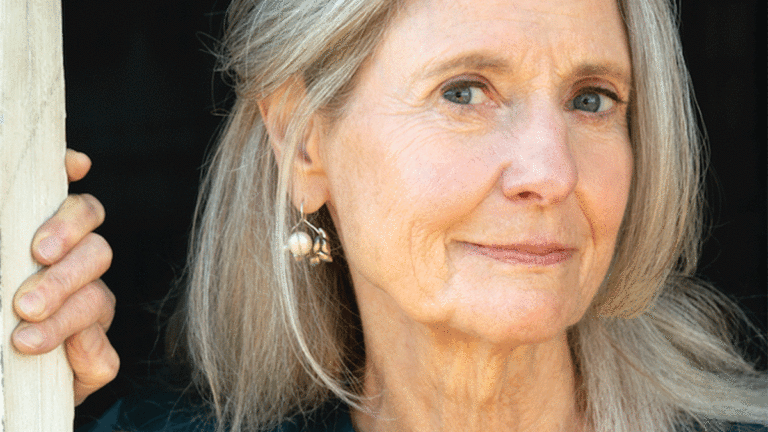
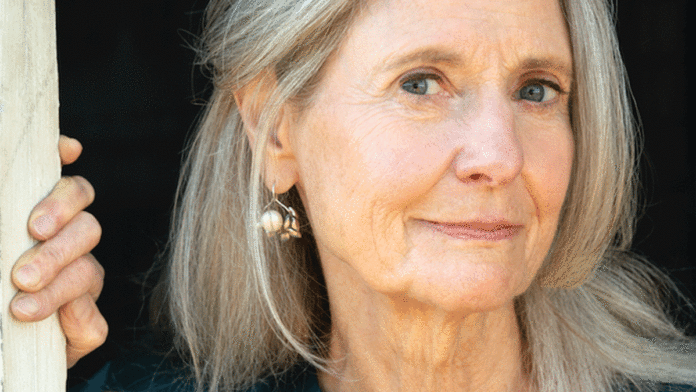
But if dying is still inevitable, a messy and inhumane death it does not have to be. That’s the message behind journalist Katy Butler’s new book The Art of Dying Well: A Practical Guide to a Good End of Life (Scribner).
Butler, who visits Bookshop Santa Cruz on March 27, has crossed this terrain before. Her 2013 book Knocking on Heaven’s Door: The Path to a Better Way of Death was part memoir, part investigation, offering the story of her father’s death as an illustration of what she calls “the Gray Zone,” the suspended state between an active life and clinical death that has been largely created by medical technology.
“I felt that I had laid out a problem in the first book,” says Butler, a long-time Bay Area reporter and writer. “I felt there was a need for a book that was about solutions. And that’s really the difference. This book says, OK, granted that we have a broken medical system that is very fragmented toward the end of life, and that we are afraid of death anyway. So given these problems, here are the workarounds, stories of people who have actually risen to the occasion and trusted their own best instincts to create a death that was less bad, or maybe even really good.”
The Art of Dying Well works best as a kind of handbook. Its seven chapters are determined by the particular stages of life, from “Resilience,” when you’re still active and healthy, all the way to “Active Dying,” the moment when it’s time to say goodbye. Along the way, each chapter outlines the attitudes and methods of preparation that could lead to a dignified and emotionally fulfilling end of life. The book’s format, says Butler, allows readers to return to it at different times in their lives.
“If you’re in the ‘Resilience’ part of life,” she says, “where you can still reverse a lot of health conditions, then you might want to read that chapter and call it a day, and put it away until you’re in some very different stage of life. And, if you’re in crisis, if there’s someone in your house who is dying, then skip the early parts and turn to the last two chapters and you’ll get a lot out of that.”
Butler was inspired by an antique text called Ars Moriendi, translated from the Latin as The Art of Dying. The text dates back to the 1400s and is a kind of medieval guidebook on the best way to meet death. She calls it one of the first bestselling self-help books. “It framed dying as a spiritual ordeal, and it named five different sorts of temptations and emotional struggles at the end of life, and how your attendants or friends could reassure you and help you through that.”
Though the fact of dying hasn’t changed, the circumstances of death have been upended since the Middle Ages. Butler, 70, started the writing process mindful of what links ancient ideas of death with contemporary ones.
“I do think there’s some commonality to what people think of as a good death. Clean and comfortable and relatively free from pain, having people that you love around you, being spiritually at peace,” she says. “Those things are still the same.”
The new book also offers up practical policy ideas to address what she calls a “technology-rich but relationship-poor” health care system. One such idea is a Medicare program known as PACE, which keeps ailing seniors out of hospitals and nursing-care facilities when it’s practical to do so, while still meeting their needs for home care, therapy and medication. The problem is, PACE is limited in its capacities and its funding. Still, there are many more down-to-earth approaches people can adopt to make a fulfilling end of life better for everyone—approaches that previous generations knew something about.
“You look at the ‘Greatest Generation,’” Butler says of those who lived through the Great Depression and World War II. “They had stronger social networks and more of an understanding to bring a cover dish when someone has a major health crisis. We need to relearn some of those more rural or red-state values of neighborliness and being part of community groups. That stuff matters.”
Katy Butler, author of ‘The Art of Dying Well: A Practical Guide to a Good End of Life.’ Wednesday, March 27. 7 p.m. Bookshop Santa Cruz, 1520 Pacific Ave., Santa Cruz. Free. bookshopsantacruz.com.
Warmer weather means more time in the sunshine, but it also brings some unwelcome furry friends. Join master gardeners Delise Weir and Sue Procter to learn integrated pest management methods for controlling vertebrate pests including gophers, squirrels, voles, rats, deer, and birds. This class will discuss pest behavior, identify the damage they cause and management strategies using traps, barriers, deterrents, and pest-resistant plants. Arrive 15 minutes early to check in.
INFO: 10 a.m.-noon. Sunday, March 24. Quail Hollow Ranch County Park, 800 Quail Hollow Road, Felton. Free/$3 facility fee.
Art Seen
Making Paper Poppys
With all of the rain California has gotten this winter, there are some stunning desert wildflower blooms, including thousands of golden poppies—the famous state flower. But for those who can’t make the drive out to Antelope Valley or other famous viewing spots, the Mission Historic Park is offering free paper poppy making classes to celebrate spring in California.
INFO: 1-3:30 p.m. Sunday, March 24. Santa Cruz Mission Historic State Park, 144 School St., Santa Cruz. 425-5849. Free.
Sunday 3/24
‘She Speaks Out…Again’
The Wheel Company presents a group of female poets, singers, drummers, musicians, dancers, and storytellers to gather and share their stories in a collective setting. The “She Speaks Out Again” event focuses on listening and learning from those who have experienced domestic violence and sexual assault, especially in the current political climate.
INFO: 6 p.m. Kuumbwa Jazz, 320 Cedar St., Santa Cruz. thewheelcompany.com. $25.
Thursday 3/21
‘Saving Democracy: The Way Forward’
The third edition to the Saving Democracy annual event, this bipartisan panel is aimed at bridging the gap between Democrats and Republicans through conversation. The panel of seven national and statewide politicians will discuss divisive partisanship and potential ways to find common ground. Alongside a few returning familiar faces like Santa Cruz County Supervisor Zach Friend and Debbie Mesloh, senior adviser to presidential candidate Kamala Harris, there are a few newcomers, such as former Press Secretary for the California Republican Leader Mike Madrid.
Join the Santa Cruz County Law Library in three 30-minute games of Scrabble. All levels are welcome, though there will be two categories of competitive and recreational players. There will be awards for the top three players in each category, including gift cards to local restaurants and businesses. Light snacks and drinks will be provided, but bring your own snacks if you are the ultra-competitive, stress-eating type. Funds support the Law Library and the Teen Peer Court Program.
INFO: 8:30 a.m.-12:30 p.m. Santa Cruz Law Library, 701 Ocean St. Room 70, Santa Cruz. 420-2205, sc*******@***oo.com. Free, advance registration recommended.
For this week’s cover story, Hugh McCormick leapt into the Santa Cruz Flea Market experience headfirst. I mean, it would have been easy enough for him to write a policy-type story on the weird fate of the local institution that didn’t involve getting up at ungodly hours to actually go and experience what selling at the flea market is like, not to mention spending countless hours hanging out with the regulars who make up the market’s community.
But because he did, a different kind of portrait of the flea market emerges in his piece, one that I think gets at the heart of a story that is easy to overlook in those rows of antiques, crafts and crazy junk: the people who make it a fascinating local subculture. Most of us have had fun crashing the flea market on at least a few afternoons over the years, but for some people in our community—both buyers and sellers—it’s a way of life.
Also, in this issue, we profile one of the winners of this year’s NEXTie Awards, Mira Goto. The Santa Cruz musician is not only receiving an award, she’s also performing at the NEXTies ceremony on Friday. And she’s one of the musicians who will play the John Prine tribute show on Saturday that is a benefit for William Strickland, who was hit hard by the NorCal wildfires. You may not think you know who Strickland is, but most locals would recognize him as the voice of the KPIG “Hog Call” and a number of other themes and jingles at the station over the years. He’s kind of a Santa Cruz legend, and if you’ve ever wondered what a guy with a voice that awesome looks like—well, he’ll be performing at the show as well. Check out the story on Goto for details on both events.
And just a reminder that DNA’s Comedy Lab and Experimental Theatre, which I wrote about last week, opens this Friday with Joe Sib!
The stunning Blue Wave that took back the House last November represented an unprecedented level of progressive resolve and political organizing.
Carson Kelly and Indivisible certainly deserve credit for the new political energy they’ve activated here in Santa Cruz County, but Kelly’s dismissive comments about the Democratic Party were unfortunate and off the mark.
The Santa Cruz County Democratic Party, representing 87,000 registered Democrats countywide, joined with thousands of new and longtime activists from groups like Swing Left, Sister District, Women’s March, Labor, and Indivisible (among others), working tirelessly to turn previously red districts blue, in California and beyond.
The result speaks for itself. Democratic candidates won 46 of the state’s 53 congressional districts, and seven of California’s congressional seats flipped from red to blue. A Blue Wave nationwide took back the House, and with everyone’s help will continue to roll on through to 2020 and beyond.
Coco Raner-Walter | Chair, Santa Cruz County Democratic Party
Transportation’s Future
Every day, the Earth reminds us that the natural environment is changing. The recent count of Monarch butterflies at Natural Bridges shows their numbers to be greatly diminished, our Monterey Bay is at risk from ocean acidification, and there is talk of managed retreat from the Santa Cruz coastline.
How does one cope with this news today, and how do we think about our the future? What is the role of our government? What is our personal role?
Both the Santa Cruz City Council and the Santa Cruz County Board of Supervisors have passed climate emergency resolutions. The hard work now will be to implement policies to drawdown carbon emissions. We must change the way we live on the earth in order to survive.
As fossil fuels are burned, CO2 and other greenhouse gases are emitted. CO2 lasts in our atmosphere for hundreds of years, meaning all CO2 produced today will contribute to the warming blanket surrounding the Earth for a lifetime. Business-as-usual emissions will raise the earth’s temperature 3-4 degrees centigrade above pre-industrial levels by the end of the century. The high temperatures will lead to severe food insecurity, migration, sea level rise, loss of potable water, and government breakdown. Our youth will be severely impacted by all our current decisions and actions regarding the extraction and burning of fossil fuels.
Transportation is the major contributor to greenhouse gas emissions in Santa Cruz County. Unfortunately, the Regional Transportation Commission (RTC) voted to widen Highway 1 by constructing auxiliary lanes from Santa Cruz to Aptos. However, vehicle travel, which has been a cornerstone of American life, needs to be scrutinized in light of its increasingly catastrophic threat to our collective future and contribution to the business-as-usual scenario.
Citizens of Santa Cruz County need to take a hard look at alternatives to highway widening. There are solutions for mitigating congestion and decreasing greenhouse gas emissions. Bus-on-shoulder, used in other cities, allows buses to travel unimpeded in a separate lane. Providing bus-on-shoulder on Highway 1 doesn’t require auxiliary lanes. In addition, as zero-emissions electric buses become part of the METRO fleet, no greenhouse gases will be discharged with bus on shoulder transit.
Seven electric buses have been ordered by Santa Cruz METRO, and delivery is expected in 2020. Other innovative solar-powered transportation systems, such as Personal Rapid Transit (PRT), are being developed and could also be used along Highway 1 and the Coastal Rail Trail.
The Campaign for Sustainable Transportation currently has filed a lawsuit to stop construction of the proposed auxiliary lanes. Information about transportation issues and the lawsuit is available at the Campaign for Sustainable Transportation website. With only about 10 years remaining to drastically limit the extraction and use of fossil fuels, there is no other choice but to change our outdated transportation system. It is an exciting time to listen to new ideas and discuss how we should boldly change the way we live on the earth.
Susan Cavalieri | Santa Cruz Climate Action Network
PHOTO CONTEST WINNER
Submit to ph****@*******es.sc. Include information (location, etc.) and your name. Photos may be cropped. Preferably, photos should be 4 inches by 4 inches and minimum 250dpi.
GOOD IDEA
The Santa Cruz County Women’s Commission has announced recipients of the 2019 Trailblazers Awards, who will be honored at the Santa Cruz County Board of Supervisors’ meeting on Tuesday, March 26. The awards recognize those who are making extraordinary differences in the lives of women or girls. This year’s recipients include Salud y Cariño co-founder Margaret Cariño-Condon, Alliance of Women Entrepreneurs co-founder Casey Coonerty-Protti, Justice and Gender Advisory Task Force member Nicole Keadle, and self-defense teacher Clara Minor.
GOOD WORK
The Downtown Streets Team, known for beautifying Santa Cruz, has now expanded to include the San Lorenzo Valley. The team, made up of homeless individuals who are paid in gift cards, has already been cleaning up other areas—downtown Santa Cruz, the San Lorenzo Riverwalk, Main Beach, Harvey West, and North County beaches. Expanding an existing pilot contract with Santa Cruz County, a five-member crew will provide services to dumping areas near downtown Felton, including Covered Bridge Park.
QUOTE OF THE WEEK
“At a flea market I always head for the junk jewelry table first.”
Live music highlights for the week of March 20, 2019
WEDNESDAY 3/20
INDIE
AND THE KIDS
No matter how And The Kids might flirt with the dim and blurred illusions of melancholic ennui, the band always finds its way back to sugary sweet pop bliss. And then rocks out, indie-style. At the forefront of the dramatic anthems and the feverish crisis of And the Kids’ music is Hannah Mohan’s stark, springy vocals. Straightforward drumming and meaty guitar riffs create songs that start out headstrong, only to ramble off into some hazy soundscape and pop back out from the nebulous shadows with twice the bite and grit. AMY BEE
Latin and Caribbean music are much closer than you think. I mean, these countries are all literally close to one another, which is probably why there’s so much overlap of genres between countries like Jamaica, Cuba, Trinidad, and the Dominican Republic. Did you know that Santa Cruz is home to a longtime group of Latin-Caribbean aficionados? That group, Broken English, is celebrating 25 years of taking Cruzan audiences on a “Caribbean Cruise.” Expect lots of cumbia, reggae, salsa, soca, mamo, son, Guajira, and more. AARON CARNES
Have you ever wanted to get really high and nod out to Fleetwood Mac rave-style, with the songs indefinitely elongated so you could just sway and sway to the psychedelic visions in your head? Well, here’s your chance! Fleetmac Wood have taken what’s best about this iconic band and put it on repeat, creating a groovy, introspective yet danceable (if your style of dance is akin to Ally Sheedy shaking dandruff from her hair, but even more emo), epic, and endless tribute to the band that made chaotic relationships sexy AF. AB
More than a meeting of minds or a vehicle for unbridled improvisation, the Transparent Water Trio is a spiritually charged communion between Cuban pianist Omar Sosa, Senegalese kora master Seckou Keita and Venezuelan percussionist Gustavo Ovalles. Glistening with lithe and seductive melodies and bright cadences, the trio’s celebratory sound is unlike any other ensemble in jazz, Latin or world music. It’s powerfully elemental and supremely sophisticated, rootsy, cosmopolitan, and sumptuously inventive. ANDREW GILBERT
INFO: 7 and 9 p.m. Kuumbwa Jazz, 320-2 Cedar St., Santa Cruz. $26.25-$42. 427-2227
SATURDAY 3/23
WORLD BEAT
SPECIAL FUN
From 1982 until 1987, local band Special Fun was the quintessential Santa Cruz band. The group blended styles from all over the world—African, Caribbean, Latin, Funk—and made it into the best party band going. The band later re-formed as Solcircle from 2004-2012, giving the already diverse influences some jazz and psychedelic elements. But guess what, everyone’s favorite party band Special Fun is back for one night. And the members promise it will be one of those old school dance-jams, where you lose your mind and forget who you are for a brief moment in time. AC
INFO: 8 p.m. Michael’s On Main, 2591 Main St., Soquel. $15. 479-9777.
ELECTRONIC
STARFARER
With a name like Starfarer, it’s no surprise that this San Jose musician dwells in the outer reaches of the electronic realm. What isn’t expected is the thumping, retro-futuristic, darkwave synth sounds he creates, shying away from burn-out, fad trends in the scene and keeping with the bleeps and bloops that stick to your guts. Fresh off the release of his (her? their?) January full-length Into the Unknown, Starfarer’s March 23 performance at the Blue Lagoon will be rounded out by Santa Cruz’s Voltaic Spore and Emeryville’s Xenocircuit. For fans of NIN, Depeche Mode and ’80s cult film soundtracks. MAT WEIR
INFO: 8:30 p.m. Blue Lagoon, 923 Pacific Ave., Santa Cruz. $5. 423-7117.
SUNDAY 3/24
FOLK
STEVE POLTZ
Canadian folk artist Steve Poltz’s songs have the kind of well-worn intimacy of a wood-paneled room or a broken-in baseball glove. Famed for his collaborations with fellow far-north folk artist Jewel (with whom he wrote the hit “You Were Meant For Me”), Poltz has seen every side of the music industry, from the major labels to the self-released. He even inspired a Weird Al original: “Albuquerque,” vis a vis Poltz’s old indie-rock band the Rugburns. Some stories are too unbelievable to be scripted, and Poltz’s is one of them. MH
Break out the hair grease and get ready to rumble as the Koffin Kats return to Santa Cruz with killer psychobilly tunes. Since 2003, the band has continuously delivered hard-hitting, head-boppin’, pit-inducing tracks about love, life, loss, and, of course, killer monsters and B-movies. Over the years it’s remained a fierce trio, despite several lineup changes. But in 2016, the current roster of Tommy Koffin on guitars, drummer Eric “E-Ball” Walls, and bassist/singer Vic Victor—also known as the “true” or “established” lineup dating from wayback in 2007—returned to the road and has been serving audiences since. That year also marked the group’s eighth and latest album, Party Time in the End Times. MW
Before her latest album, Big Picture, Christie McCarthy had released four albums, guested on other artists’ records and had songs on a Target Christmas compilation. But Big Picture is special, because it’s her first album since she moved to Santa Cruz nine years ago.
“I was focusing on some other stuff in my life and in my work,” McCarthy says. “It’s just been the last couple years that I pivoted back to music.”
The album sounds like it could have been plucked right out of the Laurel Canyon era of ’70s singer-songwriters, with lots of subtly complex hooks and lush harmonies, and a wealth of influences from the realms of folk, Americana and rock ‘n’ roll.
Overall, it’s got an uplifting vibe to it. She touches on the darkness of the times, but asks us to focus our attention on the beauty all around us instead.
“It’s interesting what’s going on in the world today. There’s a lot of conflict,” McCarthy says. “I think there is an opportunity in the dark for love and for friendship and all those things to arise.”
She worked relentlessly on the record with several local musicians she’d met since moving here. She also had a vision for the album to have the flow and feel of the old ’70s records that had specific side A and side B’s to them.
“I chose a group of songs that I thought would tell a story where the sum is larger than its parts, like reading a book,” McCarthy says.
Since moving here, she’s tended to play only occasionally, even after releasing Big Picture last year. She’s hoping 2019 will be a little bit different.
“This year, I’m really focused on doing a handful of solid shows, focused on putting together this band, really focused on getting out there a lot more,” McCarthy says.
INFO: 7:30 p.m. Thursday, March 21. Michael’s on Main, 2591 Main St., Soquel. $12 adv/$15 door. 479-9777.
It’s an early-morning feeding frenzy. A swarm of “sharks”—specialists, dealers, collectors, and seasoned deal seekers—dart through the aisles of the Santa Cruz Flea Market on a cold and blustery Sunday in November, systematically feasting on and devouring easy prey (flea market newbies, or “minnows”) with cold and practiced precision. It’s 6:45 a.m., still dark and grey out, when the first shark appears in front of our makeshift booth (some carpets laid with shoes, books and other household castaways, and a clothing rack hung with once-loved pieces). Hastily—and might I add, a tad bit scornfully—he appraises our messy rows of wares. He hovers for a moment and shrewdly watches GT’s former managing editor Maria Grusauskas and I finish unloading our packed cargo van.
Held on the grounds of the former Skyview Drive-In each week (weather permitting) since 1971, the Santa Cruz Flea Market has long been a popular local institution and weekend ritual. For decades, throngs of deal seekers, treasure hunters, people watchers, and pro/am junk slingers have happily skipped through the market’s labyrinth of aisles. Most don’t know that the flea market is officially on the chopping block.
The Palo Alto Medical Foundation (PAMF)—a branch of Sutter Hospital—purchased the property that the Santa Cruz Flea Market sits upon in 2006, and long ago announced their plan to develop a maternity ward on the valuable piece of real estate, eliminating the iconic flea market for good. No one really knows how much longer the Santa Cruz Flea Market can remain open.
And the writing may be on the wall. Earlier this year, Goodwill Central Coast, which manages and runs the Santa Cruz Flea Market, leasing the land from Sutter on a year-to-year basis, announced that it will end Friday operations at the flea market starting April 1, because Sutter wants the lots for overflow weekday parking. At least for the time being, the market will still be open Saturdays and Sundays.
Sutter actually did shut down the flea market for almost six months in 2007, sending panicked vendors scrambling for other venues and sources of income, and triggering a backlash from locals who had relied on the marketplace for decades.
Relocating the flea market to the fairgrounds in Watsonville sounded like a good idea at the time, but things never really took off there. Vendors and customers simply wouldn’t travel. Bowing to pressure from local residents, Sutter officials eventually declared that they wouldn’t shutter the flea market overnight, but also admitted that they didn’t want to run the venue themselves. The medical provider sought an established local nonprofit to operate and manage the operation, and Goodwill Central Coast stepped up to the plate.
Since then, the fate of the market has hung in limbo while Sutter hashes out a plan.
“We purchased the land in 2006 with the intent that we may need additional facilities in the future,” says Sutter communication team member Callie Lutz. “We’re currently studying what the best use of the property will be to meet the needs of the community. At this time we don’t have specific plans yet for the site.”
While there was no fixed time frame at the beginning of their arrangement with Sutter, few at Goodwill expected that it would take this long for the hospital to develop an official plan for the land. “It’s staggering to think about building an entire new hospital from the ground up. They will get it done eventually though,” says Goodwill Central Coast CEO Ed Durkee. “The flea market will end eventually—they will build a hospital on the land. But I don’t know when that will happen.”
MEET THE SHARKS
Back on that Sunday morning in November, we soon learn that the shark in front of our booth has a name. He’s Ron Wagner, a 60-year-old Santa Cruz resident who has been coming bright and early to the Santa Cruz Flea Market since the 1980s. “I come to find treasures,” he says. “You know, to find something unique.”
He spots something peeking out of a box and picks it up quickly, turning it over in his hands. “How much for the recorder?” he asks. “How about a dollar?” Maria and I reply in unison. It seems like a tough decision for Wagner, and he massages the bone-white instrument in his right palm, playing with it thoughtfully. “OK,” he finally says. Our first sale!
As the morning sun climbs higher, we ask the grizzled flea market veteran to critique our spot and setup. He mostly approves, but tells us that some of our items—like my hodgepodge of pens and coloring books—need to be more visible, and less haphazardly displayed. Seeing us shiver in the cold, he also recommends that we dress warmer next time. Thanks, buddy.
Before he wades into the sea of vendors, Wagner sagely says, “The flea market is important for Santa Cruz. It keeps low-income families—and even kids like you—dressed and clothed. And it’s become a unique cultural spot in our county. It makes Santa Cruz a better place.”
GRAB BAG From antiques and electronics to toys and food, the Santa Cruz Flea Market has a little bit of everything. PHOTO: JULES HOLDSWORTH
I take a few minutes to peruse other sellers’ stations and meet Maddie Loveless, one of many neighbors who puts our effort to shame. With a grey Crocodile Dundee hat covering her long and shockingly red hair, 22 year-old Loveless sits behind a smartly laid-out table covered with rocks, gems, assorted picture frames, and a few eclectic antiques. Her setup looks professional and polished, each item perfectly placed. As a student at CSUMB, Loveless splits her time between studying in the geology department and working long hours in campus labs or doing survey work. Selling at the Santa Cruz Flea Market is her side hustle.
Loveless and her boyfriend (now fiancée) have been regular sellers at the flea market for more than five years. They are hooked. “The flea market is the last standing bazaar you can go to. It offers the freedom to do business however you want,” she tells me. “It’s an opportunity for people like me—for small business—to happen.”
The couple operates as a team, setting up their two tables in the dark at around 5 a.m. on most Sundays. In their early days of selling, getting up and going in the morning was tough, but now they have a routine. They pack hand warmers, beanies, blankets, and a kerosene lantern in their van. People start rummaging through their items in the early hours, as Maddie and her soon-to-be husband get ready, unpack and try to stay warm.
The flea market has become a lifeline for Loveless, allowing her to live more comfortably on a student budget. Don’t let the baby face and bubbly personality fool you: Loveless is a shark. As a seasoned flea dealer, she patrols the market in the early hours of the morning, on the lookout for deals and hot buys, and things she can flip for a profit at her stall.
“Oh yeah, you can find treasures here. Folks don’t know what they have,” says Loveless. “If you know what you’re looking for you can get amazing deals. Buy low, sell high.”
The couple is also keenly aware of the fact that their entire business, and the livelihood of many county residents, can vanish at a moment’s notice. The threat of Sutter’s expansion is a dark cloud that has hovered over flea market vendors for over a decade.
“The entire community needs this place,” she says. “You can come here and help individual people out—people who are struggling.”
STORAGE LOCKDOWN
Further down the row of sellers is Santa Cruz’s own Larry J., who for decades peacefully and semi-anonymously bought and sold empty storage lockers, then flipped the contents for reliable income. At 73, Larry J. looks youthful—like someone who hasn’t had a “real job” since the late 1980s. His wavy brown hair is now speckled with grey, but he tells me that he’s been selling at the Santa Cruz Flea Market every Sunday since 1998.
Some storage lockers are full of treasure. A recent auction attendee snagged a unit in Indio for $500 that turned out to contain a safe with tightly wrapped bundles of cash totaling a cool $7.5 million. But most units, Larry tells me, are full of junk.
He doesn’t mind junk though. Heck, he’s been the king of junk here for 30 years. But after A&E’s show Storage Wars started airing each week, he says an army of would-be junk-lords have begun to show up on his turf. It used to be a relatively secret industry for those in the know, and a reliable source of income. Now, it’s become a circus, he tells me, and old-school auction buyers like himself have taken a big hit. Larry guesses that there are around eight “storage locker folks” who sell at the flea market on an average Sunday, and that number is way down from what it used to be.
“Storage Wars changed things overnight,” Larry tells me. “It drove the locker prices really high and brought out a ton of people to the auctions. This hurt a lot of good people. The excitement sort of fizzled out, but the prices are still way higher than before.”
Each week, Larry empties his mid-sized semi-truck in the wee hours of the morning, arranging neatly-spaced aisles of overflowing boxes across two entire spaces. He’s had the same spot, the same layout and the same sales strategy for more than two decades. His life has revolved around the flea market for as long as he can remember. “Some people do it for a living, and some people do it for fun. I do it for both, I guess,” he says.
Larry’s favorite thing about Sundays at the market is the energy and vibrant social scene; the sometimes-odd collection of people who show up to buy and sell each week. He’s seen it all: countless crazes like beanie babies, Pokemon, Hummel plates, and more recently, fidget spinners. “It’s hot-hot-hot, and then one day you can’t give that shit away!” he says with a laugh.
Larry equates the flea market to a living, breathing organism—one that adapts to changes in the economy, politics and the weather. When the economy is good, he’s hesitant to haggle much. But when people are hurting, suffering, and in need, he’ll bargain.
Larry tells me that the upcoming Friday closures “are going to hurt a lot of good people.” And if the entire flea market closes down, he says that the community will lose “a great and important resource where people can buy things cheap—things that they normally couldn’t afford. A lot of local people don’t make a lot of money. A lot of families would lose in the end. Everything is so damned expensive in Santa Cruz already. The flea market helps subsidize people.”
A MAN OF GOODWILL
Wearing red Hoosiers colors and a navy blue baseball cap over his just-starting-to-grey hair, Ed Durkee has the “casual executive” look nailed. As acting CEO of Goodwill Central Coast, the 52-year-old’s penetrating blue eyes don’t miss much. They visibly light up as he tells me about his six years at the helm of the organization. The Indiana transplant says that he has always wanted to do social justice and inclusion work, and that his goal, as well as his organization’s, is “to work with as many people in the community as we can—to help them reach their goals and move toward economic independence.”
Durkee has overseen Goodwill’s management and operation of the Santa Cruz Flea Market from the moment he arrived in the Bay Area.Each week, an army of Goodwill employees assist vendors and provide a safe and healthy environment for community members to buy and sell. Some of the organization’s staff does security and crowd control, while others help vendors set up and pack up, handle disputes, manage traffic, take payments and entrance fees, and make sure county rules—like no dangerous items or plastic bags—are followed. Goodwill’s relationship with Sutter is “solid,” in Durkee’s words, and the marketplace’s operation is also financially healthy for all parties involved.
LOCAL FLAVOR Produce vendors and purveyors of breakfast burritos, hot dogs and other delicacies are a flea market mainstay. PHOTO: JULES HOLDSWORTH
“Ed Durkee and the entire Goodwill Central Coast team do such a great job, and we’re glad to continue our partnership,” says Sutter’s Lutz.
Taking a sip of Verve coffee, Durkee says, “We’re paying Sutter a lot, but we are making money, too.” The money Goodwill earns helps the nonprofit further its mission of helping people on the Central Coast get jobs.
Durkee, like many of the market’s regular vendors and long-time buyers, knows the flea market has been running on borrowed time, since many expected Sutter to have broken ground long ago on the maternity wing.
“It’s one of the most valuable pieces of property in the county,” says Durkee. “The fact that we’re able to do this—to have this magical market here—is amazing. This community gem is something to appreciate and treasure as long as we have it. If it does close, it would be a loss of a beloved institution.”
SELLER’S REMORSE
For Maria and I, our first foray into selling at the flea market is a learning process, full of drama, choppy waters and a few happy moments. The market begins brutally early in the day, when coastal fog adds a few millimeters of moisture to your entire body—and everything you own. Gloves, a jacket, a nice thermos of hot coffee or tea, and a small blanket are must-haves for any flea market seller. Nobody gave us the memo, and Maria’s toes sadly developed a minor case of frostbite.
By the end of the day, we’d come up with a wide variety of ingenious strategies to lure and corral impressionable buyers into our retail extravaganza. The most successful was a box of “free stuff” that we placed in front of our space. We also attempted to physically corral people to our space using Maria’s gigantic and ancient Mary Poppins-esque bicycle. Foot traffic increased immediately with this rusty relic out front, and we were doing great until we caught the attention of authorities, who promptly requested that we stop blocking the walkway.
It was a long day—from 6 a.m. to around 2 p.m, and we spent the hours trying to wrap our heads around the baffling question of why some of our items sold and others didn’t. I was sure that my vintage Sublime clock would be snapped up toot sweet. And who wouldn’t want to inherit my eclectic, Asian-inspired lamp? But the items sat and gathered dust even as I dropped their prices. The process was downright vexing at times. Other things sold unexpectedly: a conservative and distinguished older gentleman gave me a whopping $2 for my hole-riddled, half-way burnt “No Smoking” sign.
One man’s trash, as the old adage goes, is another man’s treasure.
Sitting in a depression between high rocky cliffs near the shore, the Capitola Village is home to trendy shops, bars and restaurants, all of which have helped make the town of Capitola a popular, laid-back getaway since 1869. Over the years, the city has seen many changes—and more dramatic ones could be on the way.
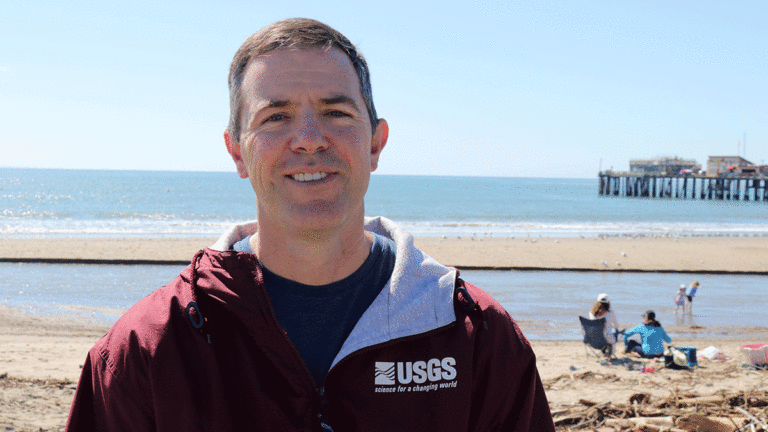
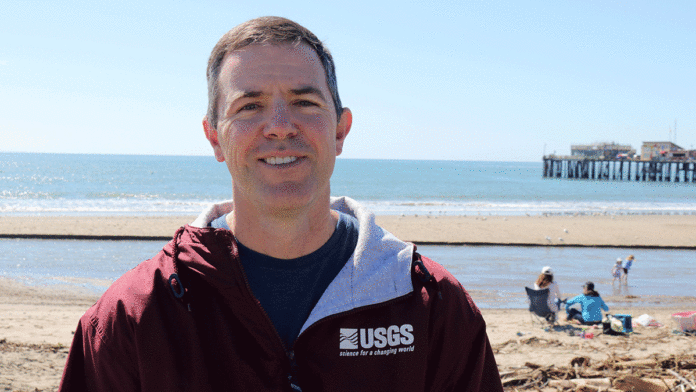
Patrick Barnard, who’s lived in the Capitola Village for more than 15 years, works as a coastal geologist with the U.S. Geological Survey (USGS)Pacific Coastal Science Center. As research director for the federal agency’s climate impacts and coastal processes team, Barnard focuses on climate-related changes to the beaches and estuaries bordering the Pacific Ocean.
Increasing global temperatures have begun melting polar ice caps, a trend that’s raising sea levels. It will all mean trouble, he says, for the town that he calls home.
“Sea-level rise is going to pose a major problem for communities up and down the coast—especially low-lying communities like Capitola,” Barnard says. “The village is built right at sea level in the flood plain of a river. Between the ocean and the creek, it’s in an extremely vulnerable position.”
To put it bluntly, there’s a chance that a portion of “Capitola by the Sea,” as it’s sometimes known, could become “Capitola in the Sea.” The city of Santa Cruz’s Climate Adaptation Plan, published in 2018, estimates climate change, caused by greenhouse gas emissions, will result in about 28 inches of sea-level rise along the Central Coast by 2060.
According to a U.N. report on climate change released last year, the world will face disastrous climate change if humans fail to to cut emissions 45 percent from 2010 levels in the next 10 years.
In Capitola’s own Climate Action Plan, adopted in 2015, leaders primarily address methods of reducing carbon emissions—encouraging bus ridership, bicycle use and electric vehicles—more than studying ways to mitigate climate change’s impacts. The report does, however, say that the city could be hit hard by “the effects of sea-level rise, changes in precipitation patterns, extreme weather events, and other inclement effects of climate change.” Such possibilities may not sound totally unfamiliar to many residents. In March of 2011, a heavy rain downpour caused a Capitola drainage pipe to burst, sending a wave of water through the village.
Barnard expects flooding and severe storms to occur more regularly, and when combined with sea-level rise, they could wreak havoc on village life.
“If you’re looking out to 2050, with a foot or more of sea-level rise, it’s clearly a serious problem,” says Barnard. “Waves are crashing through Zelda’s and Margaritaville already. Add a foot of water and these things will start happening every year, and multiple times a year.”
Capitola Mayor Jacques Bertrand says that every winter, the town puts up sandbags to serve as a barricade. There are some in place right now. One day, they won’t be enough.
“Sandbags will soon be ineffective. You can’t build high enough,” he says. “You can’t hold the water back at some point.”
WATER LEVEL UP
Even the 4 inches of sea level rise expected on the Central Coast by 2030, according to Santa Cruz’s plan, could have serious, long-lasting effects on sea-level communities like Capitola, a town of 10,000 residents spread over an area of just 1.7 square miles. Some business owners are already on edge.
Brook Penquite, 49, opened his family-run Santa Cruz Poke shop a little over a year ago in the Capitola Mercantile. Penquite, who has gray hair and a speckled brown goatee, wipes sauce from his thick apron and solemnly tells GT that “things are already changing in the village.”
“It’s beyond worrisome,” he says. “Sea-level rise is going to have a huge impact on the homes and businesses down here. I want to see us survive down here. But we are going to need to make changes.”
Penquite says he’s already seen overloaded storm drains spew sewage into the streets and water breach the sea wall during storms. “No one knows what it’s going to be like in the future,” Penquite says. “But the truth is we’ve seen flooding way more frequently. We need to approach climate change mitigation with a real cause and a real purpose.”
Nearby at Pizza My Heart, Ruby Aron, 17, darts back and forth between a large oven and the front counter, taking orders and talking to hungry customers.
A native Capitolan, Aron sees the village and nearby beach where she spent her childhood summers as “safe, family-friendly, charming, and perfect.” She and other Pizza My Heart employees are “worried sick” about climate change, sea-level rise, and the prospect that their flagship pizzeria could soon be underwater,” she says.
“The sandbar is changing,” says Aron. “The beach is shrinking. Behind our building, there’s an entire stream connecting the beach and the creek that never existed before. If things continue, a lot of people’s memories are going to be washed away. We need to do everything we can to save the village.”
CREEK PEAK
Portions of the Capitola Village, which wraps around Soquel Creek, take clear inspiration from Venice, Italy, whose complex gridlike canals weave around city blocks.
Perhaps the most obvious remnants of that 100-year-old local aspiration lie in the Mediterranean-style Venetian Court bungalows on the north side of Soquel Creek. In the real Venice, located on Italy’s northeastern shore, repeated flooding has already begun taking a significant toll. For more than 15 years, construction crews have been building gates at the mouth of the city’s lagoon to literally hold high tides at bay.
In Capitola, Public Works Director Steve Jesberg’s three-man department is responsible for all maintenance and construction projects for parks, roads and public facilities in Capitola. “We’re a small city,” he says. “There’s no one person whose job it is to look at and plan for sea-level rise and the effects of climate change.”
Capitola, he explains, is working to ensure that all existing infrastructure is as good as it can be. “Sea-level rise is a real thing, and something we need to address soon,” he says.
The Capitola jetty was built in the late 1960s to keep Capitola Beach as wide as possible. A wider beach means more protection for the village, allowing waves to break on the edge of the beach, further away from buildings. Barnard says that without a jetty, Capitola wouldn’t even have a beach. Sand would be ripped off the beach and sent down the coast.
Even with an intact jetty in place, Jesberg warns that waves will still crash over Capitola’s sea wall and into buildings in the village. He’s extremely worried about winter storm surges. With sea level rise, he says, “There is potential for water to go over our modest sea wall and enter the village and road every day. If this happens, we’d have to rebuild the entire village—with higher roads and such.”
Rebuilding would be a tall order for Jesberg and his team, but the public works director says that he and his department are “not panicking yet.”
Barnard, though, stresses that the threats are real. “Just a few inches of seal level rise can cause 100-year events to occur every five years,” he says. “Adapting to sea-level rise and the expected impacts of climate change is going to be very expensive. I truly wonder if Capitola has the resources it’s going to take.”
Mayor Bertrand says Capitola is working to improve its drainage system and planning and trying to better understand the “scope of the issues.” The city might have to raise the village in order to protect it, he says, adding that abandoning the neighborhood wouldn’t be an option. He doesn’t know how Capitola’s going to pay for it.
“How much money is it going to take to save the village? Raising all the buildings and moving them inward—that’s a huge project,” says Bertrand, a former city treasurer. “Capitola Village is going to have to change due to the threat of climate change and sea-level rise.”
Businesses may have to adjust as well. Jesberg says that the economic impacts from global warming will be big. “A lot of business will be affected,” he says. “It will definitely affect tourism and the health of Capitola Village.”
Even with the jetty improvement approved, one of the biggest challenges Capitola faces is the beach itself, which Barnard says may not exist in a few decades. With sea level rise, beaches tend to migrate and shrink inward.
Barnard says that right now, waves primarily come from the west and northwest. That leaves southwest-facing Capitola more or less buffered from big swells. He says that climate models project that more waves will start coming from the south, which would mean trouble.
“The village will see a direct impact,” Barnard says. “A direct hit.”
Fresh off Black History Month and the local Martin Luther King Jr. Day march, the Santa Cruz Police Department has opened an investigation into a police officer’s racially charged post in a law-and-order-centric Facebook group.
Officer Chris Galli first drew attention for a January post on a conservative Facebook page called “Santa Cruz, CA: Keepin’ It Real” when screenshots of his commentary about an African-American resident of the homeless encampment behind the Ross department store were published on left-leaning news site Indybay. In the exchange, Galli, posting as “Chris Meriekuh,” referred to camp resident and unofficial spokesman Michael Sweatt as, “Good ‘ol dindunuffin Mr. Sweatt”—a phrase used on Reddit and elsewhere after the 2014 Ferguson police brutality protests to mock African-American people who deny committing crimes.
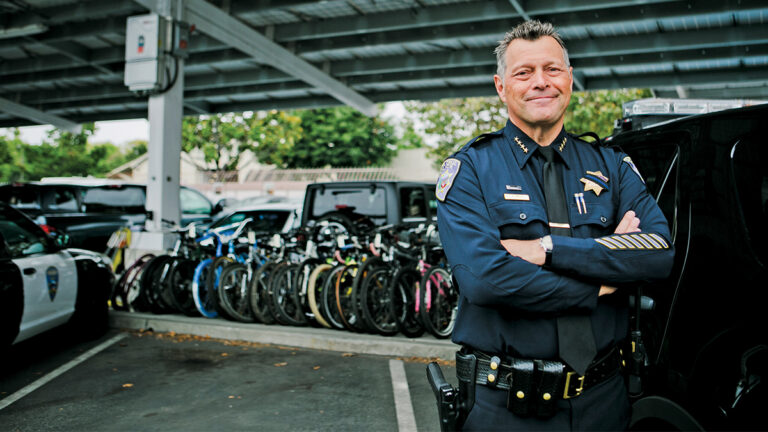
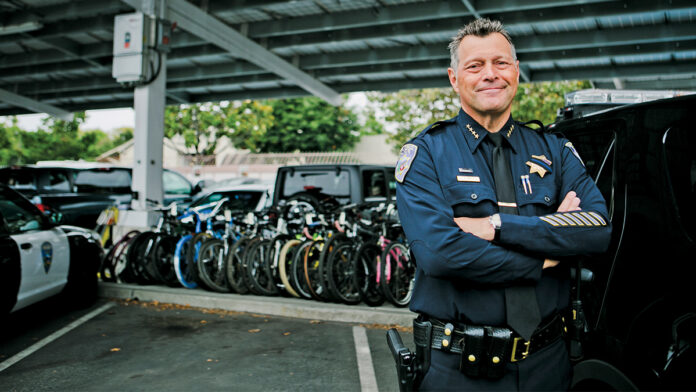
“Yes, it has been brought to my attention, and we have initiated an Internal Affairs investigation into the matter,” Santa Cruz Police Chief Andrew Mills tells GT. “I can’t comment on the personnel investigation, but I can tell you that we take all those matters seriously.”
The investigation comes as local online political groups, a microcosm of a chaotic national political environment, continue to splinter into increasingly insular corners of the Internet. If and how local law enforcement or other employers will respond to the polarizing rhetoric is the question now confronting Mills and his department.
The “Santa Cruz, CA: Keepin’ It Real” Facebook page is billed as “a humble attempt to make sense of the chaos that is daily life in the city of Santa Cruz.” It consists mostly of detailed crime and court reports compiled by moderator “Big Joe 77,” plus Law & Order-inspired slideshows of mugshots and often-vitriolic comments about people accused of crimes. City spending on homeless services is a frequent target of posters who call Santa Cruz and its elected officials a “shitshow,” and sometimes bestow a “Jackass of the Day” award.
Mills says the police department doesn’t regularly track online posting habits of police personnel on ‘Keepin’ It Real’ or other pages. If remarks are brought to the department’s attention, as was the case with Galli, the department will investigate. “We don’t actively monitor social media,” Mills says. “There’s just so much of it. I don’t really have the staff or the ability to do that.”
The Santa Cruz Police Officers’ Association did not respond to a request for comment about whether officers’ online personas should be grounds for departmental action.
Personal vs. Political
The issue of political expression among local law enforcement could be muddled by the fact that Mills himself faced criticism for uneven enforcement of department rules in his previous role as Eureka police chief. As Humboldt County media reported in 2017, Mills took issue with a Humboldt Bay firefighter wearing a “Black Lives Matter” pin on his uniform, though Mills was captured in a photo wearing a “Police Lives Matter” bracelet while on duty.
“What happened is that the city’s policy is that you cannot wear pins of any kind without prior approval from the chief of that department,” says Mills, who adds that he has also told multiple officers that they may not wear pro-Second Amendment pins or other insignias on the job. “You have to set a standard, or it gets out of control.”
As for what made his “Police Lives Matter” bracelet an exception, Mills says he was showing personal support for officers killed in a 2016 Texas ambush. And the bracelet, he adds, was not physically on his uniform.
“That is not a violation of the policy because it’s not on my uniform,” Mills says. “It was more of an issue of showing support for our officers.”
Since taking the job as Santa Cruz’s top cop in the summer of 2017, Mills has staked out a conciliatory position. In addition to championing the annual MLK Day march with the local NAACP, Mills has used his personal blog to draw attention to alleged hate crimes and civil rights milestones. In a post earlier this year titled “Words Matter,” Mills wrote that, “How we speak to one another matters greatly. People on the fringe use extreme words as justification for wrong behavior.”
Last year, after visiting a Resource Center for Nonviolence exhibition on “Black Lives in Santa Cruz: What Matters,” Mills told GT that,“We need to look at what we are doing that eliminates people of color” in public hiring.
“Me, as a white male in my 60s in government, I cannot understand what it’s like for a young African-American guy to be stopped multiple times,” Mills says. “And I don’t think that those who are not in law enforcement can truly understand what it’s like to walk up to a car when you have no idea who’s in the car at 3:00 in the morning. My goal is to bring connection and unity.”
Though he doesn’t expect questions about political expression to go away, Mills says it will take addressing underlying tension and improving a range of social and economic systems to really move the needle.
“It’s a broad topic that’s not just fixed by policing,” Mills says. “I mean, the whole system has to be changed.”
When online public safety activists told Nuz thatSeattle was “dying,” we were certainly listening.
At first, we were inclined to believe it. After all, baseball season’s starting, and to any self-respecting Seattleite, the experience of sitting down to watch the languishing Mariners would surely make the thought of eternal slumber seem comparatively cheery. Then there’s the chore of having to put up with those obnoxious Seahawks fans and the flannel-wearing Nirvana cultists trying to make grunge happen again. Add to that the malaise that comes with living in a rainy haze home to such insufferable billionaires as wannabe presidential candidate Howard “Person of Means” Schultz, and you have a…
Oh wait, nevermind.
Nuz has learned that the real reason for the Emerald City’s supposed imposing doom is Seattle’s homeless population.That idea comes from the Washington-based television station KOMO, owned by the Sinclair Broadcast Group, which faced widespread criticism last year for forcing anchors around the country toread pro-Trump editorials. Under the title“Seattle Is Dying,” KOMO ran an hour-long fear-mongering segment that was heavy on anti-homeless anecdotes, light on data and borderingon sheer propaganda. Police Chief Andy Mills tweeted the video on Tuesday afternoon.
The reason that Santa Cruz locals are talking about any of this is that thecounty has $10 million worth of homeless funding, and is getting ready to spend it. The Santa Cruz City Council, meanwhile, is moving forward with plans for new social services and homeless encampments, all while fending off public safety fears—some of which are more of a stretch than others.
For one, there are the blanket statements going around—both at City Council meetings and on Facebook—that Seattle’s crime rate is much higher than New York’s and Los Angeles’. Those claims are technically true,according to a 2017 article in the Seattle Times, but it’s worth noting that crime rates are measured per capita, so it doesn’t mean that Seattle’s property crime totals are anywhere close to approaching those of much larger cities. (Also, L.A. and the Big Apple have two of the lowest per capita crime rates among major American cities.) Seattle’s crime rate in 2016—the most recent year in which we were able to access comprehensive data—was still lower than Santa Cruz’s, which was lower than Oakland’s.
Of all the trending oft-cited claims from Santa Cruz’s Facebook pages, perhaps the one that’s most suspect is a rumor stemming from an article titled “Seattle Under Siege” published in the right-wing publication City Journal. Seattle, it argues, is spending $1 billion a year on its homeless population. But is it true?
Well, the Seattle Times pegged the region’s total homelessness spendingat one-fifth of that amount, and it was thorough in its analysis, too, including a wide array of sources—city funding, county funding, federal and state funding, private donations. So how did the Puget Sound Business Journal—whichoriginally came up with the much larger $1 billion figure—arrive at its number? Apparently, the paper used a method that—depending on how you look at it—was either exhaustive or just plain boneheaded. In its estimate, the Business Journal included a wide variety of additional costs, including $155 million worth or real estate used for homeless facilities and a whopping $746 million in the budgets of nonprofits that help the homeless. At the very least, City Journal and Santa Cruz activists have taken the $1 billion number out of context.
Making good decisions on touchy subjects is hard enough. Citing questionable data doesn’t make it any easier.
Free will astrology for the week of March 20, 2019
ARIES (March 21-April 19): During the coming weeks, everything that needs to happen will indeed happen only if you surprise yourself on a regular basis. So I hope you will place yourself in unpredictable situations where you won’t be able to rely on well-rehearsed responses. I trust that you will regard innocence and curiosity and spontaneity as your superpowers. Your willingness to change your mind won’t be a mark of weakness, but rather a sign of strength.
TAURUS (April 20-May 20): In the animated kids’ film Over the Hedge, 10 talking animals come upon a massive, towering hedge they’ve never seen. The friendly group consists of a skunk, red squirrel, box turtle, two opossums, and five porcupines. The hedge perplexes and mystifies them. It makes them nervous. There’s nothing comparable to it in their previous experience. One of the porcupines says she would be less afraid of it if she just knew what it was called, whereupon the red squirrel suggests that from now on they refer to it as “Steve.” After that, they all feel better. I recommend that you borrow their strategy in the coming weeks. If a Big Unknown arrives in your vicinity, dub it “Steve” or “Betty.”
GEMINI (May 21-June 20): I urge you to locate a metaphorical or very literal door that will give you access to a place that affords you more freedom and healing and support. Maybe you already know about the existence of this door—or maybe it’s not yet on your radar. Here’s advice from Clarissa Pinkola Éstes that might help. “If you have a deep scar, that is a door,” she writes. “If you have an old, old story, that is a door. If you love the sky and the water so much that you almost cannot bear it, that is a door. If you yearn for a deeper life, a full life, a sane life, that is a door.”
CANCER (June 21-July 22): Musician Carol Kaye is the most famous bass guitarist you’ve never heard of. Over the course of five decades, she has plied her soulful talents on more than 10,000 recordings, including gems by Frank Zappa, Stevie Wonder, Frank Sinatra, Simon and Garfunkel, and the Beach Boys. Twenty-seven-time Grammy winner Quincy Jones has testified that Kaye has written, “some of the most beautiful themes I’ve ever heard in my life,” and that she “could do anything and leave men in the dust.” I trust this horoscope will expand the number of people who appreciate her. I also hope you’ll be inspired to become more active in spreading the word about the gifts that you have to offer the world. It’s high time to make sure that people know more of the beautiful truth about you.
LEO (July 23-Aug. 22): “When you want happiness, what are you wanting?” asks aphorist Olivia Dresher. The repeat of an event that made you feel good in the past? A sweet adventure you’ve thought about but never actually experienced? Here’s a third possibility. Maybe happiness is a state you could feel no matter what your circumstances are; maybe you could learn how to relax into life exactly as it is, and feel glad about your destiny wherever it takes you. In my opinion, Leo, that third approach to happiness will be especially natural for you to foster in the coming weeks.
VIRGO (Aug. 23-Sept. 22): There are old traditions in many cultures that pay special attention to the first brick or stone that is laid in the earth to initiate the construction of a future building. It’s called a cornerstone or foundation stone. All further work to create the new structure refers back to this original building block, and depends on it. I’m pleased to inform you that now is a favorable phase to put your own metaphorical cornerstone in place, Virgo. You’re ready to begin erecting a structure or system that will serve you for years to come. Be sure you select the right place for it, as well as the best building materials.
LIBRA (Sept. 23-Oct. 22): Born under the sign of Libra, Ivan Kharchenko (1918–1989) was a military officer and engineer for the Soviet army. His specialty was disarming explosive devices before they detonated. Over the course of his career, he defused an estimated 50,000 bombs and mines. Let’s make him your patron saint for the coming weeks. Why? Because I suspect you will be able to summon a metaphorical version of his power: an extraordinary capacity to keep volatile situations from blowing up. You’ll be a virtuoso at waging peace and preventing strife.
SCORPIO (Oct. 23-Nov. 21): There was a time, less than a century ago, when pink was considered a masculine color and blue a feminine hue. In previous eras, many European men sported long hair, wore high heels and favored clothes with floral patterns. Franklin D. Roosevelt, one of America’s most prominent 20th-century presidents, sometimes wore skirts and feather-bedecked hats as a child. With these facts as your keystone, and in accordance with astrological omens, I encourage you to experiment with your own gender expressions in the coming weeks. It’s prime time to have fun with the way you interpret what it means to be a man or woman—or any other gender you might consider yourself to be.
SAGITTARIUS (Nov. 22-Dec. 21): According to estimates by population experts, about 109 billion humans have been born on planet Earth over the millennia. And yet I’m quite sure that not a single one of those other individuals has been anything like you. You are absolutely unique, an unmatched treasure, a one-of-a-kind creation with your own special blend of qualities. And in my prophetic view, you’re ready to fully acknowledge and celebrate these facts on a higher octave than ever before. It’s high time for you to own your deepest authenticity; to work with extra devotion to express your soul’s code; to unabashedly claim your idiosyncratic genius.
CAPRICORN (Dec. 22-Jan. 19): We don’t know as much about European history between the 6th and 9th centuries as we do about other eras. Compared to the times that preceded and followed, cultural and literary energies were low. Fewer records were kept. Governments were weaker and commerce was less vigorous. But historians don’t like to use the term “Dark Ages” to name that period because it brought many important developments and activities, such as improvements in farming techniques. So in some ways, “Lost Ages” might be a more apropos descriptor. Now let’s turn our attention to a metaphorically comparable phase of your own past, Capricorn: an era that’s a bit fuzzy in your memory; a phase about which your understanding is incomplete. I suspect that the coming weeks will be an excellent time to revisit that part of your life and see what new evidence and insights you can mine.
AQUARIUS (Jan. 20-Feb. 18): Why do some American libraries ban certain books, ensuring they’re unavailable to local readers? The reasons may be because they feature profanity or include references to sex, drug use, the occult, atheism, and unusual political viewpoints. Marjane Satrapi’s Persepolis is one of the most frequently censored books. Others are Maya Angelou’s I Know Why the Caged Bird Sings, Beloved by Toni Morrison, and The Kite Runner by Khaled Hosseini. In my astrological opinion, these are exactly the kinds of books you should especially seek out in the coming weeks. In fact, I suggest you commune with a variety of art and ideas and influences that are controversial, provocative and intriguing.
PISCES (Feb. 19-March 20): At the age of 97, Piscean cartoonist Al Jaffee is still creating new material for the satirical Mad magazine, where he has worked since 1964. There was one 63-year stretch when his comic stylings appeared in all but one of Mad’s monthly issues. I nominate him to be your role model during the next four weeks. It’s a favorable time for you to access and express a high degree of tenacity, stamina and consistency.
Homework: What’s the thing you lost that should stay lost? What’s the thing you lost that you should find? freewillastrology.com.