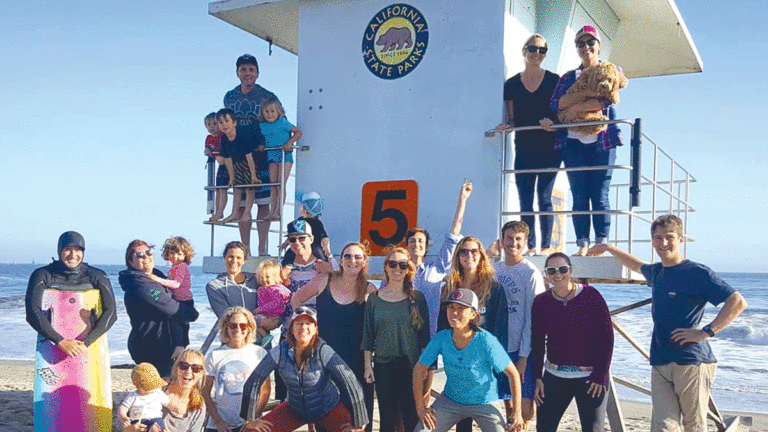
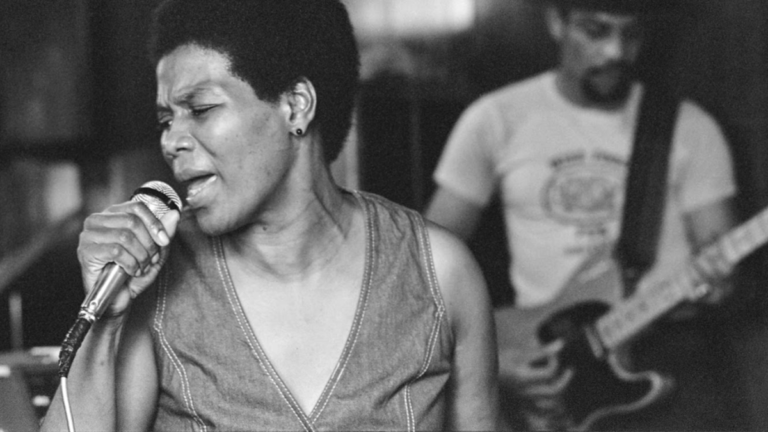
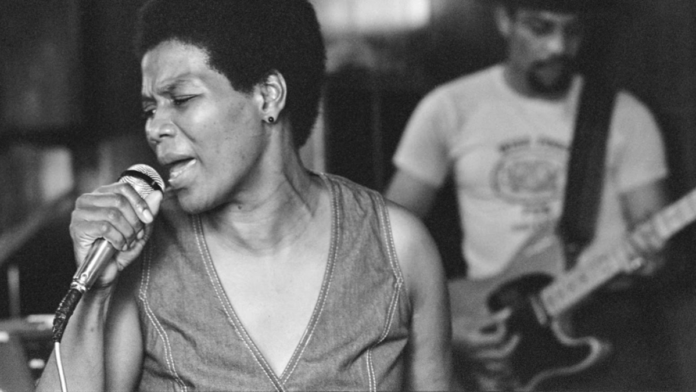
It was a special time for local Cali-reggae band Sound Reasoning as they prepared their debut album Have You Heard earlier this year. The core members have been playing together in some form or another since the โ90s, and officially played their first show in 2005. The group took a hiatus some years back, and reformed in 2013 specifically with the intention of releasing a recordโwhich they finally did this month.
โWe had done recording and we have done some EPs, but we hadnโt done a full-length album. It just seemed like it was time to finally get around to it. We definitely felt a need to do an album,โ says trumpet player Tonya Silvestri.
The three core membersโSilvestri, Todd George and Sol-I NewTreeโstarted playing together in 1996 when Silvestri and NewTree moved to Santa Cruz and met George during an open mic at Java Bobโs in Ben Lomond. After meeting at the open mic, NewTree and George started jamming together, both on guitar, and then George switched to bass as they arranged NewTreeโs songs to be performed by a full band, with Silvestri contributing horn parts.
The songs tend to sound like folk songs at first, Silvestri says, until George contributes his bass parts and the drummer starts playing. Then the California reggae and R&B elements really come into play.
For the album, they had to narrow down songs from their vast catalogue.
โWeโre planning for our second one,โ says Silvestri. โWe still have another batch of songs in the bag ready to go,โ.ย
INFO: 8 p.m. Friday, May 18. Michaelโs on Main, South Main St., Soquel. $10/adv, $12/door. 479-9777.
From the top-floor briefing room of the Santa Cruz Police Department (SCPD), windows look out over rooftops throughout downtown. Itโs one of five regions that city cops have staked out for the new neighborhood policing strategy announced by Chief Andy Mills a few months ago.
โWeโre not going to sit back and wait for crime to come to us. Weโre going to go to it,โ Mills says.
Mills is standing in front of a large map that has Santa Cruz split into color-coded areasโthe Upper Westside, Lower Westside, Downtown, Upper Eastside and Lower Eastside. In some ways, the operation sounds more like a department store staffing than a police operation, with Mills describing his lieutenants as โmid-level managers.โ Each lieutenant gets assigned a number of police and community service officers. In a department with 94 cops total, 26 community service officers, lieutenants and sergeants have been reassigned without an increase in spending, Mills says. The SCPD is also still relying on its predictive policing algorithm to target higher-crime areas before new crimes happen.
โThe theory behind neighborhood policing is to work with the neighbors to deal with long-term problems and reduce them,โ Mills says, โbecause the problems in one area are different than in others.โ
By focusing on specific sections of the city, lieutenants and their small teams of police and community service officers get to know the neighborhoods and community members better. The idea is that the groups can prioritize, respond to and prevent crime in their sections.
Although it was only implemented in February, itโs a plan Mills has worked on since becoming chief in July of last year. Over that time, the police department has held 10 community meetings to gather information and listen to residentsโ concerns about what they think are ongoing problems in their areas.
The policy has two goals. The first is to prioritize each areaโs crime so that officers can more efficiently respond if a top level threat occurs. โWhen you call 911, what do you expect?โ Mills asks rhetorically. โSomeone to respond immediately.โ
Thatโs an approach often known as โno call too small.โ However, according to a study by the Center for Public Safety Managementโa nonprofit that assists local governments on how to better serve their citizensโthat philosophy comes at a great cost.
The SCPD dispatches officers on roughly 68,000 of the estimated 100,000 yearly calls. But according to the study, 22,000 of the cases responded to could be handled by someone other than a police officer. The 911 emergency line is intended for a crime in progress, to save a life or stop imminent violence, but unintentional abuse of the hotline has dispatchers busy with barking dogs, loud music complaints and other activities that are not crimes, no matter how bothersome.
โAbout 77 percent are bottom-priority calls,โ Mills says. He encourages residents to make such calls to the departmentโs non-emergency number, 471-1131.
The second goal is to keep arrests low by preventing common crimes in specific areas. Mills says he wants officers to make any necessary arrests, but also believes many problems in the community canโt be fixed through enforcement alone.
He gives the analogy of a hypothetical intersection with a high collision rate. Officers can zero in on that intersection, ticketing anyone who runs a red light. And the city can install traffic signs with violation fees and program a forced delay between light changes to clear the area. In the case of neighborhood policing, preventative and informative measures can be as simple as educating communities with high-volume break-ins to lock their windows when theyโre not home.
Still, Mills says there are other methods โto fix these problems in the long haulโ and that the department has many tools at its disposal. โSCPD is not here to make excuses for why crime exists,โ Mills says. โWeโre trying to figure out how to proactively control it.โ
The department has integrated this neighborhood-oriented strategy into predictive policing, a tool the department has been using for more than six years. Local company PredPol helped lead something of policing revolution when it launched in 2012, helping departments like Santa Cruz target higher-crime areas at higher-crime times. PredPol is now in more than 50 departments, according to co-founder Dr. Jeff Brantingham, who is also an anthropology professor at UCLA.
These days, neighborhood lieutenants receive a report every morning to see which areas on their beat should be more heavily patrolled, based on previously reported crimes. It also serves as a gauge that will show whether or not previously problematic spots are becoming safer through officersโ efforts. The managers then give Mills a weekly report of the locations and types of crime theyโre working on, how they are doing it and their results.
Former SCPD crime analyst and current county supervisor Zach Friend says heโs seen predictive policing have a positive impact over the years.
โIt was meant to complement the strong history and philosophy of community-oriented policing within the department,โ says Friend, ย โand allow for the most effective allocation of very limited resources.โ
Kelly Luker needed to learn how to smoke crystal meth. As a criminal defense private investigator in Santa Cruz in the mid-2000s, she had been asked to learnโand be able to demonstrate to a juryโthe technique of smoking crystal meth and scraping down particles formed along the inside of a glass pipe. The client was definitely a drug addict, but she had to help prove he wasnโt a drug dealer, tooโand that meant proving that he wouldnโt have been able to profit off the amount of โsubstandardโ drug residue inside his pipeโwhich he was accused of selling.
Luker had never smoked meth, and didnโt intend to start now. She needed a teacher, a propane torch, vitamins and liquid air freshenerโnot all of which were particularly easy to find.
More than 10 stores and a couple of phone calls later, she got the goods and proceeded to visit her instructorโwho, though long clean, demonstrated how to use the torch to melt air freshener tubes and theoretically smoke the more cost-effective meth substitute she had supplied: vitamin B12 pills.
The case was dismissed. Looking back now, Luker says it was this kind of retrospectively funny and sometimes cringe-worthy moment that made the job unlike any other. She amassed a collection of used clothes for clients who looked a bit worse for wear to appear in court in, and her car became her working office of briefcases, tennis shoes, latex gloves and a camera.
It was her job to work with defense attorneys to find the cracks, holes and loose ends in the prosecutionโs cases, and try to establish a fragment of reasonable doubtโno matter how repugnant she might have found the defendant. Her work was based on the belief that everyone deserves a fair trial and a chance to prove their case. Even when the evidence was insurmountable, the defense would attempt to prove the possibility of innocence, or at least lessen a clientโs sentence in a plea bargain.
For Luker, it made sense that someone had to defend the bad guys, but deep down she struggled with the moral issues around her job.
โIt was a challenge, [but] I worked really hard for all of it, and that’s where I had to compartmentalize,โ Luker says. โThe hardest part was accepting that I would never make the job and my feelings about it congruent.โ
Luker writes about the six years she spent as a P.I. in her new book, Private Eye for the Bad Guy. After working as a staff reporter at Metro Santa Cruz and Metro Silicon Valleyย for around six years, it was natural for her to write about her experiences.
โI had to do something to express my feelings about it, because it was really hard for me,โ she says. โIf you are a writer, then itโs all material.โ
After she was laid off from Metro in 2001 during the economic downturn, it was a scramble to find something to pay the bills. She had a friend working as a P.I. and she thought the job might be fun and a good transition from journalism. After all, she loves asking questions and telling stories. An expert person-finder and record locator, Lukerโs number one job was initiating difficult conversations and navigating tense social encounters.
But separating her job from her personal life was difficult. When she started writing the book, it helped her cope with her own past history of drug abuse and sexual violence, and though she was careful to use different names and change specific details of each case, the stories in the book are all completely true and accurate, she says.
BEHIND THE SCENES Writing ‘Private Eye for the Bad Guy’ helped Kelly Luker grapple with conflicted emotions during her years as a criminal defense investigator.
โWhen it came out, I thought the attorneys wouldnโt like what I said and they would come sue me, and then the ex-cons would come butcher me,โ she says. โThen I realized that was getting in my own mind. Iโm not a New York Times bestseller. It was just something I felt like I had to write.โ
Luker delves into some of the most common, memorable and atrocious cases she worked on. From juvenile cases to capital punishment, she says each chapter was meant to illustrate how diverse they were. When asked about defense investigators who love their jobs, she can only name two people, which explains why she needed some catharsis.
โIt was really helpful [to write the book],โ she says. โIt helped me clarify a lot about what my beliefs and feelings were. It was a good escape route from it all.โ
She wrote Private Eye for the Bad Guy during the last few years of working as a P.I., which is why she was able to document such meticulous details and descriptions of her various clients and interviewees. When she told people about her work, Luker says their initial reaction was one of aweโtheyโd think, โOoh, a private investigator.โ Until they actually understood what the job entails, that is.
โI didnโt have anyone to talk to about it, and that was difficult,โ she says. โMost people werenโt thrilled with what I did, they didnโt want to hear about it and they couldnโt relate to it.โ
There were parts of the work she says she really enjoyed, like taking her dog with her on jobs, and just talking to people around town. It certainly didnโt get boring, she says, especially since there โwas never the same thing twice.โ
What Luker wants people to know, more or less, is that real-world criminal justice is not like it is portrayed on television. The vast majority of the time, she says, criminals are found guilty or reach a plea bargain. And while Lukerโs book isnโt looking for sympathy, it does humanize everyone involved in criminal defense.
โWe have awesome defense attorneys here, thatโs one thing I took away and I really hope people get,โ she says. โI mean, we have really, really good defense attorneys here. These people work their ass off for their clients.โ
Sure, they didnโt always winโand much of the time, they probably shouldnโt haveโbut what Lukerโs book so eloquently emphasizes is that despite the odds against them, the defense attorneys and investigators never gave up.
Work in the private investigator business tapered off, and she used the extra time to start her own business. Though she never officially retired from being a P.I., she has no plans to return and spends her time running a small dog boarding service, which she is very proud to say is kennel- and cage-free. The dogs run around the yard, and even sleep in the house, in a sort of ultimate canine vacation.
โI just talk to the dogs now,โ she says, laughing. โThe conversations are great, and they listen so well.โ
Stan By Me
In this excerpt from โPrivate Eye for the Bad Guy,โ author Kelly Luker finds herself grappling with a bizarre work environment
Iโd taken to coming into the Cave after 5:00 p.m. The airless, windowless office annexed a former medical building, and its walls still faintly belched ether and antiseptic. My boss, Stephen, ran his private investigation business out of it and paid rent to the law firm that occupied the rest of the building. The lawyers, in turn, relied on Stephen for their investigative needs. They handled mostly county-appointed criminal cases, those the public defenderโs office couldnโt.
For a small California beach town, Santa Cruz had a bountiful surplus of crime that kept the public defender and other defense attorneysโand therefore, Stephenโbusy. There was too much work for him, but not quite enough for another full-time investigator. Over the years, I would watch him hire other part-time investigators, brimming with optimism as he created multi-tiered inboxes. Within months, or weeks, the inboxes gathered dust as the new blood discovered they could not survive on what amounted to only ten or twenty hours of work some weeks. I managed because I had to. Jobs for anyone, much less women with my resume, were scarce. Iโd never quite managed to put together a career, only a string of disparate jobs during those decades in the workforce.
I thought I understood most folks who ended up in trouble. Their crimes were often stupid and ill-conceived, followed by contrails of alcohol and drugs. It was the attorneys that confounded me.
With a private entrance from the parking lot and its own bathroom, our office provided a refuge from the rest of the attorneys and their support staff who fed upon the upper section of the law buildingโs intestinal tract. But I still needed to invade their territory to use the copy machine or pick up files, and I hated running into the zealously territorial bookkeepers and secretaries who had assigned themselves to patrol it. My after-hours arrival time neatly eliminated those encounters.
I was filling in my timesheet that night when one of the attorneys wandered in to visit. Jeremy liked to chat. His soliloquies could run to the half-hour mark, reveling in complex intricacies of a case or sometimes, when it was a particularly heinous crime, graphic details. But I didnโt get paid for pretending to be social. I sneaked glances at my paperwork while he talked, furtively scribbling tabulations and notes. Jeremy settled his tall figure on the sofa and leaned back, scuffed Adidas stretched out in front of him. Like all attorneys, he kept a collection of business suits, dress shirts, and ties on hand for any courthouse visits. But his everyday outfit of an old T-shirt and baggy sweatpants brought a whole new meaning to โoffice casual.โ
โYou going to be here all by yourself a couple of weeks?โ Jeremy asked, hearing that Stephen had planned a family vacation. โYup,โ I smiled, as stomach acid bubbled at the thought. โJust me.โ
I knew how to write, research, and interview, which turned out to be 80 percent of my tasks. But six months in this line of work had proved not nearly long enough to understand what I was doing. I donโt mean the job itselfโthat was to make money to hopefully pay billsโbut the elusive logic of these tasks that now made up my working day. From what I could tell, we investigators were encouraged to sidestep a problematic truth, and instead, find evidence to support even the most wild-eyed stories our clients and their attorneys cooked up for a defense. Rationally, I understood that everyone deserved a fighting chance, especially against an entity as powerful and well equipped as the People of the State of California. But I sometimes felt like a bat flying without radar. The intuition Iโd learned to listen to, which warned me when someone was dishing out B.S., served no purpose in this job. I would eventually learn that truth was a malleable object with prosecutors, law enforcement, our clients, and us. But for now, I was still feeling my way through each week, and the prospect of going it alone without my bossโs guidance unnerved me.
Jeremy abruptly switched the topic to an indicted pedophile whose high-profile case was finally coming to trial. As Jeremy knew, I was headed over to the county jail later that evening to prep his client for a new wardrobe. Perhaps with the right clothes, the jury wouldnโt think Stan was the type of guy who coerced 12-year-olds to do the kind of things news articles always refused to describe. In the first of times too numerous to count, I asked myself how I ended up here. Why was I working to help someone I would have strangled without a momentโs hesitation had he come near my child? I had no answer yetโat least, no honest answer.
โStanโs going to ask you about continuances, legal documents,โ Jeremy went on. โJust tell him you know nothing.โ
When it came to crimes like Stanโs, ignorance used to be bliss. But my job now depended on dissecting graphic details. Eventually, I would need to ask victims to explain what, exactly, was entailed in โoral copulation,โ โsodomy with a foreign object,โ and other legal definitions that threatened to put my clients behind bars. Did he use one finger or two? Did he hold you down by the shoulders or by the throat? That night was still early in my new career, and since I was only putting together a wardrobe for Stan, I had barely skimmed his file. Unfortunately, I hadnโt figured on any evening chats with Jeremy.
โYou know what else he did to those girls, right?โ Jeremy was dying to unload Stanโs dark deeds on someone.
With no end in sight to Jeremyโs monologue, I tried a new tactic. Pushing the calculator aside, I turned and gave him my full attention. Ever since the case had been assigned to me, I had wanted to pose one simple question to the accused pedophileโs lawyer. Now seemed as good a time as any.
โSo let me ask you,โ I said. โHow do you justify this? You know he molested those girls. You know heโll do it again if he gets back on the street. Do you have any moral or ethical qualms?โ
Jeremy was already shaking his head before I finished.
โNot a one. Never. What these people do after the case is over, thatโs not my concern.โ
โThe letter of the law? Thatโs what you care about, right?โ
โThe letter, the spirit, the inference, the implication, the meaningโall of it,โ Jeremy replied. โI donโt pay attention to the people involved. I keep a box around me, and all I care about is whatโs inside that boxโthe law.โ
I thought I understood most folks who ended up in trouble. Their crimes were often stupid and ill-conceived, followed by contrails of alcohol and drugs. It was the attorneys that confounded me. Jeremy was brilliant and his grasp of legal intricacies awesome. He could have worked on the federal level or made many times his present income from corporate clients in Silicon Valley. Instead, he seemed to enjoy handling a perennial caseload of miscreants who managed to repulse even other criminals. Who was this guy? Perhaps if I could unscramble Jeremyโs logic and moral code, it would help me make sense of what I now did for a living. But it was like pondering hieroglyphics, where only periodically could a familiar symbol be plucked out of the tangled jumble of designs.
I would struggle with these questions for the next several years, but that night I shoved the half-finished time sheets aside and told Jeremy it was time to visit Stan.
Private Eye for the Bad Guy is available at Bookshop Santa Cruz and online at bookshopsantacruz.com.
They gathered on Sunday, May 6 at the Resource Center for Nonviolenceโthe same place they had announced their campaign four months earlierโto rejoice over a potluck-style buffet of quinoa, potato salad, chicken, and treats from Beckmannโs Bakery.
โItโs amazing. So many people have stepped up to support this and make it grow,โ said Josh Brahinsky, a leader of Movement for Housing Justice, which started the campaign. โItโs like a snowball. Weโre gathering more signatures this week than last week. Every week, it gets faster and faster. More people get involved.โ
They had reached their goal of 8,000 signatures one week earlier, pushing them to set a new goal of 9,000 signatures, which they had more than exceeded on the day of their party. By the time they turned them in on Wednesday, May 9, they had accumulated more than 10,700 signatures.
Meanwhile, however, organizers were hearing from nervous landlords who said they were sympathetic to renters, but concerned about portions of the measureโs more extreme language. That made Brahinsky and his fellow organizers contemplate a possible last-minute compromise on issues around relocation fees, subletting and the rent boardโs pay.
โWeโre not worried about it passing,โ Brahinsky explained to GT at the celebration, โbut we would love to do this in a way that didnโt divide the community so intensely.โ
Brahinsky said organizers made a proposal to the Santa Cruz City Council suggesting they revisit the measureโs wording, and Brahinsky expressed interest in looking at either reducing relocation fees or eliminating them for landlords who own fewer propertiesโโthings that for us are not the big story,โ Brahinsky said, โbut things that are creating a great deal of anxiety among people. Weโd be happy to do those changes if they would help us do it.โ
In order to get changes like those, though, the Santa Cruz City Council would have needed to put a plan in motion two days later, on Tuesday, May 8, for placing a different version of the rent control measure on the November ballot. Brahinsky said he was telling organizers they should call the city the following day, pushing for a compromise.
But no compromise ever happened. โMy understanding is the movement for housing was having second thoughts about their own initiative and they made a last-minute bid to rewrite it, but it wasnโt possible,โ says Mayor David Terrazas, who dislikes rent control, in part because it has been shown to decrease the supply of rental housing.
Brahinsky says the group was dialoguing with a couple of landlords, but that once discussions got a little more serious, many of them backed away and confessed they didnโt like rent control much anyway.
Pushback and Predictions
The push for rent control faces intense opposition, and not just from landlords with a financial interest. At a more academic level, rent-control measures have consistently faced nothing but disdain from economistsโeven liberal ones like the New York Timesโ Paul Krugman, who famously dismantled the concept in 2000, arguing that rent controlโs disastrous effect on the supply and quality of housing was โamong the best-understood issues in all of economics.โ
Locals got a look at the high-level opposition to rent control up close on May 3 at the Monterey Bay Economic Partnershipโs Regional Economic Summit, where featured speaker Dr. Chris Thornbergโa founding partner of the L.A.-based Beacon Economics LLC who was touted by MBEP as โone of the nationโs leading economistsโโtore into it mercilessly.
Thornberg was there to speak on the state of the economy in the Monterey Bay, which he declared to be robust overall thanks to nearly record low unemployment, rising wages and continuing job growth. However, he pointed to two areas that he predicted will increasingly affect the economies of Santa Cruz and Monterey counties: an escalating labor shortage and a lack of housing. On the latter issue, Thornberg singled out rent control as a misguided solution that is destined to backfire.
โBecause labor markets are tight, wages are getting better. Wages are growing faster in California than anywhere in the country right now because of this labor shortage we have. And the result of that is that the share of rent-burdened households [households paying 30 percent or more of their income in rent] has been falling, not rising, in California. Itโs actually getting better out there, because wages are rising faster than rents โฆ which brings me of course to the broader question of rent control,โ said Thornberg. โYouโve got to understand, thereโs a big downside to rent control. And that is that itโs horrible for the people youโre trying to help.โ
Thornberg said that rent control fails to create affordability for the low-income families that it should be protecting. โThatโs the dirty little secret,โ he said. โGo to places that have very ferocious rent control, and what you find is that rent control benefits largely middle-income families who maybe could buy a house or live in a nicer apartment, but โwhy would I when I have this great rent?โ You see this time after time. We went and looked at Berkeley. Berkeley put in very rigid controls on rental prices in their city. And what happened is low-income people were forced to move out, and now you have a bunch of middle-income families enjoying this wonderful protection of rent control in Berkeley, and youโve hurt the poor people youโre trying to help. In the end, it doesnโt work. Itโs as simple as that.โ
Two assistant professors of economics at Stanford came to the same conclusion last September when they released a report titled โThe Effects of Rent Control Expansion on Tenants, Landlords and Inequality: Evidence from San Francisco.โ It found that San Franciscoโs 1994 rent control initiative contributed to a 20 percent reduction in housing normally made available by tenants who move from one rental to another, and a 15 percent reduction in available housing offered by landlords, asserting that โthis led to a citywide rent increase of 7 percent and caused $5 billion of welfare losses to all renters.โ Weighing this against the money they estimated to be saved by tenants under rent control (a staggering $3,100 to $5,900 per person per year), they concluded that โsubstantial welfare losses due to decreased housing supply could be mitigated if insurance against large rent increases was provided as a form of government social insurance, instead of a regulated mandate on landlords.โ
Legal Loopholes
However, rent control supporters criticized the studyโs findings. Veteran journalist Tim Redmond of 48hills.org wrote that most of the problems the study found actually come not from rent control itself but from loopholes landlords found in San Franciscoโs 1994 initiative law. The only way to keep the strides in affordability that the study documented, while eliminating the losses to renters, he argued, is to target the loopholes while continuing to support rent control itself.
Closing such loopholes means more than passing minor tweaks and modifications. Those rules are what lets any given landlord move into one of his or her units or to change the setup into an owner-occupied condominium.
Meanwhile, there has also been an effort to close a much bigger loophole, the Costa-Hawkins Rental Housing Act, which prevents rent control from limiting rates of California apartments built after 1995. The idea met resistance in the state legislature, but grassroots organizers say they have enough signatures for a ballot measure. And if the local and statewide measures both pass, rent control would place rent restrictions locally on all types of housing, potentially causing ripple effects through the areaโs economy. Affordable housing advocate Sibley Simon, whoโs against the local measure, says the changes would lead to a steep drop in the amount of new housing construction and that the initiativeโs wording would create serious trouble for tenants. In all, Simon tells GT, via email, that the measure would be โa disaster for housing affordability in the future of Santa Cruz.โ
But Brahinsky, from Movement for Housing Justice, sees a broad support for the Santa Cruz measure. Heโs amazed by how much momentum the campaign has picked up toward the end of the petitioning window. That was in spite of organizersโ rate slowing down from 14 signatures per hour to sixโpartly because so many people had already signed.
โThe number of canvassers just increased so much in comparison,โ he says. โThe first week, we got about 600 signatures. The last week, we got about 1,600. We just kept speeding up. If I could convey that to the world, it would be that people just keep saying this matters so much.โ
Anyone alive in the latter part of the 20th century knows something about Neil Simonโs Tony-Award-winning hit comedy The Odd Couple. Premiering in 1965, the play was adapted into a film in 1968 and then splashed into television history during the 1970s. Three comic geniusesโArt Carney, Jack Lemmon, and Tony Randallโplayed the fastidious, neurotic half of the couple, Felix Unger, while Walter Matthau and Jack Klugman provided the slovenly, cigar-smoking foil Oscar Madison. Media icons, every one. So itโs inevitable that Santa Cruz audiences will bring their own preconceptions to the Jewel Theatreโs smart version of the Simon comedy classic.
Directed with sitcom style by Stephen Muterspaugh, the production moves fast and looks terrific. A vintage gem, the play pulls us back into the era where Mancini and Sinatra poured from record players. Oscar, a sportswriter, composes his newspaper articles on a typewriter, and as the play opens we see a quartet of men sitting around a poker table. The cigars, late-night poker games and rotary telephones arenโt the only indications that weโve been plunged into a whole other zeitgeist. Felix Unger (played with cringeworthy fussiness by Shaun Carroll) has just been kicked out by his wife. When he arrives at Oscarโs apartment late for the card game, heโs an emotional mess. Well, nobody wants to play cards anymore, so the others leave and Oscar invites his friend to move in with him.
The opening act of Odd Couple is a comic delight, loaded with slick dialogue glistening with men-in-groups repartee and the growing tension between a slob and an OCD perfectionist. In the second act, we meet two young women Oscar has invited to dinner, a pair of English sisters who live in an upstairs apartment. Felix has knocked himself out cooking, setting an impeccable table, but things start to go wrong. He breaks down and begins to relive the pain of his failed marriage. Without revealing too much, letโs just say that the women are sympathetic. Oscar explodes and kicks Felix out. Of course, things are resolved in the end, but not before Oscar (played with Ralph Kramden ferocity by David Ledingham) has chewed and swallowed most of the scenery out of his love/hate frustration with the irritating Felix.
A special shout-out to the poker playersโJesse Caldwell as the no-nonsense Roy, a tightly wound Scott Coopwood as Speed, Andrew Davis as Vinnie, and Geoff Fiorito as Murray the copโa close knit ensemble of professionals showcasing just how good live theater can be. The heavy lifting in this production falls to Ledingham, whose looks channel James Garner more than shaggy Walter Matthau. His zest and timing move everything along with sparkle.
The English gals are priceless as sketched by April Green and Erika Schindeleโtheir ditzy blonde giggling and leggy antics (great shoes by B. Modern) are straight out of Goldie Hawnโs glory days. But thatโs part of where the Simon play exposes its mid-20th-century rootsโNew York, urban, pre-psychedelics and sexual revolution, a time before enormous change in social customs, gender roles and cultural acceptance. Period pieces can flourish in dramatic form, but comedy lives and dies on its interrogation of the immediate context; the here-and-now world. Simonโs work reflects a culmination of values on the verge of being (largely) overthrown.
How men act in a domestic setting without a female housewife is the linchpin of this comedy, and it is one that doesnโt travel into the 21st century without considerable faultlines. The male stereotypes Simon explored have been mashed, if not swallowed. Ditto for females. We can admire the castโs abilities, but find it harder to gain traction with women as airheads who live to care for men, and men whose immediate goals involve beer, poker, and the aforementioned airheads. Felix, as written by Simon, isnโt gay, heโs simply an insufferable perfectionist. Itโs a hard character to play today with complete conviction.
Pro tip: if the contemporary dramatic sitcom by Kate Hawley hadnโt just been seen on the same stage, it might have been easier to surrender to the Neil Simon scenario. Hawleyโs Coming of Age was fresh, surprising and relevant. The Simon play has some enormous laughs, and some wise sparkling lines. But its moral assumptions make it a stretch for todayโs audience. Still, anyone who did see Coming of Age will definitely want to see Odd Couple. The juxtaposition of the two plays will provide ample fuel for discussionโwhich is exactly what vibrant theater should do.
The Odd Couple by Neil Simon will be performed at the Tannery Arts Centerโs Colligan Theater through May 27. A matinee show has been added on May 19. jeweltheatre.net.
Harrison Murphy was jealous of his friend Randy Schwartz. As both of them were longtime drummers, he couldnโt help but feel envious that Schwartz got to study rhythms and techniques with UCSCโs George Marsh, a man who refers to his own cutting-edge style as โTai Chi for the drum set.โ
โHe was a very far-out guy,โ says Murphy. โA very unique teacher who presented musical improvisation in a very different way, and I think thatโs a big reason why I wanted to know what it was, because it was so different from everything else that Iโd studied.โ
So they made a deal: Schwartz would teach Murphy everything he had learned from Marsh, and Murphy would teach Schwartz everything he knew about another instrument he played, keyboards. The arrangement started their partnership, but what came out of it turned out to be very different.
โThat literally never happened,โ says Murphy of their initial plan. โWe just got together and started a band.โ
That band is El Duo, and though the pair met in Santa Cruz, where they attended college, they now live in Oakland. Murphy still plays drums in the Santa Cruz band Harry and the Hitmen.
While Schwartz and Murphy may have not formally taught each other musical techniques, they share an unusual approach to rhythm that was a perfect foundation on which to build El Duo. There are a lot of global influences in the beats, including traditional African and Indian music, and American jazz. Itโs mixed with old drum machines and modern electronic loops.
โWeโve both been really drawn to rhythmic music coming from places around the world,โ Murphy says. โThat desire for those types of sounds and grooves, we were both already interested in that.โ
The resulting sound is pretty out there. Thereโs a seamless psychedelic blend of acoustic instruments and computers that is equal parts danceable and heady, and it inspires wildly varying audience reactions.
โSometimes thereโs five people and we still get them dancing, sometimes thereโs more and everybodyโs sitting down. Itโs hard to know,โ Murphy says. โWe can do the background thing really well, where people are having dinner and we just kind of play quietly and have it be interesting weird music in the background. Then we also can throw an all-out dance party where we crank everything up.โ
The live set is made that much more unique by their two-piece set up, which involves real instruments as well as triggers that kick off loops. The two of them improvise quite a bit, and give each set its own unique vibe.
โWe have certain things that are programmed in the drum machine, and those things arenโt going to change, but the way that Randy uses them is going to change,โ Murphy says. โThe way we respond to each other and the crowd, itโs always a little bit different. Eighty to 90 percent of it is really loose and we have some things that build up and then we play the main melody and it breaks off with solos, and we see what happens.โ
The group recorded its first EP, El Key, in 2016 with a recording studio class in Emeryville. They improvised a bit during the process, and then cut, edited and re-recorded more material on their own to create that record.
The band is releasing its new EP Mono Y Mono at this coming Crepe Place show. They will be selling vinyl records at the show, and sometime later will have it online.
โI think we feel a little bit better about it because we really did all of it ourselves,โ Murphy says. โWe didnโt go to a studio. We actually did figure out how the songs were going to go ahead of time, then piece it all together and then record a bunch of stuff over it once we got the framework going.โ
El Duo performs on Thursday, May 17 at 9 p.m. at the Crepe Place, 1134 Soquel Ave., Santa Cruz. $7/adv, $10/door. 429-6994.
ARIES (March 21-April 19): According to my assessment of the astrological omens, your duty right now is to be a brave observer and fair-minded intermediary and honest storyteller. Your people need you to help them do the right thing. They require your influence in order to make good decisions. So if you encounter lazy communication, dispel it with your clear and concise speech. If you find that foggy thinking has started to infect important discussions, inject your clear and concise insights.
TAURUS (April 20-May 20): A chemist named Marcellus Gilmore Edson got a patent on peanut butter in 1894. A businessperson named George Bayle started selling peanut butter as a snack in 1894. In 1901, a genius named Julia David Chandler published the first recipe for a peanut butter and jelly sandwich. In 1922, another pioneer came up with a new process for producing peanut butter that made it taste better and last longer. In 1928, two trailblazers invented loaves of sliced bread, setting the stage for the ascension of the peanut butter and jelly sandwich to its full glory. According to my analysis, Taurus, youโre part way through your own process of generating a very practical marvel. I suspect youโre now at a phase equivalent to Julia David Chandlerโs original recipe. Onward! Keep going!
GEMINI (May 21-June 20): One of the most popular brands of candy in North America is Milk Duds. Theyโre irregularly shaped globs of chocolate caramel. When they were first invented in 1926, the manufacturerโs plan was to make them perfect little spheres. But with the rather primitive technology available at that time, this proved impossible. The finished products were blobs, not globes. They tasted good, though. Workers jokingly suggested that the new confectionโs name include โdud,โ a word meaning โfailureโ or โflop.โ Having sold well now for more than 90 years, Milk Duds have proved that success doesnโt necessarily require perfection. Who knows? Maybe their dud-ness has been an essential part of their charm. I suspect thereโs a metaphorical version of Milk Duds in your future, Gemini.
CANCER (June 21-July 22): In my vision of your life in the coming weeks, youโre hunting for the intimate power that you lost a while back. After many twists and trials, you find it almost by accident in a seemingly unimportant location, a place you have paid little attention to for a long time. When you recognize it, and realize you can reclaim it, your demeanor transforms. Your eyes brighten, your skin glows, your body language galvanizes. A vivid hope arises in your imagination: how to make that once-lost, now-rediscovered power come alive again and be of use to you in the present time.
LEO (July 23-Aug. 22): The etymological dictionary says that the English slang word โcoolโ meant โcalmly audaciousโ as far back as 1825. The term โgroovyโ was first used by jazz musicians in the 1930s to signify โperforming well without grandstanding.โ โHip,โ which was originally โhep,โ was also popularized by the jazz community. It meant, โinformed, aware, up-to-date.โ Iโm bringing these words to your attention because I regard them as your words of power in the coming weeks. You can be and should be as hip, cool, and groovy as you have been in a long time.
VIRGO (Aug. 23-Sept. 22): I hope you will seek out influences that give you grinning power over your worries. I hope youโll be daring enough to risk a breakthrough in service to your most demanding dream. I hope you will make an effort to understand yourself as your best teacher might understand you. I hope you will find out how to summon more faith in yourselfโa faith not rooted in lazy wishes but in a rigorous self-assessment. Now hereโs my prediction: You will fulfill at least one of my hopes, and probably more.
LIBRA (Sept. 23-Oct. 22): The Polish pianist Ignacy Jan Paderewski once performed for Englandโs Queen Victoria. Since she possessed that bygone eraโs equivalent of a backstage pass, she was able to converse with him after the show. โYouโre a genius,โ she told him, having been impressed with his artistry. โPerhaps, Your Majesty,โ Paderewski said. โBut before that I was a drudge.โ He meant that he had labored long and hard before reaching the mastery the Queen attributed to him. According to my analysis of the astrological omens, you Libras are currently in an extended โdrudgeโ phase of your own. Thatโs a good thing! Take maximum advantage of this opportunity to slowly and surely improve your skills.
SCORPIO (Oct. 23-Nov. 21): The ancient Greek poet Simonides was among the first of his profession to charge a fee for his services. He made money by composing verses on demand. On one occasion, he was asked to write a stirring tribute to the victor of a mule race. He declined, declaring that his sensibilities were too fine to create art for such a vulgar activity. In response, his potential patron dramatically boosted the proposed price. Soon thereafter, Simonides produced a rousing ode that included the phrase โwind-swift steeds.โ I offer the poet as a role model for you in the coming weeks, Scorpio. Be more flexible than usual about what youโll do to get the reward youโd like.
SAGITTARIUS (Nov. 22-Dec. 21): Hereโs the operative metaphor for you these days: Youโre like a painter who has had a vision of an interesting work of art you could createโbut who lacks some of the paint colors you would require to actualize this art. You may also need new types of brushes you havenโt used before. So hereโs how I suggest you proceed: Be aggressive in tracking down the missing ingredients or tools that will enable you to accomplish your as-yet imaginary masterpiece.
CAPRICORN (Dec. 22-Jan. 19): Useful revelations and provocative epiphanies are headed your way. But they probably wonโt arrive sheathed in sweetness and light, accompanied by tinkling swells of celestial music. Itโs more likely theyโll come barging in with a clatter, bringing bristly marvels and rough hope. In a related matter: At least one breakthrough is in your imminent future. But this blessing is more likely to resemble a wrestle in the mud than a dance on a mountaintop. None of this should be a problem, however! I suggest you enjoy the rugged but interesting fun.
AQUARIUS (Jan. 20-Feb. 18): One of the saddest aspects of our lives as humans is the disparity between love and romance. Real love is hard work. Itโs unselfish, unwavering, and rooted in generous empathy. Romance, on the other hand, tends to be capricious and inconstant, often dependent on the fluctuations of mood and chemistry. Is there anything you could do about this crazy-making problem, Aquarius? Like could you maybe arrange for your romantic experiences to be more thoroughly suffused with the primal power of unconditional love? I think this is a realistic request, especially in the coming weeks. You will have exceptional potential to bring more compassion and spiritual affection into your practice of intimacy.
PISCES (Feb. 19-March 20): In accordance with astrological omens, I invite you to dream up new rituals. The traditional observances and ceremonies bequeathed to you by your family and culture may satisfy your need for comfort and nostalgia, but not your need for renewal and reinvention. Imagine celebrating homemade rites of passage designed not for who you once were but for the new person youโve become. You may be delighted to discover how much power they provide you to shape your lifeโs long-term cycles. Ready to conjure up a new ritual right now? Take a piece of paper and write down two fears that inhibit your drive to create a totally interesting kind of success for yourself. Then burn that paper and those fears in the kitchen sink while chanting “I am a swashbuckling incinerator of fears!”
Homework: Do something that you will remember with pride and passion until the end of your days. Testify at Freewillastrology.com.
Tuesdayof this week, at the Taurus new moon, Uranus, planet of change, revolution and revelations, left Aries (self-identity) and entered Taurus (values, resources and the Art of Living). Uranus changing signs is very important; the entire tenor of our world changes. Rhythms, vibrations, tones, rays, thoughts, ideas, and the past all change. We enter into the new Art of Living.
With Uranus in Aries for seven years, we have been searching for our true identity. Now, as Uranus enters Taurus, we will anchor that new state of self-identity along with new values (Taurus). Taurus takes the initiating ideas of Aries, and anchors them in practical and useful (Taurus is an Earth sign) ways. With Uranus entering Taurus, everyone shifts into a new state of reality, new rhythms and revelations. The archetypes shift.
From Ariesโ questions of self-identity, to Taurus asking us, โWhat is of value; am I of value; what do I value? From self-identity to self-value. Uranus awakens us.
Wherever Taurus is located in our astrology charts, that area of life will be roused, stirred, interrupted, disrupted, unsettled, shifted, changed, enlightened and illuminated. Surprisingly and quickly! This is how Uranus works.
Taurus transforms and uplifts all that it contacts; producing within us an inner Light through the actions of Ray 4โout of conflict, struggle and discord, a new state of coherence and Harmony emerges. We move from darkness to Light, the unreal to the real, from chaos to Beautyโthe new archetypes for the next seven years.
ARIES: You will feel more impulsive than usual; more fiery, intelligent, and more and more you will seek freedom of expression and freedom from the past which feels imprisoning to you. Daily chants and the repeating of Om โฆ their sounds will break up any obstructions hindering you from moving swiftly forward. New patterns come forth. New self-identity and a new look, too!
TAURUS: A new set of values comes forth, awakening you to areas of life never realized or seen before. Old attitudes from the past simply fall away. Taurus is a most material sign, a good thing at first. But there is the new โspiritual materialismโ manifesting. Where all that we say, do and have are offered for humanityโs well-being. New income based upon spiritual endeavors appears. You are to be future-oriented, inventive and progressive.
GEMINI: New ideas, concepts, thoughts, realities, and studies will appear. Often Geminis are bored with the usual ho hum thinking. With Uranus entering Taurus, new worlds of ideas open up. You will need courage to recognize, integrate and use them in daily life. At first you feel disoriented. But not for long. Gemini adapts to this and that easily. A new self-expression comes forth. Are you studying your astrology? Uranus rules it!
CANCER: Everything you held onto as stability shifts into a state of change. Daily life may feel disrupted; things, events, people, even your thinking may feel erratic. Plans will change. You will need to call upon great patience to sustain yourself. Know that new approaches now must be incorporated so that you once again feel in control. The Tibetan teacher tells us to โadapt to all that occurs.โ Adaptation frees us.
LEO: You will express yourself in unusual and creative ways. A new level of creativity is awakening. Nothing will be like before. Everything will feel out of the ordinary. Relationships with children and lovers and your relationship to creativity will be surprising. Inhibitions fall away. And a greater understanding of others comes forth. You will feel playful, spontaneous. Be more eccentric. Itโs more interesting.
VIRGO: You will shake yourself free from daily routines and expected behaviors. Your life takes on a new and fresh perspective. Changes in daily life will create disruptions and you adapt to them easily. You may feel restless, out of rhythm. Thatโs because Uranus is bringing in new rhythms and new archetypes. Allow yourself to perform unconventional tasks. Be inventive. Take up tai chi, yoga and chanting.
LIBRA: Be as reliable a partner as you can be. When Uranus enters Taurus, you find relationships that have become tired and worn out will fall away. You begin to look at relationships differently. Do not allow feelings of limitation or rebelliousness to interfere with loving others. You want to break free from all restrictions. Both love and freedom can exist side by side. Be gentle, be kind and forgive always. These create the freedoms you seek.
SCORPIO: Tend to finances and resources very carefully. Donโt skip over any details, especially with finances and resources shared with another. Tend to all taxes, loans, bills, etc. on time and with care. When these are completed you are free to pursue other interests. Deep unconscious waters (desires, feelings, the past, etc.) come to the surface, press upward, gather force and crash out into oneโs daily life. You handle this with pose. Be honest. Joy follows.
SAGITTARIUS: Uranus in Taurus brings the practical knowledge of our origins to the surface so that we can know the truth of our adventures here on Earth. Some of us will recapture ancient theologies. Some will question all assumptions. Some will know that the unfoldment of the Soul is what gives direction. Some of us will travel to parts unknown and travel with the ancients. Everything will be bright, brilliant, abrupt, progressive, and unexpected!
CAPRICORN: Career changes come as a surprise. Unusual offers, too. Everything that defines a Capricorn in the world seems to shape shift. Caps love tradition. But Uranus lets tradition fall to the wayside so a new future can come forth. Look at what is occurring in Hawaii with the volcanoes. Earthโs inner fires burning the crust of the Earth. This โburningโ of the past has evolutionary purpose, allowing you to come forth in the world with both greater brilliance and higher purpose.
AQUARIUS: Friends and social acquaintances grow in surprising ways. You meet new people; unusual circumstances occur in groups. You might join a spiritual group of like-minded people. You always need freedom, nothing limiting you. Aquarians are unique, inventive and surprising. One day everything changes. What we thought we wanted isnโt there anymore. Something new takes its place. We are happier.
PISCES: All of the pastโhabits, behaviors, things that hurt and traumatized us, all that we did to others unconsciouslyโthese come to light and we approach them tentatively, at first. Then we stand at their very center and we change the outcomes. We visualize the right ways, the ways that promote Goodwill and forgiveness. Then all of the elements that hurt us and others simply disappear into a cloud of safety and goodness. This occurs slowly yet surely, with precision and purity.
Thatโs right. Bonny Doon Vineyard winemaker Randall Grahm has expanded his explosive imagination to include putting pink fizzy wine in a can. The canned Fizzy Pink Wine of the Earth 2017 is now available in the Davenport tasting room, and as tasting room manager Tulsi Schneider explained, the winery will soon be making the four-packs ($32) and flats of 24 cans available to the world at large. As youโd expect, the black can with a pink bull moose on the label (lots of fun fine print helps explain this playful marketing), is quintessential Grahm. Light alcohol, and a deft blend of Rhรดne grapesโlong on Grenacheโmake this very pretty blush wine a refreshing tipple indeed. We found it to be irresistible. โThe perfect summer party wine,โ my companion pronounced. We envisioned pool parties where cans of this 2017 vintage of lovely, very light frizzante wine could be packed into iced coolers right next to other beverages in cans. Fresh, with no cloying finish, the new pink-in-a-can offers a bright nose of fraises du bois, minerals and fresh-picked leaves. Very picnic. Very much the thinking womanโs Mateus, the newest BDV offering would be brilliant with ham sandwiches, bbq ribs, even burgers and hot dogs. Think of it. No glass to worry about, hence perfect for around the pool. And for Memorial Day weekend!
โThis initiative may well backfire,โ Grahm says. โDo I care? ย Yes, absolutely, but Iโm not too worried. I think that the serious wines of Popelouchum will operate in their own unique universe populated by wine lovers who are less concerned about image and โstatements,โโ he says of his San Juan Bautista estate varietals.
Grahm admits his interest in the new product is motivated by fun and profit. โI truly love pink wine, and have developed a bit of an understanding over the years of the category.ย Secondarily, I love wine with bubbles,โ he says.
We found the bubbles to be fleeting, so one needs to enjoy this wine quickly โฆ or treat it as a pink wine with an opening salvo of bubbles. โAs far as cans,โ he says, โno deep ideological commitment there, but after deep reflection, it did appear that for this product, cans made a lot more sense than bottles.โ
Grahm promises future canned pink fizzies made from new varieties including Cinsault, Grenache Gris, and a rare French Provenรงal grape called Tibouren that heโs planted especially for his pink wines. Wanting to reach out to a millennial clientele, Grahm feels that cans will be a friendlier delivery system for his winemaking vision. The proof is in the can.
Happy 49th Birthday Staff of Life
Doing it the natural way for almost half a century, the forward-thinking folks of Staff of Life invite the entire community to come on down to a free celebration on Sunday, May 20 from 12:30 to 4:30 p.m.. โOur anniversary party is one way we show our appreciation to the community for supporting our local business since 1969,โ said Richard Josephson, co-owner of the pioneer natural foods emporium.ย On this special day, plan on enjoying live music and dancing to Harry and the Hitmen, raffle prizes, free samples, wine and beer tasting, cosmetic makeovers andโbecause this is Santa Cruzโface painting for kids of all ages. Trust me, youโll have a lot of fun. Staff of Life, 1266 Soquel Ave., Santa Cruz.
Route One Al Fresco
Quick like a bunny! Grab some of the remaining tickets to the Route 1 Rancho del Oso Summer Farm Dinner on Aug. 12. Al fresco foods by the queen of condiments, Tabitha Stroup (Friend in Cheeses Jam Co.) and wines from Ser winemaker Nicole Walsh. This will be amazing! $95 route1farms.com/category/farm-dinners.
In his cover story this week, Wallace Baine writes about how Quentin Tarantinoโs Pulp Fiction kicked off a surf music revival with its use of Dick Daleโs โMiserlou.โ I have to admit I fully embraced that revival at the time, and throughout the last half of the โ90s, I was regularly going out to see everyone from Dale himself (who played some mind-melting shows at the Catalyst as he took full advantage of that post-Tarantino comeback) to Man or Astro-Man? and Los Straitjackets to even the most obscure surf revival groups like the Ghastly Ones.
But my favorite surf band of all was the Mermen. In particular, I listened to 1996โs Songs for the Cows over and over and over again. In fact, on the Mermenโs website thereโs a GT quote about the album from that year that I may very well have written (although it may have been my esteemed colleague at the time, Rob Pratt, who was just as in to the surf-rock revival). It remains not only my favorite Mermen album, but also my favorite surf album of all time. All you really have to do to understand why is listen to the way the opening song, โCurve,โ rises out of nothing to swell into your senses in one of the most dramatic instrumental intros ever.
Despite having seen the Mermen many times at the Catalyst and Moeโs Alley, I didnโt realize they had moved here until maybe a couple of years ago. Since then, Iโve been plotting how to really do them justice in the paperโtheyโre one of the untold Santa Cruz stories that the alternative press here has always prided itself on spotlighting. When Wallace told me how big a Mermen fan he is, too, I knew this story had to finally happen. And he did a fantastic job. So hold tight and prepare to enter the world of Jim Thomas and the Mermen.
With its article on e-bike momentum in Santa Cruz (GT 5/2), Good Times missed an opportunity to catalyze a forward-thinking vision for the county, the next thing beyond e-bikes that will provide transportation options for everyone: โvelomobiles,โ or enclosed, pedal-assist personal transportation vehicles. Popping up throughout Europe, and as close as Vancouver, B.C., these vehicles have all of the advantages of e-bikes and none (as far as I can see) of the disadvantages. They keep you dry, they have a modicum of cargo space for your groceries, you can pedal with electric assistance for hills, uneven terrain, and long distances, they lock, theyโre allowed on streets in bike lanes (classified as a bicycle) and guess what? If we build a wide, separated trail in the rail corridor, multi-speed vehicles such as these would fit right in. Letโs start looking ahead, Santa Cruz, and not behind us!
Nadene Thorne |ย Santa Cruz
15 Years Late
Thank you for your recent coverage of the โrail trail debate.โ It sounds like the no-train, trail-only advocates are 15 years late to this discussion.
Weโthe community and our local urban planning and transportation expertsโhave a real plan which has been refined over many years. It’s being challenged by an imaginary plan, which has no blemishes (because it is imaginary).
Professional planners and engineers have developed the best, most cost-effective plan for Santa Cruz Countyโs rail corridor and have already shepherded it through approvals and scrutiny. The Rail Trail plan is ready to go. Why are we still talking about this?
David Van Brink |ย Santa Cruz
What About PRTs?
Neither article on the trail/rail made any mention of the technology called Personal Rapid Transit, or PRT, a radically low-cost and effective solution to mass transit. No surprise here given that RTC apparently gave up seriously pursuing this promising technology long ago, because they are afraid of it. There are virtually no working applications on the planetโone important exception being at Londonโs Heathrow Airport, connecting the terminal to the parking rampsโand most cities wonโt take the chance of investing in an โunprovenโ transportation infrastructure. Perfect application for the SC rail trail corridor.
A. Tawil |ย Santa Cruz
Rent Control Raises Costs
Santa Cruz is paradise. Property costs more in paradise to buy or build. Owners must cover their mortgage costs, maintenance and taxes even if they donโt make a profit.
Control costs for some renters results in one of two consequences. Raised costs for renters who are not in controlled housing (everyone else) or fewer rentals built, raises demand and prices.
We need to find other solutions. Tiny homes, work remotely, longer commutes, shared housing, fewer transitory students, government subsidies, fewer non-essential services, more taxes through business growth, fair taxes. Vote!
Andrew Block | Santa Cruz
Learn From Other Cities
Rail companies are largely exempt from local regulations, so I am deeply troubled by our Regional Transportation Commissionโs choice of Progressive Rail to operate our rail corridor (GT, 5/2). Progressive Rail is deeply involved in the crude oil and fracking industry, and they expect to work with Lansing Trading to build a propane distribution facility in Watsonville.
Our community must learn from the experience of Grafton, Massachusetts, which was unable to stop its local rail operator from building a propane plant near an elementary school. We must prevent railroad companies from building fossil fuel infrastructure in our community. The RTC has not signed a contract yet, so there is still time to stop Progressive Rail in its tracks.
Brett Garrett |ย Santa Cruz
PHOTO CONTEST WINNER
Submit to ph****@*******es.sc. Include information (location, etc.) and your name. Photos may be cropped. Preferably, photos should be 4 inches by 4 inches and minimum 250dpi.
GOOD IDEA
INJECTING WISDOM
At the Healthy Dogs Shots Fair on Saturday, May 19, local dogs can get rabies shots, distemper/parvovirus shots and microchips, all for free. The event, hosted by the Santa Cruz County Animal Shelter and Friends of Watsonville Animal Shelter, will also have information on spaying and neutering options that are available for free. The event will be held from 10 a.m.-1 p.m. at the Planned Pethood South Clinic, located at 150A Pennsylvania Drive, Watsonville, one block north of Ramsay Park. No reservation is needed.
GOOD WORK
MARSH FEEDBACK
Kerstin Wasson, research coordinator for the Elkhorn Slough National Estuarine Research Reserve, will receive the 2018 National Wetlands Award for Science Research on May 9. The award, presented by the Environmental Law Institute, recognizes Wassonโs commitment to the conservation and restoration of Americaโs wetlands. For more than 18 years, sheโs worked as a researcher, conservationist, and mentor at the Elkhorn Slough Reserve, one of Californiaโs few remaining coastal wetlands and its largest tract of tidal salt marsh south of San Francisco Bay.
QUOTE OF THE WEEK
โKids called it Surf music I didnโt call it that โฆ Iโm into just chopping, chopping at 60-gauge, 50-gauge strings. Thatโs the sound, the sound of the waves chopping.โ