Most kids who want to play an instrument will probably cut their teeth on their local school band. But where do they go later if they have ambitions beyond their high school jazz band? In Santa Cruz County, the answer is the Kuumbwa Jazz Honor Band.
The Honor Band program is in some ways an extension of Kuumbwa’s Summer Jazz Camp, which takes place over the course of two weeks in June. It’s a crash course in all things jazz, and open to a range of experience levels.
Then in September comes the Jazz Honor Band, which requires an audition. For the kids that make it, there’s a weekly rehearsal, as well as several performances that happen over the course of the school year.
The Honor Band bucks music-education conventions—in most school jazz bands, kids learn how to play in an ensemble setting, but here the emphasis is on improvised soloing. Young musicians need to have the basics down when they start, and chances are that by the end of the school year, they’ll have a much stronger grasp on how to create spontaneous melodies.
“Jazz is a lot of things, but ultimately the essence of it is improvised soloing. It’s an enormous skill,” says Terrel Eaton, who led the Honor Band from 2002 to 2007, and again from 2016 until this year. “These are kind of the stars from the individual high school bands getting to play with other kids that are just as good as them, as opposed to ‘I’m the star.’”
The Honor Band was started in the early ’90s when retired North Monterey district band teacher and Kuumbwa board member Phil Snyder noticed that the jazz organization’s board was putting a lot of emphasis on educational programs. He saw it as a chance to use his many decades of experience leading school bands, and give Santa Cruz County kids who were truly interested in jazz a place to learn at a higher level than they could in their schools.
“I knew they were always claiming that they were pushing jazz education, but they didn’t really have much going,” Snyder says. “I’m glad to see that it’s grown. It’s doing what they said they wanted it to do in the first place. It’s gotten bigger and better.”
The results are remarkable. The Honor Band has become a true talent factory, and many of its alumni have gone on to successful, innovative and downright fascinating careers in the music world—and beyond. Over the last couple years of writing music features and Love Your Local Band columns for GT, I began to notice that some of the musicians I was most intrigued by had been involved with Kuumbwa’s program at some point. One in particular that jumped out at me was Dillon Baiocchi, whose experimental project Hermano blew my mind. So I tracked a few of them down to ask them about what they’re doing now, and how they feel their experience in the Honor Band contributed to it.
Name: Ben Flocks
Age: 29
Instrument: Saxophone
Years in Honor Band: 2005-2007
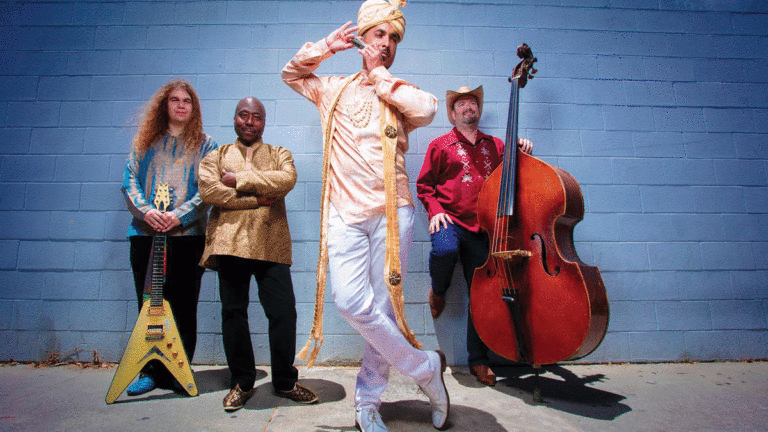
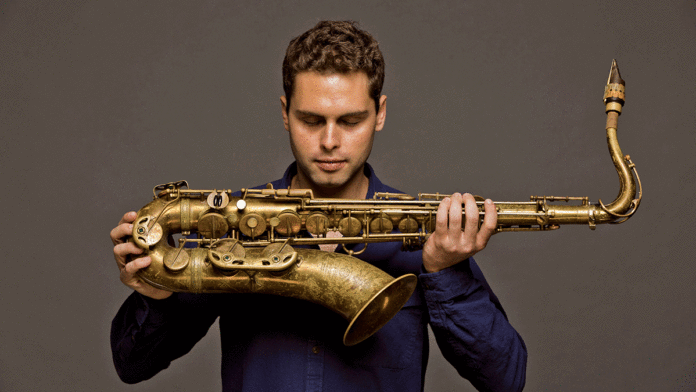
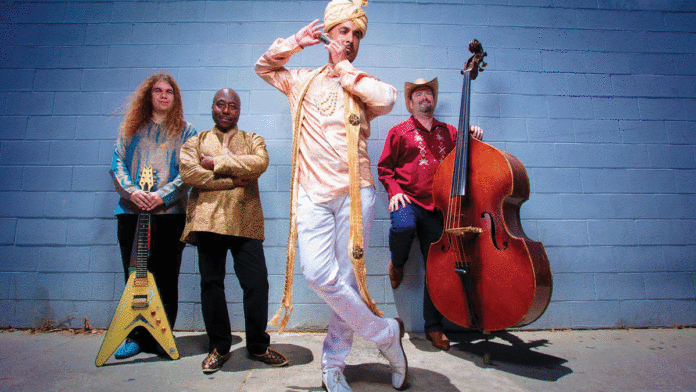
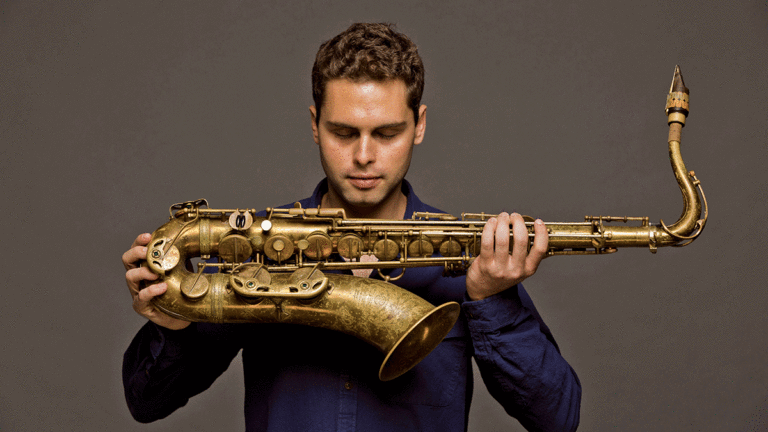
Right now, Ben Flocks is between tour dates with the group Sammy Miller and the Congregation, a wide-ranging revue production in which he plays tenor sax. He’s been in the band for a couple years, and has toured nationally and internationally with them. In this band, jazz is only one piece of the musical puzzle.
“It’s a broad range. We play a lot of old American songs. There’s a lot of old folk songs and old jazz songs: Jelly Roll Morton, Scott Joplin, Duke Ellington. A lot of new music, too, that we arrange and compose ourselves,” Flocks says. “We have a lot of theatrical elements to our performances. There’s acting, there’s costumes, dancing, and we interact with the audience. That’s been a really fun project to be involved with.”
 This gig came well over a decade after his experience with the Kuumbwa Jazz Honor Band in high school. First, he attended the Brubeck Institute in Stockton for two years, then moved to New York, where he finished his education at the New School. While there, and for several years after, he gigged as much as he could.
In 2014, he released his first official album as bandleader, Battle Mountain. It’s steeped in jazz, with also some subtle, breezy Americana influences in the mix. The record got great reviews including 4.5 stars from All About Jazz and a positive write-up in the Los Angeles Times.
Even though he was living in New York by the time he made the album, he wanted to access his Santa Cruz roots for the record. So, he did the recording in California, and used musicians almost primarily from the area that he grew up with.
“It was inspired by Santa Cruz, and my experiences growing up in Bonny Doon up on a mountain,” Flocks says. “A lot of the songs are very open and introspective. They don’t necessarily reflect my experiences in New York, with the fast-paced lifestyle of living in the city. I’m more inspired by my time growing up in the country and by the beach. We play some folk songs, we play a bolero by the Buena Vista Social Club, all songs that you might hear in Santa Cruz when you’re walking on the beach or hanging at the Boardwalk.”
He considers his time with the Kuumbwa Jazz Honor Band a big inspiration. He says it was critical for him to have an opportunity to challenge himself, learn how to improvise better, and play with higher-caliber players. But just as important, says Flocks, was the opportunity he had to see unlimited shows at Kuumbwa for free, something you get to do when you make it into the Honor Band.
“I got to see the greatest musicians on the planet coming through Santa Cruz every week on Monday night and Thursday nights, and having the opportunity to learn from them by going to these shows, it was very cool,” Flocks says. “I feel really lucky to be able to play music and teach music, and do what I do for a living. It’s a blast. I get to travel and see the world and inspire young musicians to play music.”
Name: Nick Bianchini
Age: 28
Instrument: Trumpet
Years in Honor Band: 2005-2008
Nick Bianchini is one of the youngest high school band teachers in the county. Since 2015, he’s been teaching at Harbor High and Branciforte Middle School, and he couldn’t be more excited about the opportunity.
“Growing up, most people talk about teaching as being a back-up plan for their music careers if they fail,” Bianchini says. “It was a choice for me to go into this direction.”
 It hasn’t always been easy. The program—through no fault of the previous band director, Bianchini says—wasn’t doing too great when he got there. But in a few short years, he’s already grown the band in numbers, and made an impression in competition—including the Anaheim Heritage Festival last year at the Rose Center Theater, where they got a silver rating, meaning they were in the top 20 percent of high school bands in the country.
“I’ve been working hard at building the program up. It’s been a difficult process,” Bianchini says. “I think most of the kids that do jazz band at Harbor have never really experienced jazz.”
Before jumping into the world of teaching, Bianchini lived in L.A. for a while, where he played the trumpet for bands in a number of different genres, including jazz, funk and reggae. One band, Tribal Seeds, had some breakout success, and he gigged up and down California several times with them.
“Things were going really well in Los Angeles. I had a lot of connections. I would say it was pretty successful,” Bianchini says. “I felt a need to come back to Santa Cruz and to change my direction as far as playing music goes. I fell in love with being able to teach and pass on all the knowledge that I learned in college, high school and the Kuumbwa Band, and give those opportunities to the kids now coming up. That gave me the same satisfaction and feelings that the performing did.”
When he first decided to move back to Santa Cruz, he didn’t have a teaching job lined up. Initially, he got a gig teaching “Hot Cross Buns” to second-graders—and loved it. Then the job at Harbor High opened up. He applied and got it.
Being has been trying to put some contemporary songs into the repertoire that the kids can relate to, including genres like Latin, salsa, funk and hip-hop. For instance, they play the popular electronic song “Say U Won’t” by Brasstracks.
“I’m trying to bridge the gap from what I grew up with in music and what I love about music, so that we’re not just playing classical music in band anymore,” Bianchini says. “We’re trying to move with the times and change with what’s really going on in music right now. That’s what’s made Harbor special, and made the program grow so much.”
By engaging the students with popular music, he’s been able to teach them more classical and jazz numbers.
“Now that they’re at a level where they can play it successfully, they’re finding that playing classical music is fun, too,” Bianchini says. “We’ve done great things with that.”
Name: Remy & Pascal Le Boeuf
Age: 32
Instrument: Saxophone (Remy), piano (Pascal)
Years played in Honor Band: 2001-2004
Just recently, Pascal Le Boeuf was nominated for a Grammy for best instrumental composition for the song “Alkaline” from the record Imaginist, a collaboration between his jazz group the Le Boeuf Brothers and contemporary classical ensemble the JACK Quartet.
“It felt wonderful to be recognized by the jazz community for a project I felt proud of. It brought together musicians from jazz and classical communities in a way that allowed them to speak their native languages and still have a conversation,” Pascal says.
The Le Boeuf Brothers now have four albums. The group is comprised of Pascal and his identical twin Remy Le Boeuf, who have been playing music together since they were kids, and who both went through the Kuumbwa Jazz Honor Band program.
Remy and Pascal have long been recognized as extraordinary talents in Santa Cruz, and since moving to New York they’ve been hailed as brilliant musicians by a number of publications, including the New York Times. And they give a lot of credit to their musical upbringing, which started with jamming together at an early age.
“I played a lot with Pascal on a regular basis. I had good teachers, and I was involved with good educational programs like the Kuumbwa Jazz Camp and the Kuumbwa Honor Band,” Remy says. “We were just in the right place to take advantage of all these excellent educational opportunities for young people in Santa Cruz.”
The brothers play jazz mixed with a number of other genres, including electronic, hip-hop, pop, and in the case of their last album, classical.
“Jazz is certainly our native musical language. It’s how we became fluent in music,” Pascal says. “Anyone in the jazz community will be able to understand how to converse in that language. Even now when I write for classical musicians, I still think primarily in the language of jazz—although it gets pretty blurry.”
They recall playing at Santa Cruz farmers markets as kids, where they’d give out their business card for prospective gigs—which they got. They even score free food at the markets by arranging deals with specific vendors to set up near them to increase foot traffic, and thus sales.
“I think by the time I graduated high school, so much of my identity was wrapped up in music,” says Remy. “It’s so much a part of who I was. I was and still am interested in a lot of non-musical things, but at that time in my life, music was what I was going to do.”
“We were born musicians,” says Pascal, “just following the free food.”
Name: Lucas Hahn
Age: 18
Instrument: Piano
Years played in Honor Band: 2012-2013
Lucas Hahn currently attends Columbia University in New York. He hasn’t declared a major yet, but he’s considering pre-med. He’s been back home this summer, and found a gig combining his two major passions: science and jazz. He’s working with neuroscientist and otolaryngology surgeon Dr. Charles Limb at UCSF, where they are analyzing the effects of improvisation on the brain of jazz musicians.
“Since we’re in the business of trying to assign more objective scientific reasoning and logic to jazz—which is pretty famously not logical or scientific—I’m trying to use my experience in both fields to think of new solutions,” Hahn says. “I definitely have an edge in that aspect. It’s been really valuable in the lab.”
It was in another program Hahn did after Kuumbwa, the SFJAZZ High School All Stars, that he met Limb.
“He was doing research on creativity, and used our band as a model,” Hahn says. “He would talk about creative jazz musicians, and we might play a piece to illustrate that.”
In March, Hahn looked up Limb and asked him if there were any projects he could participate in while he was home this summer. Limb offered him a spot as a summer intern for his study of improvisation called the UCSF Sound and Music Perception Lab. It was a perfect fit for what Hahn wanted to study.
“If you ask jazz musicians—or really any performer—what makes them creative, nobody can really give a scientific answer to that,” Hahn says. “It’s so very hard to quantify it in objective terms. Our goal is to kind of decode what exactly is happening to somebody like Keith Jarrett or Herbie Hancock. We want to know what allows them to be so creative [in a way] that most of the population cannot replicate.”
A simple explanation of the methodology involves studying the brain activity of a jazz musician as they are improvising, and then comparing it to control data, where the same musician is playing a piece that they’ve already memorized.
“Areas associated with language are more active during improvisation,” Hahn says. “The part of our brain that is associated with self-inhibition is kind of less active during improvisation. I think there’s a lot of interesting insight we can glean from not only a musical sense, but also broader-reaching implications. It also has to do with the feeling of ‘being in the zone’ that musicians and athletes or any other people that perform under pressure talk about.”
Hahn will continue his education after he’s finished working with Limb, but right now, he’s all in on his work with the study.
“Maybe there’s a way to harness that for other people besides the Chick Coreas of the world,” Hahn says. “There’s a lot that can be done with that information. Right now, we’re just trying to figure out exactly what’s going on in their heads.”
Name: Emily Intersimone
Age: 30
Instrument: Piano
Years played in Honor Band: 2004-2006
Emily Intersimone is using the skills she gained from jazz improvisation and the Kuumbwa Jazz Honor Band for a completely different kind of job: software engineer.
“For me there’s a link,” she says. “Both things involve having a certain amount of creativity, but within a set of rules. Let’s say you’re writing an arrangement and you know you want to land on a certain chord in a section, and you have this melody that you have to harmonize for four bars before that. So, there’s a number of choices that you have to make, but you have this ultimate destination. I see the same thing in programming.”
She has been living in New York City with this job for about a half a year. After graduating high school, she moved to Los Angeles to study jazz at UCLA, and then to New York to study jazz composition at New York University. There she recorded an album of her original pieces of songwriting as a class assignment.
She was fortunate to get started with songwriting while still at the Honor Band. She even wrote some of the music that the band would play at its shows.
“I found composition really absorbing,” Intersimone says. “I like to try to write music that I would like to listen to. I don’t think I would have had the facility if I hadn’t learned improvisation theory. When you play the standards, learn about setting up solos, all of that, it includes some form of improvisation. That’s always been in everything that I’ve ever written.”
Shortly after graduating college, she moved back to California, where she played jazz gigs, taught private piano lessons at her home, and eventually landed a gig as assistant musical director at the San Jose Repertory Theatre for a production of The Snow Queen.
Her compositional skills came in handy as she helped with arranging music and sometimes writing parts for individual musicians.
“I love that. I love being with talented performers. Some of them were truly exceptional,” Intersimone says.
Teaching was particularly special to her. Even now, with her full time coding job in New York, she still has one piano student that she teaches. Music has been a very important part of her life, and though it’s taken a backseat for now, she doesn’t think it will stay that way forever.
“I’d like to play with other people more, because that’s something I really miss,” Intersimone says. “I think I did it so much starting in high school, all the way up to a few years ago, that I didn’t really realize what I was missing until it had been gone for a little bit. I’ve just got to get out there and go to some jam sessions and re-insert myself into the scene.”
KUUMBWA JAZZ HONOR BAND AUDITIONS
Kuumbwa Jazz Honor Band auditions will be held on Tuesday, Sept. 18 at 4 p.m. and Tuesday, Sept. 25 at 5 p.m. For more information and to apply for an audition spot, go to kuumbwajazz.org.


 It hasn’t always been easy. The program—through no fault of the previous band director, Bianchini says—wasn’t doing too great when he got there. But in a few short years, he’s already grown the band in numbers, and made an impression in competition—including the Anaheim Heritage Festival last year at the Rose Center Theater, where they got a silver rating, meaning they were in the top 20 percent of high school bands in the country.
 The Le Boeuf Brothers now have four albums. The group is comprised of Pascal and his identical twin Remy Le Boeuf, who have been playing music together since they were kids, and who both went through the Kuumbwa Jazz Honor Band program.
 It was in another program Hahn did after Kuumbwa, the SFJAZZ High School All Stars, that he met Limb.
 She has been living in New York City with this job for about a half a year. After graduating high school, she moved to Los Angeles to study jazz at UCLA, and then to New York to study jazz composition at New York University. There she recorded an album of her original pieces of songwriting as a class assignment.