Live music highlights for the week of April 18, 2018.
WEDNESDAY 4/18
ROCK
LOS LONELY BOYS
Purveyors of “Texican rock ’n’ roll,” three brothers from San Angelo, Texas—Henry, Jojo and Ringo Garza—emerged on the local music scene in the 1990s. Since then, they’ve slowly but steadily established their band Los Lonely Boys as one of the premier American Chicano rock outfits. Blending rock, country, blues, Tejano and brown-eyed soul, the group has carved a unique place for itself in pop music and gone from a small Texas family band to a Grammy-winning international sensation. CAT JOHNSON
INFO: 8 p.m. Rio Theatre, 1205 Soquel Ave., Santa Cruz. $28/gen, $43/gold. 423-8209.
WEDNESDAY 4/18
FUNK & SOUL
DIRTY REVIVAL
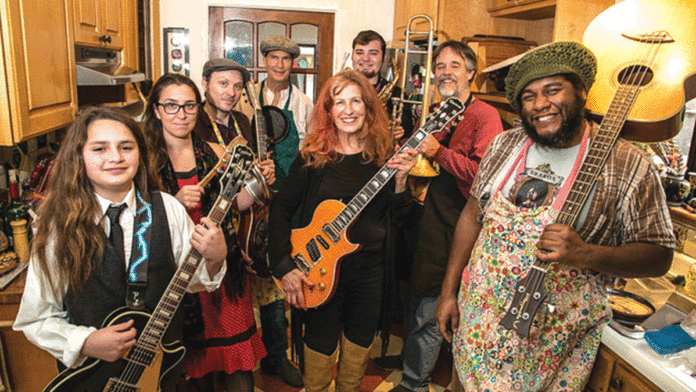
With cool grooves, impeccable instrumentation, and soul for days, Dirty Revival is a rising star of the underground funk and roots scene. Hailing from Portland, Oregon, the seven-piece has gone from a basement party band to one of the city’s standout acts. Led by vocalist and frontwoman extraordinaire Sarah Clark, Dirty Revival reworks classics and drops irresistibly funky originals driven by horns, tight percussion and Clark’s powerful, engaging voice. Also on the bill: Post Street Rhythm Peddlers. CJ
Although their brand-spanking-new album is called The Nothing They Need, Dead Meadow’s two-decade-spanning career testifies to the fact that they are definitely something. Formed in the indie rock scene of D.C. in 1998, the psych-rock trio (sometimes quartet) has rocketed listeners into twistedly dizzying dimensions of sight and sound. No strangers to Santa Cruz, Dead Meadow requires you to be prepared for a mind-melting show that will leave you wondering just exactly what that bartender put in your drink. MAT WEIR
The members of Tropa Magica describe the band’s recent single, “LSD Roma,” as “psychedelic Norteño.” It’s not hard to see how this description fits with what the East L.A. group is pulling off in their music. It’s got the authentic Norteño rhythms driving the songs, but also sounds like they’ve been beamed straight from outer space. The group is new, but the members have been messing with traditional forms of Mexican music for a while, most notably with their band Thee Commons, which can best be described as “punk cumbia.” With Tropa Magica, they seem to be stretching the limits even further. AARON CARNES
Back in the early ’80s, the line between punk rock and New Wave could be a very thin one. But as New Wave bands veered toward pop, you could hear a heavier embracing of synthesizers and pop hooks. New Tampa, Florida quartet Glove seems to have traveled back in time to find that crack that barely distinguished the genres and planted themselves there. They pile ’80s synth onto punky guitars, then add poppy vocals and a punk rock sneer. AC
A music journalist once described the Robert Cray Band as “blues-like,” and although this may seem like a dis, it really is one of the best ways to describe them. Cray has had an illustrious, 40-year career, and has played alongside blues greats like Lee Hooker, Buddy Guy and even Stevie Ray Vaughan the night of his tragic death. However, the RCB blends a cocktail that is equal parts blues, soul, gospel and jazz, shaken up and served chilled with a twist that’s all their own. MW
INFO: 7:30 p.m. Rio Theatre, 1205 Soquel Ave., Santa Cruz. $49. 423-8209.
SATURDAY 4/21
PSYCHEDELIC
WOODEN SHJIPS
For the past decade, San Francisco’s Wooden Shjips has been bringing experimental, droning sounds to the psych scene. But as out-there as the group can get, there’s always an easygoing, laid-back charm to its music that feels like cracking open a beer and watching the sun rise on a lonely, contemplative Sunday morning. The latest record, the aptly titled V (yes, their fifth album), goes for an even easier-feeling sound that’s almost folk-rock. The double meaning of the album title V. is that it’s a graphic rendering of the peace symbol, something the band feels is needed in today’s negativite environment—and the music fully embodies that philosophy. AC
INFO: 8 p.m. Michael’s on Main, 2591 S. Main, Soquel. $20. 479-9777.
MONDAY 4/23
JAZZ
WILLIE JONES III QUINTET
A drummer who combines impeccable taste with irrepressible joy, Willie Jones III has spent the past 25 years carving out a stellar career as a sideman with jazz greats (Milt Jackson, Horace Silver, Michael Brecker, and Sonny Rollins, for starters) and a bandleader in his own right. More than an all-star ensemble, Jones’ quintet brings together a cast of fellow bandleaders, including trumpeter Jeremy Pelt, a fellow Los Angeles native, pianist Eric Reed, bassist Gerald Cannon, and saxophonist Ralph Moore, one of the definitive players of the 1980s who’s been gaining visibility after 15 years in the band for The Tonight Show with Jay Leno.
INFO: 7 p.m. Kuumbwa Jazz, 320-2 Cedar St., Santa Cruz. $30/adv, $35/door. 427-2227.
TUESDAY 4/24
INTERNATIONAL
VIEUX FARKA TOURE
As the story goes, legendary Malian singer and multi-instrumentalist Ali Farka Touré didn’t want his son to follow his footsteps into the music business. But the elder Touré didn’t get his way. His son Vieux Farka Touré followed his father’s lead and has become the torchbearer of the family’s musical tradition. Nicknamed the “Hendrix of the Sahara,” Touré honors his father’s legacy and keeps Malian music alive while blending it with rock, Latin music, and other African influences to create something timely and relevant for today’s international music scene. CJ
INFO: 7 p.m. Kuumbwa Jazz, 320-2 Cedar St., Santa Cruz. $30/adv, $40/door. 427-2227.
IN THE QUEUE
JOE KAPLOW
Bay Area by-way-of New Jersey singer-songwriter. Wednesday at Crepe Place
BASTARD SONS OF JOHNNY CASH
Alt-country standout. Thursday at Michael’s on Main
HOUSE OF FLOYD
Mind-melting Pink Floyd tribute. Friday at Rio Theatre
URIAH HEEP
Pioneering prog-rock band out of the U.K.. Saturday at Catalyst
BLACK UHURU
Legendary reggae group. Tuesday at Flynn’s Cabaret
Described as a “conscious revolutionary lyricist,” award-winning artist Kabaka Pyramid blends reggae and hip-hop to present messages of spiritual evolution, positivity and global unity. Hailing from Kingston, Jamaica, Kabaka—which is Ugandan for “king”—acts as a bridge between roots reggae and African music, and the contemporary and future pop and underground styles.
INFO: 9 p.m. Wednesday, May 2. Moe’s Alley, 1535 Commercial Way, Santa Cruz. $20/adv, $25/door. 479-1854. WANT TO GO? Go to santacruz.com/giveaways before 11 a.m. on Tuesday, April 24, to find out how you could win a pair of tickets to the show.
Some bands are organized through ads and auditions. Others are formed by friends who have known each other for years. But sometimes fate steps in for a once-in-a-lifetime opportunity—like randomly meeting the person you will write music with for the next five years at a convenience store.
“It was Kong’s Market, off 26th Avenue,” remembers Wild Iris guitarist Bryan Shelton of the day in 2013 that he met singer and lyricist Kate Mullikin. “I used to work there before it closed.”
“Bryan was playing this old guitar outside, I had some lyrics, and they kind of went together,” says Mullikin.
Despite an age difference between them of “a couple decades,” Mullikin and Shelton quickly hit it off.
“We have a very organic way of doing things,” says Mullikin of their writing process. “Some songs we’ll get to right away, while others will be on the back burner for months and months.”
Wild Iris’ music is an earthy mix of Delta blues, acoustic folk and bluegrass, with the tiniest bits of country and rock. Last year, the band released their second full-length album, Covers. Not your typical cover album, it consists of songs chosen by fans who donated a certain amount of money to the band’s Kickstarter campaign when they were raising funds for their debut LP. It includes covers of everything from John Prine’s “Paradise” to Otis Redding’s “Blue Bayou” to Bessie Smith’s “St. Louis Blues” to Consuelo Velazquez’s “Besame Mucho.”
“Bessie Smith was a lot of fun to learn, and I got to sing in Spanish [on “Besame Mucho”],” says Mullikin, who is bilingual.
Even if you can’t make the band’s April 18 show at the Crepe Place with Joe Kaplow and Ladies of Sound for the Do It Ourselves Fest, Wild Iris says to look out for new music blossoming later this year.
INFO: 9 p.m. Wednesday, April 18. Crepe Place, 1134 Soquel Ave., Santa Cruz. $10. 429-6994.
At the Santa Cruz County Outdoor Science School in Corralitos, aka “Science Camp,” fifth and sixth graders spend four to five days living in the Santa Cruz Mountains among the redwoods and learning about science and the environment. No classrooms necessary, and hiking shoes are mandatory. Unfortunately, many families cannot afford to send their kids to camp, and that’s where Every Child Outdoors (ECO) comes in. ECO awards grants to local elementary schools to sponsor and promote the outdoor education program. Help them help others during their third annual fundraiser for kids outdoor education and get a delicious dinner in the process.
INFO: 6-9 p.m. Saturday, April 21. Santa Cruz Food Lounge. 1001 Center St. #1, Santa Cruz. everychildoutdoors.org. $20 general admission, plus sliding scale donations. Tickets online at brownpapertickets.com.
Art Seen
‘Many Roads: An Evening of Short Plays’
Artistic Director Sarah Albertson spent months collaborating with a variety of Cabrillo College students to create a series of 10-minute theatrical pieces. Each short play was directed by students from Albertson’s class, and though each piece is unique, she says there is a common thread of unusual life paths and circumstances—hence the title Many Roads. Cabrillo students were also responsible for facilitating the lighting, sound, costumes and props for the production.
INFO: 7:30 p.m. Fridays and Saturdays, 2 p.m. Sundays. Runs Friday, April 13-Sunday, April 29. Cabrillo College, 6500 Soquel Drive, Aptos. 479-6154. cabrillovapa.com. $17 general admission, $15 students and seniors.
Through Sunday 5/27
‘The Art of Nature’
Cell phone cameras don’t capture everything, and they certainly won’t do when every leaf vein and feather tuft matters. Sure, people buy fancy cameras, but what happens if they lose their memory card or something malfunctions? Or what if the animal is extinct? Despite its centuries-old history, scientific illustration is still a very relevant and accurate art form—and the latest exhibit at the Museum of Natural History proves it. The annual exhibit features longtime local illustrators and UCSC art students’ work that will make you go “there is no way someone drew that!” The collection of watercolors and sketches in this exhibit proves that scientific illustration is just as awe-inspiring as ever.
INFO: 5-7 p.m. Friday, May 4, Free First Friday Scientific Illustration Demos. Santa Cruz Museum of Natural History. 1305 East Cliff Drive, Santa Cruz. 420-6115. santacruzmuseum.org. $4 general admission, $2 seniors and students. Image artwork: “Cicada” by Martha Iserman.
Every day should be Earth Day, theoretically, but for some reason we limit it to a single day. In celebration of water, air and living things, get outside, ride a bike, pack your trash, and maybe even put the house spider outside instead of squishing it—it deserves to live, especially today. Join the rest of the community in celebration of this beautiful planet. There will be a climbing wall, river clean up, compost workshop and tons of live music. Show Mama Earth a little extra love and affection; she definitely doesn’t get enough.
INFO: San Lorenzo River clean up 10 a.m.-noon at the Pedestrian Bridge. 11 a.m.-4 p.m. event. 137 Dakota St., Santa Cruz. scearthday.org. Free.
Thursday 4/19-Friday 4/28
11th Annual Dance Week
There are few events that draw thousands of people to downtown Santa Cruz, and Dance Week is one of them. Presented by Motion Pacific dance studio, the event is comprised of more than 300 free dance events, including classes, performances, open rehearsals and lecture demonstrations. The annual “Dancing in the Streets” event features three hours of dance across three stages downtown. To keep things extra interesting, “Dance in Unlikely Places” will pop up anywhere. There are a few new additions this year, including a country square dance, samba dance lesson and improvisational movement along West Cliff.
INFO: Dancing in the Streets: April 19, at 5:20 p.m. on Pacific and Cooper street intersection. Dance in Unlikely Places: April 20-22.
Open dance classes: April 21-28. Varying levels, types and locations. $10 week pass.
Other times and locations vary, check scdanceweek.com for full details. Free. Photo by Crystal Birns.
[dropcap]A[/dropcap]s he walks down Seabright’s railroad tracks, Miles Reiter steps over discarded potato chip bags and paper cups. He turns to face me under a eucalyptus grove hanging overhead in the narrow valley that is Santa Cruz County’s rail corridor—perhaps the most contested piece of real estate in the entire Monterey Bay.
Not far from the steel truss bridge over the San Lorenzo River, we near East Cliff Drive’s overpass, as cars zoom overhead. Reiter says the fifth-of-a-mile ravine where we’re standing isn’t wide enough to accommodate both a train and an adequate bike/pedestrian trail, like the one the Santa Cruz Regional Transportation Commission (RTC) has planned in its “rail trail” project that’s decades in the making.
“Because look at this—what’re you going to do with this?” says Reiter, gesturing around at graffiti-tagged concrete walls that hug the tracks rather tightly. “This is one of the narrowest spots, but it’s not all that unique. Every segment has issues. Pick your segment, and we’ll go see trouble.”
Reiter, an opponent of passenger rail service in the county, is pointing with his head more than his hands, as he’s holding a 22-and-a-half-foot rod that he brought to demonstrate how tight the corridor is and what problems engineers may run into should they really try to squeeze in adequate space for cyclists along the tracks.
This much-debated rail trail would be Santa Cruz County’s portion of the Monterey Bay Sanctuary Scenic Trail (MBSST). The accepted status quo was once a 22-or-so-mile train line running from South County to Santa Cruz, with a 12-to-16 foot-wide trail alongside it.
But Reiter and a group of like-minded activists had a different idea. They decided the train would never work—given the environmental cost of carving out space for it, the financial cost of building and maintaining it, and the estimated ridership, which they felt was too small to justify the project. They also felt that bicycles are the future. The question they asked themselves was: “What if we could just build a better trail?”
However, not everyone who’s tracked the developments is on the same platform.
On the other side of the issue is Barry Scott. A train lover with a graying curly beard, Scott says he keeps railroad studies with him at all times. They’re on his MacBook, in his side bag, on his iPhone, in his head.
He keeps an eye on the big picture, too. On a recent drive up to Marin County, Scott tells me that all the squabbling over the corridor has gotten out of hand, with activists seeking out only the perspectives they want.
“There’s a lot of confirmation bias—[thinking] ‘this is what I want,’ and then going and looking for information that supports it,” Scott explains to our driver, environmentalist Bill LeBon, who’s taking us up to San Rafael, where we’ll all board the Sonoma Marin Area Rapid Transit (SMART) train for a Saturday afternoon ride. “[Rail opponents] show all the train projects that come in over budget. I do it, too—I look for trains that came in under budget. I go onto Google and type in ‘train projects that came in under budget.’”
Beyond confessing to cherry picking his data, Scott is summarizing a chief reason the fight over the rail corridor has become so contentious. There are two camps, and both groups have been developing their own sets of facts in a scorching-hot debate—with each side fanning the flames, like a 19th century train conductor shoveling coal into his engine’s firebox to make the locomotive go faster.
Drawing the Lines
[dropcap]I[/dropcap]n the years before the RTC even voted to approve a purchase of the 142-year-old freight rail line withstate money from Proposition 116, arguments have simmered about the corridor’s future. The commission first began exploring a purchase in 2001, with locals chirping in—either about whether or not it was wide enough to accommodate a trail, or more recently, whether or not it’s wide enough for a train. Escrow on the purchase finally closed in 2012.
Reiter started the Great Santa Cruz Trail Group in 2016 with venture capitalist Bud Colligan, a former rail trail supporter who once had a Friends of the Rail Trail (FORT) bumper sticker on his Prius Plug-in. Nearly a year ago, Great Santa Cruz Trail Group morphed into Greenway, a nonprofit that counts both Reiter and Colligan as board members and advocates for a trail-only approach to the corridor. Reiter, the former CEO of the berry company Driscoll’s, says that even if train-friendly planners can dig out enough of the corridor’s hillside to make room for a trail alongside the tracks, the combined trail and train project will never see enough use to justify the cost.
TRAINING DAY Mark Mesiti-Miller, a retired engineer, says commuters could one day hop on and off trains at Depot Park, which is at the edge of downtown Santa Cruz. PHOTO: KEANA PARKER
The MBSST Master Plan is ambiguous about where exactly the trail would go on this sliver of Seabright’s segment nine—one of three segments I’m surveying firsthand with Reiter during our three-hour Sunday morning stroll. (There are 20 segments total on the proposed trail.) The map shows a trail on the inland side of the tracks, but the plan’s text is more ambiguous, making it sound like the trail would get diverted up onto Murray Street without detailing the exact route. It’s one of a few confusing passages in the 2013 plan.
Reiter, who was skeptical of the train early on, first invited Colligan to walk part of the corridor with him three-and-a-halfyears ago. After they finished, Colligan—who’s out of the country until September—decided he and Reiter had to do something to change the conversation. He also ripped the FORT sticker off his car’s bumper.
They decided what the corridor needed was a better trail.
“This would be just a gorgeous trail, really functional,” says Reiter, swiveling his head, taking in the canopy around us. “By keeping the rail in place, this trail loses so much functionality. Our big interest is active transportation and reducing congestion and making people healthier, and it’s a better way to live and a better way for the community to be. But the element of creating a renowned, really fabulous, really safe beautiful bike trail that goes from Davenport to Pacific Grove—60, 70 miles. I’ve looked at all the most popular trails in the Western United States. This one would be the number one trail in the Western United States. It is wide enough. It’s wider than most trails. This would get so much use.”
In some places, their trail would be a slightly wider version of what the RTC already proposed, giving more room for speedy cyclists to pass those going for a jog or pushing a baby stroller through what Greenway supporters sometimes call “a linear park.” In other areas, there would be separated bike and pedestrian paths. This way, they say, the trail can get more use from all groups—both from those looking for leisure and those trying to commute to work or school more quickly.
Reiter periodically pauses to put one end of his yellow pole against the railroad ties and places the rod’s other end down, leaning it against the tree-covered slope.Every cubic foot of hillside and each tree that falls into the pole’s path would theoretically need to come out in the RTC’s plan. Reiter says the rod gives a sense of what the “physical capacity” of the corridor is, and to him every inch matters.
Colligan and Reiter argue that the future of transportation will take a much different path than that of previous generations. The flexibility of self-driving cars and ride-sharing will make commuters less interested in transit, they say, and electric bicycles will allow ordinary cyclists to travel longer distances on bike trails than ever before. A presentation that Colligan sent me this past fall argued that Watsonville’s working poor would have a difficult time affording train fares anyway.
One thing is certain: The discussion, both for and against the train, is being driven by wealthy, retired white men who say they want to get people moving—building a happier, healthier, more vibrant county.
Full Steam Ahead
[dropcap]I[/dropcap]t’s a hot autumn day on Santa Cruz’s upper Westside. Retired engineer Mark Mesiti-Miller, who’s given voice to train supporters with his high-profile campaigning on the issue, is sitting in his backyard, which overlooks Santa Cruz. From his patio, we can almost see segment eight of the tracks, where they pass in front of the Santa Cruz Beach Boardwalk. He’s cracked open a Rail Trail IPA, which Santa Cruz Mountain Brewing had crafted over the summer to raise money for FORT. The brew flew off the shelves, with 200 cases selling out the first weekend, but Mesiti-Miller still has a small stash going in his refrigerator months later.
A Santa Cruz planning commissioner disheartened about rampant inequality, he isn’t buying the notion that a wider trail is helpful for the county’s poorest families, and certainly doesn’t think it would be any better than a train.
“It’s wrong. Bud need look no further than his own private study, the study funded by the Great Santa Cruz Trail Group. He can look at the ridership estimates for his trail-only solution, and he could see that only 147 new recreational or utilitarian cyclists will shift from other modes in traveling from Watsonville to La Selva,” says Mesiti-Miller, a former cyclist who’s broken a sweat riding from Santa Cruz to Watsonville on two-hour Saturday morning rides. “And I think those are optimistic numbers. And so to argue that is somehow equitable is wrong, when there are thousands of people that would use the rail. It’s not even close. That he makes that argument is laughable. It’s wrong. It’s delusional. He can say it, and he does. And he says it very convincingly. It’s a zero-entry point. It’s like, ‘OK, yeah, you can buy a bicycle for very little money. But it doesn’t get you anywhere, to buy a bicycle for people who can’t ride a bike.’”
Ride of Passage
[dropcap]B[/dropcap]ack inthe Ford Bronco, which runs on half gasoline and half alcohol, LeBon is taking us up Highway 1 on our way to the SMART train. His blue pickup truck rumbles through a foggy, overcast mist, with Scott riding shotgun as I sit bunched up in the compact backseat, scribbling down notes.
It was LeBon, a fossil fuel-hating transportation activist, who first pitched the idea for the field trip to a few fellow environmentalists from the local Sierra Club, which has supported the rail trail proposal. LeBon invited me along as well. In 1991, he rollerbladed across the country to raise $10,000 for theRails to Trails Conservancy. He also co-founded local environmental operations like the Hub for Sustainable Transportation, the PedX bicycle couriersand the Green Station. Although he’s an avid cyclist, he says trains are a great way to move people sustainably.
In the coming decades, according to Mesiti-Miller, trains will become a regular part of the county’s transportation ecosystem. Caltrans’ recent draft State Rail Plan has outlined billionsof dollars for train projects across the state, and the county’s share of that could bring in hundreds of thousands of dollars, enough for “super-deluxe passenger rail systems—fully electric, quiet crossings, the whole nine yards,” he says. Travelers and commuters, Mesiti-Miller explains, will be able to transfer in Pajaro Valley and head up to Silicon Valley. The rail plan’s executive summary maps out rail lines around the state that could be active by 2040 and includes Santa Cruz County.
Skeptical of promises of state money, Gail McNulty, Greenway’s executive director, doesn’t think the county will see a dime of that without passing a sales tax measure. Such a tax would come on top of Measure D, which, after passing in 2016, is providing cash across five transportation sectors—including for the rail trail, as well as rail corridor repairs and train analysis.
Using some of that Measure D cash, the RTC is currently studying how to improve transportation via its Unified Corridor Study, with findings on track to come out by the end of the year. The commission is studying the best use for three major corridors, Highway 1, Soquel Drive and the rail corridor. Along the corridor, RTC staff is putting four ideas forward, and each of them includes a trail in some capacity: passenger rail service, freight rail service, bus rapid transit along segments of the corridor, and a wider bike and pedestrian trail with no tracks.
Open to alternatives, Greenway supporters have been floating the bus rapid transit idea as a different approach for the corridor. Depending on the routes, the buses could allow riders to take the bus to the exact stop where they want to go, instead of being stuck on the tracks.
As LeBon’s Bronco putters up a 19th Street hill in San Francisco, I bring up the idea of bus rapid transit—asking if it provides all the benefits of trains and then some. “People love trains. We’re not riding all the way up to Sonoma to go ride on a bus,” says LeBon, who’s wearing a faded blue Kona Big Wave Golden Ale shirt. “People love trains, and that’s exciting. That’s fun. [Buses] don’t have that sex appeal, and if you want to get people out of their cars, buses aren’t very sexy, but trains are. People go all the way up to Sonoma just to ride the train because it’s fun.”
The RTC estimates the rail trail will come out to $127 million and the train could be anywhere from an estimated $93 million to $176 million, depending on the specifics of the chosen scenario. That total doesn’t include yearly operational costs. Greenway’s consultants have said their plan would come out to $50-$70 million.
Both camps castigate their opponents’ estimates as laughably optimistic.
DRAWN OUT A rendering from the Monterey Bay Sanctuary Scenic Trail Master Plan shows an eight-food-wide path beside the train tracks in Aptos. Exactly how engineers can make this a reality is the subject of controversy.
Designer Dreams
[dropcap]“W[/dropcap]hat the fuck are they talking about?!” yells Reiter, smacking his copy of the MBSST plan with the backside of his hand.
We’re standing in Aptos Village staring at the corridor—both in front of us and via the renderings on the page. Reiter didn’t even bother to bring his measuring rod with him out of the car for this segment, and he doesn’t have to.
It appears obvious enough to me that the scene before us looks nothing like the plan’s drawing, an image that resembles a high school art project more than it does a professional rendering.
The illustration shows Soquel Drive on the left, along with ample parking on both sides of the trail and tracks and a tree that was left untouched. In the actual scene, those are all in much closer proximity, leaving the impression that something’s got to give. Even if a trail does fit, it looks like the parking and trees will be history. It all strikes Reiter as deceptive.
“They just went and drew something that had nothing to do with [reality], and they put the name of the street and the existing parking,” says Reiter, who believes the design groups that drew these images should be sued.
There’s another element that has got him steaming mad. Mesiti-Miller likes to say that most of the rail trail will be 16 feet wide and the rest will be 12. It’s an interpretation that Reiter takes issue with. He notes that the 2013 MBSST plan, after all, shows an 8- to 12-foot-wide trail with two-foot shoulders on each side. However, since then, I later learn, the RTC has signaled that it will do a 12- to 16-foot trail with no shoulders.
Still, given the narrowness of many corridor segments, Reiter says the RTC would end up diverting much of its bike path down local roads near the corridor. When Greenway hiredAlta Planning + Design, out of San Jose, to do an analysis, consultants found that needed diversions from the route between Seacliff and Live Oak would lead to a 35 percent drop in bike ridership along that stretch.
Mesiti-Miller, who notes that the plan won a series of planning awards, doesn’t see renderings like this one as deceptive. The retired engineer says in essence that the concepts are beyond Reiter’s pay grade—and mine, for that matter.
“I would describe that phenomenon as the difference between an engineer and everyone else. And I don’t mean that in any kind of negative way. It’s just a reality. When people like myself or train professionals, or the people who put together Monterey Bay Sanctuary Scenic Trail Plan—when they prepare a master plan, they have the ability to look at that same drawing and say, ‘I see how this can work.’ And I’m not bragging. It’s just a fact. It’s a gift that people in my profession have,” says Mesiti-Miller, who also acknowledges that the items depicted in the image—the trees, the parking—very well may not end up in the final picture, once the project’s done.
Get SMART?
[dropcap]T[/dropcap]he green SMART train makes seven stops as it rolls smoothly from San Rafael to the Sonoma County Airport, passing pastures dotted with sheep and cattle along the way. A café sells coffee, tea, beer, wine, and a few light meals. Casey Beyer, executive director of the Chamber of Commerce, says the chamber will be taking a trip of its own on SMART next month so its members can take in the whole experience for themselves.
Many rows of the train’s special-grade vinyl seats face forward, but each car has a few tables for groups to chat. LeBon, Scott and Keresha Durham, who serves on the local Sierra Club’s executive committee, and I manage to find a free one.
“You know what I notice about the train?” LeBon tells us. “Listen to all the people talking, all the conversations. This doesn’t happen in cars or even on buses. I hear more conversation on trains than on buses.”
Earlier that day, a group of Santa Cruzans, including LeBon and Durham, had gotten off the train early to ride the trail that goes down the corridor, while Scott and I stayed and took the train all the way to the end of the line. The cyclists met us on the way back after riding several miles, during which they only saw a couple pedestrians and a couple cyclists. LeBon and Durham say there was more than enough room. “There was no traffic. It was great,” LeBon says. “It’s no big deal. There’s a train track. There’s a trail. It’s a no-brainer.”
More than six months in, the train’s ridership has lived up to expectations—something SMART managers have lauded as a great success, given how October’s fires ravaged and displaced so much of Sonoma County and caused the population of some regions to drop. Managers have had to add extra cars to accommodate a surprisingly large cycling community.
But the whole day’s round trip fare comes out to $23 per person, hardly affordable for a working family, I can’t help but mention. Scott says a better model for Santa Cruz’s possible train may be the Sprinter, a 22-mile rail line that runs through North County San Diego. “SMART’s not representative of necessarily what we would have,” Scott says. “It’s going further distances. It’s a bigger train. It’s more expensive and faster.”
Looking out the window a few months prior,McNulty had a different view on that same ride. She took SMART the entire length of the tracks herself, and says she noticed the Marin-Sonoma’s corridor is much more open than Santa Cruz County’s. “They have two tracks in lots of locations,” says McNulty. “Their stations tend to be very wide. Also, look at their parking. Look at the types of things they’ve had room to build. I don’t know what we would do to build that here.”
At its current juncture, Greenway’s leaders don’t know exactly what path their organization will be taking next.
The next major stop for enthusiasts is more than six months away, as Greenway awaits results from the Unified Corridor Study, says Manu Koenig, an independent contractor and canvasser for the nonprofit. “And then we’re going to have the plan to move forward, and it’s a time to engage the public,” he says.
Koenig gathers signatures from locals in support of Greenway. He also manages a team of fellow independent contractors, each of whom gets paid per signature for petitioning county residents and convincing them to sign onto the proposal. These signatures show support for the plan but aren’t legally binding and could not be used to submit a ballot measure. Still, Koenig says that if he can show an elected official that “there are 2,000 people in your district that support the Greenway plan, that changes their minds a little bit.”
There had been chatter about gathering signatures for an actual ballot initiative, but McNulty says that Greenway will “probably not” pursue a measure for the November election. The deadline to file is Aug. 10, and a countywide measure requires that a group submit more than 7,000 signatures.
Bruising Battle
[dropcap]T[/dropcap]he California Coastal Commission rolled into quarrelsome territory this past February when it wrote a letter to Association of Monterey Bay Area Governments, weighing in on transportation planning. The letter expressed firm support for passenger rail service in the region, including through Santa Cruz County.
The letter got bandied about by train enthusiasts, with Mesiti-Miller confidently sharing it with GT and repeatedly calling the Coastal Commission an “immovable object,” proclaiming that if Greenway ever wanted to rip up tracks, they would have to go through the notoriously powerful body first.
After the SMART train ride, on our walk back to the car,Scott went one step further, telling me that he wanted to hold the Coastal Commission’s letter up to the Greenway folks and say, “This is the death of you.”
But only a couple days later, it became clear that the commission had no interest in being the nail in any organization’s proverbial coffin. In a letter to the RTC, the Coastal Commission clarified that it would not take a position on whether or not to implement passenger rail service—but rather feels that local leaders should keep options open for buses or trains along the corridor.
“We’re not an immovable force,” Susan Craig, the Coastal Commission’s deputy director for the Central Coast, explains to GT, “and we’re willing to listen to different perspectives and modify our position.”
The saga is but a glimpse into how, when a group of stakeholders gets an inch, they’ll try and take a mile.
As for Greenway, Reiter concedes that he’s heard people say, “There’s so much lying on both sides, I don’t know what to believe.”
He also knows that Brian Peoples, the anti-train executive director of Trail Now, which predates Greenway, sometimes comes off as abrasive in public meetings and on social media. “Brian gets a little extreme now and then,” says Reiter, although he’s also donated $5,000 to Trail Now and believes that Peoples has ultimately helped move the anti-rail discussion forward.
Peoples admits that he’s impatient when it comes to improving the corridor, and says he likes holding politicians accountable. He explains that he even encouraged Reiter and Colligan to start their own separate organization, one that would be more palatable to those who didn’t want to stoop to Trail Now’s level.
Before Greenway launched, Peoples, a strategic and missile defense engineer, says he told Colligan and Reiter that their mutual anti-rail cause could benefit from a friendlier ally. A separate coalition, he suggested, could appeal to a different demographic: business owners, folks with political connections and those who “don’t want to get into the mud.”
“Because in a pig fight,” Peoples says, “everyone gets muddy.”
Santa Cruz County is a community that prides itself on shared values. However, when it comes to what to do with this old freight line, the tone sometimes manages to mirror the rancorous partisanship happening in Washington D.C.—if not even make it look a little tame.
Ron Goodman spent the mid-1990s as the director of People Power, now called Bike Santa Cruz County, and he says he hasn’t seen such an unsightly fight since the early days of Arana Gulch Multi-Use Trail debate, which he calls “similarly ugly” for how it pitted groups of environmentalists against each other as it dragged on for 20 years.
After years of hearing from both sides and studying the issue closely, Goodman thinks the rail corridor would work best as a thoroughfare for buses, alongside a multi-use trail. And although he doesn’t think a train will ever happen in Santa Cruz, he says there has been misinformation from both sides.
Greenway’s yard signs, for instance, promise there will be “no trees axed,” a platitude that sounds unrealistic to me—especially if Greenway commits to separate trails for pedestrians and cyclists for any appreciable stretch of the corridor. I mention my confusion about that detail to Goodman.
“All sides have stories that don’t add up,” Goodman says, laughing at the perplexity of the face off. In a perfect world, he feels the messy discussion could get decided by a government subcommittee.
“It’s crazy!” he adds. “So it’s really hard to have conversations with everyone, and they don’t think they have to be held down by reality.”
Update 4/18/18 11:12 a.m.: This story was changed to clarify details about Ron Goodman’s statements.
“There has got to be another way.” That’s what I muttered to myself at 5:15 each weekday morning for four long years, as I sleepwalked my way onto the Highway 17 Express for a very un-express-like two-hour bus ride to my high school, Bellarmine College Preparatory. Let’s just say my daily sojourns over California’s famously dangerous highway weren’t the highlight of my teenage years. Sometimes I’d arrive to school hours late, and sometimes not at all. There were no other options for a 15-year-old commuter.
Never having been a fan of Highway 17, traffic jams, or buses in general, I accepted GT’s challenge to investigate the restoration of an old train route linking Santa Cruz County to Silicon Valley. The idea of passenger service along this route, is one of the area’s great transportation “what ifs” of the last decade, and depending on who you ask, those old tracks may even represent a “what someday could be.”
Deep in the wilderness along the Southern Pacific Railroad Company route, the Glenwood Tunnel sits quietly near the summit of the Santa Cruz Mountains. At 5,793 feet, it’s one of two mile-long tunnels along the historic route. Inside, near the entrance, huge chunks of debris have fallen from the ceiling, blocking the path deep into the belly of the cavernous chamber. Most of the Glenwood Tunnel has collapsed, as it was dynamited for insurance reasons.
The topic of a hypothetical rail line over the hill comes up from time to time in transportation discussions, especially given that the Santa Cruz Regional Transportation Commission has been considering the addition of passenger service along the coastal rail corridor. County leaders decided more than 20 years ago, however, not to pursue the idea, given that the cost could end up being $1 billion. And although the concept isn’t currently being studied, there’s little doubt that the idea of a train stopping in San Jose—one of the world’s top-tier population centers—could have been a game changer. Even Manu Koenig, who works on the anti-rail campaign via the nonprofit Greenway, says he would “probably be for building” a train system if the route ended in San Jose.
However, some Santa Cruz politicians and other locals have long shown a leeriness toward linking themselves too closely with their counterparts over the hill, as the prospect of a direct rail line from Santa Cruz County to Silicon Valley makes many people uncomfortable.
Former Santa Cruz County Supervisor Gary Patton recently told me via an email that “once a rail connection existed, Santa Cruz would cease to be as nice as it is now, since it would be flooded with people demanding that our nice residential neighborhoods be turned into high-rise, high-density dorm rooms for Silicon Valley workers, with more traffic congestion, and air pollution. Housing prices would be raised even higher.”
Unused Potential
Local historian Derek Whaley supports the reestablishment of the once-popular and historically important railway between the counties of Santa Cruz and Santa Clara. In his book Santa Cruz Trains: Railroads of the Santa Cruz Mountains, Whaley traces the history of trains in Santa Cruz County, starting with the first blast of steam whistle in the 1800s. The 34-year-old Whaley tells me that restoring the train route from Santa Cruz to Silicon Valley would have tangible benefits. “To start with, it would provide much-needed relief to many of the commuters who travel Highway 17 each day,” he says. “Getting from Santa Cruz to Diridon Station would be much faster during commuting times.”
Santa Cruz Trains is an in-depth investigation into every tunnel, trestle, twist, and turn of the 26.5 miles of track between Santa Cruz and Los Gatos. “The route, abandoned in 1940, is almost entirely intact in one form or another, and most of it is not is use,” explains Whaley. “The fact that the route hasn’t been used for anything significant in 78 years makes me want to believe it will be restored some day.”
Growing up in the Santa Cruz Mountains, Whaley admits that he didn’t give the tunnels and abandoned train tracks around his home a second thought. Sure, they were cool and slightly creepy places to hike and explore, but their rich history was completely lost on him. Now they’re his obsession. He’s spent much of his adult life poring over the dozens of proposals, pitches, feasibility studies, and other attempts to restore railroad service over the Santa Cruz Mountains between Santa Cruz and Santa Clara Valley via the abandoned Southern Pacific Railroad Company corridor.
He says most of the earlier studies showed that restoring railroad service between the two areas would be feasible—energy-efficient, environmentally conscious and cost-effective.
The Lockheed Pilot Study in the late 1970s, estimated that 27 percent of the track between Santa Cruz and Silicon Valley could be easily repaired, 37 percent of the route was still intact, 26 percent required new construction, and 10 percent involved tunnels which were generally intact, Whaley says.
Lockheed’s report concluded that restoring the railroad had clear advantages over highway expansion, something the RTC was considering at the time. It promised greater energy efficiency, lower greenhouse gas emissions, lower accident rates and a lower cost. Rebuilding the abandoned route from Santa Cruz to Los Gatos would cost hundreds of millions of dollars less.
Setting the stage for years of future battles, the Santa Cruz County Board of Supervisors dismissed the Lockheed report outright, according to a blog post written by Whaley. The board took the position that an over-the-hill route “would not be consistent with the planning objectives of Santa Cruz County.”
Out of Steam
A 1994 feasibility study was the last real attempt to revive rail service over the Santa Cruz Mountains. It came after Fred Keeley of the Santa Cruz Board of Supervisors met with Santa Clara Valley Supervisor Ron Diridon in 1991, and expressed a shared interest in restoring the railway that once connected the two counties.
But their enthusiasm was met with resistance from other supervisors. “Do we really want to invest $100 million in order to increase our ties to Santa Clara Valley?” Patton asked in an email at the time, according to correspondence that Whaley shared with me.
Keeley fired back that Santa Cruz already was a bedroom community to Silicon Valley and that it was “right, proper, and intelligent to try to provide better and safer transportation for the people who are already here.”
The study concluded that approximately 4,400 riders could be expected to take the light rail train each weekday, including 3,400 commuters traveling each direction. It was estimated that at least 15 percent of vehicular commuters would eventually hop aboard the train for their daily commutes. This, the study found, would significantly lower traffic congestion and accidents on Highway 17.
Dollar estimates studied were a bit higher than anyone had guessed, and ranged from $612.4 million to $1.07 billion, which was still less than the estimated cost of widening Highway 17.
The study concluded that the environmental impact of a train route from Santa Cruz to Santa Clara County would be minimal, but that local communities in the Laurel and Glenwood areas could be negatively impacted by noise levels and changes to the environment. It would cost around $10.6-15.8 million a year to maintain the line, depending on the route.
Santa Clara and Santa Cruz county officials dismissed the study’s recommendations in February of 1995. Instead, they opted to improve bus service along California State Route 17 and add truck-climbing lanes along the road. The truck climbing lanes, which would have cost upward of $4.8 million per mile, never materialized.
Luis Mendez, deputy director for the RTC, tells GT via email that, if leaders seriously considered pursuing a rail line over the hill today, that “any cost numbers shown in the study would need to be increased significantly.”
Lost in the Hills
I’ve got to admit I’ve become a bit obsessed myself with the ghost of the fabled Standard Pacific route, as I had fun taking pictures and imagining a steaming locomotive chugging through the stone walls almost a century ago.
Will the Glenwood Tunnel, also known as Tunnel 3, ever feel the roar of an engine again? Maybe not. Rebuilding the route would require a web of government agencies, businesses, and landowners on both sides of the hill to work together toward a controversial goal. That being said, Whaley is optimistic about future possibilities. When it comes to relieving congestion on Highway 17, there are few options available. He believes that if the cost were shared with voters of Santa Clara County, the price tag could be manageable.
“For me, it would really be a sign that California is really taking alternative transportation seriously,” he says, “and is considering all of its options.”
Free will astrology for the week of April 18, 2018.
ARIES (March 21-April 19): In the early history of the automobile, electric engines were more popular and common than gasoline-powered engines. They were less noisy, dirty, smelly, and difficult to operate. It’s too bad that thereafter the technology for gasoline cars developed at a faster rate than the technology for electric cars. By the end of the first decade of the 20th century, the petroleum-suckers were in ascendance. They have remained so ever since, playing a significant role in our world’s ongoing environmental degradation. Moral of the story: Sometimes the original idea or the early model or the first try is better. According to my analysis of the astrological omens, you should consider applying this hypothesis to your current state of affairs.
TAURUS (April 20-May 20): The Chesapeake Bay is a fertile estuary that teems with life. It’s 200 miles long and holds 18 trillion gallons of water. More than 150 streams and rivers course into its drainage basin. And yet it’s relatively shallow. If you’re six feet tall, you could wade through over a thousand square miles of its mix of fresh and salt water without getting your hat wet. I see this place as an apt metaphor for your life in the coming weeks: an expanse of flowing fecundity that is vast but not so deep that you’ll get overwhelmed.
GEMINI (May 21-June 20): You’ll soon arrive at a pressure-packed turning point. You’ll stand poised at a pivotal twist of fate where you must trust your intuition to reveal the differences between smart risks and careless gambles. Are you willing to let your half-naked emotions show? Will you have the courage to be brazenly loyal to your deepest values? I won’t wish you luck, because how the story evolves will be fueled solely by your determination, not by accident or happenstance. You will know you’re in a good position to solve the Big Riddles if they feel both scary and fun.
CANCER (June 21-July 22): Strong softness is one of your specialties. So are empathetic rigor, creative responsiveness, and daring acts of nurturing. Now is a perfect time to summon and express all of these qualities with extra flair. If you do, your influence will exceed its normal quotas. Your ability to heal and inspire your favorite people will be at a peak. So I hereby invite you to explore the frontiers of aggressive receptivity. Wield your courage and power with a fierce vulnerability. Be tenderly sensitive as an antidote to any headstrong lovelessness you encounter.
LEO (July 23-Aug. 22): In 1973, Pink Floyd released the album The Dark Side of the Moon. Since then, it has been on various Billboard charts for over 1,700 weeks, and has sold more than 45 million copies. Judging from the astrological aspects coming to bear on you, Leo, I suspect you could create or produce a beautiful thing with a similar staying power in the next five months. What vitalizing influence would you like to have in your life for at least the next 30 years?
VIRGO (Aug. 23-Sept. 22): I beg you to take a break sometime soon. Give yourself permission to indulge in a vacation or recess or sabbatical. Wander away on a leave of absence. Explore the mysteries of a siesta blended with a fiesta. If you don’t grant yourself this favor, I may be forced to bark “Chill out, dammit!” at you until you do. Please don’t misunderstand my intention here. The rest of us appreciate the way you’ve been attending to the complicated details that are too exacting for us. But we can also see that if you don’t ease up, there will soon be diminishing returns. It’s time to return to your studies of relaxing freedom.
LIBRA (Sept. 23-Oct. 22): Singer-songwriter Roy Orbison achieved great success in the 1960s, charting 22 songs on the Billboard Top 40. But his career declined after that. Years later, in 1986, filmmaker David Lynch asked him for the right to use his tune “In Dreams” for the movie Blue Velvet. Orbison denied the request, but Lynch incorporated the tune anyway. Surprise! Blue Velvet was nominated for an Academy Award and played a big role in reviving Orbison’s fame. Later the singer came to appreciate not only the career boost, but also Lynch’s unusual aesthetic, testifying that the film gave his song an “otherworldly quality that added a whole new dimension.” Now let’s meditate on how this story might serve as a parable for your life. Was there an opportunity that you once turned down but will benefit from anyway? Or is there a current opportunity that maybe you shouldn’t turn down, even if it seems odd?
SCORPIO (Oct. 23-Nov. 21): You’ve been to the Land of No Return and back more than anyone. But soon you’ll be visiting a remote enclave in this realm that you’re not very familiar with. I call it the Mother Lode of Sexy Truth. It’s where tender explorers go when they must transform outworn aspects of their approach to partnership and togetherness. On the eve of your quest, shall we conduct an inventory of your capacity to outgrow your habitual assumptions about relationships? No, let’s not. That sounds too stiff and formal. Instead, I’ll simply ask you to strip away any falseness that interferes with vivacious and catalytic intimacy.
SAGITTARIUS (Nov. 22-Dec. 21): In 1824, two British explorers climbed a mountain in southwestern Australia. They were hoping to get a sweeping view of Port Phillip Bay, on which the present-day city of Melbourne is located. But when they reached the top, their view was largely obstructed by trees. Out of perverse spite, they decided to call the peak Mount Disappointment, a name it retains to this day. I suspect you may soon have your own personal version of an adventure that falls short of your expectations. I hope—and also predict—that your experience won’t demoralize you, but will rather mobilize you to attempt a new experiment that ultimately surpasses your original expectations.
CAPRICORN (Dec. 22-Jan. 19): Capricorn rock musician Lemmy Kilmister bragged that he swigged a bottle of Jack Daniel’s whiskey every day from 1975 to 2013. While I admire his dedication to inducing altered states of consciousness, I can’t recommend such a strategy for you. But I will love it if you undertake a more disciplined crusade to escape numbing routines and irrelevant habits in the next four weeks. According to my reading of the astrological omens, you will have a special knack for this practical art.
AQUARIUS (Jan. 20-Feb. 18): Germany was one of the big losers of World War I, which ended in 1919. By accepting the terms of the Versailles Treaty, it agreed to pay reparations equivalent to 96,000 tons of gold. Not until 2010, decades after the war, did Germany finally settle its bill and fulfill its obligation. I’m sure your own big, long-running debt is nowhere near as big or as long-running as that one, Aquarius. But you will nonetheless have reason to be ecstatic when you finally discharge it. And according to my reading of the astrological omens, that could and should happen sometime soon. (P.S. The “debt” could be emotional or spiritual rather than financial.)
PISCES (Feb. 19-March 20): “I would rather have a drop of luck than a barrel of brains,” said the ancient Greek philosopher Diogenes. Fortunately, that’s not a choice you will have to face in the coming weeks, Pisces. According to my reading of the cosmic signs, your brain will be working with even greater efficiency and ingenuity than it usually does. Meanwhile, a stronger-than-expected flow of luck will be swirling around in your vicinity. One of your main tasks will be to harness your enhanced intelligence to take shrewd advantage of the good fortune.
Homework: It’s easy to see fanaticism, rigidity, and intolerance in other people, but harder to acknowledge them in yourself. Do you dare? Testify at Freewillastrology.com.
A new world crisis began last week. When crises occur, the New Group of World Servers (NGWS) stand together in the Seed Group called “The Observers,” observing with poise, gathering information, in order to assess the truth of the situation. This ongoing response is following by recitation of the Great Invocation (three parts)—Mantram of Direction for Humanity. The Great Invocations, when recited, radiates out Light, Love, Wisdom, and the Will-to-Good to humanity. We visualize each word and see the prayer’s intentions entering the hearts and minds of humanity, everywhere. Especially the countries and peoples involved in this present crisis.
The Great Invocation is a “potent solar instrument” and world prayer. Symbols emerge from each stanza. Their potency affects individuals, groups, nations and the Earth itself. The Great Invocation is humanity’s prayer (following the “Our Father”), creating a cosmic and planetary alignment. It summons the Will-to-Good, Love, Light, Purpose, Wisdom and Intelligence. We call upon all leaders of the world to research, make Right Analysis, make Right Choices in order to have Right Action. When we “stand within the WILL-TO-GOOD, then Right Actions always occurs.”
Below is the Mantram to recite daily for world peace (an active, ongoing living reality). Let us do this together.
The Great Invocation (part 1): Let the Forces of Light bring illumination to mankind/Let the Spirit of Peace be spread abroad/May men*of Goodwill everywhere meet in a Spirit of Cooperation/May Forgiveness on the part of all men be the keynote at this time./Let Power attend the efforts of the Great Ones/So let it be, and help (each of) us to (know and) do our part. (Esoteric Astrology, p. 571). *Sanskrit for “thinking ones.”
ARIES: Your new self-identity comes forth right on schedule. There’s a bit of reflection in you, left over from a wound or two, from a place within that knows reflection is good. Simultaneously, your enthusiasm outshines everything. There is a shift in your professional life that’s perhaps giving you pause. The sun shifts into your house of values. They will change. Wear more shades of green.
TAURUS: It seems these days find you in pain and suffering in the body while also being overworked and needing to complete tasks as quickly as possible. You want to be ready for the new world arriving. This poses a paradox of time. Share your beliefs and understandings concerning how the world is doing. Be outside in the garden with your lettuce, radish, beans and cucumber seeds. Follow biodynamic planting days.
GEMINI: I will assume that you are truly seeking to be the new kid on the block in some type of group or community. However, your energy takes you only so far. You can take perhaps half a step forward and then your courage fails and you turn back to what you know, what’s of comfort. Perhaps the next couple of months you’ll be able to take more baby steps forward, find yourself in the group you long for, and feel a sense of truth and stability. We’re here, waiting for you.
CANCER: You may begin to feel a bit better, a bit more comfort as the Sun enters Taurus which can absorb your tears. It’s important that your routines are shaken a bit, some excitement enter your life, and a liberating experience occur so that you can feel a fresh start in all endeavors. Focusing on gardening, in its simplest ways, is best for you. Your Cancer energies water the roots of all plants. The devas love you. The plants love you.
LEO: A resurrection is occurring in areas of adventure, or travel, study and seeing things in a new light. A certain grace comes through when you are calm, especially when transformations occur. At work you will need to see alternate perspectives, take a stand on your values, and allow disappointment to fuel thoughts of change in just about every area of life. You need a little thrill.
VIRGO: You will feel calm this week but only for a while. Then all of a sudden, a passion overtakes you. Plans are revised, things drift apart and a powerful surge of change is felt. Your best choice is to seek the utmost enjoyments, based on hidden desires. These will save you from frustration, feelings of loss, and a false consideration of what you lack (not real but you feel it). Don’t worry about finances.
LIBRA: Have you felt a sense of seclusion when it comes to your personal needs? Have you been busy with other people’s realities and needs, setting yours aside? This week relationships stabilize, there’s a liberation in terms of loving someone deeply leading to a sense of empowerment. Shadows that arrive are about old things thrown away, old patterns not dealt with, love withdrawn, which means love lost. It’s a family matter, needing deep tending.
SCORPIO: In the next year and a half, new patterns, archetypes, ways of handling money will emerge. What are your thoughts concerning money these days? Perhaps you are imagining in creative ways different situations concerning your money. Travel is one important consideration. Your daily life is in complete change. If you dash into a state of seclusion and solitude everyone would understand. These assist you in handling work pressures. Freedom from captivity is happening.
SAGITTARIUS: Soon you will experience a shift into a calmer and more composed state, soothing your more impulsive thoughts and feelings. You welcome this. However, restraint still needs to be a point of intention. You could go off and spend all your money, gambling all resources with one swift emotional trajectory. Then you’ll grieve the consequences. You can be as dramatic as you’d like. Then, one day, you become the peacemaker.
CAPRICORN: You’re both public and private, constrained and outgoing, professional and a homebody, sensible and passionate. At this time you truly need to get away, anywhere, experiencing new people, places, architecture, geography, culture, food. All things new release from within you a new vital creativity, expanding the landscapes of your mind. You will be faster than usual. Be aware that no one can keep up with you.
AQUARIUS: Be slow and careful with all interactions—communication, driving, relationships. Careful with beliefs and judgments. Always have Goodwill. Careful with anything you feel opposed to. Eventually you will need to integrate what you oppose, so shadow it, shower it with harmony, be graceful. It’s possible you’re looking for new friends, a new neighborhood that’s eclectic, artistic, unusual, vibrant, and creative. You may have to create it. Think community.
PISCES: You may feel that money is flowing from you like an unending stream and perhaps it is. Take this time to consider all aspects of your money and resources. Order and organize all finances. You have known this was important and now the time of actual implementation has arrived. Try not to destabilize previous financial endeavors. Suddenly, new values will appear. Embrace them slowly and cautiously. It’s also time to create your inspiration boards. Go wild!
Writer-director Tess Sweet has spent the last two years tangling with the film, TV and tech industries, as she worked on her web series Cleaner Daze. Set in a fictional Santa Cruz rehab facility, the show features a cast of nonprofessional teen actors who are also recovering addicts in real life, toying with the line between scripted drama and reality TV as they play characters who are in some ways reflections of themselves.
What Sweet discovered is that making the show is the fun part—and also the quick part. If she thought nine months of editing the first season was challenging, it was nothing compared to the many more months that would be spent writing academic essays for applications to film festivals, building up a social media presence for the show, and following up with the many industry people who’ve shown an interest in it.
“I work on this every day,” says Sweet. “I’ve gained 15 pounds, because normally I’m active—especially during production, you’re moving and shaking. But this stuff is like applying for things, emailing stuff, being your own publicist, working on the website. It’s just sitting in front of a screen, and it’s not as fun as making it. I can’t wait to get back to that part.”
Her wait may soon be over, as Cleaner Daze is set to finally drop across multiple internet platforms on Wednesday, April 25—preceded by a hometown screening at the Del Mar Theatre the night before.
In fact, she’s been ready to release the show for a while, but couldn’t during what she describes as the “crazy-making” process of waiting to find out if they’d been accepted into the prestigious Tribeca Film Festival in New York—releasing the show before the festival would have made it ineligible. Finally, Sweet learned last month that Cleaner Daze would indeed play Tribeca, and she leaves this week to attend three screenings there that have already sold out.
It’s a chance to have a little fun with the industry that’s been driving her crazy.
“We’re bringing our own little mini-red carpet—it’s literally a red bath mat,” says Sweet. “And a mini banner, and a couple of gold microphones. And we’re going to do Facebook Live from the red carpet at Tribeca. It’s going to be amazing. We’re the small-town kids in the big city, and we’re just going to own it rather than try to be something that we’re not.”
Throughout this whole process, in fact, she has fought hard to make sure Cleaner Daze didn’t turn into something other than what it was meant to be.
“I’m gripping strong onto the essence and mission of this show,” she says. “Some people have come in who wanted to attach stars; one team was like ‘we want Courtney Love to be in it.’ But part of what’s so charming about it is that it’s very real. A lot of the cast are in recovery, almost everybody lives in Santa Cruz. A couple of them I got out of Santa Cruz Residential, they had been homeless. The actor who plays one of the favorite characters—oh my god, he’s amazing, he plays the front-desk receptionist—he had just gotten out of jail when I met him.”
It’s not like all of the industry stuff has been a drag. It’s been fun for the cast and crew to discover which big names have been getting into the show as it’s circulated around Hollywood. Like when someone from Dwayne “The Rock” Johnson’s production company, Seven Bucks, asked to meet with Sweet.
“He has a YouTube channel with 40 bajillion followers. So we met with her, and she was like, ‘We love Cleaner Daze.’ And I said—Sweet lowers her voice to a conspiratorial whisper—‘Does that mean the Rock watched Cleaner Daze?’ And she was like, ‘Of course, or I wouldn’t be here! He loved it!’”
Far from scaring off partners, it turns out, the real-life issues around addiction and recovery have actually won the show accolades for its authenticity. It all comes back to the approach of Sweet, herself a recovering addict who has been clean for 16 years, and her producer and co-writer husband, Daniel Gambelin.
“I’m just really honest. I was raised by hippie lesbians, it’s in my genetic makeup. I’m very open,” says Sweet. “I briefly was part of this women-in-film mentorship circle, and I remember we were introducing ourselves and each woman was like, ‘I directed this and this, and I’m working on two features.’ And when it was my turn, I said, ‘Well, while you guys were doing that, I was smoking crack in an alley. So this is my first project.’”
The ‘Cleaner Daze’ screening and launch party will be held at the Del Mar in Santa Cruz on Tuesday, April 24, at 7 p.m. Advance tickets are $12/$15, available through brownpapertickets.com. Season one of ‘Cleaner Daze’ premieres on April 25 on YouTube, Facebook, Vimeo and cleanerdaze.com.
Americana singer-songwriter Chad Elliott has always been honest about his life in his music. For instance, he’s written about his divorce, as well as a period in his life where he was homeless. But writing a song about his abusive, alcoholic father proved a much bigger challenge.
It wasn’t until his 2017 record Ringgold, his 21st album, that he was able to tackle the subject, on the ballad “I Am Thunder, I Am Lightning.” Now he’s finding that it’s a popular song with his fans.
“I never thought I was actually going to record it, let alone play it out live,” Elliott says. “I find that the ones I’m most scared to play are the ones that connect the best.”
Perhaps one of the reasons the song was so scary to write is what it reflected about Elliott himself. Through the process of writing, recording and performing the song last year, he was able to face his own alcoholism. Since then, he’s quit drinking.
“I was kind of avoiding it. I played it for a couple songwriter friends. I was shaking even playing it for my friends,” Elliott says. Some of these songs teach me about my own life. And I don’t realize when I’m writing it what’s going on sometimes.”
Raised in a small town in southern Iowa, Elliott has been playing music professionally for two decades, and touring heavily for the past 10 years. A lot of his songwriting ideas come from conversations with people he’s met on the road, and he usually finds a way to connect their stories to his own. He has a currently unrecorded song now that was inspired by a homeless man he met in New Orleans.
“I find a lot more interesting way to write is to try to meld my story with others. It becomes kind of a universal song that way,” Elliott says.
There’s a song on Elliot’s soon-to-be-released album Rest Heavy called “Embarcadero Street,” that chronicles his own experiences panhandling on Fisherman’s Wharf for two months with a guy named Randy.
“It was right during the rainy season. That was not fun. I was going through a pretty difficult time in my life,” Elliot says.
Unlike the folk-country sound that tends to dominate his records, his upcoming album, which comes out in August, has a bluesy R&B swamp-rock sound to it, while still incorporating some country elements.
The record was recorded in the legendary Sun Studio in Memphis, Tennessee, and he recorded the songs live over the course of a couple days.
“There are several recording rooms that I have on my bucket list, and that was on the top of it,” Elliott says. “I really wanted to capture it. We thought we’d go to a really nice historical recording studio that has that kind of energy and vibe.”
Some of his records are recorded in his home studio, and tend to be more intimate folk albums.
“I’ll bring my band in for that, even. We’ll set up in my laundry room and the family room. We’ll bring in the band, but it’s definitely more of the stripped-down feel,” Elliott says.
As emotional as Rest Heavy is, it’s also a party record to a certain extent. It’s the natural progression his songs take as he plays them live.
“Some of my more folk-oriented songs turn into the stomping-blues type of stuff because it feels better playing it live,” Elliott says.
For his next project, the biggest challenge he faces is narrowing down his material.
“I was writing out songs I wanted to record. I came up with 75 of them. I’m like, ‘I don’t know how I’m going to do this,’” Elliott says. “I got to figure out how to streamline, so I can get these recorded more frequently.”
Chad Elliott plays on Monday, April 23, at 7:30 p.m. at Flynn’s Cabaret & Steakhouse, 6275 Hwy. 9, Felton. $15. 335-2800.