
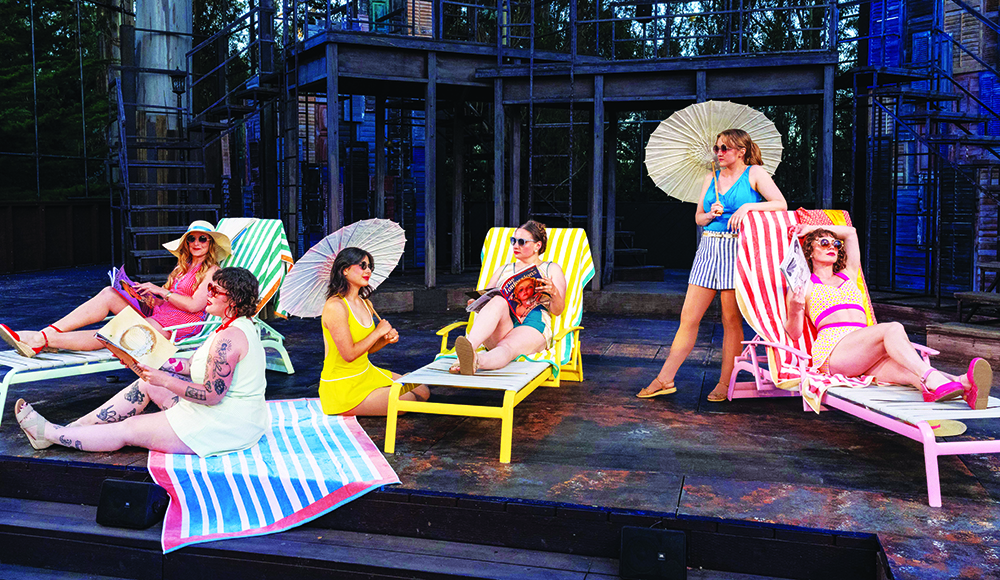
The highly anticipated summer season of Santa Cruz Shakespeare outdoor productions begins with Much Ado About Nothing on July 16, Macbeth on July 17, and Fences by August Wilson starting on July 30.
On September 5 Noel Coward’s Private Lives begins, followed by The Last Five Years, a musical by Jason Robert Brown on Sept. 12. Thanks to Artistic Director Charles Pasternak’s devotion to repertory casting, we’ll see many favorite players return to the outdoor Grove this season. The actors bring it all to life, but before they even step onto the stage their directors help sculpt the performances.
This season’s directors spoke with me about the ideas and attitudes they bring to the work we will enjoy over the next few months.
MUCH ADO ABOUT NOTHING
Directed by Charles Pasternak, this is a favorite famed for the sparring and sparkling wordplay between its pugnacious lovers, Beatrice and Benedick. And yes, the title tells you absolutely nothing about the action. Acid-tongued Beatrice and confirmed bachelor Benedick engage in some juicy repartée before being tricked into romance. Claudio and Hero, on the other hand, are in love from the beginning. These lovers are tricked into breaking up because bad guy Don John has spread plenty of malicious gossip. The truth is ultimately revealed, and there’s a happy ending complete with a double wedding.
You’re directing one of Shakespeare’s most famous plays. How do you approach something like this in a way that will keep it fresh for those of us who know the play?
Charles Pasternak: It’s interesting. On one hand, with Shakespeare’s more famous pieces like this, we always have to start by checking our assumptions at the door. So many assumptions come to us through theatrical tradition. I think one of the most famous examples is the famous Romeo and Juliet balcony scene. But Shakespeare doesn’t say anything about a balcony. We just know that Juliet is on an upper level. It’s important for us to take a close look at the text itself.
I love this play, and of course, it has the great Beatrice and Benedick, but one thing that has really struck me is that the love story of Beatrice and Benedick is the subplot. The main plot is the planned marriage between Claudio and Hero, and the deception that throws that off the rails.
The decision to come back together is an interesting and difficult decision, especially for modern audiences. We struggle to forgive Claudio. We struggle not to pity poor Hero. But the play really seems to be asking us to forgive and to give them another chance.

The play contains many potential miracles, but the two miracles in the play that are really speaking to me. First of all Benedick’s decision to abandon the world of men, the military world, to choose Beatrice and the domestic world.
We assume that just because he loves her, it is an easy thing. But it runs contrary to everything this play has told us about the world of men returning from war and what honor means to these men. I really do feel like some of our assumptions are wrong, and that’s been a major part of the process of preparation and rehearsal.
I’m wondering how much influence the actors have in terms of directing the text?
I work very actively with my actors and with my company, and I’m very open to their feedback. Once I cast somebody who I believe can play one of these amazing parts, I have to embrace their habits, their artistry, their instincts, their choices, and try to shape them into a cohesive whole. So I want my actors to bring all of themselves to the work.
You need to have ego to do that, and to believe that you can live up to these great characters, and you also must have the humility to remind yourself that it’s not about you, it’s about the playwright, and I really see my job as a director as the sort of in the middle, the interpreter between the playwright and the actors. I don’t want my actors to be automatons; I want them to be active participants in the story, but I will need to make the final decision at multiple points.
I hear you saying that it can be fluidly interpreted back and forth, perhaps, but in the end, do you let the text itself tell the story?
That is always my goal. I cannot always say I succeed. In rehearsal, inspiration strikes, we get an idea, we try something, maybe it’s very charming, maybe, maybe it’s a moment we like that’s definitely going to get a laugh. Then we have to check ourselves and ask, okay, but is that laugh in the service of this story? Are we cheating the story a little to get the laugh? I think a lot of Shakespearean productions have failed in this regard.
I think Shakespeare is intensely accessible, and I think audiences sort of continuously prove this to us. They’re smarter than we think, and our audience, who has been leaning in and doing this for 45 years now, especially canny.
You’ve worked with many of these same actors for several seasons now. Does that make directing this show easier and more interesting, or more dangerous because you know them all so well?
I think it makes it easier and more interesting. I passionately believe in the company, and sometime the next few years I intend to formalize a company here at Santa Cruz Shakespeare, and part of that I’m sure will be many of the people you’ve seen, right? It’s the same reason a hometown team will often beat an all-star team. These people have now worked together year over year. We evolve together. We learn together.
We always need some new blood every year. But there is a core group that to me becomes pillars of the work, and that adds a lot of work to my plate in terms of planning, but I think it’s worth it, but I absolutely think it’s worth it, or I wouldn’t do it.
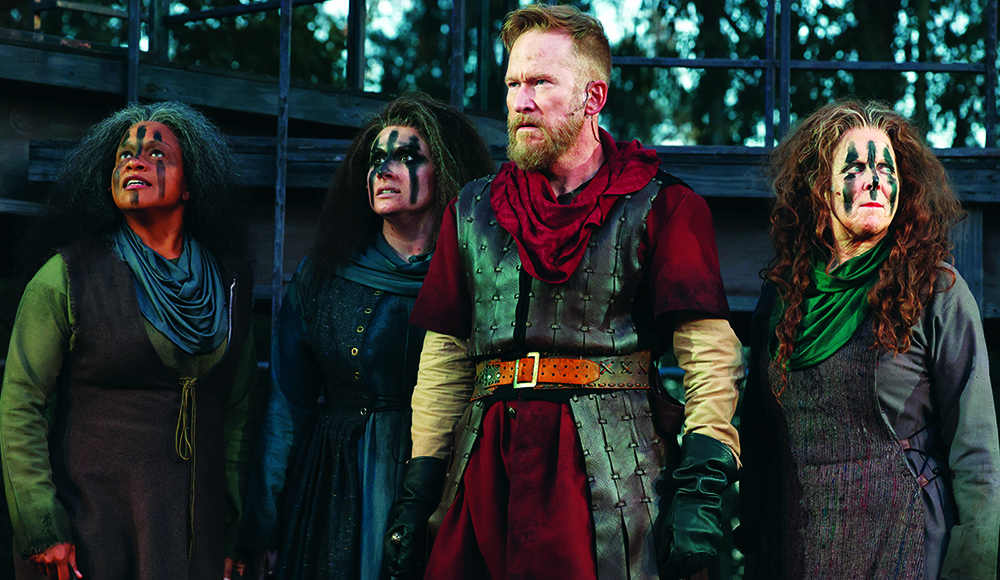
MACBETH, DIRECTED BY PAUL MULLINS
This is the high-powered masterpiece containing all those timeless speeches we tried to memorize in high school. “Out damned spot,” “life’s but a walking shadow, .” “double, double toil and trouble.” And who could forget the witches’ prophecy about Birnam Wood coming to Dunsinane or their greeting to Macbeth—”something wicked this way comes.”
A swift-moving saga of destiny, destructive ambition, and murder. Lots of murder. Extra credit: the murderous Macbeths are played by actors Paige Lindsey White and Dan Donohoe, married to each other in real life.
You’re directing one of the best-known plays in the English language. How do you tackle that perceived familiarity?
Paul Mullins: These big plays, Hamlet, Macbeth, Romeo, Juliet, Lear, yes, they are terribly well known, and this one especially. A good portion of our audience is very familiar with it, but possibly doesn’t really know it. But I think more than anything, you’ve got to make sure that you cast the best people you can.
These are set plays. What does change is the way it looks, and who’s saying it. So, I think, especially in Shakespeare plays, some of that freshness is about having people who are good at communicating his poetry. And I’ve lucked out this time, because these people are great.
I try to remember that a lot depends on the connection. We are coming out there to tell a story in front of a group of people, and of course, we want it to be cool and look neat and be fun to watch, but still it’s really the words we’re using to make this connection.
So you ultimately let the text tell the tale?
You have to. I think most of what we do in the theater is to let the actor say the words well and get out of the way. People will go to a big Broadway musical if it’s the spectacle only that they’re looking for. I think, especially in a play like this, a small one you know, that’s what’s interesting to be intensely focused on hearing the words.
Yes, it’s a fascinating thing that they don’t get old. That’s fabulous.
Is there a Paul Mullen signature style of directing that you apply, or do you actually invite the collaboration of the actors in shaping what we’ll see?
Yes, yes. I think that’s part of my role. I don’t think there is a style I have, but of course, for anyone who directs the play, because there are choices that involve something about taste. Is that something I like? Do I like that person? Do I like the way that looks? Do I like those things?
We’re in a theater, and you know, there comes a moment, and that moment is the opening night, when you’re leaving it in the hands of the people who really tell the story, which are the actors. They will be with it ’til the end.
By the time of day one rehearsal, you and the designers know more about the play than anyone else, and hopefully by the opening night, the actors on the stage know more about it than anyone else. It is hopefully literally a collaboration that is reasonably equal.
Paul, were you in on the casting for this play?
Because you’re casting a repertory season, you’re casting three plays at the same time. So Charles, as the artistic director, has a lot to say about that, as he should.
I know Charles wants everybody to be not only satisfied but excited about the 20-odd people that end up in this company. In the rehearsal room, you’ll know some people, some people you won’t know. But yeah, you have to trust them ultimately.
Even if that’s not what I wanted, but it’s who they are, so you make peace. We’re not in a world where very often people get fired, right? So you need to reach an agreement with each other that works.
I sense this is probably why people keep asking you back again to direct.
I want it to matter more than anything in the world, but I also want to remember that it’s a play, and that we are going to get up there and pretend this story, and then we’re all going to leave. So we need to be completely committed, and at the same time realize that this won’t be the solution to world peace, but I wish it would help.
What thrills you most about this play?
I think in a play like this, why we do these plays, is because comedies, tragedies, romances, they all talk to us about this human condition, and the reason we’re still doing them 400 years later is that they’re deep and insightful. This play has so much, so much to say about the corrupting nature of ambition and power, and the chaos and destruction that is created by tyranny, and these things are potent, and these things are alive in our lives right now.
What thrills me about the play is doing it with these people. I’m thrilled and so excited to watch them start to tell the story.
FENCES
Susan Dalian directs August Wilson’s gut-punching study portraying a Black American blue-collar worker, Troy Maxson, who articulates the desires so many never dared to dream. Written in 1985 but set in the 1950s, a pivotal moment in American history between Jim Crow and the dawn of the Civil Rights movement, this Pulitzer Prize-winner is loaded with raw and poetic dialogue. You’ll need to fasten your seat belt
I read the play in one sitting, and it had me in tears. It’s stunning.
Susan Dalian: Yes,it’s complicated, it’s complex, it’s stunning in the true sense of the word.
You’ve got a magnificent vehicle to work with.
Yes, I do. I have wanted to direct an August Wilson play or be involved in an August Wilson play throughout my career. I was really lucky to be able to be exposed to him in an art high school in the ‘80s, where I had an amazing program there, a drama teacher who brought people into our world like August Wilson. And then later on in college, I got to meet August Wilson during a talk back. Standing next to greatness, I’ll remember for the rest of my life.
The language alone is a little bit rough at first, and this is a very small ensemble. How does that factor into your handling of it?
I think it’s an intimate play. I like intimate plays that let you really dig a little deeper.
I often refer to August Wilson as our modern Shakespeare in ways. The way that he tells stories about people and language and poetry and rhythm. He was an artist and a poet before he was a playwright. That influences his plays.
He’s captured a rhythm found in Black American culture. It’s not real life, it’s still theater, but like Shakespeare, like Arthur Miller, he’s able to tell these stories poetically. And through that lens, we get a peek into the complexity of love and family, and this man, specifically this black American man, in the middle of the 20th century. He’s right at that crux of history.
Why do actors enjoy working with you?
I think it’s because I was an actor, I am able to talk to actors in a way that I know will be helpful for them to access what it is that we need to find in order to tell the story, in order for them to create their character.
I love actors, you know. I see that they’re all different people. I enjoy getting to know who they are as people, so that I can figure out what’s the best way to work with them, and in that way, I am very flexible. I’m not like you all have to come in and meet me in the way I do it. After all, they’re the ones who are going to be out on the stage at the end of the day; the only imprint I leave behind is the spirit of collaboration.
How much influence do the actors have on how you work in rehearsal, and ultimately, the finished product? Can we call it a collaboration?
That’s so interesting, because as the director, I am eyes and ears, and I keep the book. I am making sure that we are being true to the play that was written, through my interpretive lens. The actors are the vessels. I can’t dream of doing this work without collaborating.
Same with the design team, same with the production team, and my stage manager. We are all collaborators to make this thing; I don’t see it as I’m the director with the almighty last word.
So you trust your actors.
Yes. I often defer to the actors. I want to empower them that way, because then I get the best work out of them, and of course, they get the best work out of themselves.
I mean, they’ll have to perform this over and over and over again, so I want them to feel like this is theirs, that it’s something that they can sustain. I’ve not worked with any of the actors before, and that’s always fun. Derrick Lee Weeden, who plays Troy Maxson, is a well-known, well-revered treasure trove of the American theater, so to have him in this cast is amazing.
Santa Cruz Shakespeare’s performance calendar can be found here: santacruzshakespeare.org/calendar
DIRECTORIAL TRIO
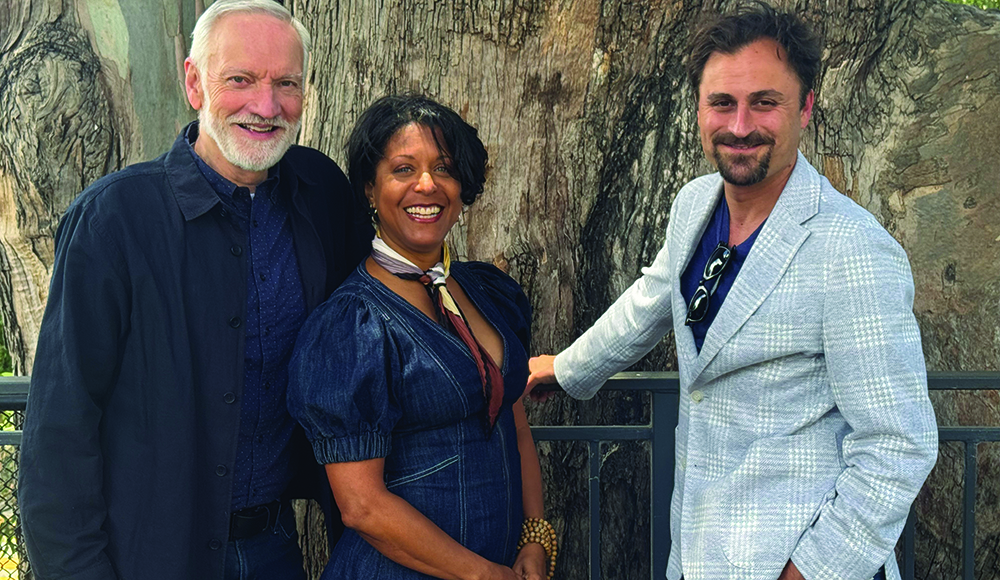
PHOTO: Brad Kava.
CHARLES PASTERNAK
Recent work with SCS: Vincent in Vincent, co-director of A Christmas Carol, director of Pericles. Charles has served as the artistic director of SCS since 2023. Over the past three years Charles has more than doubled SCS’s offerings, adding a 2-show fall repertory, A Christmas Carol, and a spring show to our traditional 3-show summer repertory. During Charles’ tenure, SCS’s yearly budget has grown by over a million dollars, and ticket sales are up over 25% across the board. He was the founding artistic director of The Porters of Hellsgate Theatre Company in Los Angeles, which he ran for fifteen years.
PAUL MULLINS
Paul returns to Santa Cruz Shakespeare, where he has directed A Midsummer Night’s Dream, The Importance of Being Earnest, King Lear, Twelfth Night, The Agitators, Pride and Prejudice, Love’s Labor’s Lost, The 39 Steps, Hamlet and Henry V. An associate artist at The Shakespeare Theatre of New Jersey, where he has acted and directed for thirty years, h. He has also directed plays for The Old Globe, Chautauqua Theater Company, Jewel Theatre Company, The Studio Theatre in Washington, DC., Dorset Theatre Festival, Portland Stage Company, Connecticut Repertory Theatre, American Stage, The Yale School of Drama, NYU Grad Acting and The Juilliard School.
SUSAN DALIAN
Dalian’s bio: For SCS: Hamlet in 2024; Troilus and Cressida, Henry VI Part 2 and Richard III for Undiscovered Shakespeare. Recent credits: Primary Trust (Boise Contemporary Theater); Antigone X, Blue Stockings. Sierra Classic Theatre: Macbeth, As You Like It, Outside Mullingar, The Merchant of Venice, The Two Gentlemen of Verona, and A Midsummer Night’s Dream. Associate Artistic Director at PlayPenn in Philadelphia. Professional acting credits in regional theater, film, and television, including Tamar in The Rape of Tamar (dir. Paul Whitworth) at SSC.