Listen up! That distant thunder you hear in the distance is a paradigm shift rearranging the world of orchestral music. The canon of Bach, Beethoven, and Brahms is shaking loose, allowing robust new partnerships to challenge old dogmas. Bernstein and Strauss, Ives and Gershwin, sitting side by side with newer, younger composers from non-Western traditions in programs unthinkable a few decades ago.
Taking his new directorship of the New York Philharmonic, a position once held by Leonard Bernstein, Venezuelan-born firebrand Gustavo Dudamel is currently shaking up Manhattan’s idea of concert programming. With his corkscrew curls and fiery conducting style the frenetic superstar is already shaking up dogma and energizing the symphonic repertoire. The spoken word, accompanying narration by dancers and actors, the addition of folkloric themes and youth orchestras—these are on the New York Philharmonic’s new menu.
SOUNDS FAMILIAR?
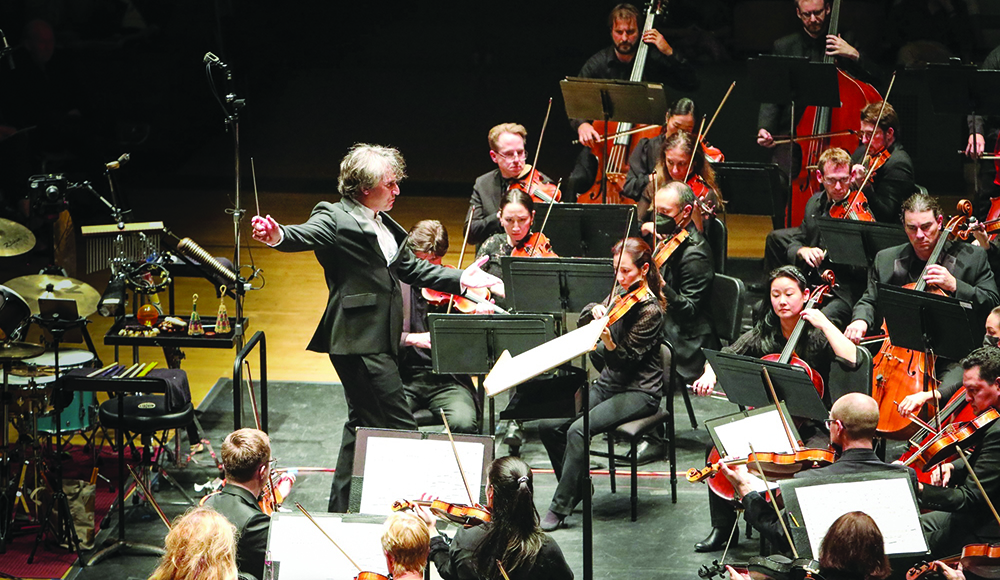
Such inventive juxtapositions and cross-genre musical programs permeate the restless imagination of Santa Cruz Symphony’s Music Director Daniel Stewart. At the season’s first concert last week, the program included Antonin Dvořák right next to Charles Ives. Nina Simone with Samuel Barber. Fearless programming is the new normal. Last year’s on-stage performance of Amadeus engaged the performance skills of actors from Santa Cruz Shakespeare, using a script created by Stewart from the Peter Shaffer play. Actors scampered throughout the orchestra and audience, interwoven with the choral sparkle of the Cabrillo Symphonic Chorus.
Again, using Stewart-adapted music from Mozart’s operas and chamber music. Turns out that full-body programming wasn’t a one-off. Welcome to the 2026-2027 season.
Big, bold, full of unexpected collaborations—with eye-popping graphics to match, the Santa Cruz Symphony’s 69th season offers a larger-than-life schedule of seven concerts. Exploring musical dialogue far beyond the predictable, the 2026-27 season has been curated by Music Director Danny Stewart inside and out.
“I think of this season in terms of the potential for dialogues and discoveries within each program,” explained Stewart, when we talked last week.“Each program is designed to offer great structural, stylistic, and cultural balance. And many unique opportunities for wonder.”
The program, criss-crossing musical genres as well as time periods, is also sure to amaze for the digitally devised artwork created for each separate concert—created by Danny Stewart himself.
GRAPHIC AGENDA
Unrestrained and impossible to ignore, the fantastical images announcing this year’s season of concerts have been keyed to what Stewart calls “the awesome reach of musical creativity across time and place.” Stewart is dedicated to music as the way to experience “the very essence of community.” He’s obviously delighted to create a buzz over his willingness to pepper the classical repertoire with selections that color outside the lines.
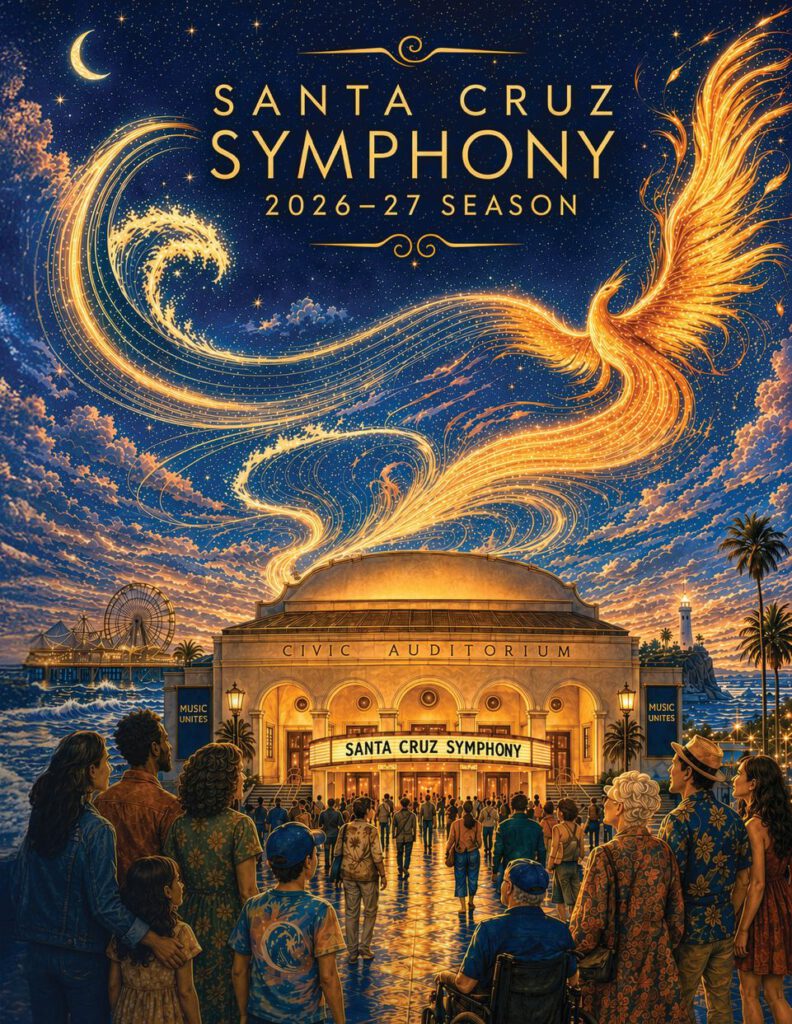
The program cover image illustrates his point. It shows the Civic Auditorium, with banners proclaiming “Music Unites” being approached by an inclusive crowd of concert-goers. An indigo ocean and rolling waves encircle the concert hall, with the Boardwalk in the distance. The sky is illuminated with a magical golden Firebird—foreshadowing a later concert— its wings mingling with clouds, watched over by a crescent moon.
Stewart proclaims his excitement in sharing “a series of posters I created to accompany our concerts,” and admits that this labor of love took “several weeks of designing, experimenting with, and refining the images to help represent the music and ideas behind them. The season cover I wanted was a fairy tale of make believe. Making these digital images with Photoshop and with several different softwares including you know experimenting with some some AI related ones I found it to be one of the most exciting ways to tell a story.”
Stewart’s choices have approval where it counts. “Danny has some brilliant ideas and has explained why he used his AI-generated images as representations for each of the concerts, in addition to our program book cover. He’s inventive and constantly evolving.” Symphony Board President Linda Burroughs maintains.
The seductive graphics are matched by the dazzle of maestro Stewart’s genre-jumping musical selections. Selections were chosen to be in dialogue with each other, and his program notes reveal his strategy.
TWO CENTURIES: NOVEMBER 14 & 15
This concert pairs Pyotr Ilyich Tchaikovsky’s romantic Violin Concerto, finishing with Italian Symphony by Felix Mendelssohn. Opening with a world premiere of “Overture” by emerging composer Daniel Strebulaev, the concert puts the spotlight on the Symphony’s Concertmaster In Sun Jang, a Juilliard graduate and a first violinist with the San Francisco Symphony.
Again putting his auteur explorations to work, Stewart has designed a poster depicting “an imaginary scene of a relaxed conversation between Mendelssohn and Tchaikovsky on an idyllic Santa Cruz afternoon at the beach.” The Boardwalk takes another starring role in this only-in-Santa Cruz imagery.
KEYBOARD TECHNO DAZZLE: JANUARY 16 & 17
Sergei Rachmaninoff’s monumental Piano Concerto No. 3 shares this program with a world premiere of Singularity Variations by tech legend Jaron Lanier. Both compositions feature piano soloist Serene. Lanier is something of a savant in the fields of composing, technology, and ethnomusicology. Playing as many instruments as the late great David Lindley, maybe more, Lanier pushes every envelope in sight, and the results are bound to be provocative to our audiences. Like Lanier, Serene is a pianist and computer scientist.
For this concert’s program, Stewart imagined a dreamy dialogue among the three artists, in which a wraparound keyboard evolves and morphs in the style of M.C, Escher. His illustration presents “the relatively recent past of Rachmaninoff’s concerto and the future-facing vision of Jaron Lanier, united in the present through the virtuosity of guest artist Serene.”
FAMILY CONCERT: FEBRUARY 28
Always special this year’s engaging open-armed program is filled with the sights and sounds of young musicians from across the county. The program is guided by multi-skilled Master of Ceremonies Omari Tau.
The highlight of this concert will be a performance of Sergei Prokofiev’s Peter and the Wolf, for which the Santa Cruz County Youth Symphony will join musicians of the Santa Cruz Symphony. A delightful bit of orchestral writing for a fairy tale plus narrator, Prokofiev’s story is told by a flute, oboe, clarinet, bassoon, horn and strings. Exciting and full of voice, dance, and instruments, the concert includes Golden KPop Demon Hunters performed by Cabrillo Youth Chorus and El Sistema, El Cascabel featuring the folkloric dancers and performers of Watsonville’s Esperanza
del Valle and Nematatlín de la Universidad Veracruzana, the Kuumbwa Honor Jazz Band playing Gershwin, Oye, a jazz/folkloric celebration of the children of Mexico by Jim Papoulis plus many opportunities for young students to perform on the spot thanks to the Carnegie Hall Link Up Programs. Stewart’s illustration for once again visualizes the Boardwalk backlit by the setting sun, behind Peter and the Wolf.
FIREBIRD AT THE BOARDWALK: APRIL 3 & 4
Unexpected programming invites us into the Art Deco period of Igor Stravinsky’s riveting fairytale, The Firebird (1919 Suite). English romantic modernist William Walton meets up with a dreamy 21st century Black Swan by BTS & Myungsoo Shin. Violist Pearl de la Motte steps into the spotlight as featured soloist in the Walton Concerto for Viola.
Dance and choreographed movement are part of the original Black Swan, a Korean hit celebrated in millions of internet viewings. Asked about dancers Stewart would only mysteriously respond, “Although our Firebird program does not officially include dancers, you never know what unannounced surprises may be in store for you at our concerts.”
How did the Music Director find this Black Swan?
“It came up in serendipitous but unexpected ways. During my time as Music Director of the Youth Orchestra in San Francisco, it was during the pandemic, and there was a mindless wave of anti-Asian sentiment. At that moment here I am conducting a youth orchestra that is approximately 90 percent Asian, and I was determined to do everything I could to make these kids feel supported. My wife had just seen this piece performed, and told me to consider it, so I wrote to the composer in Korea. He was very gracious and gave his permission to adapt it for orchestra. It was incredibly moving.”
“The two pieces,” Stewart maintains, “engage in conversation. Stravinsky’s nothing if not sophisticated and this particular Black Swan is also very sophisticated, so you have this kind of cosmopolitan but very folkloric DNA to both pieces. They talk to each other across the centuries and across the world from different contexts and different cultures. I just found that to be very poetic type of conversation.”
COMPOSERS MEET FILMMAKER: MAY 1 & 2
Stewart put his design wit into a provocative visualization of the final concert, created around the famed literary work, Also Sprach Zarathustra by Friedrich Nietzsche. Nietzsche’s famed book of nihilist aphorisms (Thus Spake Zarathustra, in English translation) is considered a sacred text of existentialism. In the background of Stewart’s visualization we see the infamous dark monolith of Stanley Kubrick’s 2001: A Space Odyssey, in which Richard Strauss’ music figured so memorably. “I also wanted to represent each composer at approximately the age they were when they composed the work of theirs on this program: A youthful Strauss regards Nietzsche, himself lost in thought, while Leonard Bernstein, later in life, shares a conversation with the youthful Reena Esmail.”
Concert Five features Bernstein’s Chichester Psalms and Ram Tori Maya by young Indian- American composer Reena Esmail, both works sung by the celebrated Cabrillo Symphonic Chorus directed by Carlin Truong. For many listeners, the surprise of this programming might just be the inclusion not only of Nietzsche’s title, but a musical composition by the philosopher himself, Hymnus an das Leben.
Nietzsche was so smitten by Wagner’s genius that he composed this piece to impress the great opera master. Alas, Wagner found the piece underwhelming, and thus the two former friends parted ways.
In creating his own images for the program this year, Stewart was sensitive to the tools and elements he’d chosen. “I had very specific ingredients I wanted to represent and I just agonized over every element, proceeding step by step just as I would in composing a musical piece.”
Asked about those digitally-sculpted graphics, a controversial design choice given varying attitudes about AI-generated imagery, Stewart responded with passion about the joy of making them. “It was just a real labor of love and whether sophisticated or simple, it was that overall experience this artist wanted to create. I’m very proud to say that you know a local artist did create this art.
Stewart contends that, “It’s much like writing a piece of music. You’ll have some people who enjoy or maybe even adore it. And for a lot of folks it’s just not their cup of tea.
I think that’s part of the artistic process, just accepting that it’s in the eye of the beholder and it belongs to whatever interpretation they bring to it. That’s life. I’m very grateful for our wonderful Symphony board of directors and their enthusiastic support of my work for these images, and this season’s artwork.”
Gary Reece, the Symphony’s Executive Director, praised Stewart’s messaging. “Danny is a genius. He was really into trying to create his own images and just felt that was the best way that he could communicate the feelings that he had for each of the concerts. I respect that.”
People might be surprised, or concerned that the music director has temporarily turned graphic designer. “I think it would be wonderful if everybody reached out of their artistic comfort zones and tried new things,” says the inventive Music Director.
“I say very emphatically it’s never too late and we should enjoy all these amazing possibilities. We’re always capable of so much more than we give ourselves credit for.”
POPS BENEFIT CONCERT: JUNE 12
A final pop of sonic excitement closes the season with the ever-popular June 12 Pops Benefit Concert celebrating the tireless film composer John Williams. The words “ever-popular” are in this case not a well-worn cliché. They are scientific fact! If you’ve drawn breath in the past 40 years you’ve heard more than one pulse-raising composition by the composer. Star Wars? Indiana Jones? Jurassic Park? Harry Potter? Yes! That’s John Williams.
Kids, families, former kids, film buffs and their parents find the rousing, throbbing, pounding, and over-the-top movie scores by the master of the soundtrack just plain irresistible. The final concert by the Santa Cruz Symphony of the 2026-27 season is fully loaded with great movie tunes, as well as dancing, food trucks and the happy invitation to come dressed in movie costumes.
After so much work, fine-tuning a program and fine-tuning the illustrations, Music Director, graphic designer, and orchestra conductor Stewart is ready for some actual music-making.
“I’m very excited and ready for it, because for so much of the year you spend in this very theoretical process of programming the season step by step. But when you’re close to actually making the music, and helping bring that to life, it’s— wow! that’s the real thing.” ■
Santa Cruz Symphony 2026-27 concert season overview
NEXT—Read Joshua Logan’s accompanying story, “Reality, Remade”, about Jaron Lanier’s music, his custom composing software and his vision for AI that puts artists in control.