
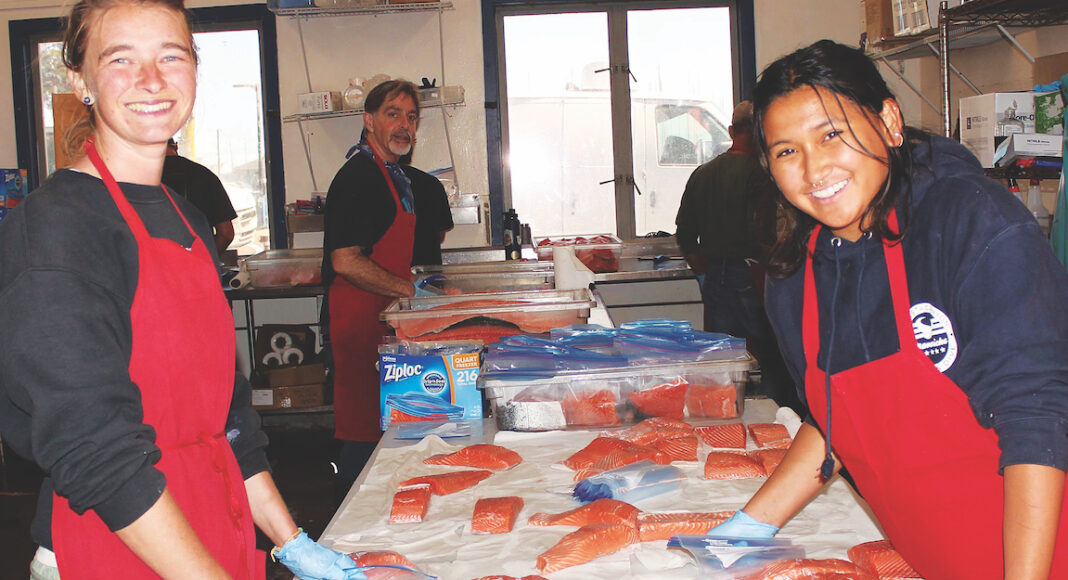
In the fishing world, sustainability comes in many forms. Those who catch wild salmon locally will tell you they pump less carbon into the atmosphere compared to fish farmed on other continents. Squid harvesters refer to new studies suggesting the species may survive an era beset by climate change better than others. And then there are the local residents who support themselves working on the dock or at sea, in an industry that connects them to a valuable source of protein.
Over the last few months, hundreds of boats have been fishing off of—or transiting along—Santa Cruz County’s coastline. Industry analysts report plenty of bright spots in both the salmon and squid markets this season. But after some scientific studies were scuttled last year because of the coronavirus pandemic, and other research couldn’t be completed due to wildfires, fisheries management is still undergoing its own pandemic comeback, as climate change fears remain ever-present.
“It’s definitely been a good season,” Scotts Valley resident Hans Haveman, the CEO of H&H Fresh Fish at the Santa Cruz Harbor says during a late-June interview. “Unfortunately, regulation from the state and feds have shut us down right when it’s goin’ good.”
Salmon Stock
Serious drought conditions in California have led to less water moving through the Klamath River Basin, up north near the Oregon-California state line, prompting the state’s largest native tribe, the Yurok, to warn in May that “unless groundwater extraction is moderated, it is a virtual certainty that Chinook and Coho salmon will not be able to reach their spawning grounds due to insufficient flows for migration.” Its fisheries department discovered an “extremely abnormal” number of juvenile salmon dying, with 97% of the small fish infected by a parasite called C. shasta. And when authorities are forced to take action to mitigate such problems, the effects ripple down to Santa Cruz County, Haveman says.
“They don’t want us to catch any of the fish from the Klamath River—like, zero,” he says, explaining how restrictions in other areas increased the number of Chinook, or king, salmon fishermen docked here. “That pretty much makes Monterey Bay the hotspot for the entire fleet.”
The season started with a bang. At one point there were about 45 salmon boats with slips in Santa Cruz, according to harbor staff. Mike Conroy, executive director of the Pacific Coast Federation of Fishermen’s Associations, a trade association representing West Coast commercial fishers, said the price was good, too—$12 a pound for king—at the outset.
“Because this is a ‘down year’ in terms of ocean abundance, the fishery had to be more highly regulated compared to years past,” he says, referencing the “in trouble” Klamath stocks, and noting the uncertainty around the effects of the pandemic on fish stewardship. “Impacts of Covid on salmon management are yet to be clearly understood.”
One thing the coronavirus has spurred is more dock sales, as fishermen looked for new outlets for their catch when restaurants closed. On a recent Sunday, 39-year-old David Toriumi, who maintains a slip in Santa Cruz, set up shop in Moss Landing to take advantage of the interest from returning tourists and locals hoping to score some fresh fish.
“The past few years have been pretty good,” Toriumi says, adding this season was going great until the market was flooded by fishermen located several schools north of San Francisco. “We just ran into a good pile of fish.”
As an advisor for the Monterey Bay Fisheries Trust, he knows all about how connected fishermen based here are to the die-offs occurring on the Klamath—not to mention the persistent battles between agricultural interests and environmentalists.
“It’s a water war,” he said. “This is going to be a consistent thing.”
Squid Life
Of the 72 seiner, 32 light boat and 46 brail boat permits given out by the California Department of Fish and Wildlife to fish for squid, a huge portion descended on the spawning grounds in the Monterey Bay area in the past several weeks. At least 43 boats “landed” squid at Moss Landing, Monterey or Half Moon Bay in the last three months, according to state records. That’s on top of the light boats contracted to lure the catch.
For 55-year-old Daniel Rasler, who has more than three decades of squid fishing experience under his belt, it isn’t a point of pride. Aboard the Lady J, at port in Monterey, he heads into the cabin and grabs some squid from the freezer he put in recently. He hints at a friendly rivalry between the north and south ends of the Monterey Bay, showcasing the difference between squid caught at Monterey (larger) and around Santa Cruz (smaller). His feelings toward those coming to fish from elsewhere, however, are much less amicable.
“I’ll be real with ya,” Rasler says. “There’s more light boats this year than there’s ever been down here. And that’s sad.”
Squid fishermen illuminate the ocean to attract the invertebrates, before snagging them with nets. At port, they’re frozen into blocks and transferred to foreign-bound vessels via the San Francisco Bay. Rasler says that from what he’s seen this year, some out-of-state fishermen are pushing the limits of sustainability.
“The boats that are coming from down south, from Alaska, Canada and them, they’re bringing three, four light boats with ’em, OK?” he says. “So, you figure, if you got only a couple tons of squid here and couple there, and these guys go out, now what pile [of] squid gets to go in and lay their eggs?”
In fact, he says, some fishermen want to cut back the number of hours they fish each week—forcing squid boats to wait until Monday at 6am to start fishing, instead of the current Sunday-through-Friday schedule.
“We did that about a month ago, we tried it for the first time,” he says, describing the effort as a success. “That next day [the entire fleet] caught 900-and-something tons in nine hours.”
But the idea didn’t stick, and he says the area is fished out—with his boat soon averaging around five tons every couple days. With so many of the West Coast boats concentrated in a single area, the squid get “traumatized” and scatter, he says.
“They hear all the boats and the vibrations,” he says, adding the out-of-area fishermen are attracted by the prices paid (upwards of $1,000 per ton) by importers in places like Japan. “And we’re risking our life now, and fishing in weather that we never fished in, and dealing with stuff we never dealt with our whole life.”
Rasler also claims to have seen some using illegal fishing methods, and pointed to the DUI arrest of a 50-year-old squid fisherman who crashed the 30-foot “Crystal Shine” into a Monterey breakwater in May, to back up his point of view.
“It’s just insane,” he says, noting many out-of-staters have already decamped for Alaska. “The reason they went to Alaska: salmon season started. So, they’re up there right now purse seining and gillnetting. Thank you, Lord! All right? Thank you! Because now, we get a breather. The squid get a breather.”
Sink or Squid
John Haynes, the Monterey harbormaster, says it’s normal for local fishermen to get frustrated at sharing the catch with boats from elsewhere. Then when they head to other ports to fish, they become the out-of-towners putting pressure on the fishery there. But the Felton resident says that after speaking with local fishermen about the proposal to change the weekly schedule, he believes their concern for sustainability is genuine.
“The squid fishery’s kind of unique in that the squid fishermen have a lot of input into the conservation of the species,” he says, adding in the past they’ve even agreed to limit the brightness of their lights. “They don’t want to see the squid population diminish.”
Diane Pleschner-Steele, executive director of the California Wetfish Producers Association, confirmed there was a voluntary move by squid fishermen not to fish on Sundays, earlier this year. But she says there wasn’t really a consensus, and notes any changes to the state’s Market Squid Fishery Management Plan must go through an official process.
But as far as population health goes, she says, their latest report suggests the squid are more successful at adapting to changing environmental conditions than previously believed. “Which is a good thing with climate change coming,” she says. “We were actually able to document an environmental change that started up in the Monterey Bay area.”
Unlike the “infinitesimally small” returns of years past, squid have been pumping out more babies in central California than at any time since 2015, researchers found. That was when El Niño and a “marine heat-wave” teamed up to invite more warm-water species here and reduce oceanic productivity, according to the association’s study. But surface temperatures have been cooling, bringing back nutrients like zooplankton—and the squid have also returned in abundance, the report states.
They were only able to come out with this new finding because they didn’t have to call off the research, the way the National Oceanic and Atmospheric Administration did with some of its work during the pandemic.
“They wouldn’t allow the ships to go out,” Pleschner-Steele said. “Covid interrupted everything.”
Katie O. Grady, an environmental scientist for Fish and Wildlife’s Pelagic Fisheries & Ecosystem Program, says squid abundance is also affected by the Pacific Decadal Oscillation, a variable ocean pattern that researchers are trying to learn more about.
“The availability of squid fluctuates based on environment, meaning landings can change dramatically across fishing seasons and regions,” she says. “Oceanographic models indicate that the California Current is moving away from a warmer water regime and into a neutral/cooler one, though it is unclear exactly how the California squid population will respond to these changes.”
Grady says Fish and Wildlife is looking for ways to work with the squid industry to introduce appropriate updates to fishery rules.
“The Department is proposing the formation of a squid fishery advisory committee to gather broad stakeholder input and review changes in fishing activity among other opportunities for management review,” she says. “Pending funding, this process would ideally begin in 2022 and would include not only the fishing industry, but scientists, conservation groups, law enforcement and other essential representatives.”