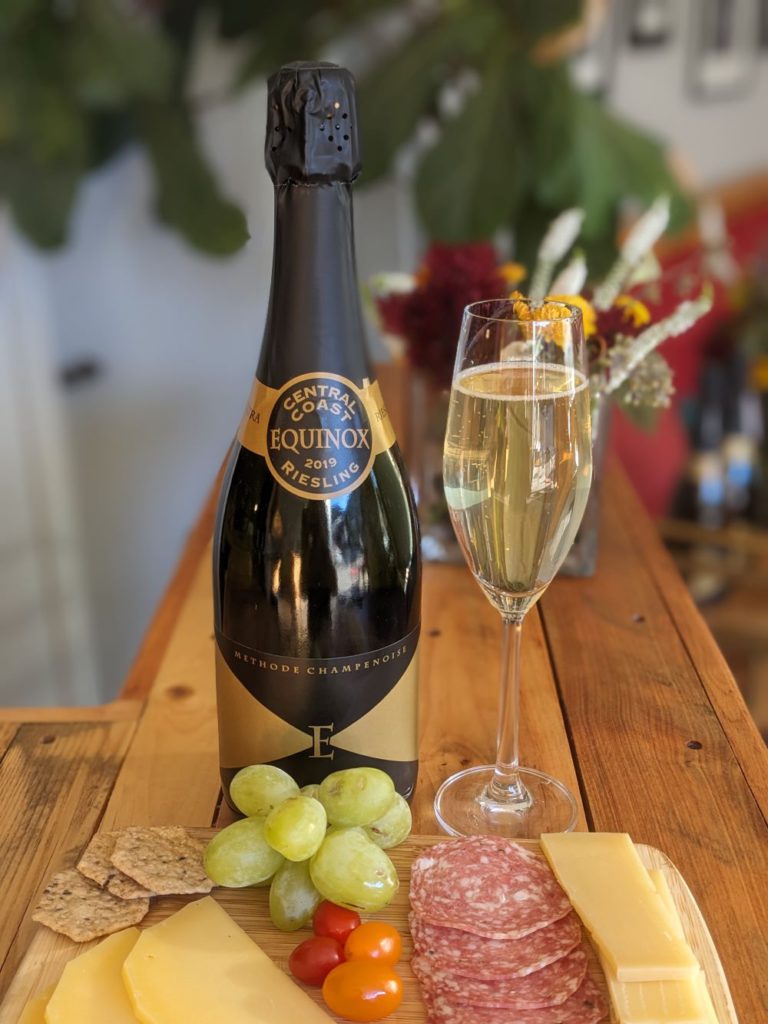
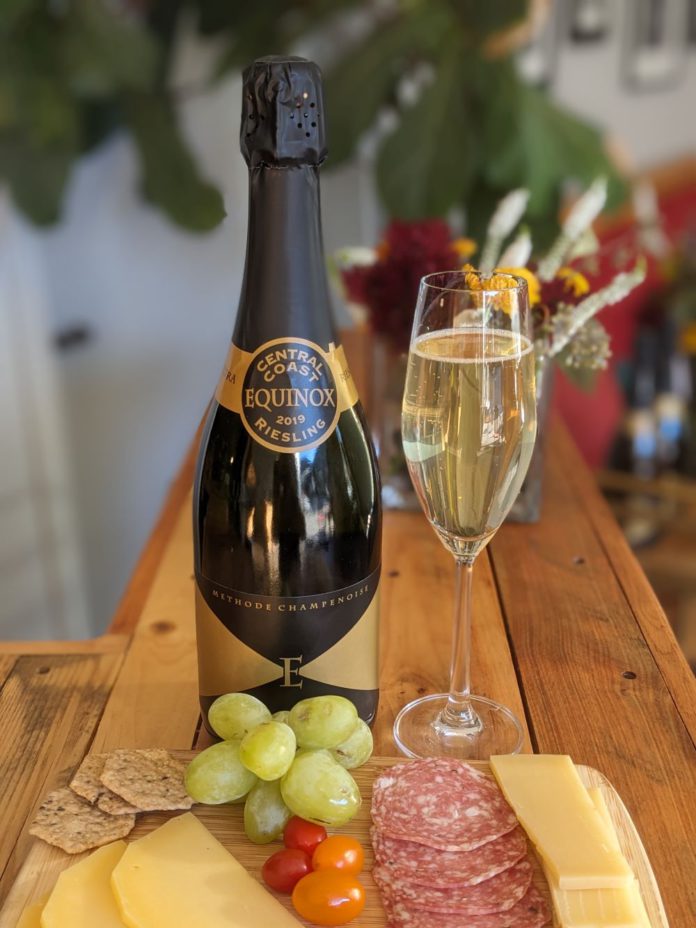
Looking for a fab celebratory sparkling wine? Look no further than Equinox!
Tasting their bubblies recently, I fell in love with a Central Coast 2019 Sparkling Riesling ($49). Equinox owner and winemaker Barry Jackson has triumphed again!
Made in the méthode champenoise style, this amazing sparkler is perfect for any special occasion. This beautiful handcrafted wine has dry flavors and a pleasurable cascade of bubbles. There’s nothing like cracking open a bottle of good wine when you have a special meal to go with it.
Jackson also makes Merlot, Petit Verdot and more under his Bartolo Wines label.
The Equinox tasting room is in the Swift Street Courtyard complex – opposite Santa Cruz Mountain Brewing. It is a terrific spot to hang out and try some superb wines. Equinox has food on many occasions such as Parker Presents with fresh oysters; the popular Adorable French Bakery on the first and third Saturday of the month; and the occasional in-house curated cheese plates.
Equinox Wines, 427-B Swift St., Santa Cruz, 831-471-8608. Equinoxwine.com
Aptos Wine Wander – Aptos Village
This Wine Wander is a partnership with the Capitola-Aptos Rotary, Wines of the Santa Cruz Mountains and Aptos Village businesses. Upbeat and fun, this event is an opportunity to try many local wines within easy walking distance. Local wineries participating include Aptos Vineyard, which recently moved to a good spot in the heart of Aptos Village in the old Armitage tasting room next to Starbucks. Enjoy an afternoon of strolling around from business to business in Aptos Village – glass and map in hand. Tickets are $45 in advance, $50 at the door. The event is 1-4pm on Saturday, Dec.9. Visit scmwa.com for more info.
“What is something about Santa Cruz that you are thankful for?”
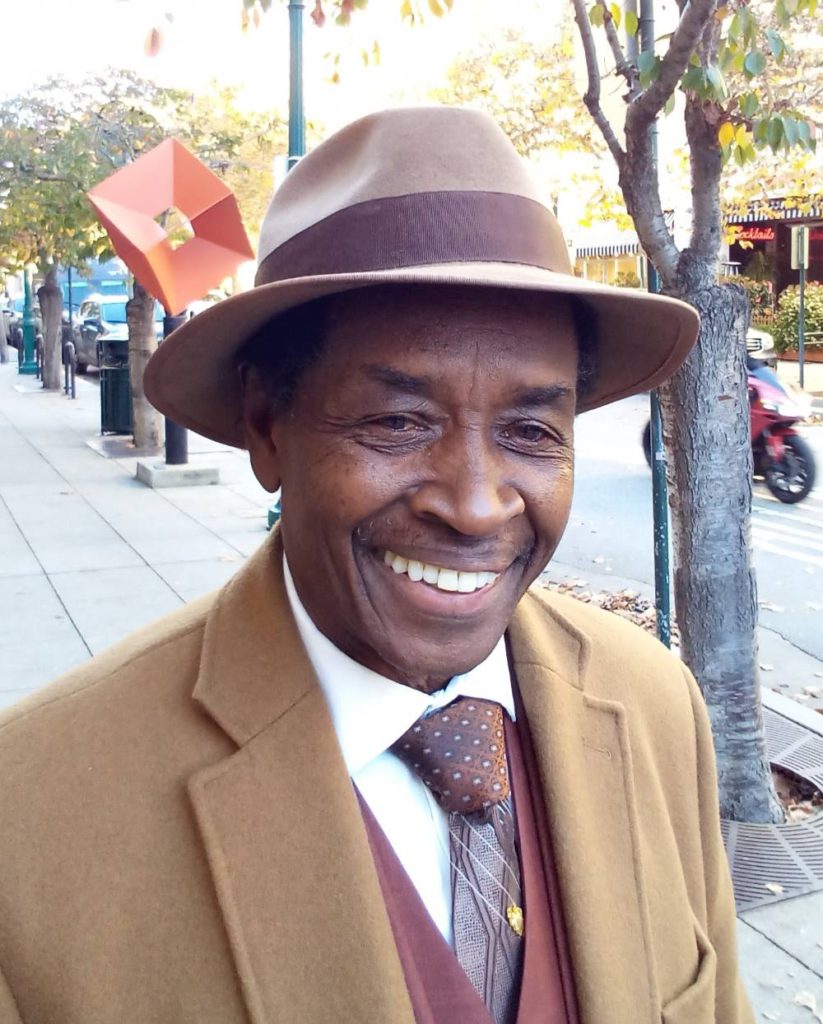
Curtis Reliford, humanitarian
“I’m grateful to be alive and wake up every day in a paradise island of a town that is full of gratitude. More grateful people here than I have met in my life. And I’m a black man talking about white people. That’s where I’m at with Santa Cruz.”
Hadley Long, 19, UCSC student
“I’m still exploring the area, and I’m thankful that it’s not too big, but there’s lots to explore and see. I love being close to the beach and downtown. I can walk around and find new things every time I go there.”
Desmond Driver, 18, UCSC student
“I’m thankful for the environment, and the wildlife, especially living closer to campus, the wildlife is pretty crazy. We see deer and raccoons. There are wild turkeys all over campus, that’s a Thanksgiving thing!”
Mira Warner, 21, Volunteer for Housing Matters
“I’m thankful for the amount of resources we have, in terms of social services and prevention. I’m in a Human Services class, so I’m learning about how many we actually have. We definitely need more, but it’s a good start.”
Rob Abundis, 56, Medical Device Sales
“I’m thankful that Santa Cruz is so diverse and eclectic. It’s unique. Its unique nature gives it what everybody loves. That’s why people stay here. And we’ve got the beach!”
Kylie O’Connor, 21, Pacific Wave
“I’m thankful for Bookshop Santa Cruz, because I love reading and I always love going there. It’s a sweet little spot .”
Local literary heavyweights are coming together for Pajaro Rising, a fundraiser that puts the spotlight on those still dealing with the aftermath of the Pajaro floods. The event will take place Nov. 30 at the Cowell Hay Barn on the UCSC campus and all proceeds will go to Community Bridges, one of the main nonprofits helping with relief and recovery.
It has been eight months since the floods devastated the South County region and as the community rebuilds these writers are hoping to draw attention to the ongoing problems.
The all-star panel features essayist and climate activist Rebecca Solnit; renowned author Ingrid Rojas Contreras and KQED’s Voice of the Bay Alexis Madrigal. Also participating are the Watsonville short story writer Jaime Cortez and Pajaro’s own up and coming poet, Claudia Ramirez Flores. The panelists will read selected works at the event, with some works inspired by the reality of people in the Pajaro area.
Pajaro Rising will not only draw attention to the tribulations of flood victims, but will also highlight the literary talent that has risen out of an often neglected community.
Jaime Cortez’s breakthrough 2021 short story collection “Gordo” breathes life into the experience of growing up in a Watsonville migrant camp in the 1970’s. The tender coming of age tales give an emotive backdrop to the geography of the area. The characters were molded out of the many farmworker families that still make up the demographic of Pajaro. The book has garnered wide acclaim and Cortez is an ascending voice in the California literary tradition.
Soon after the Pajaro floods, Rebecca Solnit—who runs a writer’s group with Cortez— floated the idea of a fundraiser for the victims and they got to work. Solnit has written extensively about climate disasters and the event will underline long-term effects of the Pajaro floods.
“We hope that it helps to build compassion for the fact that disasters have long tails and there’s a long recuperation period after a disaster,” Cortez says.
Cortez hopes that the event will help reach a new audience that may not know about the situation in Pajaro but will come to it through a rich literary experience.While searching for a selection to read at Pajaro Rising, Cortez stumbled upon a forgotten, unpublished story he wrote years ago set in Pajaro.
The story follows the journey of a religious figurine from its birth in a Chinese factory, through Mexico, and all the way to Watsonville where it gets swept away when the Pajaro River floods. The uncanny parallel between the story and the topic of the upcoming event struck Cortez.
“It was remarkable that I had actually written about that years before the flood happened,” Cortez says.
Like Cortez, Claudia Ramirez Flores takes inspiration from the working-class, predominantly Mexican immigrant community of Pajaro. She grew up in the area and her poetry is inspired by experiences of immigrant farmworkers and the heartache of being separated from loved ones by the southern border. Her work has been published in Xinachtli Journal—also known as Journal X— a bilingual literary journal focusing on social justice issues.
After getting her BA in political science from UC Berkeley as a transfer student from Cabrillo College, Ramirez Flores rediscovered her love of creative writing. She applied for a spot at the prestigious Yale Writer’s Workshop and got in. It was there that she was encouraged to find her voice through bilingual/spanglish poetry.
Ramirez Flores works with Writers of Color Santa Cruz County and through that group she met Cortez. When the Pajaro Rising event began to take shape, Cortez invited her to participate. Encouraged by one of her college mentors, Ramirez Flores made the leap.
“I just thought that this was a really life changing and important opportunity for me to be in the event,” Ramirez Flores says.
When the Pajaro River flooded, her family was evacuated and had to go to a local shelter. In the midst of the fear and confusion, Ramirez Flores says she witnessed acts of kindness that inspired her poetry. For Pajaro Rising, she will be reading a poem titled “Mi Querido Abuelito Chepe”, a bittersweet work remembering her beloved grandfather who passed away while waiting to return to the United States.
When asked how she feels sharing the stage with the likes of Ingrid Rojas Contreras—whom she’s a fan of—her voice rises with excitement.
“I feel like sharing the stage with them is mind blowing and I feel really empowered.”
For attendees, the event will offer one of a kind commemorative screen printings made on-site. Tickets range from $50-$100 and include signed copies of the authors’ works provided by Bookshop Santa Cruz. For large donors, a $5,000 donation will get them a private reading by Solnit and Cortez, while a $10,000 donation gets them a catered event with multiple authors at their home
There was a meeting last night (Nov 16th) about the rail trail. The big developers who want a “skyline” for Santa Cruz in the form 6-17 story buildings (that I wouldn’t’ wish upon anyone to have to live in) as well the $100 million ‘trail next to rail’ project are literally ‘getting away with murder’ of hundreds of legally protected trees out of the thousands they plan to take out, that ordinarily a regular developer or landowner would not be allowed to trim more than 30% of.
They are able to buy loopholes in the permit process and destroy the greenbelt riparian corridor running throughout the heart of live oak. The time is now to speak up or forever hold your peace. For when you see holes in the sky where there used to be trees, and a skyscraper shading the block it will be too late.
Gene Wood
UCSC is irresponsible about housing
I am writing to express my profound dismay and disappointment regarding the current housing crisis students face at the University of California, Santa Cruz (UCSC). As a concerned student witnessing the distress of countless friends and colleagues, it is distressing to observe the university’s apparent indifference to the plight of its student population.
The housing situation in Santa Cruz has reached an alarming state, with students grappling to secure accommodation in an excessively competitive and inflated market. The desperation has led to a frantic scramble among undergraduates, hastily signing leases for inadequate, overpriced residences merely to secure a roof over their heads. Even on-campus housing options are severely lacking, forcing students into cramped living quarters designed for one individual but housing multiple occupants, turning dormitories into tiny, overcrowded spaces reminiscent of shoeboxes.
It is troubling that UCSC seems to overlook its responsibility to provide adequate housing for its students. The decision to over-admit students without corresponding plans for accommodating their housing needs has exacerbated an already dire situation. Consequently, students find themselves in a distressing predicament, competing for scarce housing options in a city where unaffordable accommodation has sadly become the norm.
It is crucial to emphasize that housing is a basic human right and that every member of the UCSC community, whether local or student, deserves fair and accessible housing options. The university’s failure to address this pressing issue is unacceptable and requires immediate attention.
Now’s the time to count our blessings in a world that sometimes feels like it’s tottering over the edge.
One small thing I am grateful for are the little community libraries that have sprung up all over neighborhoods, giving away free books. At a time when everything seems transactional, it’s such a relief to see people helping each other with nothing expected in return.
Another thing I’m thankful for is living in such a rich and diverse artistic community. There is more music and art here than I can take in. This weekend alone I saw Alejandro Escovedo at Moe’s Alley perform a show that could have sold out an arena. The songwriting and performing were stellar. But the same weekend, I missed Bruce Cockburn and Built to Spill, lesser-known but largely talented performers in small places a short distance away.
I’m so thankful for our community’s teachers and schools. While we pay ungodly amounts of money to entertainers and athletes, the people who do our most important work–schooling our kids–get paid peanuts. It makes me sick, but I appreciate all you have done for our children. I wish I could do more than say thanks.
And I’m super thankful to the readers of Good Times and my other magazine, Growing Up in Santa Cruz. You all have given so much feedback, suggestions and ideas for articles, showing how valuable community journalism still is and always will be. There’s so much bad information and bad intentions out there, that local journalism is one of the last bastions for truth, justice…and you know the rest.
Lastly, I’m thankful for Dan Pulcrano, who publishes Good Times and 16 other weeklies and magazines. No one should work that hard or take on that much responsibility, but he’s bucking all trends, bailing out what can seem like a sinking industry, keeping the printed word alive and doing what he can to bring light into the world. Like all bosses, he can be difficult, but I have mad respect for his efforts and intentions, including donating all the labor and space for the charity, Santa Cruz Gives.
Brad Kava | Editor
PHOTO CONTEST
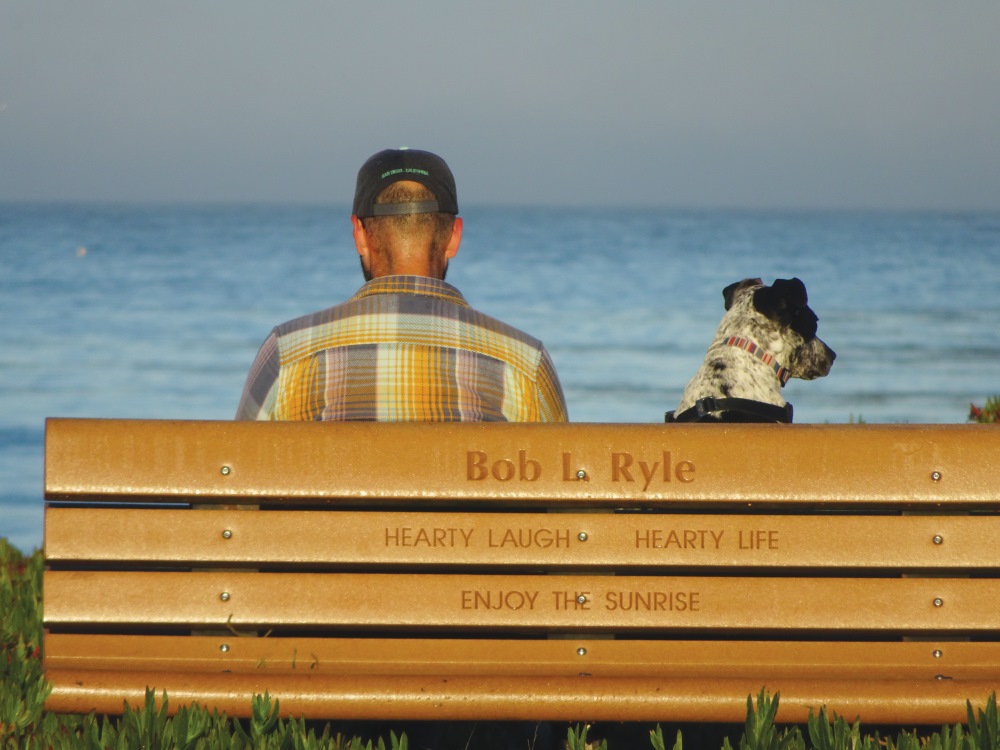
OLD FRIENDS Spotted this pair enjoying the sunrise the beautiful morning of July 25 by the Bay. Photo: Kathy Isonio.
GOOD NEWS
Santa Cruz schools are moving to electric buses, big news for the environment. The Live Oak School District, which is phasing out diesel buses, unveiled its first electric bus last week. The acquisition of the new bus is in partnership with Blue Bird, North Coast Unified Air Quality Management District, and A-Z Bus Sales. The 72-passenger electric bus features lithium-ion passenger car batteries with 125 kWh total capacity, independent battery control that improves reliability and performance, the industry’s largest view-out window that reduces blind spots and enhances visibility, an innovative structural design that provides unparalleled safety, and more.
GOOD WORK
Two inmates at the Rountree Rehabilitation and Re-Entry Facility have graduated from the Building Trades Pre-Apprenticeship Program. Brian Sidwell and Kevin Allee finished courses in nine weeks involving skills in construction, plumbing and electrical trades.
“I feel comfortable now that I can get out and get a regular job to support my family,” said Sidwell. Sidwell and Allee earned MC3, OSHA 10 Construction Safety and CPR/First Aid certifications.
QUOTE OF THE WEEK
The opposite for courage is not cowardice, it is conformity. – Jim Hightower –
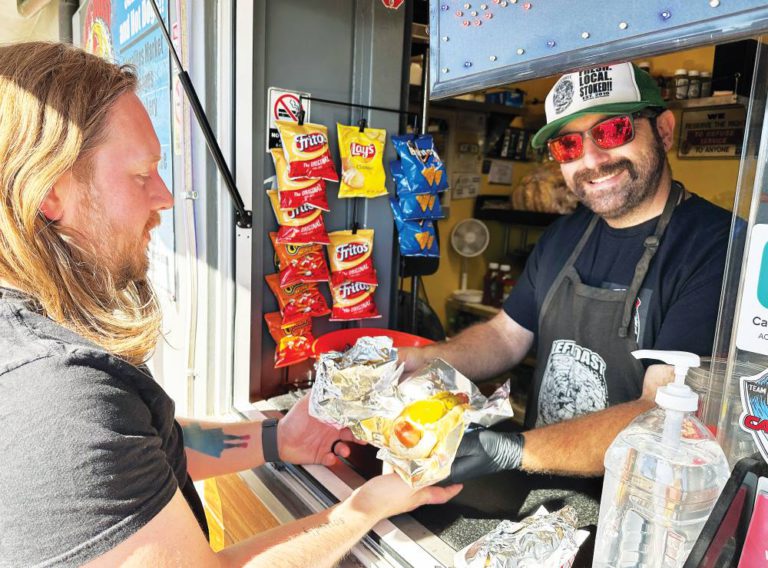
Born and raised locally, Josh Fisher worked for over 20 years in the restaurant industry, doing everything from dishwashing to cooking. Seven years ago he opened Left Coast Sausage Worx in the heart of the Capitola Village. Also a member of the local skate punk band 3upFront, Fisher says Left Coast is all about local sausages and hot dogs.
With the tagline of “Nice buns and huge weens since 2016,” they offer grab-and-go as well as on-site outdoor dining on their newly constructed beachfront deck. Their most popular dog is the Cheesy Bavarian: a cheddar, pork and beef sausage dressed with “The Worx” (ketchup, mustard, relish, onions, jalapeño, pepperoncini and mayo). Other delicious dogs include the Polish and the Hot Link, and for the more exotically inclined, they have wild game sausages like venison, boar, elk and lamb.
An original Chicago Dog, veggie dogs and all-beef “no-nonsense” footlongs round out the menu, and they also have specialized condiments like pepper bacon jam, spicy local mustard and raw sauerkraut. Current hours are Friday-Monday from 12-5pm (or until sold out).
How does your music inspire your food and vice-versa?
JOSH FISHER: Our band’s music is fun and crazy just like one of our hot dogs in your mouth. When I play shows at venues all over California, it just makes sense that good food and good music go hand-in-hand. We always have music playing here that is of a wide and eclectic variety, just like our band plays. And music helps fuel the chaos of a big lunch or dinner rush like nothing else can, other than a cold beer and a hot hot dog.
Tell me about your new deck?
JF: Our temporary Covid outdoor dining deck was destroyed during the storms earlier this year. We worked diligently with the city and helped establish a prototype, which we were the first ones to complete, and other local businesses are following suit. Our new deck has a great ocean view and is only a hot dog’s throw away from the sand. It’s a great place to bring the family for some fun in the sun.107 San Jose Avenue, Capitola, 831-295-1194; leftcoastsausageworx.com
Lyrics Born is a legend. Born in Tokyo, the Japanese and Jewish American rapper made a name for himself in the Bay as half of Latyrx (with Lateef the Truthspeaker) in the early ’90s. A decade later he dropped his debut, Later That Day, which peaked at number 40 on the US Billboard charts. In 2022, Rolling Stone named it one of the “200 Greatest Hip-Hop Albums of All Time.” Earlier this year, the same publication called his song “Callin’ Out” one of the “100 Greatest West Coast Hip-Hop Songs of All Time.” Lyrics Born also has a passion for food, and fans can catch him on his online cooking show, Dinner In Place. MAT WEIR
The First Annual Ghostland Music Festival rocks the Historic Brookdale Lodge on Friday and Saturday. The event offers 3 stages devoted to Indie, Rock/Punk and Hardcore/Metal. The music will rock from 5pm until after Midnight on Friday and Saturday. Friday’s Indie stage presents Cowboy Starr, Star 69, Cement Ship, 7 Come 11, The Bassment, Joe Kaplow and two more TBA, while the Rock/Punk stage unleashes Fulminante, Enemy of My Enemy,The Scalps, and 6 more. Friday’s Hardcore/Metal lineup includes Crossed, Sepsis, Placate, FUX, Curb Creeps, and 3 more TBA. The festival is “birthed by musicians for musicians and music lovers.” JOHN KOENIG
INFO: First bands at 5pm, Historic Brookdale Lodge, 11570 Highway 9, Brookdale. Presale tickets $15 1-Day, $25 2-Day. At the door $20 1-Day, $30 2-Day. www.brookdalelodge.com/events/ghostland-music-festival
FOLK
CHISELED
Before the pandemic, Tom Gewecke and Stefan Frazier played together at open mics around the Bay Area. When the shelter in place was called, and there was nowhere to play, they decided it was finally time to drop their debut album. Friend Kai Frazier grabbed his guitar, and just like that, Chiseled became a three-piece. Last June, they released the new lineup’s five-song debut EP, Naked in a Dream. As their name implies, the trio plays a very defined version of folk music with bits of country and indie rock carved into it. MW
It’s never too early to start looking for the perfect bespoke gift for those special loved ones, and what’s more Santa Cruz than a gift made by local artists? Stroll around Abbott Square and check out the wares of 20 unique makers, from paintings and wood burnings to crocheted goods, soaps, jewelry and much more. There’s something for everyone, and the warm feeling of knowing the money spent goes directly to supporting the creative community is a bonus. Savory beverages and tasty treats abound, so nobody has to shop hangry. MW
INFO: 11am, Abbott Square Market, 725 Front St., Santa Cruz. Free.
SATURDAY
ROCK
Pete Floyd
It’s been almost 30 years since British psychedelic trail blazers Pink Floyd played their final concert. But their influence on music and listeners lives on, and the tribute band Pete Floyd brings that influence to Felton Music Hall. Since guitarists and vocalists Pete Delaney and Pete Hale started their traveling tribute three years ago, they’ve been steadily building a following. In the sensory-saturating tradition of their role models, the show also features an immersive laser light show. Other members of the eight-piece band include guitarist-vocalist Teal Collins, keyboardist Bob McBain, drummer Sean England, vocalist Paige Clem and Alex Garcia on sax and keys. DAN EMERSON
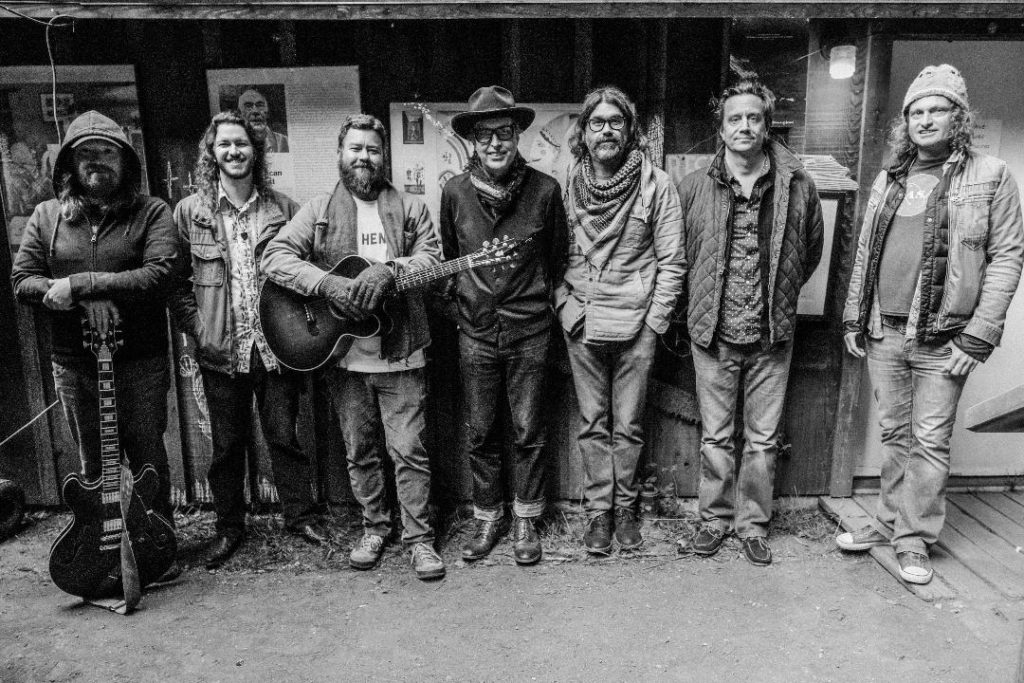
Traveling with an all-star band and singing songs by the man who wrote many of the greatest of all time? Kinda seems like Chuck Prophet has a great life figured out for himself. This tour features musicians from Phil Lesh & Friends, the Mother Hips, and Casual Coalition. They’ll be playing from Bob Dylan and the Band’s “The Basement Tapes” lexicon—not from beginning to end, but covering the songs that live most insistently in their souls. Is there a better way to shift into the holiday season than shaking it to “Mighty Quinn?” Doubtful. JESSICA IRISH
Ghostland Music Festival rocks Historic Brookdale Lodge for a second day beginning at 5pm with three stages and 20+ bands. JK
INFO: Visit brookdalelodge.com/events/ghostland-music-festival for lineup and tickets.
SUNDAY
HIP HOP
THE PHARCYDE
What would hip-hop be without “Passin’ Me By” by the Pharcyde? It’s a thought too upsetting to contemplate. The group created some of the greatest sounds of the ’90s, and their legacy is still felt in the world of hip-hop and rap today (and played from the speakers of every specialty coffee shop with impeccable vibes and perfect playlists). Their music lights up a room with undeniable choruses, funky beats and head-spinning bars highlighting language’s expansive possibilities. This is one of those tours that is too amazing to pass up because these guys are living legends! JI
French guitarist-violinist Dorado Schmitt can stand on his own as an accomplished composer and bandleader. He’s also made bolstering the gypsy music of the late, great Django Reinhardt part of his life’s mission. His long-running Django Festival Allstars is an unstoppable swing machine that includes his two sons, Samson and Amati, on lead guitar. The Allstars blend bossa nova, flamenco and modern jazz with the traditional fusion of American hot jazz and French chanson to create original compositions and arrangements. They’re playing a vital role in the evolution of gypsy jazz, with swing as the common denominator. DAN EMERSON
INFO: 7pm, Kuumbwa Jazz Center, Kuumbwa Jazz Center, 320-2 Cedar St. $52.50/adv, $57.75/door. 427-2227
TUESDAY
LITERARY
TEMPLE GRANDIN
Renowned professor Temple Grandin comes to Santa Cruz this week to celebrate Different Kinds of Minds, the Young Readers Edition of her 2022 bestseller Visual Thinking. Now adapted for children, this landmark text advocates for those who learn best through pictures and patterns—a group of thinkers, Grandin argues, modern society has woefully underserved. Dr. Grandin has made a career of making science accessible to broad audiences and is a beloved defender of people with autism and neurodiversity in all its forms. The Los Angeles Times puts it perfectly: “Temple Grandin may well think in pictures, but she has mastered the written word.” ADDIE MAHMASSANI
INFO: 6pm, London Nelson Community Center, 301 Center St., Santa Cruz. $22. 420-6177.
WEDNESDAY
JAZZ
PAUL CHERRY
Paul Cherry dramatically changed after On Top, his 2014 garage rock EP. Pop and jazz fusion called to him, and he answered. The Chicago-born musician found his voice with 2018’s Flavour and has hit his stride with his latest record, Pure Grooves Vol.1. Fresh off a tour of Asia, Cherry takes on the West Coast with a new collection of smooth, jazzy and often funny songs—and hopefully his cherry print three-piece suit. For a taste of his millennial-meets-yacht-rock sensibilities, the breezy tune “OBO” is worth a listen. Who here hasn’t considered dating the person selling them a used car? AM
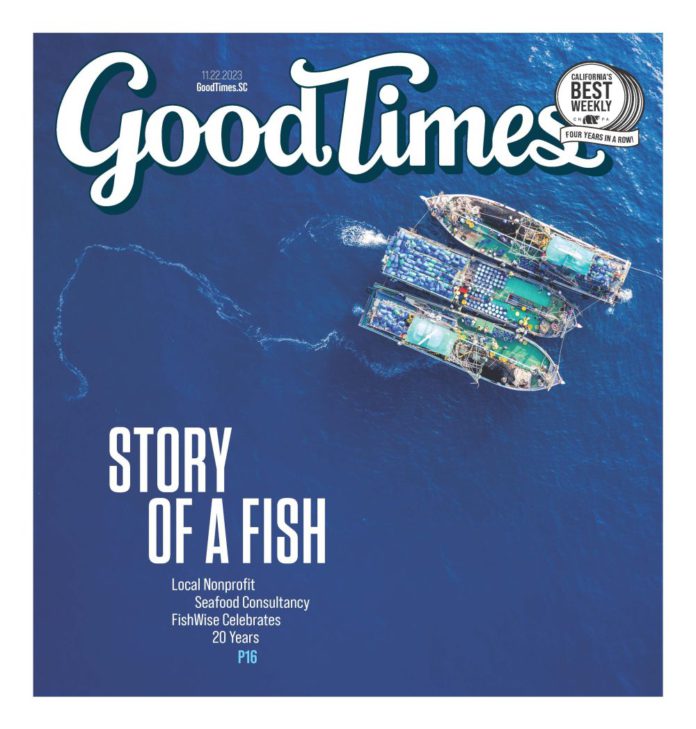
The fish on one’s plate has been on a wild journey—but not “wild” in the way people use the word to indicate something natural or untouched. Humans have gotten involved, and, as we know, humans complicate things.
Thousands of years ago, fishing was relatively simple: a few hunters, a village to feed, a nearby body of water, a spear, a fire, a meal. In the globalized economy, however, one fish often passes through countless hands over thousands of miles from the moment of catch to the grocery store shelf. The human and environmental tolls along the way are about as unfathomable as the ocean itself, in large part because traceability in these environments is an enormous challenge. The best available data on the average can of tuna, for example, often associates the fish inside with over 100 vessels.
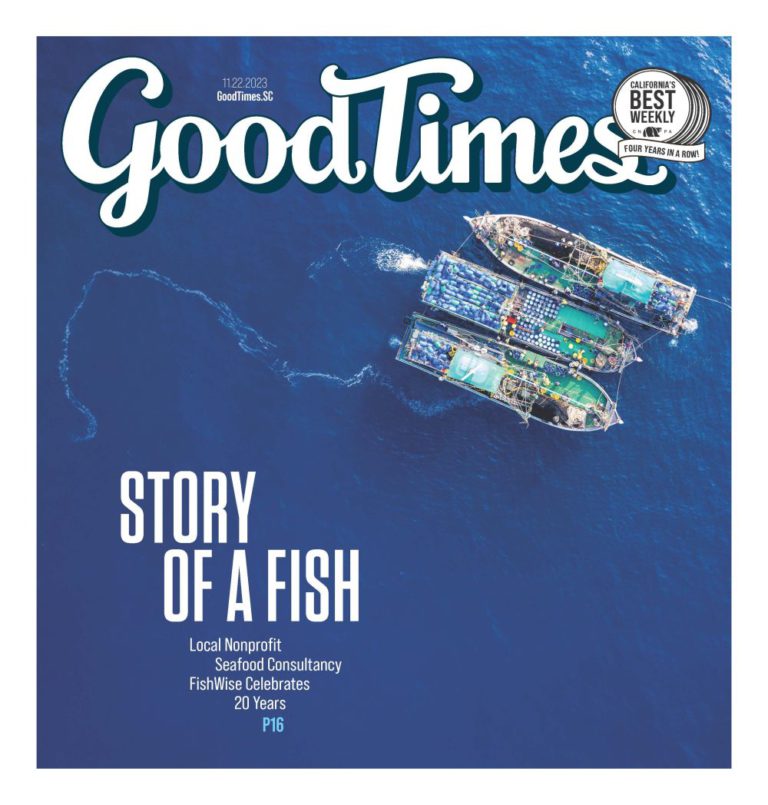
The Santa Cruz nonprofit FishWise has become a major player in worldwide efforts to improve data collection and bring full accountability to the seafood industry. Their work ranges from international waters, to Monterey fisheries, to local New Leaf stores. As the organization closes out its 20th anniversary year, its members are celebrating the progress they’ve made and looking ahead to all there is left to do to bring safety and sustainability to local waters and the high seas.
A Slippery Situation
FishWise began in 2003 when Teresa Ish and Shelly Benoit, two UCSC students in the graduate level Ocean Conservation Class, ran into a problem at a grocery store near campus. “They recognized that there was little to no information available for customers to determine whether seafood was sustainable or not,” says Senior Project Director Michelle Beritzhoff-Law. The students are now celebrated as FishWise’s co-founders. Ish’s graduate advisor, UCSC Professor Emeritus Marc Mangel became an early champion of the organization and board president. “That’s really how FishWise started, by working with a local retailer, New Leaf Community Markets, to collect information about the seafood products—where a fish was harvested, with what methods—informing them what was sustainable and what could be improved upon and then labeling it in-case so that a consumer could make an informed decision,” she says.
That mission is much easier said than done because the sea defies easy quantification from almost every angle. As the complexity of the issues they faced became apparent, FishWise grew rapidly.
“You are at the whim of nature as soon as you get out on the ocean,” says Beritzhoff-Law, “and then you are dealing with a wild resource. You can’t see the fish or the crabs or whatever it is you’re harvesting.”
Beef might come to mind as an industry that could provide some models given similar concerns about sustainability there; but ranchers have clear fences delineating property lines and the ability to own, count and trace their stock. Imagine trying to brand a fish. Sara Lewis, FishWise’s Traceability Division Director, explains, “They are parallel industries in terms of being proteins that are widely consumed, but they are not parallel in terms of how they are managed at all, because fishing is the last hunter-gatherer, the last competitive source of food.”
It’s not that there aren’t any laws. On international waters, intergovernmental groups called regional fisheries management organizations (RFMOs) attempt to monitor their shared resources through treaties based on consensus. Though some vessels want to comply with these regulations, many still take advantage of the anonymity the ocean provides. Illegal methods abound: fishing without a permit, fishing in closed-off areas, fishing with destructive gear like dynamite and cyanide. It is estimated that 90% of fish populations are currently fished at, or above, sustainable limits. One notorious vessel—The Thunder—was known to use nets measuring up to 45-miles long, which caught all manner of endangered species as bycatch throughout a decade’s worth of illegal fishing that totaled $67 million in profits.
Furthermore, vessels often conscript (or traffic) those desperate for work into dangerous conditions akin to indentured servitude or debt bondage. Approximately 50 million people work at sea, and the most vulnerable among them deal with piracy, torture, harassment and brutal murder at the hands of nefarious sea captains.
U.S. territorial waters have much stronger fisheries management than the high seas, “but they are still out there, and there’s not always someone right next to them watching everything they’re doing,” says Lewis.
A culture of confidentiality—which some call “the maritime merry-go-round”—does not help matters. “No beef rancher is really all that worried that someone might know his ‘secret spot,’” says Lewis. Many seafarers, by contrast, profit off keeping their sources to themselves and balk at the idea of increasing transparency in their trade.
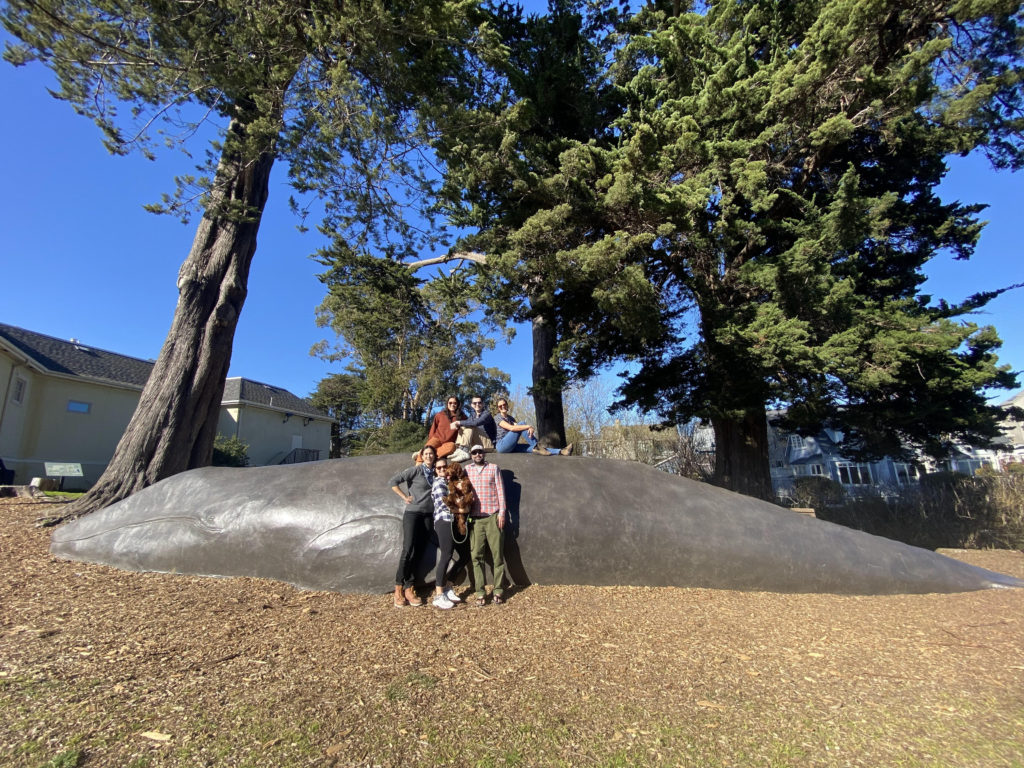
A WHALE OF A TIME The FishWise staff enjoy a day in Santa Cruz with a kindred spirit. PHOTO: Contributed
(Fish)Wise Mind
Today, FishWise provides environmental and social expertise to major U.S. and global corporations, including Albertson’s Companies (which owns Safeway), Target, as well as companies based in the E.U. and Japan. FishWise staff frequently work with the seafood directors and buyers of these companies to collect the supply chain information necessary to drive decision-making, developing interactive dashboards the companies can use to monitor progress toward sustainability goals. The programs FishWise is developing and implementing with companies are positioned within a unique intersection of business interests, marine conservation and human and labor rights advocacy.
“We take a three-pillar approach to achieve our mission,” Beritzhoff-Law says. “One is direct supply chain engagement, where we work directly with companies and their supply base. The second is collective engagement, and the third pillar is focused on governance reform.” Working across these pillars, FishWise often illuminates the ties between environmental challenges and social challenges in the seafood industry.
Beritzhoff-Law emphasizes that the issues FishWise tackles are so broad that collaboration between many stakeholders at a time is key. Facilitating those connections, FishWise is creating tangible change within the industry.
“A new thing more and more companies are looking to do is not just, you know, if they find an issue, stop supplying from that vendor or that supply chain, but really remedying the situation and working to provide resources to those impacted workers and making sure the situation improves,” she says.
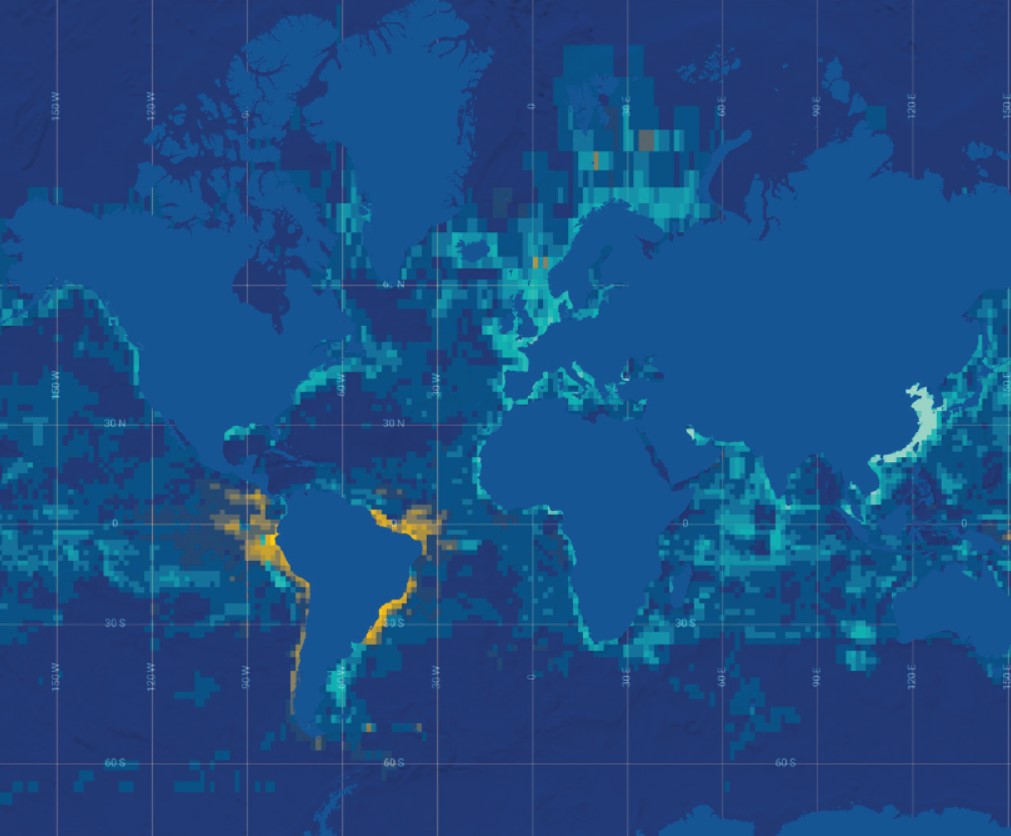
Over the past two decades, rapid change in technology has given FishWise new tools to do this work. In 2016, Google in partnership with Oceana and SkyTruth launched the website Global Fishing Watch, which uses satellite data to allow anyone with Internet access to watch the hundreds of thousands of vessels at sea in near-real time. About 200,000 vessels at any given moment agree to publicize their location, but the map also reveals countless “dark vessels” in the water. Whether identified or not, it is not rare for a vessel to veer into protected waters; or to be at sea for a suspicious amount of time, which indicates the fishers aboard may be held there working against their will. As recent documentary projects like Seaspiracy and The Outlaw Ocean have illuminated, such rogue vessels are, quite literally, floating prisons. Among many shocking reports, there have been reports of workers being beaten with stingray tails and thrown overboard when ill.
All of this to provide a can of tuna certainly gives the consumer pause, even if they are not inclined to worry about the ethics of eating the fish itself.
PLENTY OF BOATS ON THE SEA Global Fishing Watch provides a publicly-accessible
picture of the fishing footprint around the world Photo: Global Fishing Watch
The Next 20 Years
Returning to the aforementioned can of tuna, the good news is that there aren’t different fish going into each can. “The fish might not have come from 100 places,” says Lewis, “but the challenge is the way that data is collected about which vessels possibly could have contributed to that can. It’s an aggregation problem where you have let’s say 10 vessels that land tuna all in one location, and then that’s sometimes frozen, and they wait around for a while, and then they can it.” In the time between docking and canning, 100 other vessels could have easily stopped by the same facility to drop off their own catch to the same freezer. In the past, if managers knew anything at all about who caught the fish in the can, it was only the list of possible vessels.”
FishWise is pushing for more specificity, and they are succeeding. A major breakthrough came in 2022 when their retail partner Hy-Vee, a midwestern grocer, became the first major retail company ever to publicly disclose a complete list of vessels supplying its tuna.
“If you can get information about the actual vessels that are in your supply chain—the fishing vessels that collect the fish—if you can identify those and have that information flowing through your supply chain,” Lewis says, “you can use really amazing data tools to perform risk assessments to help ensure that those products were legally harvested and to understand risks to the laborers, like the fishers on board.”
In February 2023, the organization announced its new Executive Director, Jenny Barker, M.P.A. With an extensive background implementing fisheries management programs around the world from Honduras to Cambodia, Barker is an ideal leader to guide FishWise into the future.
“FishWise has grown to hold a unique and important role in the sustainable seafood movement over the last 20 years,” Barker says. “We will continue to promote comprehensive sustainability–for social, environmental, and economic benefits.”
Some ongoing projects include the Roadmap for Improved Seafood Ethics (RISE), a publicly available eLearning resource that reached 2,325 users in 88 countries in 2022. The organization also has leveraged its traceability and social responsibility expertise to consult with government agencies in both the U.S. and in other seafood-producing countries, including Peru, Ecuador, Tanzania, Vietnam, and Japan.
Though its efforts take it to the most far-flung locals imaginable, FishWise has Santa Cruz at its core. It continues to partner with New Leaf grocery stores around the city and also maintains close relationships with groups that support local fisheries, including the Monterey Bay Fisheries Trust, Real Good Fish and Ocean to Table, among others. Many of its members are avid surfers and ocean-lovers, Santa Cruz locals who understand the allure of the sea—as well as its dark side. Their work, on a simple level, aims to bring the beauty and serenity Santa Cruzians enjoy in waters just off the city’s coast to the places where the ocean represents the opposite of freedom.
“We started here,” says Beritzhoff-Law. “We really feel connected to this community.”
FishWise is a non-profit 501(c)3 whose mission is to sustain ocean ecosystems and the people who depend on them by transforming seafood supply chains. To make a tax-deductible donation to support FishWise, please visit fishwise.org/donate
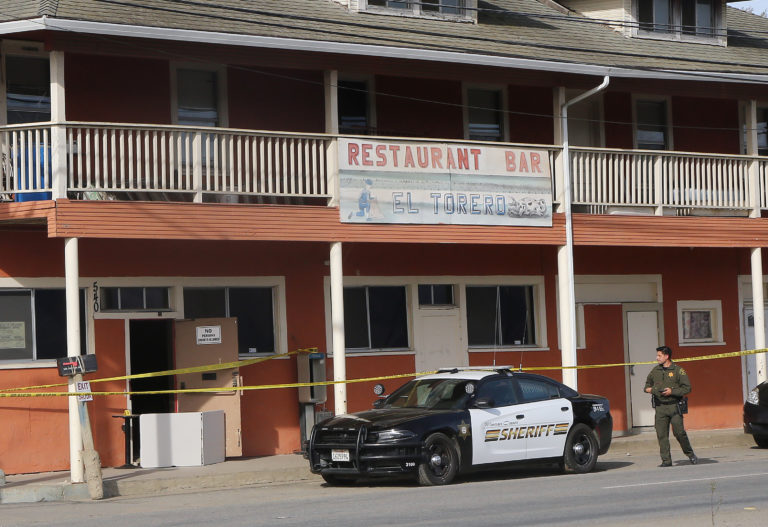
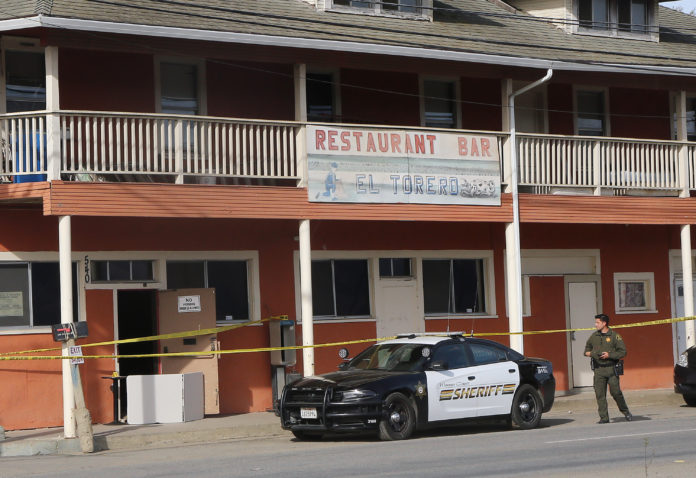
Two people were killed and two were injured in a shooting at a Pajaro bar early Tuesday morning.
According to Monterey County Undersheriff Keith Boyd, deputies responded to El Torero Bar at 540 Salinas Road just after 1am for a report of a shooting.
Upon arrival, deputies found a man dead from an apparent gunshot wound.
Three female victims were also found at the scene who had suffered gunshot wounds. They were taken to Natividad Medical Center, where one of them later died.
The historic building, with a string of apartments across the second floor, was surrounded by strands of yellow crime scene tape and a Sheriff’s deputy was parked outside the building to help secure the crime scene.
Sister Rosa Delores, director of nearby Casa de la Cultura stopped by to talk to the owners of the building.
“We’ve been here for the past 30 years and , and I know the community well and I know the owners,” she said. “This is very sad. I’ve gotten some calls from the relatives. Our community has suffered quite a bit, the flood, the damages; this area right here was flooded. This is a real sadness and it’s been a struggle for the owners of this business. You don’t expect this kind of thing to happen right here in your community. But this community knows how to come together to make a difference. They need to know that we are behind them.”
No further information was released about the ongoing investigation.
Anyone with information is asked to call the Investigations Division at 755.3700.
A 70-year-old woman died in a hit-and-run crash Saturday night on the 800 block of Bay Avenue in Capitola. She has been identified as Debra Town of Capitola.
Capitola Police said a vehicle collided with Town at about 8:30pm, and the driver reportedly sped away from the scene.
Capitola Police are now offering a $10,000 reward for information that leads to the person responsible.
Detectives are asking that anyone who may have witnessed the incident, or has useful video camera footage in the area of Hill Street and Crossroads Loop, to call CPD at 475.4242.
“Owners of Tesla vehicles with Sentry Mode enabled, or any drivers who have active dash cameras, and may have been in the area are encouraged to call,” police said. “You may have captured useful video.”
Looking for a fab celebratory sparkling wine? Look no further than Equinox! Made in the méthode champenoise style, this amazing sparkler is perfect for any special occasion. This beautiful handcrafted wine has dry flavors and a pleasurable cascade of bubbles. There’s nothing like cracking open a bottle of good wine when you have a special meal to go with it.
“What is something about Santa Cruz that you are thankful for?”
“I’m grateful to be alive and wake up every day in a paradise island of a town that is full of gratitude. More grateful people here than I have met in my life. And I’m a black man talking about white people. That’s where I’m at with Santa Cruz.”
“I’m...
Local literary heavyweights are coming together for Pajaro Rising, a fundraiser that puts the spotlight on those still dealing with the aftermath of the Pajaro floods. The event will take place Nov. 30 at the Cowell Hay Barn on the UCSC campus...
here was a meeting last night (Nov 16th) about the rail trail. The big developers who want a “skyline” for Santa Cruz in the form 6-17 story buildings (that I wouldn't’ wish upon anyone to have to live in) as well the $100 million ‘trail next to rail’ project are literally ‘getting away with murder’ of hundreds of legally protected trees...
Now’s the time to count our blessings in a world that sometimes feels like it’s tottering over the edge. One small thing I am grateful for are the little community libraries that have sprung up all over neighborhoods, giving away free books. At a time when everything seems transactional...
Born and raised locally, Josh Fisher worked for over 20 years in the restaurant industry, doing everything from dishwashing to cooking. Seven years ago he opened Left Coast Sausage Worx in the heart of the Capitola Village.
FRIDAY
HIP HOP
LYRICS BORN
Lyrics Born is a legend. Born in Tokyo, the Japanese and Jewish American rapper made a name for himself in the Bay as half of Latyrx (with Lateef the Truthspeaker) in the early ’90s. A decade later he dropped his debut, Later That Day, which peaked at number 40 on the US Billboard charts. In 2022, Rolling...
Thousands of years ago, fishing was relatively simple: a few hunters, a village to feed, a nearby body of water, a spear, a fire, a meal. In the globalized economy, however, one fish often passes through countless hands over thousands of miles from the moment of catch to the grocery store shelf. The human and environmental tolls along the way are about as unfathomable as the ocean itself...