Aspiring to provide nostalgic yesteryear vibes, independently owned Brookdale Diner opened in summer 2025 and is affiliated with the Brookdale Lodge.
Housed on the property in part of the former hotel, the décor gives classic 50’s/60’s diner, time warping with checkered floors, red vinyl booths, metal-rimmed tables and pictures of stars who performed at the Lodge, including Marilyn Monroe, James Dean and Shirley Temple.
Executive chef Juan Álvarez cooked as a hobby growing up, gaining knowledge and confidence from people’s feedback before getting into the industry as a prep cook and working his way up. He describes the menu as classic American with Italian touches, saying the best breakfasts are the chicken-fried steak with mashed potato gravy, the corn beef hash and the classic sweet trio of pancakes/waffles/French toast.
Lunch highlights include classics like a Monte Cristo sandwich and the Junior’s Do-Op double-patty burger with American cheese and barbecue aioli. Álvarez’s personal specialty headlines the dinner menu, a chicken alfredo pasta with garlic bread. Other recommendations are the peppered filet mignon with garlic rice and seasonal veggies and the fish and chips. Desserts include the cinnamon “Mon-roll” (named after Marilyn) and a cheesecake with strawberries and caramel drizzle.
What drew you to food?
JUAN ÁLVAREZ: I love the process of cooking and especially love people’s reactions when they eat my food. It really brings me joy to cook for people, so that’s where it started. But now, it’s also about growing in the industry and building community. Now that I am in charge of the kitchen, I’m inspired by such creative freedom and managing a team of talented cooks who help me to serve such classic American cuisine.
What inspires you about where you work?
I love working here because I feel great being a part of something bigger than myself. The Brookdale Lodge has such a rich and storied history; it is a pleasure and honor to be with such a long-standing, iconic legendary business with such famous former performers. Being a part of this history feels great, whether it’s welcoming returning guests or newcomers to share in this experience and try our menu. The local community has been extremely supportive and really has raved about our décor, service and food.
If the word modality is in your vocabulary, you’re going to love this week’s Health and Fitness issue. I keep asking the writers what a modality is, because it sounds like a buzzword that could easily be replaced with something simpler, but they assure me that it means a mode, or a thing.
OK. Whatever.
Kristen McLaughlin explored lots of modalities– things in my simplistic brain– in her piece exploring the new health and medical offerings in local fitness centers, as she started her New Year’s resolutions by trying some of them. I think you’ll be glad to have her sort them out for you and explain the likes of chiro-therapy, human-growth hormone, red-light therapy, biostacking and snow showers.
If I had the time, I would love to try them all.
Elizabeth Borelli checked out a different modality: microdosing psychedelic chemicals and plants to open your mind. Need I say that Santa Cruz is at the forefront of those explorations? We are first in so many things, I mean modalities. (See, I’m learning to be more Cruzie.)
Then, there’s the trip of a lifetime: in our cover story, writer DNA reports on a local who has completed the three toughest hikes in the U.S. and lived to tell the tale. That’s a modality I would love to try, if only I had unlimited time. But I feel like I got the exercise without the pain by reading the story of Jared Perry, who finished the Appalachian Trail, the Pacific Crest Trail and the Continental Divide Trail, one of only 700 people to do so.
For that, he received the Triple Crown Award for–another new term to me–thru-hiking. I suspect after one of those hikes I’d be through hiking. No, seriously, those walks were on my bucket list in college and I still fantasize about getting to one of them. Fantasize being the active word here.
You’ll learn about trail names in this story, the identities hikers choose to travel under. Mine would be ‘’Wait Up”. On a serious note: the hikes are safer and better with someone else. A friend of mine died on the PCT last year, after his family tried to convince him to travel with someone else. He made a wrong turn and fell from a cliff. It’s so sad.
On the serious front, we’ve got a warning article here for nature lovers who want to cook with wild mushrooms. BE CAREFUL. Some 35 people have been poisoned by picking the wrong ones. My little boy said kids at his school were sampling wild mushrooms. UGH. Please heed the warnings and pass them onto your friends and family.
Thanks for reading and have a great week.
Brad Kava | Editor
PHOTO CONTEST
WINTER AFTER DARK The Walton Lighthouse is lighting the way and making for great photos. Photograph by Bethany Clare
GOOD IDEA
With so many Seabright businesses struggling from the Murray Street Bridge repair, the City of Santa Cruz and Ecology Action with support from Bike Santa Cruz County came up with a great idea to bring hungry patrons to local restaurants and help revive the neighborhood. It’s a night bike ride through Seabright Sunday, Jan. 25 starting at Seabright and Murray Street at 4pm. Decorate your bikes there and parade them at 5:30pm and fine dine afterwards. Learn more at letsmodo.org. Bring bright bike lights!
GOOD WORK
Volunteers are the backbone of a strong, vibrant community — yet their impact often happens behind the scenes. The Be the Difference Awards shines a light on that generosity.
Hosted by the Volunteer Center of Santa Cruz County and Santa Cruz Community Credit Union, the Be the Difference Awards honors 50 individuals, groups, and businesses whose service strengthens our community.
Each year, neighbors nominate neighbors, lifting up the people who quietly make life better in our community. From these nominations, honorees are selected and celebrated at a live community awards event each spring. Nominate your favorites at https://scvolunteercenter.org.
QUOTE OF THE WEEK
“Our young men are walking around like landmines.” —Ashanti Branch
The County Board of Supervisors met in Scotts Valley last Tuesday and approved moving the new rules forward that will allow large-scale flammable and explosive battery energy storage (BESS) projects in neighborhoods, such as is proposed for 90 Minto Road in Watsonville. Despite multiple requests from the public and GreenAction, a Social Justice group, that the Supervisors continue their decision-making to February 10, a short time, in order to allow Watsonville residents to attend their scheduled meeting at the South County Government Center, the Board refused.
What is next? No Supervisor seems to know. New Leaf Energy, the developer for the 90 Minto Road project, is shoving this through, leading Supervisors and Planning staff by the nose to save time and money for the project. New Leaf Energy attorneys are telling County Counsel what to say when asked about the legality of removing ag land from production and other legal issues.
This must stop. Call your Supervisor today 831-454-2200 or write Fe**************@***************ca.gov.
Becky Steinbruner | Santa Cruz
ONLINE COMMENTS
TRIBUTE TO BOB WEIR
I saw Bob Weir in 1975 at UC Santa Cruz when he performed with his side project, Kingfish. The show was announced on the radio station KFAT and the announcer simply said that one of the members of the Grateful Dead would be playing but they didn’t say who. The concert was in what looked like a cafeteria. I had listened to Grateful Dead albums, but the only member I would have recognized would be Jerry Garcia. The band came out and played and I noticed Jerry wasn’t on stage, so I wondered who it was.
During the set break, I went to the bathroom and the rhythm guitarist was at the urinal next to me. I broke, “the code” and said, “You guys sound great!’. The guy nodded thanks to me and finished before me. When I went to wash my hands, another guy said to me, “Holy cow, that was Bob Weir!”
I went on to see Bob play live more than 200 times, 95 with the Grateful Dead. I got to meet him 3 more times over the years. Always gracious and unassuming. RIP Bobby and thanks or the fun!
I had recently moved to San Jose in 1974 and had heard that Kingfish was going to play at the Chateau one night. I had driven up there alone in the dark. Cars were parked everywhere and music was pumping out of the house. When I entered, there was Bob Weir and Kingfish playing right in front of me in what seemed like someone’s living room.
They had the classic ’60s pulsing wildly colored bubbles projected on the wall or big screen behind them. I was very blown away! This awkward kid from the Midwest (me), who had gone to every Dead show that I could back East, was suddenly in the living room with his heroes.
Randy Godfrey | Goodtimes.sc
AFFORDABLE HOUSING PROJECT BACK ON TRACK
Yay Good Times! Thanks for the update. I just drove by there today and was wondering what the stall for the last few months was. Thank you for proactive answers!
The PVUSD board approved cutting over $5 million from the school budget, including key positions like mental health staff and assistant principals, to address funding shortfalls, drawing concern from some trustees and community members about impacts on students exposure, and practice rather than just time. The tips on daily immersion and realistic goals are very helpful for beginners Great article! I like how you explained that learning a new language depends on consistency.
Santa Cruz is a community where new ideas take root early—sometimes quietly, other times colorfully, often long before the rest of the country catches on. From organic food and environmental activism to mindfulness and alternative healing, this coastal town is known for embracing alternative ways of being. Lately, one of those questions has resurfaced with renewed curiosity: can microdosing psychedelics help people change deeply ingrained habits?
Not in the escapist, countercultural sense often associated with the past, but in a far more intentional way—focused on well-being, behavior change, and psychological flexibility.
Microdosing, the practice of taking very small, sub-hallucinogenic doses of psychedelic substances like LSD and psilocybin (magic mushrooms). The saying goes, “If you feel like you’re tripping, it isn’t a microdose.”
Some proponents compare microdosing to taking an SSRI or some other kind of medication that you might take every day to help dampen symptoms of a condition like depression. Yet so far, the research is inconclusive. One study in Scientific Report says that microdosing psychedelics can show small to medium improvements in mood and health.
Yet another study in the Translational Psychiatry report notes no objective evidence of improvements and creativity, well-being, and cognitive function.
Meanwhile, new research suggests that people who microdose report improvements in everyday behaviors tied closely to health: better sleep, more consistent exercise, increased mindfulness practices, and healthier eating patterns. What’s particularly striking is that the strongest predictor of positive change wasn’t the dose or even the substance itself—it was intention. People who set clear goals for why they were microdosing were more likely to report meaningful shifts in their habits.
This finding aligns with a broader understanding of habit change. Sustainable behavior shifts rarely come from willpower alone; they emerge when people feel more aware, flexible, and capable of making different choices. Psychedelics appear to temporarily increase those qualities, often described as a loosening of rigid thought patterns or a greater ability to step outside autopilot.
That may help explain why Santa Cruz has quietly become a hub for thoughtful psychedelic exploration. The city’s decision several years ago to deprioritize enforcement of certain plant-based psychedelics opened the door for more open dialogue, education, and community-based approaches. Rather than pushing these substances underground, local organizers, educators, and wellness practitioners have focused on harm reduction, integration, and intentional use.
In Santa Cruz, psychedelics are increasingly discussed not as a shortcut to enlightenment, but as one tool among many for personal growth. Community gatherings, educational events , and integration circles emphasize preparation, context, and follow-through—how insights gained during altered states translate into everyday life.
Local SoulCare Wellness Studio incorporates microdosing into a variety of holistic wellness offerings facilitated by a team of licensed mental and physical health professionals.
Co-founder Cindy Ford-Hill explains, “When microdosing is approached with intention, many people experience subtle yet meaningful benefits. Individuals often report increased self-compassion, a stronger sense of connection, and enhanced mindfulness—without noticeable physical effects. This allows for full daily functioning while gently supporting ongoing emotional and mental well-being.”
Javiera Köstner and Sebastián Beca were early and influential voices in shaping Santa Cruz’s grounded, integration-focused psychedelic movement, helping shift the conversation from altered states to lasting change. While Green Magic Yoga has since closed, the couple continues their work by leading intentional microdose hikes. The real work, participants often say, happens afterward: going to bed earlier, moving the body, setting boundaries, or breaking long-standing patterns around stress, food, or substances like alcohol.
Neuroscientists studying psychedelics point to changes in brain networks related to self-reflection and flexibility. When those networks become less rigid, even temporarily, people may find it easier to interrupt habits that once felt automatic. That doesn’t mean psychedelics create change on their own. In fact, researchers caution that the benefits reported so far are largely self-reported and observational. Placebo effects, expectation, and environment all play powerful roles.
Still, the pattern is compelling—especially in a culture where many people feel stuck. Stuck in sleep deprivation. Stuck in sedentary routines. Stuck in coping strategies that no longer serve them.
What’s emerging in Santa Cruz isn’t a psychedelic free-for-all, nor a promise of quick fixes. It’s a measured, community-centered exploration of how altered states—paired with intention, education, and integration—might help people loosen old habits and choose healthier ones.
In a town that has always valued experimentation with consciousness and care for the whole person, the conversation feels less radical than it might elsewhere. Here, psychedelics are being folded into a larger dialogue about wellness, accountability, and personal responsibility.
“Some people say the only way you really train for a thru-hike is you get out there and do it,” hiker, Slow Burn.
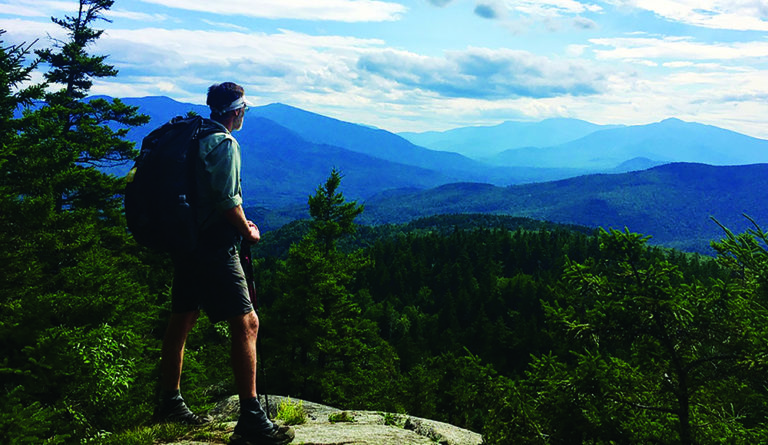
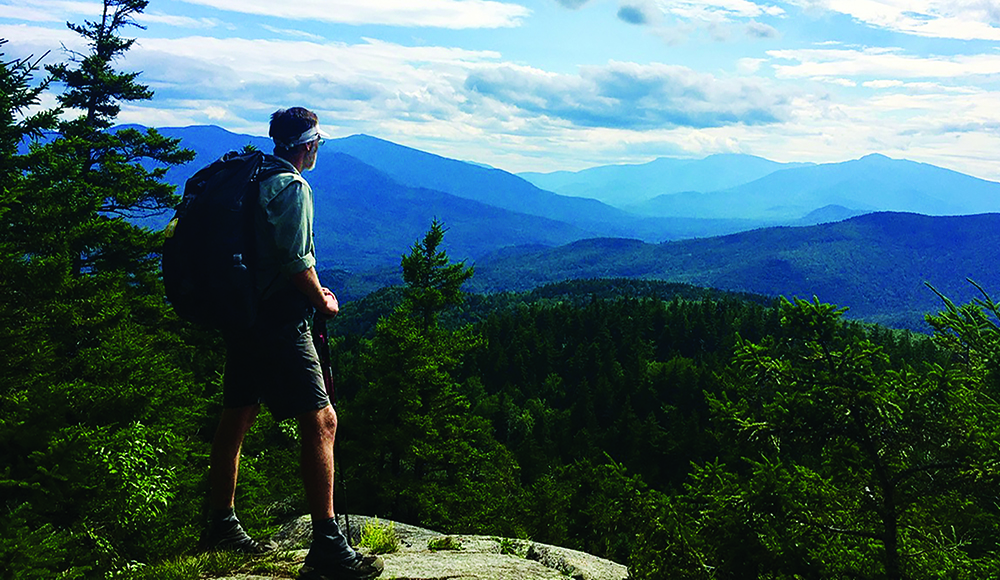
Late in the summer of 2025, Santa Cruz County’s native son, Jared Perry, had accomplished something only 700 people in the world had done. Jared had completed thru-hiking three of America’s most noteworthy and notorious trails, and by doing so, received the Triple Crown award.
The Triple Crown is the Heisman Trophy of thru-hikers, and the Stanley Cup of trail blazers. It means you walked, from start to finish, the Pacific Crest Trail (PCT), the Continental Divide Trail (CDT), and the Appalachian Trail (AT).
It’s not difficult to imagine that for most Americans, thinking about taking six months off, to walk from Mexico to Canada, is put into the category of: impossible. But for the wide array of people who do it, or attempt it, impossible is just another day on the trail.
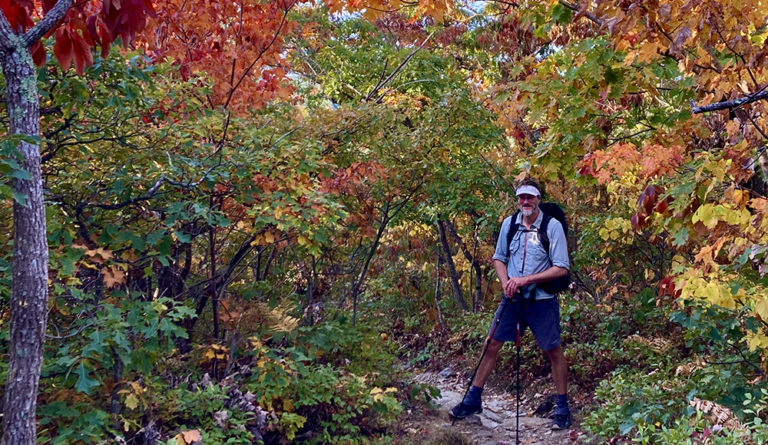
TRAILING Corralitos resident, and Triple Crown thru-hiker, Jared Perry in northern New Hampshire, on the Appalachian Trail in 2024 PHOTO: Coyote
MAVERICK
Jared Perry was born in San Jose, but don’t hold that against him. His father Mike, was a member of the Carpenters Local Union 405. In between working full-time, Mike began building a home for his family in Aptos, where they relocated when Jared was five years old.
By his own account, Jared was a hyperkinetic kid growing up who got involved in whatever he could find that involved motion.
“I played soccer, baseball, and football,” he says. ‘When I got to Aptos High School, my sport was skateboarding, which was not looked at as a sport back then. But now it’s in the Olympics.”
His easy laughter is something that makes others feel comfortable. The 41-year-old has a thoughtful, inviting, and kind disposition. But Jared’s easy-going nature camouflages his intense drive and passion. Often organizing large groups of friends for backpacking adventures and foraging in every shrubbery for potential edible greens, his life, when he has a choice, takes place outside.
“I was carried up Mt. Shasta as an infant. So I guess that qualifies as my first hike,” says Jared.
LODGE POLE
His father Mike’s branch of the Perry family has always embraced the outdoors with gusto, making it an important, essential part of one’s upbringing and experience. With an intergenerational family cabin deep in the woods of Northern California (laid waste in 2021 by the Dixie Fire), hiking, and being amongst the Red Fir and Mountain Hemlock, was as common as shared meals around the dining room table.
Mike Perry is a big guy, and has the body of a man who did physical labor his entire life. But, he also possesses an extremely clever mind that seeks out facts about the world, where he then begins cataloguing information, savoring on the details, and sussing out how to build it, find it or make it happen. What today is called rabbit-holing and homesteading
In 2012, just a few years into retirement, Mike was investigating online about the Pacific Crest Trail (PCT) and one thing that stood out was that the halfway point was at the family mountain cabin. “I’ve been hacking portions of the Pacific Crest Trail with my folks growing up, and my family. Jared and I were hiking a section of the PCT and he had mentioned that it would be nice to do some overnight backpacking and do a larger section. So that prompted me to get on the internet and see what was out there. I discovered a long distance hiking group. I initially thought that if I trained myself enough, I could do half of it,” says Mike who completed the entire PCT.
“His idea was, wouldn’t it be cool to start in Mexico at the border and hike all the way to the cabin? The more research he did about the trail, he found it was way more expansive than he thought. It went all the way to Canada,” Jared recalls.
Eventually, Mike asked Jared if he wanted to do this walk as a joint venture. A father and son bonding experience. An Amazing Race where the prize was companionship and adventure. And there were strong reasons to do it as a team, they reasoned. Number one was safety. They knew they wouldn’t be alone on the trail. There would be other people on the trail. A lot of other people, as it turns out.
TRAIL NAMES
Another aspect of this micro-culture is that when one is on the trail, one adopts, or is given, a trail name. Jared accepted the Triple Crown as Maverick, a name given to him when he played a season on the Santa Cruz Beach Boardwalk volleyball team. “I was afraid of getting a crappy name,” Jared admits.
Mike walked as Lodge Pole, a name given to him by his daughter.
“So that was Jessica. It wasn’t given to me by a hiker, which is traditional for the trail names. Jesse and I have done plenty of hiking, so I feel like it was appropriate. I was thinking of other names like Warner Valley or Chester. Jessica abruptly said, ‘No, it’s not going to be Chester,’ though, I still think that’s logical, because Chester is where the cabin was,” Mike laughs.
On the trail, you might meet people who go by the names of Shroomer, Jester, Huff and Puff, Weathercarrot, Big Stick, Ratatouille, Breezeway and Kismet.
SLOW BURN
Eric Rupp is another local trail enthusiast who began his first hike in 2023. At 63-years old, Rupp was fresh off a deep recent trauma. He had precious little backpacking experience. What he did have was a desire to do something that would push his personal boundaries. So he decided to walk 7,000 miles.
“A lot of people on the trail, when you talk to them, and you do get a chance to do that, they’re going through changes in their lives,” says Rupp. “The hike doesn’t represent a ‘period’ in their lives, it represents a ‘comma’. It was the same for me. I was leaving a marriage. A long-term marriage. I basically had an opportunity to run away and join the circus. So I took it.”
Rupp is a section hiker. Like many others who cannot take the time to do the entire six month walk, Rupp would hike parts of the trail at different times. In 2023, Rupp began the PCT in April. But by June, the higher altitudes of the Sierra Nevada mountain range became impassable.
“2023 was the biggest snow year since the Donner Party in the Sierras. That’s just the way it panned out, much to everyone’s shock and awe. And so what that meant for most mortal humans is that you’d hike from the Mexican border, through the desert, and up to the Sierras, which basically was Kennedy Meadows South,” Rupp recalls.
When Rupp started walking the trails, he would often get as far in one month, as younger hikers would get to in two weeks, which is when he received his trail name, Slow Burn. “I came back knowing things that I didn’t know about, and that changed my life,” Rupp says.
And there you have it. Besides the rigor and the internal fortitude of thru-walkers, there’s something less apparent and more transcendent happening on the trails of America. People are returning to peak physical movement, walking and snowshoeing through pristine nature, in order to heal what ails them. It’s an American Walkabout. John Muir and Henry David Thoreau’s ghosts are acting as sherpas and emotional midwives to those seeking completion of their soul on the trail.
MICRO WEENIES
You’ve decided that your goal is to join the 0.000175% of the population and earn your Triple Crown. Once you get a grasp on a general direction of where you will be walking for the next six months, and your physical and mental training is in motion, one of the biggest “to-do” items is to get your backpack to weigh as little as possible. That starts with obtaining ultralight gear and eliminating all ‘gram weenies’ as they are called within the tribe. “Removing tags off clothing, buttons that you don’t need on shirts, and if the zipper is not needed, it’s got to go,” says Jared.
The gremlins of long-distance hikers are the extra pounds of gear that you have on your back. Sleeping bag, snow shoes, poncho, thermals, and toiletries. It’s a much longer list. Each extra ounce can feel like a pound after just 10 miles. Jared would dry out his toothpaste and, using a carpenter’s razor blade, carve out thin slices for his travels. Mini green Chiclets for good dental hygiene, whilst in the middle of nowhere.
Slow Burn says: “My gear was bona fide ultra light. So my base weight was around 13 to 14 pounds. And then you add food and water. So, at the heaviest, it would be seven days of food, and that’s 14 more pounds. Now I’m up to 28lbs. Add 3 liters of water and now I’m up to 34lbs. But most of the time I’m hiking lighter than that. There’s no reason to carry more weight than you need.”
Jared says: “My pack ended up with the food and water being 45 lbs. Which is really heavy by today’s standards. So with all the work I had done, and all the diligence of dehydrating toothpaste, I still ended up carrying 45 lbs. And then I started shedding what I didn’t need and ended up at about 30 or 35 lbs.”
TRAIL ANGELS
There’s a large load of decisions and determinations to consider when doing a long thru-hike. And all of it is woven together with a tremendous amount of hope, and fingers crossed. One thing that keeps hikers supported, and in some instances alive, are the Trail Angels. At one point, an unorganized group of good Samaritans who would leave much-needed water at certain junctures, or catch thru-hikers when they made visits to towns, and welcome them in like the weary travelers they are.
For Maverick and Lodge Pole, those angels started back at home in Corralitos, where Mike’s wife, Cindy, and his daughter, Jessica, led a detailed, often comically dramatic routine of assembling much-needed care packages. The packages were sent ahead to strategic towns that the duo would eventually walk through.
COYOTE
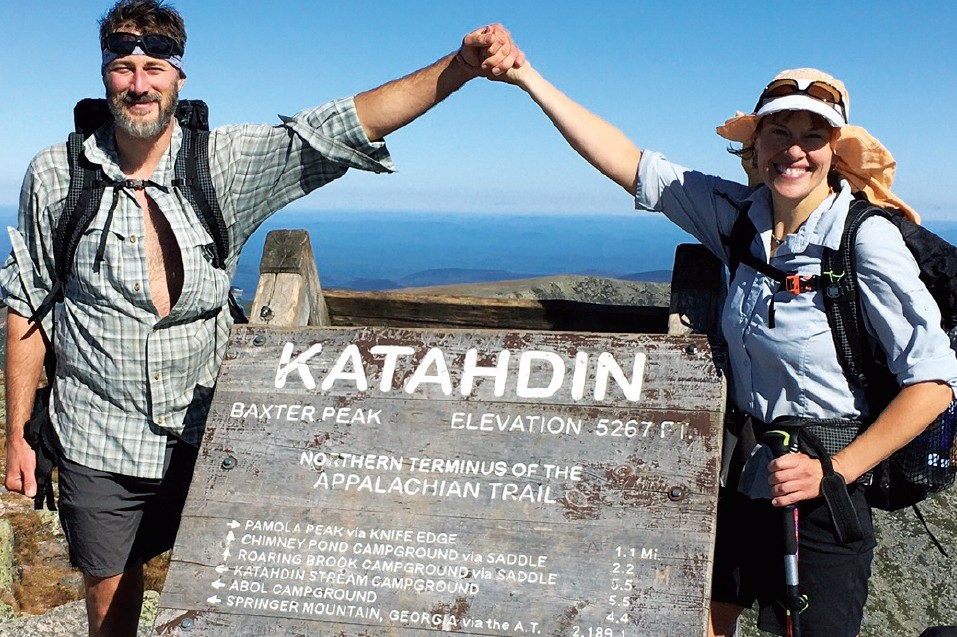
TOP OF MAINE Jared Perry and Coyote at the top of Mt Katahdin, the northern terminus of the Appalachian Trail and the highest point in Maine. PHOTO:Taken by a stranger with Jared’s phone.
Jared had heard of Coyote before they met. “I knew she was a legend,” he says gleefully. “I actually saw her during the early part of the Pacific Crest Trail. My dad and I stopped into a trail angel’s house to do laundry, and that night around a bonfire, I saw her. I recognized her from the movies,” says Jared.
Coyote is a celebrity amongst the in-the-know thru-hikers. Appearing in several documentaries about trail life, Coyote is a no-nonsense, adventuresome, experience-seeking, ball of energy with boundless inspiration. And while she seeks no acclaim, her written diary of life on the trail is exquisite.
“Because we’ve been walking south with fall, a beautiful carpet of autumn leaves covers the ground. This, too, slows us, because the crunchy leaves hide all the nooks and crevices between the rocks. But it sure makes for gorgeous days in the woods. Under the canopy, everything seems brighter – golden and glowing. The ‘green tunnel’ has become a golden tunnel. It’s pure enjoyment. From the ankles up,” Coyote wrote in October of 2024, somewhere in Pennsylvania.
In the long-distance hiking world, Coyote is known as a repeat offender. “So I had hiked the Appalachian Trail (AT) first in 2004,” Coyote recalls with ease. “The PCT in 2008, the CDT in 2012, and then another long-distance trail called the Pacific Northwest Trail in 2016, and that was right before I met Maverick at a hiker gathering. We sort of met each other and decided, ‘Oh, you’re really cool. But bye. I got to go. I signed a contract,” says Coyote with a wink.
While Coyote worked for a year in Antarctica, as a field coordinator for scientists, Jared was building homes in the Bay Area (and still pondering) his Triple Crown. The potential relationship had been back-burnered.
The two stayed in touch, and started dating in 2019. They found out about the Great North American Eclipse, a unique planetary experience best viewed in Maine in late 2023, and made a plan. “Why not tack on a six month walk to a five minute experience,” Coyote quips.
“We went to Maine to see the eclipse. But because it was April and May and we didn’t want to start in that kind of climate, we flew down to DC and got on the Appalachian Trail in the middle and hiked it in what we call a flip-flop. Which is in two parts. We went from basically the middle of the trail down to the southern terminus in Georgia. Then we flew up to Maine and we hiked South from the northern terminus down to the middle. And, that’s how we did it. We also knew this would qualify Maverick for the Triple Crown,” Coyote relates, obviously relishing the details.
FAMILY DUO
As much as Jared enjoyed hiking with his father, or the solitude of hiking solo, or even with new trail friends, when asked the best thing about doing the AT (and completing the Triple Crown) was, “To be able to hike it with my partner,” Jared replied.
“We already knew some of our capabilities. How far we could go, and what we could do together. We’ve been trail-tested as a couple. A lot of couples don’t hike together. We walk at the same pace. So, we get to walk together, and it’s comfortable. So many people don’t have the same pace, and if you’re off by a little bit, after 10 miles, you end up really far apart from each other.
“By comfortably hiking at the same pace, we got to point things out to each other. And I think my most memorable time on the trail was walking south through the fall, the color change in New England. We had a whole month of walking through a rainbow forest with crunchy leaves underneath our feet.”
On the trail, self-realizations abound, relationships with others are strengthened, bonds are forged, some find love, and some look for Bigfoot.
SQUATCH
Scott Herriott, trail name Squatch, loves making documentaries about thru-trail hikers, as well as the elusive search for the long-rumored Sasquatch. His film The Flip Flop Flipping Trilogy, about the AT, and Still Walking, about the PCT, are perfectly captured moments in linear space, of perhaps the most American tradition of all time, walking in nature. Of course, he also made Asquatchalypse Now ( a documentary about. . .you know) and Unverified (his first feature available on Amazon Prime).
“I’ve done both the AT and the PCT,” Herriott begins. He talks fast, his mind divergently landing on several topics at once.
“I’m at best a mediocre hiker. I’m basically a section hiker. I completed those trails in chunks. I met Coyote in ’08 when I was doing my fourth and final film about the PCT. She was part of Team Bad Wizard. Shane ‘Jester’ O’Donnell was also making a film that year of his thru hike (Wizards of the PCT). I was doing the remaining 1,400 miles that I needed to do to complete the PCT. And Coyote ended up being in both of our films,” Herriott says.
There must be some sort of energy that flows through the primal forests, mountains and landscapes across America. Because certain hikers seem to symbiotically harness a different mode of energy that breaks them apart and brings them together again, like waves upon the shore.
INJURIES
Through all the tales of healing, and wonderment and magic – walking 8,000 miles, in snowstorms, deserts, lightning strikes and flash flooding doesn’t happen without some missteps and hopefully, narrowly averted tragedies.
Jared began the idea of thru-hiking with one singular thought, “I wanted to avoid a serious injury. I knew I would push through it, but when I actually did get an injury, it was a lot harder to push through than I had thought. But it was really rewarding,” he says.
Taking a three-year break after completing the PCT, Mike, then 61, and Jared, 30, were planning to conquer the CDT. They started together in 2016, but only Jared completed the trip.
At one point on the CDT, close to the border of Colorado, in a privy in lower Lagunitas Campground, Jared and Mike, now fully in Maverick and Lodge Pole mode, found a lost camper who had died of exposure and starvation. Stephen “Otter” Olshansky had gone missing months before and ended up barricaded in a campground bathroom, until the end.
It wasn’t a sign, or a potent omen, but something unplanned for was just up ahead.
Mike says: “So on the CDT I made about one-third. I had done about 1,000 miles of a 3,000 mile trail. The higher elevation was messing with some medication that I was on. I felt sick. But more so, I felt homesick. I missed my wife’s retirement party. On the CDT it’s hard to get phone reception and my body was falling apart. I lost 25 pounds. I just wanted to get home to my wife.”
Jared completed the final 2000 miles, solo.
END OF THE TRAIL
It has been said that walking the trail warps time. You wake up, pack up your camp’s debris and detritus, and start walking, again. You’re Bill Murray in Groundhog Day. Besides breaks to pee, or for taking a breather, or to catch an eye-popping vista, you’re constantly in motion. Everything you see is fresh and novel. You hear new sounds like Mormon Crickets and dippers, wrens, finches and warblers. Time begins to stretch out. Six months on the trail, they say, begins to feel like years. You begin to feel like you are really milking the most you can get out of life. You feel robust and healthy. Tomorrow you’ll walk another 12 hours.
The trickster, Coyote, has other thoughts. “The trail warps time? Initially, that was also my feeling, in the beginning, when I started thru-hiking. But I feel like the so-called ‘real world’ is what has warped our perception of time. The trail is actually you tapping into something that is more real, more natural, more in circadian rhythm, more biological, and more intrinsic to us as human beings,” Coyote laughs before walking off to her newest adventure.
This summer, Maverick and Coyote and Squatch are going to walk Patagonia.
It starts on Bay Avenue, goes along West Cliff Drive and makes a keyhole loop before returning to the Mark Abbott Memorial Lighthouse. Of course, we’re talking about the 16th annual She Is Beautiful 5K/10K Run, which cruises into Santa Cruz on Saturday, May 9.
With the race just a few months away, spring is already in the air for runners, walkers, joggers and stroller pushers, as four more trainings and meetups precede the race day: Wednesday, January 21st 7 pm at Fleet Feet Aptos; Saturday, February 21, 8 am at Fleet Feet Monterey; Saturday, March 7, 8 am at REI in Berkeley; and Sunday, April 19, 8 am at Verve Coffee, Seabright location. No registration is needed, just show up.
She Is Beautiful has evolved from 500 people in 2011 to 6,000 in 2025, and added a second race in Santa Barbara. She is Beautiful was founded and is directed by sisters Melissa McConville and Sara Marie Tanza with a mission “to get people moving forward physically, emotionally and spiritually.”
The Jan. 21 session includes a presentation by the Hoka shoe company and a run. “We welcome every level,” McConville added. “We normally plan a route, always routes that are easy, safe. You are not required to stay in a pace group.”
Anyone who registers for the race is invited to attend a free, 90-minute yoga session March 29 in the Warriors stadium. This year will be a candlelit flow led by Hannah Muse.
“We want it to be more than just a race,” said McConville. “We want it to really feel like a community space where people can show up wherever they are. We welcome strollers.”
Both races finish at the lighthouse, which is also the site of a post-race festival. The 10K extends up into Natural Bridges, “which is so beautiful,” McConville says.
She is Beautiful is in a partnership with the Walnut Avenue Women and Family Center, a public benefit organization dedicated to improving quality of life for women, children and families. SIB has donated over $200,000 to the center. Registration to SIB is now open and includes access to all pre-event race activities, a cute race T-shirt or tank top, access to the post-race festival and free race photos. Register for She is Beautiful at runsheisbeautiful.com
When people think of a gym, they often picture muscle-bound bodybuilders lifting stacks of weights, waiting for that one popular machine, or rooms jammed with treadmills and stationary bikes… but there are plenty of other options in Santa Cruz.
Providing a bridge between a traditional gym and alternative health care, spaces like Santa Cruz Core Fitness and Rehab and Athletic Club Santa Cruz blend fitness, medical and day spa all under one roof. This is a new and vital trend, as folks are discovering treatments usually reserved for a medical clinic, such as regenerative Platelet-rich Plasma (PRP), stem cell therapy and mental health therapy, in the same spaces as weight training, yoga and health coaching.
As January arrived and New Year’s resolutions abounded, I resolved to add something new to my fitness routine, which until now, was primarily yoga and walking on the beach. I started my New Year’s wellness journey with a consultation downtown at Santa Cruz Core Fitness & Rehab. With both one-on-one private and semi-private classes, the first thing I noticed at the downtown wellness center is no crowds, just a handful of private clients, each engaged in a different modality. While one person was working with weights in the downstairs studio, another was getting a sports massage, and a third was getting acupuncture in a private room.
For more than 17 years, owner Jami Jansen has led a dedicated team helping patients to reduce pain, restore mobility and improve overall health.
For Jansen, the path to wellness started with a bike accident many years ago when she was hit by a car while biking at UCSC, suffering a ruptured disc and traumatic brain injury. After the injury, she learned first-hand how professional treatment sought early can make a big difference in outcomes and reduce the risk of serious health issues down the line.
“We started as a preventative treatment center, and now we are doing pre- and post-operative work,” she says. “Instead of going to medical school, I hired experts to help. We take a holistic approach to health and wellness, whether someone is rehabbing from an injury or training for the Olympics.”
My consultation included in-body analysis, which calculates a basal metabolic weight, considered more accurate than a Body Mass Index (BMI). Jansen asked about my health goals, past injuries and trouble areas. I explained that I had degenerative rotator cuff pain and recurring knee pain.
Armed with results of my posture and movement assessment, the fun part begins: selecting both traditional and alternative treatments to address my chronic pain, osteoarthritis and injury recovery. Following are some of the treatments I tried or may try in the future.
Red Light therapy is a way to reduce fine lines and boost cellular regeneration. It is FDA-cleared and proven to stimulate collagen production, which can lead to faster wound healing and improve skin’s elasticity. It also claims to boost energy, improve blood flow and calm inflammation, says Janson.
As for reducing fine lines, I did notice an immediate improvement and overall brighter complexion after only 20 minutes under the Red Vive 300 light panel. Treatments start at $25 and include a workout session on a Vasper bike.
Unlike UVA light, Red Light Therapy is not damaging to the skin and can treat many conditions, including acne, wrinkles, hair loss, and joint and muscle pain. It is also “good for eyes, skin and gum disease,” saysCamille Perriat, co-owner of Athletic Club Santa Cruz with husband Chris Ellis.
ACSC offers a full-spectrum red light bed and the RedRoom + heated studio classes. Walking into the club’s Recovery Lounge, visitors can access both private or small group spaces, dry stone sauna and cold plunges.
“We have the biostacking fiber acoustic lounge with a red light canopy for those beneficial rays,” Perriat says. The facility also has two hard-shell hyperbaric oxygen chambers.
For an extra chill, the Snow Shower at ACSC blasts chilled, “really cold water” from above which lasts about 30 seconds.
The workout. At Core Fitness, there is onlyone bike. The Vasper (vascular performance) is a seated elliptical with three modalities: cooling, compression and grounding. The cooling and compression work with the goal of pushing muscles to failure and creating lactic acid, which creates human growth hormone (HGH). Riding a Vasper involves pedaling on copper plates to create grounding and draw out impurities. Twenty-one minutes on the Vasper is purported to produce hormone recovery benefits equivalent to a 2-hour workout, Jansen said.
After the initial assessment, Santa Cruz Core personal trainer Guy Ferreira walked me through an exercise regimen to address my osteoarthritis and leg syndrome. Ferreira says he trains about 12 people weekly. He designed a fun program using lacrosse balls to loosen quads and hip resistance bands, small hand weights and a dome-shaped Bosu Ball.
ACSC offers a full gym floor with premium equipment and includes kick boxing, yoga and circuit training in its heated Red Room. Perriat says: “Yoga has a much different feel, heated with infrared heat and humidity.”
“The Soft Tissue Lounge with Normatec compression is great for lymphatic drainage,” Perriat added. “It feels like you’re getting an amazing foot massage.”
Among the workout options are Keiser pneumatic resistance machines for smooth, joint-friendly training, and five stations to work out muscle soreness. “All of our members have access to this. It’s used constantly … and “great for muscle soreness and tissue release.” Personal trainers are available for biomechanical consultations and metabolic testing to optimize cardio output.
Acupuncture adventure
I showed up at Santa Cruz Core eager for my first-ever acupuncture treatment, albeit a bit nervous. As a form of Traditional Chinese Medicine, acupuncture purports to relieve acute tissue damage by identifying markers which send out signals for help. As the immune system kicks in and nerve signals are processed, the patient receives hormonal regulation.
Acupuncturist Amberlee Gustafson calmed my qualms right away. The single-use needles are tiny .14 to .25 mm, and often undetectable. A board-certified Doctor of Traditional Chinese Medicine with more than 3,000 hours of clinical training at Five Branches University, Gustafson focused treatment on chronic muscle pain areas, such as wrist flexion, the aforementioned shoulder, and a knee and hip diagnosed with Patello-femoral Temporal Pain Syndrome. I didn’t notice any significant improvement after one session, so I booked five more sessions. After my third treatment, my shoulder pain had cleared considerably and range of motion improved.
Sports Chiro-therapy
Chiropractic medicine is widely-known for spine decompression, but there is so much more to this approach to spine and musculoskeletal disorders. Dr. Rhodes Walton is a sports chiropractor who uses assessment-based tools to pinpoint pain and create an intense but effective means to release soft tissue known as Sports Chiro-therapy at Santa Cruz Core Fitness. Each program is informed by the individual’s body movement.
Adjustment and soft tissue release is the majority tool of sports chiro-therapy, along with corrective exercise, Walton explained. “The treatment is influenced by how your body moves,” Walton said. “I wanted to get a more dynamic approach to help with soft tissue function. Adjustment is part of the protocol.” I felt a little sore after this treatment and I didn’t feel any different.
Corrective Exercise & Rehab Beau Jansen is an advanced elite personal trainer and fitness director at Santa Cruz Core, trained in Hanson Muscle Therapy method, a trigger point therapy informed by how your body moves. “It’s like acupressure mixed with a little art and moves along the meridian lines,” he said. A mix of active release therapy and physical therapy, HMT emphasizes the parasympathetic nervous system for a balance of rest and digest to achieve optimal benefits.
Two massage therapists are on hand at Athletic Club Santa Cruz, offering a variety of massages, including deep tissue, relaxation and therapeutic massage.
From Medical Aesthetics to Mental Health
State-of-the-art health therapies co-exist with physical fitness at both facilities. Santa Cruz Core offers Xeomin injection, prolotherapy, rejuvenative Platelet-rich Plasma (PRP) “super healthy for injury prevention” Jami says, and stem cell therapy for bone repair, cartilage and ligaments. Injection of PRP helps create blood flow and bring blood to non-vascular tissues, she said.
Santa Cruz Core accepts most major health insurance. They also offer wellness treatment for various disorders such as anxiety, depression and addiction recovery as well as Ketamine therapy.
ACSC offers medical procedures as well, including full blood work, hormone therapy, peptide therapy, vitamin shots and B12.
Another local option, Dr. John Grady’s Harbor Health Center, provides a full line of weight loss, aesthetic and rejuvenative services including weight loss peptides, microneedling and PRP injections. I tried the facial micro-needling treatment with PRP, also known as the “vampire facial” because it harvests your own stem cells drawn from your own blood. I don’t want to use any artificial fillers or ingredients. This process speeds healing from the microneedle injuries and reduces recovery time from about 5 days to 1 or 2 days. I am making this one a regular part of my wellness routine.
Santa Cruz Core Fitness & Rehabilitation, S315 Potrero St., Ste. C Santa Cruz 831-425-9500
Harbor Health Center, 4450 Capitola Rd., 831-278-8800
Athletic Club at Santa Cruz, 901 Soquel Ave., 831-425-4653
Poisonous death cap mushrooms have sickened people in Santa Cruz and Monterey counties, according to a statewide list of areas reporting severe illnesses.
A group of California doctors warned Wednesday that foraging for wild mushrooms can be deadly, after an unusually high number of people have been sickened by the deadly fungus.
Poisoning from death caps, whose scientific name is Amanita phalloides, is marked by delayed gastrointestinal symptoms, including nausea, vomiting, diarrhea and abdominal pain, according to Dr. Craig Smollin, a professor of emergency medicine at UC San Francisco Medical Center.
Those symptoms can be followed by progressive liver injury that in some cases advances to liver failure and death, he said.
Smollin said a typical year might bring as many as five death cap poisonings, but 35 cases have been reported statewide since Nov. 18. The most recent was reported Jan. 4. Patients have ranged in age from 19 months to 67 years old.
Medical treatment has been provided in Alameda, Contra Costa, Monterey, San Francisco, San Luis Obispo, San Mateo, Santa Clara, Santa Cruz and Sonoma counties, Smollin said.
Mushrooms linked to the cases were foraged from multiple locations, including Castroville, Millbrae, Novato, the Oakland Hills, Pinnacles National Park, Santa Cruz, Santa Rosa, the Salinas area and the Stinson Beach area, he said.
All of the patients either gathered the mushrooms themselves or ate mushrooms foraged by family members or others in their group, Smollin said. None of the cases was linked to mushrooms purchased from stores, restaurants, farmers’ markets or other vendors.
During the outbreak, three adults have died and three patients have received liver transplants, Smollin said. As of Wednesday, one patient remained hospitalized.
“There is no amount of Amanita phalloides that would be considered safe,” Smollin said, adding that even a single bite can cause significant toxicity. He warned there is no way to neutralize the toxin through cooking or freezing.
Smollin said California’s last major outbreak occurred in 2016, when 14 cases were reported — fewer than half the current total. He said mycologists have reported a large number of death caps fruiting in the region, making them easier to find and increasing the risk for accidental poisoning.
Dr. Rita Nguyen, assistant state public health officer at the California Department of Public Health, said the cases have involved people who speak a range of languages, including Spanish, Chinese, Mandarin, English and Mixteco, highlighting the need for broad public outreach.
While the Bay Area is an ideal environment for death caps, Nguyen said they have also been found as far south as Los Angeles and possibly into the San Diego area, as well as north into Oregon, Washington and Canada.
Health officials urged people to avoid eating wild mushrooms unless they have been identified by an expert, and said death caps are expected to continue fruiting.
Thousands of people assembled in downtown Santa Cruz Monday for the annual “People’s March for the Dream”, an event held to celebrate Martin Luther King Jr. Day.
The crowd included representatives from religious organizations and nonprofits, elected leaders and individuals holding handmade signs and other artistic expressions of King’s message.
“He wanted everyone to get along and to be free,” said Jack Langley, 10, of Aptos, who attended with his parents and his 6-year-old sister.
Jack held a poster with King’s photo and a handwritten message reading, “We still have a dream.”
Ashten Gomez, 11, said she attended in support of Second Harvest Food Bank, an organization she has volunteered with in the past and which she said fits the spirit of the day.
“Second Harvest is about feeding the homeless,” Ashten said. “It helps us feed homeless people and people who are in need of help.”
Olivia Millard, founder and group lead of Indivisible Pajaro Valley, said her organization’s presence at the event was meant to underscore the current political climate.
“As we are seeing increasingly clearly, this administration has no compunction and does not hold back when it comes to trying to intimidate and oppress people who are not straight white men,” Millard said. “So all of us who are on the receiving end of their cruelty need to work together to overcome, because the power lies with the people, and the more all of us who recognize the inhumanity and cruelty of this administration, the more all of us can come together and demonstrate our solidarity.”
Elaine Johnson, president of the Santa Cruz branch of the NAACP, said celebrating King and the issues for which he fought remains essential.
“In this political climate, now more than ever, we have to come together and make sure that we don’t go backwards,” Johnson said. “The current administration is trying to strip us of our dignity, our basic human rights, and we cannot allow that to happen.”
Mary Reynolds is part of Santa Cruz Welcoming Network, a grassroots group formed to help immigrants — particularly asylum seekers — with basics such as food, clothing, shelter, medical care, schooling and immigration services.
The group is currently helping about 30 families.
“People of color are on the United States government’s agenda, and I don’t go along with that at all,” Reynolds said. “Thank God, Santa Cruz is remaining somewhat liberal, and I want to keep that going.”
Santa Cruz County Superintendent of Schools Faris Sabbah said King’s message “is more relevant today than ever.”
“When I think about so many vulnerable communities, when I think about his sacrifice and his work, and I think about immigrant communities, LGBTQ+ communities that are under attack by the current administration, I think his message reminds us that we need to continue to stand up for the rights of those who are most vulnerable,” Sabbah said.
The event in Santa Cruz was shadowed by the cancellation in Marina of that city’s annual Martin Luther King Jr. Day march after police on Sunday shot and killed a Black man during a traffic stop.
The man, who was not identified, was pronounced dead at the scene in the Marina Heights area near Bluff Drive.
Police found a firearm during the incident, Marina officials said in a news release.
The Monterey County District Attorney’s Office is conducting the investigation.
The involved officers were not injured and were placed on administrative leave, which is standard practice, according to the release.
“From a human standpoint, our thoughts are with everyone impacted by this tragic incident,” the release said. “We recognize the seriousness of the incident and remain committed to transparency while also protecting the integrity of the investigation.”
Marina officials did not release additional details and referred questions to the district attorney’s office.
A DREAM Marchers bring their messages of justice, rejecting hate and honoring Martin Luther King along Locust Street. Photo: Tarmo Hannula
King March Fills Downtown
Keeping the dream alive
By Todd Guild
Thousands of people assembled in downtown Santa Cruz Monday for the annual “People’s March for the Dream”, an event held to celebrate Martin Luther King Jr. Day.
The crowd included representatives from religious organizations and nonprofits, elected leaders and individuals holding handmade signs and other artistic expressions of King’s message.
“He wanted everyone to get along and to be free,” said Jack Langley, 10, of Aptos, who attended with his parents and his 6-year-old sister.
Jack held a poster with King’s photo and a handwritten message reading, “We still have a dream.”
Ashten Gomez, 11, said she attended in support of Second Harvest Food Bank, an organization she has volunteered with in the past and which she said fits the spirit of the day.
“Second Harvest is about feeding the homeless,” Ashten said. “It helps us feed homeless people and people who are in need of help.”
Olivia Millard, founder and group lead of Indivisible Pajaro Valley, said her organization’s presence at the event was meant to underscore the current political climate.
“As we are seeing increasingly clearly, this administration has no compunction and does not hold back when it comes to trying to intimidate and oppress people who are not straight white men,” Millard said. “So all of us who are on the receiving end of their cruelty need to work together to overcome, because the power lies with the people, and the more all of us who recognize the inhumanity and cruelty of this administration, the more all of us can come together and demonstrate our solidarity.”
Elaine Johnson, president of the Santa Cruz branch of the American Civil Liberties Union, said celebrating King and the issues for which he fought remains essential.
“In this political climate, now more than ever, we have to come together and make sure that we don’t go backwards,” Johnson said. “The current administration is trying to strip us of our dignity, our basic human rights, and we cannot allow that to happen.”
Mary Reynolds is part of Santa Cruz Welcoming Network, a grassroots group formed to help immigrants — particularly asylum seekers — with basics such as food, clothing, shelter, medical care, schooling and immigration services.
The group is currently helping about 30 families.
“People of color are on the United States government’s agenda, and I don’t go along with that at all,” Reynolds said. “Thank God, Santa Cruz is remaining somewhat liberal, and I want to keep that going.”
Santa Cruz County Superintendent of Schools Faris Sabbah said King’s message “is more relevant today than ever.”
“When I think about so many vulnerable communities, when I think about his sacrifice and his work, and I think about immigrant communities, LGBTQ+ communities that are under attack by the current administration, I think his message reminds us that we need to continue to stand up for the rights of those who are most vulnerable,” Sabbah said.
The event in Santa Cruz was shadowed by the cancellation in Marina of that city’s annual Martin Luther King Jr. Day march after police on Sunday shot and killed a Black man during a traffic stop.
The man, who was not identified, was pronounced dead at the scene in the Marina Heights area near Bluff Drive.
Police found a firearm during the incident, Marina officials said in a news release.
The Monterey County District Attorney’s Office is conducting the investigation.
The involved officers were not injured and were placed on administrative leave, which is standard practice, according to the release.
“From a human standpoint, our thoughts are with everyone impacted by this tragic incident,” the release said. “We recognize the seriousness of the incident and remain committed to transparency while also protecting the integrity of the investigation.”
Marina officials did not release additional details and referred questions to the district attorney’s office.
At least one person was detained in Watsonville on Sunday morning by armed men who appeared to be U.S. Immigration and Customs Enforcement (ICE) agents, according to community members who posted video on social media.
The video appeared to show an unidentified man being handcuffed by a person wearing a jacket labeled “Police” and “ICE.”
It was not clear Sunday night where the man was taken or whether he was still in custody.
Watsonville police did not respond requests for comment.
“We’re reminding people about their constitutional rights not to open the door, to remain silent and not to share any additional information with law enforcement,” Moreno said.
The group, known as YARR, has about 200 members. Its website says its mission is “to use our bodies, tactics and resources to document, resist and prevent actions by ICE or other oppressive forces that would harm our fellow human beings.”
Santa Cruz County Supervisor Felipe Hernandez, whose district includes portions of Watsonville, said he went to the area where the detention took place—a small alley between Martinelli’s and Catz Paws across from the Henry J. Mello Center on East Beach Street—but the agents had already left.
“Our community does not welcome enforcement actions that intimidate families or target non-violent residents, and if ICE operates here, it should be limited to individuals who pose a real threat to public safety,” Hernandez said. “Everyone, regardless of status, has rights, including the right to remain silent and to request a judge-signed warrant.”
Moreno said volunteers were unable to locate the vehicles.
“Some people say the only way you really train for a thru-hike is you get out there and do it,” hiker, Slow Burn.
Late in the summer of 2025, Santa Cruz County's native son, Jared Perry, had accomplished something only 700 people in the world had done. Jared had completed thru-hiking three of America’s most noteworthy and notorious trails, and...
Poisonous death cap mushrooms have sickened people in Santa Cruz and Monterey counties, according to a statewide list of areas reporting severe illnesses.
A group of California doctors warned Wednesday that foraging for wild mushrooms can be deadly, after an unusually high number of people have been sickened by the deadly fungus.
Poisoning from death caps, whose scientific name is Amanita...
Thousands of people assembled in downtown Santa Cruz Monday for the annual “People’s March for the Dream”, an event held to celebrate Martin Luther King Jr. Day.
The crowd included representatives from religious organizations and nonprofits, elected leaders and individuals holding handmade signs and other artistic expressions of King’s message.
“He wanted everyone to get along and to be free,” said...
At least one person was detained in Watsonville on Sunday morning by armed men who appeared to be U.S. Immigration and Customs Enforcement (ICE) agents, according to community members who posted video on social media.
The video appeared to show an unidentified man being handcuffed by a person wearing a jacket labeled “Police” and “ICE.”
It was not clear Sunday night...