Bill O’Reilly calls him “the master of nailing.” Barbra Streisand is more succinct—“You’re a son of a bitch,” she purrs.
So it’s hard to imagine someone less likely to be caught selling peanut butter in TV commercials than Mike Wallace. The intrepid TV journalist and co-host of 60 Minutes is best known for dogged, on-air interviews that struck terror into the hearts of his subjects. But Kinescope flashbacks of the youthful Wallace pitching the sponsor’s products are among the more surprising moments in Avi Belkin’s documentary Mike Wallace Is Here.
Belkin cobbles together this backstory about a footloose youth who finds himself entranced by the new mid-century medium of television. Footage of Wallace and TV growing up together as he eventually pioneers the art and craft of the live televised interview have historical and pop-cultural value, as do the many excerpts from his decades of interviewing the rich and infamous: Salvador Dali, Frank Lloyd Wright, Bette Davis, Ayatollah Khomeni, Vladimir Putin, and a puffy, young Donald Trump.
But for all the vagaries in Wallace’s career, and the variety of his interview subjects, the movie never establishes its own viewpoint. It remains a random collection of clips, many fascinating in their own right, that are never quite shaped into a larger picture or more cohesive theme. I wish Belkin had dug a little deeper to get the full story.
Hailing from Brookline, Massachusetts, and so badly acne-scarred in his teens that he figured he had “a great face for radio,” Wallace started out in that medium as a staff announcer and pitchman. But with the advent of television, he switched allegiance; he sold everything from soap to cigarettes to cosmetics on the air, hosted game shows, and was routinely thrust into minor acting roles (as documented in a treasure trove of those vintage Kinescopes).
In 1956, he came up with the idea for Night Beat, a late-night interview show featuring subjects like the Grand Wizard of the Ku Klux Klan (fulminating in his full pointy-headed satin Klan robes), gangster Mickey Cohen, and Rod Serling. This eventually morphed into The Mike Wallace Interview, a program that engendered so many libel lawsuits the network finally had to shut it down.
But while the show was dead, it gave birth to a new TV icon in allowing its host to “become” Mike Wallace. Although he went briefly back to pitching Revlon lipstick, he decided he wanted to be a serious reporter, traveling the world in search of stories, until he landed at CBS—in the august company of Walter Cronkite, Eric Severeid and Edward R. Murrow. After a few years at the network, Wallace and producer Don Hewitt co-created the concept of TV news magazine 60 Minutes, which debuted in 1968.
Concerned that he didn’t have the same hard news credentials as his new colleagues, Wallace was determined to ask the hard questions instead. We see tantalizing bits of Wallace coaxing an eyewitness account of the My Lai massacre from a Vietnam soldier, making cold-fish John Erlichman visibly sweat, and sparring with Richard Nixon and Manuel Noriega in between showbiz celebs like Johnny Carson and Shirley MacLaine.
Meanwhile, attempts by 60 Minutes cohort Morley Safer and others to interview Wallace himself are largely futile, as he rebuffs questions he doesn’t like—“Why would you ask me that?” “That’s a stupid question”— or simply does not respond.
Belkin never really discovers the man behind the public persona. Nor does he find (in what must have been hundreds of hours of footage) any particular “aha!” moment with an interview subject that would cap Wallace’s legacy.
But his take on the evolution of modern journalism fascinates. Oriana Fallaci tells Wallace she’s not a reporter but a historian, as “a journalist who writes history as it happens.” And a montage of news-bashing from Spiro Agnew to Trump reminds us to never, ever take for granted the privilege of a free press.
MIKE WALLACE IS HERE
**1/2 (out of four)
With Mike Wallace and Morley Safer. A film by Avi Belkin. A Magnolia release. Rated PG-13. 90 minutes.
In the gorgeous Aptos dining room of Persephone, Chef Cori Gouge-Ayer will prepare a multi-course meal to pair with five distinctive bottlings from Windy Oaks Estates at an Aug. 22 winemaker dinner.
Those new to the concept owe themselves a chance to sample a series of wines from the steady hand of winemaker Jim Schultze, which will be coupled with foods especially created to harmonize with selected varietals. The sequence of flavors and often-spectacular tuning of sensory ideas that join the recipes and the wines make for a delicious learning experience. Those who are veterans—and fans—of the winemaker dinner format won’t want to miss this one. Here’s why.
Dinner begins with Watermelon Gazpacho paired with a Windy Oaks Bastide La Combe 2017 Rosé, before continuing on with a linguine created of tender abalone, pancetta and smoked paprika. With this course, Jim Schultze will pour the 2016 Estate Chardonnay. Then comes a duck confit with candy cap mushrooms joined by Windy Oaks’ “Diane’s Block” Estate Pinot Noir 2017. (I can practically taste that duck/Pinot combination right now.)
The second entrée is a pork loin roulade stuffed with rosemary-roasted figs and served with caramelized onion-fennel farro and balsamic glaze. This tour de force will be paired with a special release barrel-fermented Estate Pinot Noir 2016. Dessert of a floating island with saffron meringue and pomegranate creme Anglaise comes with a festive Windy Oaks Sparkling Albariño 2015. That’s an adventurous tasting journey starting at 6 p.m., priced at $150 per person, all inclusive.
The chef is a Santa Cruz native who, along with her sommelier brother Alex Potter, orchestrates the restaurant’s winemaker dinner series. Windy Oaks wines are well known locally and nationally, and proprietors Jim and Judy Schultze are savvy participants in these customized events. “Jim and I both feel that winemaker dinners provide the opportunity for the general public to meet the winemaker in an intimate setting,” says Judy Schultze. They can also “show how the right wine paired with the right food enhances both.”
In putting this event together, Gouge-Ayer and Potter bring team members for a trip to the vineyard to taste the wines, tour the operation and get to know the winemakers. “This is our second dinner with Windy Oaks,” says Potter, “and we have a great working relationship, as well as an excellent understanding of their wine and winemaking philosophy.”
Potter explains that in putting together these labor-intensive events, “We like to taste through most of a winery’s offerings and then narrow it down to five choices. We keep in mind that we want to put together a comprehensive meal with a certain flow and progression for our guests to follow. Once we have decided which wines to use, we will often re-taste the wines the next day and discuss more ideas for dishes we think will accentuate the qualities of the wine we have decided to highlight. From there, it usually takes another week or so of ironing out details and checking to make sure we can locally source the ingredients we need.”
Potter says that what’s available locally, and seasonally, “has a huge influence on each menu. Often during our process, someone will have an idea for a dish we all think would be a great pairing, but a key ingredient is not in season or is unavailable locally.” The farmers market also supplies plenty of food for inspiration for the chef and sommelier. An ambitious multi-course menu paired with wines from one of our very top winemaking estates—plus the presence of the winemaker—make this dinner one not to be missed.
Jamaican reggae artist Protoje was destined to be a reggae star.
His mother Lorna Bennett topped the Jamaican charts twice in the early ’70s; her biggest hit was the chilled out “Breakfast in Bed.” Protoje’s father was a calypso star in Saint Vincent.
Fast forward to 2005, when their son—the appropriately named Protoje—entered the world of reggae with one foot in the classic roots tradition, and the other in the more contemporary dancehall sound. He’s got several albums and hit singles under his name, but what’s most important is the infectious shows he puts on.
9 p.m. Tuesday, Aug. 27, Catalyst, 1011 Pacific Ave., Santa Cruz. $20. Information: catalystclub.com.
WANT TO GO?
Go to santacruz.com/giveaways before 11 a.m. on Thursday, Aug. 22, to find out how you could win a pair of tickets to the show.
Last year, Keshav Kumar was a junior policy analyst at the Santa Cruz County Business Council researching city issues and scouring California news outlets for topics affecting the state’s communities.
Kumar spotted a troubling trend. A spate of legal challenges were cropping up against local governments over their election systems. The threats took aim at cities with at-large elections, in which voters may support multiple candidates on their ballots in local city council races.
The plaintiffs behind these notices of violation were claiming that such elections diluted the votes of Latino voters and reduced Latino representation, in violation of the California Voting Rights Act. Law firms were challenging cities to implement district elections, which means dividing up a city into geographical voting blocks with one city councilmember per district.
Kumar quickly realized that no city had ever prevailed in a legal challenge under the California Voting Rights Act—and when cities fight the lawsuits, instead of settling, they can end up paying fees totaling more than $30,000. Dozens of California cities, including Watsonville, have made the switch either as a result of legal action or under the threat of it.
That’s why Kumar applied to jointhe Charter Amendment Committee, which the Santa Cruz City Council established last year to look at possible changes to the city’s election set-up. One idea for the committee to study: switching to election districts.
The Charter Amendment Committee, which had just two meetings, has now essentially landed in government purgatory. The council never officially killed the committee, but the group hasn’t met since November of last year, before Santa Cruz’s new city councilmembers took office. Now, a Santa Barbara-based law firm has hit the city of Santa Cruz with a notice of violation over its at-large elections, alleging that they haven’t adequately represented the town’s Latino community, which makes up 20.6% of the population.
The threat leaves Santa Cruz with a potentially difficult decision. The already fiscally strained city can settle, pay the fee and decide on a plan to implement district elections. Or it can get ready to go to court—which could result in a lengthy, expensive legal battle—and attempt to be the first city to win such a case. If Santa Cruz were to lose, a judge could demand that Santa Cruz make whatever electoral changes he or she chooses.
“I feel like the boy who cried wolf, except that, every time, I really did see a wolf,” says Kumar, who now works as the public affairs coordinator for the California Apartment Association. “And now other people are seeing the wolf, too.”
City Attorney Tony Condotti’s office won’t comment on the pending legal matter. As of press time, the City Council was expected to discuss the item in closed session on Tuesday, Aug. 13.
One question going forward is whether district elections would actually improve representation for the Latino community.
Pedro Hernandez, senior policy coordinator for nonpartisan voting rights group Fair Vote, says his San Francisco-based organization has studied the demographics of Santa Cruz’s Census tracts. Because the town’s Latino population is spread across various neighborhoods, he says, it would be impossible to draw the boundaries of any district with a significant Latino electorate.
Instead of switching to election districts, Hernandez thinks changing to another system, like ranked-choice voting, might have a bigger impact on improving elections and representation. He hopes that the city of Santa Cruz explores changing to a format like that as part of its settlement. But it wouldn’t only be the City Council’s call to make.
Part of a possible decision would be up to a legal team that includes UC Santa Barbara economics lecturer Lanny Ebenstein. Ebenstein is president of the California Voting Rights Project, which is involved with the notice of violation against the city. The Voting Rights Project already issued a legal challenge to Santa Cruz City Schools that prompted theschool district to switch to district elections earlier this year.
Ebenstein has a tough time imagining the team would settle for ranked-choice voting, or anything less than an agreement that includes district elections.
“I don’t think so. I should never say never about the possibility of any other approach, but the California Voting Rights Act is pretty specific about districts as the remedy,” he says.
The deadline for the city to issue its first response to the plaintiff would have come up in about a week, after a 45-day window closed. But because many city employees were on vacation last month, Ebenstein says the legal team has granted an extension, giving Santa Cruz until Sept. 30 to respond.
Part of what frustrates Kumar about the fiasco is that the City Council has left the Charter Amendment Committee in limbo.
In January, four councilmembers—Chris Krohn, Sandy Brown, Drew Glover, and Vice Mayor Justin Cummings—expressed interest in adding new members to the committee. When their colleagues and some committee members, like Kumar, pushed back against that idea, the council put a stay on any future committee meetings and tabled the item, signaling that it would revisit the concept after a more in-depth discussion about adding new members.
The item never came back. Kumar met with both Cummings and Krohn, asking them to reinstate the committee. He didn’t even care anymore if the council added new members, he says. If the body had remained active, Kumar argues that the committee might have already finished important legwork of working through possible election changes—work that City Council and staff may now be forced to rush through on a shortened timeline.
If nothing else, Kumar hopes that the council considers officially killing the committee, so that its members can meet again on an informal basis.
Hernandez, of FairVote, says it’s “unfortunate” that the committee did not move forward. At this point, the city may not have time to look back.
“It’s really up to the City Council right now to decide how it wants to move forward, because it seems like there is a ticking clock,” he says. “That doesn’t mean that all the options are off the table, but it does mean they are going to have to make a decision about their next step soon.”
In 1987, saxophonist Tim Cappello was in Santa Cruz for two days to film what would become one of the most famous scenes in the cult classic Lost Boys.
He played the shirtless, oiled-up sexy sax man who soulfully sang “I Still Believe” while rocking his instrument hard at the Boardwalk, surrounded by flames and mystified teenagers. As Cappello walked around town during his down time, it struck him how fitting Santa Cruz was for the film.
“It’s a hippie slacker town. Everybody was tie-dyed out and stoned. People are just coming up to me and chatting,” Cappello says. “I was like, ‘Wow, I’m walking around in the script.’”
That was the last time he set foot in Santa Cruz. The shoot was a brief vacation for him in his otherwise-rigorous touring schedule playing sax in Tina Turner’s band. It was a fun two days, he says, and he deliberately made his character kitsch.
“Purple and pink tie-dyed pants that are as tight as yoga pants. Big Doc Martens, lots of chains, and all greased up. That’s not what you do when you want to be Guns N’ Roses,” Cappello says. “It was definitely not my intention to be sexy.”
On Wednesday, Aug. 14, Cappello returns to Santa Cruz, this time to play the Blue Lagoon. It’s part of his first-ever solo tour, and he’s literally alone, with not even a crew member to help haul gear.
“I was on tour with Tina for 15 years. Now I’m in my little Corolla stopping at every Motel 6 from New York to L.A.,” Cappello says. “This tour is the most fun I’ve ever had with music. I’m not a big fan of glitz and glamour.”
Cappello has been playing to rooms of 150 to 200 people. He plays sax and sings over a backing track, in front of TV screens with custom-made video collages designed to entertain his rabid cult fanbase. He’s playing music off his debut solo album Blood On The Reed, which he released last year. It’s made up of fun dance songs that capture the era he came from, when sax was an important component to bands of all genres.
“Bruce Springsteen. Huey Lewis. They all had one,” Cappello says. “I thought it was dead forever. I’m really shocked I’m starting to get calls for session work again.”
Cappello has been in the spotlight again the last few years. Last year, he made a guest appearance on Michelle Wolf’s Netflix show The Break for a bit called “Saxophone Apologies.” He also played saxophone on synthwave band Gunship’s 2018 single “Dark All Day,” which has nearly garnered 3 million views on YouTube.
In the ’80s and ’90s, Cappello existed on the fringe of pop culture, never able to break out as a star. At one point, Warner Bros. gave him a publishing deal to write songs, but it didn’t go anywhere.
“As I got better, the people at the company liked it less and less,” Cappello says.
But the cult around Lost Boys only grew as the years passed, especially in the age of the internet. Love for the sexy sax man scene skyrocketed. Saturday Night Live made a digital short in 2010 where John Hamm played a Tim Cappello character named Sergio. Cappello was honored to be the obvious inspiration for the sketch.
Then, in 2015, the Mad Monster Party horror convention asked Cappello to make an appearance. He accepted, and was shocked to see the overwhelming fandom that existed for him. That got him plugged into the convention circuit, and gave him the confidence to do something he always wanted to do: record a solo album.
As the center of attention, he could be as flamboyant as he wanted to be—his solo show is a lot of fun. With Turner, it was a tug of war. She wanted her band to be over the top, but Cappello was often too far over the top for her. He could never predict when she’d ask him to tone down his outfits.
“She bought me my first codpiece,” he says. “She said, ‘This would be a fun thing for you to wear.”
Now he can dress how he wants and play his songs.
“I cannot get over how much people love it. There’s a roar that comes at me that just physically knocks me back,” Cappello says. “The smiles on people’s faces are those enormously wide, ugly smiles. I’ve never experienced it before.”
Tim Capello performs at 9 p.m. on Wednesday, Aug. 14, at Blue Lagoon, 923 Pacific Ave., Santa Cruz. $7. 423-7117.
Situated in the Santa Cruz Mountains in what is known as the Vine Hill district, Alberti Vineyard is in a sweet spot for growing premium Pinot Noir grapes.
“The slope of the vineyard is quite critical,” says owner and winemaker Jim Alberti. The vineyard’s gentle incline allows air to move within the vines, which minimizes frost in early spring when buds and tender shoot tissues are vulnerable. “The slope also allows the heat of the midsummer day to rise, causing a cooling air flow within the vineyard,” Alberti adds.
The Alberti Vineyard continues in the tradition of producing an estate-grown and limited estate-bottled Pinot from a spot in the Santa Cruz Mountains only 500 meters from the first established vineyard in California, Alberti says.
Jim, along with his wife Peggy, is making some outstanding Pinot Noir (around $30)—the only varietal they produce right now—all handmade and aged in French oak barrels. The result is a fine wine with aromatic flavors of raspberries and cherries, which makes a perfect companion to meats, cheeses and Italian food.
This small winery does not have a tasting room, but they do have a wine club.
Cantine Winepub is celebrating five years in business with an anniversary party. To thank customers for their support, drink specials will be available all day.
The event will run 2-9 p.m. on Saturday, Aug. 10, with raffle prizes, a photo booth and live music. DJ Dustbowl will spin vinyl from 2-5 p.m., followed by Cooper Street Music from 6-9 p.m. If you have never been to Cantine, you’ll love the cozy vibe and selection of food and drinks. (It’s located in the same complex with Akira sushi and Armitage Wines’ tasting room.)
Tucked between hiking trails and Tibetan prayer flags, Land of Medicine Buddha has a one-of-a-kind kitchen.
Chef Stephanie Rentz and her team serve organic, vegetarian, buffet-style dishes like Indian curries, tempeh-style chorizo or housemade veggie burgers to retreat guests, hikers and other visitors.
Rentz earned her culinary stripes doing backstage catering for music acts like Chris Isaak, No Doubt and Def Leppard. Now, as kitchen manager for LMB, she oversees daily breakfast ($10), lunch ($16) and dinner ($14). Walk-ins are welcome, but space is limited, so call to reserve a spot.
What’s different about cooking at LMB vs. other kitchens you’ve worked in?
STEPHANIE RENTZ: We really provide as organic as possible, as local as possible, as sustainable as possible. We have vegans, many people that come with dietary restrictions, allergies. Offering a buffet for up to 70 people where everyone feels nourished, everyones’ dietary restrictions or requests are offered in a safe way, that’s huge. It can be really complicated.
Where do you get your inspiration for your cooking?
A lot of the menus that have become popular when I’m doing the cooking are things I’ve made for my family, or that my mother made for me. If I am delving in for some inspiration, honestly, I think I’m a cookbook hoarder. I have them stacked up in my living room, stacked up in my bedroom.
A lot of people have an image of Buddhist retreat centers being really calm, zen spaces, but kitchens can also be pretty hectic. Does it ever get stressful?
Oh, absolutely. Coming from backstage catering where it’s loud outside, it’s loud inside, the cooks are screaming at each other across the kitchen. Coming to this Buddhist retreat center, I was shushed so many times.
Do you practice Buddhist principles in the kitchen?
Our two main rules are not to harm any sentient beings—and sentient to the Buddhists is any living creature, so from the ants to the bugs that come to me with the organic vegetables, I escort them outside … And no intoxicants, no alcohol, so I don’t cook with any wine.
Land of Medicine Buddha, 5800 Prescott Rd., Soquel. 462-8383, landofmedicinebuddha.org.
As a community newspaper grounded in the alt-weekly tradition, one of the things we like to do here at GT is explore interesting Santa Cruz subcultures. We also write fairly often about locals with interesting or offbeat professions. But this is the first time I can remember publishing a cover story about a subculture that is also a profession. Considering that lifeguards are integral to our beach culture, and that our lives may at some point be in their hands, it’s kind of surprising that we don’t know more about the people in the towers and what they have to go through to get there. I think you’ll find this piece by G.P. Scheppler pretty enlightening, as well as entertaining.
One thing we didn’t know when we first conceived this story months ago was how poorly most of our local lifeguards are paid for looking out for us. As often happens with these stories, this unexpected element of the story turned out to be one of the most important things that it revealed. Thank you to our local lifeguards, and thanks for reading!
Kudos to Good Times and Geoffrey Dunn for the engrossing article on the mysterious presence (and yet mystifying absence) of Ah Fook in the 7/10 issue of GT. I have lived in Santa Cruz since 1987, and consider myself an adopted local. Across those decades, I have caught various murmurings of our legendary local Chinatown, mostly the Front Street incarnation (which I believe burned at some point, possibly from arson?), but never have I felt a true insight into this whole muffled chapter of our history. This piece at last changed all that for me and, with its bell-ringing photo of our noble local entrepreneur and philanthropist George Ow as a child beside Ah Fook himself, I felt a tangible “aha” moment as this secretive, private, and sometimes illicit but almost always industrial society of Chinese immigrants and their American descendants became palpable through Dunn’s transparent and subtly eloquent writing. May Ah Fook and his community continue to haunt us—all lovers of this wonderful town—as long as we have history to tell!
John Roevekamp
Scotts Valley
Extinction Rebellion
It is relieving to see the Good Times—which, formerly as Metro Santa Cruz and the Santa Cruz Weekly, too, has often been on the cutting edge of news reporting here—make a foray into reporting on the current climate crisis. It’s true that as other species “go,” so too will we. Of course, lizards are not the only species that speak to the profound effects the crisis is having now, here, and the potential for full-blown catastrophe if we reach certain global tipping points—many of which look alarmingly, alarmingly (!) tippy now.
UCSC professors and local biologists are studying the decline of coastal bull kelp beds and sea stars, particularly the Sunflower Sea Star, as related to “wasting syndrome,” atmospheric heating, and the heating of our oceans in response. UCSC Professor Mark Carr says of the Sunflower Star: “We cannot find them anywhere,” and this has led to an explosion of sea urchins and creation of patchy urchin barrens, where urchins have eaten up kelp beds, in Pacific Grove, for example.
The further implications of a heating, acidifying ocean on kelp (which thrives within a narrow temperature band) on the oceanic food chain, as well as increasingly severe weather along the global grain belt, cannot be overstated at this time.
As much as we may not want to acknowledge this, we are now in an “all hands on deck” planetary crisis; and that means the City Council, the Board of Supervisors, Anna Eshoo and Jimmy Panetta, along with our state reps and senators must do everything in their power to both educate the public (Extinction Rebellion Demand #1: “Tell the Truth”) about the current state of emergency, and work full-tilt toward mobilization of the population to respond in a manner that may save at least some parts of the ecosystem for generations to come, including current generations.
If there is any doubt a climate emergency is at hand, ask the people of the Micronesian Islands—currently disappearing—of Isle de Jean Charles in Louisiana and of Norfolk, Virginia. Ask the Guatemalans, fleeing, in part, because they can no longer farm due to severe drought. If we think there is no crisis, it is only because our focus is overly and dangerously narrow.
Ami Chen Mills-Naim
Santa Cruz
Thanks, Ami! (For those who don’t know, she was formerly a star reporter at Metro Santa Cruz.) We’ve actually done quite a lot of reporting on climate change over the last few years. I recommend readers search for the phrase at goodtimes.sc to see the local and global angles we’ve tackled on the subject. — Editor
CORRECTION
In last week’s review of Cabrillo Stage’s “Into the Woods,” the names of the actors who play the stepsisters were incorrectly listed. They are Morgan Peters and Catrina Contini. Also, Melissa Harrison’s name was misspelled in the photo caption. We regret the errors.
PHOTO CONTEST WINNER
Submit to ph****@*******es.sc. Include information (location, etc.) and your name. Photos may be cropped. Preferably, photos should be 4 inches by 4 inches and minimum 250dpi.
GOOD IDEA
PARTY AND PARCEL
Any Santa Cruz resident who has been thinking about getting their neighbors together or wants a car-free afternoon on their street is in for a treat. The Santa Cruz Neighbors 11th-Annual Block Party is coming up on Sunday, Sept. 29. It will run from noon-8 p.m. that afternoon. Santa Cruz Neighbors has directions on how to reach out to neighbors and register an individual block for the event. Forms are due Sept. 19. For more info email em***@****************rs.org, call 423-0745 or visit santacruzneighbors.com.
GOOD WORK
CORPS SUPPORT
A married Santa Cruz couple returned from volunteering in the Peace Corps in Senegal and felt that their work wasn’t done. Abby Edwards and Chad Oliver established a GoFundMe.com campaign in December, and within four days, they raised $4,000, enough for Peace Corps Senegal employee Youssoupha Boye to fulfill his lifelong dream of visiting the U.S. In Washington D.C., Boye, who’s worked for working for Peace Corps Senegal in 2003, was able to meet with Peace Corps Director Jody Olsen.
QUOTE OF THE WEEK
“The problem with the gene pool is that there’s no lifeguard.”
Cowell Beach has been on the “beach bummer” list for nine years running. Let’s lend a helping hand. We suggest dressing in layers, wearing sunscreen and bringing a reusable water bottle, since drinking fountains (and restrooms) are available onsite. Volunteers under the age of 18 must be accompanied by an adult, and closed-toed shoes are also required. Parking is limited, so make or bring a friend and carpool. Meet at the base of the stairs to Cowell Beach; no RSVPs necessary, but you can print and complete the Save Our Shores waiver online beforehand to save time.
INFO: 9 a.m.-5 p.m. Cowell Beach, 21 Municipal Wharf, Santa Cruz. saveourshores.org, ni*@***********es.org. Free.
Art Seen
Creativity Thrives: Nine Women Artists
Doodles are thought of as absent-minded toss-offs, but in fact, they can be as artistic as any still life. R. Blitzer Gallery is showcasing the work of a group of local women artists working mostly in oil and acrylics, and some of these artists’ work is influenced by doodling. With nature, people and current event themes in mind, this highly personal, unconscious way of working from internal impulses makes the resulting piece authentic to each person.
INFO: Exhibit runs Friday, Aug. 2-Saturday Aug. 31 with an artist talk at 2 p.m. on Saturday, Aug. 17. R. Blitzer Gallery, 2801 Mission St., Santa Cruz. 458-1217, rblitzergallery.com. Free.
Sunday 8/11
The 42nd-Annual International Musical Saw Festival
The musical saw, also known as the singing saw, may not be the kind of instrument you find in music class, but it is still one of the most unique music-makers around. In fact, a group of 53 musical sawists hold the world record for largest live saw ensemble event. Santa Cruz’s Musical Saw Festival is a collection of the world’s greatest saw players, plus other acoustic musicians. There will be bluegrass, country, folk, gospel, blues, classical works, and show tunes throughout the day, plus a musical saw contest and workshop.
INFO: 10 a.m.-5p.m Roaring Camp Railroads, 5401 Graham Hill Rd., Felton. sawplayers.org. Free.
Saturday 8/10
River Health Day
Join the Coastal Watershed Council in celebrating the San Lorenzo River. Volunteers will lend a hand removing invasive plants, planting native species and maintaining the site to promote the well-being of the river. Gloves, tools and light refreshments will be provided; it’s recommended that all volunteers dress in comfortable gardening clothes, including long pants, socks and sturdy closed-toe shoes. Bring layers, sun protection and a reusable water bottle. All ages and abilities are welcome, but volunteers under the age of 18 must be accompanied by an adult. Can’t make this one? No problem, the event happens every second Saturday of the month, though meeting location will vary each time.
On the 74th anniversary of the fateful Hiroshima-Nagasaki bombings, there will be a vigil honoring the tens of thousands of victims, plus reflections and songs meant to call attention to those lives lost with the intention of learning from the past to create a more just and nuclear-free future.
INFO: Noon-3 p.m. Santa Cruz Town Clock, Santa Cruz. Free.
Perched atop baby-blue towers scattered along the coast, the lifeguards who watch the water from behind polarized sunglasses and thick layers of zinc are a staple of the beaches that sustain the Central Coast.
The mix of authority, adrenaline, sun, and sand make for a perfect summer job for many of the roughly 140 seasonal guards who swell the county’s ranks from Memorial Day through Labor Day each year.
“I grew up idolizing the lifeguards,” says Patricia Jake Stark, who joined the local Junior Lifeguards at age 8. “I knew from a very young age that ocean rescue was what I wanted to do.”
In pop culture, movies and on TV, lifeguards are routinely fetishized as abnormally attractive watchdogs of the sun-soaked masses. Every pool, lake or beach has a Billy Hargrove prowling to “Moving in Stereo,” or a Wendy Peppercorn like the Sandlot boys drool over.
Still, lifeguarding is rarely a viable long-term career. Stark, a 21-year-old Santa Cruz High alum, is one of many whose dreams of patrolling the sand eventually morph into the pursuit of better-paid and more plentiful jobs in local fire departments, the military or emergency medicine. In Stark’s case, lifeguarding led to becoming a search and rescue swimmer who jumps out of helicopters for the U.S. Navy.
Part of the challenge is that the pressure of preventing drowning doesn’t necessarily translate to high pay. Most local lifeguards make $15-20 an hour, on par with many local restaurants or service sector jobs.
“You don’t get into lifeguarding to get rich,” says Anaiis Nysether, a 22-year-old seasonal lifeguard who plays water polo at Cabrillo College. “Most of us have either another job, or this is just a summer gig while they are home from school.”
At state beaches, the California Department of Parks and Recreation employs two full-time lifeguards charged with enforcing the law at beaches they patrol. These guards also lean on seasonal guards, many of whom return for multiple summers, to help manage tasks like dispatch, scheduling and communication with the public.
All told, Santa Cruz area lifeguards have saved 7,657 souls and presided over more than 66 million beach visitors since the United States Lifesaving Association started keeping records in 1968. Each year, they’ll rescue about 200 people from local waters and keep watch over about 1 million beachgoers.
The result is “a culture that transcends specific postings,” Stark says. On a personal level, she says being a lifeguard “helped me find my voice. I learned how to be assertive in emergency situations, and that I wanted to make a career out of saving lives.”
THE PIPELINE
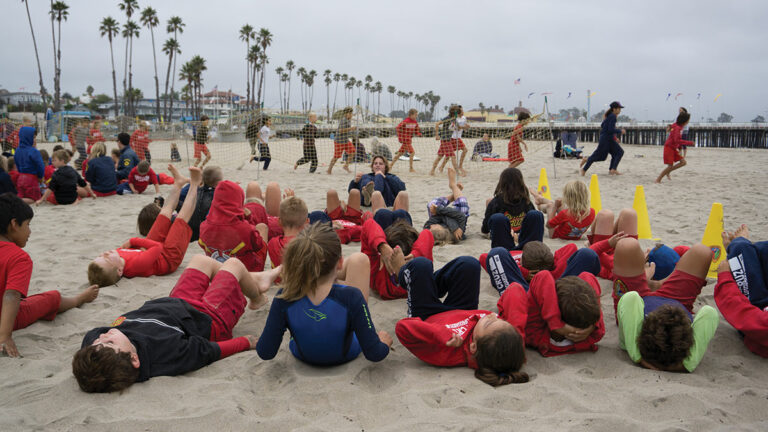
On any given weekday from June through August, the hundreds of little bodies skittering around the sand at Cowell Beach create the same kind of choreographed frenzy as a flock of Starlings. It takes a cadre of seasoned instructors to corral the Junior Lifeguards decked out in bright reds and navy blues.
“OK guys, let’s keep the energy up for these push-ups,” an instructor yells to a loosely assembled group of nearly two dozen 12-year-olds on a recent Tuesday.
“I can feel my sweats filling with sand,” one junior guard whispers to another as they dive down into plank position.
On this mid-July day, a thick layer of clouds keeps the temperature brisk at the water’s edge. Some make the rookie mistake of starting their daily calisthenics routine while still wearing sweat suits. Veterans know to always ditch your gear before the workout; much like a rescue, you never know how long the push-ups, crunches, lunges, and flutter kicks will last.
By now a rite of passage in Santa Cruz and neighboring cities, the summer Junior Lifeguard program supplies a steady stream of young athletic talent to keep towers around the county staffed. Over 1,000 junior guards enroll in various city and state parks programs each year to learn the basics of ocean safety and conservation.
For Jason Sweatt, a 42-year-old Capitola transplant originally from Alabama, signing his 5-year-old son Cody up for junior guards was a no-brainer. With a lifetime spent in the water as a surf instructor, and as a former lifeguard himself, Sweatt is more familiar than most with the skills his son is learning.
“I have pulled people out of the water that were unconscious in Waikiki and required CPR,” says Sweatt, who co-founded the Santa Cruz Veterans Alliance in 2011 after spending his first few years post-Army service working in Hawaii as a surf instructor. “It’s those basic lifesaving skills that you carry on and never let go. I want that for Cody.”
It takes time to develop a good lifeguard. In addition to runs and workouts on the sand, basic lessons like how to identify a water emergency eventually evolve into more advanced mock-rescue drills.
During more intense rescue drills, a fellow guard simulates the behaviors of someone drowning, such as frantically trying to climb onto a rescuer in the surf. Uninitiated lifeguards can easily find themselves in danger from not only rough water, but the person they’re trying to save.
“We are exposed to some dangerous environmental factors,” says Anna Marie Scott, a 19-year-old in her third season as a summer lifeguard, from riptides and rocks to skin cancer.
Still, it’s hard to argue with the benefits of working on the beach.
Isaiah Mullen, a 21-year-old Santa Cruz native, saw it as a natural step when he became a seasonal guard four years ago while enrolled at UCSC.
“After doing junior guards for years, it just felt like I was setup,” says Mullen, a legal studies major who previously studied and played water polo at Cabrillo. “And who wouldn’t want to work at the beach while they are in college?”
MURKY WATERS
With a steady pipeline of junior guards growing up idolizing heroes in red and blue uniforms, lifeguarding has endured and evolved despite pay that—like many jobs in Santa Cruz County—has struggled to keep pace with the skyrocketing costs of living.
“Everybody knows it’s difficult living in Santa Cruz,” says Brendan Daly, a 33-year-old marine safety officer who transitioned to a full-time position with the Santa Cruz Fire Department after 11 years as a seasonal guard. “You have to really grind to find a job that will allow you to stay in a place like this.”
Virtually every city guard in the towers is a seasonal, part-time employee earning between $14-20 an hour with limited benefits, including health insurance for job-related incidents. Leadership positions like beach lieutenants and beach captains pay $17-24 per hour, compared to a full-time firefighter salary of $35-50 per hour, not including potential overtime.
LONG HAULMarine Safety Officer Brendan Daly spent 11 seasons as a part-time lifeguard before accepting a full-time position. PHOTO: G.P. SCHEPPLER
At state beaches, the majority of lifeguards are also seasonal, with pay starting at $15 per hour and limited benefits. Full-time state peace officers are generally the guards driving white pick-up trucks outfitted with long rifles that supervise and patrol the shoreline, who earn $20-33 an hour not including potential overtime.
“In Santa Cruz, (lifeguarding) is not a feasible career,” says seasonal guard Nysether. The tradeoff, she says, is that the job has allowed her to gain emergency medical experience while doing student nursing work at Dominican Hospital.
Nysether is also one of many guards who pursues year-round work as a rescue swimmer with the fire department’s Marine Safety Unit. While lifeguards do the legwork of standing long rotations in the towers watching the water line, rescue swimmers are emergency responders with specialized medical and rescue training. Unlike lifeguards, rescue swimmers typically have other duties as firefighters, police officers or medical specialists.
Before he became a full-time marine safety officer with the fire department, Daly says he worked a variety of jobs to make ends meet, like doing surf photography or videography for the Monterey Bay Aquarium.
At 33, this is Daly’s 16th year as a lifeguard and fifth in a full-time role supervising a small army of seasonal guards. He studied cultural anthropology at UC Santa Barbara, and after graduation was discouraged to find that most of the tribes of the world had already been discovered. He went back to working as a lifeguard as he’d done over summers in college, and though the career path hasn’t always been clear, Daly says the intangible benefits of training young people how to save lives makes up for it.
“Just last year we had several former junior guards rescue a swimmer in distress,” Daly says.
DOLPHIN-DIVING IN
To become a city lifeguard in Santa Cruz, applicants must survive a gauntlet of physical challenges.
Just to earn the chance to interview, an aspiring guard must complete a 1,000-meter open water swim in under 20 minutes, then a 200-meter run, 400-meter swim and another 200-meter run all in under 10 minutes.
With the scarcity of full-time lifeguarding jobs, aspiring guards often try to separate themselves from their peers by shelling out for professional certifications, gym memberships or specialized personal trainers. Many participate in sports like swimming and water polo during the offseason, sometimes while also studying for credentials such as emergency medical technician, or EMT.
“Being an EMT isn’t a requirement,” Daly says, “but it is preferred.”
If city lifeguards want to advance beyond entry-level pay, holding an EMT certification becomes a necessity.
Being familiar with the Central Coast isn’t a requirement, but there is an inherent advantage for those who start training nearby.
“I was lucky to be local and have grown up here in the junior guards program,” Stark says. “I saw outsiders come in and struggle to paddle or navigate the kelp fields or handle the cold water.”
For Stark and other guards, a typical day on the tower starts around 10:30 a.m. and runs until about 6:30 p.m. Aside from a daily fitness break or nature’s occasional call, lifeguards must stay focused on the water while surrounded by a sea of distractions that has only grown with the region’s tourism industry.
Local lifeguards have completed 1,283 reported rescues since 2015. Most often, they leave their towers to help beachgoers who have either over-indulged in seaside libations or overestimated their ability—usually, some combination of the two.
Hazards like riptides, shore breaks, cliff falls, sneaker waves, and medical emergencies on the beach all present potential threats at land’s end. Just go to Youtube and search “Santa Cruz water rescue,” and all kinds of drone footage and news reports will surface. In recent years, the number of rescues has spiked during busy warmer months.
Last month, rescue swimmers pulled out a young boy whose head was the only part of his body visible in rough water near Sunny Cove. In July of last year, a 10-year-old was rushed to the hospital after he was buried in sand while digging a tunnel and had to be pulled out by a lifeguard. Just south in Monterey County, both a lifeguard and a swimmer in duress about 30 feet from shore had to be pulled out of the waves by Cal Fire crews last fall.
Hearing from lifeguards first-hand about these incidents, however, is rare.
Lifeguards are bound by the same medical privacy laws as doctors and nurses, and they’re notoriously tight-lipped about their most harrowing rescues. Rather, they speak in general terms about “an unconscious male” or “distressed elderly female bather” swept out to sea.
“These moments are some of the most traumatic in people’s lives,” Mullen says. “It’s important to always keep that in perspective when talking about the rescues we make.”
POLICING THE BEACH
Depending which department they work for, lifeguards’ tools of the trade might include jet skis, pick-up trucks, rescue boards, helicopters, swim fins, rescue buoys—or, sometimes, guns.
Full-time State Parks Lifeguards are trained peace officers whose authority extends across California. As a result, they carry .40-caliber pistols on their hips and a long rife in their trucks during shifts on the beach. Unlike their seasonal counterparts, peace officers are charged with enforcing state laws and issuing citations, or potentially making arrests.
Far from Baywatch stereotypes, the role many lifeguards play in the coastal ecosystem is as much that of warden as rescuer. They’re the first line of defense in preventing emergencies by telling the public about rapidly changing coastal hazards, shark sightings and more.
“I view myself as an educator and informer, not as an enforcer,” says seventh-season State Parks Lifeguard Jackson Shaffer-Yunger, 28, who went to Harbor High and played water polo at Cabrillo. “I recognize that not everyone who comes to our beaches has grown up with the ocean the way I did, so I try to be patient.”
The vast and dynamic 29 miles of coastline in Santa Cruz County are watched by a network of emergency water-rescue units and personnel from the Santa Cruz Fire Department, Central Fire Protection District, Aptos Fire Department, California State Parks Lifeguards, and the U.S. Coast Guard. These federal, state and local agencies monitor and respond to everything from rocky shores to high-traffic beaches, all on the edge of one of the nation’s largest underwater sanctuaries.
RESCUE SEASONFourth-year local lifeguard Isaiah Mullen says junior guards set him up to spend summer breaks from college watching the water. PHOTO: G.P. SCHEPPLER
When a water emergency happens somewhere in the county, the agencies use a grid to decide who will respond. Guards who work under the city’s fire department cover Cowell, Main and Capitola beaches. State Parks guards cover state parks and sections of unincorporated Santa Cruz County.
Often, the work is more pragmatic than high-risk rescue scenarios.
“We reunite lost children with their families every day,” Nysether, says.
It’s this kind of work, says State Parks Lifeguard Supervisor Eddie Rhee-Pizano, that keeps the county’s most popular beaches safe.
“It’s the seasonal guards that are the unsung heroes,” Rhee-Pizano says. “These young people step up and make it possible to open up as many towers as we do.”
FUTURE GUARDS
Lifeguarding is one of many professions in California that has had to adapt to a changing economy and surging costs of living.
Local law enforcement departments and the U.S. military increasingly say that recruiting can be a struggle thanks to a shift away from physical labor and the difficulty of paying for housing and other necessities on low starting salaries. Lifeguarding is something of an outlier because of the job’s unusual sun-soaked allure, but state and local departments have expanded junior guard programs in recent years to keep the pond stocked with able-bodied candidates.
Like cops or firefighters, there’s also a hierarchy to lifeguarding. For those who excel in junior guards, like former fire department Lifeguard of the Year Henry Tobias, there are distinctions to strive for. One mark of prestige is becoming part of “Captain’s Corp,” or the Marine Safety Unit within the fire department.
Looking ahead, Tobias hopes that lifeguarding will help give him a leg up applying to state and local fire departments.
“Working as a lifeguard helped me get exposure to local fire departments, and that motivated me to get my paramedic degree,” Tobias said. “I grew up wanting to be a lifeguard and a firefighter.”
He may get the chance to realize both dreams in the same place.
In addition to the Marine Safety Unit, 17 local firefighters are certified as rescue swimmers, enabling them to provide emergency water response during the off-season from fire engines. The 15-year-old program was adopted by the fire department to increase its capacity to protect ocean-goers during the offseason when summer lifeguards go back to school or work.
For those who return to the towers year after year, like State Parks guard Shaffer-Yunger, lifeguarding comes with a sense of purpose that can be hard to replicate.
“Working for State Parks has been one of the best jobs I have ever worked,” he says. “I have bussed tables, worked in food prep and hung drywall, but nothing as rewarding an experience as lifeguarding.”
UPDATE: Aug. 7, 11:10 a.m. — This story has been updated to clarify the Santa Cruz Fire and California State Parks departments’ overtime pay policy, and the title of Santa Cruz Fire Department Marine Safety Officer Brendan Daly.