The new Summer menu at Vim is full of impressive and tasty surprises.
An outstanding chicken breast marinated in spicy yogurt came with an addictive quinoa pilaf laced with almonds and golden raisins ($28). Brilliant pink pickled cabbage on one side, and electric orange harissa-spiced carrots on the other. Topped with feta and fresh mint. the chicken was as good as it sounds. Another new and welcome entrée showcased plump strips of skirt steak fanned across a vibrant pool of crimson romesco sauce ($29). A smart variation on beef and potatoes, the balsamic-infused steak was joined by a thicket of haricot verts and crisp roasted potatoes so good they could have given lessons. Seriously, these potatoes blew me away—a tribute to the chef’s skill and sensitivity with veggies of all kinds.
Our meal began with an early summer green salad (a welcome addition) crafted of tender lettuce from the Homeless Garden Project and pickled strawberries from Koch Farms ($14). The greens came atop a pool of creamy feta, flecked with crunchy pistachios and crowned with a boiled quail egg. The entire salad was tossed in a peppery balsamic dressing that had my dinner companion speaking in tongues. Chef Jesikah Stolaroff, a Culinary Institute of American grad, tends to use more rather than fewer ingredients—there is a copious crunch of pistachios and almonds—and often offers two sauces, rather than one. Some diners will enjoy this extra flavor complexity and intrigue. Others might find it unnecessary.
And on this, my second visit to Vim, I found the noticeably upmarket “butter board” ($21) featuring flavored cultured butters still the menu’s only path to bread. The popcorn provided as a bread substitute feels like a novelty rather than a creative addition to the rest of the outstanding menu items. Both entrée portions were large enough to make portion size a talking point throughout dinner.
We partnered our Vim dinner with glasses of excellent Termes Tempranillo 2015 ($11) and an earthy Costaripa Mazane 2015 ($14) and appreciated the generous pours—generous enough to last throughout our meal. I admit we did longingly admire the quartet of cocktails on the table across from ours in arboretum shades of pink, magenta and lime. Choosing desserts is a challenge at Vim, where the gamut wanders amongst fresh berry trifle, double chocolate fantasias and other intricate temptations. We succumbed to a shared order of the evening’s special warm apricot galette, large enough for most of the NBA’s free agents ($13). A tender crust surrounded warm apricots packed into a thin cream cheese foundation. The whole was liberally strewn with toasted pistachios—an inspired counterpoint to the sweet tang of warm apricots. But the whipped cream provided seemed mysteriously aerated. It tasted like genuine whipped cream, but was texturally light, rather than densely creamy as expected. For $13, freshly whipped cream is in order, especially with such a lovely pastry creation. The menu is coming along smartly in this very new dining room. And the summer season is clearly an inspiration for this chef, who deserves a setting as sophisticated as her abilities and ambitions. The ingredients—fresh, organic, local—tend (in most cases) to justify the pricy menu. If some of the huge portions were downsized, prices might be scaled accordingly. Vim’s summer menu gave us much to enjoy.
Vim Dining and Dessert, 2238 Mission St., Santa Cruz. Closed Tuesday. vimsantacruz.com.
SUMMER WINE
Alfaro Family Vineyards’ tasting room in a glorious vineyard setting is now open both Saturdays and Sundays, from noon-5 p.m. through August. Terrific picnic and exploring opportunities.
Santa Cruz County live music picks for the week of July 10
WEDNESDAY 7/10
ROCKABILLY
HILLBILLY CASINO
Hailing from the country music Mecca of Nashville, Tennessee, this whiskey soaked four-piece is true rockabilly, combining the boogie-woogie of barn dances with the stylings of slick rockers. Their most recent studio album was 2017’s Red, White & Bruised. MAT WEIR
Santa Rosa acoustic Americana trio Snaps For Sinners recently moved to Madison, Indiana, but they should have moved to Santa Cruz. This group, not unlike our beloved Devil Makes Three, mixes boot-stomping old country, popping upright bass, progressive values and an affinity for alternative culture. Perfect for us! Madison is lucky to have them, but at least they still come and visit Santa Cruz. AARON CARNES
Chicano Batman members E Arenas (bass) and Bardo Marintez (lead vocals, keys) are working together to bring wonderfully weird music to your ears. E Arenas’ recent two-song EP, La Fila de Tommy’s, is like a Latinx version of the Earthbound soundtrack, firing off rubbery synths and goofy space sounds over hyperactive cumbia beats. Last year, Bardo Martinez issued two sun-drenched Southern California soul tracks via his Yemaya Sol label. It’s less zany than Arenas’ recent work, but no less entertaining. MIKE HUGUENOR
Who says San Francisco has lost its soul? Definitely not anyone who’s heard the funk and soul ambassadors, Midtown Social. Although only three years deep in the scene, this six-piece experience has already taken their city by storm, making the SF Weekly declare that “an alabaster statue would have two-stepped” to their music. MW
The Bay Area’s flamenco scene has thrived since at least the 1950s, and in recent years, few local artists have done more to build and promote the art form than Yaelisa, who launched her non-profit organization Caminos Flamencos in 1993. A gifted choreographer and respected teacher who has collaborated with fellow nuevo flamenco artists and musicians in kindred traditions, she’s created festivals and regular flamenco showcases in venues around the region. But her most powerful statements flow from her crisp authoritative foot work, coiled pivots and sweeping arms. ANDREW GILBERT
7 p.m. Kuumbwa Jazz, 320-2 Cedar St., Santa Cruz. $26.25/adv, $31.50/door. 427-2227.
SATURDAY 7/13
COMEDY
DAVE STONE
Dave Stone wants to give you a recipe for homemade fried cornbread in his Kitchen Survival Guide PDF. He also wants to spin some outlaw country tunes for you on his radio show The Gravy Boat. There’s also that paranormal podcast with Kyle Kinane he’s certain you’ll enjoy, and why not read an article about Stone saving money by living in a van for two years? When you’ve had your fill, it’s time to see Stone live. He’s a natural comedian and storyteller, two talents which unfailingly seem to settle on the topic of food. AMY BEE
7 & 9:30 p.m. DNA’S Comedy Lab, 155 S. River St., Santa Cruz. $20/adv, $25/door. 530-592-5250.
SUNDAY 7/14
BLUES
HOWELLDEVINE
Classic blues is some of the spookiest music ever written. Imagine you are living in rural Mississippi in the early 1900s, listening to a blues musician holler like he was possessed by the devil. It would scare and excite you. The electric blues that later evolved in big cities never quite had that quality, but San Francisco trio HowellDevine harkens back to the earliest, most dangerous era of blues. AC
After listening to El Castillo, a grand, rock-operatic album full of quirks, depths, and sunny California desert fever, it’s clear what’s absent from Honyock’s ’60s psych-rock missive: nostalgia. Nostalgia is almost a mourning of the past, and Honyock doesn’t sound like they’re looking backward. Instead, they’re firmly in the present, conveying not a wistful snapshot of a period, but a fully realized ethos independent of fame or fad. AB
Martha Scanlan has a voice like a prairie wind: elemental, haunting, and impossible to miss as it glides over her pastoral guitar work. As a member of the Reeltime Travelers, Scanlan appeared on the Cold Mountain soundtrack. In 2007, she recorded her debut solo album at Big Pink with Levon and Amy Helm—a heartstring-tugging collection of mournful folk anthems titled The West Was Burning. Since 2010, Scanlan has collaborated with Portland guitarist Jon Neufeld, whose background in the metal and prog scenes informs his acoustic work. Together, they make a powerful duo, equal parts spare and masterful. MH
7:30 p.m. Michael’s On Main, 2591 Main St., Soquel. $15. 479-9777.
Local three-piece Generation Hopeless may look and sound like a normal punk band—fast, energetic tunes, depressing lyrics, catchy hooks—but they have a magic trick up their sleeves.
A few songs in, guitarist and lead singer Jesse Lopez will switch with drummer Anthony Campbell—who suddenly becomes, without warning, guitarist and lead singer, with Lopez taking over the drums. This switch happens at least a couple times during their set, and it’s a smooth, seamless transition.
“We’re both good enough at both instruments. It’s also a way to keep the crowd entertained,” says Campbell. “I’ll get up from the drums and I’ll pick up my guitar. We’ll start the next song. I’ve seen people with their jaws open, like, ‘Whoa.’”
It also adds to the variety of the band’s sound; though Lopez and Anthony Campbell have similar pop-punk influences, you can still hear the differences in how they write, sing and play drums.
When Campbell and Lopez started jamming together, both had left broken up bands. Campbell, normally a drummer, had written a few songs on guitar and asked Lopez, normally a guitarist, to back him up on the drums. Pretty soon they were switching off so much that they forgot who played what the best.
The name Generation Hopeless fits the group’s music, which has an upbeat sound with downer words.
“We write about a lot of sad things,” says Campbell. “It’s a way of processing our feelings. The music is upbeat, but it’s still aggressive. Trying to face that hopelessness I guess.”
7:30 p.m. Wednesday, July 17, SubRosa Community Space, 703 Pacific Ave., Santa Cruz. $7. 426-5242.
When the beloved Capitola Book Café closed its doors five years ago, Gayle Ortiz—the namesake master baker and entrepreneur behind Gayle’s Bakery, and a former mayor—was, like many of her neighbors, distraught. Looking for something from the bookstore to save, she zeroed in on the paintings on the wall. She proposed a deal with the Book Café’s owners about the art.
“I told them, ‘If I could guarantee you that it would go into the new Capitola Library, whenever it’s built, would you give it to the city of Capitola?’” remembers Ortiz. “And they said, ‘If we can be guaranteed that, sure.’”
Sometime in the summer of 2020, Ortiz is poised to deliver on her promise. The paintings from the Book Café are now part of the renderings of the new Capitola Library, which means that from the first day of its opening next summer, the new library will already contain meaningful cultural DNA linking it to its community.
Ortiz was one of the many champions of the Capitola Library, a $15.1 million project now under construction on the same site as the former Capitola Branch Library, on the corner of Clares Street and Wharf Road.
It represents the largest capital project that the city of Capitola has ever undertaken. It also puts Capitola at the forefront of a public-library renaissance.
The Capitola Library is the design work of the Berkeley-based architectural firm Noll & Tam, which has designed many of Northern California’s new public libraries, including the recently opened Half Moon Bay Library, which earlier this year won a national design award from the American Institute of Architects.
The old Capitola Library was essentially two mobile units fused together. Though it will occupy roughly the same footprint, the new library will look nothing like the old one. “It’s going to be beautiful,” says Susan Nemitz, the director of the county’s library system, which includes Capitola, “and almost unrecognizable.”
At one time, the public library was considered one of many familiar institutions that would be upended, maybe to the point of extinction, by the digital revolution. But the library has repurposed itself and, in many communities, has found a thriving role to fill in the new economy.
“The new wave of libraries aren’t these reading rooms of quiet anymore,” says Nemitz. “They’re learning spaces.” Libraries have become community centers, a dependable and safe place for kids and a reliable touchstone for adults. They have become, say their advocates, an antidote to the atomizing effects of anonymous online culture: a place to engage with your local community.
What new libraries are not—and this includes the new Capitola Library—is a warehouse for old books. Christopher Noll, one of the partners at Noll & Tam, and a designer of the Capitola project, says that the public library now has a different orientation to books. “The idea of these eight-foot-tall shelves stacked from top to bottom with books” is over, he says, calling the old paradigm “oppressive.”
“We want open, airy, light-filled spaces for people to sit,” he explains.
Like many new libraries, Capitola will have dedicated spaces for kids, teens and adults. At 11,700 square feet, it will have spaces that can be easily adapted for meetings, events and presentations. It will also have homework rooms, an outdoor patio, even a reading room with a working fireplace. But much of the new library’s space, says Noll, will be vertical.
“We spent a little extra to get a high ceiling,” he says. “High ceilings allow more natural light, more room for that light to bounce around. It saves energy on lighting, it’s a better kind of light, healthier for people. And high ceilings give you a sense of grandeur. It’s a way of saying this isn’t a house, it’s something else. It’s a way to uplift your spirits.”
Noll says that modern library design has put to rest the clichéd image of the shushing librarian. Though the new library will contain quiet spots for reading, “libraries are generally getting much more noisy and active.”
The idea of the public library has gotten a new currency thanks to a suddenly popular 2018 book by sociologist Eric Klinenberg called Palaces for the People. (Among its many fans is Democratic presidential candidate Pete Buttigieg). In the book, Klinenberg explores “social capital”—the face-to-face, interpersonal relationships within a given community—and celebrates public libraries as the primary conduit that holds together many communities. Noll says the design principles of his firm are in the spirit of what Klinenberg is talking about.
The opening of the Capitola Library in 2020 will continue a curious trend from the perspective of its neighboring city to the west. Santa Cruz is now ringed by communities that have all opened spacious new-model libraries in the last decade, including Half Moon Bay, Los Gatos, Scotts Valley, Morgan Hill, Gilroy, and Watsonville. Yet Santa Cruz, home to the region’s largest bookstore and university, still operates from a downtown branch on Church Street, first opened more than 50 years ago.
Santa Cruz has wrestled with the idea of a new library for years, and currently, the Santa Cruz City Council has empaneled a subcommittee of three—councilmembers Justin Cummings, Sandy Brown and Donna Meyers—to explore options and present a report by October. The City Council will likely have to choose between building a state-of-the-art library coupled with a controversial parking garage and doing a partial remodel of the existing facility.
The downtown branch has few fans. Architect Chris Noll calls it “awful,” and Nemitz says that it’s “shabby.”
“People get angry when I say that,” says Nemitz, “but Santa Cruz’s public libraries are shabby.” The opening of the gleaming new branch in Capitola might represent a revelation for many in Santa Cruz, she says.
“Because Santa Cruz hasn’t consistently invested in libraries, there are a lot of people in this community who have never really been in a 21st-century facility,” says Nemitz, who arrived in Santa Cruz in 2016. “My first meeting with the City Council, someone asked, ‘Well, what’s wrong with the downtown library?’ I was so surprised by the question, I didn’t answer it well. Everything is wrong with the downtown library. It’s like people who buy a house with a crack in the ceiling—three months later they don’t even notice it. People are accustomed to what they already have. But I think when Capitola opens, everybody [in Santa Cruz] is going to say, ‘Hey, we want that too.’”
I’m no historian, but I’ve run enough pieces by historians to feel like I have somewhat of a feel for what are considered to be the major names and places in Santa Cruz history. Whenever the subject of this area’s Chinatown (actually Chinatowns, as there were several) comes up, I’ve read enough to know some of the timeframes and locations. But reading Geoffrey Dunn’s cover story this week, I was shocked at how much I didn’t know about the outrageous racism that Chinese immigrant communities here faced, and how they had to employ extreme measures—including giving up their own personal identities—to navigate it.
But then, that’s kind of the point of Dunn’s piece—we don’t even know what we think we know about Santa Cruz’s Chinatowns. And the way he uses a Chinese immigrant who achieved a small measure of fame here to frame that discussion is ingenious. To the pre-World War II Santa Cruz public, the man they knew as Ah Fook lived a simple fishing life that played into their racial stereotypes. But his real story was so much more complicated, and those complications contributed to what seemed to be his disappearance. Dunn’s research for this story led to a breakthrough that both honors the man’s legacy and sheds more light on the realities he faced as part of the Chinese community here. It’s an absolute must-read.
Re: “Point of Contention” (GT, 6/26): Since the county took over the only syringe program in the community, at each biannual report the Board of Supervisors has issued more and more restrictions. One would think they have not got the memo that we are living during a time of an opioid and overdose crisis.
We are blessed with a Health Services Director who is committed to this program and has a fantastic staff, including program manager Jen Herrera.
It is time for the Board of Supervisors to untie the hands of the people who know public health and who know how to operate the most successful and widely accepted means of reducing syringe litter, reducing the spread of disease and improving the health of the community at large.
There is no such thing as overestimating the value of reducing the spread of disease. We have examples in Indiana and Seattle where an HIV outbreak decimated families and communities, now costing taxpayers millions of dollars to treat.
I take offense to the complaints of Ryan Coonerty that Downtown Streets Team and Save Our Shores have been picking up syringes. The county contracts with both of these organizations to do just that—pick up and minimize the impact of all litter in our public places.
We should fully expect these organizations to find syringes, because that is what we are tasking them to do and supporting them with equipment and supplies to safely do this, so that unprepared community members do not encounter syringes. Downtown Streets Team often cleans up abandoned and relocated encampments, and we dearly appreciate both of these organizations for the work they do.
Both organizations would find more syringes if there was not a syringe services program in the community, and this is data proven.
The Harm Reduction Coalition has spent months engaging with people who do not use the county program, and who regularly pick up discarded syringes that they find.
We should appreciate the community of people who use drugs and value their role in syringe pick up rather than constantly berate and judge them. People who use drugs are as diverse as any segment of the population. Viewing people as broken, wrong or pathological is a barrier that keeps people from getting the support they need.
If you want to push people away from services, tell them what we think they need and don’t allow them the dignity of determining their own needs.
Denise Elerick
Santa Cruz
Addicts Are Beyond Helping
Re: “Point of Contention”: Like illegal aliens, who are now referred to simply as “undocumented immigrants,” it seems that even junkies have been caught up in political correctness, and are now known instead as “injection drug users.” What kind of bizarre world have we morphed into where illegal drug users are provided (at taxpayer expense) the means to maintain their addictions? Offering free needles to heroin and methamphetamine users only encourages them to scale-up their involvement. Those just being introduced to drugs through inhaling or smoking can now easily step up and bang the final nail into their coffins by mainlining these poisons. A secondary outcome of this policy is that even more junkies will be attracted to places like Santa Cruz, where drugs are readily available and the necessary tools to use them are provided free of charge. The recently dismantled Ross Camp should serve as a grim reminder of just how a sizeable influx of these freeloaders can impact a town like ours.
In a right-thinking world, instead of needles being handed out to addicts for free, they should cost $50 each. We as a community should be doing everything within our power to discourage intravenous drug use, not encourage it.
And finally, we need to stop kidding ourselves that programs like the needle exchange will really help users “get over the hump and become tax-paying citizens,” as Arnold Leff states in your article. The grim reality is that very few hardcore drug users will ever turn their lives around and become responsible citizens. A more likely scenario is that most will continue to be a burden on society for the rest of their miserable lives.
Jim Sklenar
Santa Cruz
PHOTO CONTEST WINNER
Submit to ph****@*******es.sc. Include information (location, etc.) and your name. Photos may be cropped. Preferably, photos should be 4 inches by 4 inches and minimum 250dpi.
GOOD IDEA
FEELING PUMPED
Soquel Creek Water District is one of the best employers around, according to a new ranking from Bay Area News Group. The mid-county water district came in at number 36. It’s anyone’s guess how the corporate-owned Bay Area News Group scrapes together time to develop such a list, in between slashing away at its budget and letting go of experienced reporters. Maybe one of those laid-off journalists can now get a job at Soquel Creek Water District, which has three openings.
GOOD WORK
ROBOT (VICTORY) DANCE
For the second time in three years, the Aptos High School robotics club has taken home first place at the International Marine Advanced Technology Education Remotely Operated Vehicle. Aptos High’s Seal Team Scalyr competed last month in Kingsport, Tennessee. Its Argo VI was built to accomplish complex tasks underwater. The machine simulates work done by larger remote-operated vehicles in oceans and lakes, like restoring broken dams and recovering sunken artifacts. A team from Vladivostok, Russia took second.
QUOTE OF THE WEEK
Quote of the Week “I wanted my children to have the best combination: American circumstances and Chinese character. How could I know these two things do not mix?” — Amy Tan, ‘The Joy Luck Club’
There’s been a lot of vape smoke in the air lately—enough that it may have clouded our perception of at least one important detail.
In a news story last month about new cigarette vending rules (“Puff of Smoke,” 6/26), GT reported that the county’s smoke shop industry has not seen a significant problem with merchants selling cigarettes or vaping paraphernalia to kids, according to remarks from Damon Hancock, the county’s tobacco compliance officer. That much is true. In April, Hancock credited smoke shops with doing a good job of checking IDs.
What’s also true, however—and what GT neglected to mention—is that five retailers did get busted for selling to minors in a sting operation at the beginning of the year.
Shops should double down on making sure to check IDs. And in future vape coverage, we’ll double-check our notes.
RABBLE HOUSERS
The city’s new Community Advisory Committee on Homelessness has the potential to transform how we talk about homelessness.
Then again, the task force—approved on a 4-3 Santa Cruz City Council vote—also has the potential to be latest advisory body that no one listens to.
The underlying problem is not that the council ultimately chose to ignore liberal Councilmember Sandy Brown’s pleas to include homeless residents on the committee. The committee will have at least one formerly unhoused individual, as well as the authority to add more homeless residents if it chooses.
The problem with the committee is that it has to exist at all. Over the past half-decade, the City Council has increasingly punted on topics by forming new, often-expensive advisory bodies to study the biggest issues for them. The city has barely started implementing widely popular suggestions from the Homelessness Coordinating Committee from a couple years ago.
So all this committee nonsense is purely the fault of a gall-less council for repeatedly refusing to lead on pressing topics… right?
Wrong again!
Even on the nights when city councilmembers show shades of borderline competency on the homeless issue, it’s nearly impossible for them to display any leadership, because of the polarized, increasingly distracting peanut gallery of extremists in the audience, cheering, jeering, smirking, yelling and holding up ridiculous signs.
If the latest committee’s findings don’t work out, the City Council might try hanging up a sign of its own during contentious meetings—one that reads, “Shut the hell up. We’re working here.”
STAKE OUT
This past weekend, Emiley Stake, who served for seven years as local Woodstock’s business development manager, moved to San Diego, where she accepted a promotion to the corporate office and serve as business development director for the whole pizza chain.
The move ends Stake’s three-year run as board president of the Downtown Association. Speaking of which, the departure of so many Santa Cruz figures these past couple months leaves Nuz to ponder one important question: would people still read this column if it were written from Paraguay?
The day after Trump got elected, L.A. electronic musician Robert Delong wrote “The Beginning of the End.” It’s a triumphant, spine-tingling electronic song with layers of synths and guitar and vocal processors, and a foreboding tone to the lyrics. (“Guess I should’ve seen the signs, but I didn’t.”)
The song’s not intended to be explicitly political, or even provide commentary on Trump—Delong just felt compelled to capture the dark emotion of the moment.
“That day was intense. You could definitely sense the tension in the air, especially here in Los Angeles,” Delong explains.
There aren’t even any obvious references to Trump, or the day after the election.
“You can also interpret it to be about relationships,” Delong says. “If any song is too specific, I’m not interested in it. I’m always interested in subtext in songwriting.”
“The Beginning of the End” was the first song Delong wrote for his most recent EP, See You In The Future, released in October of last year. He wrote the rest of songs several months after “The Beginning of the End,” but they capture a similar tone. These are large-scale, emotive electronic songs—bigger sounding than anything he’s released thus far—with apocalyptic lyrics that are “written out of the anxieties of modern life,” as he puts it.
The song “Revolutionary” comments on how technology and social media affects our lives. “First Person on Earth” is a love song that takes place in the apocalypse, with romantic lyrics like “If I’m the last one standing, I would wanna watch it burn with you.”
Probably the weirdest of all is “Favorite Color is Blue,” a collaboration he did with alt-rapper K.Flay. The song is a somber, almost robotic expression of watching the world crumble all around you, and has a bizarre, menacing chant in the chorus. The two artists wrote the song as a collaboration, a byproduct of their friendship. Delong says the song could not have been written by either of them without the other, and likely without the circumstances—a hot L.A. day with no air conditioning.
“It was like a hundred degrees in my studio,” Delong says. “Maybe that oppression is what came through the weird frenetic lines that sound like a fucked-up circus.”
Earlier in his career, Delong was making more lo-fi, experimental electronic music that was driven structurally by his past as a drummer. He started out playing drums in various punk and indie bands, but later transitioned to production and got hooked on creating music via computer software.
“The music I make tends to rely on my sense of rhythm,” Delong says. “It’s the way I approach music. I’m always thinking about it as a drummer. I don’t know how else I could at this point.”
As a younger musician, he did write songs on his acoustic guitar, but he felt a strong draw to the possibilities of electronic music.
“The sense of scale is not really possible in a traditional rock setup. And really, just the amount of sonic information that you can fit into a song,” Delong says. “You can have a thousand different sounds from a thousand different places. It all feels like it’s part of the same thing. As opposed to just being limited to guitars, bass, drums, which I love as well.”
He also surprised himself as an electronic musician by becoming a solo performer. As he’s developed a career over the past decade, he’s become known as a one-man-band with some pretty out-there electronic gear; for instance, he’ll play a solo using light beams as the notes. This past year, as his latest EP shows, he’s really focused on making larger productions. And his live show is quickly becoming, oddly enough, a full-on band showcase.
“It’s fun because I can do my crazy looping. It has a really interactive performance part,” Delong says. “But I can just be a singer. Let the band take care of all the other stuff.”
Robert Delong performs at 9 p.m. on Wednesday, July 17, at the Catalyst, 1011 Pacific Ave., Santa Cruz. $18/adv, $20/door. 423-1338.
“Ah Fook was born to fish…For Santa Cruzans not to know him is comparable to a mountaineer spending a lifetime within five miles of Yosemite Valley and never taking the trouble to view the wonders of its waterfalls.”
— Warren “Skip” Littlefield, Santa Cruz Evening-News, 1941
Ah Fook may be the biggest, most badass ghost in Santa Cruz County history. A hungry ghost? Maybe. Angry? He could be—maybe even should be—but I don’t think so. He seems to have a perennially beatific smile on his face, as though he’s got a big cosmic secret hidden somewhere in his soul, and one of these days he’s going to let us all in on the joke.
One thing’s for certain: Ah Fook’s ghost is tenacious as hell. He’s got pure neon tenacity running through his phantasmal veins.
Raised during a time in local history when immigrants of Chinese descent were branded as subhuman or worse, the person—or more accurately the character—who today we call Ah Fook, or Cheung Ah Fook, witnessed an ugly brew of hatred, racism, violence and xenophobia that cast him and others in his community to the shadowy margins of 19th-century Santa Cruz society. Let’s not pull any punches: the xenophobic Yankee power structure in Santa Cruz did everything it could to drive the Chinese out of town.
In one legendary editorial appearing in the Santa Cruz Sentinel in 1879, close to the year that Ah Fook was born, Chinese immigrants were described as “half-human, half-devil, rat-eating, rag-wearing, law-ignoring, Christian civilization-hating, opium-smoking, labor-degrading, entrail-sucking Celestials.”
So much for subtleties. The anti-Chinese movement in Santa Cruz was as racist and vicious as it was anywhere in the West.
And while the Chinese played an absolutely critical role in the economic development of Santa Cruz County (and the rest of California for that matter), their roles in the region’s expansive mythology have often been relegated to faceless stereotypes as railroad workers and laundrymen, their lives tossed carelessly (and ceaselessly) on the ash heap of history.
As Cabrillo College historian emeritus Sandy Lydon wrote in his definitive Chinese Gold: The Chinese in the Monterey Region: “Though the Chinese are not explicitly mentioned in the local and regional histories, if you hold each page to the light you can make out a faint pattern. The longer you look, the stronger the pattern becomes. The Chinese are in the very paper; they are the watermark.”
Ah Fook’s lined, weathered face surely appears in the patterns on those pages.
In the 1940s, when most of his elder American Chinese compatriots were left lurking in the shadows of Santa Cruz’s final Chinatown, Ah Fook became something of a local celebrity, appearing on the front pages of newspapers and calendars, promotional brochures and advertising billboards. For the next decade and more, even into the sanitized 1950s, he appeared regularly as a character in newspaper columns, with various details of his life recorded on a weekly, if not daily, basis.
And then he mysteriously disappeared. His death went unnoticed, and more surprisingly, seemingly unrecorded. After being a media darling and public figure here for the better part of two decades, his passing, rather shockingly, went unreported. His spirit vanished. His memory became an apparition.
Then, two generations later, he returned again. As interest in local Chinese history experienced a resurgence with the publication of Lydon’s work in the 1980s, he appeared in movies and later on the cover of the book Chinatown Dreams: The Life and Photographs of George Lee, which I edited and co-wrote with my friends Lisa Liu Grady, Tony Hill, James D. Houston, Morton Marcus, George Ow Jr., and Lydon. In the cover image, Ah Fook is holding the 7-year-old Ow with his weathered hands as though he is hanging onto the future.
Just this past spring, Ah Fook returned again. He had a cameo in Tessa Hulls’ fascinating exhibit at the MAH, Chasing Ghosts, which chronicled her own family’s migration to the U.S. along with the history of Santa Cruz’s various Chinese communities.
Ow, who spent the first seven years of his life raised in the final Santa Cruz Chinatown, has gone so far to suggest, at least casually, that a footbridge crossing the San Lorenzo River, in a project spearheaded by Greg Pepping of the Coastal Watershed Council, be renamed in his honor.
“Ah Fook is not letting Santa Cruz forget about its Chinese history,” says Ow. “I can feel his positive energy. He wants the spirits of the old Chinese men and women who never got their due to be remembered, honored and recognized. He won’t be denied.”
Ah Fook’s ghost is tenacious indeed.
Most Santa Cruzans give you a long, blank stare when you talk about the city’s Chinatown and its myriad Chinese historical roots. There’s good reason for that. There are few remnants of this history to be found anywhere in the community, save for a relatively hidden plaque on the Galleria Building downtown and the recently constructed and colorful memorial Chinese gate located in the Evergreen Cemetery, which is overseen by MAH. Not much else.
But in the 1800s, Santa Cruz County claimed major Chinatowns in both Santa Cruz and Watsonville, along with several smaller Chinese communities scattered from Davenport up the San Lorenzo Valley and the California Powder Works (today Paradise Park), and south to Capitola (New Brighton Beach) and the Pajaro River.
The City of Santa Cruz actually had four distinct Chinatowns in the late 19th and early 20th centuries, all of which were located on the periphery of the city’s downtown economic center. The first was located on what was then known as Willow St. (today Pacific Ave.), between Walnut Ave. and Lincoln St. The second stretched along Front St., from just below the current site of the Post Office down along what is now the Comerica Bank property. The third, Blackburn’s Chinatown, was located along the west side of Chestnut St., just south of Laurel, above what is today Depot Park.
These so-called Chinatowns were largely bachelor communities (Santa Cruz had the lowest percentage of Chinese women in the region) and many of the men worked as servants for upper-middle class families residing in the city’s stately Victorian homes. Others worked in laundries and in vegetable gardens scattered around the city; still others developed the region’s commercial fishing and agricultural industries; while a handful operated small businesses and retail stores, importing mercantile items from China.
It would be a bit of an overstatement to describe the Santa Cruz County Chinese immigrant economy as thriving, but it was as industrious as it was persistent. At its peak in the 1890s, U.S. Census figures indicate that nearly five percent of the county’s population was composed of Chinese immigrants.
In Santa Cruz, the city’s final Chinese community—known as “Birkenseer’s Chinatown” on Bellvue Place and, later, China Lane—was nestled between the San Lorenzo River and the city’s downtown business district, just east of Front St. (running into Cooper St.), and sloping into the San Lorenzo River.
During the 1920s and 1930s, Birkenseer’s Chinatown was known largely for its underground activities—gambling and prostitution, rum running (during Prohibition) and drug dealing, with opium and heroin being the drugs of choice. References in the local newspapers were almost exclusively from arrests and police raids. Graft was omnipresent and bribes the currency du jour. Scandal was always lurking in the shadows. Chinatown had a hard edge.
The 1940 Federal Census of downtown Santa Cruz indicates that there were still more than 60 residents of Chinese descent living in Chinatown on the eve of World War II. Nearly all were men, though George Ow’s maternal grandmother, Gue She Lee, lived there along with her husband, Sung Si Lee, and several children, including Ow’s mother, Emily. His father, George Ow Sr., lived there as well.
Living next door to the Lee family, at what was commonly known as the Joss House—which was operated by the Gee Chong Tong (Chinese Freemasons), along the edge of the San Lorenzo River—was a handful of elderly men. One of them, according to everyone I’ve interviewed over the last 40 years, was Ah Fook. And that is the name by which residents of Chinatown referenced him in the 1940s and beyond. It is how Ow and his uncle Jun Lee, now 83, reference him to this day.
But in the 1940 census, there is no one listed by that name living in the Joss House—or anywhere else in Chinatown, for that matter. This presents one of the great problems in tracking down Chinese biographies and personal historical details of American Chinese in the 19th and early 20th centuries: individuals often went by different names—sometimes a dozen or more.
Chinese emigrating to the U.S. often did so as “paper sons” or “paper daughters,” purchasing fraudulent documents claiming blood relations to those legally living in the U.S. They changed their names to match the documents, often more than once. This was a common practice until well into the 20th century. And it’s a secret still held closely by many Chinese American families living in the U.S. for more than a century. Add to that the racist ignorance of U.S. immigration officials, census takers, court officials, peace officers, journalists and others who butchered Chinese names.
Then there was the matter of protecting one’s identity and sowing confusion among those who maintained power. The novelist Maxine Hong Kingston once told me the story of how her father, who ran a gambling house in Stockton’s Chinatown not unlike those located in Santa Cruz, changed his name on each occasion that he was arrested, which was often. He never got a record, she said, because he changed his name every time. Sometimes the name came to him in the back of the police car; sometimes when he was getting booked. “I got away with all those aliases,” her father told her, “because the white demons can’t tell one Chinese name from another, or one face from another.”
George Ow told me that his own father went by at least a half-dozen different names during his lifetime. “For many,” he said, “it was simply a matter of expediency, convenience, or survival.”
The three men listed in the 1940 Census as living in the Joss House were Yee Chin, Mon L. Chin, and Lam Lee. An article appearing in the Santa Cruz Sentinel in November of the following year noted that two men had just left the structure—Un Hay and Lee Lem—and that three remained—Ah Jim, Lem Bach, and Ah Fook, the latter of whom was identified as a “chair repairer and fisherman.”
Earlier that year, Ah Fook had caught the literary imagination of one of Santa Cruz’s most colorful promotional figures of that or any era, Warren “Skip” Littlefield, who then served as the publicity director of the Santa Cruz Beach Company, better known as the Boardwalk. I knew Littlefield well as a young adult (he died in 1985), and discussed local history with him as often as I could, but I don’t remember him ever talking about Ah Fook.
That said, on the first day of spring, 1941, Littlefield turned Ah Fook into a full-blown character (and perhaps a bit of a caricature, too) in Santa Cruz media, and even in publications outside the community. In a front-page story appearing in the Santa Cruz Sentinel entitled “Fishing Comes First, Work Comes Last With Ah Fook, Venerable Angler on S.C. Municipal Pier,” Littlefield introduced Ah Fook to the community.
Accompanied by a large photograph of Ah Fook fishing from the end of the wharf, the article described its subject as a “peppery little Chinaman,” his face “weathered to the color of driftwood” with “piercing brown eyes, fanned with wrinkles from squinting over sunny waters” that “will suddenly sparkle like diamonds when a 12-inch jack smelt whips line and pole into agitated motion.”
Ah Fook, Littlefield assured readers, “has never been known to allow business to stand in the way of pleasure.”
Littlefield had obviously done some homework. He described Ah Fook’s living quarters in Chinatown—“an old wood cooking stove and a mid-Victorian bed provide help in the simple operations of sleeping and eating”—and Ah Fook’s complementary employment of repairing reed and rattan chairs in some detail, pointing out that he had learned his trade from “an American woman in Oakland,” and that he purchased his materials through a “Chinese concern” in San Francisco that he “paid every Chinese New Year.”
Littlefield’s portrait certainly catered to Chinese American stereotypes typical of the times. But Littlefield also conducted an interview with Ah Fook with a formal interpreter present that elicited some fascinating information about his familial roots in Santa Cruz. It also underscored the fact that the often nameless, faceless elderly men who lived in the shadows of Chinatown had fully rendered and complex lives of their own.
According to Littlefield’s interview, Ah Fook’s father arrived in Santa Cruz on the sailing ship Alexander in February of 1857, and later worked for railroad baron Leland Stanford as a foreman on the Union Pacific Railroad. In 1876, Littlefield asserted, “the elder Fook… procured Chinese labor gangs to build [Frederick Augustus] Hihn’s railroad from Santa Cruz to Watsonville.”
I wasn’t able to verify any of these precise details, but in respect to Littlefield’s assertion about Hihn, I asked my friend Stan Stevens—a librarian emeritus at UCSC, and an expert on all things related to Hihn—if he was in possession of any such records, and he sent me back the transcript of an agreement from 1881 between Hihn and an “Ah Kay,” in which the latter agreed to supply Hihn with a “gang of [C]hinamen of about twenty eight (28) men for five months” for the purpose of “building roads and grubbing land.”
Eight months later, in November of 1941, Littlefield reworked his Ah Fook story, this time for the Santa Cruz Evening News, with banner headlines in the Sunday paper declaring “$1200-a-ton Soup Fin Sharks Tempt Ah Fook.” The subhead proclaimed: “Ancient Fisherman In Tiny Skiff Promises ‘Me Catch ’Im Big One.’”
Once again, a large portrait of Littlefield’s smiling subject accompanied the story —this time with him mending chairs—and there were similar references to his father, his history with Hihn and his love of fishing. This time, he was aiming to make big money by landing the prized shark.
From that point on, Ah Fook was a local media maven. Littlefield promoted him yet a third time, in September of 1942, with headlines proclaiming “Now He Can Fish Once More.” In the early months of World War II, with anti-Japanese (and anti-Asian) sentiment in the region at a fevered pitch, Ah Fook had been prohibited from fishing in local waters (or even off the local pier).
Fred Castagnola of the General Fish Corporation took him down to Monterey to meet with the regional military commander, who cleared Ah Fook for fishing—making him, according to Littlefield, “the only Celestial fisherman in California coastal waters” thus permitted.
The second Santa Cruz scribe to pick up Ah Fook’s cause was Ernest Otto, the dean of not only Santa Cruz journalists, but of all California newspaper reporters. Born in Santa Cruz in 1871, Otto started his career as a 10-year-old delivery boy at the Santa Cruz Surf in 1881, advanced to a reporter while still in his teens, then continued with the Sentinel in 1919, where he remained until his death in 1955.
Otto’s regular “Waterfront” column kept close tabs of Ah Fook’s activities. He reported his catches regularly—mostly jack smelt, perch, mackerel, king fish, gopher cod and lingcod—and also on his health. If he didn’t fish, Otto reported that as well. On July 31, 1952, after a hiatus of nearly three years, Otto reported: “Ah Fook, the well-known Chinese fisherman, was at the end of the wharf yet again yesterday—his first visit there for a long time.”
Three months later, in October of 1952, Otto noted: “Some jack smelt were caught. The high catch was by Ah Fook, the Chinese, who had a pail of jack smelt as usual.”
That was the last time Otto, or anyone else, reported on Ah Fook while he was still alive. There was never an obituary under his name, nor a death notice.
Ah Fook vanished without a trace.
Ah Fook, circa 1941, as photographed by legendary Santa Cruz photographer George Lee. Courtesy Chinatown Dreams.
More than a decade later, on July 21, 1963, a familiar face reappeared in the pages of the Sentinel, this time in an article on the history of Chinese fishing in the region by Mildred Ann Smith. Smith mentioned the varied accounts of Ah Fook fishing on the Santa Cruz waterfront, and in the last line of her story mentioned that he had “died a few years ago at the county hospital.”
That was the only reference to his death I ever found.
For several decades now, I have been trying to figure out what happened to Ah Fook. None of the old residents of Chinatown could remember. “I don’t have a last memory of him,” Ow recalled. “The memory of him just faded away.”
Finally, out of a sense of final desperation in putting together this story, I went to search the County Recorder’s archive of vital records. The Death Index had been upgraded significantly since I had last been there in the early 2000s, and I decided to broaden my search to include any Chinese men older than 70 who had died within five years of the 1963 date referenced by Smith. I also added the last name of Cheung—or a close facsimile thereof—to my search.
I came across several possibilities, and one that initially seemed a good shot named Ying Chong Chin, but he was only 65 when he died and had lived in Santa Cruz County only 35 years. Just when I was about to give up, I discovered the name of Chung Git, who had died in Santa Cruz in September of 1958.
The information about his life corresponded in general terms with the outline established by Littlefield two decades earlier. I then recalled another brief newspaper clipping from 1942, in which Otto referenced Ah Fook by a slightly different name: “Gin Chet Ah Fook, the Chinese character who spends much time about the wharf and also mends chairs, is the proud possessor of his commercial license and proudly shows the card with his picture and finger prints.”
“Gin Chet” and “Chung Git” were close enough in the Chinese name game. I was all but certain this was him.
His listed cause of death also explained why his demise might have gone unnoted and the details of his life unexplained: he died of heart disease caused by “generalized artereosclerosis with senile dementia.” Emphasis added. Ah Fook had outlived all of his generation, and he had lost his memory. He could not tell his story. Ernest Otto had died. And there was nobody else to tell it.
The death certificate listed the burial site of the person identified as Chung Git (and I believe Ah Fook) as Oakwood Memorial Park, on Paul Sweet Road, just west of Dominican Hospital. I have many friends and a handful of family buried there, so I am fairly familiar with the terrain.
On Monday of last week, I went out to visit Oakwood, where memorial counselor Leonard Robideaux kindly checked to see if there were any records listed under Chung Git’s name. He returned with “both good news and bad news.” The good news was that he had found the decedent’s burial record, but that he was buried in a large, unmarked area of the cemetery where the indigent had been laid to rest without grave markers. The site was listed as “Block#6, Division B, Grave #318 (County).”
A couple of oak trees cast shade over portions of the site, but other than a trio of scattered markers, the site is unimproved. The weeds that grow there are mowed occasionally throughout the year to abate fire hazards.
I walked the entire grounds, looking for ghosts, and somewhere beneath my steps rested the grave of Ah Fook. His site may be unmarked, but his spirit remains strong and tenacious. Someday soon, I sense, he and the other forgotten Chinese men and women of his generation are going to receive their due. The prized soup fin shark may have eluded him, but respect and recognition will not.
Cora X. Crux is moving out. And she’s looking for a new crash pad.
If you have a room to rent, there are a few things you should know about Cora—she won’t be around much, amenities like a bed or a shower aren’t really necessary, she has some weird stuff and she expects to have lots of visitors.
Oh, and she’s also entirely fictional.
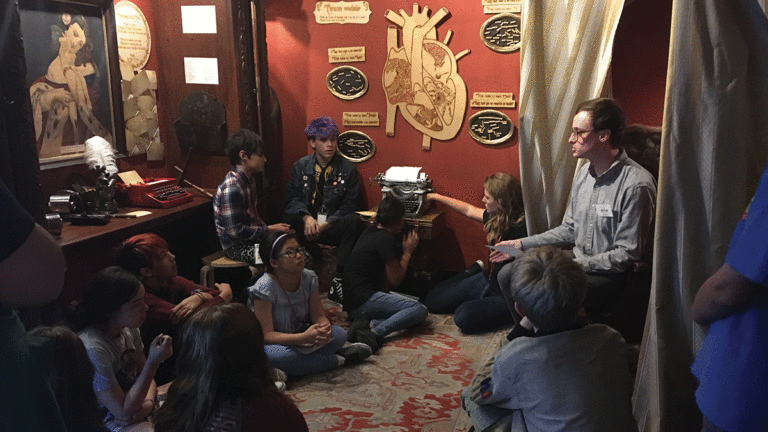
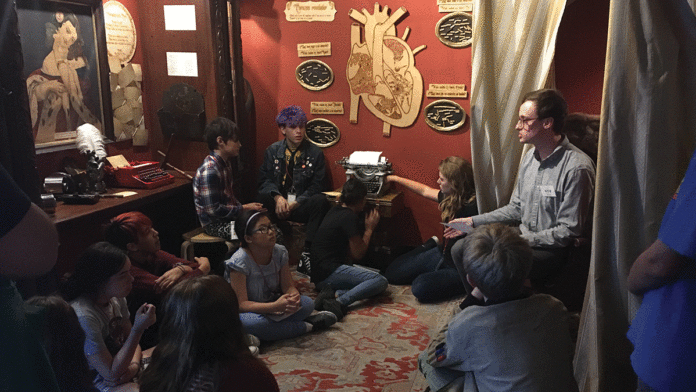
Cora is an explorer/adventurer and crypto-zoologist. She’s also the unseen presence at the Chamber of Heart and Mystery, the beguiling, 350-square-foot room of delights at Santa Cruz’s Museum of Art & History. The Chamber is a product of the Young Writers Program, in which visitors of all ages can come and inspect Dr. Crux’s study, a kind of Lemony Snicket-esque closet of antiquated technologies, including old telephones and typewriters—all in the service of inspiring the imaginations of young writers.
This month, after three years at the MAH, the Chamber is packing up and leaving, without a new permanent spot. To mark the occasion, the Young Writers Program will be holding a farewell party on Thursday, July 11 at the MAH, that will also act as a fundraiser to help the Chamber find a new home. The event will feature live music by Coffee Zombie Collective, plus refreshments.
“We are going to have a celebration for the de-installation of the Chamber,” said YWP director Julia Chiapella. “That’s how we’re looking at it: a celebration. Our plan has always been to have a space like 826 Valencia.”
That is a reference to the famous “Pirate Supply Store” retail storefront in San Francisco that serves as the portal for the writing program founded by novelist Dave Eggers and teacher Ninive Calegari. Ideally, Chiapella would love to find a retail space that can serve the same purpose. In the meantime, the artifacts of Dr. Crux will be placed in a new space at Branciforte Middle School.
For the past three years, the Chamber has served as a portal for the Word Lab, the on-site after-school literary program operated by the YWP. The Word Lab will continue on at the MAH without the Chamber. That program has served about 145 students from Mission Hill and Branciforte middle schools, and Harbor and Santa Cruz high schools every year in three separate, nine-week sessions. Also continuing will be the YWP’s in-classroom projects that inspire middle- and high-school students to write poetry, fiction and nonfiction.
“We couldn’t be there forever,” said Chiapella on the Chamber’s exit from the MAH. “Real estate being what it is in Santa Cruz, it’s hard to find a place for a non-profit. So the (July 11 event) will be both a celebration and a call to the community on how we can keep this going, or if we want to keep this going.”
The Chamber has many interactive features and old-school technologies, including story cubes, a magic lantern and a cabinet of curiosities. They are designed to work as writing prompts or otherwise stoke young imaginations, all presented in a rich Edwardian-era aesthetic with no trace of the digital, push-button world that surrounds kids today.
“The kids that come in are absolutely enchanted,” said Chiapella, “and the adults are as well. We have this telephone—we call it a ‘heart phone’—where people pick it up and several things are recorded on it. Some of the things are odd, or zany, or tender, or surreal. It’s been a lovely thing.”
Chiapella worked with Santa Cruz children’s author David Zeltser to establish a place like 826 Valencia in Santa Cruz. And project designers Rebecca Goldman and Carmen Clark conceived of the idea after a visit to the San Francisco site.
“We do get those kids who look around and say, ‘This is stupid,’ and move on. But they are really few and far between,” said Chiapella. “There is an enchanting element to the analog nature of it, at this point. It engages you in a way that’s not directing you necessarily. It doesn’t have that instant gratification quality to it. It demands that you think, slow down, and tell your own story.”
A celebration of the Chamber of Heart and Mystery will be held Thursday, July 11, 7 to 9 p.m. at the Museum of Art and History, 705 Front St., Santa Cruz. $15 general admission. youngwriterssc.org.
Ed Muns showcased his wines at Vino Locale on the Santa Cruz Municipal Wharf recently, an opportunity for my husband and I to check out the sea lions and try the new-ish wine bar on the water. The best part was tasting the superb wines of Muns Vineyard, including the 2014 Syrah ($30) from Muns’ estate vineyard.
Muns and partner Mary Lindsay not only make wine under their own Muns Vineyard label, but also grow an abundance of grapes for regular customers. Out of several wines I tried at their pop-up tasting, the 2014 Syrah is my favorite. Its stewed plum and blackberry aromas, with notes of pepper, jam and spices, add enormous depth and complexity.
Vino Locale is owned by Debra Szecsei and offers small plates of food and tapas to pair with their ample inventory of wines, many of them local. I recommend the quiche ($9) from Kelly’s French Bakery or the mini chicken empanadas ($10).
Muns Vineyard doesn’t have a tasting room, but their wines are available at various stores in the Santa Cruz area. Muns is a sponsor of the Jazz on the Plazz free summer concerts in downtown Los Gatos, a chance to imbibe good wine while listening to cool vibes.
Muns Vineyard. 408-234-2079, munsvineyard.com; Vino Locale Wine Bar & Bistro, 55 Municipal Wharf, Santa Cruz. 426-0750, vinolocale.com.
CHOCOLATE…AND COCKTAILS
The hot downtown Santa Cruz restaurant Chocolate will be serving up some fabulous cocktails starting July 12. Owner David Jackman is showcasing a dry chocolate martini with an unsweetened cacao-nib-vodka infusion and “a delicious chocolate taste, not bitter and not sweet,” says Jackman. Another nib infusion is the Chocolate-Mint Mojito—just delish! And try the Lilikoi Margarita with passion fruit puree. Jackman also has added burgers to his menu, either vegan or free-range pork on house-made buns and served with organic roasted steak papas (thick-cut potato wedges). And don’t miss Jackman’s ambrosial hot cocoas, perfect for cool Santa Cruz weather.