A Return Journey—Mercury retrograde: Risa’s Star’s Nov. 14-20

As Venus becomes stationary direct, Friday (Nov. 16), Mercury becomes stationary retrograde. An interesting intersection of planetary movements. Although soon in direct motion, Venus will remain in her retrograde shadow until Dec. 18. With Venus slowly moving forward, our newly assessed values and how to use resources more effectively become apparent. We are careful and observant of these things. 

And so, as one planet ends its retrograde motion, another begins. Mercury (wing-footed Hermes) retrograde (13 degrees Sag – 27 degrees Scorpio) is retrograde until Dec. 6 at the new moon. Mercury retrograde—rediscovering, sorting through and assessing the past, eliminating what is no longer useful, keeping what is. Mercury retro in Sag, then Scorpio. We all know the rules of Mercury retrograde. We refrain from initiating new projects, or buying large items (cars, homes, appliances, things of great value).

We are careful with communication, thinking, speaking, driving, etc. We check and recheck the fine print. We ponder upon our words before we speak. We are compassionate with others as they speak. Everyone’s mental apparatus is upside down, inside out, sideways. Except those born in Mercury retrograde.

With Mercury retrograde in Sagittarius, we are careful while traveling. We may end up in places we least expect. We are careful while communicating with the law, with lawyers and professors. Mercury retro is a time of productivity. We clean out, review, update, confirm, revise, catch up, reconnect and become aware of deep revelatory insights. We are flexible and adaptable and sometimes think backwards. We research and reflect. We rethink, rework, re-envision, rearrange and rekindle.

We slow down, enter into a sort of retreat. We consider Mercury retro as a time to hide away, creating a sanctuary and a refuge from the world. We slow down.

ARIES: Those working with you seek your direction and mentorship. You’re the courage, bravery and light needed that “lights their way.” This is not a compliment. It’s a responsibility of leadership coupled with love. It’s important to maintain health, exercise and a simple diet. Possibly you need more calcium/magnesium for calmness. With all relationships, be kind.

TAURUS: The work and responsibilities continue to arrive. You tend to everything needed, forging ahead with Vulcan’s (Soul ruler) help. Vulcan fashions gold out of iron (Soul/personality), creates a forward momentum, allows for optimism (a little), drives you toward future goals. On your mind, always, is how to create and sustain community. It takes more than a village. Tend to your health carefully. Rest every other day.

GEMINI: Home matters more and more. Where you live, with whom, and how to create an environment that supports health and well-being. Simultaneously you must nourish your curious and dual mind. Movement forward is always an issue. Continue to care for yourself and others nearby with compassion and humor. You are to serve with a wise heart. Venus, your companion, surrounds you with a pale orange light.

CANCER: Home and family become increasingly filled with responsibilities and work. You try to carry on family traditions. However, so many tasks interfere. Restrict how much work you’re doing for others or exhaustion ensues. An acupuncture treatment is most likely needed and chiropractic, too. You’re the one at home needing tender loving care. Rest a while.

LEO: Are you finding yourself creating deeper relationships with others? Leos often tend only to themselves and this creates loneliness. Wherever there’s an imbalance, ask questions, listen, assess, speak from the heart and forgive. Saturn, Dweller on the Threshold of new ways of being, asks you to review past beliefs before new foundational realities can form. Share resources and values. Tend to your favorite kingdom.

VIRGO: In daily life, have the intention to focus on facts not fictions, fantasies, or wishful thinking. Facts are the foundation of a clear thinker and later, a good leader. Facts help uplift emotional disturbances, disappointments and confusing changes. Venus asks that you continue to consider what is of value to you and provides both emotional and intellectual inspiration. Listen for the still small voice of God, the Soul within.

LIBRA: You seek a sense of belonging. Your talents and gifts have created a life filled with much abundance. Perhaps you now seek spiritual intuition. You wonder how all the work needed in your life can have less stress and limitation. You know you’re here to serve. You change your appearance with confidence. You’re more harmonious. You’re a bit mysterious, too. Careful with exercise. Careful with bones and ligaments. Careful driving.

SCORPIO: Notice your concern with how others (groups) see and assess you. Notice a change of values occurring, too. It’s an excellent time to contact old friends; assess business opportunities, re-enter groups and review social media. There’s a community or group needing your research abilities. Your self-identity shifts all about. This will continue until it stabilizes. Maintain composure, balance, faith.

SAGITTARIUS: Work should be good and fruitful. You know you’re well-liked, however, you possibly feel restricted, constrained and controlled by situations not quite in your control. It will be important to make yourself more productive, creating harmony at all levels of work. Banish any thoughts of limitation, create a positive, light-filled aura. The outcome will be more than expected. Work on the honor system. Your honor.

CAPRICORN: Contact those far away who love and care for you. Your communication creates harmony and happiness. As your mind ponders future goals, include religious as well as physical, emotional and intellectual considerations. Spirituality and religion sustain us, for they touch energies greater than ourselves. Prayer stabilizes us. As you continue to transform, recite the Soul and Great Invocations daily and with family.

AQUARIUS: Careful with money in terms of the future. It may slip through your hands easily. Assess how you are living and if it’s sustainable for you. Consider other futuristic ways of living. Allow no limitations of thought. Discuss with others how the present world situation affects how and where you live. Share with everyone what you value and need. Daily routines are changed. Your vitality (life force) is intact. Pray to the devas. They’re your friends.

PISCES: Sometimes we are walking a razor’s edge precipice, remembering yesterday, not seeing tomorrow. It’s good to summon faith that there is indeed a Path ahead even if it’s invisible. There will be a moving forward soon (after years of unknowing). The forests will become the trees of opportunity. Do what’s necessary to create and build community. Ask humanity to help. Draw up a wish list and work on it each day. Everything’s possible. Everything comes to us that we ask for. In time and space.

Catch This Cab Franc From DeVincenzi Cellars

I was spending the night at a friend’s house after her surgery, only to find out she was out of wine—so  I dashed over to Deer Park Wine & Spirits to get a bottle to enjoy with some split pea soup she’d made ahead of time for dinner.

I found just the thing to pair with the hearty soup and crusty bread—a reasonably priced DeVincenzi Cellars Cabernet Franc for about $20. It’s a good buy for a well-made wine—and after a long day spent in the hospital’s waiting room, a glass of Cab Franc never tasted so good.

DeVincenzi Cellars is a small family-owned winery located in the Santa Cruz Mountains. Winemaker Frank Virgil has infused a touch of passion into his 2014 Cabernet Franc along with a subtle licorice and violet nose and a full-bodied cherry-brandy oak finish. Try it with a big juicy steak.

DeVincenzi Cellars, 24572 Hutchinson Road, Los Gatos, 831-334-6083. devindenzicellars.com.

Equinox Library Wine Party

Equinox Wines will be throwing a party to share a selection of limited-edition, exquisitely aged Equinox and Bartolo wines. These cellared-to-perfection reds and sparklings will be introduced by winemaker Barry Jackson and complemented by a carefully curated snack. All the wines are ready to drink and share with friends, and each would bring something special to your holiday table. The event is 7-9 p.m. Saturday, Oct. 13 and tickets are $50 ($25 for wine club members).

Equinox Sparkling Wine & Bartolo Reds, 334C Ingalls St., Santa Cruz, 471-5608. equinoxwine.com.

Sip and Sail on a Wine Cruise

Setting out to sea with one of your favorite wineries on board is an all-time top-notch pleasure.

Here are two wineries—both with longtime customers and wine club members—who you can sign up to sail with. Burrell School is set for a Taste of Bordeaux trip to France in November; and Big Basin Vineyards will cruise through the Rhone Valley in April 2019. It goes without saying that you’ll be served superb food and wine.

For more info visit the Santa Cruz Mountains Winegrowers Association website at scmwa.com.


This Veterans Day, Pro-Peace Vets Remember Armistice Day

On Nov. 11, an impassioned group of local veterans will be marching 17.7 miles from Watsonville to Santa Cruz to bring awareness to the issue of veteran suicide.

Bells will toll and bagpipes will play at 11:11 a.m., welcoming the two dozen vets making the long trek to the clock tower in downtown Santa Cruz, and kicking off 2018’s Veterans Day Remembrance and Armistice Day Celebration in Santa Cruz.

“The walkers will highlight the epidemic of suicide that exists in the veteran community,” says Tatanka Bricca, event coordinator and human rights advocate. “Veterans live with the guilt of war, and more of our soldiers die from suicide than actual combat.”

When the large, ornate bell, crafted out of a canister shell from the Vietnam War, stops ringing at 11:12, a remembrance ceremony will be held for all veterans. The bell is symbolic—in the spirit of turning swords to plowshares—and is representative of the theme of this year’s festivities: peace.

“We need to remember there’s a large group of veterans returning from war who are very passionate about peace. We want to celebrate them both,” says Bricca. “We need to celebrate the end of war—where we won’t need war to solve our problems.”

After the ringing of the bells, the celebration will move across the street to the Veterans Memorial Building for the “Afternoon Community Symposium on Creating Peace,” packed with speakers, panel discussions, food, music and more. It will be the culmination of the work Veterans for Peace, Armistice 100 SC and a host of other organizations have done over the last year.

For this year’s celebration, local vets have decided to resurrect and reclaim the original Nov. 11 title of Armistice Day: “A Day of Peace.” Leaders in the veteran community feel it’s possible—and appropriate—to celebrate Veterans Day and the lesser-known Armistice Day at the same time.

One hundred years ago, Nov. 11 was a day of celebration. On the 11th minute of the 11th hour of the 11th day of 1918, World War I finally ended. Decades before Veterans Day became an official national holiday in 1954, Nov. 11 was a day to celebrate that peace and to rejoice in the end of war. It was called Armistice Day.

Armistice Day’s plea for peace in this complicated and chaotic world exists as a reminder that the last hundred years have been anything but peaceful.

“Ultimately, I hope I am one of the last humans to be called a veteran,” says Paul Damon, a veteran and founder of Holistic Veterans. “If this title does not exist, then we have found peace amongst all human beings.”

Opinion: November 7, 2018

EDITOR’S NOTE

One of the things we like to do is follow some of the notable graduates who come out of UCSC. But I have to say that this is maybe the strangest story of that type that we’ve ever run. It’s certainly the most unexpected.

That’s not just because Charles Harder went on to be Donald Trump’s personal lawyer and represent a number of famous conservative figures. Sure, there’s a certain amount of irony there already, as Trump is one of the most passionately hated figures at UCSC, and in Santa Cruz in general. But it’s not like there are no Republicans in Santa Cruz, or conservative graduates from UCSC—of course, there are plenty of both.

What makes Harder’s story so intriguing is that he was very active in progressive causes while he was at UCSC, and that he doesn’t really seem to disavow them now. I don’t want to spoil too much of Jacob Pierce’s fascinating cover story, but I will say I think he did a fantastic job of reporting in it—both in his interviews with Harder, and in how he tracked down people who knew and worked with him while he was in Santa Cruz. It’s a complex and often surprising profile, and the kind of story that will draw a wide range of reactions from readers, I’m sure. Enjoy!

STEVE PALOPOLI | EDITOR-IN-CHIEF


LETTERS TO THE EDITOR

Read the latest letters to the editor here.

We Are Not Alone

Re: “Closer to Encounters”: Great article on Frank Drake (GT, 10/31). I would like to add that we are “closer to encounters.”

There is another interesting organization, ECETI (Enlightened Contact with Extraterrestrial Intelligence) in Mt. Adams, Washington, studying the skies. ECETI was founded by James Gililland over 30 years ago, and has more footage and documentation of flying craft than anyone on the planet. It is quite impressive.

Mt. Adams is sacred Yakima Indian land, with hundreds of flying craft sightings recorded in their history. ECETI has attracted people from all over the world, including Boeing engineers, astrophysicists, and NASA scientists to witness the overwhelming evidence that Drake’s Equation is correct. We are not alone!

I personally have had several mind-blowing experiences at ECETI that are, quite frankly, out of this world. Great news that Mr. Drake and SETI can continue this important study in solving mankind’s greatest mystery. I believe!

Fiona Fairchild
Santa Barbara

Don’t Be Fooled

Re: “Up in Smoke” (GT, 10/3): Santa Cruz can do something about the single most preventable cause of death in California—tobacco use. The city should join San Francisco and two dozen other cities and counties in California in restricting the sale of flavored tobacco products. Menthol and candy-flavored tobacco products are a key part of the tobacco industry’s strategy to bait new users, especially youth, into becoming tomorrow’s addicts.

Ending the sale of these flavored tobacco products is an issue of both health and social justice. Young people who use flavored tobacco products, including menthol, are often African American, Asian American, LGBTQ and from low-income communities already significantly impacted by tobacco-related disease. All the while, local taxpayers continue to foot the bill for tobacco-related illnesses.

According to a government study, 81 percent of kids who have tried tobacco started with a flavored product. The American Cancer Society (ACS) says while e-cigarettes may be less harmful than smoking cigarettes, the health effects of long-term use are not known. Don’t let anyone tell you e-cigarettes are not tobacco products, either. The nicotine found in e-cigarettes is derived from tobacco. FDA regulates e-cigarettes as tobacco products.

ACS also recommends FDA-approved cessation treatment as the preferred means to quit smoking and ACS states every effort should be made to prevent youth from using e-cigarettes. The use of products containing nicotine in any form among youth is unsafe and can harm brain development.

The American Cancer Society Cancer Action Network, the advocacy affiliate of ACS, recently supported San Francisco as it enacted the most comprehensive flavored tobacco sales restrictions in the country after a lengthy and brutal battle against Big Tobacco, which poured nearly $12 million into fighting the historic new law.

Put public health above business profits and put flavored tobacco sales restrictions in place—for our kids and for our future!

Jim Knox 
| American Cancer Society Cancer Action Network

Re: New WAMM Garden

My heart rejoices at this news my beloved Valerie and my beloved family at WAMM, I am so happy that this has come about. We have persevered. Well done. And to the benevolent providers of this gift I will be eternally grateful. I think of my friends my beloveds who have gone before the hard work of so many.

In our garden, the sign “love grows here”—no truer words are spoken. A true gift of love is just working in the garden, having the camaraderie and the support in a non-judgmental environment helps ease suffering. Those who can providing for those who can not. Nature heals, love heals, our life-saving natural plant medicine heals. Blessings.

— Diana Dodson


PHOTO CONTEST WINNER

Submit to ph****@*******es.sc. Include information (location, etc.) and your name. Photos may be cropped. Preferably, photos should be 4 inches by 4 inches and minimum 250dpi.


GOOD IDEA

Aptos locals will soon get a chance to reimagine their hub for reading, learning and gathering as a community. Santa Cruz Public Libraries and the county of Santa Cruz have invited members of the public to join in a series of meetings to help plan renovations to the Aptos Branch Library. The first is from 7-8 p.m. on Tuesday, Nov. 13, at the Aptos Library
, located at 7695 Soquel Drive. The second meeting, which will also be at the library, is on Tuesday, Dec. 11, from 7-8 p.m.


GOOD WORK

The Santa Cruz Warriors’ season is now underway (see page 14), and the team has announced an agreement to broadcast all 24 regular season home games for the 2018-19 season on television. The games will air on NBC Sports Bay Area, already the television home of the back-to-back NBA champion Golden State Warriors. Twelve of Santa Cruz’s home games can also be seen on NBC Sports Bay Area’s new MyTeams app, which can be downloaded for free.


QUOTE OF THE WEEK

“If there were no bad people, there would be no good lawyers.”

-Charles Dickens

Effigy Launches ‘Nomadic Brewery’ in Santa Cruz

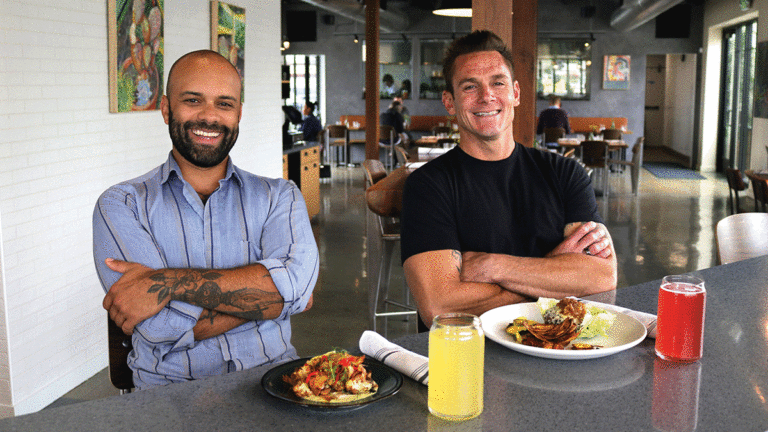
If you’re tempted to roll your eyes at the idea of yet another craft brewery opening in Santa Cruz County, brewer Ben Ward agrees with you. That’s why his Effigy Brewing is a “nomadic brewery,” without its own production facility.

Rather, Ward partners with other local breweries to use their production systems to make Effigy branded beers, which are then available at the breweries that he partnered with, as well as local taphouses.

Although he hopes one day to establish his own agriculturally focused farmhouse brewery, with the entry rate at more than a million dollars, he’s not rushing to open a brick-and-mortar.

“I’ve gone from having the same idea as most other people, which is [that] I like homebrewing and I want to see what I can do commercially. The standard way to do that is finding a warehouse and doing what you can to get open,” says Ward. “But somewhere along the way, I realized that it doesn’t make sense to keep doing that, and I don’t think the community needs or wants that.”

As he finds his place in the beer community, Effigy has begun brewing a wave of collaboration beers with local breweries—a Berliner Weisse with Elkhorn Slough Brewing, a Double IPA with Seabright Brewery and a cask-friendly Brown Ale with East Cliff Brewing. Although most of these beers have already been enjoyed by thirsty customers, Ward says the next wave is coming in late November.

Having drank many Effigy beers over the years while working with Ward at the now-closed Seven Bridges Organic Homebrewing Supply, I can say his brews have earned their reputation for being well-crafted, balanced and delicious. With over a decade of homebrewing under his belt, Ward has honed his skills working on commercial systems at Humble Sea, Shanty Shack and Elkhorn Slough, and others.

Now, he wants his own brewery to focus on “California beer that’s sourced as locally as I possibly can. Right now, that means malts from Admiral Malting in Alameda, hops from Akiyama Hopyard in Watsonville and other California hop yards, and as much wild yeast and bacteria as I can capture. I want to lean heavily on relationships with farms and seasonality.”

Look for Effigy’s beers at local breweries, Lupulo and Beer Thirty later this month.

effigybrewing.com.

5 Things To Do in Santa Cruz Nov. 6-13

A weekly guide to what’s happening.

Green Fix

Light Up the Night

Too many bike riders are not lit enough. No, not like that kind of lit! Lit like illuminated. Bike Santa Cruz County wants to light you up, and is giving out free bike lights to the first 250 people that show up to their Light Up the Night event, so get there early. No worries if the bike lights run out, there are still a number of activities happening, including bike decorating, making reflective spoke cards, custom helmet stenciling, and a raffle with visibility-related prizes. The event will conclude with the most well-lit bike parade Santa Cruz has ever seen. Photo: Richard Masoner.

INFO: 6 p.m. Friday, Nov. 9. Current eBikes. 131 Front St., Santa Cruz. 425-0665. bikesantacruzcounty.org. Free.

Art Seen

I.M.A.G.I.N.E. Peace Now

In the aftermath of the deadly Pittsburgh synagogue shooting, the Radius Gallery’s newest exhibit is more potent than ever. The I.M.A.G.I.N.E. traveling art show stands for “innovative merger of art and guns to inspire new expressions.” The 74 included artists created sculptures using decommissioned firearms collected during a Pittsburgh gun buyback program, and made them into art. The show isn’t necessarily anti-gun, rather it represents the pro-peace and pro-responsible gun legislation idea that art can diffuse violence.

INFO: Artists talk 2 p.m. Sunday, Nov. 11. Show runs through Nov. 11. The Radius Gallery. 1050 River St., Unit 127. Santa Cruz. 706-1620. radius.gallery. Free.

Saturday 11/10

‘Pigeon and the Crow’ Graphic Novella Release

Who knew a girl could fall in love with a crow? Or a crow could fall in love with a girl? All she did was feed the crow, and before she knew it the crow was bringing her gifts and she turned into a pigeon. Let that be a lesson for those who feed the birds—you might get more than you bargained for. This illustrated modern folktale is a collaboration between local illustrator Mike Benzce, who helped put together the graphic novella, and songwriter Nels Andrews, who wrote a song to narrate the story. It’s based on a real concept of crows bringing back shiny trinkets to those who feed them, and is set on the Central Coast. Join the two artists in celebrating the debut of the graphic novella.

INFO: 8 p.m. The Radius Gallery. 1050 River St., Unit 127. Santa Cruz. 706-1620. radius.gallery. Free.

Friday 11/9

Reel Rock 13

Adam Ondra is not a real human person—anyone can tell from watching him climb. He looks like he’s possessed, and kind of sounds like it too. It’s a kind of otherworldly grunting and screaming that’ll make Halloween seem like Easter. Ondra is one of the best climbers in the world, if not the best climber in the world. He recently climbed the hardest route in the world—a 5.15d, for reference—and made a movie about it. Why anyone would enjoy doing this, we don’t know, but it sure is fun to watch. Joining Adam Ondra is another climbing legend, Alex Honnold, who is also not really human because he likes to scale El Capitan without ropes. Reel Rock 13 is bringing both dudes to the big screen, along with a long-dismissed type of climbing—speed climbing—that may be finally getting its well-deserved due. Photo: Brett Lowell.

INFO: 7 p.m. Rio Theatre. 1205 Soquel Ave., Santa Cruz. riotheatre.com. 423-8209. $20/$25.

Saturday 11/10

11th Hour Coffee Grand Opening Party

Wait, you say, hasn’t 11th Hour Coffee been open forever? Why yes, yes it has, and they have been making some super fancy yet delectable avocado toast, too. Thanks for asking! They never really did have a big to-do, though, so they are really kicking off the business with a barista competition, live music, and the Gordo Gustavo’s food truck—because what goes better with a latte than a pork breakfast sando? Nothing!

INFO: 8 a.m.-9 p.m. 11th Hour Coffee. 1001 Center St., Santa Cruz. eleventhhourcoffee.com. Free.

Sunday 11/11

Mountainfilm Festival

Hailing from Telluride Colorado, Mountainfilm Festival is celebrating 40th anniversary with some particularly special and timely films. The 12 short films are spread across the outdoor appreciation spectrum, from climbing crusher brothers (for those of you who didn’t get enough climbing from Reel Rock 13) to political calls to preserve our wilderness. There’s a sprinkling of celestial awe, Icelandic fishing, and plenty of snowy wonderlands for those biting at the bit to get to the snow.

INFO: 7 p.m. Rio Theatre. 1205 Soquel Ave., Santa Cruz. riotheatre.com. 423-8209. $18.

Election 2018 Results: Rent Control, City Council and More

0

Update 11/8/18: The elections department announced that ballots from a few precincts were mistakenly left out of the initial counts. When officers added them in yesterday, it amounted to an additional 3,528 votes. Santa Cruz City Council candidate Drew Glover is still in fifth place. The gap has widened slightly, though, between Glover and Greg Larson and Richelle Noroyan, who are third and fourth, respectively, in the race for three seats. County Supervisor Greg Caput has extended the lead in his re-election bid over Watsonville City Councilmember Jimmy Dutra.


It’s still early, but anyone expecting a major change in local housing policy via Santa Cruz County ballots may be poised for a significant disappointment.

Measure H, the county’s affordable housing bond, is, at this point, well short of the two-thirds majority it needs to pass. The initiative saw a small jump between the initial results, released just after 8 p.m. tonight, and the third round, which were released at 10:30 p.m. The measure is now up to 52.3 percent, up from being below 50 percent in the first round.

Another measure that’s still trailing badly is Measure M, the city of Santa Cruz’s rent control initiative, which is garnering just 33.9 percent of voter support so far.

In the Santa Cruz City Council race, environmental consultant Donna Meyers is currently in first place. Trailing her is environmental educator Justin Cummings, who’s followed by management consultant Greg Larson, Councilmember Richelle Noroyan, community organizer Drew Glover, and psychotherapist Cynthia Hawthorne.

With 10 candidates vying for three City Council seats, it’s far too early to say what will happen. Cummings and Glover are both rising as more results come in. In general, voters who cast their ballots later in the process often lean farther to the left.

Transient occupancy taxes in Capitola, Scotts Valley and Watsonville all look poised to pass, as does Measure G, Santa Cruz County’s sales tax measure. Measure L, Greenway Capitola’s measure, is ahead.

County Supervisor Greg Caput is leading in his race against challenger Jimmy Dutra, a Watsonville city councilmember. Caput is comfortably ahead with 54.2 percent to Dutra’s 44.9 percent.

Rebecca Garcia looks poised to coast to re-election to the Watsonville City Council, and Ari Parker looks poised to win there as well. Francisco Estrada is ahead of Jenny Sarmiento, and Watsonville Mayor Lowell Hurst ran unopposed.

Scotts Valley Mayor Jim Reed and real estate agent Derek Timm are leading in their quest for two seats on the Scotts Valley City Council, ahead of Councilmember Stephany Aguilar.

In the race for three seats on the Capitola City Council, education officer Yvette Brooks, former Mayor Sam Storey and Councilmember Jacques Bertrand are pretty comfortably ahead of ironworker Jack Digby.

Congressmember Jimmy Panetta (D-Carmel) and state Assemblymember Mark Stone (D-Scotts Valley) are both winning by wide margins, as expected. San Benito County Supervisor Robert Rivas, who’s also running for the Assembly’s 30th District, which includes Watsonville, is also doing well.

Statewide, Gavin Newsom is projected to win the governorship, while U.S. Senator Dianne Feinstein is projected to win re-election.

Nationally, Democrats are expected to take control of the House of Representatives, while losing seats in the Senate.

For Santa Cruz County’s full election results, visit: votescount.com.

Love Your Local Band: Mr. Bounce Man

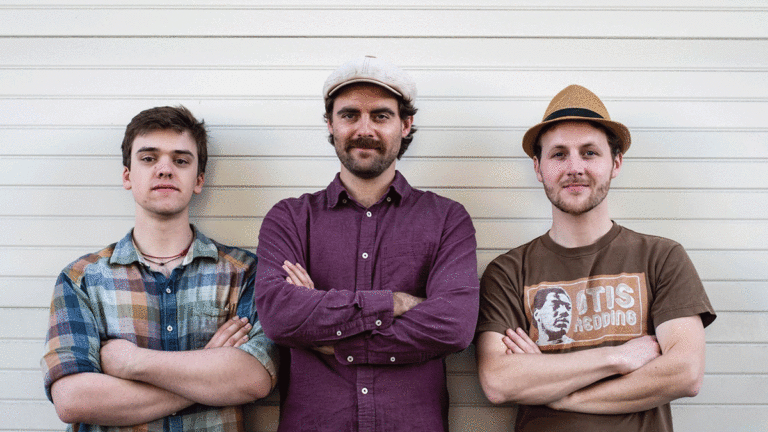
Jeff Peters grew up going to raves in the early ’90s.

A few short years later, some friends told him about Burning Man, which was where a lot of the raver kids were congregating to. He really dug it. A friend of his built an EDM-blasting art car for the desert festival, which he called the “bounce car.”

“That sparked the love for the whole DJing aspect of music. I went full head-on from there,” says Peters, who DJs under the name Mr. Bounce Man. “We started with a pretty janky version. Every year we upgraded.”

The Bounce Car is still very much a thing, with multiple DJs (including him) continuing to create a massive desert party at Burning Man every year. They also play other gigs, like at Decompression in San Francisco recently, to thousands of EDM fans. Gigs in Santa Cruz are less frequent, but they do happen—they performed at the Santa Cruz Music Festival last year and will likely play next year.

“I’m trying to keep the music and vibe kind of bouncy. It’s creating an energy for people to follow,” Peters says.

When he’s not getting a massive dance party going on the bounce car, Mr. Bounce Man is doing solo gigs in more intimate spaces. The vibe is basically the same. It’s all about getting people bouncing. The music is fun, high energy and usually revolves around house, hip-hop, trap and whatever else the crowd is digging on.

“I’m a person that’s been dancing since 15 or 16,” Peters says. “It’s always been a thing for me. It’s kind of like full circle to be able to make people move constantly and enjoy life in that way.”

INFO: 8:30 p.m., Thursday, Nov. 8, Moe’s Alley, 1535 Commercial Way, Santa Cruz. $12/adv, $15/door. 479-1854.

How Charles Harder Went From UCSC Democrat to Trump’s Top Lawyer

Charles Harder fell in love with UCSC the first time he visited in the fall of 1986.

He remembers the wispy clouds, bright blue sky and wet-glistening dew of the forest around him. The scene reminded him of the camping trips that his best friend’s mom would take him and his buddy on to National Parks like Yosemite. “I was over the moon, I just loved it,” Harder remembers. “It was like we were simpatico.”

The following year, Harder moved from the San Fernando Valley to Santa Cruz, where he began his freshman year at UCSC as a biology major, but soon switched to politics. He embedded himself in the local Democratic scene, leading the UCSC College Democrats. “No one else wanted to do it,” he says. He interned with then-Assemblymember Sam Farr and served on liberal county Supervisor Gary Patton’s staff. He remembers winning awards from Farr, Dianne Feinstein, Leon Panetta and Henry Mello. Harder served for one quarter as managing editor of the Santa Cruz Independent, a campus newspaper at the time. He took theater arts classes and sang as a tenor in the elite UCSC Chamber Singers choir. Thirsty for adventure, he biked across the country on a summer vacation in 1989, at age 19.

Those who knew Harder, a 1991 graduate of the university’s Merrill College, and have followed his post-college career have been surprised to see where it has led him. Now an attorney, he’s defending Donald Trump, the 45th president of the United States, as his personal lawyer.

“If you told any of us back in 1990 that he’d be working for Trump, we’d say you’re fucking crazy, because he was a liberal guy,” says a former high-ranking staffer at the Independent, who asked to remain anonymous.

Harder remembers starting the College Democrats club, and says he served as president for about three years. These days, no one at the organization has records going back that far, nor does anyone from the Student Organization Advising and Resources Department.

If the town leaned liberal in Harder’s college days, Santa Cruz’s Democratic Party has solidified its local presence in the years since. Only 9 percent of Santa Cruz city voters supported Trump in the 2016 election, one-fifth of the popular vote percentage that the current president earned nationwide.

The Washington Post reported that Harder donated $500 to Barack Obama in 2008 and voted in the 2016 Democratic primary, but that, in December 2016, after Trump’s election, he changed his party affiliation to nonpartisan. He won’t say how he voted in 2016, but stresses that he’s long written checks to candidates of both parties, expressing an affinity for politicians like former Gov. Arnold Schwarzenegger.

“It’s nice that we have a secret ballot,” Harder says. “I don’t think I’ve ever disclosed who I’ve voted for, at least not to a reporter.”

Hush with Fame

Harder has been working for Trump on a few cases, including the lawsuit brought by porn star Stormy Daniels over a dispute about hush money stemming from an alleged affair she had with the president. Harder’s also defending him against former aide and fellow reality television star Omarosa Manigault.

Trump may be one of the most polarizing presidents in American history, but Harder says representing him has nothing to do with politics.

“The things where I’ve represented the president—they really have nothing to do with public policy,” Harder says, his shoes kicked off in his Beverly Hills office, revealing socks with a pattern of dancing hula girls. “I’m not representing him on immigration, or the environment, or the economy, or foreign policy. I have nothing to do with any of that. So people should not look to me as if I have any role to play on that, because I don’t.”

He says he doesn’t have a “litmus test” for potential clients. Rather he takes on cases that he likes and that he thinks have merit, and that he turns about two-thirds of potential cases away.

Harder is also representing the Trump campaign and Trump’s son-in-law Jared Kushner. He represented Melania Trump in a defamation suit against the Daily Mail that settled for $2.9 million. Last year, he wrote the New York Times a letter on behalf of Harvey Weinstein, threatening to sue if the paper published its months-long investigative report into sexual assault allegations against the movie mogul. Harder resigned from Weinstein’s legal team a few days after the story, which would later win a Pulitzer Prize, was published.

Harvey Weinstein
Disgraced Hollywood Producer Harvey Weinstein is among Harder’s previous clients.

Harder’s big break was representing Hulk Hogan against Gawker Media in a case that earned a $140 million judgment. Of course, he wasn’t exactly a small-time attorney at the time, having already represented Hollywood celebrities like Schwarzenegger, Clint Eastwood, George Clooney, Sigourney Weaver, Bradley Cooper, Sandra Bullock, Cameron Diaz, Reese Witherspoon and Lena Dunham.

Harder’s earlier Hollywood work often focused on celebrity images, like when a furniture company was using Eastwood’s name and image to sell chairs without his permission.

Harder, whose two sons attend middle school in Santa Monica, has clear turquoise eyes, and were it not for his silvering brown hair, would look a decade younger than his 48 years. Sitting in the sunlit communal “living room” area of the law office, he asks me not to record—an uncommon request from sources in news interviews. He says it’s always been his policy with reporters.

Politically, Harder says he strongly supports the environment and civil rights, but also believes that government spending and taxes are out of control. He has a vision that government should work more like a smartphone app, like Uber. Disillusioned by the news media, he sees CNN and the New York Times as being as far to the left as Fox News is to the right. His views, he says, have evolved slowly over time.

Sam Farr, a Democrat who represented the Monterey Bay in the House of Representatives for 20 years, has vague memories of Harder, even though he had probably about 100 other interns after Harder’s tenure. Farr remembers him as very likeable and “a real go-getter.” Although Farr wasn’t familiar with Harder’s career, he isn’t surprised to hear that his former intern found success as an attorney. Farr thinks Harder’s success shows how valuable an internship can be, as it shows how government processes work. He hopes the experience has made Harder a better citizen and a better lawyer.

Farr is a little disappointed, though, to hear about some of the shifts in Harder’s politics.

“It seems like his desire to be big lawyer has stepped on the good learning he got at UC Santa Cruz,” Farr says, before adding something his Democrat father, who had been raised conservative before attending UC Berkeley, told him: “People with good educations don’t end up as Republicans.”

“Sure, some do,” Harder responds, when asked about Farr’s quip. “But I’m not a Republican, so no comment on that one.”

Client Privileged

Sitting across from Harder in early October, I got a clear sense of what it would take my fellow left-leaning friends in Santa Cruz a couple more weeks to learn: Trump could prevail in his legal battles against Daniels.

Say what you want about Harder—you might find his politics confusing or perhaps believe that he’s protecting a president who shows dangerously authoritarian tendencies. In conversation, though, even a total novice could plainly see that Harder is a serious lawyer. I knew, even in the midst of my discussion with him, that this was a bizarre revelation to come to. Considering that he is an attorney involved in one of the news cycle’s highest-profile lawsuits, it should go without saying. But I only had to follow the antics of prosecuting attorney Michael Avenatti, who seems to be using the legal system to run for the Democratic nomination for president—and whose skill for trolling the American public nearly matches that of the sitting president himself—to know that Daniels, sympathetic as many Americans might find her, might not have an easy day in court.

Trump
President Donald Trump, First Lady Melania Trump and White House Adviser Jared Kushner have all appeared on Harder’s client roster.

“Lawyers run the gamut,” Harder says. “You could have a lawyer that barely passed the bar and is unethical. You could have lawyers that are super geniuses, but they’re evil geniuses. You could have lawyers who are super by-the-book. The approach that I take is that I have fun, but I’m very serious.”

The October ruling was not central to the Daniels-Trump hush money feud itself—that remains to be decided—but rather concerned a tweet that the president had sent about Daniels, which she claimed was defamatory. In throwing out the case, the judge ordered Daniels’ team to pay Trump’s legal fees. Avenatti immediately appealed the decision. In the days after, Avenatti suffered two other legal setbacks—an eviction notice for his law firm and an order to pay a former associate $4.85 million.

Hulk Smash

Before the Daniels affair, Harder’s most controversial case came in 2016, when his team won $140 million for his client, the wrestler Hulk Hogan, against Gawker after the online news gossip site posted a video of Hogan having sex with his best friend’s wife.

The Netflix documentary Nobody Speak: Trials of the Free Press painted the lawsuit as a frightening moment for American journalists, many of whom are open to attack by a president who has called them “the enemy of the people” and threatened to expand the reach of libel laws.

The Gawker suit was funded, to the tune of a reported $10 million, by Peter Thiel, a venture capitalist who had a vendetta against Gawker, at least in part, because the site outed him as gay. (Theil, coincidentally, later served as an advisor to Trump, most notably on his transition team to the presidency.) Free press advocates have raised concerns that other billionaires might use the courts to take down news outlets they don’t like.

Harder says he was surprised by the dollar amount, which was $40 million above what they had asked for, and which he believes would have been reduced on an appeal. Gawker ultimately went bankrupt.  

He’s also adamant that Gawker’s blatant refusal to take down the video amounted to a “horrific privacy violation”—arguing that, were it not for outside help, Hogan would have never been able to afford the legal fees.

“The man was in a home. The doors were closed. He had no idea he was being recording. Everything was consensual. The public’s not allowed. The jury 100 percent agreed,” Harder says.

When he reads and watches the news, Harder feels that it’s very often too one-sided. He believes the news should be straight-ahead, showing two sides of an issue. He argues that the New York Times shoots itself in the foot for printing negative coverage, like its months-long investigation into the Trump family’s inheritance, arguing that it will turn many readers away, although he also predicts the story will win a Pulitzer Prize.

“It’s way too partisan. It’s dangerous, and I think the American people are not happy about that, either,” says Harder, suggesting that former President Obama would probably agree. “We’ve gotten a lot more polarized as a people. The tone of what people are saying is getting more and more chilling, and I don’t think that’s productive. It used to be that we would disagree with each other, but now we’re arguing more.”

Harder has spoken favorably about changing libel laws, though certainly with less bravado and more nuance than Trump does. In particular, Harder argues that the burden on plaintiffs is far too high to prove that a given reporter had “actual malice” and “reckless disregard for the truth,” making the current framework unfair.

Hulk Hogan
Harder represented ex-wrestler Hulk Hogan in a case that ultimately bankrupted Gawker media.

In addition to the Daily Mail and Gawker, Harder has taken on other media organizations. He hasn’t always prevailed, but the legal news website Above the Law wrote, “If you’re looking for a lawyer to bring a publication to its knees, Harder’s the leader in the clubhouse.”

Conn Hallinan, a longtime journalist who served as UCSC’s print media adviser and remembers the Independent, paints Harder’s media work as a “dangerous” piece in a changing landscape of threats to news organizations.

“If someone sues you, you may be able to win the case, but the average decision for one of those suits is $45,000. If small publications get charged with defamation, it may put them out of business. Anything that encourages these cases is very dangerous to the press,” says Hallinan.

Harder insists that he isn’t against a free press, just bad actors.

He stresses also that he doesn’t only represent celebrities and political figures. He’s been working on two cases that he has petitioned to the U.S. Supreme Court—one on behalf of a woman he says was defamed on Yelp.com, and another for an alleged rape victim of comedian Bill Cosby.

Amy Everitt, who worked with Harder at the Independent, first met Harder during their freshman year and shared politics classes with him. An ardent defender of freedom of the press, she believes journalists should be able to pursue any news story they want to. She says that many times, however, media outlets like Gawker cross the line, delving into personal issues with no news value, and should face the consequences.

Everitt, now the state director of NARAL Pro-Choice California, hasn’t kept in touch with Harder, but, like many who remember his college days, she has no issue with his business decisions.

“Charles is doing his job. He’s got a client, and lawyers defend their clients,” Everitt says. “He’s an enormously thoughtful person, and he has an enormous respect for the rule of law. When he gets up in the morning, I think he does the best job he can for his clients.”

Great Meadow Days

Les Gardner, a longtime leader in the Santa Cruz County Democratic Party, remembers when he brought Jerry Brown to UCSC in 1990. Brown, then a former governor, was campaigning on a get-out-the-vote effort for Democrats like Dianne Feinstein, then a former San Francisco mayor who was running for governor.

Gardner enlisted Harder to draw the biggest turnout possible to the Great Meadow for the rally. When Gardner checked in with the student leader, he learned that Harder had printed out two flyers, a serious-looking blue one and a seperate teal one that read “Governor Moonbeam”—a nickname that, unbeknownst to Harder, Brown hated. The thought of Brown catching sight of one of those signs worried Gardner, and the night before the event, Harder went through campus, ripping down each Moonbeam sign one by one. Gardner heard that Brown would be going to visit the chancellor, and once he learned Brown’s route, he double-checked to make sure the flyers had all come down along the way. The ordeal served as a reminder that, for all his ambition, Harder was just 20 years old.

“He was a very bright young man,” Gardner says with a laugh. “And he had a great spirit, but he was a kid.”

The event had a huge turnout. In retrospect, Gardner concedes that the flyer was awfully creative.

Harder says, for a while, he considered running for Santa Cruz City Council, and he can’t remember why he ended up moving back to Southern California.

Dianne Feinstein Charles Harder
Harder with now-Democratic Sen. Dianne Feinstein in 1991.

Sitting in his Rodeo Drive law office last month, Harder tells me that he likes the area, although he’s not crazy about the glitz of his address. He wonders if the sight of the words “Beverly Hills” might cause some jurors—and even some judges—to roll their eyes before proceedings get under way.

Harder says he tries to keep his workload manageable. It’s not uncommon for him to show up at 9:30 a.m. and leave around 3:30 or 4 p.m., but he often works in the early morning or late at night from home, trying to make himself available 6 a.m. to 11 p.m. “I don’t work that hard, to be honest with you,” Harder says. “I’ve got people in the office that do the vast majority of the work.”

Almost three decades after graduating, Harder says that Santa Cruz is still one of his favorite places in the world, and he often pictures himself moving back one day. He wonders aloud if the town would be welcoming.

“I just love Santa Cruz. I would love to teach at UCSC someday,” he says. “I hope that Santa Cruz has an open enough mind that they could allow somebody in their city and on their campus that may not agree with all their views and perspectives.”

Sam Farr, who retired from Congress in 2016, says it’s an idea that the university should be open to. “They want people who can encourage thinking. It certainly would depend on how good of a teacher he is,” Farr says. “They wouldn’t want some goofy right-wing guy.”

UCSC spokesperson Scott Hernandez-Jason tells GT, via email, that “someone’s viewpoint would not preclude them from working at UC Santa Cruz.” Typically, he adds, when the school hires someone to teach, it’s a lecturing appointment, where the university picks lecturers via an open hiring process from jobs that are posted on its website. Those “jobs are defined based on curricular need,” explains Hernandez-Jason, and college deans consider all qualified applicants, regardless of political affiliation.

When I follow-up with Harder via email, to ask about his experience and teaching style, he says that he’s given many talks, usually to attorneys on topics like defamation, privacy law, and the First Amendment. Harder thinks he would be “a spectacular teacher” and says that teaching at UCSC would be a “dream come true.” When on stage, he says, he tries to engage the audience, channeling Mark Twain, who in addition to being a novelist and a humorist, would pack concert halls with fans eager to hear him speak.

“My two sons are applying to high school right now in L.A. Perhaps when they are in college, especially if one of them gets accepted to UCSC and attends, then I will definitely apply for a teaching job there,” Harder says. “My father is convinced that the best job in the world for me is chancellor of UCSC. He’s probably right, but I’m sure there are several steps in the process, including teaching classes for several years, becoming a leader in the UCSC Academic Senate, etc. It would be unreal.”

Update: 11/7/18 10 a.m.: A previous version of this story misreported some details about the Hulk Hogan sex tape.

Gary Griggs Digs Up Perils of Monterey Bay Quakes, Floods

Local geologist Gary Griggs has lived in Santa Cruz through some of the biggest natural disasters of the last 100 years, but his view of them sometimes defies convention. Despite his extensive experience studying quakes and tsunamis, flooding and landslides, he doesn’t advocate for earthquake insurance (since he says the deductibles are high) or even a huge amount of earthquake preparedness.

“Generally, earthquakes don’t kill people, falling things do,” Griggs says. “Your odds of dying are really, really low. I mean, there are simple things to secure and proof your house for an earthquake, but I don’t have a bunch of stuff ready to go.”

If the status quo is often wrong, it’s probably because of the general lack of knowledge beyond our superficial understanding of natural disasters. In his 50 years of studying and lecturing on local geology, Griggs has seen many people, particularly realtors, who don’t know the history of this region’s disasters. Newcomers buy homes in flood zones or right along fault lines without knowing it, and are shocked when there’s a huge crack in their kitchen floor or their backyard is underwater.

Griggs can’t land-survey everyone’s house before they buy, so instead he wrote a book that details patterns of disasters around the Monterey Bay. Between Paradise and Peril recounts this area’s lengthy history of natural disasters from earthquakes to major flooding. Griggs says he’s wanted to put together a book like this for some time now, but finally got inspired after his “Perils in Paradise” lecture at the Rio Theatre last year.

Griggs thought the event would draw only friends and family to the front row, where they would be sitting surrounded by a bunch of empty seats. “Well, they sold it out—like 600 people showed up,” he says. “That was really gratifying. I got some really great responses from people. That got me going, and I thought I could finally do this in a book. It was time.”

That was in January of 2017, around the same time Griggs was writing two other books, Coasts in Crisis: A Global Challenge and The Edge: The Pressured Past and Precarious Future of California’s Coast. This is all along with his regular column in the Santa Cruz Sentinel.

“It’s not about making money or selling tons of copies,” Griggs says. “It’s more to give people a perspective that we live in this wonderful place that looks like paradise, but really if you look at the environmental hazards around here, there are tons of places that aren’t safe to live at all.”

Climate Conundrums

The book’s eight chapters include nearly 200 years of earthquakes, flooding, droughts and tsunamis, topped off with a final chapter on climate change. If readers take away one or two things from the book, he hopes it’s the chapters on climate change and flooding. “We have an impact on climate change. We can consciously affect the outcome and do something about it,” Griggs says. “We have some control over flooding, too. It has affected more areas in the county more frequently than any other hazard.”

As a geologist, Griggs says it’s important to know the history of natural disasters in order to predict their future impacts and occurrence. Just two weeks before the Loma Prieta earthquake, Griggs predicted that Watsonville and downtown Santa Cruz would be subject to liquefaction if a big enough earthquake hit. He wasn’t wrong.

“Lots of people ask me when the big one is coming,” Griggs says. “The point of this book is there isn’t going to be one—there’s going to be lots of big ones because of where we live. The 1989 earthquake was probably the biggest we are going to see in most of our lifetimes, but there will be more.”

Griggs lives on the lower Westside of Santa Cruz, just inland enough to not have to worry about immediate sea level rise or flooding. It must be reassuring to be his neighbor. But most people can’t afford to live next to Gary Griggs, realistically, and one problem is that those who can’t afford to live in town often end up looking to buy in Love Creek or Felton Grove, which experience much more frequent flooding.

“Homebuyers rely on the realtors, but the realtors don’t know. They aren’t scientists,” he says. “I give this talk to the realtors every year about coastal geology and natural disasters. They have really responded, because I show a lot of pictures and they think, ‘Huh, maybe I should reevaluate that house I just sold on the cliff.’ They get pretty shook up.

The Monterey Bay Region is known for its picturesque views, prime surf spots and redwood forests. When surrounded by such beauty, Griggs points out that it’s easy to forget the extensive history of disasters. The point of Between Paradise and Peril is to educate the community, particularly those that just moved to the Monterey Bay area, about the extensive history of natural disasters in this area and what to expect in the future.

Griggs points out that although we live in a natural disaster hotspot, the number of deaths from natural disasters is extraordinarily low compared to the fear and hype around them. In fact, he says, people are more likely to die from a dog bite or bee sting than an earthquake or tsunami.

“People in my classes are afraid of sharks, mountain lions and tsunamis,” Griggs says. “There’s never been a shark death in Monterey Bay, I don’t think there’s been a mountain lion death, and one person died from a tsunami. Opiod deaths and drive-by shootings are much higher and more common here.”

Griggs says he’s always been an optimistic, motivated person. “People say their glass is half full or half empty. Mine is overflowing,” he says. But he’s the first to admit that when it comes to climate change, things are not fine. There have been many setbacks in the last couple of years, including reinvestment in the coal industry, but he says there are still things that can be done to combat climate change in particular, and that hope is essential.

“I always tell people the most important thing they can do is vote, and I hope that in the long run there are enough people that are smart enough to make good decisions. The trouble right now isn’t Trump, it’s the number of people who believe in him and back him,” Griggs says. “We talk about tipping points and points of no return, and I think that’s a little bit misleading because I don’t think we necessarily have a tipping point where everything goes off the edge. It’s more of an incremental increase. It’s good in that it takes a while, but it’s bad because people aren’t as likely to respond to it.”

On a local level, he notes that Santa Cruz is unique because the majority of people are not climate deniers—they fall on the same side of the political spectrum, but disagree over specifics.

“What’s interesting is in Santa Cruz we have environmentalists fighting environmentalists over issues,” Griggs says, noting that two of the biggest arguments lately have been over the rail trail and rent control, which appeared on Nov. 6 ballots. “It has everyone riled up, and it’s probably not going to end anyone’s life. There’s some perspective in that.”  

Gary Griggs will be discussing his new book at two upcoming events:

7 p.m. Thursday, Nov. 8. Bookshop Santa Cruz. 1520 Pacific Ave., Santa Cruz. 423-0900. bookshopsantacruz.com. Free.

6 p.m. Thursday, Nov. 29. Seymour Marine Discovery Center. 100 McAllister Way, Santa Cruz. 459-3800. seymourcenter.ucsc.edu. Free, seating limited.

A Return Journey—Mercury retrograde: Risa’s Star’s Nov. 14-20

risa's stars
Esoteric Astrology as news for the week of Nov. 14.

Catch This Cab Franc From DeVincenzi Cellars

DeVincenzi Cellars
Big finish, great price for Cabernet Franc 2014

This Veterans Day, Pro-Peace Vets Remember Armistice Day

veterans flag
March from Watsonville to Santa Cruz will highlight veteran mental health

Opinion: November 7, 2018

melania trump
Plus letters to the editor

Effigy Launches ‘Nomadic Brewery’ in Santa Cruz

Effigy Brewing
Who needs your own million-dollar brewing system when you can share?

5 Things To Do in Santa Cruz Nov. 6-13

Radius Gallery
Guns meet art at Radius Gallery; Mountainfilm Tour makes Santa Cruz stop

Election 2018 Results: Rent Control, City Council and More

vote
Wins, losses and too-close-to-call Nov. 6 races in Santa Cruz County

Love Your Local Band: Mr. Bounce Man

Mr. Bounce Man
Santa Cruz DJ Mr. Bounce Man plays Moe's Alley on Nov. 8

How Charles Harder Went From UCSC Democrat to Trump’s Top Lawyer

Former rising star in Santa Cruz Democratic politics has made his name representing Trump family and shutting down Gawker

Gary Griggs Digs Up Perils of Monterey Bay Quakes, Floods

Gary Griggs
New book chronicles Central Coast natural disasters
17,623FansLike
8,845FollowersFollow